Counter-Currents
  • Advertise
  • Private Events
  • T&C
  • About
  • Contact
  • RSS
    • Main feed
    • Podcast feed
    • Videos feed
    • Comments feed
  • Welcome
  • Webzine
  • Books
  • Merch
  • Podcasts
  • Videos
  • Donate
  • Patrons
  • Subscribe
  • Crypto

LEVEL2

Donate Now Mailing list

Writers of May

(2 votes) Morris van de Camp David M. Zsutty Derek Stark Jayant Bhandari Greg Johnson

Articles of May

Heidegger on Nietzsche, Part One by Collin Cleary The Lunch Wars by David M. Zsutty 2 votes
  • Welcome
  • Webzine
  • Books
  • Merch
  • Podcasts
  • Videos
  • Donate
  • Patrons
  • Subscribe
  • Crypto
    • Counter-Currents Radio Podcast No. 691
      Rob Rundo Returns

      Counter-Currents Radio

    • The Fragile Polity that is Syria

      Morris van de Camp

      1

    • Nigel Farage Calls Britain a Two-Tier State

      Mark Gullick

      3

    • Nationalism This Week
      Letter to J. D. Vance

      Greg Johnson

      26

    • Lost In Trans-Mission:
      How the Media Fails To Reveal the Inconvenient Truth About the Usual Suspects

      Steven Tucker

      10

    • Liar, Liar, Pants on Fire!

      Beau Albrecht

      7

    • Editor’s Update
      Rob Rundo on Counter-Currents Radio, Fundraiser Update, & a New $20,000 Matching Grant

      Greg Johnson

    • The Bitter End of Western Metaphysics:
      Heidegger on Nietzsche, Part Three

      Collin Cleary

      10

    • Uncivil War

      Mark Gullick

      49

    • Exclusive Interview with Karel Veliky:
      The Final Chapter in the Film Series! Part II

      Ondrej Mann

      2

    • Happy Birthday to Us!

      Greg Johnson

      6

    • Zsutty’s Maximum

      David M. Zsutty

      16

    • Exclusive Interview with Karel Veliky:
      The Final Chapter in the Film Series! Part I

      Ondrej Mann

      2

    • The Union Jackal, June 2026

      Mark Gullick

      23

    • The Inferiority Behind Immigrant Superiority

      Jayant Bhandari

      15

    • Counter-Currents Radio Podcast No. 690
      Greg Johnson & David Zsutty Discuss Current Things: AI, Henry Nowak, the Iran Crisis, & More

      Counter-Currents Radio

      7

    • Collin Cleary: What Rome Means to Me

      Collin Cleary

      4

    • Paul Krugman: Closet Bolshevik

      Spencer J. Quinn

      21

    • Fugue of Ideas:
      Ibram X. Kendi’s Chain of Ideas

      Greg Johnson

      19

    • Based Blacks

      Lipton Matthews

      24

    • Black Intellectual Fatigue

      Derek Stark

      41

    • Why White Advocates Should Avoid “Based Blacks”

      Dani Vypont

      32

    • Nietzsche & Race

      Mark Gullick

    • Editor’s Update
      Rob Rundo Rescheduled to Next Week on Counter-Currents Radio;
      Tonight Greg Johnson & David Zsutty Answer Your Questions;
      Fundraiser Update & a New $20,000 Matching Grant

      Greg Johnson

    • The Counter-Currents 2026 Fundraiser
      Lifetime Subscriber Welcome Packages Extended

      Greg Johnson

    • Nationalism This Week
      Who’s Looking Back?

      Greg Johnson

      29

    • China’s Threat to American Security:
      Food, Farmland, Foreign Control, & Energy Policy

      Lipton Matthews

      5

    • The Bitter End of Western Metaphysics:
      Heidegger on Nietzsche, Part Two

      Collin Cleary

      16

    • The Killing of Henry Nowak

      Mark Gullick

      38

    • The Crisis of Chinese Technology Thieves

      Morris van de Camp

      1

    • The Strange World of Gender Bender Fiction:
      & What This Genre Tells Us About Autosexuality

      Dani Vypont

      3

    • Watching the Watchers:
      The Dark Triad Question

      David M. Zsutty

      14

    • The Remigration Movement Solidifies

      F. Roger Devlin

      2

    • Casting Aspersions:
      The Fatal Consequences of Race-Swapped Casting, From Helen of Troy to Henry of Southampton

      Steven Tucker

      20

    • The Murder of Henry Nowak

      Millennial Woes

      23

    • Don’t Forget to Vote in Our Writer & Article of the Month Poll

      Greg Johnson

    • The Robot Hotdog Stand

      Greg Johnson

      37

    • Laughing Our Way to Victory

      Dave Chambers

      7

    • The Zodiac Killer

      Mark Gullick

      11

    • Jared Taylor: What Rome Means to Me

      Jared Taylor

      1

    • An Interview with Endeavour:
      My Way of Life Is an Adventure!

      Ondrej Mann

      6

    • José Pedro Zúquete’s The Identitarians

      Greg Johnson

      3

    • Editor’s Update
      Fundraiser Update & How to Watch the Remigration Summit

      Greg Johnson

      5

    • The Bitter End of Western Metaphysics:
      Heidegger on Nietzsche, Part One

      Collin Cleary

      12

    • Berlin: City of Stones

      Spencer J. Quinn

      6

    • True Folk-Horror Is Horror of Your Own Folk:
      Mark Gatiss vs the Brexit Blind Dead  

      Steven Tucker

      4

    • Counter-Currents Radio Podcast No. 689
      Thomas Massie, the America 2050 Bust, the Need for Whites to Divest from America, the AI Economic Apocalypse, & Pro-White Project Pitches to Billionaires

      Counter-Currents Radio

      7

    • Nationalism This Week
      Remigration is Inevitable, Part 3

      Greg Johnson

      27

    • Why Billionaires Should Fund White Identity Politics

      Lipton Matthews

      8

    • How Cold War Two Came About

      Morris van de Camp

      5

    • Beau Albrecht

      The Fragile Polity that is Syria

      It seems that they didn't learn the lesson that diversity is a country's greatest strength.  How...

    • Will Williams

      Counter-Currents Under Attack

      I was interviewed by the NY Post Friday, mostly about Miss Heidi’s participation with the SPLC. The...

    • Will Williams

      Nigel Farage Calls Britain a Two-Tier State

      Farage may turn out to be the latest in a line of snake-oil salesmen posing as saviors…---He’s...

    • Joe Gould

      Letter to J. D. Vance

      "If Trump does not go quietly, Vance can withhold his pardon and let the dogs in Congress tear Trump...

    • Peter Quint

      Letter to J. D. Vance

      I can’t tell from this far off. I wouldn’t put it pass him; it is pretty common these days. 🙃

    • Adrian Roberts

      Letter to J. D. Vance

      Does he wear eye-liner?

    • Doug Harrison

      Letter to J. D. Vance

      So it's a good career move for the cabinet secretaries to save the country from a deranged chief...

    • Greg Johnson

      Letter to J. D. Vance

      I am pretty sure that everyone in the cabinet wants a political career or just to enjoy his life in...

    • Adrian Roberts

      Nigel Farage Calls Britain a Two-Tier State

      ‘Unelected PM’. This is a silly term, first used by David Cameron to taunt Gordon Brown after he...

    • Greg Johnson

      Letter to J. D. Vance

      He "stood up" to the neocons because Iran had the ability to completely wreck the Gulf and the...

    • Doug Harrison

      Letter to J. D. Vance

      Yes, the pardon would be Vance's defensive weapon. Who would Vance trust to confide in regarding the...

    • Lexi

      Letter to J. D. Vance

      Yes, I think a brief Democratic Congressional majority is now baked in.  There will not be a...

    • Judas

      Letter to J. D. Vance

      I'm not sure if Trump is a Svengali or more of a Pied Piper and I don't really know who may be...

    • Will Williams

      Uncivil War

      Paudi McCreevey: June 16, 2026  White Nationalism and Christianity are compatible.---No, they...

    • Peter Quint

      Nigel Farage Calls Britain a Two-Tier State

      This carefully crafted animus is reaching critical levels in the US after the conviction and...

    • Will Williams

      Uncivil War

      Peter Quint: June 12, 2026  There are many reports of Catholics and Protestants sitting down...

    • JaymunD

      Lost In Trans-Mission

      The same goes for the "race is a social construct" creed.  Pretty soon my Money Market Fund will be...

    • Paudi McCreevey

      Uncivil War

      I know. It's sad. They preach Woke and not the Scriptures. Dark times.

    • Greg Johnson

      Uncivil War

      Preach it in the churches.

    • Greg Johnson

      Letter to J. D. Vance

      It isn't like Leftism will start working magically. And it isn't like they will learn to moderate...

    • Earth Day Special

      John Morgan

      12

    • A Robertson Roundup
      Remembering Wilmot Robertson
      (April 16, 1915 – July 8, 2005)

      Margot Metroland

      13

    • The Paranoid Style in White Nationalism

      Greg Johnson

      30

    • Join the Dance!

      Andrew Hamilton

      1

    • We Can’t Save the Earth Without Reducing African Birth Rates

      James Dunphy

      36

    • “I’m Not a Conspiracy Theorist, but . . .”:
      Jeffrey Epstein’s Death Gives New Life to “Conspiracy Theories”

      Greg Johnson

      22

    • Sylvia Plath: Stasis in Darkness

      Vic Olvir

      17

    • Vanguardism, Vantardism, & Mainstreaming

      Greg Johnson

      80

    • Aviation, Geography, & Race

      Charles Lindbergh

      3

    • Some Thoughts on Yule

      Collin Cleary

      4

    • Living in Truth:
      A Yuletide Homily

      Jef Costello

      7

    • John Kennedy Toole’s A Confederacy of Dunces

      Greg Johnson

      20

    • On Aleksandr Solzhenitsyn’s Warning to the West

      Spencer J. Quinn

      7

    • Elitism, British Modernism, & Wyndham Lewis

      Jonathan Bowden

      6

    • Philip K. Dick’s Do Androids Dream of Electric Sheep? as Anti-Semitic/Christian-Gnostic Allegory

      Greg Johnson

      20

    • “Conspiracy Theory” or Conspiracy?

      Andrew Hamilton

      21

    • Remembering H. P. Lovecraft
      (August 20, 1890–March 15, 1937)

      Greg Johnson

      3

    • Who Are We?
      Nordics, Aryans, & Whites

      Greg Johnson

      71

    • Remembering William Gayley Simpson
      (July 23, 1892–December 31, 1990)
      A Pleasant Afternoon with Harriet & Bill Simpson

      Margot Metroland

      18

    • Here are the Young Men
      Remembering Ian Curtis
      (July 15, 1956–May 18, 1980)

      Mark Gullick

      18

    • Percy Grainger
      Artist of the Right

      Alex Graham

      7

    • Remembering Revilo Oliver
      (July 7, 1908–August 20, 1994)

      Greg Johnson

      18

    • The Meaning of July 4th for the White Man

      Gregory Hood

      13

    • The Front National’s Evolution

      Bruno Mégret

    • Merwin K. Hart
      Forgotten American Hero & Man of the Right

      Morris van de Camp

      10

    • George Orwell’s Nineteen Eighty-Four

      Jonathan Bowden

      8

    • Carleton S. Coon
      Scientist & Reluctant White Advocate

      Morris van de Camp

      3

    • The Kwanzaa Absurdity Will Be Dwarfed by Juneteenth

      Robert Hampton

      10

    • Stravinsky

      Alex Graham

      7

    • Like the Roman:
      Remembering Enoch Powell (1912-1998)

      Mark Gullick

      23

    • The 1970s: The Golden Age of Hijacking

      Morris van de Camp

      21

    • Jonathan Bowden’s Deliverance
      Part 6

      Jonathan Bowden

    • Do You Want to Play a Game?

      Mark Gullick

      1

    • Sexually Incontinent on the Indian Subcontinent:
      Who Rapes More Animals, Indians or Pakistanis? The Battle Continues!

      Steven Tucker

      3

    • Neo-Fascism in Film
      Part 5

      Karel Veliky

      15

    • The Game of Tarot

      Mark Gullick

      2

    • Institutions Cannot Be Transplanted

      Jayant Bhandari

      5

    • Jonathan Bowden’s Deliverance
      Part 5

      Jonathan Bowden

    • Crosstown Traffic:
      Jimi Hendrix & The Post-War Rock ‘N’ Roll Revolution

      Mark Gullick

      1

    • Slaves from the North:
      Finns & Karelians in the East European Slave Trade, 900–1600

      Lipton Matthews

      14

    • Neo-Fascism in Film
      Part 4

      Karel Veliky

      2

    • David Lean’s A Passage to India

      Spencer J. Quinn

      1

    • Elites are Essential to Development

      Lipton Matthews

      7

    • Jonathan Bowden’s Deliverance
      Part 4

      Jonathan Bowden

    • Neo-Fascism in Film
      Part 3

      Karel Veliky

      6

    • E. M. Forster’s A Passage to India & the Indian Mentality

      Spencer J. Quinn

      25

    • Jonathan Bowden’s Deliverance
      Part 3

      Jonathan Bowden

    • The Rest Is Silence
      Heidegger’s Quietism

      Mark Gullick

      2

    • Dispelling the Historical Fallacy of Indian Nationalism

      Lipton Matthews

      8

    • Neo-Fascism in Film
      Part 2

      Karel Veliky

      8

    • Jonathan Bowden’s Deliverance
      Part 2

      Jonathan Bowden

    • Life of a Klansman

      Mark Gullick

      8

    • Jonathan Bowden’s Deliverance, Part 1

      Jonathan Bowden

    • Decolonial Ideas are Holding Back Developing Countries

      Lipton Matthews

      8

    • Neo-fascism in Film, Part 1

      Karel Veliky

      21

    • Jonathan Bowden’s Onslaught, Part 8
      Divigations on Decadence

      Jonathan Bowden

    • Jonathan Bowden’s Onslaught, Part 7
      Intrigues in the National Front

      Jonathan Bowden

      1

    • Rotten to the Core

      Mark Gullick

      8

    • Strauss on Husserl’s “Philosophy as Rigorous Science”

      Greg Johnson

    • Jonathan Bowden’s Onslaught, Part 6
      Francis Bacon & Right-Wing Nihilism

      Jonathan Bowden

    • András László
    • Derek Hawthorne
    • Beau Albrecht
    • Alain de Benoist
    • Kerry Bolton
    • Jonathan Bowden
    • Collin Cleary
    • Jef Costello
    • Savitri Devi
    • Julius Evola
    • Jim Goad
    • Gregory Hood
    • Juleigh Howard-Hobson
    • Greg Johnson
    • Charles Krafft
    • Anthony M. Ludovici
    • Trevor Lynch
    • H. L. Mencken
    • J. A. Nicholl
    • James J. O’Meara
    • Christopher Pankhurst
    • Tito Perdue
    • Michael Polignano
    • Spencer J. Quinn
    • Fenek Solère
    • Irmin Vinson
    • Leo Yankevich
    • Francis Parker Yockey
    • Multiple authors
  • Editor-in-Chief

    • Greg Johnson, Ph.D.

    Featured Writers

    • Beau Albrecht
    • Gunnar Alfredsson
    • Collin Cleary, Ph.D.
    • Jef Costello
    • Morris V. de Camp
    • F. Roger Devlin, Ph.D.
    • Stephen Paul Foster, Ph.D.
    • Jim Goad
    • Alex Graham
    • Mark Gullick, Ph.D.
    • Greg Johnson, Ph.D.
    • Travis LeBlanc
    • Trevor Lynch
    • Margot Metroland
    • James J. O’Meara
    • Angelo Plume
    • Spencer J. Quinn
    • Fred Reed
    • Clarissa Schnabel
    • Michael Walker
    • David M. Zsutty

    Frequent Writers

    • Asier Abadroa
    • Aquilonius
    • Alain de Benoist
    • Kerry Bolton, Ph.D.
    • Dave Chambers
    • Steven Clark
    • James Dunphy
    • Endeavour
    • Richard Houck
    • Jason Kessler
    • Titus Livius
    • Ondrej Mann
    • Lipton Matthews
    • Mark Mazari
    • John Morgan
    • Jaroslav Ostrogniew
    • Kathryn S.
    • Christian Secor
    • Anne Wilson Smith
    • Thomas Steuben
    • William De Vere
    • Kenneth Vinther
    • Max West

    Classic Authors

    • Maurice Bardèche
    • Jonathan Bowden
    • Julius Evola
    • Guillaume Faye
    • Ernst Jünger
    • Kevin MacDonald, Ph.D.
    • D. H. Lawrence
    • Charles Lindbergh
    • Jack London
    • H. P. Lovecraft
    • Anthony M. Ludovici
    • Sir Oswald Mosley
    • National Vanguard
    • Friedrich Nietzsche
    • Revilo Oliver
    • William Pierce
    • Ezra Pound
    • Saint-Loup
    • Savitri Devi
    • Carl Schmitt
    • Miguel Serrano
    • Oswald Spengler
    • P. R. Stephensen
    • Jean Thiriart
    • John Tyndall
    • Dominique Venner
    • Leo Yankevich
    • Francis Parker Yockey

    Other Authors

    • Howe Abbott-Hiss
    • Michael Bell
    • Giles Corey
    • Jack Donovan
    • Richardo Duchesne, Ph.D.
    • Emile Durand
    • Guillaume Durocher
    • Mark Dyal
    • Tom Goodroch
    • Andrew Hamilton
    • Robert Hampton
    • Huntley Haverstock
    • Derek Hawthorne
    • Gregory Hood
    • Juleigh Howard-Hobson
    • Alexander Jacob
    • Ruuben Kaalep
    • Tobias Langdon
    • Julian Langness
    • Patrick Le Brun
    • G A Malvicini
    • John Michael McCloughlin
    • Millennial Woes
    • Michael O’Meara
    • Christopher Pankhurst
    • Michael Polignano
    • J. J. Przybylski
    • Quintilian
    • Edouard Rix
    • C. B. Robertson
    • C. F. Robinson
    • Herve Ryssen
    • Alan Smithee
    • Fenek Solere
    • Ann Sterzinger
    • Robert Steuckers
    • Tomislav Sunic
    • Donald Thoresen
    • Marian Van Court
    • Irmin Vinson
    • Book Reviews
    • Movie Reviews
    • TV Reviews
    • Music Reviews
    • Art Criticism
    • Graphic Novels & Comics
    • Video Game Reviews
    • Fiction
    • Poems
    • Interviews
    • Videos
    • English Translations
    • Other Languages
      • Arabic
      • Bulgarian
      • Croatian
      • Czech
      • Danish
      • Dutch
      • Estonian
      • Finnish
      • French
      • German
      • Greek
      • Hungarian
      • Italian
      • Lithuanian
      • Norwegian
      • Polish
      • Portuguese
      • Romanian
      • Russian
      • Slovak
      • Spanish
      • Swedish
      • Ukrainian
    • Commemorations
    • Why We Write
  • Archives
  • Top 100 Commenters
  • The Looney Bin
  • Advertise
  • Private Events
  • T&C
  • About
  • Contact
  • RSS
    • Main feed
    • Podcast feed
    • Videos feed
    • Comments feed
Sponsored Links
Europa.com Above Time Coffee Antelope Hill Publishing Paul Waggener IHR-Store Spencer J. Quinn American Renaissance Jim Goad The Occidental Observer
Print April 29, 2021 6 comments

Curb Your Enthusiasm 

Andrew Hamilton

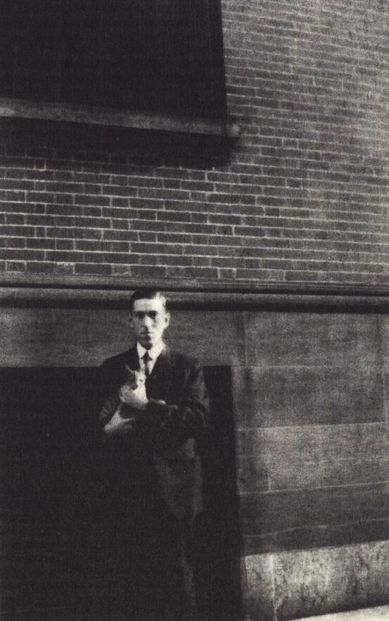
H. P. Lovecraft with Felis

3,233 words

A thought has been lurking in the back of my mind for some time.

In terms of fiction, and even outside it (with the notable exception of H. P. Lovecraft), were certain authors reflexively embraced as soul mates by white conservatives and racialists, in reality . . . anti-white — out of “principle,” opportunism, or just unconsciously?

Perhaps an outsider was needed to see this. Vietnamese American author Linh Dinh recently made such a case explicitly with respect to Flannery O’Connor: “Flannery O’Connor’s White Trash” (April 19, 2021).

A preliminary word about the Irish-American O’Connor’s literary Catholicism, which Dinh does not mention, but most conservatives do: a University of Illinois English professor with the Irish-sounding name Dan(iel) Curley (a teacher and later close friend of celebrity film critic Roger Ebert), believed that

Her characters are indeed God-ridden but not in a way that appears to be uniquely Catholic. Rather they seem the essence of Protestantism, seeking an individual and immediate relationship with God. . . . Clearly Flannery O’Connor is religious if not clearly Catholic.

After praising her fiction, perhaps excessively in his opening paragraph, Dinh observes, “O’Connor’s liberal usage of the word ‘nigger’ has always made many people uncomfortable.”

He quotes two short passages from her letters suggesting that she was privately anti-black, even though they are frankly tepid, and she also states — sincerely — “I’m an integrationist by principle . . .”

In the body of his essay, he paints a grim picture of the white freaks and grotesques who populate her fiction, the all-too-familiar outlandish exotics associated with so-called “Southern Gothic” literature, perhaps a sly euphemism disguising more than a little anti-white animus. [1]

O’Connor’s [supposed] disdain and condescension towards blacks don’t show up in her fiction. In O’Connor’s stories, blacks are generally dignified and likable, unlike her idiotic, freakish or criminal white trash. . . . The South has been little more than a stinking mudhole of white trash, so down the decades, we’re served with Deliverance, Easy Riders [sic], Honey Boo Boo and, yes, also Flannery O’Connor. As great as she is, O’Connor contributes to that relentless calumny.

The contribution of some other notable “conservative” and “racialist” writers to relentless anti-white calumny is the theme of this essay.

Dinh adds — and this is important: “In 2021, the term ‘white trash’ has been compacted to just ‘whites,’ so it’s not just the South.”

James Dickey, Erskine Caldwell, William Styron

James Dickey’s Deliverance fits Dinh’s thesis perfectly. Many of its white characters are repulsive or disgusting caricatures. Even the local sheriff near the end of the 1972 film, convincingly played by author Dickey himself in a bit part, and the “civilized,” city-bred canoers, are far from role models, with the single exception of Lewis, the masculine, hard-edged survivalist played by Burt Reynolds. And even he is not likable.

Illustrating Wilmot Robertson’s contention that, “Aware or unaware of the [racial] forces working against them,” many white artists become self-destructive, Dickey was an alcoholic. The former United States Poet Laureate and National Book Award winner even turned up drunk on the set, where he got into a fistfight with director John Boorman.

Racially aware blogger Irish Savant said in response to Dinh’s essay, “All of O’Connor’s work (of which I’ve read most) has the same theme. Remarkable that she was woke so very long ago. Obviously even back then it was a good career move.”

Another commenter said, “Don’t forget Erskine Caldwell and the poor white trash of Tobacco Road! First the novel [1932], then the long-running stage play and then the movie.”

Georgia-born Erskine Caldwell wrote salacious, libelous tales of poor rural whites. His play ran continuously on Broadway (New York City, that is!) for more than seven years, the longest-running Broadway play in history up to that time. “As of 2018,” the Establishment tells us, “it was still the 19th longest-running Broadway show in history, as well as being the second-longest running non-musical ever on Broadway.”

Zoo City audiences reveled in its depiction of white poverty, degenerate sex, and social crudity. Academics in 1971 noted approvingly that Caldwell’s fiction, including his “equally notorious” God’s Little Acre (1933), shocked “with its picture of the ugliness and decay of American life.” In 1949, 20 million copies of his books were in circulation.

It might be argued that Dickey, fellow alcoholic William Styron (The Confessions of Nat Turner [Pulitzer Prize, 1968] and Sophie’s Choice [1979, pro-Jewish]) who suffered from clinical depression (Truman Capote said: “Styron is accepted [by New York’s “Jewish literary mafia”] because if there was a goy Yid, it’s Bill Styron”), and Erskine Caldwell (“Death of a Scalawag,” Instauration, July 1987, p. 19), were never embraced by the Right.

True, but a pattern emerges of the sort of fiction demanded, published, and promoted by America’s mid-twentieth-century cultural gatekeepers and their white orbiters, to which celebrated conservative- and racialist-favored authors willingly contributed. Moreover, the pro-Communist Caldwell’s Tobacco Road “ultimately argued for the sterilization of Georgia’s poor whites,” a eugenic practice (not limited to Georgia) favored by many racialists.

William Faulkner

I read a great deal of Faulkner in my teens. I was fascinated by his modernist prose style, which I greatly preferred to Hemingway’s excessively spare writing. (Today it’s the opposite.)

In an incautious attempt to provide American whites with a usable past, Wilmot Robertson lavished praise upon the Southerner:

The power and sustenance that an artist derives from being part of a racially and culturally homogeneous community helps explain the success of William Faulkner, the one first-rate Majority writer who survived both as an individual and as an artist the nationwide uprooting of his cultural heritage. Faulkner was born, lived, flourished, and is buried in Mississippi, adjudged to be the fourth most illiterate state [according to a 1960 Census Bureau estimate]. (The Dispossessed Majority, 3rd ed., 1981, p. 248)

“Environmentalist logic,” Robertson continued, cannot explain “why a supposedly backward state in the Deep South should produce America’s greatest twentieth-century novelist.”

To further buttress his case, Robertson added that “Much as he liked and respected Negroes [don’t gloss over that statement!], Faulkner said [in 1956] that if antiwhite racial agitation increased he would be forced to join his native state against the United States and shoot Negroes in the street.” (p. 226, n. 29)

Robertson provides his source for this paraphrased bit of braggadocio, but I know of no such militance, even verbal, ever exhibited by the Nobel laureate. Perhaps he was drunk when he said it, because Faulkner, too, was an alcoholic.

I was too young and ill-informed to evaluate Faulkner properly at the time I read him. I now remember very little firsthand about his work. Everyone of course knows (well, did know) his short story “A Rose for Emily,” but it only reinforces Dinh’s thesis. A novel I recall being particularly impressed by was As I Lay Dying (1930).

Faulkner’s exceedingly obscure and complex prose no doubt concealed his worst moral and racial excesses from the American public (it certainly did from me as a youth) while nevertheless being understood by key members of the hostile elite, his texts thus serving both esoteric and exoteric functions.

I strongly believe that revisiting Faulkner today would necessitate a reassessment placing him in the category of the authors mentioned above, Wilmot Robertson’s enthusiasm notwithstanding. Too much miscegenation, too many Snopeses [2] and similar whites, too many noble black or mulatto Lucas Beauchamps and Amerindians.

The probability that this would be the case increased greatly after I read Spencer Quinn’s damning critique of Faulkner’s Go Down, Moses (1942) (“Go Down, William Faulkner,” April 1, 2019), written from a white racialist perspective by someone who had just read the book — which Quinn describes as “enemy literature.”

The author calls Faulkner “the prime architect of the Southern Gothic genre,” which is probably correct. He launched the series of novels and stories set in fictional Yoknapatawpha County in northern Mississippi with Sartoris as far back as 1929.

Quinn writes:

I have never understood why Southern-apologist paleoconservative scholars like M. E. Bradford and Clyde Wilson eulogize Faulkner so. Wilson describes Faulkner as “the greatest writer produced by the United States in the 20th century,” and Bradford opined positively on Faulkner here. Why they never showed William Faulkner the same scorn he shows their beloved Southland is perhaps the only thing I find more baffling and incomprehensible than Go Down, Moses itself.

Nothing produced by the Abbeville Institute circle baffles me. Indeed, it is churlish of the Jews not to pat those boys on the head for the yeoman work they do.

“Go Down, William Faulkner” is a milestone in white nationalist literary criticism.

Malcolm Cowley, the New York editor who rescued Faulkner from obscurity and shaped his reputation among America’s ascendant elite by publishing The Portable Faulkner in 1946 (two years earlier he had performed the same favor for Ernest Hemingway), was closely associated with the Communist Party and its innumerable front groups. The editor would never have promoted the work of a genuine white racialist author.

Finally, had Faulkner portrayed race from an uncompromising or even implicitly pro-white standpoint, he would not have enjoyed the remuneration, critical acclaim, screenwriting jobs, two National Book Awards, two Pulitzer Prizes, and Nobel Prize for Literature that he did enjoy.

You can buy Greg Johnson’s White Identity Politics here.

H. P. Lovecraft

From a racial perspective, the twisted fiction of the giant of what might be called “Northern Gothic,” H. P. Lovecraft, is similar to that of his “conservative” Southern counterparts.

Lovecraft’s ancestry was entirely English; he was born, lived most of his life, and died in Providence, Rhode Island. Most of his family had been in New England since colonial times; his maternal line went back to the Massachusetts Bay Colony in 1631.

A major distinction is that Lovecraft harbored unequivocally racialist views in “private,” that is, outside of his fiction. These beliefs are well-documented; he was quite open about them in his copious correspondence and self-published periodical the Conservative.

The underground magazine Instauration published a favorable cover story about the horror writer in March 1984 called “H. P. Lovecraft: An American Original,” which quoted extensively from his letters. The editor joked in a footnote:

Eleven issues [of the Conservative] appeared. We at Instauration can understand his reasons for giving up his project. Putting out a woefully understaffed magazine provides an editor with so many horrible experiences that he is sorely tempted to take full advantage of this rich source of material by quitting his job and concentrating full time on the writing of horror fiction.

The essay’s anonymous author made the following curious statement: “Lovecraft’s vast output of horror fiction does not overly interest Instauration,” adding, “We have read only a few of Lovecraft’s stories.” Lovecraft’s correspondence, in which he expressed his social and racial views, “interests us far more than his fiction.” So that is what the article focused on.

This created an unfortunate thematic bifurcation that left readers unaware of Lovecraft’s near-total negative portrayal of native New Englanders in his fiction.

Numerous extracts from his letters can be found in the Instauration profile, at Counter-Currents (here, here, and here), and elsewhere. By and large his racial, social, and cultural opinions are refreshing in today’s stifling intellectual atmosphere.

Even so, Lovecraft’s racial views contained some serious misconceptions, many of which were expressed in a November 22, 1934 letter to Natalie H. Wooley not reproduced at any of the above links. Keep in mind that he had been thinking and writing extensively about race since 1915, if not before. He died at age 46 in early 1937, so these are mature convictions.

As usual with whites, Lovecraft could easily “see” — and reject — blacks. Whites should never mix with them, and if admixture did occur, the mulatto offspring should be “rigidly” treated as black, not white: “I am in accord with the most vehement & vociferous Alabaman or Mississippian on that point.” 

But all other racial questions “are wholly different in nature.” Though “it is wise to discourage all mixtures of sharply differentiated races,” “the color-line does not need to be drawn as strictly as in the case of the negro.” A dash of East Asian, Amerindian, “Hindoo,” or other blood “will not actually injure a white stock biologically.” 

Most of the psychological race-differences which strike us so prominently are cultural [i.e., environmental] rather than biological. If one could take a Japanese infant, alter his features to the Anglo-Saxon type through plastic surgery, & place him with an American family in Boston for rearing — without telling him that he is not an American — the chances are that in 20 years the result would be a typical American youth with very few instincts to distinguish him from his pure Nordic college-mates. The same is true of other superior alien races including the Jew — although the Nazis persist in acting on a false biological conception.

Instead of what they were doing, Germans should force Jews to surrender their “separate culture” and biologically absorb them into their population through admixture: “It wouldn’t hurt Germany — or alter its essential physical type — to take in [miscegenate with] all the Jews it now has.” This would not be workable, however, in Poland or New York City, where Jews were too numerous, and “of an inferior strain.” There, Jewish absorption “would essentially modify the [Gentiles’] physical type.” 

Turning to Lovecraft’s fiction, something that immediately put me off was his description of a deserted rural New England with few towns and isolated, widely separated farms — a virtual wilderness in the American Northeast. This geography was not believable, and broke my suspension of disbelief.

It turned out I was wrong. Lovecraft’s demographically desolate countryside was accurately pictured, at least if you eliminate his strongly pejorative attitude toward the landscape and those who dwelt upon it. 

This was the result of a century-long Yankee exodus from the region as its native inhabitants migrated westward across the northern U.S. as far as the Pacific coast and Hawaii. It is vividly portrayed in Robert Frost’s 1947 poem “Directive.” In 1923, critic Carl Van Doren commented on the relic “Yankee community” of New England, “a neighborhood left behind by its more ambitious members” and “overrun by outsiders of another culture.”

The mass of foreigners newly present in America rarely feature in Lovecraft’s fiction, though they are prominent topics of his social commentary.

Two fictional tales that do unflatteringly depict America’s foreigners are “He” (Weird Tales, September 1926) and “The Horror at Red Hook” (Weird Tales, January 1927). Both are set in New York City rather than Lovecraft’s customary New England locales. Today the stories are reviled by members of the anti-White Establishment as “racist.” 

Both tales evoke hidden geographic and population remnants of Old New York tenuously surviving amidst race replacement and a radically altered cityscape. 

In “He,” the focal character is a squire from 1768 who cheated Indians who had occupied the land his house now stands upon to obtain occult tribal secrets, then murdered them. The Indians’ spirits inflict revenge on the colonial squire, still living in 20th-century New York thanks to his magical powers.

The antagonist of “The Horror at Red Hook” is Robert Suydam, an aging, eccentric, socially isolated scion of an Old Dutch family who’d inherited a decaying mansion in the formerly Dutch neighborhood of Flatbush, and owned a waterfront flat in Red Hook (originally founded by the Dutch as Roode Hoek in 1636). Red Hook and Flatbush are both neighborhoods in Brooklyn.

Like the squire, Suydam is a decadent, intimately involved with foreign criminals and a devil-worshipping cult.

These New York tales were the result of Lovecraft’s two-year stay in the slum of Red Hook during his brief marriage to a Jewish woman. (They had no children.) The fact that he married a Jew highlights the weakness of his “anti-Semitism.” Lovecraft hated New York and the foreigners who filled its streets, and soon returned to Rhode Island. But he made a point of seeking out and exploring the hidden Aryan landscape of Old New York during the time he lived there.

Best known are Lovecraft’s scathing stories of New England’s small towns and rural inhabitants.

A prime example is his popular novella “The Dunwich Horror” (Weird Tales, April 1929), set in the remote, fictional Massachusetts village of Dunwich, with its “cluster of rotting roofs,” houses “deserted and falling to ruin,” and “broken-steepled church” harboring “the one slovenly mercantile establishment of the hamlet.” A “faint, malign odour [hovers] about the village street, as of the massed mould and decay of centuries.”

The natives are now repellently decadent, having gone far along that path of retrogression so common in many New England backwaters. They have come to form a race by themselves, with the well-defined mental and physical stigmata of degeneracy and inbreeding. The average of their intelligence is woefully low, whilst their annals reek of overt viciousness and of half-hidden murders, incests, and deeds of almost unnamable violence and perversity. The old gentry, representing the two or three armigerous families which came from Salem in 1692, have kept somewhat above the general level of decay; though many branches are sunk into the sordid populace so deeply that only their names remain as a key to the origin they disgrace.

The deformed, monstrous members of the Whateley family are the antagonists of this well-known tale.

I have not cherry-picked the examples selected above; they are representative. Indeed, Lovecraft’s Northerners are frequently (literal) monsters, or the hybrid offspring of depraved whites and extraterrestrial beings now occupying an interstitial space governed by natural or supernatural laws different from our own, ready at any moment to take possession of the planet and exterminate mankind. They can be summoned forth by little-known blasphemous rites that many degenerate, immoral Lovecraftian whites are happy to track down, laboriously study, and put into practice.

There are exceptions to the rule, men who typically serve as the narrative lens through which some of the stories are viewed: the anonymous narrator of “He,” Irish-born New York City police detective Thomas Malone in “The Horror at Red Hook,” and various Yankee Miskatonic University professors who investigate the diabolical doings of the horrifying, dysgenic inhabitants of rural New England. Miskatonic is a prestigious, Harvard-type university in fictional Arkham, Massachusetts.

But such men are incidental to Lovecraft’s demonic Northeastern freaks and monsters.

Even the Massachusetts university town is no beacon of enlightenment, civilization, or normalcy: “the ancient, mouldering, and subtly fearsome town in which we live — witch-cursed, legend-haunted Arkham, whose huddled, sagging gambrel roofs and crumbling Georgian balustrades brood out the centuries beside the darkly muttering Miskatonic” River (“The Thing on the Doorstep,” Weird Tales, January 1937).

“Herbert West–Reanimator” (of corpses) is a medical student at Miskatonic. (Home Brew, February-July 1922.)

The paradox of H. P. Lovecraft’s fantastic representations of repellent Northern whites is that they fly directly in the face of his clearly expressed and strongly held racial views. 

Notes

[1] Maybe the term “Southern Gothic” should be dispensed with, even in its “classic” form, inasmuch as it tends to obscure rather than clarify. Furthermore, it is being repurposed by Left-wing academics to promote extraneous new racist and sexist tropes and stereotypes.

[2] “Snopes family, recurring characters in the Yoknapatawpha novels and stories, notably The Hamlet (1940), The Town (1957), and The Mansion (1959). Snopes family members also appear in Sartoris (1929), As I Lay Dying (1930), and The Unvanquished (1938). Through treachery and corruption, Flem Snopes gathers power in Frenchman’s Bend, Miss. His cousins are emblems of depravity, including murderous Mink, pedophile Wesley, bigamist I.O., mentally disabled Ike, who lusts after a cow, and Launcelot (“Lump”), who sells tickets to view Ike’s perverted scenes. The next generation includes a pornographer, a venal politician, a thief, and the uniquely honest Wallstreet Panic Snopes.”


Curb Your Enthusiasm 

Curb%20Your%20Enthusiasm%C2%A0

Share

  • Gab

Enjoyed this article?

Be the first to leave a tip in the jar!

Instant Echeck GreenPay™

Related

  • Uncivil War

  • Zsutty’s Maximum

  • Jared Taylor: What Rome Means to Me

  • An Interview with Endeavour:

  • Remigration is Inevitable Part 3

  • Remigration Is Inevitable

  • Lessons from the Hungarian Election for MAGA

  • A Blunder, Not a Betrayal

Tags

American literatureAndrew Hamiltonanti-white rhetoricErskine CaldwellFlannery O'ConnorH. P. LovecraftimmigrationJames DickeyliteratureNew Englandrace realismSouthern Gothicthe SouthWilliam FaulknerWilliam Styron

6 comments

  1. DarkPlato says:
    April 29, 2021 at 7:29 am

    Great essay.  I miss Andrew Hamilton!  I think the mainstream of American literature is anti white because it has to be to get promoted and published.  I think the system is already so controlled by the early twentieth century that no pro white fiction can be published and disseminated, similar to Hollywood.  Truman Capote clearly understood what the deal was by the quote the author gives, but what was capote’s mulch cow?  In True Blood, a graphic true crime depiction of psychopathic white killers.  Capote likely understood what sort of material he had to write to make himself famous.  The people who promoted and ate up this material I imagine regard it as synecdoche, a part to represent the whole.  A Tito Perdue simply would not be published and promoted.

    I think the reason lovecraft could be relatively racist is that Weird Tales was an obscure pocket dimension of the nascent pulp industry.  The pulp magazines were only invented in the late 1890s and were in their infancy still in the early twentieth century.  Most of our racialist writers come from the pulps: lovecraft, re Howard, in weird tales, but also jack London and Edgar rice Burroughs in the greater magazines like Argosy.  Also, much of this literature is fantasy/sci-fi so the racial messages are disguised under a layer of allegory.  For example, in pirates of Venus by Burroughs, the scene on the ship allegorizes a kkk takeover of a communist government.  The bird man slaves represent blacks—“bird brained,” but capable of heroism.  David duke published a commentary jack London story Mutiny on the Elsinore, which has a similar allegory.

    I think the reason for this permissiveness has to do with the newness of the pulps at the time.  Similar to the internet in its early days, it takes “them”(no guesses as to whom) a little while to get control of new media, but they always eventually do!  In film also dw Griffith’s Birth of a Nation was from the earliest days of the film industry. When “they” realized the destiny and power of the film medium, it was quickly controlled and took its modern political form quickly, before the birth of the talkies.

    0
    0
  2. Margot Metroland says:
    April 29, 2021 at 9:21 am

    Wow just wow, what a tour-de-force, what a gem.

    I’ll limit myself to just one (positive) critical comment. The Southern writers who continually dwelt upon white-trash characters were not being anti-white nor were they, for the most part, pandering to New York literary prejudices. If you spent any time in the Deep South a half-century or more ago, you were fully aware that the “white trash” element was regarded as a separate people, almost as distinctly different as the Negro, and far more horrifying. The O’Connors and Dickeys and Caldwells and Faulkners seldom met or interacted with them, but they knew they were out there . . . and that was a main source of Southern Gothic sensibility. Lovecraft may have had a similar horror of the “swamp Yankee” element in the New England outback, but I don’t believe that aspect has received much ink.

    0
    0
    1. DarkPlato says:
      April 29, 2021 at 9:33 am

      They still exist.  The other night I was next to this girl with most horrible rotten broken out teeth.  I couldn’t even look at her.  I could write stories…

      I think it has something to do with whites having standards for one another, whereas even the most woke, without explicitly realizing it, regard blacks and other nonwhites as NPCs or orcs and tend to dehumanize them, sad to say.  As Steve sailer has noted whites are much more concerned about their status competition with one another than anything else.

      0
      0
  3. Kathryn S says:
    April 29, 2021 at 12:28 pm

    Thank you for an interesting read, Mr. Hamilton. I enjoyed it very much.

    “Maybe the term ‘Southern Gothic’ should be dispensed with, even in its “classic” form, inasmuch as it tends to obscure rather than clarify. Furthermore, it is being repurposed by Left-wing academics . . .”

    Maybe, but there aren’t a lot of literary genres these days that have fully escaped “repurposing” by Left-wing academics. I’ve usually interpreted Faulkner’s works as being explorations of the tragedy inherent in a bi-racial society — a tragedy that affects nearly everyone and everything in it. He was squishy on blacks, but dismissing him as simply an anti-white writer would be a mistake. Another quote by the man:

    “For every Southern boy fourteen years old, not once but whenever he wants it, there is the instant when it’s still not yet two o’clock on that July afternoon in 1863, the brigades are in position behind the rail fence, the guns are laid and ready in the woods and the furled flags are already loosened to break out and Pickett himself with his long oiled ringlets and his hat in one hand probably and his sword in the other looking up the hill waiting for Longstreet to give the word and it’s all in the balance, it hasn’t happened yet, it hasn’t even begun yet, it not only hasn’t begun yet but there is still time for it not to begin against that position and those circumstances which made more men than Garnett and Kemper and Armistead and Wilcox look grave yet it’s going to begin, we all know that, we have come too far with too much at stake and that moment doesn’t need even a fourteen-year-old boy to think This time. Maybe this time with all this much to lose than all this much to gain: Pennsylvania, Maryland, the world, the golden dome of Washington itself to crown with desperate and unbelievable victory the desperate gamble, the cast made two years ago.”

    Few people could write that without having experienced the same dream themselves. There is both critique and deep sympathy there.

    Alos: by many accounts, Hemingway, too, was an alcoholic.

    0
    0
  4. Greg Johnson says:
    April 29, 2021 at 1:44 pm

    Personally, I prefer literature that focuses on white people. I just find them more interesting and intelligible than other groups. But white literature would be pretty dull without the full range of different white types, including poor, backward, criminal, dysgenic, addicted, and “trashy” white people. I don’t think there’s necessarily anything anti-white-as-such about literary portrayals of such people, unless they are supposed to be typically white.

    In fairness to Lovecraft, his scientific investigators are often astonishingly dunderheaded and unimaginative.

    Nothing better prepared me for the Clintons than Faulkner’s literary portrayal of the Snopses.

    0
    0
  5. Andrew Hamilton says:
    November 15, 2021 at 3:42 pm

    To further buttress his case, Robertson added that “Much as he liked and respected Negroes [don’t gloss over that statement!], Faulkner said [in 1956] that if anti-White racial agitation increased he would be forced to join his native state against the United States and shoot Negroes in the street.” (p. 226, n. 29)

    Robertson provides his source for this paraphrased bit of braggadocio, but I know of no such militance, even verbal, ever exhibited by the Nobel laureate. Perhaps he was drunk when he said it, because Faulkner, too, was an alcoholic.

    Talk about shrewdness. I just learned the details behind this anecdote, as reported in a long, laudatory cover story about Faulkner in Time magazine (July 17, 1964) published two years after his death:

    His most notorious statement on the racial crisis came in the course of a rambling, angry Oxford interview in February 1956 with British Newsman Russell Warren Howe, who reported Faulkner as saying: “If it came to fighting I’d fight for Mississippi against the United States even if it meant going out into the street and shooting Negroes.” 

    In that same interview, Faulkner insisted repeatedly that “the Negroes are right—make sure you’ve got that—they’re right,” and that Southern white racists “are wrong and their position untenable.” But ripped from context, shooting in the streets made headlines. Negro Author James Baldwin condemned Faulkner, in large part for that statement, as “guilty of great emotional and intellectual dishonesty.”

    Faulkner himself followed up the headlines with letters to many newspapers insisting that he had been misquoted by Howe. What the letters naturally did not mention was the fact that at the time of the interview Faulkner had spent several days working his way through a demijohn of bourbon, a bout set off by a running quarrel about the racial question with his brother John Faulkner, who was a diehard segregationist.


    0
    0

Comments are closed.

If you have a Subscriber access,
simply login first to see your comment auto-approved.

Note on comments privacy & moderation

Your email is never published nor shared.

Comments are moderated. If you don't see your comment, please be patient. If approved, it will appear here soon. Do not post your comment a second time.

Writers of May

(2 votes) Morris van de Camp David M. Zsutty Derek Stark Jayant Bhandari Greg Johnson

Articles of May

Heidegger on Nietzsche, Part One by Collin Cleary The Lunch Wars by David M. Zsutty 2 votes
    • Counter-Currents Radio Podcast No. 691
      Rob Rundo Returns

      Counter-Currents Radio

    • The Fragile Polity that is Syria

      Morris van de Camp

      1

    • Nigel Farage Calls Britain a Two-Tier State

      Mark Gullick

      3

    • Nationalism This Week
      Letter to J. D. Vance

      Greg Johnson

      26

    • Lost In Trans-Mission:
      How the Media Fails To Reveal the Inconvenient Truth About the Usual Suspects

      Steven Tucker

      10

    • Liar, Liar, Pants on Fire!

      Beau Albrecht

      7

    • Editor’s Update
      Rob Rundo on Counter-Currents Radio, Fundraiser Update, & a New $20,000 Matching Grant

      Greg Johnson

    • The Bitter End of Western Metaphysics:
      Heidegger on Nietzsche, Part Three

      Collin Cleary

      10

    • Uncivil War

      Mark Gullick

      49

    • Exclusive Interview with Karel Veliky:
      The Final Chapter in the Film Series! Part II

      Ondrej Mann

      2

    • Happy Birthday to Us!

      Greg Johnson

      6

    • Zsutty’s Maximum

      David M. Zsutty

      16

    • Exclusive Interview with Karel Veliky:
      The Final Chapter in the Film Series! Part I

      Ondrej Mann

      2

    • The Union Jackal, June 2026

      Mark Gullick

      23

    • The Inferiority Behind Immigrant Superiority

      Jayant Bhandari

      15

    • Counter-Currents Radio Podcast No. 690
      Greg Johnson & David Zsutty Discuss Current Things: AI, Henry Nowak, the Iran Crisis, & More

      Counter-Currents Radio

      7

    • Collin Cleary: What Rome Means to Me

      Collin Cleary

      4

    • Paul Krugman: Closet Bolshevik

      Spencer J. Quinn

      21

    • Fugue of Ideas:
      Ibram X. Kendi’s Chain of Ideas

      Greg Johnson

      19

    • Based Blacks

      Lipton Matthews

      24

    • Black Intellectual Fatigue

      Derek Stark

      41

    • Why White Advocates Should Avoid “Based Blacks”

      Dani Vypont

      32

    • Nietzsche & Race

      Mark Gullick

    • Editor’s Update
      Rob Rundo Rescheduled to Next Week on Counter-Currents Radio;
      Tonight Greg Johnson & David Zsutty Answer Your Questions;
      Fundraiser Update & a New $20,000 Matching Grant

      Greg Johnson

    • The Counter-Currents 2026 Fundraiser
      Lifetime Subscriber Welcome Packages Extended

      Greg Johnson

    • Nationalism This Week
      Who’s Looking Back?

      Greg Johnson

      29

    • China’s Threat to American Security:
      Food, Farmland, Foreign Control, & Energy Policy

      Lipton Matthews

      5

    • The Bitter End of Western Metaphysics:
      Heidegger on Nietzsche, Part Two

      Collin Cleary

      16

    • The Killing of Henry Nowak

      Mark Gullick

      38

    • The Crisis of Chinese Technology Thieves

      Morris van de Camp

      1

    • The Strange World of Gender Bender Fiction:
      & What This Genre Tells Us About Autosexuality

      Dani Vypont

      3

    • Watching the Watchers:
      The Dark Triad Question

      David M. Zsutty

      14

    • The Remigration Movement Solidifies

      F. Roger Devlin

      2

    • Casting Aspersions:
      The Fatal Consequences of Race-Swapped Casting, From Helen of Troy to Henry of Southampton

      Steven Tucker

      20

    • The Murder of Henry Nowak

      Millennial Woes

      23

    • Don’t Forget to Vote in Our Writer & Article of the Month Poll

      Greg Johnson

    • The Robot Hotdog Stand

      Greg Johnson

      37

    • Laughing Our Way to Victory

      Dave Chambers

      7

    • The Zodiac Killer

      Mark Gullick

      11

    • Jared Taylor: What Rome Means to Me

      Jared Taylor

      1

    • An Interview with Endeavour:
      My Way of Life Is an Adventure!

      Ondrej Mann

      6

    • José Pedro Zúquete’s The Identitarians

      Greg Johnson

      3

    • Editor’s Update
      Fundraiser Update & How to Watch the Remigration Summit

      Greg Johnson

      5

    • The Bitter End of Western Metaphysics:
      Heidegger on Nietzsche, Part One

      Collin Cleary

      12

    • Berlin: City of Stones

      Spencer J. Quinn

      6

    • True Folk-Horror Is Horror of Your Own Folk:
      Mark Gatiss vs the Brexit Blind Dead  

      Steven Tucker

      4

    • Counter-Currents Radio Podcast No. 689
      Thomas Massie, the America 2050 Bust, the Need for Whites to Divest from America, the AI Economic Apocalypse, & Pro-White Project Pitches to Billionaires

      Counter-Currents Radio

      7

    • Nationalism This Week
      Remigration is Inevitable, Part 3

      Greg Johnson

      27

    • Why Billionaires Should Fund White Identity Politics

      Lipton Matthews

      8

    • How Cold War Two Came About

      Morris van de Camp

      5

    • Beau Albrecht

      The Fragile Polity that is Syria

      It seems that they didn't learn the lesson that diversity is a country's greatest strength.  How...

    • Will Williams

      Counter-Currents Under Attack

      I was interviewed by the NY Post Friday, mostly about Miss Heidi’s participation with the SPLC. The...

    • Will Williams

      Nigel Farage Calls Britain a Two-Tier State

      Farage may turn out to be the latest in a line of snake-oil salesmen posing as saviors…---He’s...

    • Joe Gould

      Letter to J. D. Vance

      "If Trump does not go quietly, Vance can withhold his pardon and let the dogs in Congress tear Trump...

    • Peter Quint

      Letter to J. D. Vance

      I can’t tell from this far off. I wouldn’t put it pass him; it is pretty common these days. 🙃

    • Adrian Roberts

      Letter to J. D. Vance

      Does he wear eye-liner?

    • Doug Harrison

      Letter to J. D. Vance

      So it's a good career move for the cabinet secretaries to save the country from a deranged chief...

    • Greg Johnson

      Letter to J. D. Vance

      I am pretty sure that everyone in the cabinet wants a political career or just to enjoy his life in...

    • Adrian Roberts

      Nigel Farage Calls Britain a Two-Tier State

      ‘Unelected PM’. This is a silly term, first used by David Cameron to taunt Gordon Brown after he...

    • Greg Johnson

      Letter to J. D. Vance

      He "stood up" to the neocons because Iran had the ability to completely wreck the Gulf and the...

    • Doug Harrison

      Letter to J. D. Vance

      Yes, the pardon would be Vance's defensive weapon. Who would Vance trust to confide in regarding the...

    • Lexi

      Letter to J. D. Vance

      Yes, I think a brief Democratic Congressional majority is now baked in.  There will not be a...

    • Judas

      Letter to J. D. Vance

      I'm not sure if Trump is a Svengali or more of a Pied Piper and I don't really know who may be...

    • Will Williams

      Uncivil War

      Paudi McCreevey: June 16, 2026  White Nationalism and Christianity are compatible.---No, they...

    • Peter Quint

      Nigel Farage Calls Britain a Two-Tier State

      This carefully crafted animus is reaching critical levels in the US after the conviction and...

    • Will Williams

      Uncivil War

      Peter Quint: June 12, 2026  There are many reports of Catholics and Protestants sitting down...

    • JaymunD

      Lost In Trans-Mission

      The same goes for the "race is a social construct" creed.  Pretty soon my Money Market Fund will be...

    • Paudi McCreevey

      Uncivil War

      I know. It's sad. They preach Woke and not the Scriptures. Dark times.

    • Greg Johnson

      Uncivil War

      Preach it in the churches.

    • Greg Johnson

      Letter to J. D. Vance

      It isn't like Leftism will start working magically. And it isn't like they will learn to moderate...

    • Earth Day Special

      John Morgan

      12

    • A Robertson Roundup
      Remembering Wilmot Robertson
      (April 16, 1915 – July 8, 2005)

      Margot Metroland

      13

    • The Paranoid Style in White Nationalism

      Greg Johnson

      30

    • Join the Dance!

      Andrew Hamilton

      1

    • We Can’t Save the Earth Without Reducing African Birth Rates

      James Dunphy

      36

    • “I’m Not a Conspiracy Theorist, but . . .”:
      Jeffrey Epstein’s Death Gives New Life to “Conspiracy Theories”

      Greg Johnson

      22

    • Sylvia Plath: Stasis in Darkness

      Vic Olvir

      17

    • Vanguardism, Vantardism, & Mainstreaming

      Greg Johnson

      80

    • Aviation, Geography, & Race

      Charles Lindbergh

      3

    • Some Thoughts on Yule

      Collin Cleary

      4

    • Living in Truth:
      A Yuletide Homily

      Jef Costello

      7

    • John Kennedy Toole’s A Confederacy of Dunces

      Greg Johnson

      20

    • On Aleksandr Solzhenitsyn’s Warning to the West

      Spencer J. Quinn

      7

    • Elitism, British Modernism, & Wyndham Lewis

      Jonathan Bowden

      6

    • Philip K. Dick’s Do Androids Dream of Electric Sheep? as Anti-Semitic/Christian-Gnostic Allegory

      Greg Johnson

      20

    • “Conspiracy Theory” or Conspiracy?

      Andrew Hamilton

      21

    • Remembering H. P. Lovecraft
      (August 20, 1890–March 15, 1937)

      Greg Johnson

      3

    • Who Are We?
      Nordics, Aryans, & Whites

      Greg Johnson

      71

    • Remembering William Gayley Simpson
      (July 23, 1892–December 31, 1990)
      A Pleasant Afternoon with Harriet & Bill Simpson

      Margot Metroland

      18

    • Here are the Young Men
      Remembering Ian Curtis
      (July 15, 1956–May 18, 1980)

      Mark Gullick

      18

    • Percy Grainger
      Artist of the Right

      Alex Graham

      7

    • Remembering Revilo Oliver
      (July 7, 1908–August 20, 1994)

      Greg Johnson

      18

    • The Meaning of July 4th for the White Man

      Gregory Hood

      13

    • The Front National’s Evolution

      Bruno Mégret

    • Merwin K. Hart
      Forgotten American Hero & Man of the Right

      Morris van de Camp

      10

    • George Orwell’s Nineteen Eighty-Four

      Jonathan Bowden

      8

    • Carleton S. Coon
      Scientist & Reluctant White Advocate

      Morris van de Camp

      3

    • The Kwanzaa Absurdity Will Be Dwarfed by Juneteenth

      Robert Hampton

      10

    • Stravinsky

      Alex Graham

      7

    • Like the Roman:
      Remembering Enoch Powell (1912-1998)

      Mark Gullick

      23

    • The 1970s: The Golden Age of Hijacking

      Morris van de Camp

      21

    • Jonathan Bowden’s Deliverance
      Part 6

      Jonathan Bowden

    • Do You Want to Play a Game?

      Mark Gullick

      1

    • Sexually Incontinent on the Indian Subcontinent:
      Who Rapes More Animals, Indians or Pakistanis? The Battle Continues!

      Steven Tucker

      3

    • Neo-Fascism in Film
      Part 5

      Karel Veliky

      15

    • The Game of Tarot

      Mark Gullick

      2

    • Institutions Cannot Be Transplanted

      Jayant Bhandari

      5

    • Jonathan Bowden’s Deliverance
      Part 5

      Jonathan Bowden

    • Crosstown Traffic:
      Jimi Hendrix & The Post-War Rock ‘N’ Roll Revolution

      Mark Gullick

      1

    • Slaves from the North:
      Finns & Karelians in the East European Slave Trade, 900–1600

      Lipton Matthews

      14

    • Neo-Fascism in Film
      Part 4

      Karel Veliky

      2

    • David Lean’s A Passage to India

      Spencer J. Quinn

      1

    • Elites are Essential to Development

      Lipton Matthews

      7

    • Jonathan Bowden’s Deliverance
      Part 4

      Jonathan Bowden

    • Neo-Fascism in Film
      Part 3

      Karel Veliky

      6

    • E. M. Forster’s A Passage to India & the Indian Mentality

      Spencer J. Quinn

      25

    • Jonathan Bowden’s Deliverance
      Part 3

      Jonathan Bowden

    • The Rest Is Silence
      Heidegger’s Quietism

      Mark Gullick

      2

    • Dispelling the Historical Fallacy of Indian Nationalism

      Lipton Matthews

      8

    • Neo-Fascism in Film
      Part 2

      Karel Veliky

      8

    • Jonathan Bowden’s Deliverance
      Part 2

      Jonathan Bowden

    • Life of a Klansman

      Mark Gullick

      8

    • Jonathan Bowden’s Deliverance, Part 1

      Jonathan Bowden

    • Decolonial Ideas are Holding Back Developing Countries

      Lipton Matthews

      8

    • Neo-fascism in Film, Part 1

      Karel Veliky

      21

    • Jonathan Bowden’s Onslaught, Part 8
      Divigations on Decadence

      Jonathan Bowden

    • Jonathan Bowden’s Onslaught, Part 7
      Intrigues in the National Front

      Jonathan Bowden

      1

    • Rotten to the Core

      Mark Gullick

      8

    • Strauss on Husserl’s “Philosophy as Rigorous Science”

      Greg Johnson

    • Jonathan Bowden’s Onslaught, Part 6
      Francis Bacon & Right-Wing Nihilism

      Jonathan Bowden

    • András László
    • Derek Hawthorne
    • Beau Albrecht
    • Alain de Benoist
    • Kerry Bolton
    • Jonathan Bowden
    • Collin Cleary
    • Jef Costello
    • Savitri Devi
    • Julius Evola
    • Jim Goad
    • Gregory Hood
    • Juleigh Howard-Hobson
    • Greg Johnson
    • Charles Krafft
    • Anthony M. Ludovici
    • Trevor Lynch
    • H. L. Mencken
    • J. A. Nicholl
    • James J. O’Meara
    • Christopher Pankhurst
    • Tito Perdue
    • Michael Polignano
    • Spencer J. Quinn
    • Fenek Solère
    • Irmin Vinson
    • Leo Yankevich
    • Francis Parker Yockey
    • Multiple authors
  • Editor-in-Chief

    • Greg Johnson, Ph.D.

    Featured Writers

    • Beau Albrecht
    • Gunnar Alfredsson
    • Collin Cleary, Ph.D.
    • Jef Costello
    • Morris V. de Camp
    • F. Roger Devlin, Ph.D.
    • Stephen Paul Foster, Ph.D.
    • Jim Goad
    • Alex Graham
    • Mark Gullick, Ph.D.
    • Greg Johnson, Ph.D.
    • Travis LeBlanc
    • Trevor Lynch
    • Margot Metroland
    • James J. O’Meara
    • Angelo Plume
    • Spencer J. Quinn
    • Fred Reed
    • Clarissa Schnabel
    • Michael Walker
    • David M. Zsutty

    Frequent Writers

    • Asier Abadroa
    • Aquilonius
    • Alain de Benoist
    • Kerry Bolton, Ph.D.
    • Dave Chambers
    • Steven Clark
    • James Dunphy
    • Endeavour
    • Richard Houck
    • Jason Kessler
    • Titus Livius
    • Ondrej Mann
    • Lipton Matthews
    • Mark Mazari
    • John Morgan
    • Jaroslav Ostrogniew
    • Kathryn S.
    • Christian Secor
    • Anne Wilson Smith
    • Thomas Steuben
    • William De Vere
    • Kenneth Vinther
    • Max West

    Classic Authors

    • Maurice Bardèche
    • Jonathan Bowden
    • Julius Evola
    • Guillaume Faye
    • Ernst Jünger
    • Kevin MacDonald, Ph.D.
    • D. H. Lawrence
    • Charles Lindbergh
    • Jack London
    • H. P. Lovecraft
    • Anthony M. Ludovici
    • Sir Oswald Mosley
    • National Vanguard
    • Friedrich Nietzsche
    • Revilo Oliver
    • William Pierce
    • Ezra Pound
    • Saint-Loup
    • Savitri Devi
    • Carl Schmitt
    • Miguel Serrano
    • Oswald Spengler
    • P. R. Stephensen
    • Jean Thiriart
    • John Tyndall
    • Dominique Venner
    • Leo Yankevich
    • Francis Parker Yockey

    Other Authors

    • Howe Abbott-Hiss
    • Michael Bell
    • Giles Corey
    • Jack Donovan
    • Richardo Duchesne, Ph.D.
    • Emile Durand
    • Guillaume Durocher
    • Mark Dyal
    • Tom Goodroch
    • Andrew Hamilton
    • Robert Hampton
    • Huntley Haverstock
    • Derek Hawthorne
    • Gregory Hood
    • Juleigh Howard-Hobson
    • Alexander Jacob
    • Ruuben Kaalep
    • Tobias Langdon
    • Julian Langness
    • Patrick Le Brun
    • G A Malvicini
    • John Michael McCloughlin
    • Millennial Woes
    • Michael O’Meara
    • Christopher Pankhurst
    • Michael Polignano
    • J. J. Przybylski
    • Quintilian
    • Edouard Rix
    • C. B. Robertson
    • C. F. Robinson
    • Herve Ryssen
    • Alan Smithee
    • Fenek Solere
    • Ann Sterzinger
    • Robert Steuckers
    • Tomislav Sunic
    • Donald Thoresen
    • Marian Van Court
    • Irmin Vinson
    • Book Reviews
    • Movie Reviews
    • TV Reviews
    • Music Reviews
    • Art Criticism
    • Graphic Novels & Comics
    • Video Game Reviews
    • Fiction
    • Poems
    • Interviews
    • Videos
    • English Translations
    • Other Languages
      • Arabic
      • Bulgarian
      • Croatian
      • Czech
      • Danish
      • Dutch
      • Estonian
      • Finnish
      • French
      • German
      • Greek
      • Hungarian
      • Italian
      • Lithuanian
      • Norwegian
      • Polish
      • Portuguese
      • Romanian
      • Russian
      • Slovak
      • Spanish
      • Swedish
      • Ukrainian
    • Commemorations
    • Why We Write
  • Archives
  • Top 100 Commenters
  • The Looney Bin
Sponsored Links
Europa.com Above Time Coffee Antelope Hill Publishing Paul Waggener IHR-Store Spencer J. Quinn American Renaissance Jim Goad The Occidental Observer
Donate Now Mailing list
Books for sale
  • The Philosopher Is In
  • Sexual Utopia in Power (Expanded Edition)
  • In Defense of Prejudice
  • Loving Our Own
  • Tyranny & Wisdom
  • The Populist Moment
  • Is America Doomed?
  • To all books
Copyright © 2026 Counter-Currents Publishing, Ltd.

Paywall Access


Please enter your email address.

Lost your password?

Edit your comment

Writer & Article of the Month May 2026

Voting for this month has concluded. Here are the final results!

Top Writers

  • #1 Morris van de Camp 2 votes
  • #2 David M. Zsutty 2 votes
  • #3 Derek Stark 2 votes
  • #4 Jayant Bhandari 2 votes
  • #5 Greg Johnson 2 votes
  • #6 Jared Taylor 1 vote
  • #7 Collin Cleary 1 vote
  • #8 Spencer J. Quinn 1 vote
  • #9 Mark Gullick 1 vote
  • #10 Lipton Matthews 1 vote
  • #11 Keith Woods 1 vote
  • #12 Steven Tucker 1 vote

Top Articles

  • #1 Heidegger on Nietzsche, Part One 2 votes
  • #2 The Lunch Wars 2 votes
  • #3 The 1970s: The Golden Age of Hijacking 1 vote
  • #4 True Folk-Horror Is Horror of Your Own Folk 1 vote
  • #5 Finding Atlantis Part 4 1 vote
  • #6 Berlin: City of Stones 1 vote
  • #7 The Ghost of the Confederacy 1 vote
  • #8 Lothrop Stoddard’s The Revolt Against Civilization 1 vote
  • #9 Could Fascism Work? 1 vote
  • #10 Jared Taylor's Elevator Pitch to a Billionaire 1 vote
  • #11 Predation Wearing the Mask of Civilization 1 vote
  • #12 Peak Fatigue in Fort Wayne 1 vote
  • #13 Keith Wood's Elevator Pitch to a Billionaire 1 vote
  • #14 Do You Want to Play a Game? 1 vote
  • #15 Why Billionaires Should Fund White Identity Politics 1 vote

Total votes cast: 17