9,401 words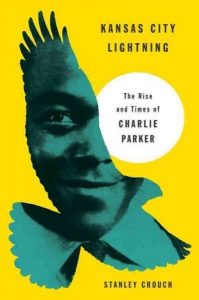
Stanley Crouch
Kansas City Lightning: The Rise & Times of Charlie Parker
HarperCollins, 2013
“The double consciousness so fundamental to jazz: the burdens of the soul met by the optimism of the groove.” — Stanley Crouch
“I can live a week without poetry, but not a day without jazz.” — Philip Larkin
For Black History Month, let us leave aside dubious claims of scientific genius and instead celebrate the real and uniquely American genius of Charlie Parker. Indeed, the book under review makes a compelling case for the equation: Charlie Parker = Jazz, and Jazz = America.
The cultural conservative, typically a man of the Right, always has a problem with jazz. Take Giulio Cesare “Julius” Evola, for example:
Fitzgerald was not wrong when he said that in one of its main aspects, American civilization can be called a civilization of jazz, i.e., of a negrified music and dance. In this domain, very singular “elective affinities” have led America, by way of a process of regression and primitivization, to imitate the Negroes. Assuming there would be a need for frenzied rhythms and forms as a legitimate compensation for the mechanical and materialistic soullessness of modern civilization, one would have done much better to look to the many sources available in Europe: we have elsewhere mentioned, for example, the dance rhythms of southeastern Europe, which often have something truly Dionysian. But America has chosen to imitate the blacks and the Afro-Cubans, and then from America the contagion has gradually spread to all other countries. [1]
From metaphysics, we can move to the more existential viewpoint of Hermann Hesse, or rather, Harry Haller, his fictional doppelganger and narrator of the novel Steppenwolf — just as Evola was, in some ways, also Hesse’s doppelganger: [2]
From a dance hall there met me as I passed by the strains of lively jazz music, hot and raw as the steam of raw flesh. I stopped a moment. This music, much as I detested it, had always a secret charm for me. It was repugnant to me, and yet ten times preferable to all the academic music of the day. For me too, its raw and savage gaiety reached an underworld of instinct and breathed a simple honest sensuality. I stood for a moment on the scent, smelling this shrill and blood-raw music, sniffing the atmosphere of the hall angrily, and hankering after it a little too. One half of this music, the melody, was all pomade and sugar and sentimentality. The other half was savage, temperamental and vigorous. Yet the two went artlessly well together and made a whole.
Compared with Bach and Mozart and real music it was, naturally, a miserable affair; but so was all our art, all our thought, all our makeshift culture in comparison with real culture. This music was at least sincere, unashamedly and primitive and childishly happy. There was something of the Negro in it, and something of the American, who with all his strength seems so boyishly fresh and childlike to us Europeans. Was Europe to be the same? Was it on the way already? Were we, the old connoisseurs, the reverers of Europe as it used to be, of genuine music and poetry as once they were, nothing but a pig-headed minority suffering from a complex neurosis, whom tomorrow would forget or deride. Was all that we called culture, spirit, soul, all that we called beautiful and sacred, nothing but a ghost long dead, which only a few fools like us took for true and living?
Both authors make the same, somewhat paradoxical claim: Jazz is both primitive and ultra-modern: “something of the negro . . . and something of the American.” Stanley Crouch, in the book under review, explodes the “primitive” while making a definitive case for “American.” [3]
The slightly odd title clues us in on the tack taken by Crouch. It deals with the rise of Charlie Parker, because it follows his early life up to and including his first steps into the New York City scene, and then just stops. [4] Had Parker died around that time, aged 25 or so, he might be recalled by some old-timers as a remarkable newcomer who unfortunately went nowhere; his recorded legacy would have been an unaccompanied home recording of “Honeysuckle Rose” and “Body and Soul” (if, indeed, anyone would have bothered to preserve it). [5] As it is, the rest of his life — the legendary part — would only take up another 12 years and leave a heroin-ravaged corpse the medical examiner estimated to be “a man in his mid-sixties.” [6]
And to understand the rise he needs to deal with the times, Depression-era America, which for Crouch requires taking the reader back beyond ragtime, or even slavery; at least as far back as the first horses introduced by the conquistadores. Crouch in the epilogue, quoting Richard Schickel, calls this “the American vastness.”
Crouch begins with 21-year-old Parker, his life and times already cooking together, hanging out in an alley with his fellow Kansas City musicians the morning of Pearl Harbor. He draws an analogy between war and the cutting contests of ambitious musicians that those with actual military experience might find strained if not distasteful; [7] yet he develops it as a creed of self-improvement readers at Counter-Currents might almost call Faustian. [8]
By the end of that first chapter, Jay McShann’s band of Kansas City had blown the house band off the stage at New York’s Savoy Ballroom — a veritable musical Pearl Harbor — followed by a legendary radio performance the next afternoon that produced a crowd “tucked as close as the cylinders of paper and tobacco inside a cigarette pack” to hear “the anonymous saxophone player who’d run all that melodic lightning through ‘Cherokee,’ swinging his butt off all the while.” [9]
All the nights he had worked on it, the flubs, the fumblings, the sore lips, mouth, and tongue, the cramped fingers — they all paid off that afternoon. Suddenly, the man with the headphones was signaling McShann, Don’t stop! Don’t stop! Keep on playing!
Stretched out like that, with the rhythm section after his scalp and the cyclical traps of the harmonies ever before him, Bird reached down and called upon all his skills and instincts, all the gifts for perception in emergency that he had developed over the years, even at this tempo making coherent statements, playful variations, and mocking responses to the musical ideas by which he was surrounded, supported, attacked. His obsession with shifting, deceptive rhythm resulted in endless ways of toying with the beat that jelled perfectly with his desire to create melodies accompanied by harmonic surprise. In his hands, a single note functioned on five levels: its individual pitch was melodic; it was a brass-balled harmony note; it was given individual texture through his control of color; its voicing was dictated by the register in which it was played; and it served a rhythmic function within its phrase.
“Bird knew how to dance in and out of that meter, with the tempo, and still get back when Mama come some for dinner. He could take a chord that had a bastard relationship to the rest of the harmony, and before you knew it, had has woven that bastard into the flock like it was supposed to be there all the time.”
Crouch then swings out again from that time and place, in a crane shot worthy of Sergio Leone, taking us further back yet, for to explain how Parker came to this peak moment requires an understanding of the intertwined — indeed, miscegenated — roots of jazz and America:
The skills that Charlie Parker brought to such visceral prominence on those nights at the Savoy were the result of a tenacious ambition that first took shape in that latter-day Wild West known as Kansas City.
Like all jazz musicians, Charlie Parker embodied many things: three hundred years of black American dance and music, everything from slave cabin steps and field hollers to the melodic-rhythmic revolution of improvised phrases spun out by Louis Armstrong and the arpeggiated harmonic dazzle of Art Tatum. That long march to improvised sophistication began in Jamestown, Virginia, in 1619, [10] when African slaves were first brought to North America.
But this particular western dog and innovator had his roots in that forgotten American West of Kansas and Missouri — that world of explorers, horses, wars, and settlers.
This “forgotten American West of Kansas and Missouri” is what rock critic Greil Marcus would call, apropos, the biracial folk tradition recovered and re-presented by Harry Smith and drawn on by Bob Dylan, “the old weird America, [11] a land as foreign to today’s SJWs, NPCs, and SWPLs as it is to Conservative Inc. and Europeans like Evola and Hesse. Indeed, the land that Americans — even most Deplorables — today think of as a flat, boring nothingness was anything but:
In the nineteenth century, when Americans thought of the Wild West, they didn’t mean California, [they] were thinking of towns just west of the Missouri River, towns in Kansas like Dodge, Abilene, Wichita, Ellsworth.
Americans thought of the broad center of the country, which italicized its difference from the East when three events took place in 1876: when Custer and the Seventh Cavalry got their ashes hauled at Montana’s Little Bighorn; when Jack McCall blew Wild Bill Hickok’s brains out in Deadwood, South Dakota, as the lawman held a hand of aces and eights; and when the Jesse James–Cole Younger gang was fed an afternoon meal of lead in an abortive raid in Northfield, Minnesota. Cowboys. Indians. Gunfighters. Bank and train robbers.
It was a violent, largely lawless land that required certain skills for survival, which would shape both America and jazz:
The Old West was rife with such violence — it was also enlivened by the provocative tension between the thrust of individual liberty and the desire for order and safety. Out there in the West, that tension made for an improvised world.
This was also a land of miscegenation: Elizabeth Warren’s world, [12] where mixed blood was too common to be shameful and often a point of family pride.
Violent competition, within and among all the races of mankind, promoting the fight to assert oneself as a free individual through quick improvisation: That, transposed into music, would be jazz.
The aesthetic parentage of early jazz was as complex as the miscegenated identity of the flesh-and-blood culture. Musically speaking, an artist could have a Negro father, a white mother, a Negro sister, a white brother, and cousins who were Christian, Jewish, Indian, Italian, Irish, and so on.
Lester Young — a light-skinned Negro — took the smooth tone of the C-melody saxophone as played by [Frankie] Trumbauer — a white man with Cherokee blood — and remade it into a sound of deceptive understatement. He took Trumbauer’s high-minded timbre and used it to serve up the low-down options of the blues. Fusing that tonal color with his greatest influence — the floating swing and melodic logic of the most liberated and daring Louis Armstrong — the tenor man with the light sound gave birth to an approach of chameleon plasticity and cool elegance.
And contrary to both its cultured despisers and some misguided fans, [13] while it may well have been “born in the dives of New Orleans, where the word appears first to have signified an elementary animal function,” [14] the music (as Crouch demonstrates in a detailed historical interlude here) became something new and sophisticated, wholly American, but neither primitive nor capable of mass production: first, by expanding the expressive possibilities of harmony:
Getting with the kind of sound blues singers were putting in the air was a job in itself, and meant encrusting notes with nuances that reached back to the field hollers, moans, and hums of the shared Negro memory — the elements that took music beyond the tonal precision of the piano, opening the door to what might have initially seemed like guttural exhortations or cries of pain, even ambivalence, but were actually the foundations of a language that was expanding the expressive power of Western music. [15]
Then, in Kansas City, the warring bandleaders Bennie Moten and Walter Page expanded the notion of improvisation to include the entire rhythm section:
The development of the improvising rhythm section separates jazz from both African and European music, because the form demands that the players individually interpret the harmony, the beat, and the timbre while responding to one another and the featured improviser. To play such music demands superfast hearing — a component of genius that is one of the greatest stands against the mechanization of pop music, in which the players send in their parts to be mixed by producers and engineers.
That coordination allowed musicians of Charlie Parker’s era to create a new experience of time, an innovation in performing consciousness that was fresh to Western performing art. It amounted to a kind of control of the present. Unlike the European concert musician, who could be compared to an actor, a person who used the subtleties of interpretation to bring vitality to material created in the past, the jazz musician wrote and interpreted his own script on the spot, right in the middle of the chaos of the moment.
All this interacts with another characteristic of the Old West: Rather than the fixed identities of Old Europe, one had to assert oneself as an individual against a violent background that called for improvised responses to the developing situation. The music that would be called “jazz” proved an ideal medium for this; quoting Hermann Broch’s axiom, “The civilization of an epoch is its myth in action,” Crouch asserts that:
In jazz, the myth in action was the discovery of how to use improvisation to make music in which the individual and the collective took on a balanced, symbiotic relationship, one that enriched the experience without distracting from it or descending into anarchy.
Kansas City “was a kind of experimental laboratory where the collective possibilities of American rhythm were being refined and expanded on a nightly basis.” Kansas City jazzmen were known as “warriors who lay in wait for traveling jazzmen to appear in town expecting to get through a jam session without losing slices of scalp and butt to the locals.”
Carrying their instruments like rifles [16] — the necks crooked over their shoulders, the body held in one hand — they were constantly on the lookout for another place to go and do battle with their musical imaginations, blowing to goad and challenge, inspire and devastate. There was only one rule: however hot and sparkling one of the others played might be, you couldn’t imitate it. You had to find a way to make it part of your own identity.
As Parker’s friend Bob Redcross recalls:
You wanted to be known by your name, not “that nigger over there.” [17] To be an individual was the most important thing in the world to you. . . That was the goal, and competition made for a whole lot of invention, you can believe that. . . After all, how are you going to make any headway if you only do what somebody else did?
So we have America and jazz. Where does Parker fit in? Quite snugly: “You could look at Bird’s life and see just how much his music was connected to the way he lived.”
[Parker’s] bloodline was both cosmopolitan and all-American, mingling African, Indian (which is also to say Asian), and European stock. [His father was] part Negro, part Indian, with some white genes from an overcast point in the family history, [his mother,] Addie, was [like Elizabeth Warren] from Oklahoma, the region once called Indian Territory. Like Jay McShann [the bandleader at that Savoy performance] she claimed Muskogee as her hometown. She was part Choctaw, her Indian blood probably the result of President Andrew Jackson’s policies.
And his home, Kansas City, was still an Old West town:
The music known as Kansas City jazz [was] a music that benefited from a regime that believed all money was good money, no matter how it was obtained.
It was a city where corruption sprawled in comfort and a child could get the idea that right was wrong and wrong was right: the mayor was a pawn, the city boss was a crook, the police were corrupt, the gangsters had more privileges than honest businessmen, and the town was as wild with vice as you could encounter short of a convention of the best devils in hell.
But there were still the old virtues:
He remembered the neighborhood as one where everybody knew everybody else and a child seen misbehaving had to face whippings in triplicate: the first from the neighbor who saw the act; the second from Mother when he got home, or after she got home from work; and the third when Daddy arrived and found out what had happened. [18] You might not like it if one of those people put a strap on you for being way in the wrong, but you could count on them when you had troubles.
“You could go to anybody’s house and eat on Thanksgiving.”
But remember, this is the old, weird America; things are not necessarily as orthodox as nostalgic memory, or conservative dogma, would have it. For instance, take Halloween: Another chance to assert oneself, but more Greenwich Village than Charlie Brown:
On that night, people would go to Eighteenth and Vine to watch the parade of homosexuals. “It was the only time they could wear dresses,” Bryant chuckled, “and they put it on that night. They got on their dresses and their falsies, their lipstick. They had on their hats and their high heels, and they would strut it. That was such a good show it became a family thing. It was the highlight of Halloween.”
And closer to home:
“For instance, [our] next-door neighbor was what you call a homosexual today, but we called them sissies in those days. His name was Julius. He was tall; he was handsome, light-skinned, looked like he could have been mixed, had almost Indian color, and he smelled good and he wore tailored clothes. Julius had a twist in his walk.” As Charlie and Rebecca sat on the front porch swing, “Julius would tell us about how he was going to go to this sissy ball that they would have on Eighteenth and Vine where there was a tent and the men would wear women’s clothes. [19] Yes, they did! They wore big hats and big beautiful dresses. They wanted to be something like girls. I guess that’s what they wanted. Anyway, that’s what they did and everybody knew it and that’s all there was to it!” He seemed unabashed about his sexuality: “Julius didn’t hide what he was. He didn’t have to. Kansas City wasn’t like that. If you knew how to handle yourself, if you was a nice person, you had your business and I had mine. Everything was clear way back then.”
And even today’s die-hard racist might be surprised if his beloved minstrel shows returned:
The sentimental ballad went all the way back to the minstrel shows, the tunes of Stephen Foster and the overweening moments of mush when the white men — yellowed up as Creoles — sang of, or to, their objects of affection, who were also white men, but in drag.
Nevertheless, a culture that promoted — expected — individual excellence; whether one was, like Parker’s father, a Pullman porter (a high-class occupation for Negroes, with not a few Ph.D.s among them):
Negroes like Charlie Parker’s father showed off their stuff as waiters, filling glasses almost to the top and moving from car to car without spilling a drop. They served with so much style that their deportment and skill were part of the definition of luxurious travel. The trains allowed a colored man such a wide berth he sometimes almost felt as free as those whose only privilege was white skin, not money or class. The Negro railroad men smoked cigars as often as cigarettes; they wore their clothes mercilessly pressed, wore shoes so well-shined that the gleam told onlookers that they were men who knew of faraway places and felt comfortable all over the country. . . Charlie’s father was somebody, in the way only accomplishment makes possible.
Or a cook serving up chicken and ribs to musicians:
“All of those men were proud of what came out of their kitchens. People were like that then. They worked hard to do something right. That’s how everybody expressed himself, putting in that little extra. [20] You had to get it right. Oh, yes, you had to get it right. It would be your signature, you might say. Then people knew who you was. Wasn’t no confusion. You were good. The facts spoke up for you. That’s right. They sure did. They spoke loud and clear.”
“You had to be clean in those days. Your parents took pride in how you looked and how you carried yourself.”
To race and environment, more elements added via nurture:
Addie Parker reared her son as a homebred aristocrat, a young lord, and the expressions we see in his childhood photographs are probably the results of his being treated as royalty.
It was probably during this period that Parker wore the Little Lord Fauntleroy suit he often recalled when selecting details from his childhood. “Had a wide collar,” said Edward Reeves, “a silk tie that you tied like a bow tie, but it came almost down to your stomach. The coat and the pants were velvet, the pants had two buttons down the side, You wore stockings then and buttoned shoes. Some fellows had buckled shoes. You were in there when you wore that kind of stuff.” [21]
[Attending a Catholic school] separated young Charlie from his surroundings, and he recognized early that there were ways to do things that were different from standard practice. His mother recalled him telling her that “we” didn’t’ do things a certain way — identifying with the way Catholics taught, thought, and lived.
Not that Parker was a sissy or even a dude, either; in the old, weird America, at least in the Wild West, aristos knew how to take care of themselves in the wild. [22] On an early trip to the Ozarks, Parker and a fellow musician hunt rabbits for dinner:
Unlike their more urban counterparts, who has spent their childhoods dressed up as movie cowboys and Indians, Charlie and Clarence weren’t at all squeamish about dressing a dead animal killed to be eaten. Later, as he was moving through the big time, that country boy side of Charlie Parker would shock those who knew him for his urban sophistication, his literate speech, and his artistry.
Nor is rabbit hunting unrelated to the topic of jazz:
When the rodent showed, Clarence turned — and almost shot Charlie, who damn near squeezed off a slug into his buddy. They had fired too fast, but not fatally; the split-second judgment that was at the core of their burgeoning artistic success had not betrayed them out in the field. [23]
These are the elements that went into producing Charlie Parker’s Faustian project:
For Parker, the artistic problem of improvising had become clear over the years: how to create a consistent stream of musical phrases that had life of their own — phrases that were marked by fluidity and emotional power, and that were made even stronger by the surrounding environment in which they were placed. The real player invented his own line, his own melody, and orchestrated it within the ensemble so that he was in effect playing every instrument. Only a few did that. But Parker wanted to be one of the few.
Like most jazz musicians, he had started by training his reflexes. When he heard a certain chord, or a certain phrase, he knew exactly what his body had to do to relate. But that was the primitive, almost Pavlovian aspect of playing. What the improvising artist did was something different: he experienced time at the tempo of emergency, when the consciousness understood that in order to survive — as in an accident, or when facing the threat of death — your perception had to be sharp enough to recognize every significant detail and put it to use. . . . Whether or not they thought about it, all good improvisers called upon those resources. But Charlie Parker wanted to be more than good; he wanted to be different. Part of your statement was your sound, and the one he was developing struck some more conventional musicians as brittle or harsh. Parker didn’t care. [24]
Now, I’ve said “Faustian” a couple times now, so perhaps I should finally try to explain and justify what I mean by that. I would suggest (and this is me now, not Crouch, who would likely hit me upside the head, as he likes to express himself) that the genius of Charlie Parker arises from the particularly American combination of his White and Negro heritage.
From the Negro, he received not “natural rhythm” as the stereotype goes, but an acute sense of moment-to-moment awareness, essential to an improvising artist. I was inspired to make this connection from a comment which appeared at Unz, contemporaneous with my reading of Crouch’s biography. Make of it what you will:
In everyday interactions with lower IQ blacks I never feel like I am smarter than them or they are smarter than me. I have trained a lot of blacks at work for many years, though, and see differences there. They seem to be able to actually think faster than me. In an emergency situation they would be able to respond faster than me and do better.
Which, of course, is exactly what Crouch says about jazz improvisation.
I always suspected this might be due to differing ancestral environments. Their ancestors had to react fast in case a lion jumped out from behind a bush in the jungle [again, Crouch on the old, weird American West] while my ancestors had to think of ways to survive a harsh winter and then patiently implement those more complicated long term plans so they wouldn’t end up starving or freezing to death. When I started reading in this area I found out I certainly wasn’t the first to think of something like this.
Indeed, Crouch was already there. And then note this follow-up comment:
You are definitely not the first to make this observation. Blacks seem to be pretty good at things that require rapid response and improvisation rather than thoughtful composition and contemplation. Basketball rather than chess. Jazz rather than classical music. Writing rap songs rather than books.
The relevance of this to the old, weird American West, and to not just the jazz musician, but particularly the Kansas City jazz musician, where bands had developed the knack of what might be called an environment of total improvisation, should be clear.
But the additional, Faustian element is found — again, not in intelligence as such — but in a particular kind of personality, which Richard Duchesne describes thusly:
Drawing on Kojève, I argued that the ultimate origins of Western uniqueness are to be found in the reality that only Western man became “truly” self-conscious, because only this man created — in the environment of the Pontic steppes — a society in which the struggle to become a man involved a contest “for something that does not exist really,” that is, a contest solely for the sake of being recognized by another human being as a man exhibiting aristocratic excellence against the biological fear of death and against the fear of rebelling against the norms mandated by mysterious/despotic gods and rulers. [25]
There they all are: Violent struggle for recognition via aristocratic excellence. To these we can attribute another White characteristic alluded to above, the inverse of improvisation at speed: The ability to create and sustain a long-term structure:
Jazz, as a performing art, is about navigating a landscape in which spontaneous creation whizzes by in layered stacks, and about creating a fresh and continual response to that landscape. The music is about more than merely making something up; as drummer Max Roach often said of playing jazz, it is about creating, maintaining, and developing a design.
The genius of Charlie Parker, then, lies in his ability to utilize characteristically White and Negro modes of thought with equal precision:
Like most New Orleans musicians, Armstrong and Bechet were fundamentally bluesmen. Hawkins and Tatum, by contrast, were impassioned intellectuals whose music introduced another aspect of consciousness into the art. In time, Charlie Parker would combine both orientations — melding the visceral with the intellectual, the freedom and force of swinging the blues with an extraordinary conceptual appetite and capacity for intricacy.
Of course, it also involves hard work, and here again, we find the Aryan tradition of devoted work under a master.
One master jazz musician said to a young player, “It’s not magic, but it should seem like it is.” The master also said that the role of the jazz professional was quite close to that of the magician. No matter how much labor had been put into working out all the aesthetic details, [it] was supposed to seem like the work of a musical prestidigitator [who] could pull love potions or explosions right out of the air. And yet improvisation was never truly accidental, never the result of the hot mess that was ignorance. [26]
Parker sometimes gave the impression that he was largely a natural, an innocent into whom the cosmos poured its knowledge while never bothering his consciousness with explanations. The facts of his development were quite different. He worked for everything he got, and whenever possible, he did that work in association with a master.
I may be wrong, but I won’t be wrong always. It was a maxim for the life he intended to live, not desperately, but with iron resolution.
“You couldn’t be sure what he knowed and what he didn’t’ know. If he was interested, he would study. If there was information, Charlie would get it.” (Rebecca, his first wife)
“He was practicing every day,” [Joe] Wilder said, “and he would practice diligently. Whatever he played in one key, he would play in all the other keys. No matter how difficult the figure he was playing, he would practice it in every key. And that’s where, apparently . . . not apparently — that’s how he developed that dexterity that he had, where keys meant nothing at all to him.” In those long practice sessions, Wilder says, he heard some foreshadowing of the harmonic devices that later distinguished bebop.
Of course, genius can help out a bit:
“The thing I loved about Bird,” Biddy Fleet tells the author, “is this: he wasn’t one of those who’s got to write something down, go home, study on it, and the next time we meet, we’ll try it out. Anything anyone did that Bird liked, when he found out what it was, he’d do it right away. Instantly. Only once on everything.”
This is the kind of book whose ideal author — perhaps only possible author — would be Stanley Crouch. He has the right “bloodlines,” as he calls them: “I, like many others, am an all-American guy: part African, part Asian, part Choctaw, and part Irish.”
And he writes with style, at ease with a kind of Whitmanesque patriotic invocation (the kind of thing modern poets like Ginsberg can only do as satire):
They embraced the powers that endlessly rocked in the cradle of the past, whether true or mythic or simply poetic, but never flinched in the face of modern life as it was lived, from the suites to the streets.
Aa well as often throwing in bits of Negro street vernacular (quite different from the hip-hop lingo which he, as we shall see, despises), effortlessly mixing levels like Parker himself:
“Now that’s what you hear when you listen to him play: he can reach the most intellectual and difficult levels of music, then he can turn around — now watch this — and play the most lowdown, funky blues you ever want to hear.” (Earl Coleman)
Sometimes Crouch’s invocation of America approaches a Randian pastiche; here, describing Roy Eldridge:
His work echoed the industrial confidence of the culture, the disdain for heights that led to the skyscrapers, the energy that laid the railroad tracks, that dug the subways, that rolled car after car off the assembly lines, that lit the American night. It was the sound of steel, electricity, and concrete made lyrical.
And Rand may not be far off. Counter-Currents readers may be familiar with, or vaguely remember, Crouch as something of a neocon favorite in the late 80s and 90s, due to his vociferous, take-no-prisoners dissent from the evolving neo-orthodoxy of identity politics, expressed in his New York Daily News column and a couple of books. [27] From his Wikipedia entry:
Crouch has criticized, among others: Alex Haley, the author of The Autobiography of Malcolm X and Roots: The Saga of an American Family; community leader Al Sharpton; filmmaker Spike Lee; [28] scholar Cornel West and playwright Amiri Baraka.
As Reason magazine said back in 2003:
Crouch has called Louis Farrakhan “insane” and Al Sharpton a “buffoon.” He has denounced black nationalism, Afro-centrism, and “the balkanization of America.” He writes columns with titles like “It’s Not Profiling, It’s Good Policing.” These are not the positions of a reverse racist, and this is not a man who plays the race card lightly.
Crouch is similarly dismissive of rap music and its culture, writing here of the “the thug-and-slut hip-hop world,” which he regards as a new kind of minstrelsy which jazz took great pains, from Duke Ellington onward, to leave far behind; and of rapper Tupac Shakur, “what dredged-up scum you are willing to pay for is what scum you get, on or off stage.”
He even dismisses the term “African-American” which he finds pretentious and unwieldy, and while he does not refuse “black,” his proudly preferred term is “Negro,” or even “colored,” calling the former “majestic” due to the accomplishments of the people so describes, and the latter able to encompass a range of skin tones “so undeniably epic,” as he writes here about the residents of Harlem:
The skin tones of the residents rambled the gamut, inspiring the Negro people to say of their race that it was like a flower garden, including “everything from lily-white to blue-black.”
Despite all of this, Crouch is definitely not one of us. [29] For Crouch, Hitler is bent on world domination, and Eleanor Roosevelt a secular saint; [30] eugenics is mentioned twice: “purportedly scientific balderdash” and “junk science.” His America is a land of slavery, lynching, and just all-round discrimination. The hinterlands are full of savage cracker beasts that musicians can try to humanize with jazz, and even New York City is fraught with danger: Crouch may support police profiling today, but when Parker is stopped by patrolman — not for “driving while black,” but because it is, in fact, illegal to drive a truck through Central Park — the incident is presented as if fraught with danger, defused only by Parker’s fast-talking. [31]
What distinguishes him from, and puts him at odds with, today’s “woke” consensus is that for him none of this sums up America. There’s plenty left over in what used to be called “the land of opportunity” — D. W. Griffith, for example, has “a huge and appalling influence,” both an American genius whose cinematic innovations are worthy of comparison with Duke Ellington’s innovative arrangements, and the man who invented a whole range of Negro stereotypes for Hollywood to exploit for decades.
They both composed in long, broken lines that had the up-and-down sensation of a roller coaster. Just as Griffith mastered the art of resequencing individual moments of performance into compelling stories, Ellington figured out how to feature his soloists within a complementary context, placing each new improvised solo where the arrangement made it sound better, allowing the improviser to supply the special effect of well-thought-out spontaneity to the written music.
Perhaps more importantly, his Negroes are not passive victims but individuals who can grasp what’s uniquely available to them here and make something of themselves. While the “woke” reject America — and the Western world — as irretrievably tainted by racism, for Crouch, racism is itself the crime of denying entry into that culture. [32] Crouch quotes Ralph Ellison, who grew up in the same territory as Parker:
“Those Negroes who taught us were both idealistic and optimistic. Theirs was a social world of segregation, of course. I emphasize the word social because they had taken it upon themselves to make sure that we never became segregated in our minds. . . . [The] teachers at Frederick Douglass High School “made sure that we were accountable to the rich diversity of America and the world at large. We grew up hearing all kinds of music, Negroes singing the classics, Negroes singing spirituals, Negroes performing classical piano pieces in the Negro churches, and so on. We did European folk dances, and we observed jazz musicians broadening the identities of the instruments they were playing.” Everything was open to adaptation. “Hell, you could learn a lot from listening to the white cornet players in the circus bands, and Negroes did learn a lot from them. Our world may have been segregated, but our objectives were not.”
Fundamentally, though, and more to the point in looking at his book on Parker, Crouch is a jazz critic of profound importance; a longtime mentor and associate of Wynton Marsalis, with whom he founded Jazz at Lincoln Center — which some have accused of being a museum, or mausoleum, of traditional jazz of exactly the sort that a White audience enjoys and expects. [33] Reason again:
Crouch’s position has less to do with color than it does with sound. He defines jazz within famously narrow limits — a music that doesn’t stray far from the blues or the techniques that have traditionally produced it, musicians who never, ever forget where and how the sound was born. [34] One doesn’t have to be black to find a groove (though some critics have taken him to mean this), but one must be willing to bow to the “Negro aesthetic.” He is convinced that the white establishment resents a musical history from which it can’t help but feel alienated, and so champions jazz that sounds “white” instead of jazz that looks backward. In this view, the desire to innovate past swing is tantamount to fearing its origins and the people who created it. The lines between the advancement of a music and the rejection of its history become entangled in the vast mire of racial politics.
It’s a hard position to hold on a music defined by improvisation and innovation, but Crouch insists on equating the evolution of jazz with crass commercialism.
Ironically, Crouch displays the same fear and loathing of post-Parker jazz that Kingsley Amis and Philip Larkin had for Parker and those he influenced. And weirdly, too; for he finds jazz “authenticity” in exactly the kind of “backward-looking” music that Larkin preferred, while the music of Davis, Ornette Coleman, etc., which he considers to be “white-friendly,” is what Larkin deplored. [35]
Frank Allen has already addressed this here on Counter-Currents, although I for one would not want to cross Stanley Crouch:
André Hodeir [a White Frenchman, be it noted]. . . argued that because there was not a trace of blues in one of the most famous jazz improvisations of all time (Coleman Hawkins’ tenor saxophone solo in his 1939 version of “Body and Soul”) “either Hawkins’ work is not really jazz or else the melodic language of the blues is not an essential part of such music.” As jazz has continued to develop, its relationship to blues has continued to diminish, even — perhaps especially — among black jazz musicians. And it is certainly true that much of what would be considered jazz has little to no connection to the blues. [36]
Ultimately Crouch has the vices of his virtues: He’s packed his book with so much history and sociology, and so much biographical detail (it is, after all, a biography), that his 300-plus pages only bring Parker up to that night at the Savoy — there’s no Dizzy Gillespie, no bebop at all — and the same may account for the time that has passed without a sequel. Which is to say the casual reader will have to take the author’s word for it — that all this will lead up to an epochal moment in American music.
Charlie Parker, no matter how highly talented, was not greater than his idiom. But his work helped to lead the art form to its most penetrating achievement. Jazz, as a performing art, is about navigating a landscape in which spontaneous creation whizzes by in layered stacks, and about creating a fresh and continual response to that landscape. . . Today we might call this multitasking, but at its most fundamental level, it is about victory over chaos, about achieving and maintaining a groove that meets the demands of melodic, harmonic, rhythmic, and timbral inventions in milliseconds . . .
Trumpeter Bobby Bradford once said that whenever people heard jazz, and understood how the elements within it were lining up and working in coordination, its emotional and intellectual power was strong enough to convince them that they had been dreaming. Maybe . . . a dream team could make its art by dreaming together — mutualizing Apollo and Dionysus — until nothing but the fact of their instruments separated the players from one another. Charlie Parker was another dreamer, ready to enter that large and mutual dream.
E pluribus unum: victory over chaos, mutualizing Apollo and Dionysus, [37] the large and mutual American Dream.
Notes
[1] Curiously, although an opponent of jazz and other aspects of “Negrified America,” Evola liked to style himself “Baron Evola,” like Count Basie, Duke Ellington, Nat “King” Cole, or Lester “The Pres” (as in President Roosevelt) Young. “It is a pity that no researcher, while there was still time, was prompted to go to Sicily to try to find some cousins or to establish the claim to the title of ‘Baron’ to which he sometimes answered.” (Jocelyn Godwin, “Julius Evola: A Philosopher for the Age of Titans,” in Tyr 1 (2002), p. 127. His typical outfit of evening dress, slicked-back hair and monocle, would have been perfect for the big bandstand, as an announcer, bandleader or vocalist. One might also mention one of Evola’s sources, Arthur “Count de” Gobineau; see Gobineau: Selected Political Writing, Michael D. Biddiss (ed.), Jonathan Cape, 1970, pp. 15-15. Gobineau despised America as a racially mixed society (in texts left out by his American translators) but “always feared he might have black ancestors on his mother’s side,” says Wikipedia.
[2] See my “Two Orders, Same Man: Evola, Hesse,” reprinted in Magick for Housewives: Essays on Alt-Gurus (Manticore, 2018).
[3] To get a bit ahead of ourselves, for Crouch, jazz is not only non-European but, surprisingly enough, non-African; nor is it “modern” in the sense of assembly-line, mass production: “The development of the improvising rhythm section separates jazz from both African and European music, because the form demands that the players individually interpret the harmony, the beat, and the timbre while responding to one another and the featured improviser. To play such music demands superfast hearing — a component of genius that is one of the greatest stands against the mechanization of pop music, in which the players send in their parts to be mixed by producers and engineers.”
[4] Like Camille Paglia, or his close friend Ralph Ellison, Crouch has been promising a second volume ever since, with no signs yet appearing. New York’s legendary jazz historian Phil Schaap says that “I think the last novel I read was ‘Invisible Man,’ when I was at Columbia [in the 70s].” Ralph Ellison will appear again below.
[5] Schapp adds that there’s also “a home recording of Parker in February, 1943 — important because he was playing tenor saxophone, not his customary alto — and the sound [is] so bad that you couldn’t quite tell if you were hearing ‘Sweet Georgia Brown’ or radio waves from the surface of the planet Uranus.”
[6] George Reisner, Bird: The Legend of Charlie Parker ( New York: Da Capo Press, 1977), p133. In the Absolutely Fabulous Christmas special episode “Cold Turkey” a nurse guesses that Patsy is around 65 years old.
[7] It also neatly elides the vexed question of the role of the Negro (Crouch’s preferred term, as we’ll see) in wartime, where the military is as segregated as society itself; “In the days that followed, the musicians all heard variations of the same refrain: You niggers better get ready to trade them horns for rifles.”
[8] “[The] pagan Dissident Right often talks about the Faustian nature of the white race (and very correctly, I believe) in which exploration, creativity, and an aristocratic disdain for the quotidian predominate, and in which the pursuit of truth and excellence results in an acknowledgment and celebration of true difference.” Quintillian, reviewing Return of the Strong Gods: Nationalism, Populism, and the Future of the West (Washington, DC: Regnery Gateway, 2019).
[9] It might have sounded like this.
[10] The NYT now promotes its “The 1619 Project,” published by the New York Times as a special 100-page edition of its Sunday magazine on August 19, 2019, which intends to “reframe the country’s history, understanding 1619 as our true founding, and placing the consequences of slavery and the contributions of black Americans at the very center of the story we tell ourselves about who we are.” According to the World Socialist Workers website, “Despite the pretense of establishing the United States’ “true” foundation, the 1619 Project is a politically motivated falsification of history. Its aim is to create a historical narrative that legitimizes the effort of the Democratic Party to construct an electoral coalition based on the prioritizing of personal “identities” — i.e., gender, sexual preference, ethnicity, and, above all, race.”
[11] Greil Marcus, The Old Weird America (Picador, 2011; published in 1997 as Invisible Republic: Bob Dylan’s Basement Tapes). Crouch describes ragtime, the precursor of jazz as “music for home entertainment in the time before radio, in the days when American music was more like a democracy that was enjoying a high level of active participation.” Marcus describes the White and Negro performers whose work Smith’s Anthology preserves as “cut off by cataclysms of the Great Depression and the Second World War and by a national narrative that had never included their kind, they appeared now like visitors from another world, like passengers on a ship that had drifted into the sea of the unwritten.”
[12] Born: June 22, 1949, Oklahoma City, Okla. Warren is infamous for claiming a microscopic fraction of Cherokee blood; that, of course, is the name of the tune Parker ran with at the Savoy. As we’ll see, Crouch shares with the times a relaxed approach to ethnicity: “When Joe Wilder first encountered Charlie, he was struck by the way the young man played the saxophone: thrusting the horn straight out, not holding it to the side or with any of the posing associated with the big boys of the instrument. No visual sauce, no extras, just a deadpan stare that earned him the nickname ‘Indian.’ He ‘reminded [them of] the cigar store Indians that you used to see in front of the tobacco shops . . . because he held it right in front of him and he had features somewhat like an Indian.’ There was no derision in Charlie’s nickname, however. Charlies was the highest-ranking combatant in Banjo Burney’s orchestra, and when things got especially hot in a jam session, someone would say, “Go get Indian.” Then it was off to find him, practicing somewhere but always ready to step into the tempo, the key, and the harmony, and to put something down so rough that victory had to come his way.”
[13] “Jazz has no need of intelligence; it needs only feeling.” Robert Goffin, Jazz, p.42; quoted in Richard Weaver, Ideas Have Consequences, p85.
[14] Weaver, loc. cit.
[15] “The success of African American music, with its ‘blue’ notes so alien to equal temperament and therefore so expressive, is not due merely to fashion. It shows the need for an understandable musical system, for logical and true intervals that can remove the veil of inexpressive insipidity which temperament spreads over even the most impassioned movements of the greatest symphonies.” Alain Daniélou, Music and the Power of Sound: The Influence of Tuning and Interval on Consciousness (Rochester, Vt.: Inner Traditions, 1995), p. 16.
[16] Recall: “You niggers better get ready to trade them horns for rifles.”
[17] Related no doubt to the internet’s THOT (“that ho over there”). Speaking of which, young Charlie could give teach the Gamesters a thing or two: “Charlie might suddenly drop his shy western boy reserve and walk up to a woman he didn’t know and begin a conversation with her. Those he approached weren’t the typical young women hanging around in a joint, keen to make the most of a potential thrill at close quarters; they might be a little older, spotted on the street or alone in the hall of Fleet’s apartment house. Somehow, whether it led anywhere or not, Charlie could get a woman to talk with him, not to ignore his unexpected advance, even smile at something he said. Once in a while, they even agreed to come hear him play.”
[18] Unless you’re Major Amberson’s grandchild; around the time of Parker’s New York debut Orson Welles lovingly recreates the atmosphere of the Old Weird Indiana (Indian Territory!) in this scene from The Magnificent Ambersons (1942).
[19] The origins of Drag Queen Story Hour?
[20] “Do more than you are paid for” is Lesson #9 of The Law of Success in Sixteen Lessons, Napoleon Hill’s 1,600+ page first draft published prior to Think and Grow Rich.
[21] Again, this scene from Ambersons.
[22] I’ve frequently noted that the Wild West was considerably less of a “family values” environment than conservatives might find comfortable; see “Wild Boys and Hard Men“ (reprinted in The Homo & the Negro: Masculinist Meditations on Politics & Popular Culture; 2nd, Embiggened Edition; ed. by Greg Johnson (San Francisco: Counter-Currents, 2017), “Welcome to the Club: The Rise & Fall of the Männerbund in Pre-War American Pop Culture“ (reprinted in Green Nazis in Space! New Essays on Literature, Art, & Culture; ed. by Greg Johnson (San Francisco: Counter-Currents, 2015) and “The WinkleTwins Win One! Owen Wister’s Philosophy 4: A Story of Harvard University“ (reprinted in The Eldritch Evola . . . & Others: Traditionalist Meditations on Literature, Art, & Culture; ed. Greg Johnson (San Francisco: Counter-Currents, 2014). One might also recall the scenes of Don Fabrizio enjoying the hunt in The Leopard.
[23] One recalls Ken’s misadventure while hunting with executives from GM: as Roger Sterling laconically remarks, “You know what they say about Detroit; it’s all fun and games until they shoot you in the face. Mad Men, Season 6, episode 13.
[24] Crouch addresses the problem of Parker’s tone, “almost completely devoid of vibrato,” which opponents, like Larkin, have always complained about. “One trumpeter thought it sounded like knives being thrown into the audience,” a sentiment Larkin would agree with. It was a necessary compromise, or sacrifice, to preserve his ability to manipulate other aspects of his improvisations at speed. “He didn’t want the kind of rich vibrato that characterized the sound of older players…. Charlie Parker’s mind moved faster, and had a greater command of detail, than that of the merely gifted. And in order to serve his quicksilver consciousness — and the montages of passion that it demanded — he had to address not only his own physical limitations, but those of his instrument…. to get rid of that goddamn vibrato and create a sound that was built for speed.” “His tone replaced the conventional vibrato with a sound like a light streak….” “Clarity is what he was after, all of the notes coming out right, none getting lost. Charlie was looking for his way to say it.” One might compare this to the simplification of the modes of Western music to two, major and minor, along with equal temperament, in the interests of harmonic complexity needed to create large scale musical structures.
[25] Such norms as segregation, favoring “those whose only privilege was white skin, not money or class.” Under Jim Crow, improvisational skills were finely honed: “One of the talents these wise men passed on was a knack for registering subtle cues of danger. Negroes learned to read such signals as soon as they began to enjoy freedom of movement, and they learned to protect themselves the best they could.”
[26] Mann’s Dr. Faustus explores the relation of mathematics, magic and musical composition (the titular composer Leverkühn is inspired by a numerical magic square to devise something not unlike Schoenberg’s twelve-tone system); at one point, his improvised piano playing terrifies a fellow theological student: “‘Improvising!’ cried Probst, honestly startled, and peered with his pale blue eyes at Adrian’s forehead, as though he expected it to be glowing with fever…. ‘Surely on cannot play what is not?’ ‘Oh yes,’ said Baworinski mildly. ‘One can play what does not yet exist.’” Doctor Faustus: The Life of the German Composer Adrian Leverkühn As Told by a Friend, trans. John E. Woods (New York: Knopf, 1999), Chapter XIV. As far as I know, deals with the Devil are more commonly associated with blues than with jazz..
[27] Notes of a Hanging Judge: Essays and Reviews, 1979-1989 and The All-American Skin Game, or, The Decoy of Race: The Long and the Short of It, 1990-1994.
[28] See Morris v. de Camp’s recent re-evaluation of Lee’s Malcolm X.
[29] He might not have any objection to the title, though perhaps the content, of The Homo & the Negro: Masculinist Meditations on Politics & Popular Culture; 2nd, Embiggened Edition; ed. by Greg Johnson (San Francisco: Counter-Currents, 2017). He’s also not averse to appearing amongst the luminaries of the Manhattan Institute; see his “Beyond the Afrocentric Con” in Beyond the Afrocentric Con, Alternatives to Afrocentrism (Washington, D. C.: Center for the New American Community, Manhattan Institute, 1994), pp. 62-67.
[30] As previously noted, Crouch observes that Lester Young was named The Pres after President Roosevelt; “Franklin Delano Roosevelt used to be admired for Social Security and winning The Big One, but recently he’s mostly notorious for redlining.” – Steve Sailer.
[31] Another example of Parker’s smooth-talking takes place after Dizzy Gillespie punches out a white man who tried to pull him off a shoeshine platform in a Detroit bus station; oddly, this is intended to illustrate the increasing sophistication of black musicians post-Ellington.
[32] Elsewhere he writes: “The discontinuity of ideals and actions… have convinced many Western intellectuals that the only sensible postures are those of the defeatist and the cynic…. As with the tenured Marxist, Afrocentrists will use the contradiction to define the whole, asserting that Western civilization is no more than the work of imperialists and racists….” Crouch, op. cit.,p62.
[33] “Dreamcatcher” advises that “you can get a further sampling of his arguments in the Ken Burns Jazz DVD and companion coffee-table book, which hew to the Wynton Marsalis-approved ‘jazz stopped in 1967” party line,’” and goes on to articulate my own view: “ I don’t think that all of Miles’s electric music worked (my personal favorite era is the second great quintet featuring Shorter, Hancock, Carter, and Williams), but when it did, on In a Silent Way, “Spanish Key,” the right live dates (the It’s About That Time archival release featuring the “lost” quintet of Shorter, DeJohnette, Holland, and Corea is simply mindblowing), Jack Johnson, On the Corner, etc. it really worked. There are also many continuities between the Marsalis and Crouch-approved second quintet and the electric era that followed.
And I find the “sell-out” argument to be completely unfounded. If Miles had really wanted to sell out in emulation of Sly and the Family Stone or whomever back in ‘69, don’t you think he would have gotten a vocalist? Or maybe released an album that didn’t consist of four side-long instrumental tracks? Miles’s electric music certainly won him some new “rock” fans, but his fusion records did not sell anywhere near the amount that the major rock albums of the day did. They were still too challenging for true mass popularity.”
[34] Crouch compares this to how Western literature has continually drawn on the Greek classics, especially Homer.
[35] I exaggerate for emphasis; Larkin’s views were more nuanced, and he not infrequently found something good to say about many a “modern” artist; see Richard Palmer and John White, eds., Larkin’s Jazz: Essays and Reviews, 1940–1984 (Continuum, 2001), especially the Introduction by Alan Palmer.
[36] Frank Allen, “The Other JQ: The Jazz Question“
[37] Compare, from the other direction: “Abbado always cultivated the principle of freedom. But this should not be taken to mean originality at any price. …The overall context of the performance may have been Olympian [Apollonian], “Toscaninian,” but within this Abbado cultivated the Dionysian, what might be called the Furtwangler, approach.” Enrico Girardi, “Beethoven’s symphonic works under Abbado: Rediscovering their universality,” in Abbado: Beethoven (DG, 2015).
10 comments
“E pluribus unum: victory over chaos, mutualizing Apollo and Dionysus, [37] the large and mutual American Dream.”
I wonder why Greg wants to publish a piece meant to glorify miscegenation and pluralism? I am not angry or offended, I am just confused. Nobody here is getting persuaded.
The only possible virtue of this article is to argue against the hypothesis that whites have some sort of Faustian spirit that non-whites do not. However, the piece explicitly explains the “Faustian-ness” of the Jazz musicians to their white ancestry.
I do not know why ppl on the alt-right accept this as dogma; it is not as if it was proven scientifically or something. It is clear that other races have their own outlets of “Faustian energy.”
The Faustian energy of black people is tangible and constant. They always show off, in an attempt to make people melt in adoration. This article mentions that: the waiters who stacked glasses, the Jazz and blues musicians with their improvisation, the loudness of black music. This is an obvious trait of theirs, and I hate it.
I do not much like Jazz music, and never have. The only kind I like is the cool jazz that plays in the background at some restaurants.
The purpose of the improv is to impress people. It is about showing off. The entire musical form is about that. It is the same phenomenon as black athletes acting cocky, taunting opponents, strutting around. It is NOT fundamentally different from the crotch-grabbing, bragadocious rappers.
The result is that some whites get blown away and cuck. They figuratively bend over and ask for the black daddy to give it to them. And that is what black people are trying to achieve.
The style of white music is to hold back the ego and intensity of the performers, and focus on making beautiful and gentle music. The performer is not trying to show off. He is not trying to blow people away. He is trying to please the audience, not conquer them. This is how whites do it.
I agree with your post overall, though I’m not sure I entirely agree with your statements about Faustian energy. Based on my understanding of Spengler, I regard the defining Faustian characteristic to be the constant yearning for the infinite and perfect. Your interpretation reminds me more of the Will to Power.
“The style of white music is to hold back the ego and intensity of the performers, and focus on making beautiful and gentle music. The performer is not trying to show off.”
This is simply not true. Many of the greatest and most famous white musicians in history were violin or piano virtuosi who loved showing off.
Showing off is something that’s common to all cultures. It’s a way of establishing dominance and, ergo, increasing mating opportunities.
A White person “showing off” looks like a black person on sedatives.
I recently went to an Andrea Bocelli concert. When he sings, he stands still and firm, holding a neutral facial expression. He had a more spirited female also perform, and she was more animated, but in an intentionally childish and playful way (her act was meant to be humorous). There was a great flutist who played Flight of the Bumblebees, which was the most show-off-ish part of the night, but he also remained neutral and humble in demeanor before, during, and after his performance. None of the music was overly loud, none of it was melodramatic.
Black musicians literally grab their crotches. They literally swagger. They literally brag. They amp up the animation and emotion to maximum degree. Modern African American musicians wear aggressive facial expressions during performances, like they are trying to flatten you.
You are right that all musical performance involves showing off and earning status. There is no escaping it. But come on. There is a massive difference in degree between black and white here, and there are reasons for that. Whites are trying to de-emphasize this aspect.
“There is a massive difference in degree between black and white here, and there are reasons for that.”
Frankly, rock musicians are not much different from hip hop “musicians” in terms of the ugliness of their performance routines.
Not too many years ago, a performer with a white German rock band started having sex with a naked white woman right on stage during a performance! I’m not sure if that’s ever been done by a hip-hop group.
I would also note that Charlie Parker’s style of performing was essentially the same as Bocelli’s; he typically stood ramrod straight with almost no theatricality.
This article did not sit well with me – too verbose, an overly detailed celebration of miscegenation and primitivism, a distorted historical representation of American midwest culture IMO.
I enjoyed this essay. I now understand better why I was never a fan of Charlie Parker as well as why it might be worth my time to listen again with O’Meara’s insights in mind. Some people seem to question the relevance to this essay to CC. Not to speak for the author, but jazz, in general, is perhaps the subject matter upon which to hang a history or even archaeology of American race relations.
I have come to see separate and racially homogeneous homelands as essential to the future of America and of White People. However, any White person who does not think that we will miss the Negro is just plain being honest with themselves. It’s a price I’m willing to pay, but it’s disingenuous to think that there is no price to pay for separation.
“However, any White person who does not think that we will miss the Negro is just plain being honest with themselves. It’s a price I’m willing to pay, but it’s disingenuous to think that there is no price to pay for separation.”
So you won’t miss random assaults, racially-motivated rapes, robberies, and murders, home invasions, mall riots, Black Lives Matters tying up traffic, harangues by black power agitators on the streets and in Congress, the over-representation of blacks on TV and in movies, including in roles that should be played by White people, or the barbarian preenings of Afleets in every sports stadium?
I won’t miss one of them or their aberrant noise-clatter “music”. What freaking planet do you live on?
It sound like Parker has been fortunate in finding a worthy chronicler. There certainly aren’t many blacks capable of writing so well as Crouch. And, it seems to me, to hope for an inside view of such a phenomenon, that chronicler had to be black like Parker. To whites, the major phase of jazz music (pre-1960) is fundamentally quite alien.
In a visionary future I can imagine a new black nation, with eugenic assistance, reclaiming jazz as its greatest cultural achievement. But, for whites, this spectacle must be peripheral–if occasionally interesting–if we are to prosper in our new nation.
The only importance of jazz cropped up in the Cold War, Russian stilyagi, with great skill and sometimes danger, taped American jazz off of Voice of America or other European radio stations. If they had a job that took them west, they bought albums there. Parker was a favorite, but the stilyagi revered them all.
Stilyagi were Russian young people, in a sort of beatnik/hippie mode. The word comes from “style-seeker.” From the end of WWII till about 1962 or so, they thrived and some published. Vasily Aksyonov was one of their early spokesman and insisted that jazz music was a beacon of hope to Soviet youth in those years. Reading his novel The Island of Crimea a few years back, I caught a taste of what “cultural dissent” actually means. Using a stance, a style, to make a statement when you are forbidden political dissent is something we can learn from the Russians of that era — and obviously it wouldn’t mean jazz for us. Those times were different. Jazz mattered to young Russians.
You might say it “sounded like freedom” to them; perhaps not so oddly, that was partly why the French kids picked up on jazz after the First World War, in their disgust at the old fools who caused all the slaughter of that insane war. Hemingway might have clicked well in the Paris of the Twenties for that reason.
Fact is, once white and black separate as is inevitable, I doubt many whites will miss or even very much remember the connection jazz had to freedom for many Europeans during the 20th century. When men are actually free, they don’t need substitutes or simulacrums of it.
But then as Eric Hoffer put it, “You can never get enough of a substitute” and that explains the reverence the stilyagi had for it.
Comments are closed.
If you have a Subscriber access,
simply login first to see your comment auto-approved.
Note on comments privacy & moderation
Your email is never published nor shared.
Comments are moderated. If you don't see your comment, please be patient. If approved, it will appear here soon. Do not post your comment a second time.