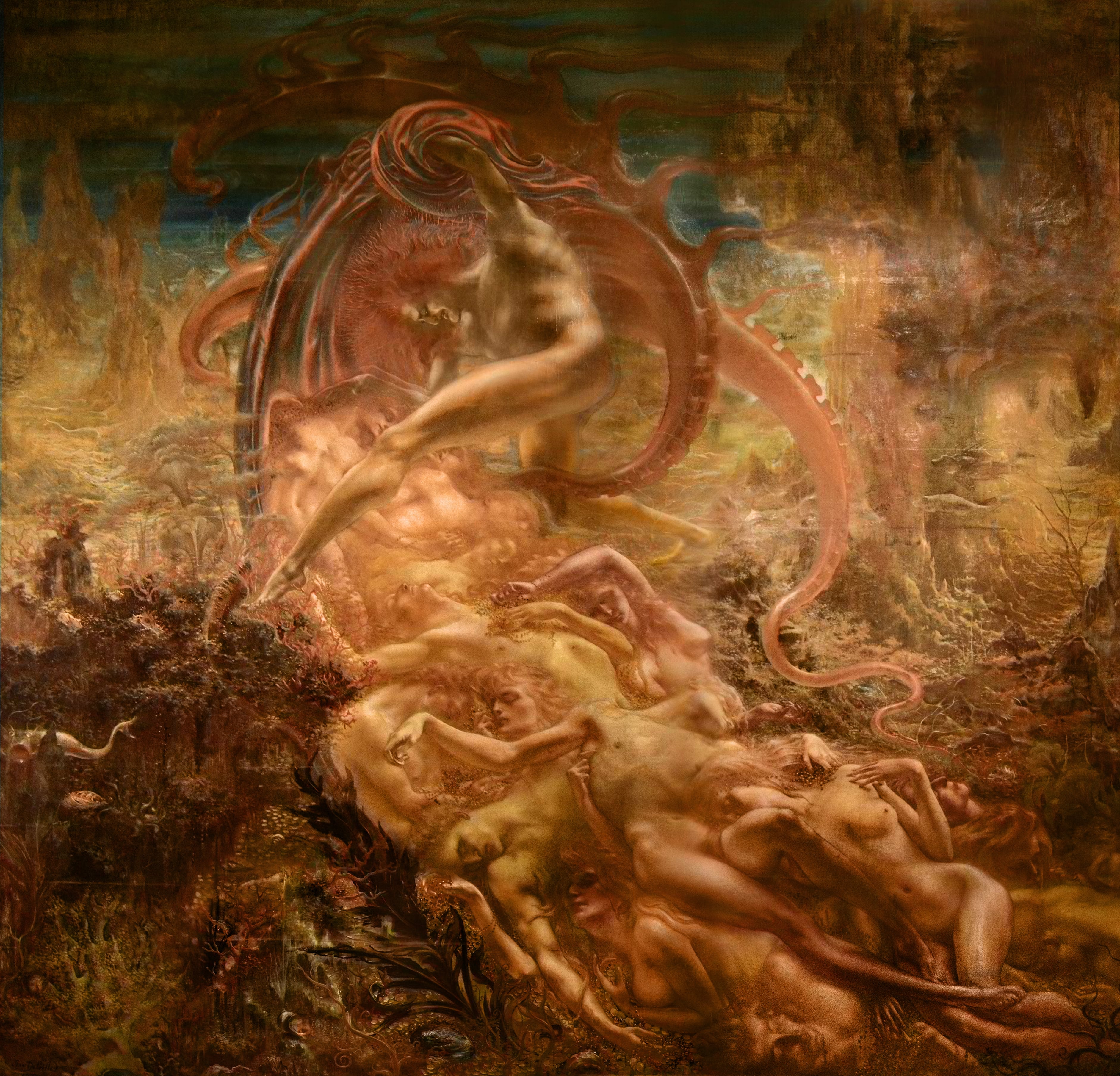
Jean Delville, The Treasures of Satan, 1895.
3,223 words
Part 4 of 8
Edited by Greg Johnson and Peter Jacobi
In 1995, Jonathan Bowden self-published his Collected Works in 6 volumes (London: Avant-Garde, 1995), edited by Jürgen Schwartz, one of Bowden’s pen names. The six volumes comprise 27 distinct books, 12 of which had been previously published. Altogether, the Collected Works contain more than 2,600 pages of rare early Bowden.
Onslaught is the third book in volume 2. It had not been previously published. We will publish it online in 8 installments. The titles are editorial.
Like many of the Collected Works volumes, Onslaught covers a wide range of political and cultural topics, interspersed with fictional narratives that may be loosely based on real people and events.
Eventually, a fully annotated version of Onslaught will appear at the Jonathan Bowden Archive. It will then be followed by similar editions of the rest of the Collected Works, plus a couple more early volumes that were not included. — Greg Johnson
Basically the liberal-left cannot understand evil unless it is based on critique; on a criticism of what already exists. Since their understanding of life is completely devoid of the past and it lacks a generic bias, a historical specificity. Basically such people can only understand evil as something which comes from without, and it seizes hold of human beings like an exterior force, such as an “invasion of the body snatchers” in Don Siegel’s memorable film. As a consequence, the liberal-left has a sociological view of human beings, and it believes in a form of relativism, a form of relativism which is certainly not divine. If you like, liberals believe in a socially constructed man, or at the very least, a man who can escape from the bonds of tradition—when tradition and the order of the past are seen as something which people have a duty to escape from. In short, the dissolving of these bonds is seen as “enlightened,” even liberating, and it accords with the historical Enlightenment and general liberal opinions. It also draws upon ideas such as tolerance, respect for others, general liberality, and the “religion of human rights”—when in fact, of course, man is naturally debased; he is most naturally evil—destructive and sadistic—and he only refrains from these actions when he is forced to do so. In short, as T. E. Hulme, the Edwardian philosopher put it, man is naturally prone to evil and destructivity but he can rise above this in certain circumstances.[1] When all that preserves any sense of ‘goodness’ in relation to society is hierarchy and inequality, kinship and a sense of order—when all of these are inherited from the past—they are organic and predetermined—and naturally wholesome. Inevitably they are fertilized by the nature of their own dung, as is true of all other human affairs, but they do carry forward into the future a sense of the past—when human beings need to have the pity, the pain, terror, and exhaustion which lurks in their breasts ameliorated by authority. In a sense, as Hobbes pointed out, the destructivity of the individual—his pain, isolation, and nobility—is bargained away by the nature of the state. As a result men and women are only free in their unfreedom; they are only free when the boundaries of their fear are encompassed by the state. As Giovanni Gentile, a hierarchical and elitist Liberal, as well as Mussolini’s house-philosopher, put it in the nineteen thirties: all men in the state, no-one outside the state, no-one above the state, only the state, now and forever.
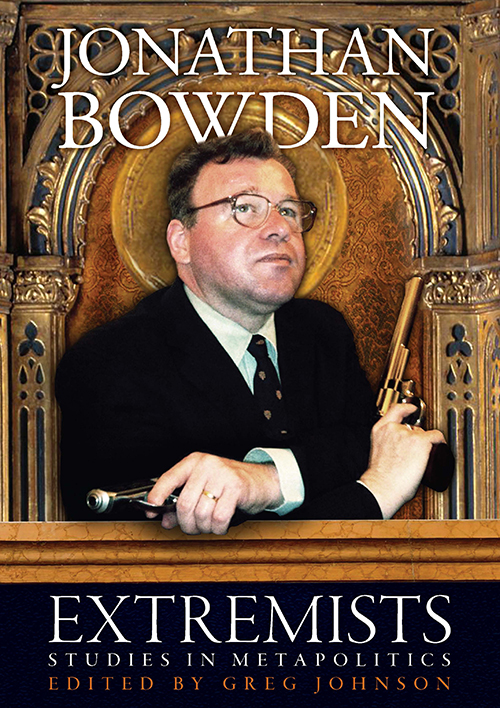
You can buy Jonathan Bowden’s Extremists: Studies in Metapolitics here.
Of course, the original justification for authority was religious; it had to do with original sin, when in fact man was only original in his sin and he was only original by virtue of his sin. In short, the terror, fear, and expiation which he felt in his own heart—according to this pessimistic calculus—could only be ameliorated by authority. All of which is not to say that man is born for damnation; he is merely born to damn himself in accordance with the absence of damnation. Nor is authority particularly moral—far from it—it is merely designed to enforce tradition and the absence of immorality in others. When we understand morality and tradition to be synonymous, in that tradition preserves existence and morality serves to perpetuate the nature of existence. As a result the individual is only free in his turpitude when he obeys the tradition, the injunction to remain alive. For if tradition—an organic and voluntaristic community—preserves its own existence, then it entertains, at the very least, a prospect of the moral. It understands that the tools of destruction; the harbinger of Satan, have been forged by the state, they have been requisitioned by the state. This is one of the reasons why the head of state, the monarch, schemed and plotted to poison and murder his rivals in accordance with Christian love and civilization. You see, civilization and barbarism are not opposed to one another, as many imagine, in that they cannot exist without one another, and you cannot have civilization without the prospect of barbarism.
Various libertarians (such as Beatrix Campbell) cannot understand Satanism because they have no conception of evil. Such people have no understanding of religious issues, faith, and observance; indeed, as far as they are concerned the whole thing is a mystery. Basically because they have a morality which is contingent and vacuous; it is purely individualistic and has no higher authority, certainly no understanding of either the psyche or aesthetics. In a sense these liberal ideas are completely devoid of any emotional impact, and they lack a sense of intuition, an understanding of the senses—an opening up to higher states of the mind.
Satanism, as I mentioned before in my third book Sade,[2] is divided into roughly five different areas depending on the definition used. One form of Satanism is essentially epicurean; sensual, even Rabelaisian, while others are variations on neo-Crowleyanity. When Crowley’s religion believes that the left-hand path can be confused with the right-hand path and that they are both rival sources of energy. Moreover, these forms of energy cancel one another out; merge into one another and essentially become one another at higher levels of existence. Similarly a deviant source of neo-Crowleyanity is a type of magic which is called Kaos—and this is a deconstructive process. It is a process of deconstructive deconditioning where each level of the psyche is stripped bare to reveal nothing at all. Indeed the irony of Kaos magic is that this process reveals nothing, just a muted and inconsequential gasp. Once the psyche had been stripped bare you would expect something to happen, but this is not actually the case. Basically because this type of neo-Satanism is merely a prank on the occult ‘left,’ amongst the devotees of the left-hand path. It strips the psyche, the personality away to reveal a meaningless contingency, a sense of nothingness and despair. If you like, such a strategy is futilitarian; it has nothing to do with morality, let alone a new type of morality; it is merely disingenuous. More accurately, it is little more than a covering, a metaphysical excuse for drug-taking, sexual perversion, and orgies. A different type of orgy, however, is engaged in by traditionalist Satanists, those who revere Lucifer as the lord of the Nether regions, the Prince of Darkness, the satrap of the Unholy Anus. These individuals—in their stupidity—desecrate churches and their altars, irrespective of denomination, and force the Churches concerned to reconsecrate their altars. As a result, these traditionalists, as we might call them, celebrate the Black Mass—the inversion of the Roman Mass—as detailed in the works of Montague Summers and J. K. Huysmans. In a sense these Satanists take the caricature of their faith seriously; they wish to celebrate a certain sense of devilry, a type of relish. Indeed we might say that these individuals are playing with their own dung; they are making sand-castles out of their own excreta. Such individuals believe that they are being wicked and evil; positively delirious, even antinomian, when in fact they are adolescents in need of moral guidance. They are people who experience a thrill, a positive frisson of pleasure, from abusing other’s sensibilities; in a sense, therefore, they are nihilists, religious anarchists, who do not understand the nature of that term.

You can buy Jonathan Bowden’s Reactionary Modernism here.
The traditional Satanists, if we can call them this, boast about the misdeeds which take place at their Masses, their dark initiation rites. In fact, of course, nothing of any great consequence can be said to happen at their masses; they are merely metaphors for evil, transparent attempts to be malevolent. Occasionally reports surface in the media, such as Sunday Sport, about Satanic rituals which involve the abuse and destruction of infants, the brutalizing of babes. According to this scenario—which draws upon sources as far back as the Malleus Maleficarum in the fourteenth century—these Satanists tear a child to pieces and devour it. In a sense this story is a gloss on Jewish Ritual Child murder—a sort of blood-libel—and Dominican testaments from the Inquisition during the Middle Ages. It is, if you like, a collective exercise in bad faith in the Sartrean sense, where people believe the worst of somebody, especially when this is desired by the person concerned. Hence feminists believe that pornographers kill and mutilate their victims, their female victims, so they need to invent the “snuff movie”—and lo and behold!—press comment about snuff movies appears overnight. As is the case with Jewish ritual blood rite, anti-Semites hate Jews so much that they will literally believe anything about them. Moreover, a large number of the social workers who are investigating ritualistic abuse, i.e., Satanic child-sex abuse, are fundamentalist Christians (or if not they have been influenced by such groups)—when many evangelical and revivalist organizations have trawled the social work departments of England and Wales over Satanism, children, abuse, and ritual. Ultimately, however, people do not believe in the truth—insofar as such a category exists—they merely believe in what suits them at that particular instant.
Other forms of devilry are various cults like The Process in the United States, a cult which emerged from sectarianism and which thrives on sectarianism—essentially The Process represents a split in the Church of Scientology (or the Dianetics Foundation) as it then was in its earlier incarnation. These dissidents were people who left the Dianetics Foundation and moved over to Luciferianism and finally merged with a neo-Crowleyanite sect to form The Process—something which they found relatively easy to do because both religions, namely Scientology and neo-Satanism, are power religions, in that they are faiths based on propinquity. They are churches, dissident churches admittedly, which offer power to their adherents during life and even after death when they rule over the souls of the departed in Hades in the underworld. Of course, these religions are essentially dialectical; they take power away from the votary and then return it to him through the intervention of Lucifer. If you like, this is a minor league grimoire, a casting up of spirits for the purposes of domination, humiliation, and renewal.

You can buy Jonathan Bowden’s Pulp Fascism here.
Of course, a lot of Satanism has to do with the desire to shock one’s elders; and it is a religious form of épater les bourgeois, a form of revenge against the fathers. In a sense it is the equivalent of Jean-Paul Sartre who once described the bourgeoisie, the class from which he was descended, as “bastards” in order to cultivate a certain shock. As a result, many rock bands, particularly those associated with the sub-culture of heavy metal, are linked to Satanism or move towards it in an immature way. The term immature is used, of course, because these bands really have no idea of the religious area they are moving towards; indeed, as far as they are concerned, Aleister Crowley is just another name on the page, an obscure magician, an Edwardian vitalist—if they knew what that meant. It cannot be stressed enough, in other words, that the culture which flirts with neo-Satanism is “low,” very low, if not the dregs of popular culture—although these bands, such as Black Sabbath and Ozzie Osbourne, even Alice Cooper, are little more than a sub-culture within popular music. In a sense, therefore, we might call them a deviant strand within a dissonant tradition or put another way—take the music of Varèse, a sort of anti-music, an orchestrated sound—a form of concrete poetry—and add to it the rock band KISS. Nevertheless, there is a certain wanton side to this culture; indeed, in its decibel count one sees a tacit desire to assault the audience. It is as if the orchestrated sound—these hecatombs of noise—are designed to destroy the hearing of those listening to the music concerned. While George Steiner, the cultural critic, once declared that these pockets of sound, these envelopes of noise—particularly with the development of the personal stereo—are profoundly destructive. Although it would be more accurate to say that they alter the configuration of the senses, the relationship between the outer ear and the inner man. In a sense they provide a womb, an enclosed space, albeit in the form of sound, which enables the individuals concerned to be “alone with their music.” As a result, the individual comes to need this sound—to positively require it—in order to function. (Although the addictive metaphor, the consideration of popular music as a form of junk, is easily over-played and ends up defeating its own point.) Nevertheless, this need for music, for exterior sound, soon passes beyond the innocence of “music while you work” or a radio tinkling in the background—a policy which was introduced, incidentally, by the National Government of the 1940s in accordance with the wishes of Ernest Bevin, the Minister of Labour.
Ultimately though, this need for music is a human emotion which involves the avoidance of itself, the desire never to be alone. In a sense, therefore, it is a desire not to be alone with one’s thoughts, to hear the emptiness of one’s insides (or alternatively) the blood pounding in one’s ears. If you like, it is a fear of interiority—of being alone—with nothing but the whisper of one’s soul for company. As such it resembles the fear of people who are naturally servants, who are frightened of an interior life, who have, in turn, no interior life worth mentioning. When a sense of consciousness, which is all that interiority is, resembles the whispering of the soul—the ghost in the machine—the foreknowledge of death. Particularly when we understand that the most important point about life is death—is ‘dying well’—or living well in relation to the inevitability of death.
One of the more unpleasant features of this music, however, is the confused form of sexuality which it exhibits. Indeed much of popular music, of pop music so called, is fluid and inconstant in its sexual appeal, at once viscous [vicious?] and straight-laced in a peculiar way. If you like, the culture of Boy George; an infantile version of the artists Gilbert & George, is a form of conservative transvestism, a mixture of Richard O’Brien’s The Rocky Horror Show and The Daily Mail. As a result this type of sexuality is a parody of itself; it is a parody of a parody of a parody. Nevertheless, there is something decadent and sterile—if superficially erotic—about its bi-sexuality; the fact that it is underscored by pink eye-liner—the Rock or Gothic headpieces—where grown men disport themselves in women’s underwear; a mélange of lace and frills, whilst wearing wigs and make-up. Although the irony of this imagery is that it involves women and it is a form of arrested sodomy; a form of Eonism, a type of heterosexual Eros. It is an attempt to eroticize the heterosexual which involves a sense of looseness, of fluidity, which only appears to be homosexual. If you like, therefore, it is a form of decayed and decadent heterosexuality which plays with its opposite in the moment of its dissolution.

You can buy Jonathan Bowden’s Western Civilization Bites Back here.
The other phenomena which are associated with this sub-culture are death and destruction; the element of the death’s-head at the feast which always haunts these gatherings. As a result, the sub-culture which is known as heavy metal exhibits a death wish in the Freudian sense, a concern with the nature of destruction. Indeed, it is not for nothing that certain bands in the United States—although they do not tend to be heavy metal bands—set their drums alight and throw them into the audience after a performance, a gig. In a sense, therefore, there is a fascination with horror—with the ghoulishness of the grave-yard—in this type of music. Hence we find it concerned with the corpse, with images of horror (as in the “horror art”; the Gothic pastiche which covers its albums), the record jackets or sleeves of its long-playing records. When these signs and symbols are redolent of the stories by H. P. Lovecraft, Clive Barker, Stephen King, M. R. James, Algernon Blackwood, Graham Masterton, and so on—and there tends to be a simultaneous interest in horror novels and these forms of music—what we might call a concern with the sepulchral, the flashings of teeth, up-turned eye-lids, and hecatombs of the damned. Needless to say, the skin-tone in such analyses is grey, flaccid, fungible, glaucous—tending to rot and despair—when it is little more than the flesh on a skeleton’s arms, the creaking, leathery, even armorial, plight of the limbs. As a result this poetry of decomposition (as we might call it), has become the stock-in-trade of certain writers such as William Burroughs—although in his case these descriptions are a form of arrested necrophilia, a poetics of the damned; while for Ernest Jünger in The Storm of Steel the horror takes on a different meaning, when it is the revelation of what was always apparent and yet scarcely glimpsed. If you like, the mottled corpse, the green and grey cadaver, is the accomplice to a later thought, a moment of revelation. It is, in short, a fixed instant, a fixity—not withstanding any tremulousness—a moment when you know what life is like. When this can be described as a dark or negative epiphany in the Joycean sense, as he uses it in Dubliners, a sinister counterpoint to the madeleine which Proust uses to resurrect memory in The Remembrance of Things Past. Such sub-cultures also have a fascination with the damned; indeed, one of the more prominent punk rock bands which emerged from this sub-culture was called The Damned. They have a fascination with extreme situations, often crepuscular and decrepit situations, such as the internal monologues of the speakers at Hyde Park Corner, as outlined by Heathcote Williams in his book The Speakers.
Notes
[1] [See especially Hulme’s ‘Humanism and the Religious Attitude’ in Speculations, ed. Herbert Read (London: Kegan Paul, Trench and Trubner, 1924), pp. 1–71.]
[2] [Fourth book.]
6 comments
Bowden doesn’t understand what he’s talking about when he writes about the esoteric.
Can you spell that out a bit?
What Bowden says falls in the category “not even wrong”, if you’ve read Crowley or any esotericist you can tell he just repeats bien pensant views, what any educated man takes in from mass media—platitudes.
He doesn’t know what he talks about, he’s a pseud here.
It reads as if his understanding of faith and the meaning of its purpose is something he read about and never experienced. There’s a lot of big words and no authenticity of feeling. Like this was due on Monday at 8:00 and he crammed it out.
I thought that too. It’s like a book report at school from someone who had to wing it, just read the summary on the back cover.
From what I’ve read, a Black Mass was performed as a way to help people overcome their Christian indoctrination. As for the destruction of churches, (which is taking place and in the news all the time in the Western world), maybe it’s a kind of payback for all the pagan temples, statues and libraries which were destroyed by Christians (not to mention the Europeans killed for not converting or conforming to Church teachings). Maybe the Christians should be concerned that their churches are empty and being sold and turned into mosques. Instead they advocate for “Welcoming the stranger”.
If you have a Subscriber access,
simply login first to see your comment auto-approved.
Note on comments privacy & moderation
Your email is never published nor shared.
Comments are moderated. If you don't see your comment, please be patient. If approved, it will appear here soon. Do not post your comment a second time.