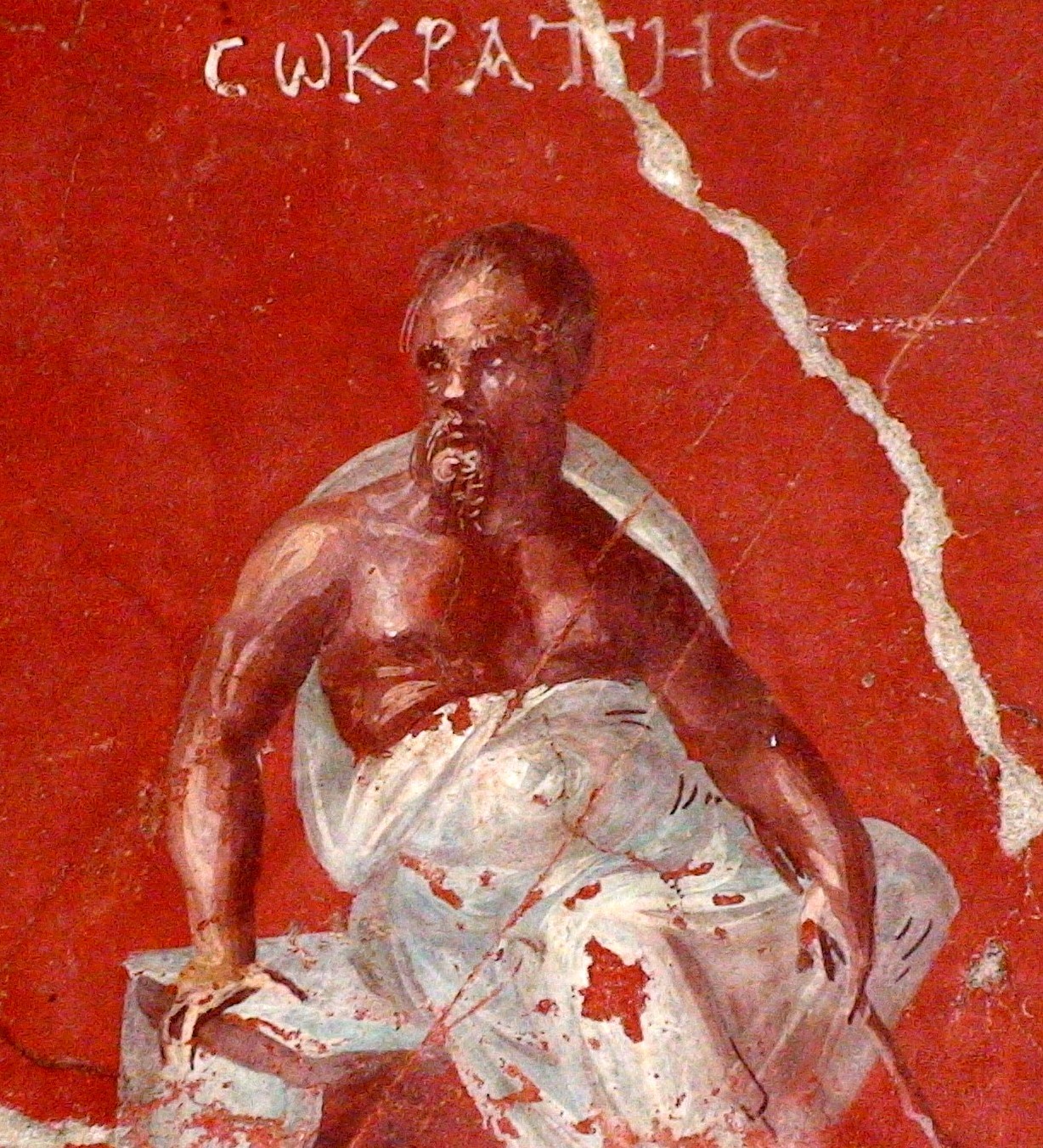
Seated Socrates, fresco from ancient Ephesus
1,732 words
Sometimes the most momentous truths can be established with the simplest arguments. A good example is Plato’s argument in his little-known dialogue Euthydemus for why philosophy (the pursuit of wisdom) is more important than any other pursuit. I found this argument completely convincing. It shattered and remade how I lead my life, and I used it to similarly shattering effect for years in Introduction to Philosophy courses.
Socrates’ presentation of this argument is fairly lucid because his audience is a philosophically naïve young man named Cleinias. But still, Socrates makes Cleinias and us work for our enlightenment by tossing some red herrings into the argument while leaving some premises and conclusions unstated. In this essay, I will present a very straightforward reconstruction of Socrates’ zig-zagging argument at Euthydemus 278e–282d.
Socrates’ first premise is:
All men wish to “do well.”
Doing well (eu prattein) has a double sense in Greek. It means to do well, as in flourish or prosper, and to do good, as in to do the right thing. For Plato, doing well and doing good basically mean the same thing. Plato also identifies eu prattein with eudaimonia, which is usually translated as well-being or happiness. The basic point is that all human beings wish to flourish, and that’s a good thing.
Socrates’ second premise is:
To do well, we must have certain goods.
He names wealth, health, good looks, the things that the body needs, noble lineage, power, honor among one’s countrymen, moderation, justice, courage, wisdom, and good fortune.
Later, Socrates adds art (techne) and science (episteme). Techne does not refer simply to the “fine arts” but to any practical skill for making or managing things. Episteme refers to all bodies of knowledge, including purely theoretical pursuits.
Socrates’ third premise is not explicitly stated:
Goods can be divided into conditional and unconditional goods.
|
Conditional Goods
|
Unconditional Goods |
|
Wealth Good looks Bodily necessities (food, drink, sex) Noble lineage Power Honor Arts Sciences
|
Goodness Moderation Justice Courage Wisdom Good fortune Health
|
Unconditional goods are necessarily good and can never be bad. Conditional goods, however, are not necessarily good. They are good only under certain conditions, but under different conditions, they can be bad.
Unconditional goods are inherently good. They are good in themselves. Conditional goods are neither inherently good nor inherently evil. Instead, their good or evil depends on conditions outside themselves.
To distinguish conditional goods from unconditional ones, just try to imagine circumstances in which any good can be bad for you. Can you be too rich for your own good? Can you eat or drink too much? Sometimes too much of a good thing is a bad thing. When you are living through a Communist revolution, wealth, good looks, and noble lineage might be bad for you. If there is a bad place, a bad time, or a bad amount for any good, then it is only conditionally good.
The most important condition, however, is “use.” Socrates’ fourth premise is:
Just having goods is not enough to produce happiness. You must use them.
This leads immediately to Socrates’ fifth premise:
Merely using goods is not enough for happiness. You must use them rightly.
You can buy Greg Johnson’s The Philosopher Is In here.
Money can contribute to happiness if used well, but it can lead to misery if used badly. The issue of use is especially important with the arts and sciences. The techniques of medicine can be used to cure or to kill, to relieve pain or to inflict it. The result depends entirely on how the art is used. The same is true of all bodies of knowledge. Even purely theoretical knowledge is something we pursue. Thus we can pursue it well or badly. The only unconditionally good form of knowledge might be knowledge of the good itself. Any other body of knowledge is only as good as how we use it.
To use a good to produce happiness is “right use.” To use a good to produce misery is “wrong use.” Right and wrong are measured by the pursuit of happiness. One implication of this is:
If you use money and other conditional goods to ruin your life, you’d be better off not having them in the first place.
We think that winning the lottery is an example of good fortune. But the goodness is entirely in how you use the money. If you use the money well, winning it is good fortune. If you use it badly, winning it is a misfortune. Some people are actually better off poor. The welfare state doesn’t really contribute to human welfare if it gives people the ability to destroy themselves.
A sixth premise is of crucial importance, but it is only implied, not fully stated:
The “conditions” in conditional goods fall into two categories: those we can’t control and those we can.
Let’s call the first category the realm of “fortune” and the second category the realm of “freedom.”
Fortune deals us certain cards: our genes, our culture, our whole historical situation, including the arts and sciences we can learn. Fortune both opens up and closes off certain possibilities for us. We then have the freedom to play our cards well or badly, i.e., to use or misuse what fortune gives us. The prize we are playing for is our own happiness.
This brings us to Socrates’ seventh and most important principle:
Wisdom (sophia) is the ability to make right use of all things.
Socrates also uses another word for wisdom: “phronesis,” which I will translate as prudence. Prudence specifically means practical wisdom, but in the context of this argument, all wisdom is practical. The opposite of wisdom is folly, which is the misuse of what fortune deals us.
All gifts of fortune are conditional goods, meaning that they require a supplement from outside them to become good for us, i.e., to become reliable contributors to happiness. That supplement is wisdom, which imparts right use.
Plato’s eighth premise is:
Wisdom is unconditionally good.
If wisdom is the ability to make right use of all things to produce human happiness, then you can never have too much wisdom. There is never a bad time and place for wisdom. Wisdom can never be misused, because wisdom just is the right use of all other things. Thus wisdom is always and unconditionally good.
A corollary of the unconditional goodness of wisdom is:
The opposite of wisdom, folly, is unconditionally bad.
There is never a circumstance in which folly is a good thing, because folly can transform any putative good into an evil. In the hands of a fool, wealth, beauty, high birth, skill, knowledge—all can ruin your life and provide fodder for tabloids and celebrity biographies. Perhaps the best example of a woman who had every “good” thing handed to her by fortune and managed to turn it all into a curse was Diana, Princess of Wales. She was a prize fool.
A ninth, unstated premise is:
Wisdom is not the only path to happiness, but it is the most reliable one.
There is such a thing as a lucky fool. There is such a thing as a fool’s paradise. It is at least conceivable that a foolish person can lead a happy life from sheer good luck. But you’d have to be a fool to rely entirely on luck. There is a sense in which wise people make their own luck.
A tenth, unstated premise is:
Wisdom can reduce the power of fortune but not eliminate it.
It is always possible that even the wisest man may encounter circumstances he cannot surmount. But Socrates believed that the true sage can be happy in almost any conditions. (Still, part of wisdom must be learning to accept the things that cannot be changed.)
This leads us to an eleventh, unstated premise:
Wisdom is a great equalizer.
Just as someone like Princess Diana can receive every advantage from fortune but end up miserable from sheer folly, a person who is dealt terrible cards by fortune can play them wisely and end up happy.
Plato’s twelfth and final premise is:
Philosophy is the pursuit of wisdom.
Philosophy literally means the love of wisdom, and we wish to possess the things we love, hence we pursue them.
Now let’s take stock of the argument and draw some conclusions. We are all pursuing happiness. We think many things will make us happy. But it turns out that they will only make us happy under certain conditions. We can’t control all these conditions, but we can control some of them. Our control is basically a matter of using fortune’s gifts rightly. Wisdom is the capacity to make right use of all things. Wisdom is unconditionally good and helps us make other things good for us.
Now let’s take stock of our lives. We’re all pursuing happiness. But how much of our lives do we spend pursuing merely conditional goods that don’t necessarily make us happy—as opposed to the unconditional good, wisdom, which is the most reliable way to make all the other goods good for us?
If you are pursuing money, sex, fame, power, etc. but not the wisdom to use them rightly, you’re doing it wrong. The more things you amass without the wisdom to use them rightly, the greater the danger, the more rope you have for hanging yourself. You’re devoting all your intelligence and efforts to amassing things that might destroy you—while counting on luck to make them all work for rather than against your happiness. Maybe you’ve been lucky so far. Maybe you’ve been living in a fool’s paradise. But you’d better change your life now, before your luck runs out.
Pursue wisdom as if your life depended upon it, because in a very real way, it does.
How do you begin to philosophize? If you’ve followed Plato’s argument this far, you’ve already started.
I find this argument completely compelling. But perhaps you have questions. Perhaps you have objections. Plato would congratulate you, because those would be philosophical questions and philosophical objections. The only way to deal with them is to go still deeper into philosophy. In other words, you’re hooked. Your life will never be the same.
29 comments
Great piece. Plato, and Socratic humility, is a well from which we all ought to drink.
Thanks so much, Mark.
“The spear of wisdom is sharper than the spear of iron.” – Rumi
Then I would say don’t leave home without both spears.
That was a great essay, first off.
But I’m already up to my ears in “wisdom.” I need money! This reminds me of this anecdote I heard. One of the French privateers of St. Malo had just seized a British ship in the early modern period. it was a merchant ship, the English captain became furious and said to the French Captain “you French you fight for money, we English fight for honor.” so the French Captain replied, “monsieur, each of his fights for what he does not have.” I fight for what I lack. you can’t take wisdom with you. Money on the other hand you can leave your descendants.
“Money on the other hand you can leave your descendants.”
But without wisdom you will not do so.
Without wisdom you will squander your money on vice, you will promote evil, and you will be one of those wretched people who blow off the bad consequences of their actions by saying “I won’t be around when that happens.”
Another practical point about money is that the wisdom bar for using money well is pretty low. I would say comparatively few people destroy themselves through an over abundance of money, as compared with the number of people, potentially bright and wise, who died from poverty. Even if you blow all your money in one great big party, that’s a subjective choice, not objectively different from any other choice. I personally would choose great intelligence over being born with a lot of money, because I’m intelligence seeking, but really it might be better to born with a great amount of money and just slightly above average intelligence.
This argument is good but I have other ideas. I would like to engage with this strong and good argument, and oppose Plato’s argument some extent while still respecting it.
This is an outline of my “other ideas,” which caused Kevin MacDonald’s books to have a great impact on me. I cannot present this in a philosophical fashion because I lack the skill, but roll with me.
Philosophy is or should be meritorious. That implies that the love of wisdom is good. Wisdom is calm and somehow correct conduct in the important parts of life. (It would be a strange “wisdom” that made men fools.) For us to play this game of life well there must be a goal, or the wise man and the fool are largely the same. But all men die, and the time that we live is piffling compared to the time that comes after. So to be wise we need a great goal that transcends our individual deaths, which our individual happiness does not.
(So I am proposing that individual happiness is a great good but not the greatest good.)
Every good creature, good of its kind, strives in its own way for the perpetuation of its own kind.
Even trees make more trees. There is a potential in us that draws us toward it the way the potential of the seed is a cause of the seed becoming a tree, and this potential is made manifest not only in the tree that eventually dies but in the perpetuation of the forest. The bird is part of the flock, and so on. (I am starting to lean on Aristotle here, and I will leave that all out because you know it much better than I do.)
I do not believe a man can be a good man who is not even a good living thing. As men we can work for the good of our race, using reason in ways that other living things cannot do, but the goal does not vary. The best thing a man can become is a good man, and a good man necessarily uses his gifts, including reason, to be good for his race.
This is the great good which is even better than individual happiness, and which, if we orient on it, can enable us to be wise.
But, there are conflicts of interest.
Due to the culture of critique we have all grown up and been enculturated in societies that teach us that for one race, the White race, goodness is favoring every other race against our own. The good White man is an “ally” or a “righteous gentile” who fights for the defeat of “White power” and the coming into existence of a world where White people will not really be able to continue to exist.
Isn’t that strange? For all other kinds of creatures, even all other kinds of living things, at all times, everywhere in the Universe, that which calls us as the beloved calls the lover rightly and legitimately says “live,” but to us we are told it says, “wither and die!”
I don’t believe that. Whites are not the malign exception of the universal order. Like everything living we have an identifiable good and so it is possible for us to be wise.
This is good. You have the philosophy bug.
I would go further actually. With the possible exception of some north Asians, White are the only group that can create a sustainable civilization on earth with mindfulness of the environment and self population control.
Diana made one wrong decision in her life, and everything else follows from there. She married a man who didn’t love her — and by marrying him, she also married into a high pressure, ice cold family.
But she was 19, British, an aristocrat, a product of a turbulent childhood, she had an unstable personality (biology), she had no good advisors around her, and it was 1981. Can you blame her?
The next wrong turn was to trust the Bashir character, who was telling her that his sources at MI5 were working on an assasination plot.
But it was 1995, the BBC was this august institution, Bashir was a leading journalist, and he presented forged documents.
Can you blame her?
Around this time, on the verge of paranoia and mental collapse, she had a crush on a high IQ Pakistani. Who then dropped her, which lead her into the hands of the sleazy Arabs.
Yes, the end was bad, but considering the previous events, is it surprising? Would you have come out of it better?
There’s enough material here for a Greek tragedy.
Honestly, would you be interested in Socrates without his suicide? The people who sentenced him to death did a great favor to him.
Because what he says is part truism, part boredom. It’s philosophy for normies. How to be a proper, good, happy normie? Here’s what Socrates says…
I sense something boomerish, pedestrian, churchlady-like here. I don’t see life in this, with all its highs and lows, cruelties, tragedies, the inevitable nature of it, the unstoppable unfolding of the universe.
Greek tragedy > Socrates.
Just drop him. It’s your last chance, before you become unreadable.
I’m just getting started. Bail out while you still can.
“There’s enough material here for a Greek tragedy.”
Greek tragedy required greatness of soul, and that’s the last thing anyone in that family had. More like a dime store novel, a tawdry and cheap potboiler, where the hat check girl gets it in the end.
There’s an historical anecdote that at a performance of The Clouds when the figure representing Socrates came on stage the real Socrates, who was in the first row, stood up and took a bow, to general applause. It was a world in which giants walked the earth to be sure.
If you could be happy Greg but in the end everything ends with you. No white race, descendants, beauty, legacy, civilization etc, but you knew you would be happy and content would you do it? Like truly happy and content, not drug induced euphoria. Like if you could flip a switch right now and then all of the sudden the thing that would make you feel deeply satisfied, full of purpose, enlightened, spiritually fulfilled, happy, etc or whatever was just sitting in a room somewhere painting the most perfect painting. And you knew with 100% certainty that eventually you would be able to create it. Would you flip that switch? I think most people would say no, I would, but why not? Is it just because we can‘t let go of the current thing we think will bring us contentment? But if the purpose of why we do things is to ultimately be content in of itself then logically flipping the switch is the correct answer. Is it the morally/spiritually right one though?
I don‘t want to come across as someone who puts the idea that you can’t be happy to do the right thing because I don’t think that’s entirely true.
The second thing is, can we really change the things that make us happy? Like truly happy, not just having money, power, drugs, sex, etc. But truly content and satisfied. True spiritual happiness. Knowing that you lived well and fought and struggled for what you really believed. Essentially completed your duty. If the answer to this question is no then I guess we don’t have to worry too much about my hypothetical.
I’m not saying these things to argue or say that this is wrong I just feel like maybe there is something incomplete. It’s probably something that I’m missing though or haven’t discovered yet. I might have misread this article or am taking away the wrong thing as well… anyways it logically makes sense though that it wisdom is the thing that enables one to utalize the good in the correct way that you could never have too much of it, well at least on it’s surface. Is it true though? Can one never have too much wisdom?
I personally have an intuition that philosophy, religion/spiritually is ultimately where half or so of the formula to power lies. True power and strength, not just power to dominate others. It seems from my point of view right now in our time that the weak are in power.
Perhaps 3000 years of European philosophy and spiritualism is finally culminating in our spiritual/philosophical evolution, just in time to save our white asses. Or maybe i’m just rambling…
No, I wouldn’t take that deal. Honestly, I could not be happier doing what I am doing right now, which is trying to make the world a better place, long after I am gone. Ultimately, the most meaningful lives are led in pursuit of things of permanent value, meaning things of value even when you are not around to enjoy them. The people who lead self-absorbed lives with no thought to the greater good, who just consume goods and experiences, and leave nothing of permanent value behind them are deeply trivial. They surely seem like they are pursuing happiness, but I think they have a flawed and shallow understanding of what that means, so they aren’t really happy in the end.
I don’t believe in moral relativism. I think there are right and wrong, true and false, answers to the question of what makes human beings happy. That is the best explanation for why, if we are all pursuing happiness, so few people actually are happy. They pursue what they think will make them happy, but they are mistaken.
If moral relativism were true, then we could make up the rules for what makes us happy. And if we make the rules, there’s no excuse for losing the game. We’d all set ideas of happiness that can be easily achieved. So there’d be no excuse for unhappiness at all. Practically everyone, except the deeply foolish, would lead happy lives.
Another premise that Socrates seems to be making but not stating clearly is that there is a distinction between true happiness which is fulfillment and fake happiness which is pleasure. I’m sure that he would reject hedonism. The highest or most (true) happiness is found in the fulfillment of duty.
Ancient Athens had a homogeneous ruling class of White, Greek, Athenians. There was no substantial racial, or ethnic clash of interests. (I wanted to say “no racial, ethnic, or religious clash of interests,” but Aristophanes had a different view on that.) This would affect what ideas were relevant and what assumptions would be accepted.
Individual happiness is a great starting point. In the little world of ancient Athens everyone had a healthy attitude or they had to fake one to fit in. If you lay down as your foundation stone that everyone wants to be happy, you don’t need an argument to support that. Everyone will just accept that a man who preferred unhappiness to happiness would be perverse and that such a position did not deserve consideration. There would be no Professor Karen Bitterstein demanding to know why men (“men!”) should be happy, and there would be no ethnocentric Professor Shlomo Shekelstein finding it implausible that it was better if men (the goyim!) were happy rather than if they were unhappy. The starting point for Plato’s argument was healthy, relevant, and (in context) unquestionable. That’s great.
I don’t think my ethic of acting for the good of the biological type of which you are an instance would have been as good. Everyone in the discussion would have been of the same general biological type, so what would this ethic be about? It would be irrelevant.
I think we are never happy at rest, meaning we are never in neutral. Evolutionarily speaking(I’m an evolutionist), we always seek improvement. We become bored if we are merely “happy” and seek renewed challenges to improve our lot even more. This is why people take risks, engage in risky self destructive behaviors, and go to war. The neutral state of happy doesn’t last very long and only in retrospect as nostalgia do we often realize how happy we are. Read Baudelaire’s To the Reader.
So “happiness” as being at rest is a wrong concept of happiness, which is actually being in motion.
I don’t mean in physical motion, but in changing our circumstances. Our level of happiness resets to a certain homeostasis shortly after any change in status, by which I mean fulfillment in someway, family, job money, I don’t know. Once we are at certain level of well being, we will seek improvement from that level, and our level of happiness will reset wherever it was prior to when we reached that level. We always want more. But this is evolutionary. This is a will to power driven by our genes.
a sort of corrolary or related concept is that our happiness has nothing to do with our absolute material comfort, but rather with our perception of status relative to other people. People in the modern age, even though we are much healthier and have much more property and food than people in the middle ages, are not more happy than the people are in the Middle Ages, who were poor diseased and starving. Our happiness is relative to the people around us. This is from that book farewell to alms, but its backed by sociological research.
Interesting piece, Greg. Most modern philosophers discuss things that are over my head. I disagree that “happiness” is a high pursuit, especially these days when collective racial preservation should be the highest pursuit. Pursuit of truth is arguably higher than pursuing wisdom.
Not considering myself an intellectual, I may have missed it, but didn’t see preservation of our race addressed here from either Socrates or Plato.
Hitler’s favorite philosopher allegedly was Schopenhauer, so I found this interesting 2-part piece about him five years ago from Dr. Thomas Dalton, PhD: “Schopenhauer and Judeo-Christian Life-Denial, part 1” at nationalvanguard.org
My favorite modern philosopher is William Pierce with his reality-grounded, Nature-based belief system (ideology, world view, or religion, if you prefer): Cosmotheism, geared toward long term preservation of our race. Some academic philosophers will say Pierce was a physicist, not an acadenucally credentialed philosopher, but I and other race-thinkers have adopted his philosophy as our own nevertheless.
Vitam impendere vero (“Dedicate one’s life to truth.”)
— Juvenal, Satire IV, 91[1]
EVERY MOVEMENT needs its icons, racial-nationalism no less than any other social-political ideology. Any icon — a term deriving from the Greek eikôn, meaning a likeness or image — serves to embody key elements or aspects of a particular outlook, or to encapsulate certain key values. Within Christianity, the image of a crucified Jesus serves this purpose, as does an empty cross, which signifies his alleged resurrection. Within racial-nationalism, we have our own secular heroes, often drawn from among the great philosophers and intellectual figures of Western history, among whom I would include Socrates, Plato, and Aristotle; French thinkers like Rousseau, Diderot, and Voltaire; and leading German intellectuals like Kant, Goethe, and Nietzsche. All have contributed seminal and indispensable ideas to the Western project.
But special standing is reserved for Arthur Schopenhauer (1788–1860), a man of exceptional insight and courage. At once a brilliant metaphysician and a visionary social critic, Schopenhauer combined both aspects of his persona in his two main works, The World as Will and Representation (1818)[2] and Parerga and Paralipomena (1851)[3]. It is worthwhile examining his views on life and death, Christianity, and the Jews. There are valuable lessons here for us all…
—
“The Jews are the scum of the earth, but they are also great masters in lying.”
― Arthur Schopenhauer
Diana was a good example. Hunter Biden is another one. Hunter was a man who was given everything but did not do well. For him, having enough wealth and social status to get away with anything meant being able to wallow in vice till it was a habit.
For Hunter Biden his misused conditional goods were harmful. He would have been better off being forced to clean up his act and form good habits when he was young.
The ability to make right use of all things, which Hunter Biden lacks, would have been better for him than any of his conditional goods.
Wisdom is unconditionally good.
The opposite of wisdom, folly, is unconditionally bad.
Socrates’ argument still looks good.
Examples of that demonstrate that a reasonable amount of adversity helps build character. Trust fund kids who get everything handed to them might end up as big slackers, or worse.
The conditionals for that pampered junkie bum would never be undertaken willingly.
I think the Queen was wrong to pressure Charles to marry Diana. He simply used her as a brood mare while he flaunted his affair with Camilla, the adulteress and descendant of a courtesan. Charles was foolish and should have practiced discretion. Yes, Diana was an emotional basket case and attention whore, but she just needed love and guidance and then wouldn’t have gone off the rails.
Sorry, but you’re a cold, cold man!
Diana was a highly privileged person. She led a miserable life because she played her cards badly. I am not going to make excuses for her by painting her as a victim of circumstances. There are millions of genuine victims in this world. I am saving my pity for them.
Charles tried to make the marriage work and it was only later that Camilla came back on the scene.
Diana was descended from a royal mistress as well.
Perhaps I should have used Hunter Biden as an example.
Yes, Charles tossed Diana a few trinkets and tried to make the marriage work, but I think his heart always belonged to Camilla. The tragedy is that he bowed to pressure from his mother and rushed into marriage with Diana.
If you have a Subscriber access,
simply login first to see your comment auto-approved.
Note on comments privacy & moderation
Your email is never published nor shared.
Comments are moderated. If you don't see your comment, please be patient. If approved, it will appear here soon. Do not post your comment a second time.