
Counter-Currents
  • Advertise
  • Private Events
  • T&C
  • About
  • Contact
  • RSS
    • Main feed
    • Podcast feed
    • Videos feed
    • Comments feed
  • Welcome
  • Webzine
  • Books
  • Merch
  • Podcasts
  • Videos
  • Donate
  • Patrons
  • Subscribe
  • Crypto

LEVEL2

Donate Now Mailing list
Upcoming podcasts
  • Rob Rundo on Counter-Currents Radio

    Rob Rundo on Counter-Currents Radio

    Counter-Currents Radio

    06/13/2026 — 3 pm EST / 9 pm CET
  • Daniel Tyrie on Counter-Currents Radio

    Daniel Tyrie on Counter-Currents Radio

    Counter-Currents Radio

    06/20/2026 — 3 pm EST / 9 pm CET

Writers of May

(2 votes) Morris van de Camp David M. Zsutty Derek Stark Jayant Bhandari Greg Johnson

Articles of May

Heidegger on Nietzsche, Part One by Collin Cleary The Lunch Wars by David M. Zsutty 2 votes
  • Welcome
  • Webzine
  • Books
  • Merch
  • Podcasts
  • Videos
  • Donate
  • Patrons
  • Subscribe
  • Crypto
    • The Bitter End of Western Metaphysics:
      Heidegger on Nietzsche, Part Three

      Collin Cleary

    • Uncivil War

      Mark Gullick

      11

    • Exclusive Interview with Karel Veliky:
      The Final Chapter in the Film Series! Part II

      Ondrej Mann

    • Happy Birthday to Us!

      Greg Johnson

      6

    • Zsutty’s Maximum

      David M. Zsutty

      12

    • Exclusive Interview with Karel Veliky:
      The Final Chapter in the Film Series! Part I

      Ondrej Mann

      2

    • The Union Jackal, June 2026

      Mark Gullick

      22

    • The Inferiority Behind Immigrant Superiority

      Jayant Bhandari

      15

    • Counter-Currents Radio Podcast No. 690
      Greg Johnson & David Zsutty Discuss Current Things: AI, Henry Nowak, the Iran Crisis, & More

      Counter-Currents Radio

      5

    • Collin Cleary: What Rome Means to Me

      Collin Cleary

      4

    • Paul Krugman: Closet Bolshevik

      Spencer J. Quinn

      16

    • Fugue of Ideas:
      Ibram X. Kendi’s Chain of Ideas

      Greg Johnson

      18

    • Based Blacks

      Lipton Matthews

      11

    • Black Intellectual Fatigue

      Derek Stark

      36

    • Why White Advocates Should Avoid “Based Blacks”

      Dani Vypont

      24

    • Nietzsche & Race

      Mark Gullick

    • Editor’s Update
      Rob Rundo Rescheduled to Next Week on Counter-Currents Radio;
      Tonight Greg Johnson & David Zsutty Answer Your Questions;
      Fundraiser Update & a New $20,000 Matching Grant

      Greg Johnson

    • The Counter-Currents 2026 Fundraiser
      Lifetime Subscriber Welcome Packages Extended

      Greg Johnson

    • Nationalism This Week
      Who’s Looking Back?

      Greg Johnson

      29

    • China’s Threat to American Security:
      Food, Farmland, Foreign Control, & Energy Policy

      Lipton Matthews

      5

    • The Bitter End of Western Metaphysics:
      Heidegger on Nietzsche, Part Two

      Collin Cleary

      16

    • The Killing of Henry Nowak

      Mark Gullick

      38

    • The Crisis of Chinese Technology Thieves

      Morris van de Camp

      1

    • The Strange World of Gender Bender Fiction:
      & What This Genre Tells Us About Autosexuality

      Dani Vypont

      3

    • Watching the Watchers:
      The Dark Triad Question

      David M. Zsutty

      14

    • The Remigration Movement Solidifies

      F. Roger Devlin

      1

    • Casting Aspersions:
      The Fatal Consequences of Race-Swapped Casting, From Helen of Troy to Henry of Southampton

      Steven Tucker

      20

    • The Murder of Henry Nowak

      Millennial Woes

      23

    • Don’t Forget to Vote in Our Writer & Article of the Month Poll

      Greg Johnson

    • The Robot Hotdog Stand

      Greg Johnson

      37

    • Laughing Our Way to Victory

      Dave Chambers

      7

    • The Zodiac Killer

      Mark Gullick

      11

    • Jared Taylor: What Rome Means to Me

      Jared Taylor

      1

    • An Interview with Endeavour:
      My Way of Life Is an Adventure!

      Ondrej Mann

      6

    • José Pedro Zúquete’s The Identitarians

      Greg Johnson

      3

    • Editor’s Update
      Fundraiser Update & How to Watch the Remigration Summit

      Greg Johnson

      5

    • The Bitter End of Western Metaphysics:
      Heidegger on Nietzsche, Part One

      Collin Cleary

      12

    • Berlin: City of Stones

      Spencer J. Quinn

      6

    • True Folk-Horror Is Horror of Your Own Folk:
      Mark Gatiss vs the Brexit Blind Dead  

      Steven Tucker

      4

    • Counter-Currents Radio Podcast No. 689
      Thomas Massie, the America 2050 Bust, the Need for Whites to Divest from America, the AI Economic Apocalypse, & Pro-White Project Pitches to Billionaires

      Counter-Currents Radio

      7

    • Nationalism This Week
      Remigration is Inevitable, Part 3

      Greg Johnson

      27

    • Why Billionaires Should Fund White Identity Politics

      Lipton Matthews

      8

    • How Cold War Two Came About

      Morris van de Camp

      5

    • Now Available for Pre-Order at a Special Price!
      Greg Johnson’s The Philosopher Is In

      Greg Johnson

    • David Zsutty’s Elevator Pitch to a Billionaire

      David M. Zsutty

      1

    • Headbanging Lite

      Mark Gullick

      5

    • White Advocacy Past and Present

      Peter Bradley

      13

    • The Lunch Wars

      David M. Zsutty

      47

    • The Russians are Coming/The Russians are Coming

      Steven Clark

      1

    • Peak Fatigue in Fort Wayne

      Gabriel Anderson

      24

    • Jocelynn Cordes

      Uncivil War

      The immigration policies may be foolish, but they are conducted with fervor. But why fervor?

    • Jocelynn Cordes

      Uncivil War

      An army heavy on gays and chicks are hardly Mongol hordes.  Gold.

    • Adrian Roberts

      Zsutty’s Maximum

      Counter-Currents would not need to exist if whites were never mean to other whites.

    • Mark Gullick

      Uncivil War

      I would say genocidal immigration rather than suicidal, but your point holds. Even Blackadder knew...

    • ArminiusMaximus

      Uncivil War

      Thank you. I neglected to mention that the main grocery store that was by my hotel had two security...

    • Mark Gullick

      The Union Jackal, June 2026

      Good point well made. That said, as far as I am aware, the only big tennis match ever to be halted...

    • Dominic Fox

      Zsutty’s Maximum

      Thank you! This one will be added to my list. I've always been obsessed with condensing insights...

    • Mark Gullick

      Uncivil War

      One of many things I like about CC is that you can read whole essays in the comments section. You...

    • ArminiusMaximus

      Uncivil War

      I was just in Brescia where I counted at least 5 Chinese owned cafes. One used the mud world as...

    • Thomas Johnson

      Uncivil War

      "Recently, [Professor Betz] made an interesting comment. If civil war or something similar starts in...

    • Joe Gould

      Uncivil War

      Good. There is not a branch of our great family that ought to be quiet in the face of White genocide...

    • Mark Gullick

      Uncivil War

      I absolutely agree. There is much talk of the "people-smuggling gangs", but no one ever sees one....

    • Fred C. Dobbs

      Uncivil War

      I highly doubt that the retarded Sudanese man figured out how to game the immigration system on his...

    • Elear

      Uncivil War

      I've seen claims on social media that the rioters are predominantly Scots-Irish, not Irish. Same for...

    • Ondrej Mann

      Exclusive Interview with Karel Veliky:
      The Final Chapter in the Film Series! Part I

      This is a matter of aesthetics and historical context, and that is always problematic. As for the...

    • Greg Johnson

      Happy Birthday to Us!

      Thank you! The Philosopher Is In is now shipping. Take a look and let me know what you think

    • Joe Gould

      Zsutty’s Maximum

      Uniquely, Whites typically favor morally defined in-groups.* That means you can get us to treat you...

    • CC Reader

      Happy Birthday to Us!

      Happy birthday

    • Scott

      Why White Advocates Should Avoid “Based Blacks”

      I would agree that arch Conservative William F. Buckley, Jr. was a bit of a con man. Buckley’s “...

    • Nicholas Krause

      Counter-Currents Radio Podcast No. 690
      Greg Johnson & David Zsutty Discuss Current Things: AI, Henry Nowak, the Iran Crisis, & More

      I agree with David, the most impressive aspect of the Remigration Summit was hundreds of...

    • Earth Day Special

      John Morgan

      12

    • A Robertson Roundup
      Remembering Wilmot Robertson
      (April 16, 1915 – July 8, 2005)

      Margot Metroland

      13

    • The Paranoid Style in White Nationalism

      Greg Johnson

      30

    • Join the Dance!

      Andrew Hamilton

      1

    • We Can’t Save the Earth Without Reducing African Birth Rates

      James Dunphy

      36

    • “I’m Not a Conspiracy Theorist, but . . .”:
      Jeffrey Epstein’s Death Gives New Life to “Conspiracy Theories”

      Greg Johnson

      22

    • Sylvia Plath: Stasis in Darkness

      Vic Olvir

      17

    • Vanguardism, Vantardism, & Mainstreaming

      Greg Johnson

      80

    • Aviation, Geography, & Race

      Charles Lindbergh

      3

    • Some Thoughts on Yule

      Collin Cleary

      4

    • Living in Truth:
      A Yuletide Homily

      Jef Costello

      7

    • John Kennedy Toole’s A Confederacy of Dunces

      Greg Johnson

      20

    • On Aleksandr Solzhenitsyn’s Warning to the West

      Spencer J. Quinn

      7

    • Elitism, British Modernism, & Wyndham Lewis

      Jonathan Bowden

      6

    • Philip K. Dick’s Do Androids Dream of Electric Sheep? as Anti-Semitic/Christian-Gnostic Allegory

      Greg Johnson

      20

    • “Conspiracy Theory” or Conspiracy?

      Andrew Hamilton

      21

    • Remembering H. P. Lovecraft
      (August 20, 1890–March 15, 1937)

      Greg Johnson

      3

    • Who Are We?
      Nordics, Aryans, & Whites

      Greg Johnson

      71

    • Remembering William Gayley Simpson
      (July 23, 1892–December 31, 1990)
      A Pleasant Afternoon with Harriet & Bill Simpson

      Margot Metroland

      18

    • Here are the Young Men
      Remembering Ian Curtis
      (July 15, 1956–May 18, 1980)

      Mark Gullick

      18

    • Percy Grainger
      Artist of the Right

      Alex Graham

      7

    • Remembering Revilo Oliver
      (July 7, 1908–August 20, 1994)

      Greg Johnson

      18

    • The Meaning of July 4th for the White Man

      Gregory Hood

      13

    • The Front National’s Evolution

      Bruno Mégret

    • Merwin K. Hart
      Forgotten American Hero & Man of the Right

      Morris van de Camp

      10

    • George Orwell’s Nineteen Eighty-Four

      Jonathan Bowden

      8

    • Carleton S. Coon
      Scientist & Reluctant White Advocate

      Morris van de Camp

      3

    • The Kwanzaa Absurdity Will Be Dwarfed by Juneteenth

      Robert Hampton

      10

    • Stravinsky

      Alex Graham

      7

    • Like the Roman:
      Remembering Enoch Powell (1912-1998)

      Mark Gullick

      23

    • Sexually Incontinent on the Indian Subcontinent:
      Who Rapes More Animals, Indians or Pakistanis? The Battle Continues!

      Steven Tucker

      3

    • Neo-Fascism in Film
      Part 5

      Karel Veliky

      15

    • The Game of Tarot

      Mark Gullick

      2

    • Institutions Cannot Be Transplanted

      Jayant Bhandari

      5

    • Jonathan Bowden’s Deliverance
      Part 5

      Jonathan Bowden

    • Crosstown Traffic:
      Jimi Hendrix & The Post-War Rock ‘N’ Roll Revolution

      Mark Gullick

      1

    • Slaves from the North:
      Finns & Karelians in the East European Slave Trade, 900–1600

      Lipton Matthews

      14

    • Neo-Fascism in Film
      Part 4

      Karel Veliky

      2

    • David Lean’s A Passage to India

      Spencer J. Quinn

      1

    • Elites are Essential to Development

      Lipton Matthews

      7

    • Jonathan Bowden’s Deliverance
      Part 4

      Jonathan Bowden

    • Neo-Fascism in Film
      Part 3

      Karel Veliky

      6

    • E. M. Forster’s A Passage to India & the Indian Mentality

      Spencer J. Quinn

      25

    • Jonathan Bowden’s Deliverance
      Part 3

      Jonathan Bowden

    • The Rest Is Silence
      Heidegger’s Quietism

      Mark Gullick

      2

    • Dispelling the Historical Fallacy of Indian Nationalism

      Lipton Matthews

      8

    • Neo-Fascism in Film
      Part 2

      Karel Veliky

      8

    • Jonathan Bowden’s Deliverance
      Part 2

      Jonathan Bowden

    • Life of a Klansman

      Mark Gullick

      8

    • Jonathan Bowden’s Deliverance, Part 1

      Jonathan Bowden

    • Decolonial Ideas are Holding Back Developing Countries

      Lipton Matthews

      8

    • Neo-fascism in Film, Part 1

      Karel Veliky

      21

    • Jonathan Bowden’s Onslaught, Part 8
      Divigations on Decadence

      Jonathan Bowden

    • Jonathan Bowden’s Onslaught, Part 7
      Intrigues in the National Front

      Jonathan Bowden

      1

    • Rotten to the Core

      Mark Gullick

      8

    • Strauss on Husserl’s “Philosophy as Rigorous Science”

      Greg Johnson

    • Jonathan Bowden’s Onslaught, Part 6
      Francis Bacon & Right-Wing Nihilism

      Jonathan Bowden

    • London After (& Before) Midnight:
      Aleister Crowley, The Landlord’s Worst Nightmare

      James J. O'Meara

      2

    • Jonathan Bowden’s Onslaught, Part 5
      The Post-War British Far Right

      Jonathan Bowden

    • No Rules: Rollerball

      Mark Gullick

      4

    • András László
    • Derek Hawthorne
    • Beau Albrecht
    • Alain de Benoist
    • Kerry Bolton
    • Jonathan Bowden
    • Collin Cleary
    • Jef Costello
    • Savitri Devi
    • Julius Evola
    • Jim Goad
    • Gregory Hood
    • Juleigh Howard-Hobson
    • Greg Johnson
    • Charles Krafft
    • Anthony M. Ludovici
    • Trevor Lynch
    • H. L. Mencken
    • J. A. Nicholl
    • James J. O’Meara
    • Christopher Pankhurst
    • Tito Perdue
    • Michael Polignano
    • Spencer J. Quinn
    • Fenek Solère
    • Irmin Vinson
    • Leo Yankevich
    • Francis Parker Yockey
    • Multiple authors
  • Editor-in-Chief

    • Greg Johnson, Ph.D.

    Featured Writers

    • Beau Albrecht
    • Gunnar Alfredsson
    • Collin Cleary, Ph.D.
    • Jef Costello
    • Morris V. de Camp
    • F. Roger Devlin, Ph.D.
    • Stephen Paul Foster, Ph.D.
    • Jim Goad
    • Alex Graham
    • Mark Gullick, Ph.D.
    • Greg Johnson, Ph.D.
    • Travis LeBlanc
    • Trevor Lynch
    • Margot Metroland
    • James J. O’Meara
    • Angelo Plume
    • Spencer J. Quinn
    • Fred Reed
    • Clarissa Schnabel
    • Michael Walker
    • David M. Zsutty

    Frequent Writers

    • Asier Abadroa
    • Aquilonius
    • Alain de Benoist
    • Kerry Bolton, Ph.D.
    • Dave Chambers
    • Steven Clark
    • James Dunphy
    • Endeavour
    • Richard Houck
    • Jason Kessler
    • Titus Livius
    • Ondrej Mann
    • Lipton Matthews
    • Mark Mazari
    • John Morgan
    • Jaroslav Ostrogniew
    • Kathryn S.
    • Christian Secor
    • Anne Wilson Smith
    • Thomas Steuben
    • William De Vere
    • Kenneth Vinther
    • Max West

    Classic Authors

    • Maurice Bardèche
    • Jonathan Bowden
    • Julius Evola
    • Guillaume Faye
    • Ernst Jünger
    • Kevin MacDonald, Ph.D.
    • D. H. Lawrence
    • Charles Lindbergh
    • Jack London
    • H. P. Lovecraft
    • Anthony M. Ludovici
    • Sir Oswald Mosley
    • National Vanguard
    • Friedrich Nietzsche
    • Revilo Oliver
    • William Pierce
    • Ezra Pound
    • Saint-Loup
    • Savitri Devi
    • Carl Schmitt
    • Miguel Serrano
    • Oswald Spengler
    • P. R. Stephensen
    • Jean Thiriart
    • John Tyndall
    • Dominique Venner
    • Leo Yankevich
    • Francis Parker Yockey

    Other Authors

    • Howe Abbott-Hiss
    • Michael Bell
    • Giles Corey
    • Jack Donovan
    • Richardo Duchesne, Ph.D.
    • Emile Durand
    • Guillaume Durocher
    • Mark Dyal
    • Tom Goodroch
    • Andrew Hamilton
    • Robert Hampton
    • Huntley Haverstock
    • Derek Hawthorne
    • Gregory Hood
    • Juleigh Howard-Hobson
    • Alexander Jacob
    • Ruuben Kaalep
    • Tobias Langdon
    • Julian Langness
    • Patrick Le Brun
    • G A Malvicini
    • John Michael McCloughlin
    • Millennial Woes
    • Michael O’Meara
    • Christopher Pankhurst
    • Michael Polignano
    • J. J. Przybylski
    • Quintilian
    • Edouard Rix
    • C. B. Robertson
    • C. F. Robinson
    • Herve Ryssen
    • Alan Smithee
    • Fenek Solere
    • Ann Sterzinger
    • Robert Steuckers
    • Tomislav Sunic
    • Donald Thoresen
    • Marian Van Court
    • Irmin Vinson
    • Book Reviews
    • Movie Reviews
    • TV Reviews
    • Music Reviews
    • Art Criticism
    • Graphic Novels & Comics
    • Video Game Reviews
    • Fiction
    • Poems
    • Interviews
    • Videos
    • English Translations
    • Other Languages
      • Arabic
      • Bulgarian
      • Croatian
      • Czech
      • Danish
      • Dutch
      • Estonian
      • Finnish
      • French
      • German
      • Greek
      • Hungarian
      • Italian
      • Lithuanian
      • Norwegian
      • Polish
      • Portuguese
      • Romanian
      • Russian
      • Slovak
      • Spanish
      • Swedish
      • Ukrainian
    • Commemorations
    • Why We Write
  • Archives
  • Top 100 Commenters
  • The Looney Bin
  • Advertise
  • Private Events
  • T&C
  • About
  • Contact
  • RSS
    • Main feed
    • Podcast feed
    • Videos feed
    • Comments feed
Sponsored Links
Europa.com Above Time Coffee Antelope Hill Publishing Paul Waggener IHR-Store Spencer J. Quinn American Renaissance Jim Goad The Occidental Observer
Print May 12, 2025 2 comments

True Protectionism vs Crony Capitalism
Part 3: Implementing Economic Nationalism & Reindustrializing the West

D. H. Corax

4,654 words

Part 1 here. Part 2 here.

So given what we learned in part 2 about capital accumulation, the role of human capital in that process, and the nature of genetics and intelligence, what is the best way for the West and East Asia to help not only themselves but the entire world in the long run? Well, by keeping their homelands as white or yellow as possible and by preventing the offshoring of capital from those homelands to the third world. The first, while even more important than the second, is largely a matter of obvious policy changes (kick the illegal aliens out, followed, perhaps more gradually, by all the remaining nonwhites, stop them from coming back, etc.) that have been well covered by others and it’s unnecessary to rehash them here, so my focus will be on the second.

As for undoing the damage of decades of offshoring, part of the solution, as Paul Craig Roberts has repeatedly pointed out, will involve repealing the tax incentives favoring offshoring:

Instead of tariffs, the income tax should be used. US corporations that produce domestically using American labor–not H-1B and L-1 imported labor– should have a lower tax rate. US corporations that produce abroad with foreign labor goods and services sold in the US should have a higher tax rate. The tax rate should be high enough to more than offset the lower labor and regulatory cost of producing abroad for American markets.

This is indeed a good starting point, but without tariffs as well it is a no-go in the long run because without tariffs on foreign goods, you leave open the possibility of American capital simply switching from American companies to investing in, say, Chinese companies or companies nominally owned by Chinese citizens (which would not be subjected to taxes on US companies) that sell to America; also, since money can easily flee, you could have our oligarchs simply taking dual citizenship in one of these countries or even becoming full citizens of them and then enjoying their profits from the American market there. They might even be able to obtain sweetheart tax rates or dual Chinese/[minor country that’s a tax haven] citizenship using their wealth to bribe the right officials. But with tariffs in place as well, as I shall show below, this problem is preempted.

In addition, a system of tariffs designed to equalize labor costs between two trading countries should be put into place, this being the part of an economic nationalist program that most of those who have heard the term protectionism think of it as relating to—though most of them have only a vague idea of how such a tariff system can work and should work. And that, in turn, allows the crooked and/or stupid pols to pass off as true protectionism what is actually crony capitalism. To see the difference, let’s show how true protectionism (what I call veraprotectionism) works, which can be summarized as:

  • Measuring the average cost of production in the country you’re trading with, determining what percentage on average of it is labor costs, and using tariffs to equalize the cost of labor between the two countries. You might also do this with costs associated with one country having laxly enforced or nonexistent environmental regulations (not the crazy, screaming Greta kind, mind you, but the kind that would punish a company for, say, dumping formaldehyde into a nearby river to save money on disposal).
  • Making the rate needed to equalize labor (and possibly environmental regulation) costs apply uniformly to at least all manufactured goods and possibly all goods period.
  • If raw materials and agricultural products are not included in the equalization rate, apply a revenue tariff rate to them to generate funds for the (hopefully small and limited) government.
  • If the country has higher labor and/or environmental costs than yours, apply a revenue tariff rate uniformly to its exports to you.
  • Use market incentives and private enterprise as well as (small numbers of) government officials to enforce the tariff collection and minimize potential corruption.

Recall the graphic from part 2:
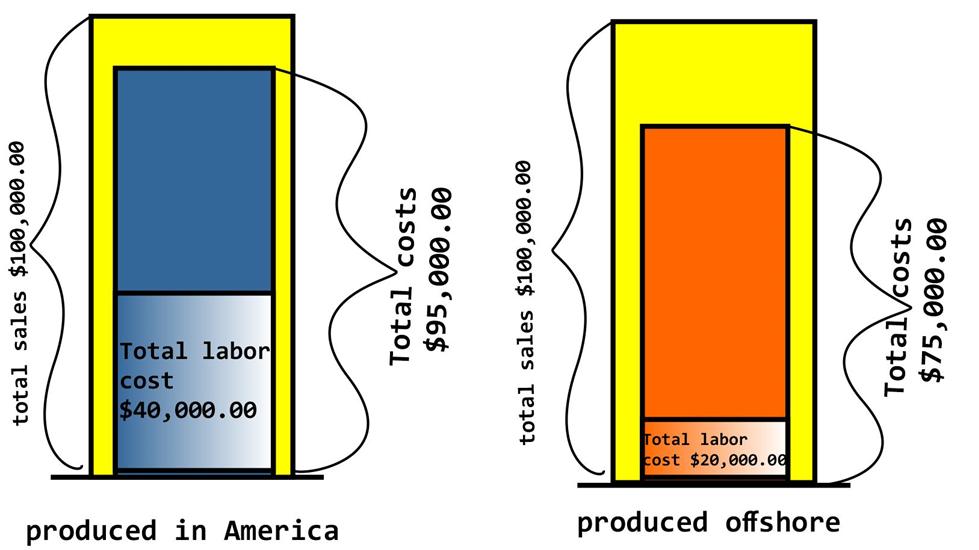
Let’s assume that average costs of producing a given product within the two countries are such that in the first country the product that could be sold in the home market for $100,000 costs $95,000 to produce, whereas in producing it in the second, for sale in the first at $100,000, costs only $75,000. With such a differential, the stampede to offshore will be all but inevitable—unless there is a tariff in place.

Were we to add a tariff of 27% (the average cost difference between the two countries is $20,000, which is $20,000 ÷ $75,000 = .2666 rounded to 27%, so $75,000 x 27% = $20,250, and $75,000 + $20,250 = $95,250, which is over due to rounding but close enough) to all manufactured goods from the second country, the costs of producing our example product there would be the very same as producing it here and there would be no incentive to offshore production. Again, we’re assuming the only difference in average costs between the countries is due to difference in average labor costs.

This is how true protectionism works. Save for cultural concerns (which, again, we’ll be covering in a separate paper), it aims for nothing more and nothing less than intensifying the accumulation of capital per capita by preventing, through tariff barriers, cheap labor in a foreign nation from siphoning off capital from our nation where labor costs are higher. The beauty and elegance of a labor-cost equalizing tariff lies in how once the system is in place consumers can choose any item they want based on price. In that way, it does not lead to economic inefficiency for the country implementing it, since foreign products that are truly superior relative to their price for whatever reason—be it for technological prowess (as with German cars) or a cultural and traditional mastery of the creation process (as with Persian rugs)—will get through and be preferred by the country’s consumers.

Because veraprotectionism goes by labor costs, it has the greatest effect on manufactured goods (where labor is so often a relatively high percentage of total costs) and the least effect on agricultural products and raw materials (where land is by far the most important and priciest factor of production). In that way, veraprotectionism very closely (and ironically) resembles the free trade of classical economists, whose examples were virtually all based on agricultural or animal-based products and assumed the immobility of capital across borders. And, indeed, veraprotectionism as I define it is designed to allow nonmanufactured goods to get through easily, with just enough taxation to fund a government very limited in its scope. The other way to do this (which would also constitute a veraprotectionism policy) would be to make raw materials and food or agricultural products duty free and apply the equalization rates only to manufactured goods. That would lower producers’ costs and make your manufactured goods more competitive, but it might lower tax revenue below the level needed to fund even a minimalist government and thus force it to rely on other forms of taxation which both cost more to collect and are more intrusive, such as the income tax, and thus hurt the economy and citizens overall.

The alternative, a kind of voluntary protectionism on the part of individuals, in which they freely choose to buy American-made products only and convince others to do so by moral suasion, might be the only kind that the diehard free traders such as the Austrians would find acceptable–ideologically they could have no grounds for complaining since it would be totally voluntary and therefore not statist; but such a proposal would be not only extremely foolish and wasteful but also ironic to an extreme degree, because of the way it would have American consumers implicitly try to do what the Austrians would explicitly condemn them for trying to do in another context: that is, the Austrians ask consumers to, like the socialist central planners that they all rebuke, make micromanaging decisions about what goods in the economy ought to be produced where, based on knowledge too limited to make such decisions with any degree of success or economic efficiency. Under veraprotectionism, on the other hand, they just buy what they want based on the goods’ qualities and prices, safe in the knowledge that the tariff schedule is keeping capital accumulation at home. To be clear, most of the Austrians would likely say that the people are being extremely foolish to try their “Buy American!” voluntary protectionist system at all; but I still find it amusingly ironic that the Austrians’ ideology would force them to rebuke my system, which is actually rather similar to the system of free trade described by the 19th century writers (in that it is a system in which agricultural goods and raw materials get through at at most revenue-tariff rates while capital does not freely flow across borders) while admitting the legitimacy of a system much closer to the socialism that they all deplore.

It is important to note that veraprotectionist tariffs do NOT keep capital from going abroad; rather, they keep the level of capital per capita rising until it hits the point of producing a spillover effect.

What’s that?

It’s what happens when the value of selling capital to a foreign nation exceeds the value of keeping and using it at home. This could happen for one (or more) of several reasons:

  • The capital goods being exported from the US will be used by companies with economic efficiency that is due to something other than the cheaper labor cost there, and whose products are therefore able to successfully compete with our own in our own markets despite the tariff rates.
  • Enough time has passed and enough capital has accumulated at home that the last tariff rate is no longer enough to keep capital from flowing abroad or it will likely be used to sell products in the country that produced that capital: e.g., if the tariff is readjusted every five years and at three years the home economy has a gone from having real wages that instead of being 10 times a poorer nation’s are 11 times that (the former being what the tariff rates were designed to compensate for), goods that once were unprofitable to produce there to sell here are now profitable. Of course, whether companies will begin offshoring and to what extent depends on whether the profits they anticipate making in the time between then and the next scheduled tariff adjustment (and what their options for using their offshored factories after that are) are enough to make the move worthwhile.
  • Technological improvement makes old but usable and fairly efficient machinery cheap enough that poorer nations find it worth the cost to buy it.
  • Etc. There are others but those are the major ones that come to mind.

So even an economic nationalist (and white nationalist, for that matter) like me does not in any way intend to and would not be able to hurt foreign nations with my veraprotectionist policies; those like me wish only to, in keeping with the nationalist notion that a nation (and/or race, for a white nationalist) is just the family writ large and ought to be treated like it, help their own above and before they help others. And as I’ve shown earlier, those policies do help others in the world, albeit unintentionally and indirectly.

With that in mind, it ought to be noted that veraprotectionism is easily made part of the policy of a truly Christian nation, given that it adheres to Golden Rule standards: all nations are persuaded to set equalization tariffs (or nominal, revenue-generating ones if the country they’re trading with has higher labor/regulatory costs than they do); hence, it is both inherently nationalist and universalist at the same time. Encouraging this international system won’t lead to peace, but if embraced by most nations (unlikely, but one can hope), it will remove some of the hypocrisy and irritations inherent in the present system that give politicians convenient excuses to demonize their fellow elites abroad to the rubes at home.

Also, just as important is the fact that veraprotectionism’s method leaves no room for government favoritism; you just set one rate per country you’re trading with and that’s it: no special treatment for politically well-connected industries; no lobbyists swarming DC like a plague of locusts seeking exclusive or extra protection for their industries; no central planning of any kind!

This is why most of what the political classes sell as protectionism is actually crony capitalism. In their model, specific industries are designated—by themselves, of course, mostly in conjunction with their most important donors—for specific amounts of protection, often in a fashion that’s economically arbitrary but based on “rational” political calculations. By such means is the economic nationalist’s noble quest for renewal and reindustrialization of his homeland turned into just another political racket and mutual grift by the public and private sectors. Under the veraprotectionism system of one uniform rate per country, on the other hand, the pols and their cronies are left out in the cold: the former can do nothing for the latter, and if they want their industries to benefit from the veraprotectionist tariffs, they will have to make them state of the art such that their efficiency is far above that of those of the majority in the countries we are trading with, and hence with labor costs equalized, the American firms’ products are cheaper and of better quality than their foreign competitors’. Under such a system, men with money to invest will not be tempted to fleece their fellow countrymen by either gaming the political system or offshoring our capital stock and will focus on gaining an edge over their domestic and foreign (from high-IQ, high-capital levels countries) competition by using research and development to develop better and better capital, which aids both their homeland and other nations as well via the spillover effect (that is, as we begin to replace our old capital with ever more efficient versions, we sell that old stock for cheap to the poorer foreign nations that can then upgrade theirs). Again, this is more to the benefit of the entire world than free trade. If the standard version of protectionism is able to achieve anything near this, it’s not for lack of trying by the political classes, who seem pathologically determined to corrupt any good idea man may devise. The less government involvement the better. And veraprotectionism keeps government interference to a bare minimum—even in its enforcement mechanism!

You see, knowing how corrupt and/or incompetent politicians and bureaucrats can be, I designed the enforcement mechanism for veraprotectionist tariffs to rely on private sector competition. The bureau or department that would handle collecting tariff duties has agents to perform the collections, but for verification of the accuracy of the goods and monetary values declared, those bureaucrats rely on both the importers and (much more critically) inspectors on the payroll of their competitors or anyone else who would stand to gain from their loss. The penalty for lying about goods imported could go something like this: the first time you are fined five times the value of the goods that you lied about, the second time (if it occurs within the same three-year period; the slate is wiped clean every three) the fine is ten times of the value of the goods, and the third time your company loses its importing license for good. The exact penalty is debatable. What is not is that it must be high enough to make it not worth the risk to try to skirt the system but not so high as to make it safer—given that mistakes are made and if the first strike were your last, human error would prove fatal—for companies to create dozens small companies that each apply for licenses. Ports that handle foreign imports are to be open to a large number of inspectors, some of which will be from other importers, whether large or small, who are direct competitors of the companies they will inspect (and thus would, unlike bureaucrats, stand to gain more from pointing out cheaters—and thus knocking them out of the pool of competition—than from accepting bribes to look the other way). Of course, to ensure that competitors do not resort to sabotage—say, planting cocaine in with some of the goods—all inspectors are required to wear cameras and microphones at all times during inspections.

Such a preference for free market forces ought to be the default for any true economic nationalist (as opposed to crony capitalist), with deviation from natural market forces considered only when necessary and justified by a rigorous economic analysis. The reason protectionism is necessary is that without it there exists a tragedy of the commons–type scenario in which even if everyone could know the damage to national wealth done by exporting capital to countries with cheaper labor costs (and often with much lower average IQs), the move by companies who value profit over nation will also be utilized by the more scrupulous since doing so is the only way they can compete with those who don’t care. There is no way for the free market to overcome such tragedy of the commons forces—which is precisely why government intervention in the form of tariffs is necessary. Where there is a free-market solution that works just as well (or better, as is usually the case), that should always be preferred.

For it must never be forgotten that the economy that you seek to protect, for economic nationalist or crony capitalist reasons, behind tariff walls is only as powerful as its human capital and institutions and will be riddled with as many flaws as nature and/or man will allow: trap a crony capitalist economy riddled with the inefficiencies that result from unnecessary government intervention and you’ll have a garbage economy that tariffs will have no power to make into an economic dynamo. Such is why the Peronist disaster that those who oppose protectionism constantly make reference to was the way it was: it was a hot mess of not only tariffs—which were not even necessary in the case of a county that in Peron’s time had enough of a lower average IQ and cheaper enough labor costs that siphoning off capital from the free-trading US would have been a better, faster route to increasing prosperity—but massive, inefficient labor unions and a bevy of interventionist laws and regulations that hamstrung the economy to a ludicrous degree. Under such conditions, tariffs would have no chance of producing prosperity. Therefore, it is absolutely critical that those who seek to protect their economy from capital drain take care to ensure that what they are protecting within their tariff walls is worth protecting.

What remains is for us to discuss the best way to transition, with the least pain and most gain, from our current state to one fully implementing the veraprotectionist system. To begin, we must note that we do not need a kind of economic shock therapy such as was forced on Russia in the early ‘90s in which everything is done rapidly and harshly, either out of incompetence or (as in that case) to allow politically connected oligarchs to make off like bandits before anyone out of the loop has a chance to react. Trump may be right to use massive tariff increases as political tools to help end the immigration crisis, but such an approach to solving economic problems is like trying to use a 10-pound sledge hammer to fix a bent fender on a bicycle. Rather, what is needed is for Trump and his most trusted economic advisors to use various media to lay out a complete veraprotectionist plan, including its schedule of tariff increases: this should involve tariffs that begin extremely low and gradually increase over a period of time, say one to three years, till they reach the point of labor (and possibly regulations) equalization. This will serve several purposes:

  • It will allow Trump et al. to concentrate in the near term on the ultimately more important task of rounding up and deporting all of the 50 million or so illegals that “Biden” let into the country: this in and of itself will be indirectly most useful for the veraprotectionism program since it will greatly lower housing and other costs and thus allow the average consumer to see lowering prices and rising real incomes across the board even with the slight increase in prices in the short term that the tariff increases will cause. This will prevent the Dems, MSM, and their oligarch allies (the latter having grown fat off the offshoring craze) from using the temporary price increases which even veraprotectionist tariffs will entail to turn voters against the program in the time leading up to the ‘26 elections.
  • By laying out the plan in full and implementing it over several years, Trump and his team can give everyone time to rationally adjust to the changes:
  • By having tariff rates start out small and increase gradually, there will develop a step-by-step process by which a few types of businesses (likely manufacturing in nature) that had not been profitable suddenly become so; entrepreneurs then move into those areas and have time to concentrate on mastering and improving them before another batch become profitable—by which time they will have the profits and expertise from the first set to quickly and efficiently begin moving into and remaking the next set. Suddenly increasing tariffs to very high levels all at once simply unleashes chaos by making far too many businesses suddenly profitable and robbing businessmen of a way to know which they should move into first; it gives them too many rabbits to chase at once, leaves them no time to perfect their knowledge of any individual sector, and makes the whole effort become far more disorderly than it need be.
  • Having the increases be gradual will also allow the effects of much of what painful aspects of the plan must be experienced to be lessened and also spread out over a longer period of time rather than concentrated in the time before the midterms.
  • This also gives consumers and workers time to adjust to the new jobs and new prices (some of which will be higher in the short term). By giving them this time, Trump and his supporters can lessen the chaos and economic pain that ordinary Americans would otherwise strongly experience—and which the vicious elements of the deep state could then use to turn them against Trump.
  • This also gives other nations time to make the adjustment to an economically multipolar world: as the US and Europe (assuming they embrace veraprotectionism as well) begin to reindustrialize, China will see its preeminent status as the world’s factory begin to fade somewhat, this being the flip side of the US ending its Talmudic quest to be the sole writer (and when need be, ignorer) of the unwritten “rules-based order” rules; just as it is fair for China and Russia to demand that the US stop acting like they are Israelis and the rest of the world is Palestine, so it is fair for the white nations to demand that China respect their wish to revitalize their economies—and for all to demand that the plans for the new international arrangement be laid out in full and put into place at a slow enough rate to make the transition as orderly as possible.
  • Doing it this way will give Trump time to implement policies to improve the human capital stock of the nation, which in turn will make the transition much easier and the end result much better.

That last point is especially important and needs to be emphasized as fully as possible. You see, far more than soft times, parasitic times make weak men; that is, in late stages of empires, when force and the inertia of a (weakening) military machine yet bring economic plenty, there is a strong tendency toward the dysgenics and parasitism in the general population that has been documented to have been the case with the Roman Empire: we know from historic documents that the Roman welfare state[1] (supported mostly by the grain of its Egyptian holdings) was breeding an underclass even as its upper classes were having fewer children; and from Davide Piffer, et al.’s genetic analysis[2] we now know that this was producing gradual declines in average IQ that went on until the Empire’s fall. The same thing has happened with the American empire in the post-WWII era when its welfare state, immigration policies, and extensive system of antiwhite discrimination gradually lowered average IQ levels and the quality of human capital in general.

While the restoration of the genetic aspects of US human capital will take some time—tossing out the human refuse from the third world would be a great start—the restoration of the intellectual aspects of it can be accomplished almost instantly if Trump can muster the political will. And here I might find some disagreement with my fellow Dissident Righters. I will here argue that Trump’s attempts to take back the universities and other leftist bastions is a fool’s errand, since those leftists are entrenched in them and can use their allies in the courts to stonewall him until his term expires. Instead, I would advocate that Trump put aside his ego and desire to be a demigod king and put out a national call for those at the state and local levels to create new educational institutions to outcompete and replace the old liberal hives. That way, all Trump and his allies have to do is keep leftist lawfare that might threaten them at bay while the newly formed academic and vocational schools begin cranking out STEM-types and other professionals better, faster, and at less cost than the old institutions ever did. Also, training as many STEM-capables as is efficient at the small, private, and local operation level will make such schools and training programs immune to liberal lawfare efforts from either a de jure or de facto standpoint: the ones that are wholly private and not for profit can’t be sued for discrimination, and even the ones that might be suable will simply be too numerous and spread out for the system to punish without being overwhelmed. And the more the regime tries to destroy such ubiquitous private efforts, the more they look like bullies and tyrants in the eyes of ordinary Americans, especially if Trump leaves their tainted institutions alone; regime overreach and the outrage it will generate can then allow Trump and his allies to use the numbers in the burgeoning state and local efforts to justify not forcing the liberal hives to close or become politically neutral (which would allow them to play the part of politically persecuted martyrs) but to have their federal funding massively shrink to match their growing irrelevance, forcing them to either abandon their vicious ideologies or keep hemorrhaging ever more users to the new institutions and thus justify further cuts to their budgets.

The synergistic effect of both of these efforts will be profound: just as the cost of STEM-level human capital in the US gradually begins to decline with the increase in supply, making producing products in the US less expensive, so the tariffs will begin to gradually make producing goods offshore more expensive, accelerating the reindustrialization process by making more manufacturing ventures more economically viable at a faster rate; both trends moving toward each other like two blades of a scissors will slice through the socioeconomic malaise and restore both white confidence and economic power, and American economic prowess.

Notes

[1] Haskell, H. J. The New Deal in Old Rome: How Government in the Ancient World Tried to Deal with Modern Problems. Muriwai Books, 2019.

[2] Piffer, Davide, et al. “Intelligence Trends in Ancient Rome: The Rise and Fall of Roman Polygenic Scores.” OpenPsych, 21 July 2023, https://doi.org/10.26775/OP.2023.07.21.

True Protectionism vs Crony Capitalism Part 3: Implementing Economic Nationalism & Reindustrializing the West

True%20Protectionism%20vs%20Crony%20Capitalism%0APart%203%3A%20Implementing%20Economic%20Nationalism%20andamp%3B%20Reindustrializing%20the%20West%0A

Share

  • Gab

Enjoyed this article?

Be the first to leave a tip in the jar!

Instant Echeck GreenPay™

Related

  • Paul Krugman: Closet Bolshevik

  • Fugue of Ideas: Ibram X. Kendi’s Chain of Ideas

  • Watching the Watchers

  • The Robot Hotdog Stand

  • How Cold War Two Came About

  • America’s Century of Humiliation has Begun

  • The 1970s: The Golden Age of Hijacking

  • Trump vs. Transgenderism

Tags

Austrian economicscapitalismD. H. CoraxDonald Trumpindustrializationprotectionismtariffs

Previous

« But He “Sieg Heil”s, Bro

Next

» George Wallace & Elijah Muhammad: Short Guys Who Cast Long Shadows

2 comments

  1. Ultrarightist says:
    May 14, 2025 at 5:28 am

    I want to thank the author for writing this series of thought provoking articles, and for the considerable amount of thinking that went into them. Economics can be dry, but it is important. I particularly appreciate the reconciliation of protectionism with free-market economics – protectionism only where and as necessary on non-political grounds, with a free-market within the tariff walls, and a strong, but small and limited, government.

    As a dissident Rightist with Austrian school sympathies, I encourage the author to write about monetary policy, fiat vs. commodity money, and hard money vs. nationalist social credit system (a la Ezra Pound and our very own Greg Johnson).

    0
    0
    1. Lord Shang says:
      May 14, 2025 at 7:42 am

      I’d like to see Corax bring Friedrich List into the discussion.

      My objections to Trump’s tariffs are that they are a distraction from the real issue, which is mass deportations (not easy to do, given the leftist obstacles embedded in our corrupted legal system, man of which need to be legislatively removed), one for which Trump has (had?) a major electoral mandate, something he cannot claim wrt tariffs; and that they were rolled out in an irrational way, overly sweeping instead of tightly focused on building a global anti-China trade alliance.

      I’ve only skimmed this third post, though I read the first two carefully. I might offer a more extended reply over this coming weekend.

      0
      0

Comments are closed.

If you have a Subscriber access,
simply login first to see your comment auto-approved.

Note on comments privacy & moderation

Your email is never published nor shared.

Comments are moderated. If you don't see your comment, please be patient. If approved, it will appear here soon. Do not post your comment a second time.

Upcoming podcasts
  • Rob Rundo on Counter-Currents Radio

    Rob Rundo on Counter-Currents Radio

    Counter-Currents Radio

    Sat, Jun 13th — 3 pm EST / 9 pm CET
  • Daniel Tyrie on Counter-Currents Radio

    Daniel Tyrie on Counter-Currents Radio

    Counter-Currents Radio

    Sat, Jun 20th — 3 pm EST / 9 pm CET

Writers of May

(2 votes) Morris van de Camp David M. Zsutty Derek Stark Jayant Bhandari Greg Johnson

Articles of May

Heidegger on Nietzsche, Part One by Collin Cleary The Lunch Wars by David M. Zsutty 2 votes
    • The Bitter End of Western Metaphysics:
      Heidegger on Nietzsche, Part Three

      Collin Cleary

    • Uncivil War

      Mark Gullick

      11

    • Exclusive Interview with Karel Veliky:
      The Final Chapter in the Film Series! Part II

      Ondrej Mann

    • Happy Birthday to Us!

      Greg Johnson

      6

    • Zsutty’s Maximum

      David M. Zsutty

      12

    • Exclusive Interview with Karel Veliky:
      The Final Chapter in the Film Series! Part I

      Ondrej Mann

      2

    • The Union Jackal, June 2026

      Mark Gullick

      22

    • The Inferiority Behind Immigrant Superiority

      Jayant Bhandari

      15

    • Counter-Currents Radio Podcast No. 690
      Greg Johnson & David Zsutty Discuss Current Things: AI, Henry Nowak, the Iran Crisis, & More

      Counter-Currents Radio

      5

    • Collin Cleary: What Rome Means to Me

      Collin Cleary

      4

    • Paul Krugman: Closet Bolshevik

      Spencer J. Quinn

      16

    • Fugue of Ideas:
      Ibram X. Kendi’s Chain of Ideas

      Greg Johnson

      18

    • Based Blacks

      Lipton Matthews

      11

    • Black Intellectual Fatigue

      Derek Stark

      36

    • Why White Advocates Should Avoid “Based Blacks”

      Dani Vypont

      24

    • Nietzsche & Race

      Mark Gullick

    • Editor’s Update
      Rob Rundo Rescheduled to Next Week on Counter-Currents Radio;
      Tonight Greg Johnson & David Zsutty Answer Your Questions;
      Fundraiser Update & a New $20,000 Matching Grant

      Greg Johnson

    • The Counter-Currents 2026 Fundraiser
      Lifetime Subscriber Welcome Packages Extended

      Greg Johnson

    • Nationalism This Week
      Who’s Looking Back?

      Greg Johnson

      29

    • China’s Threat to American Security:
      Food, Farmland, Foreign Control, & Energy Policy

      Lipton Matthews

      5

    • The Bitter End of Western Metaphysics:
      Heidegger on Nietzsche, Part Two

      Collin Cleary

      16

    • The Killing of Henry Nowak

      Mark Gullick

      38

    • The Crisis of Chinese Technology Thieves

      Morris van de Camp

      1

    • The Strange World of Gender Bender Fiction:
      & What This Genre Tells Us About Autosexuality

      Dani Vypont

      3

    • Watching the Watchers:
      The Dark Triad Question

      David M. Zsutty

      14

    • The Remigration Movement Solidifies

      F. Roger Devlin

      1

    • Casting Aspersions:
      The Fatal Consequences of Race-Swapped Casting, From Helen of Troy to Henry of Southampton

      Steven Tucker

      20

    • The Murder of Henry Nowak

      Millennial Woes

      23

    • Don’t Forget to Vote in Our Writer & Article of the Month Poll

      Greg Johnson

    • The Robot Hotdog Stand

      Greg Johnson

      37

    • Laughing Our Way to Victory

      Dave Chambers

      7

    • The Zodiac Killer

      Mark Gullick

      11

    • Jared Taylor: What Rome Means to Me

      Jared Taylor

      1

    • An Interview with Endeavour:
      My Way of Life Is an Adventure!

      Ondrej Mann

      6

    • José Pedro Zúquete’s The Identitarians

      Greg Johnson

      3

    • Editor’s Update
      Fundraiser Update & How to Watch the Remigration Summit

      Greg Johnson

      5

    • The Bitter End of Western Metaphysics:
      Heidegger on Nietzsche, Part One

      Collin Cleary

      12

    • Berlin: City of Stones

      Spencer J. Quinn

      6

    • True Folk-Horror Is Horror of Your Own Folk:
      Mark Gatiss vs the Brexit Blind Dead  

      Steven Tucker

      4

    • Counter-Currents Radio Podcast No. 689
      Thomas Massie, the America 2050 Bust, the Need for Whites to Divest from America, the AI Economic Apocalypse, & Pro-White Project Pitches to Billionaires

      Counter-Currents Radio

      7

    • Nationalism This Week
      Remigration is Inevitable, Part 3

      Greg Johnson

      27

    • Why Billionaires Should Fund White Identity Politics

      Lipton Matthews

      8

    • How Cold War Two Came About

      Morris van de Camp

      5

    • Now Available for Pre-Order at a Special Price!
      Greg Johnson’s The Philosopher Is In

      Greg Johnson

    • David Zsutty’s Elevator Pitch to a Billionaire

      David M. Zsutty

      1

    • Headbanging Lite

      Mark Gullick

      5

    • White Advocacy Past and Present

      Peter Bradley

      13

    • The Lunch Wars

      David M. Zsutty

      47

    • The Russians are Coming/The Russians are Coming

      Steven Clark

      1

    • Peak Fatigue in Fort Wayne

      Gabriel Anderson

      24

    • Jocelynn Cordes

      Uncivil War

      The immigration policies may be foolish, but they are conducted with fervor. But why fervor?

    • Jocelynn Cordes

      Uncivil War

      An army heavy on gays and chicks are hardly Mongol hordes.  Gold.

    • Adrian Roberts

      Zsutty’s Maximum

      Counter-Currents would not need to exist if whites were never mean to other whites.

    • Mark Gullick

      Uncivil War

      I would say genocidal immigration rather than suicidal, but your point holds. Even Blackadder knew...

    • ArminiusMaximus

      Uncivil War

      Thank you. I neglected to mention that the main grocery store that was by my hotel had two security...

    • Mark Gullick

      The Union Jackal, June 2026

      Good point well made. That said, as far as I am aware, the only big tennis match ever to be halted...

    • Dominic Fox

      Zsutty’s Maximum

      Thank you! This one will be added to my list. I've always been obsessed with condensing insights...

    • Mark Gullick

      Uncivil War

      One of many things I like about CC is that you can read whole essays in the comments section. You...

    • ArminiusMaximus

      Uncivil War

      I was just in Brescia where I counted at least 5 Chinese owned cafes. One used the mud world as...

    • Thomas Johnson

      Uncivil War

      "Recently, [Professor Betz] made an interesting comment. If civil war or something similar starts in...

    • Joe Gould

      Uncivil War

      Good. There is not a branch of our great family that ought to be quiet in the face of White genocide...

    • Mark Gullick

      Uncivil War

      I absolutely agree. There is much talk of the "people-smuggling gangs", but no one ever sees one....

    • Fred C. Dobbs

      Uncivil War

      I highly doubt that the retarded Sudanese man figured out how to game the immigration system on his...

    • Elear

      Uncivil War

      I've seen claims on social media that the rioters are predominantly Scots-Irish, not Irish. Same for...

    • Ondrej Mann

      Exclusive Interview with Karel Veliky:
      The Final Chapter in the Film Series! Part I

      This is a matter of aesthetics and historical context, and that is always problematic. As for the...

    • Greg Johnson

      Happy Birthday to Us!

      Thank you! The Philosopher Is In is now shipping. Take a look and let me know what you think

    • Joe Gould

      Zsutty’s Maximum

      Uniquely, Whites typically favor morally defined in-groups.* That means you can get us to treat you...

    • CC Reader

      Happy Birthday to Us!

      Happy birthday

    • Scott

      Why White Advocates Should Avoid “Based Blacks”

      I would agree that arch Conservative William F. Buckley, Jr. was a bit of a con man. Buckley’s “...

    • Nicholas Krause

      Counter-Currents Radio Podcast No. 690
      Greg Johnson & David Zsutty Discuss Current Things: AI, Henry Nowak, the Iran Crisis, & More

      I agree with David, the most impressive aspect of the Remigration Summit was hundreds of...

    • Earth Day Special

      John Morgan

      12

    • A Robertson Roundup
      Remembering Wilmot Robertson
      (April 16, 1915 – July 8, 2005)

      Margot Metroland

      13

    • The Paranoid Style in White Nationalism

      Greg Johnson

      30

    • Join the Dance!

      Andrew Hamilton

      1

    • We Can’t Save the Earth Without Reducing African Birth Rates

      James Dunphy

      36

    • “I’m Not a Conspiracy Theorist, but . . .”:
      Jeffrey Epstein’s Death Gives New Life to “Conspiracy Theories”

      Greg Johnson

      22

    • Sylvia Plath: Stasis in Darkness

      Vic Olvir

      17

    • Vanguardism, Vantardism, & Mainstreaming

      Greg Johnson

      80

    • Aviation, Geography, & Race

      Charles Lindbergh

      3

    • Some Thoughts on Yule

      Collin Cleary

      4

    • Living in Truth:
      A Yuletide Homily

      Jef Costello

      7

    • John Kennedy Toole’s A Confederacy of Dunces

      Greg Johnson

      20

    • On Aleksandr Solzhenitsyn’s Warning to the West

      Spencer J. Quinn

      7

    • Elitism, British Modernism, & Wyndham Lewis

      Jonathan Bowden

      6

    • Philip K. Dick’s Do Androids Dream of Electric Sheep? as Anti-Semitic/Christian-Gnostic Allegory

      Greg Johnson

      20

    • “Conspiracy Theory” or Conspiracy?

      Andrew Hamilton

      21

    • Remembering H. P. Lovecraft
      (August 20, 1890–March 15, 1937)

      Greg Johnson

      3

    • Who Are We?
      Nordics, Aryans, & Whites

      Greg Johnson

      71

    • Remembering William Gayley Simpson
      (July 23, 1892–December 31, 1990)
      A Pleasant Afternoon with Harriet & Bill Simpson

      Margot Metroland

      18

    • Here are the Young Men
      Remembering Ian Curtis
      (July 15, 1956–May 18, 1980)

      Mark Gullick

      18

    • Percy Grainger
      Artist of the Right

      Alex Graham

      7

    • Remembering Revilo Oliver
      (July 7, 1908–August 20, 1994)

      Greg Johnson

      18

    • The Meaning of July 4th for the White Man

      Gregory Hood

      13

    • The Front National’s Evolution

      Bruno Mégret

    • Merwin K. Hart
      Forgotten American Hero & Man of the Right

      Morris van de Camp

      10

    • George Orwell’s Nineteen Eighty-Four

      Jonathan Bowden

      8

    • Carleton S. Coon
      Scientist & Reluctant White Advocate

      Morris van de Camp

      3

    • The Kwanzaa Absurdity Will Be Dwarfed by Juneteenth

      Robert Hampton

      10

    • Stravinsky

      Alex Graham

      7

    • Like the Roman:
      Remembering Enoch Powell (1912-1998)

      Mark Gullick

      23

    • Sexually Incontinent on the Indian Subcontinent:
      Who Rapes More Animals, Indians or Pakistanis? The Battle Continues!

      Steven Tucker

      3

    • Neo-Fascism in Film
      Part 5

      Karel Veliky

      15

    • The Game of Tarot

      Mark Gullick

      2

    • Institutions Cannot Be Transplanted

      Jayant Bhandari

      5

    • Jonathan Bowden’s Deliverance
      Part 5

      Jonathan Bowden

    • Crosstown Traffic:
      Jimi Hendrix & The Post-War Rock ‘N’ Roll Revolution

      Mark Gullick

      1

    • Slaves from the North:
      Finns & Karelians in the East European Slave Trade, 900–1600

      Lipton Matthews

      14

    • Neo-Fascism in Film
      Part 4

      Karel Veliky

      2

    • David Lean’s A Passage to India

      Spencer J. Quinn

      1

    • Elites are Essential to Development

      Lipton Matthews

      7

    • Jonathan Bowden’s Deliverance
      Part 4

      Jonathan Bowden

    • Neo-Fascism in Film
      Part 3

      Karel Veliky

      6

    • E. M. Forster’s A Passage to India & the Indian Mentality

      Spencer J. Quinn

      25

    • Jonathan Bowden’s Deliverance
      Part 3

      Jonathan Bowden

    • The Rest Is Silence
      Heidegger’s Quietism

      Mark Gullick

      2

    • Dispelling the Historical Fallacy of Indian Nationalism

      Lipton Matthews

      8

    • Neo-Fascism in Film
      Part 2

      Karel Veliky

      8

    • Jonathan Bowden’s Deliverance
      Part 2

      Jonathan Bowden

    • Life of a Klansman

      Mark Gullick

      8

    • Jonathan Bowden’s Deliverance, Part 1

      Jonathan Bowden

    • Decolonial Ideas are Holding Back Developing Countries

      Lipton Matthews

      8

    • Neo-fascism in Film, Part 1

      Karel Veliky

      21

    • Jonathan Bowden’s Onslaught, Part 8
      Divigations on Decadence

      Jonathan Bowden

    • Jonathan Bowden’s Onslaught, Part 7
      Intrigues in the National Front

      Jonathan Bowden

      1

    • Rotten to the Core

      Mark Gullick

      8

    • Strauss on Husserl’s “Philosophy as Rigorous Science”

      Greg Johnson

    • Jonathan Bowden’s Onslaught, Part 6
      Francis Bacon & Right-Wing Nihilism

      Jonathan Bowden

    • London After (& Before) Midnight:
      Aleister Crowley, The Landlord’s Worst Nightmare

      James J. O'Meara

      2

    • Jonathan Bowden’s Onslaught, Part 5
      The Post-War British Far Right

      Jonathan Bowden

    • No Rules: Rollerball

      Mark Gullick

      4

    • András László
    • Derek Hawthorne
    • Beau Albrecht
    • Alain de Benoist
    • Kerry Bolton
    • Jonathan Bowden
    • Collin Cleary
    • Jef Costello
    • Savitri Devi
    • Julius Evola
    • Jim Goad
    • Gregory Hood
    • Juleigh Howard-Hobson
    • Greg Johnson
    • Charles Krafft
    • Anthony M. Ludovici
    • Trevor Lynch
    • H. L. Mencken
    • J. A. Nicholl
    • James J. O’Meara
    • Christopher Pankhurst
    • Tito Perdue
    • Michael Polignano
    • Spencer J. Quinn
    • Fenek Solère
    • Irmin Vinson
    • Leo Yankevich
    • Francis Parker Yockey
    • Multiple authors
  • Editor-in-Chief

    • Greg Johnson, Ph.D.

    Featured Writers

    • Beau Albrecht
    • Gunnar Alfredsson
    • Collin Cleary, Ph.D.
    • Jef Costello
    • Morris V. de Camp
    • F. Roger Devlin, Ph.D.
    • Stephen Paul Foster, Ph.D.
    • Jim Goad
    • Alex Graham
    • Mark Gullick, Ph.D.
    • Greg Johnson, Ph.D.
    • Travis LeBlanc
    • Trevor Lynch
    • Margot Metroland
    • James J. O’Meara
    • Angelo Plume
    • Spencer J. Quinn
    • Fred Reed
    • Clarissa Schnabel
    • Michael Walker
    • David M. Zsutty

    Frequent Writers

    • Asier Abadroa
    • Aquilonius
    • Alain de Benoist
    • Kerry Bolton, Ph.D.
    • Dave Chambers
    • Steven Clark
    • James Dunphy
    • Endeavour
    • Richard Houck
    • Jason Kessler
    • Titus Livius
    • Ondrej Mann
    • Lipton Matthews
    • Mark Mazari
    • John Morgan
    • Jaroslav Ostrogniew
    • Kathryn S.
    • Christian Secor
    • Anne Wilson Smith
    • Thomas Steuben
    • William De Vere
    • Kenneth Vinther
    • Max West

    Classic Authors

    • Maurice Bardèche
    • Jonathan Bowden
    • Julius Evola
    • Guillaume Faye
    • Ernst Jünger
    • Kevin MacDonald, Ph.D.
    • D. H. Lawrence
    • Charles Lindbergh
    • Jack London
    • H. P. Lovecraft
    • Anthony M. Ludovici
    • Sir Oswald Mosley
    • National Vanguard
    • Friedrich Nietzsche
    • Revilo Oliver
    • William Pierce
    • Ezra Pound
    • Saint-Loup
    • Savitri Devi
    • Carl Schmitt
    • Miguel Serrano
    • Oswald Spengler
    • P. R. Stephensen
    • Jean Thiriart
    • John Tyndall
    • Dominique Venner
    • Leo Yankevich
    • Francis Parker Yockey

    Other Authors

    • Howe Abbott-Hiss
    • Michael Bell
    • Giles Corey
    • Jack Donovan
    • Richardo Duchesne, Ph.D.
    • Emile Durand
    • Guillaume Durocher
    • Mark Dyal
    • Tom Goodroch
    • Andrew Hamilton
    • Robert Hampton
    • Huntley Haverstock
    • Derek Hawthorne
    • Gregory Hood
    • Juleigh Howard-Hobson
    • Alexander Jacob
    • Ruuben Kaalep
    • Tobias Langdon
    • Julian Langness
    • Patrick Le Brun
    • G A Malvicini
    • John Michael McCloughlin
    • Millennial Woes
    • Michael O’Meara
    • Christopher Pankhurst
    • Michael Polignano
    • J. J. Przybylski
    • Quintilian
    • Edouard Rix
    • C. B. Robertson
    • C. F. Robinson
    • Herve Ryssen
    • Alan Smithee
    • Fenek Solere
    • Ann Sterzinger
    • Robert Steuckers
    • Tomislav Sunic
    • Donald Thoresen
    • Marian Van Court
    • Irmin Vinson
    • Book Reviews
    • Movie Reviews
    • TV Reviews
    • Music Reviews
    • Art Criticism
    • Graphic Novels & Comics
    • Video Game Reviews
    • Fiction
    • Poems
    • Interviews
    • Videos
    • English Translations
    • Other Languages
      • Arabic
      • Bulgarian
      • Croatian
      • Czech
      • Danish
      • Dutch
      • Estonian
      • Finnish
      • French
      • German
      • Greek
      • Hungarian
      • Italian
      • Lithuanian
      • Norwegian
      • Polish
      • Portuguese
      • Romanian
      • Russian
      • Slovak
      • Spanish
      • Swedish
      • Ukrainian
    • Commemorations
    • Why We Write
  • Archives
  • Top 100 Commenters
  • The Looney Bin
Sponsored Links
Europa.com Above Time Coffee Antelope Hill Publishing Paul Waggener IHR-Store Spencer J. Quinn American Renaissance Jim Goad The Occidental Observer
Donate Now Mailing list
Books for sale
  • The Philosopher Is In
  • Sexual Utopia in Power (Expanded Edition)
  • In Defense of Prejudice
  • Loving Our Own
  • Tyranny & Wisdom
  • The Populist Moment
  • Is America Doomed?
  • To all books
Copyright © 2026 Counter-Currents Publishing, Ltd.

Paywall Access


Please enter your email address.

Lost your password?

Edit your comment

Writer & Article of the Month May 2026

Voting for this month has concluded. Here are the final results!

Top Writers

  • #1 Morris van de Camp 2 votes
  • #2 David M. Zsutty 2 votes
  • #3 Derek Stark 2 votes
  • #4 Jayant Bhandari 2 votes
  • #5 Greg Johnson 2 votes
  • #6 Jared Taylor 1 vote
  • #7 Collin Cleary 1 vote
  • #8 Spencer J. Quinn 1 vote
  • #9 Mark Gullick 1 vote
  • #10 Lipton Matthews 1 vote
  • #11 Keith Woods 1 vote
  • #12 Steven Tucker 1 vote

Top Articles

  • #1 Heidegger on Nietzsche, Part One 2 votes
  • #2 The Lunch Wars 2 votes
  • #3 The Ghost of the Confederacy 1 vote
  • #4 Lothrop Stoddard’s The Revolt Against Civilization 1 vote
  • #5 Could Fascism Work? 1 vote
  • #6 Jared Taylor's Elevator Pitch to a Billionaire 1 vote
  • #7 Predation Wearing the Mask of Civilization 1 vote
  • #8 Peak Fatigue in Fort Wayne 1 vote
  • #9 Keith Wood's Elevator Pitch to a Billionaire 1 vote
  • #10 Do You Want to Play a Game? 1 vote
  • #11 Why Billionaires Should Fund White Identity Politics 1 vote
  • #12 The 1970s: The Golden Age of Hijacking 1 vote
  • #13 True Folk-Horror Is Horror of Your Own Folk 1 vote
  • #14 Finding Atlantis Part 4 1 vote
  • #15 Berlin: City of Stones 1 vote

Total votes cast: 17