
Counter-Currents
  • Advertise
  • Private Events
  • T&C
  • About
  • Contact
  • RSS
    • Main feed
    • Podcast feed
    • Videos feed
    • Comments feed
  • Welcome
  • Webzine
  • Books
  • Merch
  • Podcasts
  • Videos
  • Donate
  • Patrons
  • Subscribe
  • Crypto

LEVEL2

Donate Now Mailing list
Upcoming podcasts
  • Rob Rundo on Counter-Currents Radio

    Rob Rundo on Counter-Currents Radio

    Counter-Currents Radio

    06/06/2026 — 3 pm EST / 9 pm CET
  • Daniel Tyrie on Counter-Currents Radio

    Daniel Tyrie on Counter-Currents Radio

    Counter-Currents Radio

    06/20/2026 — 3 pm EST / 9 pm CET

Writers of May

(2 votes) Morris van de Camp David M. Zsutty Derek Stark Jayant Bhandari Greg Johnson

Articles of May

The Lunch Wars by David M. Zsutty Heidegger on Nietzsche, Part One by Collin Cleary 2 votes
  • Welcome
  • Webzine
  • Books
  • Merch
  • Podcasts
  • Videos
  • Donate
  • Patrons
  • Subscribe
  • Crypto
    • Editor’s Update
      Fundraiser Update, a New $20,000 Matching Grant, & Rob Rundo Returns to Counter-Currents Radio

      Greg Johnson

    • The Counter-Currents 2026 Fundraiser
      Lifetime Subscriber Welcome Packages Extended

      Greg Johnson

    • Nationalism This Week
      Who’s Looking Back?

      Greg Johnson

      10

    • China’s Threat to American Security:
      Food, Farmland, Foreign Control, & Energy Policy

      Lipton Matthews

      1

    • The Bitter End of Western Metaphysics:
      Heidegger on Nietzsche, Part Two

      Collin Cleary

      4

    • The Killing of Henry Nowak

      Mark Gullick

      24

    • The Crisis of Chinese Technology Thieves

      Morris van de Camp

      1

    • The Strange World of Gender Bender Fiction:
      & What This Genre Tells Us About Autosexuality

      Dani Vypont

      3

    • Watching the Watchers:
      The Dark Triad Question

      David M. Zsutty

      14

    • The Remigration Movement Solidifies

      F. Roger Devlin

      1

    • Casting Aspersions:
      The Fatal Consequences of Race-Swapped Casting, From Helen of Troy to Henry of Southampton

      Steven Tucker

      19

    • The Murder of Henry Nowak

      Millennial Woes

      23

    • Don’t Forget to Vote in Our Writer & Article of the Month Poll

      Greg Johnson

    • The Robot Hotdog Stand

      Greg Johnson

      34

    • Laughing Our Way to Victory

      Dave Chambers

      4

    • The Zodiac Killer

      Mark Gullick

      11

    • Jared Taylor: What Rome Means to Me

      Jared Taylor

      1

    • An Interview with Endeavour:
      My Way of Life Is an Adventure!

      Ondrej Mann

      6

    • José Pedro Zúquete’s The Identitarians

      Greg Johnson

      3

    • Editor’s Update
      Fundraiser Update & How to Watch the Remigration Summit

      Greg Johnson

      5

    • The Bitter End of Western Metaphysics:
      Heidegger on Nietzsche, Part One

      Collin Cleary

      11

    • Berlin: City of Stones

      Spencer J. Quinn

      6

    • True Folk-Horror Is Horror of Your Own Folk:
      Mark Gatiss vs the Brexit Blind Dead  

      Steven Tucker

      4

    • Counter-Currents Radio Podcast No. 689
      Thomas Massie, the America 2050 Bust, the Need for Whites to Divest from America, the AI Economic Apocalypse, & Pro-White Project Pitches to Billionaires

      Counter-Currents Radio

      7

    • Nationalism This Week
      Remigration is Inevitable, Part 3

      Greg Johnson

      27

    • Why Billionaires Should Fund White Identity Politics

      Lipton Matthews

      8

    • How Cold War Two Came About

      Morris van de Camp

      5

    • Now Available for Pre-Order at a Special Price!
      Greg Johnson’s The Philosopher Is In

      Greg Johnson

    • David Zsutty’s Elevator Pitch to a Billionaire

      David M. Zsutty

      1

    • Headbanging Lite

      Mark Gullick

      5

    • White Advocacy Past and Present

      Peter Bradley

      13

    • The Lunch Wars

      David M. Zsutty

      47

    • The Russians are Coming/The Russians are Coming

      Steven Clark

      1

    • Peak Fatigue in Fort Wayne

      Gabriel Anderson

      24

    • Keith Woods’ Elevator Pitch to a Billionaire

      Keith Woods

    • The Cruelty of Kindness

      Morris van de Camp

      9

    • Predation Wearing the Mask of Civilization

      Jayant Bhandari

      13

    • The Mandalorian & Grogu

      Trevor Lynch

      24

    • Editor’s Update
      Fundraiser Update & a New $20,000 Matching Grant
      Greg Johnson & David Zsutty Discuss Thomas Massie on Counter-Currents Radio

      Greg Johnson

      2

    • How the Jews Defeated Thomas Massie—& Themselves

      David M. Zsutty

      24

    • Jared Taylor’s Elevator Pitch to a Billionaire

      Jared Taylor

      15

    • Nationalism This Week
      Remigration Is Inevitable, Part 2

      Greg Johnson

      8

    • Could Fascism Work?

      Mark Gullick

      40

    • Jonathan Bowden’s Deliverance
      Part 7

      Jonathan Bowden

    • China’s Quiet Hand:
      Influence, Infiltration, & the Western Blind Spot

      Lipton Matthews

      9

    • Counter-Currents Radio Podcast No. 688
      Tyler Dykes on Running for US Congress in South Carolina

      Counter-Currents Radio

      3

    • Lothrop Stoddard’s The Revolt Against Civilization

      Spencer J. Quinn

      14

    • Lewis Strauss Did Nothing Wrong:
      How the politics of the Atom Bomb during the early Cold War Apply to Artificial Intelligence Today

      Morris van de Camp

      14

    • The Ghost of the Confederacy

      Dave Chambers

      12

    • America’s Century of Humiliation has Begun

      Greg Johnson

      27

    • Will Williams

      Remigration is Inevitable Part 3

      Will Williams: June 4, 2026  I mention [“Christ is King” Bryan Dawson] here in this piece that...

    • Collin Cleary

      Heidegger on Nietzsche, Part Two

      It will likely presence itself next Friday. Thanks for reading!! Please take a look at the many...

    • Collin Cleary

      Heidegger on Nietzsche, Part Two

      You’re looking at the wrong website. Counter-Currents is not political propaganda. My essay is not...

    • Mark Gullick

      The Killing of Henry Nowak

      Look up the British BIT. I forget what it stands for, but it is known as the "nudge unit". I bet a...

    • Stronza

      The Killing of Henry Nowak

      Here's the entire sentencing statement by the judge. https://www.judiciary.uk/wp-content/uploads/...

    • Will Williams

      Crosstown Traffic

      ...His girlfriend of the time was undergoing serious investigation by another biographer of Hendrix’...

    • YT

      Who’s Looking Back?

      Also, we’re not speaking about “true AI”, are we? True AI - HAL from Kubrick’s 2001 - suggests real...

    • Will Williams

      America Has Already Lost the Iran War

      US Warships Flee Oman Sea after Iranian Navy’s Missile WarningJune, 05, 2026 – Politics...

    • Hi-Ya!

      Who’s Looking Back?

      17.68 It will appear a handsome deed To have made, of yourself, a party of one.

    • YT

      Who’s Looking Back?

      I’m not even 60, and this is the second CC article read today which I really don’t understand. The...

    • Peter Quint

      Casting Aspersions

      Maybe he is one of those reptilians we have been hearing about. 🙃

    • Peter Quint

      The Killing of Henry Nowak

      Unfortunately, you are correct; there’s not enough racial loyalty out there to kill a piss-ant...

    • Tye

      Heidegger on Nietzsche, Part Two

      Fascinating series I have followed since the beginning. This bird’s eye view piece has been...

    • Vagrant Rightist

      Who’s Looking Back?

      Yes. No one knows where this data is going. I’ve never used an AI for anything personal and never...

    • Connor McDowell

      The Killing of Henry Nowak

      Apparently, Nowak’s father has come out with a statement of “please let’s not make this about race...

    • Sigurd

      The Murder of Henry Nowak

      I'm really having a hard time trying to figure out if those police officers who made the arrest are...

    • DarkPlato

      Who’s Looking Back?

      What math problems do you use ai for?  It’s ever so wonderful.  It can solve them better...

    • kolokol

      Who’s Looking Back?

      Never sign up for AI. You're asking for trouble, if you do. I only use Google AI-mode, because it...

    • kolokol

      China’s Threat to American Security

      This is a disturbing article. I respect China, but I don't fear them. They are strong and...

    • Peter Quint

      Who’s Looking Back?

      Someone please break this tie for “writer of the month,” or it is going to be a long citation...

    • Earth Day Special

      John Morgan

      12

    • A Robertson Roundup
      Remembering Wilmot Robertson
      (April 16, 1915 – July 8, 2005)

      Margot Metroland

      13

    • The Paranoid Style in White Nationalism

      Greg Johnson

      30

    • Join the Dance!

      Andrew Hamilton

      1

    • We Can’t Save the Earth Without Reducing African Birth Rates

      James Dunphy

      36

    • “I’m Not a Conspiracy Theorist, but . . .”:
      Jeffrey Epstein’s Death Gives New Life to “Conspiracy Theories”

      Greg Johnson

      22

    • Sylvia Plath: Stasis in Darkness

      Vic Olvir

      17

    • Vanguardism, Vantardism, & Mainstreaming

      Greg Johnson

      80

    • Aviation, Geography, & Race

      Charles Lindbergh

      3

    • Some Thoughts on Yule

      Collin Cleary

      4

    • Living in Truth:
      A Yuletide Homily

      Jef Costello

      7

    • John Kennedy Toole’s A Confederacy of Dunces

      Greg Johnson

      20

    • On Aleksandr Solzhenitsyn’s Warning to the West

      Spencer J. Quinn

      7

    • Elitism, British Modernism, & Wyndham Lewis

      Jonathan Bowden

      6

    • Philip K. Dick’s Do Androids Dream of Electric Sheep? as Anti-Semitic/Christian-Gnostic Allegory

      Greg Johnson

      20

    • “Conspiracy Theory” or Conspiracy?

      Andrew Hamilton

      21

    • Remembering H. P. Lovecraft
      (August 20, 1890–March 15, 1937)

      Greg Johnson

      3

    • Who Are We?
      Nordics, Aryans, & Whites

      Greg Johnson

      71

    • Remembering William Gayley Simpson
      (July 23, 1892–December 31, 1990)
      A Pleasant Afternoon with Harriet & Bill Simpson

      Margot Metroland

      18

    • Here are the Young Men
      Remembering Ian Curtis
      (July 15, 1956–May 18, 1980)

      Mark Gullick

      18

    • Percy Grainger
      Artist of the Right

      Alex Graham

      7

    • Remembering Revilo Oliver
      (July 7, 1908–August 20, 1994)

      Greg Johnson

      18

    • The Meaning of July 4th for the White Man

      Gregory Hood

      13

    • The Front National’s Evolution

      Bruno Mégret

    • Merwin K. Hart
      Forgotten American Hero & Man of the Right

      Morris van de Camp

      10

    • George Orwell’s Nineteen Eighty-Four

      Jonathan Bowden

      8

    • Carleton S. Coon
      Scientist & Reluctant White Advocate

      Morris van de Camp

      3

    • The Kwanzaa Absurdity Will Be Dwarfed by Juneteenth

      Robert Hampton

      10

    • Stravinsky

      Alex Graham

      7

    • Like the Roman:
      Remembering Enoch Powell (1912-1998)

      Mark Gullick

      23

    • Institutions Cannot Be Transplanted

      Jayant Bhandari

      5

    • Jonathan Bowden’s Deliverance
      Part 5

      Jonathan Bowden

    • Crosstown Traffic:
      Jimi Hendrix & The Post-War Rock ‘N’ Roll Revolution

      Mark Gullick

      1

    • Slaves from the North:
      Finns & Karelians in the East European Slave Trade, 900–1600

      Lipton Matthews

      14

    • Neo-Fascism in Film
      Part 4

      Karel Veliky

      2

    • David Lean’s A Passage to India

      Spencer J. Quinn

      1

    • Elites are Essential to Development

      Lipton Matthews

      7

    • Jonathan Bowden’s Deliverance
      Part 4

      Jonathan Bowden

    • Neo-Fascism in Film
      Part 3

      Karel Veliky

      6

    • E. M. Forster’s A Passage to India & the Indian Mentality

      Spencer J. Quinn

      25

    • Jonathan Bowden’s Deliverance
      Part 3

      Jonathan Bowden

    • The Rest Is Silence
      Heidegger’s Quietism

      Mark Gullick

      2

    • Dispelling the Historical Fallacy of Indian Nationalism

      Lipton Matthews

      8

    • Neo-Fascism in Film
      Part 2

      Karel Veliky

      8

    • Jonathan Bowden’s Deliverance
      Part 2

      Jonathan Bowden

    • Life of a Klansman

      Mark Gullick

      8

    • Jonathan Bowden’s Deliverance, Part 1

      Jonathan Bowden

    • Decolonial Ideas are Holding Back Developing Countries

      Lipton Matthews

      8

    • Neo-fascism in Film, Part 1

      Karel Veliky

      21

    • Jonathan Bowden’s Onslaught, Part 8
      Divigations on Decadence

      Jonathan Bowden

    • Jonathan Bowden’s Onslaught, Part 7
      Intrigues in the National Front

      Jonathan Bowden

      1

    • Rotten to the Core

      Mark Gullick

      8

    • Strauss on Husserl’s “Philosophy as Rigorous Science”

      Greg Johnson

    • Jonathan Bowden’s Onslaught, Part 6
      Francis Bacon & Right-Wing Nihilism

      Jonathan Bowden

    • London After (& Before) Midnight:
      Aleister Crowley, The Landlord’s Worst Nightmare

      James J. O'Meara

      2

    • Jonathan Bowden’s Onslaught, Part 5
      The Post-War British Far Right

      Jonathan Bowden

    • No Rules: Rollerball

      Mark Gullick

      4

    • Jonathan Bowden’s Onslaught, Part 3
      Brett Easton Ellis’ American Psycho

      Jonathan Bowden

    • An Alternate History of the Harris Presidency

      Beau Albrecht

      5

    • The Origins of Mass Education:
      Augustina S. Paglayan’s Raised to Obey

      Francis Rockwell

      4

    • András László
    • Derek Hawthorne
    • Beau Albrecht
    • Alain de Benoist
    • Kerry Bolton
    • Jonathan Bowden
    • Collin Cleary
    • Jef Costello
    • Savitri Devi
    • Julius Evola
    • Jim Goad
    • Gregory Hood
    • Juleigh Howard-Hobson
    • Greg Johnson
    • Charles Krafft
    • Anthony M. Ludovici
    • Trevor Lynch
    • H. L. Mencken
    • J. A. Nicholl
    • James J. O’Meara
    • Christopher Pankhurst
    • Tito Perdue
    • Michael Polignano
    • Spencer J. Quinn
    • Fenek Solère
    • Irmin Vinson
    • Leo Yankevich
    • Francis Parker Yockey
    • Multiple authors
  • Editor-in-Chief

    • Greg Johnson, Ph.D.

    Featured Writers

    • Beau Albrecht
    • Gunnar Alfredsson
    • Collin Cleary, Ph.D.
    • Jef Costello
    • Morris V. de Camp
    • F. Roger Devlin, Ph.D.
    • Stephen Paul Foster, Ph.D.
    • Jim Goad
    • Alex Graham
    • Mark Gullick, Ph.D.
    • Greg Johnson, Ph.D.
    • Travis LeBlanc
    • Trevor Lynch
    • Margot Metroland
    • James J. O’Meara
    • Angelo Plume
    • Spencer J. Quinn
    • Fred Reed
    • Clarissa Schnabel
    • Michael Walker
    • David M. Zsutty

    Frequent Writers

    • Asier Abadroa
    • Aquilonius
    • Alain de Benoist
    • Kerry Bolton, Ph.D.
    • Dave Chambers
    • Steven Clark
    • James Dunphy
    • Endeavour
    • Richard Houck
    • Jason Kessler
    • Titus Livius
    • Ondrej Mann
    • Lipton Matthews
    • Mark Mazari
    • John Morgan
    • Jaroslav Ostrogniew
    • Kathryn S.
    • Christian Secor
    • Anne Wilson Smith
    • Thomas Steuben
    • William De Vere
    • Kenneth Vinther
    • Max West

    Classic Authors

    • Maurice Bardèche
    • Jonathan Bowden
    • Julius Evola
    • Guillaume Faye
    • Ernst Jünger
    • Kevin MacDonald, Ph.D.
    • D. H. Lawrence
    • Charles Lindbergh
    • Jack London
    • H. P. Lovecraft
    • Anthony M. Ludovici
    • Sir Oswald Mosley
    • National Vanguard
    • Friedrich Nietzsche
    • Revilo Oliver
    • William Pierce
    • Ezra Pound
    • Saint-Loup
    • Savitri Devi
    • Carl Schmitt
    • Miguel Serrano
    • Oswald Spengler
    • P. R. Stephensen
    • Jean Thiriart
    • John Tyndall
    • Dominique Venner
    • Leo Yankevich
    • Francis Parker Yockey

    Other Authors

    • Howe Abbott-Hiss
    • Michael Bell
    • Giles Corey
    • Jack Donovan
    • Richardo Duchesne, Ph.D.
    • Emile Durand
    • Guillaume Durocher
    • Mark Dyal
    • Tom Goodroch
    • Andrew Hamilton
    • Robert Hampton
    • Huntley Haverstock
    • Derek Hawthorne
    • Gregory Hood
    • Juleigh Howard-Hobson
    • Alexander Jacob
    • Ruuben Kaalep
    • Tobias Langdon
    • Julian Langness
    • Patrick Le Brun
    • G A Malvicini
    • John Michael McCloughlin
    • Millennial Woes
    • Michael O’Meara
    • Christopher Pankhurst
    • Michael Polignano
    • J. J. Przybylski
    • Quintilian
    • Edouard Rix
    • C. B. Robertson
    • C. F. Robinson
    • Herve Ryssen
    • Alan Smithee
    • Fenek Solere
    • Ann Sterzinger
    • Robert Steuckers
    • Tomislav Sunic
    • Donald Thoresen
    • Marian Van Court
    • Irmin Vinson
    • Book Reviews
    • Movie Reviews
    • TV Reviews
    • Music Reviews
    • Art Criticism
    • Graphic Novels & Comics
    • Video Game Reviews
    • Fiction
    • Poems
    • Interviews
    • Videos
    • English Translations
    • Other Languages
      • Arabic
      • Bulgarian
      • Croatian
      • Czech
      • Danish
      • Dutch
      • Estonian
      • Finnish
      • French
      • German
      • Greek
      • Hungarian
      • Italian
      • Lithuanian
      • Norwegian
      • Polish
      • Portuguese
      • Romanian
      • Russian
      • Slovak
      • Spanish
      • Swedish
      • Ukrainian
    • Commemorations
    • Why We Write
  • Archives
  • Top 100 Commenters
  • The Looney Bin
  • Advertise
  • Private Events
  • T&C
  • About
  • Contact
  • RSS
    • Main feed
    • Podcast feed
    • Videos feed
    • Comments feed
Sponsored Links
Europa.com Above Time Coffee Antelope Hill Publishing Paul Waggener IHR-Store Spencer J. Quinn American Renaissance Jim Goad The Occidental Observer
Print April 16, 2019

An Introduction to the Jodoverse

Alex Graham

Alejandro Jodorowsky

4,467 words

Best known for his surreal, avant-garde films – El Topo (1970), The Holy Mountain (1973), and Santa Sangre (1989) – Alejandro Jodorowsky is also a prolific comic book author whose collaborations with artists such as Jean Giraud (Moebius), Zoran Janjetov, and Juan Giménez have exerted a lasting influence on the comics industry and science fiction in general.

Jodorowsky’s science fiction comics came out of his abortive adaptation of Frank Herbert’s Dune (see Frank Pavich’s excellent 2013 documentary, Jodorowsky’s Dune). The creative team Jodorowsky assembled to work on set design and costumes for the film consisted of Moebius, Chris Foss, and H. R. Giger. Dan O’Bannon was to provide special effects, and Pink Floyd and Magma were to compose the soundtrack. The cast was to include Salvador Dalí as Emperor Shaddam IV, Orson Welles as Baron Harkonnen, and David Carradine as Duke Leto. Over the course of two years, Moebius created more than three thousand drawings for the film. Jodorowsky proposed to Moebius that they recycle their work on Dune by collaborating on a graphic novel. Thus, The Incal was born. Jodorowsky went on to author many more science fiction comics, all set in the same vast universe, or “Jodoverse.” Like Dune, the Jodoverse comics blend the conventions of space opera with mysticism and manifest an archeofuturist sensibility.

The Jodoverse comics include The Incal, Before the Incal, Final Incal, The Metabarons, Weapons of the Metabaron, Metabarons Genesis: Castaka, The Metabaron, The Technopriests, and Megalex. Humanoids Publishing has also issued two reference guides to the Jodoverse (Deconstructing the Incal and Deconstructing the Metabarons) and a 112-page volume collecting excerpts from the Jodoverse comics for those who wish to sample them before diving in.

The Incal

The saga of the Incal consists of The Incal, Before the Incal, and Final Incal. The plot revolves around a private detective named John DiFool who is in possession of the Incal, an extremely powerful, pyramid-shaped crystal. The Incal was given to him by a dying Berg (a bird-like alien creature) in a ventilation shaft that DiFool managed to escape through as he was being chased by a wolf-headed man in a nightclub. The story begins with DiFool plummeting to what would have been his death when he is saved by the police, who interrogate him. Later that day, his house is stormed by Bergs and a giant robot. DiFool escapes, but he is immediately apprehended and is taken to the floating palace of the “Prezident.” He escapes once again by hiding in a train headed for Technocity.

In Technocity, he embarks upon his first quest: to acquire the Black Incal. He is captured once again and is nearly slaughtered and dissected by the techno-pope, leader of the technopriests. The technopriests are right out of The Protocols of the Elders of Zion: a sinister elite who hold secretive rituals (chanting “Hail Darkness!” all the while), and they are plotting to destroy the universe by launching “Shadow Eggs” into the atmosphere. DiFool’s loyal pet seagull, Deepo, rescues him by shattering the technopope’s crown. DiFool finally obtains the Black Incal after defeating a giant beast.
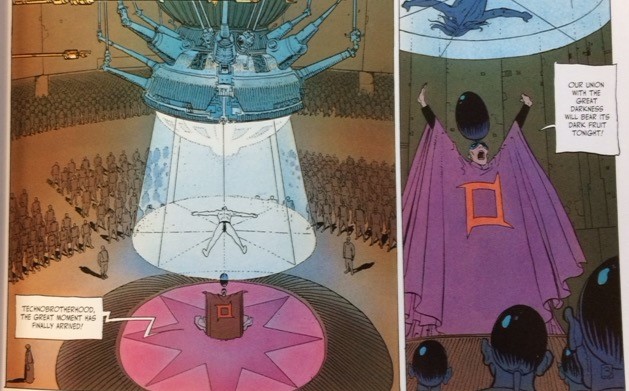
The technopope about to kill DiFool

Meanwhile, Tanatah, Queen of Amok, orders the Metabaron – the greatest warrior in the galaxy – to capture DiFool and promises to release his son, Solune, in return. The Metabaron returns to the Lair of Amok with DiFool and Deepo, and Tanatah tries to have him and Solune killed. But she has a change of heart and decides to join forces with DiFool and the Metabaron after seeing that they are all being pursued by the Necrodroid (the Prezident in the form of a giant robot).

The rest of the story follows DiFool, Deepo, the Metabaron, Solune, Tanatah, Animah (her sister), and Kill Wolfhead (the wolf-headed guy mentioned earlier) as they embark on a mad intergalactic adventure featuring flying leeches, singing crystals, giant jellyfish, interdimensional teleportation, human cloning, and holy androgynes. I will not spoil any more of the plot.

There are a few nods to Dune: Iman Horlog – a fat, sadistic government official – is reminiscent of Baron Harkonnen; Greyfield, the Emperoress’ “mentrek,” is like Thufir Hawat; and Aquend is a planet consisting only of water, the opposite of Arrakis.

The story gets zanier as it progresses, and nearly every page introduces a new plot device or technological oddity. Its drawback is that the plot lacks some cohesion. But the sheer imaginativeness of the tale and Moebius’ masterful artwork compensate for this flaw.

Moebius is widely considered one of the greatest comic book artists of all time, and his gifts are on full display here. His style is both ornate and streamlined, richly detailed yet elegant, and economical. He also excels at depicting the surreal and the fantastical.

The iconic second page

The closest analogue to The Incal’s sci-fi zaniness and stylish visuals is Luc Besson’s The Fifth Element. Jodorowsky actually sued Besson on the grounds that he ripped off The Incal. Moebius had worked with Besson, which probably accounts for the similarities there. The Incal’s influence can also be seen in the Alien franchise, as well as in Blade Runner, The Matrix, and other films.

The overarching themes of The Incal reflect Jodorowsky’s interest in mysticism and esotericism. DiFool is named for the Tarot card of the Fool; the path of the Major Arcana is sometimes termed the “Fool’s Journey,” which is analogous to the hero’s journey. The Incal follows DiFool as he is ripped from his mundane surroundings and made to undergo a process of spiritual initiation and transfiguration. (Amusingly, DiFool becomes more physically attractive in his more enlightened and heroic moments.)

The central narrative of the book is one of journeying through the depths of hell to achieve transcendence and self-transformation. DiFool lives in a squalid urban dystopia characterized by anarchy, corruption, and vice. The Prezident is a lazy narcissist who uses television as a means of mass indoctrination. DiFool himself is addicted to “vhisky” and “homeo-whores” (prostitutes).

This nightmarish landscape is explored further in Before the Incal, a prequel to The Incal that chronicles DiFool’s early adulthood and his career as a detective. DiFool’s mother is a prostitute who subsists on amorine (a “love drug”) and commits suicide at the beginning of the series. His father is a petty criminal whose memory is erased by the government after he is caught wearing a fake halo in imitation of “aristos” (the appellation for the ruling class). DiFool is forced to kill him before he transforms into a bloodthirsty murderer controlled by the state. The city itself is ruled by an omniscient computer called the Supra-Divinoid. Most of the population is addicted to SPV (another drug) and television. The government incentivizes citizens to fight in wars by offering them unlimited access to homeo-whores and vhisky. Customers at brothels can customize homeo-whores according to their preferences by picking features from a digital menu. The media are ever-present, and acts of violence are publicly broadcasted to appease the public’s need for entertainment, as are the Prezident’s multiple body transplants. When the insulation around the Supra-Divinoid’s diodes melts, causing a temporary blackout, the citizens go crazy and protest in the streets.

DiFool decides that his first mission as a class “R” detective will be to investigate the mysterious absence of children among the homeo-whores of the Red Ring. He is motivated by his curiosity about the strange circumstances of his childhood; his mother was forced to lock him away to keep his existence a secret. This is a classified subject, and the Supra-Divinoid arranges for all witnesses to be destroyed. But DiFool is determined to solve the case. His companions along the way are Deepo, a kindly cybo-cop named Kolbo-5; an eye-cop (an eye-shaped, whirring device used for espionage); and a female aristo named Luz de Garra, who is his love interest. At one point, he also forms an alliance with a band of “psycho-anarchists,” one of whom is named Stirner.

DiFool and his friends end up uncovering a sordid conspiracy encompassing every sector of society: the Prezident and his hunchbacked henchmen, the cybo-cops, the Supra-Divinoid, the Cocaloco Industries, and others. They discover the dark truth about the case of the missing children, which unmasks the aristos as a vampiric elite whose power is derived from the deaths of innocents.

The remainder of the story ties up some of the loose ends in The Incal, such as how Tanatah stole the Black Incal and came to be the Queen of Amok. The ending overlaps with the beginning of The Incal.

Before the Incal is less spectacular in scope than The Incal, and mostly takes place in the dystopian city-shaft where The Incal begins. However, the setting and characters in Before the Incal are more fleshed-out. Both are wild, fast-paced yarns packed with adventure, violence, bizarre technological creations, and a good dose of mysticism.
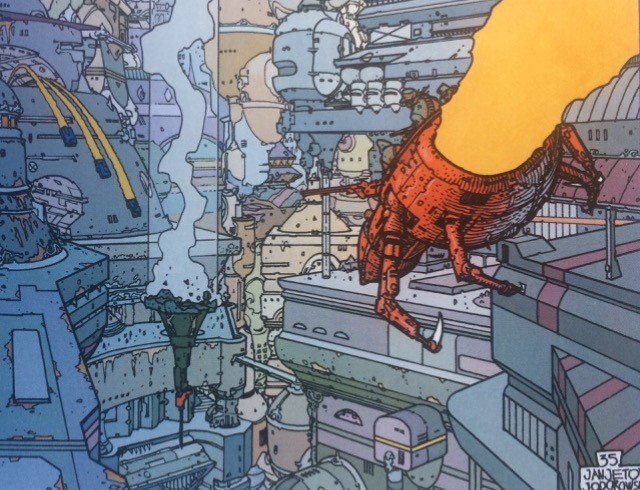
Janjetov’s art for Before the Incal was influenced by Moebius

Final Incal picks up where The Incal left off and follows DiFool’s quest to defeat the Benthacodon, a techno-techno invention akin to the Shadow-Egg in The Incal that is poised to exterminate all living things using a virus that will force people to relinquish their bodies for robotic ones. The Benthacodon is engaged in a cosmic battle with the “white meca-mutant” Elohim, or the divine life force. The universe can only be saved if DiFool is reunited with Luz, his true love. (The message is a bit sentimental, but it manages not to be too cringeworthy, largely because the art is so awe-inspiring.)

In the first volume, DiFool encounters three versions of himself from alternate realities. Among them are an “enlightened” guru and a hyper-evolved angel, both of whom Jodorowsky pokes fun at. The one selected by the Incal is the ugliest and least enlightened version of DiFool. He absorbs the essences of the other DiFools and embarks on his quest.

Moebius intended to illustrate the conclusion of the saga, but he stopped working on it after one volume. José Ladrönn went on to illustrate the story, which was reworked by Jodorowsky. The story is good, but Ladrönn’s artwork is stellar. The aesthetic is strongly reminiscent of Blade Runner.

The Metabarons

The saga of the Metabarons delves into the backstory of the character of the Metabaron, who was introduced in The Incal. It consists of four series: The Metabarons, Metabarons Genesis: Castaka, Weapons of the Metabaron, and The Metabaron. A role-playing game based on The Metabarons was also released in 2001.

The Metabarons is the centerpiece of the saga. It is a sprawling, epic space opera chronicling the rise of the Metabarons and how they came to be the greatest warriors in the galaxy. Each issue is dedicated to a different character: Othon, Honorata, Aghnar, Oda, Steelhead, Dona Vincenta, Aghora, and No-Name. The story is presented in the form of one android, Lothar, recounting the tale of the Metabarons to another android, Tonto (their antics are a source of comic relief throughout the series). The saga begins with Othon von Salza, the great-great-grandfather of the current Metabaron. Intergalactic war breaks out after it is discovered that their planet, Marmola, is in possession of a substance called epyphite (the equivalent of the spice in Dune) that allows objects to defy gravity. Everyone on Marmola is killed except for Othon and his crippled son, Bari. Othon reveals the secret location of the epyphite in exchange for a new planet, advanced technology, and a horse for his son. During a nighttime raid in which pirates steal Bari’s horse, he accidentally kills Bari and is castrated by gunfire. However, he manages to conceive another child by placing a drop of his blood into the uterus of a “whore-priestess” of the Shabda-Oud named Honorata, who bears him a son, Aghnar. (This motif appears in Jodorowsky’s screenplay for Dune, in which Duke Leto is castrated in a bullfight, and Paul Atreides is conceived from a drop of blood from his finger through Bene Gesserit magic.)

When Aghnar is of age, Othon puts him to the test by having him fight a giant robot and then mutilates his feet to test his pain tolerance. Thus begins the Metabarons’ tradition of mutilating their heirs in order to teach them to endure pain. The son of each Metabaron also receives a bird-shaped birthmark that symbolizes the Castaka dynasty. It calls to mind Jodorowsky’s own Santa Sangre, in which the protagonist’s father tattoos him with a phoenix (“Now you’re a man, just like me”). When Honorata is killed by Shabda-Oud priestesses for having defied their orders to bear Othon a hermaphrodite, Othon orders Aghnar to fight him to the death in order to ensure that he has what it takes to avenge his mother’s death. Thus begins a second tradition: each Metabaron must earn the title by killing his father.

Steelhead and Aghora fighting in hand-to-hand combat

The training to become a Metabaron is grueling. Each Metabaron-in-training is taught to be strong in both body and mind and to be ruthless in the face of enemies, like the Sardaukar in Dune. The Castakas adhere to a code of honor called the Bushitaka (after Bushido) that demands that they fight to the death. It also demands that father and son fight each other with swords from “paleo-medieval times.”

The line of Metabarons ends with Aghora’s son, No-Name, who becomes disillusioned with violence and decides that he will be the last Metabaron. He curses his ancestors, sterilizes himself, and withdraws into his spaceship, the Metabunker (sort of like Batman). But he becomes profoundly unhappy in leading a life of inactivity. Suddenly, his bird-shaped birthmark bursts from his chest and presents him with a mission: to clean up the “putrid swamp” that the universe has become. The Metabaron declares that he will fight the techno-technos “because that was the original goal of my genealogical tree: to engender a warrior capable of cleansing evil from the universe!”

The Metabarons is not as trippy as The Incal, but it has own fair share of weirdness, especially when it comes to reproduction. For instance, Honorata transfers her soul to a princess named Oda and has a child with Aghnar (her son). Their son, Steelhead, seduces his wife, Doña Vincenta, by exchanging his prosthetic steel head for the head of a poet. She bears him conjoined twins, a boy and a girl, of which only one can survive. Steelhead saves the girl, Aghora, but implants the boy’s brain in her body. Aghora later gives birth to the next Metabaron by extracting male cells from her brain and implanting them in her womb.

Aghora is basically transgender, but her character is not really subversive because she accepts the responsibilities of being a man and a Metabaron. Indeed, SJWs and feminists have objected to The Metabarons due to its glorification of patriarchy. The women in the story are strong-willed and powerful, but their ultimate purpose is to procure sons who will continue the Castaka dynasty. There are also scenes involving sexual coercion.

There are some echoes of Jodorowsky’s philosophy of “psychomagic” in The Metabarons, particularly in the use of ritual to overcome adversity and psychological torment, and in the notion that one’s ancestors leave an imprint on one’s unconscious.

Juan Giménez’s art is jaw-droppingly good. His work is often reminiscent of H. R. Giger:
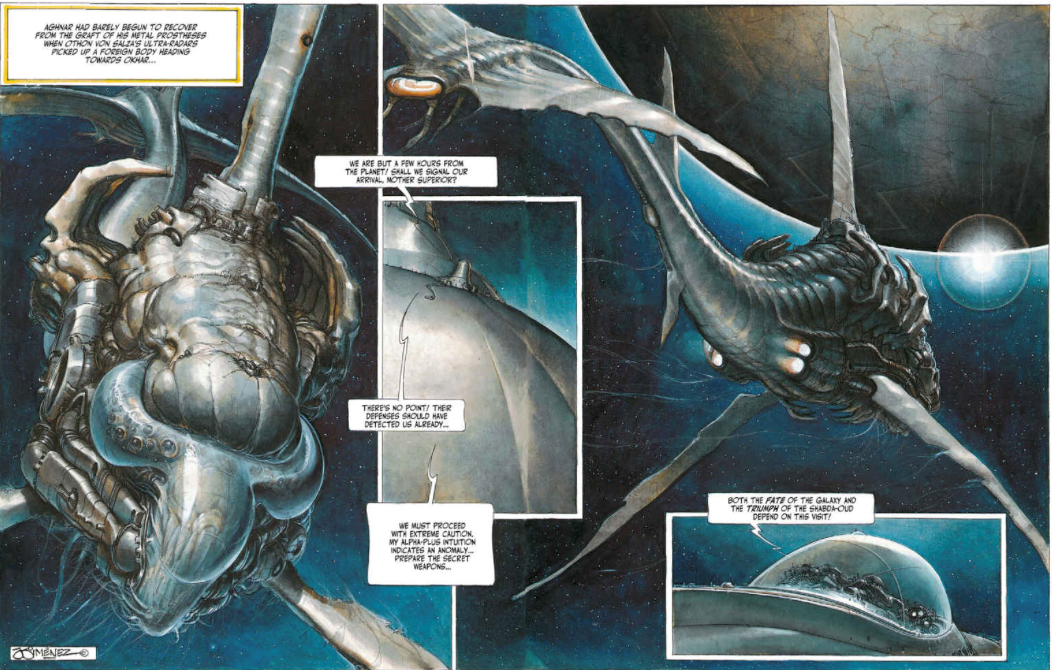
“Othon von Salza’s ultra-radars picked up a foreign body heading towards Okhar . . .”

Metabarons Genesis: Castaka chronicles the history of the Castakas in the three generations leading up to Othon von Salza. It is presented as a flashback in which Baron Bernard recounts the history of his ancestors. The central theme is their struggle to continue the Castaka bloodline. At the start of the book, the Castaka Queen is abducted and raped by the leader of a warring clan, who also sterilizes all Castaka men with a bioweapon. The battle between the clans has the air of a samurai film. The Queen’s son, Dayal, is banished by the Castaka King, but he manages to find a Castaka woman, who bears him twin daughters. His planet is destroyed by techno-technos, but he and his family hijack a techno convoy and head toward Thor-Thougah, a pirate asteroid, where a bloody war is fought. The struggle to preserve the bloodline continues when Dayal’s daughters become afflicted with malignant tumors, and he must graft the upper body of one onto the lower body of the other. The new hybrid daughter is impregnated by the last man alive on Thor-Thougah, Ulrich the Blond. Their child is Berard, who transfers the title of Baron to Othon, his son-in-law, endowing him with the Castaka birthmark.

In Castaka, we also learn about the history behind the Castaka birthmark. It symbolizes Gangez, the former guardian of the epyphite of Marmola, who sacrificed his life to protect the secret of the epyphite when he was attacked by three bandits. Dayal gives him a proper burial; in return, Gangez offers his soul to him, and he is led to the epyphite.
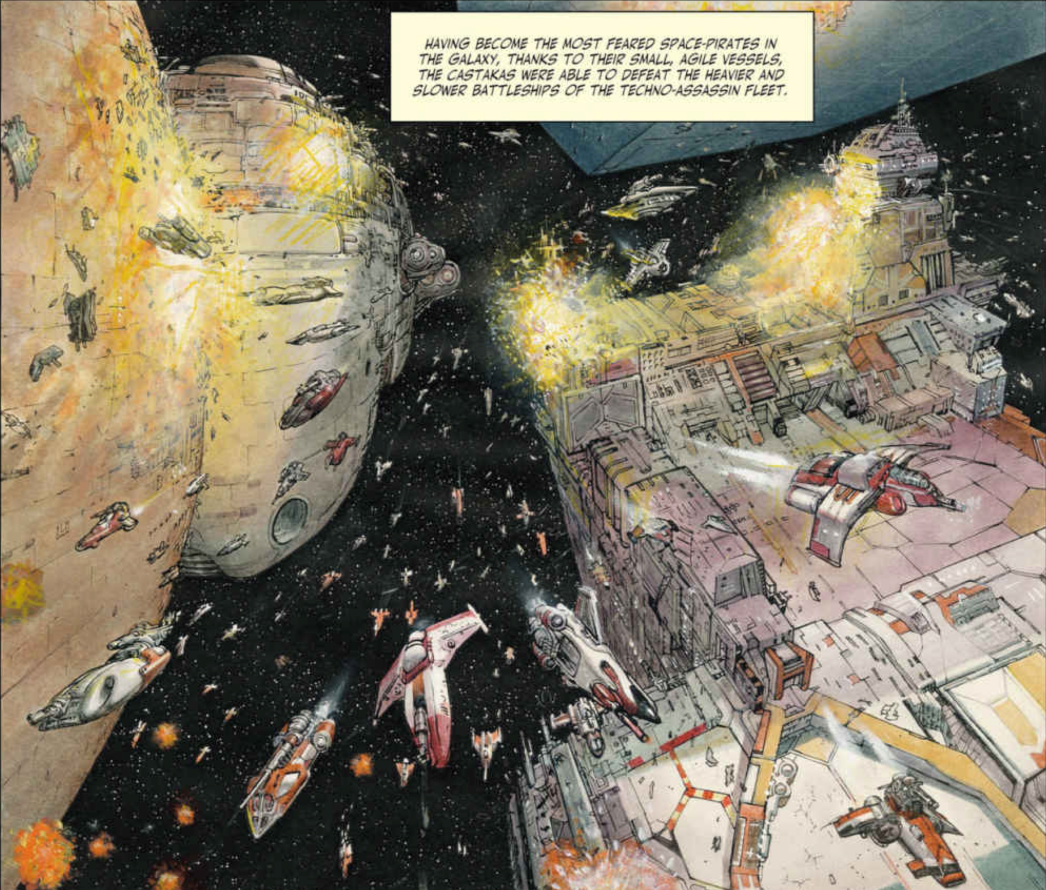
The war against the techno-technos in Metabarons Genesis: Castaka

Weapons of the Metabaron is a short graphic novel in which the last Metabaron obtains three magic weapons: a sword, a golden chalice, and the “transpineal eye” (at the end, he himself is deemed the final weapon). It is the weakest link in the Metabarons saga, but is an entertaining romp through space nonetheless. The Metabaron meets a group of eight mysterious, hooded figures (“dream-shifters”) who inadvertently opened a portal to vampiric beasts called the Hulzgeminis, and who are now in search of a warrior who can defeat them and close the portal. They present him with certain trials he must complete in order to win his weapons. One of the enemies he must face is a tribe of lizard-men who feast on the blood of children.

The Metabaron is a sequel to the main series and chronicles the last Metabaron’s war against the techno-technos, who have been profiting off epyphite extracted from Marmola, the land of the Metabarons’ ancestors. When the techno-pope finds out that the Metabunker is headed for Marmola, he appoints techno-admiral Wilhelm-100 as techno-governor and entrusts him with dealing with the Metabaron. The plot reaches a climax when the techno-techno armada invades Algoma, a hidden universe of epyphite, and the Metabaron makes a deadly deal with the Techno-techno Empire. Overall, The Metabaron comes close to being as good as the main series. The story is gripping, and Valentin Sécher and Niko Henrichon’s artwork is outstanding.

The Metabaron’s disillusionment with his bloodline returns in this series. It is also revealed that Othon was instructed by the epyphite itself to guard it with his life and protect its location. Othon’s betrayal of the epyphite came to be his greatest regret.

Jodorowsky has compared the Metabarons to the protagonists of a Greek tragedy: neither entirely good nor evil, but tragic heroes whose fate was sealed from the day that Othon fell under that block of marble: heroic and noble, but cursed by destiny. It is also worth noting that Othon’s motivation in betraying the location of the epyphite was to save his son’s life (not to obtain favor or material goods), which makes him even more of a tragic figure.

Of course, the Metabaron never ends up actually renouncing violence; he wages an interplanetary war against the techno-technos. Toward the end of the story, he vows to “eradicate the techno-techno menace, once and for all.”
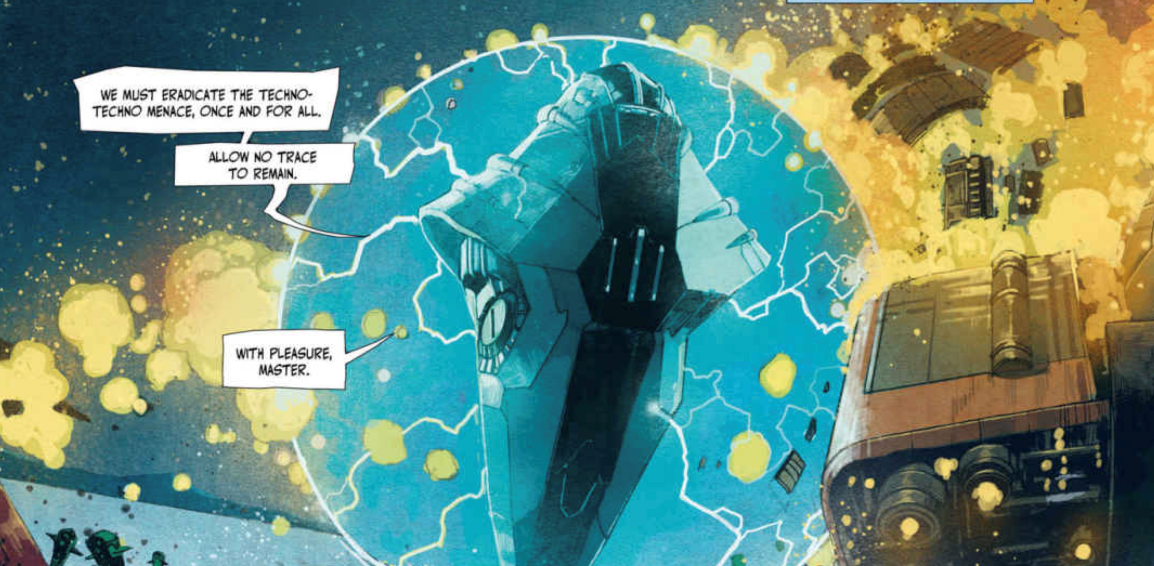
The Metabaron vows to eradicate the techno-technos

There is an ecological dimension to The Metabaron as well. The techno-technos look upon nature with contempt and see both human biology and the natural world as things that must be overcome. When Orne-8 is castrated during his/her ordination ceremony as techno-cardinal at the techno-Vatican, the techno-pope declares that he/she is “freed from the slavery nature imposes on mankind.” The techno-technos are hyper-utilitarians who see epyphite as mere fuel for their vessels. But the epyphite is more than that: a living, breathing life force that underpins the universe itself. The Metabaron’s realization of this is what galvanizes him to fight the techno-technos again.

The Technopriests

Like The Metabaron, The Technopriests revolves around a lone rebel who takes on the Techno-techno Empire. It takes the form of an extended flashback in which the Supreme Technopriest, Albino (with his murine companion, Tinigrifi, by his side), recounts his childhood and his mission to lead five hundred thousand technopriests to the “promised galaxy.” Though not the equal of The Incal or The Metabarons (a high bar indeed), The Technopriests boasts a compelling story and high-quality art, making it a worthy addition to the Jodoverse.

Albino is the offspring of Lady Panepha, a high-born woman poised to become the oracle of the imperial palace before she was raped by a band of invading pirates. Her quest to exact revenge upon the pirates is a prominent subplot throughout the series. Because of his bright white skin, his mother sees Albino as a defective mutant and treats him as a slave. Albino turns to the virtual world and becomes skilled with computers. His dream is to create games that will transport people to other worlds. In techno-school, he is hailed as a genius, but his curiosity and imagination put him at odds with the system’s rigid bureaucracy. He is sent to a penitentiary after attempting to speak with Saint Severo de Loyola, the founder of the techno-ministry, who is locked away in a cybercrypt. Saint Severo recounts that when he founded the techno-ministry, his goal was “to bring light and knowledge to humanity,” but the technopriests perverted this aim by using technology to hoard power and tyrannize their subjects.

Albino runs into trouble with authority again when he creates his first game, a psychedelic adventure that imbues players with wisdom and self-knowledge. He learns that in the Techno-techno Empire, games are designed to serve one purpose: to induce addiction, passivity, and apathy in citizens and trap them into becoming perpetual consumers.
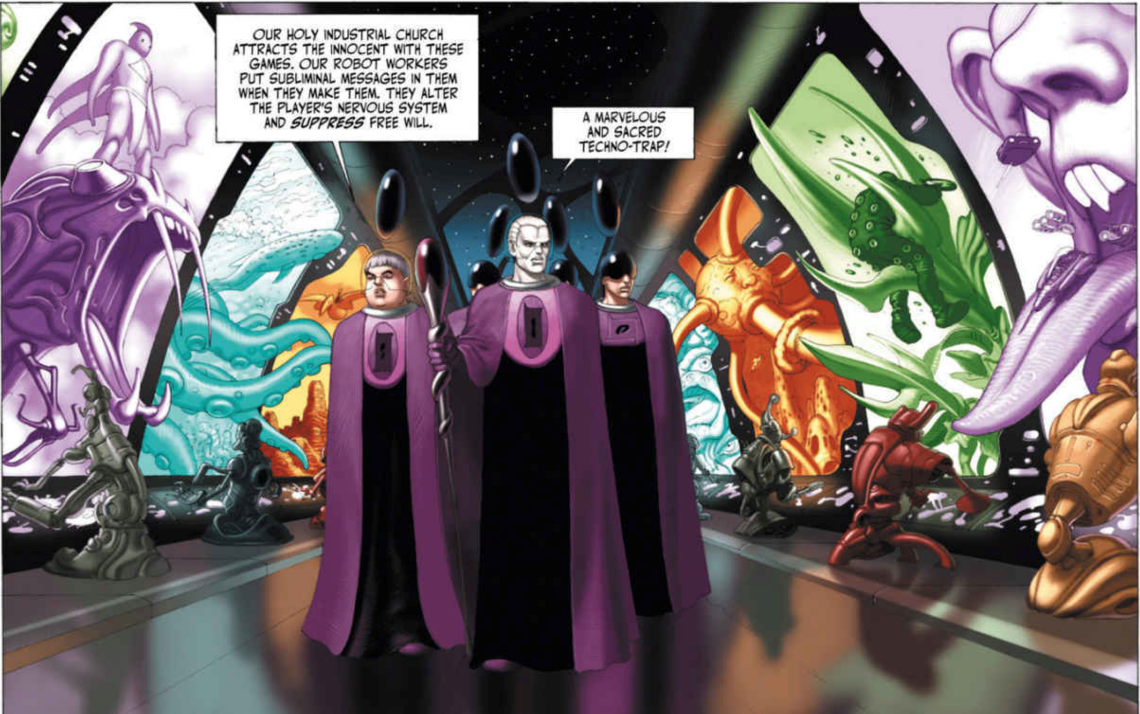
The techno-bishops on the purpose of their games

Albino decides that he must join the “techno-executioners,” who serve as the arbiters of games and are high up in the techno-papal hierarchy. Each techno-executioner has his brain removed upon his initiation, and all of their brains are plugged into a giant matrix. Saint Severo creates a replica of Albino to undergo the procedure, while Albino himself is sealed in a cybercrypt. Albino watches as his replica terrorizes “anti-techno” communities and people who consume media that is not state-approved. After five years, Albino takes control of the techno-executioners’ brains and forces them to recognize him as their master.

Albino is eventually crowned supreme technopriest. As before, he plays along with the techno-techno agenda for a time, and he is forced to guard his soul against the forces of darkness on multiple occasions. Finally, his true mission begins: to defeat the Empire from within and guide his followers to a new galaxy. He selects his followers by means of a challenging game he designed that requires players to go on an odyssey across an empty planet, and finally through an aerial maze in space whose endpoint is Albino’s ship.

Jodorowsky does not oppose technology per se. He is against the manner in which technos-technos approach it, i.e., as a tool to manipulate citizens and keep them in a state of ignorance, and as something to be worshipped in itself to the exclusion of all else. (Indeed, despite their high-tech society, the techno-technos are actually rather irrational and unthinking.)

Megalex

Megalex is set in a hyper-industrial dystopian city-state (Megalex) in which nearly all organic life has been purged. The government rules over the populace with an iron fist, and the law is enforced by clones that were created in a lab and are programmed to retaliate against anyone who commits an infraction. Natural procreation is banned, and the entire population is genetically engineered. The clones who comprise the police are allotted four hundred days of life, while the upper classes are allotted four hundred years.

The story begins with the creation of an “anomaly,” or a clone that went awry: he is ten feet tall. When this is discovered, the government embarks on a witchhunt for him, but he manages to escape down the root of a tree and into a secret underground world. Beneath the modern city of Megalex lies a two thousand-year-old labyrinth constructed by an eccentric genius. We later learn that Megalex used to be called Giragod and was a lush, fertile kingdom before it was devoured by a computer called the “mega-brain.” All that remains of Giragod is the underground realm and a forest that the royal family of Megalex are currently plotting to destroy.

The rest of the story follows the “undergrounders” as they coordinate an attack on Megalex. Their leader, Zerain, is a charismatic warrior who acquires a bat’s wings. There is one scene in which one of the “undergrounders” brings back manna – which can be molded into any food using one’s imagination – from the world above. Zerain stomps on the manna and castigates his comrades for giving in to their individual wants, reminding them that the manna is the embodiment of everything they despise.

Megalex is essentially a commentary on modern post-industrial society. However, the ending shows that Jodorowsky is not categorically opposed to technology. It is revealed that seven hundred million alien creatures are headed for the planet and will arrive in four years, and the royal family must use their advanced technology to create a shield to cover the planet. They resolve to create harmony between technology and biology.

“Our lives depend on the union of Megalex and Giragod!”

Megalex is the least compelling series in the Jodoverse, but it nonetheless makes for a good read. The shift from digital art to traditional comic art is abrupt, but one could argue that it mirrors the changing balance of power in the story. Beltran’s computer-generated art in the first two volumes is a good fit for the sterile uniformity of Megalex.

* * *

The main theme that remains consistent across the Jodoverse comics is the search for transcendence, self-actualization, and authenticity in an inhumane, indifferent universe. Each character is engaged in a form of spiritual warfare. The enemy by turns takes the form of nihilism, greed, consumerism, ecological degradation, and one’s own weaknesses.

This quest narrative is implicitly Rightist because it presupposes the existence of a spiritual hierarchy and glorifies the values of heroism, transcendence, and so on. This arguably makes Jodorowsky a fellow traveler of the Right. The Jodoverse is also free of PC moralizing, unlike Saga or Star Trek.

I strongly recommend the Jodoverse comics (especially The Incal and The Metabarons) to fans of science fiction and great art. Dune fans, in particular, will appreciate Jodorowsky’s blend of science fiction, mysticism, and surreal weirdness. The spirit of Jodorowsky’s Dune lives on in the Jodoverse.

An Introduction to the Jodoverse

An%20Introduction%20to%20the%20Jodoverse

Share

  • Gab

Enjoyed this article?

Be the first to leave a tip in the jar!

Instant Echeck GreenPay™

Related

  • Berlin: City of Stones

  • Dating Advice for the Socially Impaired

  • Telenovela Nationalism: Gen Z and the Rise of the Off-White Right

  • On “White Privilege”

  • The Solipsism of NAXALT

  • Who Commits “Hate Crimes”?

  • Abigail Shrier’s Bad Therapy

Tags

Alejandro JodorowskyAlex Grahamcomics and graphic novels
Upcoming podcasts
  • Rob Rundo on Counter-Currents Radio

    Rob Rundo on Counter-Currents Radio

    Counter-Currents Radio

    Sat, Jun 6th — 3 pm EST / 9 pm CET
  • Daniel Tyrie on Counter-Currents Radio

    Daniel Tyrie on Counter-Currents Radio

    Counter-Currents Radio

    Sat, Jun 20th — 3 pm EST / 9 pm CET

Writers of May

(2 votes) Morris van de Camp David M. Zsutty Derek Stark Jayant Bhandari Greg Johnson

Articles of May

The Lunch Wars by David M. Zsutty Heidegger on Nietzsche, Part One by Collin Cleary 2 votes
    • Editor’s Update
      Fundraiser Update, a New $20,000 Matching Grant, & Rob Rundo Returns to Counter-Currents Radio

      Greg Johnson

    • The Counter-Currents 2026 Fundraiser
      Lifetime Subscriber Welcome Packages Extended

      Greg Johnson

    • Nationalism This Week
      Who’s Looking Back?

      Greg Johnson

      10

    • China’s Threat to American Security:
      Food, Farmland, Foreign Control, & Energy Policy

      Lipton Matthews

      1

    • The Bitter End of Western Metaphysics:
      Heidegger on Nietzsche, Part Two

      Collin Cleary

      4

    • The Killing of Henry Nowak

      Mark Gullick

      24

    • The Crisis of Chinese Technology Thieves

      Morris van de Camp

      1

    • The Strange World of Gender Bender Fiction:
      & What This Genre Tells Us About Autosexuality

      Dani Vypont

      3

    • Watching the Watchers:
      The Dark Triad Question

      David M. Zsutty

      14

    • The Remigration Movement Solidifies

      F. Roger Devlin

      1

    • Casting Aspersions:
      The Fatal Consequences of Race-Swapped Casting, From Helen of Troy to Henry of Southampton

      Steven Tucker

      19

    • The Murder of Henry Nowak

      Millennial Woes

      23

    • Don’t Forget to Vote in Our Writer & Article of the Month Poll

      Greg Johnson

    • The Robot Hotdog Stand

      Greg Johnson

      34

    • Laughing Our Way to Victory

      Dave Chambers

      4

    • The Zodiac Killer

      Mark Gullick

      11

    • Jared Taylor: What Rome Means to Me

      Jared Taylor

      1

    • An Interview with Endeavour:
      My Way of Life Is an Adventure!

      Ondrej Mann

      6

    • José Pedro Zúquete’s The Identitarians

      Greg Johnson

      3

    • Editor’s Update
      Fundraiser Update & How to Watch the Remigration Summit

      Greg Johnson

      5

    • The Bitter End of Western Metaphysics:
      Heidegger on Nietzsche, Part One

      Collin Cleary

      11

    • Berlin: City of Stones

      Spencer J. Quinn

      6

    • True Folk-Horror Is Horror of Your Own Folk:
      Mark Gatiss vs the Brexit Blind Dead  

      Steven Tucker

      4

    • Counter-Currents Radio Podcast No. 689
      Thomas Massie, the America 2050 Bust, the Need for Whites to Divest from America, the AI Economic Apocalypse, & Pro-White Project Pitches to Billionaires

      Counter-Currents Radio

      7

    • Nationalism This Week
      Remigration is Inevitable, Part 3

      Greg Johnson

      27

    • Why Billionaires Should Fund White Identity Politics

      Lipton Matthews

      8

    • How Cold War Two Came About

      Morris van de Camp

      5

    • Now Available for Pre-Order at a Special Price!
      Greg Johnson’s The Philosopher Is In

      Greg Johnson

    • David Zsutty’s Elevator Pitch to a Billionaire

      David M. Zsutty

      1

    • Headbanging Lite

      Mark Gullick

      5

    • White Advocacy Past and Present

      Peter Bradley

      13

    • The Lunch Wars

      David M. Zsutty

      47

    • The Russians are Coming/The Russians are Coming

      Steven Clark

      1

    • Peak Fatigue in Fort Wayne

      Gabriel Anderson

      24

    • Keith Woods’ Elevator Pitch to a Billionaire

      Keith Woods

    • The Cruelty of Kindness

      Morris van de Camp

      9

    • Predation Wearing the Mask of Civilization

      Jayant Bhandari

      13

    • The Mandalorian & Grogu

      Trevor Lynch

      24

    • Editor’s Update
      Fundraiser Update & a New $20,000 Matching Grant
      Greg Johnson & David Zsutty Discuss Thomas Massie on Counter-Currents Radio

      Greg Johnson

      2

    • How the Jews Defeated Thomas Massie—& Themselves

      David M. Zsutty

      24

    • Jared Taylor’s Elevator Pitch to a Billionaire

      Jared Taylor

      15

    • Nationalism This Week
      Remigration Is Inevitable, Part 2

      Greg Johnson

      8

    • Could Fascism Work?

      Mark Gullick

      40

    • Jonathan Bowden’s Deliverance
      Part 7

      Jonathan Bowden

    • China’s Quiet Hand:
      Influence, Infiltration, & the Western Blind Spot

      Lipton Matthews

      9

    • Counter-Currents Radio Podcast No. 688
      Tyler Dykes on Running for US Congress in South Carolina

      Counter-Currents Radio

      3

    • Lothrop Stoddard’s The Revolt Against Civilization

      Spencer J. Quinn

      14

    • Lewis Strauss Did Nothing Wrong:
      How the politics of the Atom Bomb during the early Cold War Apply to Artificial Intelligence Today

      Morris van de Camp

      14

    • The Ghost of the Confederacy

      Dave Chambers

      12

    • America’s Century of Humiliation has Begun

      Greg Johnson

      27

    • Will Williams

      Remigration is Inevitable Part 3

      Will Williams: June 4, 2026  I mention [“Christ is King” Bryan Dawson] here in this piece that...

    • Collin Cleary

      Heidegger on Nietzsche, Part Two

      It will likely presence itself next Friday. Thanks for reading!! Please take a look at the many...

    • Collin Cleary

      Heidegger on Nietzsche, Part Two

      You’re looking at the wrong website. Counter-Currents is not political propaganda. My essay is not...

    • Mark Gullick

      The Killing of Henry Nowak

      Look up the British BIT. I forget what it stands for, but it is known as the "nudge unit". I bet a...

    • Stronza

      The Killing of Henry Nowak

      Here's the entire sentencing statement by the judge. https://www.judiciary.uk/wp-content/uploads/...

    • Will Williams

      Crosstown Traffic

      ...His girlfriend of the time was undergoing serious investigation by another biographer of Hendrix’...

    • YT

      Who’s Looking Back?

      Also, we’re not speaking about “true AI”, are we? True AI - HAL from Kubrick’s 2001 - suggests real...

    • Will Williams

      America Has Already Lost the Iran War

      US Warships Flee Oman Sea after Iranian Navy’s Missile WarningJune, 05, 2026 – Politics...

    • Hi-Ya!

      Who’s Looking Back?

      17.68 It will appear a handsome deed To have made, of yourself, a party of one.

    • YT

      Who’s Looking Back?

      I’m not even 60, and this is the second CC article read today which I really don’t understand. The...

    • Peter Quint

      Casting Aspersions

      Maybe he is one of those reptilians we have been hearing about. 🙃

    • Peter Quint

      The Killing of Henry Nowak

      Unfortunately, you are correct; there’s not enough racial loyalty out there to kill a piss-ant...

    • Tye

      Heidegger on Nietzsche, Part Two

      Fascinating series I have followed since the beginning. This bird’s eye view piece has been...

    • Vagrant Rightist

      Who’s Looking Back?

      Yes. No one knows where this data is going. I’ve never used an AI for anything personal and never...

    • Connor McDowell

      The Killing of Henry Nowak

      Apparently, Nowak’s father has come out with a statement of “please let’s not make this about race...

    • Sigurd

      The Murder of Henry Nowak

      I'm really having a hard time trying to figure out if those police officers who made the arrest are...

    • DarkPlato

      Who’s Looking Back?

      What math problems do you use ai for?  It’s ever so wonderful.  It can solve them better...

    • kolokol

      Who’s Looking Back?

      Never sign up for AI. You're asking for trouble, if you do. I only use Google AI-mode, because it...

    • kolokol

      China’s Threat to American Security

      This is a disturbing article. I respect China, but I don't fear them. They are strong and...

    • Peter Quint

      Who’s Looking Back?

      Someone please break this tie for “writer of the month,” or it is going to be a long citation...

    • Earth Day Special

      John Morgan

      12

    • A Robertson Roundup
      Remembering Wilmot Robertson
      (April 16, 1915 – July 8, 2005)

      Margot Metroland

      13

    • The Paranoid Style in White Nationalism

      Greg Johnson

      30

    • Join the Dance!

      Andrew Hamilton

      1

    • We Can’t Save the Earth Without Reducing African Birth Rates

      James Dunphy

      36

    • “I’m Not a Conspiracy Theorist, but . . .”:
      Jeffrey Epstein’s Death Gives New Life to “Conspiracy Theories”

      Greg Johnson

      22

    • Sylvia Plath: Stasis in Darkness

      Vic Olvir

      17

    • Vanguardism, Vantardism, & Mainstreaming

      Greg Johnson

      80

    • Aviation, Geography, & Race

      Charles Lindbergh

      3

    • Some Thoughts on Yule

      Collin Cleary

      4

    • Living in Truth:
      A Yuletide Homily

      Jef Costello

      7

    • John Kennedy Toole’s A Confederacy of Dunces

      Greg Johnson

      20

    • On Aleksandr Solzhenitsyn’s Warning to the West

      Spencer J. Quinn

      7

    • Elitism, British Modernism, & Wyndham Lewis

      Jonathan Bowden

      6

    • Philip K. Dick’s Do Androids Dream of Electric Sheep? as Anti-Semitic/Christian-Gnostic Allegory

      Greg Johnson

      20

    • “Conspiracy Theory” or Conspiracy?

      Andrew Hamilton

      21

    • Remembering H. P. Lovecraft
      (August 20, 1890–March 15, 1937)

      Greg Johnson

      3

    • Who Are We?
      Nordics, Aryans, & Whites

      Greg Johnson

      71

    • Remembering William Gayley Simpson
      (July 23, 1892–December 31, 1990)
      A Pleasant Afternoon with Harriet & Bill Simpson

      Margot Metroland

      18

    • Here are the Young Men
      Remembering Ian Curtis
      (July 15, 1956–May 18, 1980)

      Mark Gullick

      18

    • Percy Grainger
      Artist of the Right

      Alex Graham

      7

    • Remembering Revilo Oliver
      (July 7, 1908–August 20, 1994)

      Greg Johnson

      18

    • The Meaning of July 4th for the White Man

      Gregory Hood

      13

    • The Front National’s Evolution

      Bruno Mégret

    • Merwin K. Hart
      Forgotten American Hero & Man of the Right

      Morris van de Camp

      10

    • George Orwell’s Nineteen Eighty-Four

      Jonathan Bowden

      8

    • Carleton S. Coon
      Scientist & Reluctant White Advocate

      Morris van de Camp

      3

    • The Kwanzaa Absurdity Will Be Dwarfed by Juneteenth

      Robert Hampton

      10

    • Stravinsky

      Alex Graham

      7

    • Like the Roman:
      Remembering Enoch Powell (1912-1998)

      Mark Gullick

      23

    • Institutions Cannot Be Transplanted

      Jayant Bhandari

      5

    • Jonathan Bowden’s Deliverance
      Part 5

      Jonathan Bowden

    • Crosstown Traffic:
      Jimi Hendrix & The Post-War Rock ‘N’ Roll Revolution

      Mark Gullick

      1

    • Slaves from the North:
      Finns & Karelians in the East European Slave Trade, 900–1600

      Lipton Matthews

      14

    • Neo-Fascism in Film
      Part 4

      Karel Veliky

      2

    • David Lean’s A Passage to India

      Spencer J. Quinn

      1

    • Elites are Essential to Development

      Lipton Matthews

      7

    • Jonathan Bowden’s Deliverance
      Part 4

      Jonathan Bowden

    • Neo-Fascism in Film
      Part 3

      Karel Veliky

      6

    • E. M. Forster’s A Passage to India & the Indian Mentality

      Spencer J. Quinn

      25

    • Jonathan Bowden’s Deliverance
      Part 3

      Jonathan Bowden

    • The Rest Is Silence
      Heidegger’s Quietism

      Mark Gullick

      2

    • Dispelling the Historical Fallacy of Indian Nationalism

      Lipton Matthews

      8

    • Neo-Fascism in Film
      Part 2

      Karel Veliky

      8

    • Jonathan Bowden’s Deliverance
      Part 2

      Jonathan Bowden

    • Life of a Klansman

      Mark Gullick

      8

    • Jonathan Bowden’s Deliverance, Part 1

      Jonathan Bowden

    • Decolonial Ideas are Holding Back Developing Countries

      Lipton Matthews

      8

    • Neo-fascism in Film, Part 1

      Karel Veliky

      21

    • Jonathan Bowden’s Onslaught, Part 8
      Divigations on Decadence

      Jonathan Bowden

    • Jonathan Bowden’s Onslaught, Part 7
      Intrigues in the National Front

      Jonathan Bowden

      1

    • Rotten to the Core

      Mark Gullick

      8

    • Strauss on Husserl’s “Philosophy as Rigorous Science”

      Greg Johnson

    • Jonathan Bowden’s Onslaught, Part 6
      Francis Bacon & Right-Wing Nihilism

      Jonathan Bowden

    • London After (& Before) Midnight:
      Aleister Crowley, The Landlord’s Worst Nightmare

      James J. O'Meara

      2

    • Jonathan Bowden’s Onslaught, Part 5
      The Post-War British Far Right

      Jonathan Bowden

    • No Rules: Rollerball

      Mark Gullick

      4

    • Jonathan Bowden’s Onslaught, Part 3
      Brett Easton Ellis’ American Psycho

      Jonathan Bowden

    • An Alternate History of the Harris Presidency

      Beau Albrecht

      5

    • The Origins of Mass Education:
      Augustina S. Paglayan’s Raised to Obey

      Francis Rockwell

      4

    • András László
    • Derek Hawthorne
    • Beau Albrecht
    • Alain de Benoist
    • Kerry Bolton
    • Jonathan Bowden
    • Collin Cleary
    • Jef Costello
    • Savitri Devi
    • Julius Evola
    • Jim Goad
    • Gregory Hood
    • Juleigh Howard-Hobson
    • Greg Johnson
    • Charles Krafft
    • Anthony M. Ludovici
    • Trevor Lynch
    • H. L. Mencken
    • J. A. Nicholl
    • James J. O’Meara
    • Christopher Pankhurst
    • Tito Perdue
    • Michael Polignano
    • Spencer J. Quinn
    • Fenek Solère
    • Irmin Vinson
    • Leo Yankevich
    • Francis Parker Yockey
    • Multiple authors
  • Editor-in-Chief

    • Greg Johnson, Ph.D.

    Featured Writers

    • Beau Albrecht
    • Gunnar Alfredsson
    • Collin Cleary, Ph.D.
    • Jef Costello
    • Morris V. de Camp
    • F. Roger Devlin, Ph.D.
    • Stephen Paul Foster, Ph.D.
    • Jim Goad
    • Alex Graham
    • Mark Gullick, Ph.D.
    • Greg Johnson, Ph.D.
    • Travis LeBlanc
    • Trevor Lynch
    • Margot Metroland
    • James J. O’Meara
    • Angelo Plume
    • Spencer J. Quinn
    • Fred Reed
    • Clarissa Schnabel
    • Michael Walker
    • David M. Zsutty

    Frequent Writers

    • Asier Abadroa
    • Aquilonius
    • Alain de Benoist
    • Kerry Bolton, Ph.D.
    • Dave Chambers
    • Steven Clark
    • James Dunphy
    • Endeavour
    • Richard Houck
    • Jason Kessler
    • Titus Livius
    • Ondrej Mann
    • Lipton Matthews
    • Mark Mazari
    • John Morgan
    • Jaroslav Ostrogniew
    • Kathryn S.
    • Christian Secor
    • Anne Wilson Smith
    • Thomas Steuben
    • William De Vere
    • Kenneth Vinther
    • Max West

    Classic Authors

    • Maurice Bardèche
    • Jonathan Bowden
    • Julius Evola
    • Guillaume Faye
    • Ernst Jünger
    • Kevin MacDonald, Ph.D.
    • D. H. Lawrence
    • Charles Lindbergh
    • Jack London
    • H. P. Lovecraft
    • Anthony M. Ludovici
    • Sir Oswald Mosley
    • National Vanguard
    • Friedrich Nietzsche
    • Revilo Oliver
    • William Pierce
    • Ezra Pound
    • Saint-Loup
    • Savitri Devi
    • Carl Schmitt
    • Miguel Serrano
    • Oswald Spengler
    • P. R. Stephensen
    • Jean Thiriart
    • John Tyndall
    • Dominique Venner
    • Leo Yankevich
    • Francis Parker Yockey

    Other Authors

    • Howe Abbott-Hiss
    • Michael Bell
    • Giles Corey
    • Jack Donovan
    • Richardo Duchesne, Ph.D.
    • Emile Durand
    • Guillaume Durocher
    • Mark Dyal
    • Tom Goodroch
    • Andrew Hamilton
    • Robert Hampton
    • Huntley Haverstock
    • Derek Hawthorne
    • Gregory Hood
    • Juleigh Howard-Hobson
    • Alexander Jacob
    • Ruuben Kaalep
    • Tobias Langdon
    • Julian Langness
    • Patrick Le Brun
    • G A Malvicini
    • John Michael McCloughlin
    • Millennial Woes
    • Michael O’Meara
    • Christopher Pankhurst
    • Michael Polignano
    • J. J. Przybylski
    • Quintilian
    • Edouard Rix
    • C. B. Robertson
    • C. F. Robinson
    • Herve Ryssen
    • Alan Smithee
    • Fenek Solere
    • Ann Sterzinger
    • Robert Steuckers
    • Tomislav Sunic
    • Donald Thoresen
    • Marian Van Court
    • Irmin Vinson
    • Book Reviews
    • Movie Reviews
    • TV Reviews
    • Music Reviews
    • Art Criticism
    • Graphic Novels & Comics
    • Video Game Reviews
    • Fiction
    • Poems
    • Interviews
    • Videos
    • English Translations
    • Other Languages
      • Arabic
      • Bulgarian
      • Croatian
      • Czech
      • Danish
      • Dutch
      • Estonian
      • Finnish
      • French
      • German
      • Greek
      • Hungarian
      • Italian
      • Lithuanian
      • Norwegian
      • Polish
      • Portuguese
      • Romanian
      • Russian
      • Slovak
      • Spanish
      • Swedish
      • Ukrainian
    • Commemorations
    • Why We Write
  • Archives
  • Top 100 Commenters
  • The Looney Bin
Sponsored Links
Europa.com Above Time Coffee Antelope Hill Publishing Paul Waggener IHR-Store Spencer J. Quinn American Renaissance Jim Goad The Occidental Observer
Donate Now Mailing list
Books for sale
  • The Philosopher Is In
  • Sexual Utopia in Power (Expanded Edition)
  • In Defense of Prejudice
  • Loving Our Own
  • Tyranny & Wisdom
  • The Populist Moment
  • Is America Doomed?
  • To all books
Copyright © 2026 Counter-Currents Publishing, Ltd.

Paywall Access


Please enter your email address.

Lost your password?

Edit your comment

Writer & Article of the Month May 2026

Voting for this month has concluded. Here are the final results!

Top Writers

  • #1 Morris van de Camp 2 votes
  • #2 David M. Zsutty 2 votes
  • #3 Derek Stark 2 votes
  • #4 Jayant Bhandari 2 votes
  • #5 Greg Johnson 2 votes
  • #6 Jared Taylor 1 vote
  • #7 Collin Cleary 1 vote
  • #8 Spencer J. Quinn 1 vote
  • #9 Mark Gullick 1 vote
  • #10 Lipton Matthews 1 vote
  • #11 Keith Woods 1 vote
  • #12 Steven Tucker 1 vote

Top Articles

  • #1 The Lunch Wars 2 votes
  • #2 Heidegger on Nietzsche, Part One 2 votes
  • #3 Could Fascism Work? 1 vote
  • #4 Jared Taylor's Elevator Pitch to a Billionaire 1 vote
  • #5 Predation Wearing the Mask of Civilization 1 vote
  • #6 Peak Fatigue in Fort Wayne 1 vote
  • #7 Keith Wood's Elevator Pitch to a Billionaire 1 vote
  • #8 Do You Want to Play a Game? 1 vote
  • #9 Why Billionaires Should Fund White Identity Politics 1 vote
  • #10 The 1970s: The Golden Age of Hijacking 1 vote
  • #11 True Folk-Horror Is Horror of Your Own Folk 1 vote
  • #12 Finding Atlantis Part 4 1 vote
  • #13 Berlin: City of Stones 1 vote
  • #14 The Ghost of the Confederacy 1 vote
  • #15 Lothrop Stoddard’s The Revolt Against Civilization 1 vote

Total votes cast: 17