 1,183 words
David Eltis
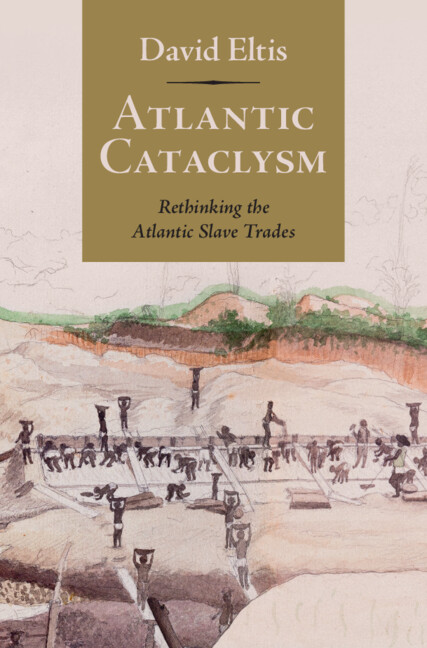
Atlantic Cataclysm: Rethinking the Atlantic Slave Trades
Cambridge: Cambridge University Press, 2025
David Eltis’s Atlantic Cataclysm is an indispensable book for college students and anyone seeking a nuanced, deeply researched, and global understanding of slavery. This masterwork, grounded in decades of archival research and statistical data, obliterates parochial and mythologized versions of the Atlantic slave trade. It compels readers to reassess what they think they know about slavery, particularly the tendency to see it as a uniquely American tragedy. Eltis makes an irrefutable case: slavery is not peculiar to the Americas—it is an ancient, global institution, and the transatlantic trade, while monstrous in scale and cruelty, is but one episode in the long human history of enslavement.
Slavery Beyond the American Narrative
From the opening pages, Eltis urges us to place the Atlantic slave trade within the “rich and extensive annals of inhumane behavior around the globe.” This means understanding that before Europeans turned to enslaving Africans, slavery had already existed for millennia in Africa, Asia, Europe, and the Middle East. Humanity’s oldest surviving work of literature—the Epic of Gilgamesh—contains references to slavery. The Roman Empire, at its peak, trafficked hundreds of thousands of people annually, dwarfing even the worst year of the Atlantic trade in 1829.
Eltis reminds us that even after serfdom faded in Northwestern Europe, the Mediterranean world—and Iberia in particular—remained steeped in slavery. Guanches from the Canary Islands, Slavs, Moors, and Berbers were enslaved in Portugal and Spain before the transatlantic trade shifted its focus to sub-Saharan Africa.
In other words, the moral frameworks, logistical patterns, and cultural justifications for slavery were deeply embedded in human history long before 1619.
The Bush Family, Thomas Walker, and the Hidden Legacies of Enslavement
One of the more haunting revelations in the book is the story of Thomas Walker, a slave trader from Bristol who captained slave ships from 1784 to 1791 before emigrating to the new American republic. Walker is an ancestor of President George W. Bush. His story serves as a symbol of Britain’s deep entanglement in the trade, especially from West Country ports like Bristol. But Eltis takes the analysis a step further by suggesting a provocative inversion: while Walker’s family participated in slavery as traffickers, they might also have had ancestors who were themselves enslaved or trafficked. The West Country was not just home to slave traders—it was also a source of human traffic during earlier centuries of European bondage. In a region marked by economic hardship and a porous border between servitude and slavery, trafficking was multidirectional.
Africa: A Complex and Misunderstood Actor
Eltis masterfully debunks the caricatured view of Africa as a passive victim of European rapacity. He emphasizes that African states and elites played complex roles as sovereign agents in the trade. African rulers operated within political, judicial, and moral frameworks very different from modern sensibilities but entirely consistent with the global norms of their era. African societies had clear eligibility rules for who could be enslaved, often limiting this to outsiders, criminals, or debtors. Europeans could not simply raid African villages at will; as several examples in the book show, slave traders who violated local norms sometimes faced fatal consequences.
When inexperienced captains such as Churchill ignored these rules, local communities retaliated. Churchill’s ship, for instance, was sabotaged, killing all 240 captives on board. African traders saw themselves not as victims but as equal partners. The exchange was frequently violent and fraught with risk for both sides, but it was fundamentally a commercial relationship. Letters between British traders in Liverpool and African elites in Old Calabar show a mutual respect—and a shared interest in profit.
The use of data from the African Origins database further reveals that dominant slave-trading groups, like the Vai or Vili, rarely sold members of their own ethnic communities. In some regions, less than 1% of captives shared the ethnicity of their captors, suggesting that African traders operated within internally coherent rules about who was alienable.
Debunking Myths: No “Depopulation” or Dumping of Inferior Goods
Perhaps one of the most important contributions of Atlantic Cataclysm is the demolition of persistent myths about the trade’s economic impact on Africa. Contrary to the widely held belief that the slave trade led to the wholesale depopulation of the continent or the flooding of African markets with worthless European goods, Eltis presents a more nuanced and evidence-based picture. Population loss occurred, but not to the point of depopulation. Moreover, African societies showed strong preferences for particular European goods and frequently rejected substandard products. Trade terms were often set by African sellers, not European buyers.
Eltis also demonstrates that power imbalances at the point of sale were not as one-sided as many assume. African societies maintained the upper hand in most coastal interactions. The asymmetry of power only truly emerged with colonial occupation in the 19th century, as illustrated in a British naval officer’s account of fining an African king for showing up late to a meeting in 1865—a moment that captures the changing dynamic as European empires transitioned from trade to direct rule.
The Iberian Backbone of Atlantic Slavery
You can buy Greg Johnson’s The Year America Died here.
Eltis challenges the Anglocentric narrative that elevates British, Dutch, and French involvement as the core of Atlantic slavery. In fact, he shows that the Iberians—particularly the Portuguese and Spanish—were the true architects of the Atlantic slave system. Iberians not only pioneered the slave trade but continued to dominate it long after British abolition in 1807. As late as 1640, 80% of slaving voyages originated from Iberia. More significantly, 63.3% of Africans transported to the Americas were taken to Iberian colonies.
Moreover, the Iberians developed deep and durable ties with African societies through intermediaries like lançados and grumetes—mixed-heritage traders embedded in African communities. This integration allowed the Portuguese to sustain the trade with lower costs and greater efficiency than their northern European rivals.
Why Students Should Read This Book
For college students—particularly those studying history, political science, or African and African American studies—Atlantic Cataclysm is essential reading. It expands the horizon of slavery studies beyond the familiar American plantation and encourages a global, comparative, and deeply humanistic approach. The book does not diminish the horrors of the Atlantic slave trade. Rather, it contextualizes them, enabling readers to see both the continuities and ruptures in the human history of forced labor.
Eltis’s work is not merely a chronicle of atrocity—it is a challenge to moral and historical complacency. It asks us to consider why slavery endured for so long, why it changed form, and how it shaped the world we now inhabit.
Conclusion
David Eltis’s Atlantic Cataclysm is a landmark in the scholarship of slavery, empire, and global history. With precision, empathy, and a wealth of evidence, he dismantles parochial myths and insists on a broader, more complicated truth. Slavery was not unique to America. It was a human catastrophe—centuries in the making, globally distributed, and woven into the fabric of modernity itself. That is why this book is not just informative—it is vital. Every college student should read it.
9 comments
This seems like it was written for a different publication, broadly conceived.
Interesting article, LM. I’ll have to check out this book.
Just finished Hugh Thomas’ Rivers of Gold, about the early years of Spain’s New World empire. I returned it to the library just yesterday, otherwise I would type out his paragraph on who founded the African slave trade to the New World. It was one of Charles V’s Flemish courtiers who got the exclusive right to send African slaves to the West Indies. But he immediately sold that right to a Spaniard, who sold it to another Spaniard, who finally decided to do the work, assisted by four (?; damn, I wish I still had the book) ship captains/merchants who formed a kind of syndicate with him. In the most profound and dramatic sentence I’ve seen in a history book, Thomas writes “these are the men who founded the African slave trade to the New World.” At least two of them, Thomas notes, were conversos, Jews who had converted to Christianity to avoid being expelled from Spain.
Somewhat related.
But I’ve been reading up a little bit on the decline of slavery in Medieval England, and it seems like serfdom was in many ways a downgrade for the lower classes. The Marxists often asserted that, and for ages I was skeptical but it seems they might have a point on this front. It was functionally a loss of a major safety net for many of the freed slaves. Having to make your own clothes and being responsible for producing your own food lead to a certain vulnerability. Slavery was also expensive on the part of manor lords, as they were often feeling obliged to provide upkeep for slaves that may or may not be worth the effort. The economic calculation problem made it hard for them to identify whether or not they were wasting effort on feeding and maintaining one extra slave, going by a marginal analysis. Each winter they’d be faced with “What quantity of slaves do I feed and provide for, and how many do I allow to marry and have children?”. Serfdom solved this by having the supply of labour on the manor tied to the private plots, if a serf could feed and provide for himself, then he was economically a benefit. If he couldn’t, the manor was overpopulated and a sort of natural selection would take place, economic factors would force migration to the cities or cause the marginal serf to die off. It saved manors having to do so much manual computation of inputs and outputs.
It also gave a clear signal to who the productive and pro-social people were, and who were the lazy bludgers. The state of their private plots and their own ability to provide for themselves and their family gave manor lords clear signals about their ability and competency. If their private plot was a mess and they were constantly having to ask to borrow grain, then they’d be flagged as undesirable. If they managed their private plot well and weren’t hassling to borrow grain, they’d be flagged as desirable and given more responsibilities.
Slavery was a wildly inefficient system even back then. It’s no wonder that after the Norman conquest, when the French brought over superior institutions, slavery faced a terminal decline. By the time the Domesday book was published in 1086 only 10% of the English were enslaved, and it fell further in the following decades before finally being phased out entirely.
Slavery only consistently makes economic sense in a cash-crop situation, where land is newly discovered, and you can just dump labour at the problem wantonly and turn a profit. As soon as the population grows, institutions become established and there’s proper markets, the economic calculation problem starts to creep in. Even in the 19th century United States you started to see the economic calculation problem aspect, with many people starting to joke about how little many of the black slaves laboured.
But I’ve been reading up a little bit on the decline of slavery in Medieval England, and it seems like serfdom was in many ways a downgrade for the lower classes. The Marxists often asserted that, and for ages I was skeptical but it seems they might have a point on this front.
When it comes to assessing the power relations between the classes, Marxists are often right. Slavery is adopted and abolished depending on the calculations of the upper classes. Morality only serves as justification. The abolishment of serfdom had also shifted new costs upon the lower classes and nobody was going to hurt the landowners by re-distributing their land among the free peasants/farmers. Many nationalists understood that along with the developing middle-class they need support & influence among the most numerous demographic in the emerging Nation- the peasants.
Everybody who has read Jules Verne’s “Un capitaine de quinze ans” knows that African tribal kings co-operated with slave-traders.
Sounds like good reading. Why have we been blessed with the least accomplished and yet most vocal far distant relatives of previous slaves? Why do we continue to bend over backwards to make sure they’re comfortable and rebuild their burned down neighborhoods? Books like this prove we owe them nothing but free passage to africa or hatee. They hate us and should be given a place to call their own in Liberia or Ghana. Anything to make the noise stop.
They deserve nothing but revenge punishments for the centuries of hell, not given two more nations they’ve irreparably fucked up to fuck up even more.
Well they need to go somewhere and those are two places that have invited them to return. It doesn’t amount to us giving them anything. Their absence would be ample reward.
Comments are closed.
If you have a Subscriber access,
simply login first to see your comment auto-approved.
Note on comments privacy & moderation
Your email is never published nor shared.
Comments are moderated. If you don't see your comment, please be patient. If approved, it will appear here soon. Do not post your comment a second time.