 3,959 words
We are all suffering from Nazi fatigue. Donald Trump is celebrating a decade of being “literally Hitler,” and will apparently soon be putting immigrants into camps. In Britain, young schoolchildren are shown timelines linking Mussolini, Hitler, and Nigel Farage, and showing how the first two lead inexorably to the Reform UK leader. The rest of us on the Right are just plain Nazis, although one consolation is that if we are, at least we get to wear cool clothes. Leftists have learned a new word, “Weimar” and they use the phrase “1930s Germany” more often than they call their mothers. Those flinging these accusations around like a mad woman’s excrement know nothing of the actual Nazis, of course. They don’t tend to know much about anything outside the worldview supported by the fragile framework of their own failed personalities. But who were the Nazis and, equally importantly, what or who caused their rise to power?
On their third album, English band The Fall feature a song called Who Makes the Nazis? Singer Mark E. Smith had in mind the punk fascination with Nazi imagery in the late 1970s, but if we tweak Smith’s tenses, it is a perfectly good question; who made the Nazis? Stephen R. C. Hicks PhD, in his 2005 book Nietzsche and the Nazis: A Personal View (Ockham’s Razor Publishing) has a novel theory, and gives a philosophical backdrop to Nazism as well as a historical one. Dr. Hicks considers and dismisses five explanations usually given for the rise of Hitler and the Nazis.
The first two generally accepted causal factors are economic and political. The first is Germany’s aggrievement after the punitive Treaty of Versailles, the second that Germany’s economic problems in the 1920s caused the rise of National Socialism. The author finds both to be weak and insufficient arguments on the basis that other countries go through similar misfortunes, but they don’t elect fascist or national-socialist governments. The next explanation, that “there is something innately wrong with the Germans” he also dismisses as absurd. They wanted to expand their territory for their own ethnically homogeneous people, and they used warfare to do so. I don’t believe that is a historical first. Next, the author discounts the argument that Nazism was caused by the “personal neuroses and psychoses of its leadership.” Again, his point is that neurotics and psychotics are hardly unknown among history’s political leaders, but they don’t all invade Poland. Finally, Dr. Hicks says that any of the above can be combined with the Nazis’ revolutionary new arrival as “masters of rhetoric and propaganda,” and this is how they changed the nature of politics, which allowed them to fool the German people into electing Hitler. But, after his brief debunking, Dr. Hicks has a suggestion of his own:
I want to suggest a better explanation: The primary cause of Nazism lies in philosophy. Not economics, not psychology, and not even politics.
The first quarter of Dr. Hicks’ book is an efficient summation of the Nazis’ rise to power, and thus a useful history for those who have been taught to see “the Nazis” as simply a synonym for evil rather than a historical event. Firstly, he itemizes the central pillars of National Socialist ideology. The Nazis stood for German collectivism against the individual. Economically, Hitler despised both Communism and capitalism. “We are socialists,” Hitler said in a 1927 speech. “We are enemies of today’s economic system for the exploitation of the economically weak.” The Nazi party had actually attempted to merge with the German Socialist Party in 1921. As for the Communists, they were “obsessed and too narrowly focused on money”:
To the Nazis money is only part of the battle… between different racial groups with different biological histories, languages, values, laws, and religions.
Above all, democracy, liberalism, and republicanism must be replaced with “strong authoritarianism and centralized power.”
Hitler and Goebbels were the architects of the idea that in order to revive a crestfallen people, each vital sector of the nation must come under direct and full control of the Reich. As Goebbels put it:
In order to pursue a policy of German culture, it is necessary to gather together the creative artists in all spheres into a unified organization under the leadership of the Reich. The Reich must not only determine the lines of progress, mental and spiritual, but also lead and organize the professions.
The new system worked. After the economic depression of the 1920s, between 1932 and 1936, Germany’s economy took off.
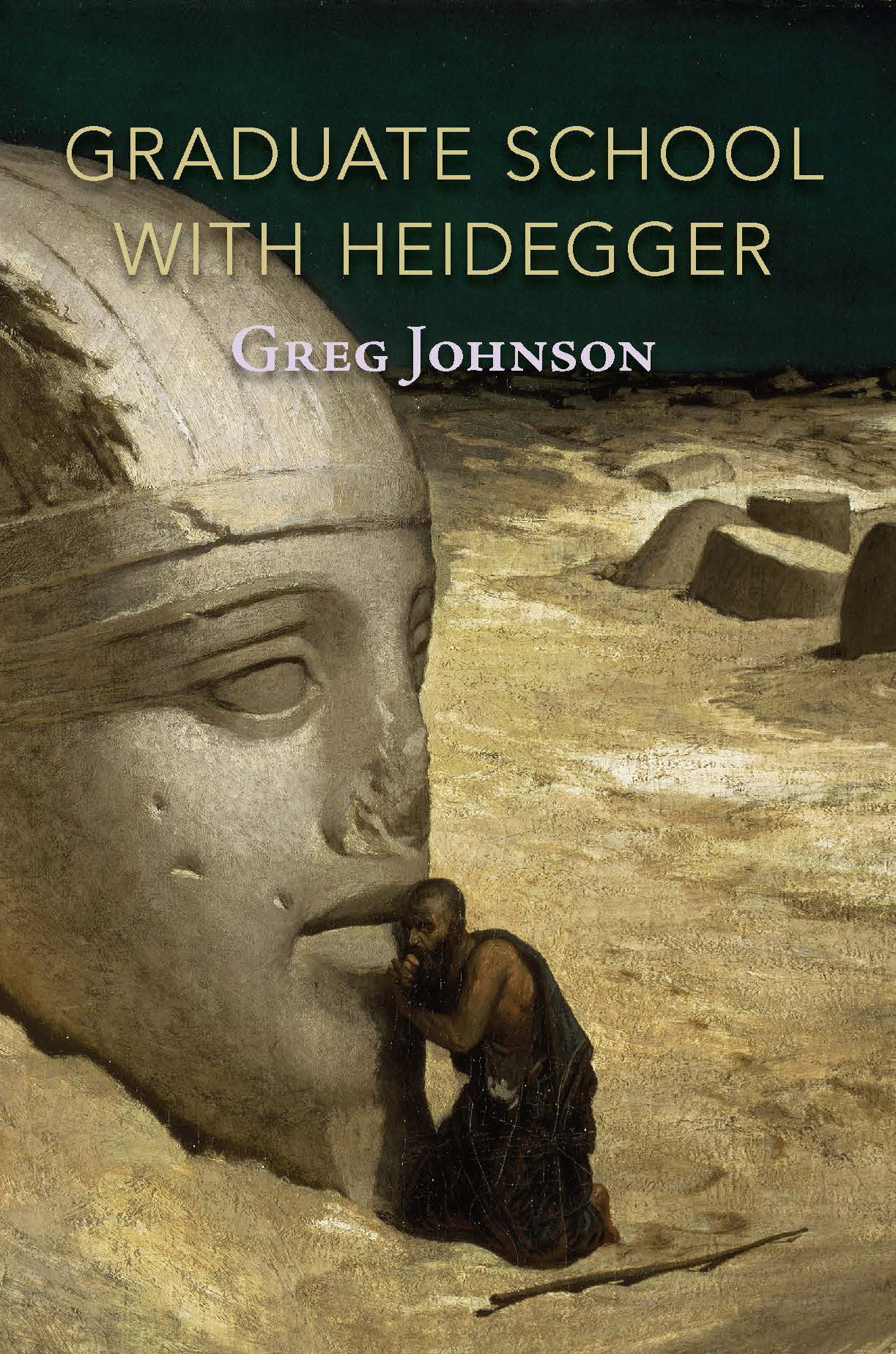
You can buy Greg Johnson’s Graduate School with Heidegger here
But if intellectual tides were indeed complicit in the Nazis’ path to power, who were the guilty men? Certainly, some names can be crossed off the list when we see the names of authors whose books—some 20,000 volumes—were burned on the night of May 10, 1933, a few months after Hitler’s electoral triumph: Thomas Mann, Albert Einstein, Jack London, Helen Keller, H. G. Wells, Sigmund Freud, Émile Zola, and Marcel Proust. Dr. Hicks’ book, however, looks to the first philosophical name (other than that of Martin Heidegger) which is always the first to be mentioned in the context of Nazism. A quarter of the way through the book, incipit Nietzsche.
That Hitler took the Lutheran pastor’s son seriously in the context of Germany is made clear:
In his study, Adolf Hitler had a bust of Friedrich Nietzsche. In 1935, Hitler attended and participated in the funeral of Nietzsche’s sister Elisabeth. In 1938, the Nazis built a monument to Nietzsche. In 1943, Hitler gave a set of Nietzsche’s writings as a gift to fellow dictator Benito Mussolini.
Dr. Hicks does not mention that Elisabeth (her brother’s beloved “llama”, and by then Elisabeth Förster-Nietzsche) made a gift of Nietzsche’s walking-stick to der Führer. Nietzsche claimed that some of his best ideas came while walking, which he did a lot of. He once walked 30 miles to attend a Beethoven concert. One wonders whether Hitler himself might have used the cane while walking, and whether his best ideas—and Hitler had many good ideas which the heavy tarpaulin of the Holocaust has been used to obscure—might have come to him while doing so. This direct, albeit familial, connection with the party and the individual deemed history’s most evil is enough to damn Nietzsche in the eyes of those who would find him too difficult to read. “Hitler,” after all, is synonymous with “Holocaust.” If you asked anyone in the UK which people Hitler had gassed in World War 2, they would unhesitatingly and virtuously reply that it was the Jews. That’s fine as far as it goes, but the Jews were a demi-Holocaust, one half of a larger cull. The Jews’ famed “six million” was not the full tally. At least a further five million people (and in some estimates many more) were also programmatically executed by the Nazis. These included the disabled, the mentally ill, Roma gypsies, POWs, political prisoners, and Freemasons. (The last category seems odd until the depth of Hitler’s hatred of secret societies is understood). The fate of these other unfortunates is not taught in school, because the Jews reserve the monopoly of suffering during World War 2, and indeed throughout history. But where does Nietzsche stand in relation to this carnage?
Nietzsche is one of the best-known philosophers for the Dissident Right, or at least that part of it which actually reads philosophy, and so his life-story is superfluous here. There were philosophers in the 1930s who were directly connected with and—at least initially—fully supportive of Hitler and Nazism. Oswald Spengler endorsed the new regime, and Heidegger effectively worked directly for Hitler for a short time, but Nietzsche’s influence was obviously posthumous. Hitler was eleven years old when Nietzsche died, having been born in 1889, just three months after the philosopher’s mental breakdown in Turin.
That Nietzsche was also familiar to the inner sanctum of Hitler’s cabinet is not in doubt:
We know that Adolf Hitler, Joseph Goebbels, and most of the major intellectuals of National Socialism were admirers of Nietzsche’s philosophy. They read him avidly during their formative years, recommended him to their peers, and incorporated themes and sayings from Nietzsche into their own writings, speeches, and policies.
Goebbels’ semi-autobiographical novel, Michael, ends with the discovery of three books in the dead protagonist’s knapsack, one of which is Thus Spake Zarathustra.
So, the Nazi elite certainly read Nietzsche. But did they understand him? “Understanding Nietzsche” is, of course, not like understanding David Hume or Bertrand Russell. Nietzsche is notoriously ambiguous, his work riddled with contradictions, blind alleys, non-sequiturs, stylistic flights, and aphorisms which have no context and fit no system. Nietzsche was absolutely not a systematizer, although it is possible to assemble a conceptual framework in which to contain his thought: The eternal return of the same, the will to power, the Übermensch, slave morality, the death of God and others. Did the Nazis misinterpret Nietzsche, then, twisting whatever meaning is to be found into something polemic for their own uses? If so, what did they take from the philosopher who had a far wider influence than Heidegger in the 20th-century, despite the latter often being referred to as that period’s greatest philosopher.
Dr. Hicks begins his assessment of Nietzsche and the Reich with the idea of the “blond beast.” In Nietzsche’s late work, The Genealogy of Morals, he seems to be using this trope to call directly to the future German Reich:
[What is required in Europe is] some pack of blond beasts of prey, a conqueror and master race which, organized for war and with the ability to organize, unhesitatingly lays its terrible claws upon a populace.
Nietzsche, the author writes, is referring to the lion rather than the Germans, but still makes the claim that the Nazis found this extended simile “an endorsement by Nietzsche of the German Aryan type.” It is amusing to note that a recent video has caused a tea-cup storm across the busy playground of social media. It’s the one in which various Democrats are depicted by AI as animals, and the Obamas are portrayed as monkeys. When Trump arrives—something of a blond beast himself—he is a lion.
Across his work, Nietzsche is actually far from complimentary with his fellow Germans. This is not to say that he was unpatriotic, far from it. His father was an extreme patriot, and Nietzsche worshipped the sire taken from him so early in his life, which leads many commentators inevitably to use this fact to explain Nietzsche’s insistence that “God is dead,” as though every philosopher has to pass into critical acceptance via Freud’s couch. Nietzsche himself formed a “secret society” with university friends and called it Germania. But he still found the Germans “full of beer and sausage” with none of the cultural lightness of his beloved Italy. Again, from the Genealogy, he finds the Germans of the late 19th-century to be a sorry shade of what his fellow countrymen once were:
[B]etween the old Germanic tribes and us Germans there exists hardly a conceptual relationship, let alone one of blood.
Ultimately, of course, as with any discussion of the Nazis, there is the hot-button issue of anti-Semitism. Hitler and Goebbels had a hill to climb with this one, given the Nietzsche of Beyond Good and Evil wrote of “the anti-Jewish stupidity” of the Germans. From the same book:
The Jews, however, are beyond any doubt the strongest, toughest, and purest race now living in Europe.
In his great anti-Christian polemic, The Antichrist, Nietzsche is even more fulsome in his praise of the Twelve Tribes:
Psychologically considered, the Jewish people are a people endowed with the toughest vital energy, who, placed in impossible circumstances… divined a power in these instincts with which one could prevail against the world.
This is hardly The Protocols of the Elders of Zion. In The Gay Science, Nietzsche is extravagant in his praise of Jewry at the expense of his fellow Germans:
Europe owes the Jews no small thanks for making its people more logical, for cleaner intellectual habits—none more so than the Germans, as a lamentably deraisonnable race that even today needs to be given a good mental drubbing.
This apparent defense of the Jews sits at odds with Nietzsche’s accusations that they were “responsible for subverting human greatness” by “devising the slave morality and foisting it on the world.” Ultimately, however, Nietzsche admired one aspect of Jewish protectionism, “that the Jews have hit upon a survival strategy and kept their cultural identity for well over two thousand years.”
Nietzsche locates history’s key tension as that between Judaea and Rome, and although he often conflates the two (we still hear about “Judeo-Christian values” even today, despite the vast difference between the Talmud and the Bible), the Nazis were absolutely clear concerning the division:
Early in the Nazi Party’s history, in its founding document, the 1920 Program, point 24 states the following: “The party, as such, stands for positive Christianity, without, however, allying itself to any particular denomination. It combats the Jewish-materialistic spirit.”
Perhaps the clumsiest mis-association made between Nietzsche and Hitler is the latter’s adoption of the idea of the “superman.” Übermensch does not mean “superman” in the sense this idea exists in the modern consciousness with capes and avoiding Kryptonite, but “overman.” The one whose coming is presaged by Zarathustra is the next philosophical stage of mankind, not some blond Aryan body-builder flexing his Teutonic muscles. The Nazis’ eugenics program, comprehensive and ruthlessly dedicated to the Fatherland, certainly aimed at producing new generations of Germans who were physically and mentally superior to their forebears. The Nazis prioritized physical well-being over mental training, and Nietzsche often ridiculed this physicality.
There are five main differences, writes Dr. Hicks, between Nietzsche’s beliefs and that of the Nazis. The first is that, while the Nazis believed the Aryan German to be racially superior, Nietzsche held that superior types “can be manifested in any racial type.” Secondly, Hitler’s regime believed German culture to be obviously superior to that of the rest of Europe, while Nietzsche found it to be “degenerate and to be infecting the rest of the world.” Next, while the Nazis “are enthusiastically anti-Semitic… Nietzsche sees anti-Semitism to be a moral sickness.” The fourth point is an adjunct to this, as noted, in that Nietzsche praises the Jews for their generational toughness and native intelligence. Finally, the Nazis sharply divide Judaism and Christianity where Nietzsche conflates the two.
What does unite Nietzsche and the Nazis is their mutual understanding of democracy and authoritarianism. Dr. Hicks sounds the alarm concerning democracy and its intellectual reception in Nazi Germany early on in the book:
What if culture’s brightest thinkers believe that democracy is a historical blip?
Let us hope it is. You can always tell when a political principle is useless and even dangerous to the ordinary man and expedient to the political class when the latter can’t stop calling its name. That Trump, or Farage, or anyone to the right of Castro are a “threat to democracy” is something we are used to hearing, but given the current state of the West, it seems far more likely that democracy is a threat to us. Firstly, what is the point of the people having power (Demos; the people, Kratos; Power) when the people are so politically illiterate? One of the best things to come out of the current farce playing out in the UK is that more ordinary citizens are beginning to see how the sausages are made. We learned Government and Politics at college, whereas teenagers are more likely to be taught about the slave trade or trans rights in today’s centers of learning.
As for authoritarianism, and given that the Nazis revolved around a cult of personality, that does tend to come with the territory. Nietzsche favored an intellectual aristocracy as an instantiation of a natural order which Christianity attempts to deny and expunge. And there is no ideal form of authoritarianism, which links Nietzsche’s concept of the Übermensch with the aristocratic class Nietzsche believed should rule Europe:
Nietzsche is not programmatic about what for the new aristocratic class will take or what specific goals it will pursue. He believes that will be up to the overmen themselves—they will create their own values and shape the vehicles of their realization.
Put simply, these future men will rely on their instincts—the Trieben, the primal drives—and use initiative, something anathema to the modern Left.
Dr. Hicks rounds off this short but valuable book with a summary of the five main similarities he has isolated from a not inconsiderable conceptual tangle. While the Nazis were obviously collectivistic, and Nietzsche is usually deemed to be strongly individualistic, it may be a surprise to see collectivism on the list. Dr. Hicks, however, finds Nietzsche’s endorsement of individualism to be quirky rather than doctrinal. The second similarity is one which the Left would pounce upon, should they ever read Nietzsche. Traditionally, Nietzsche is implicitly bracketed with the political Right but, as Allan Bloom points out in his seminal book, The Closing of the American Mind, the German’s influence was equally attractive to the Left. And if there is one thing the Left is against (except, apparently, at street-level), it’s warfare. Not to see the obvious necessity of war, even now, is to display a woeful ignorance both of history and of the human, all-too-human:
Both Nietzsche and the Nazis see zero-sum conflict as inescapable and as fundamental to the human condition.
War, as the song says, what is it good for? Well, the preservation of the race, for a start.
The next point of overlap is what Dr. Hicks’ calls the “irrationality” of both the Nazis and Nietzsche. This I would dispute, as it assumes that instincts and reason are two separate functions, whereas they are certainly interconnected in a way that both Nietzsche and Freud investigated. Anyone calling the Holocaust “irrational” would be making a serious mistake of category. It was hyper-rational, mechanization (with which the Jews are often charged with using to dominate) brought to its ultimate destiny in a post-theological world; the taking of life. That said, reason did not act alone with the chambers. Instinct was always an eager accomplice. The Holocaust was a mix of managerialism, technology, and Thanatos, the death-drive. The necessity of war is revisited as the next similarity between philosopher and Reich, and warfare takes on an almost aesthetic quality, with both seeing war as “necessary, healthy, and even majestic.” Finally, the shared anti-democratic, anti-capitalistic, anti-liberal approach to political constitution is noted.

You can buy Savitri Devi’s book, Gold in the Furnace, here.
The appendices to Dr. Hicks’ book contain the Program of the National Socialist German Workers Party, the Nazi constitution and founding document. This is full of sensible political proposals and worth reading in its own right. Finally, a compendium of quotes, both by leading Nazis and other commentators speaking about Nazism, gives a good closing snapshot both of the intellectual atmosphere which caused the Nazis, and that which they themselves brought into being. There are some amusing quotes which show the rooted antipathy that many Leftists have to the idea that Hitler was a socialist. It is reminiscent of taunting vegetarians with the fact that Adolf was one of those as well. Ian Kershaw, author of the excellent two-volume biography of Hitler, claims simply that “Hitler was never a socialist.” This despite Hitler informing the world on countless occasions that was precisely what he was. This is reminiscent of the politicians who told us that Islam was “a religion of peace” despite mullahs and imams across the Arabic world telling us plainly that it is nothing of the sort. Bertrand Russell’s observation also brings a wry smile; “Hitler is an outcome of Rousseau.”
The fact that Hitler was an avowed socialist, and the economic and social programs of the Nazis were fundamentally socialist, is often used to ridicule today’s Left. But Hitler hardly got his socialism from Nietzsche, who believed that “both religion and socialism… glorify weakness and need.” Weakness, decline, decadence, and humility are all dangerous to the continuance of a strong species. The resultant “slave morality” is another central pillar of Nietzsche’s view of the human race:
Nietzsche believes that the slave-morality of the Judeo-Christian tradition is a two-fold strategy: (1) It is a survival code that enables the weak to band together for survival; and (2) it is as revenge and a power play in their battle against the strong.
Despite the death of Christianity in the West (it is at the very least in a hospice), where the untermensch are waging war against any sign of white identitarian interest, the modern socialist—exemplified by the white Western liberal woman—is weak in precisely the same way. The low-IQ Muslims being force-fed into Europe, on the other hand, are not weak in the same sense, and Dr. Hicks does not mention a key line from The Antichrist; “Islam at least assumes it is dealing with men.” The Nazis and the Muslim world maintained links throughout Weimar and the war. Finally, however, the Nazis are simply a byword for the event we are told was history’s most despicable, a word that comes from the Ancient Greek for a ritual consummation of flesh by fire; the Holocaust.
The problem with the Holocaust is not one of evil—Nietzsche suggesting moving beyond both that and “good”—it is one of Jewish expediency. It is not merely necessary, whenever mentioning this event, to describe one’s abhorrence and disgust in hyperbolic terms, it is necessary to believe that it is the only such event in human history. Forget the “other Holocaust” mentioned. Forget the Holodomor, the Ukrainian famine. Forget Mao. Forget Pol Pot. It’s Jews all the way down. The Holocaust was a legitimate attempt to rid Germany of what the Nazis saw as a malevolent presence, the same as those other dictators who massively outscored Hitler in their bloodlust. In and of itself, reaction to the Holocaust very much depends on your stance. Subtract morality from the equation, that won’t get you anywhere. No one except the commissars is interested in what your or my moral response to anything is, let alone history. Had Hitler sent over 11 million Muslims to the gas, for example, some of us would have his portrait on the wall today. That would never have happened, of course. Muslims were great supporters of Hitler for obvious reasons. Dr. Hicks notes that, in the year his book came out, Mein Kampf was a best-seller in Turkey. It would be interesting to see today’s sales figures across the Arab world.
Nietzsche and the Nazis is a short book, and so cannot be expected to be comprehensive, but Dr. Hicks neglects to mention that Goebbels produced a small book of Nietzschean sayings to be issued to front-line troops. One can assume that the passages praising the Jews and ridiculing the Germans did not make the editorial cut. But the connection between this most enigmatic yet dazzling of philosophers and a somewhat failed experiment in aggravated civic nationalism is worth investigation. Philosophy is certainly a perfectly valid area of enquiry when considering the revolution in German politics represented by the Nazis. Look at other revolutions, writes Dr. Hicks. The Communist revolutions in Russia and China lead inexorably back to Marx, the French revolution harks back to Rousseau, and one of the founding fathers of the American revolution was clearly Locke.
Dr. Hicks convincingly analyzes the conceptual chain which links Nietzsche and the Nationalsozialistische Deutsche Arbeiterpartei, or National Socialist German Workers’ Party, or Nazis. Nietzsche wished his words both to live on after him (“I will be born posthumously”) and that they be dynamite. Perhaps he got his wish.
1 comment
Thanks for this excellent review.
Comments are closed.
If you have a Subscriber access,
simply login first to see your comment auto-approved.
Note on comments privacy & moderation
Your email is never published nor shared.
Comments are moderated. If you don't see your comment, please be patient. If approved, it will appear here soon. Do not post your comment a second time.