2,017 words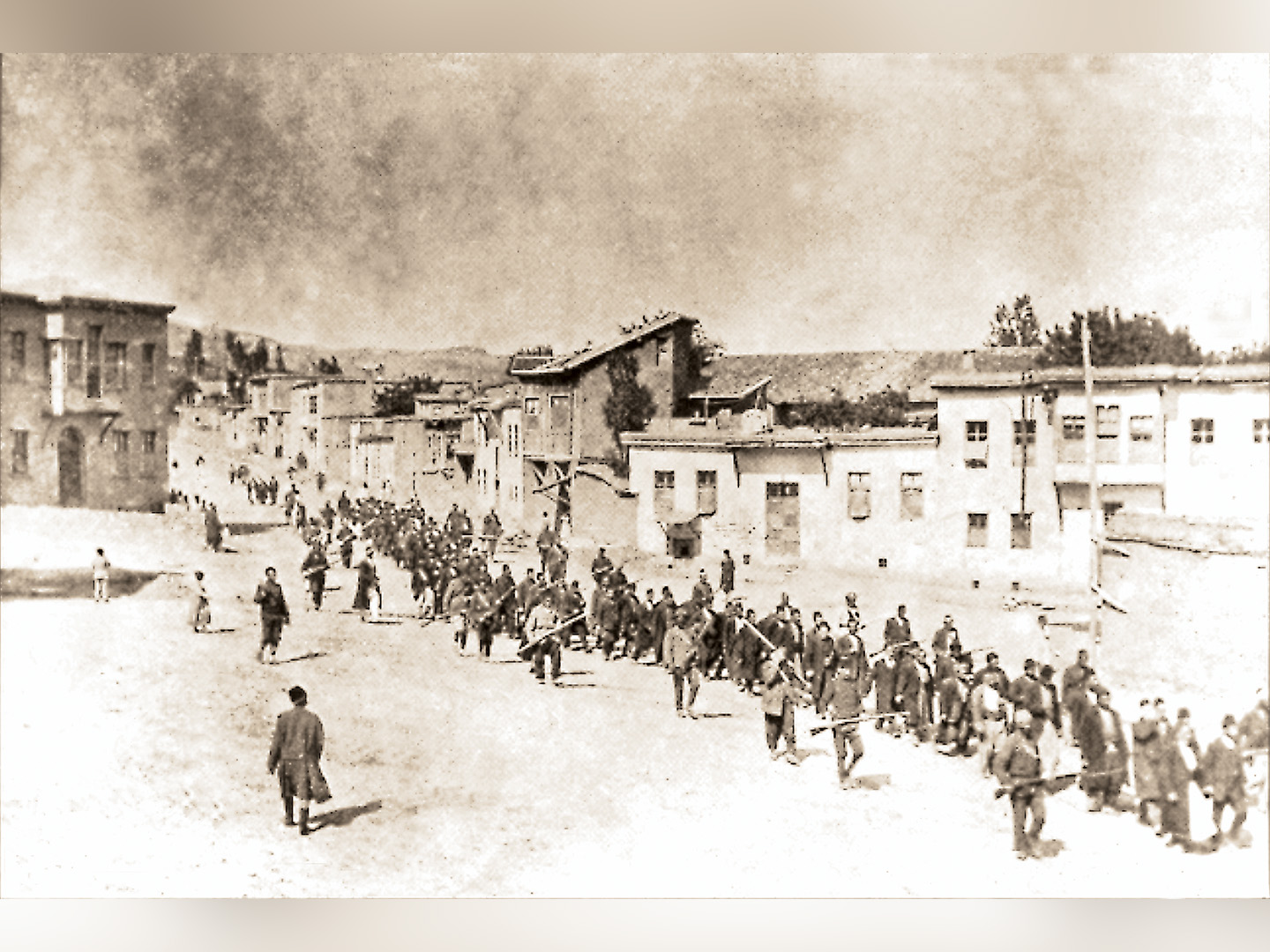
As would be expected, Ronald Suny ends They Can Live in the Desert but Nowhere Else, his comprehensive history of the Armenian Genocide, by placing the genocide within its historical context and comparing it to other genocides of the 20th century, primarily the Jewish Holocaust. Suny makes pains to differentiate genocide, i.e., the intentional elimination of an entire people, from ethnic cleansing, which prioritizes displacement and deportation. He admits that these two phenomena often overlap, and certainly did during the Armenian Genocide, but are distinct enough for separate analysis. Suny also differentiates between genocide per se and other forms of mass killings, which can be just as enormous in scale but lack the lethal intent set aside for genocide. For this reason he excludes the Soviet dekulakization, Stalin’s purges of the 1930s, and the terror famines of the Holodomor, while admitting that these were every bit as reprehensible as the Armenian Genocide.
This said, I was surprised to discover how little Suny dwelled on the Jewish Holocaust. It’s as if he set out to mention it as little as possible. Of course, he never casts doubt on the official Jewish Holocaust narrative, but he doesn’t pay undue obeisance to it either. This was indeed refreshing, especially compared to the only other book on the Armenian Genocide I have read, The Armenian Genocide in Perspective (published in 1986 and edited by Richard Hovannisian) which mentions the Jewish Holocaust quite often. Most of Suny’s references to the Jewish Holocaust or to Nazi Germany, on the other hand, are fairly oblique, such as his treatment of Max von Scheubner-Richter, the Russian émigré who had helped found the Nazi Party in the early 1920s and died in Hitler’s arms during the Beer Hall Putsch. Suny calls his career “extraordinary and contradictory,” given that the man saw the Turks’ intentions with razor sharp clarity and denounced them as the genocide was happening—and yet still became a Nazi. This was also extraordinary since the Germans during the war desperately needed the Turks to hold down hundreds of thousands of Allied soldiers, and so said and did as little as possible with regard to the massacres, as much as they may have deplored them. The Germans had their own existential dilemmas to worry about at the Somme and Verdun.
Still, however, there are parallels between the Armenian Genocide and the Jewish Holocaust which I would like to use Suny’s research to explore. On a superficial level, they do mirror each other. An ethnic minority diaspora existed inside a great nation where stark differences in intelligence, temperament, and religion caused a good deal of strife between the populations. In both instances there were sudden shifts in population, economic hardships, and anti-liberal, authoritarian regimes still smarting from a humiliating military defeat. Also in both instances the minorities were excluded from mainstream life because they posed some kind of threat to the identity of the greater nation. Finally, in both cases the majority accused the minority of using foreign powers to act on their behalf and interfere with the nation’s governance.
Of course, these parallels are not perfect, and they become less so with closer analysis. Yes, both the Armenians and the German Jews were able to economically dominate their host populations. But only in Germany do we find degeneracy and cultural hostility on the part of the minority, as expressed during the Weimar period. Nowhere in They Can Live in the Desert do we find the Armenians behaving this badly. Yes, thanks to Tanzimat reforms, urban Armenians grew wealthy and incurred the bitter envy of the Turkish masses as a result, but they weren’t attempting to undermine the Turkish people through miscegenation and sexual perversion. They weren’t trying to usurp the state media and education with anti-Turk messaging. And they certainly weren’t communists. If they had been or done any of these things, Talat Bey would have told Henry Morgenthau all about it in their many conversations justifying his ghastly actions. But he never did, presumably because the Ottoman Armenians were more interested in selling olive oil and bulgur wheat than tickets to gender-bending cabaret acts in Istanbul.
Pulling back a bit further, I found almost no mention of exploitation on the level of what appears in John Klier’s 2006 Russians, Jews, and the Pogroms of 1881-1882. So comparisons to anti-Semitism in Russia are inapt as well. Klier claims that all contemporaneous Russian sources pointed to Jewish exploitation of the Russian peasant as a reason for the pogroms. This usually entailed usury and the liquor trade. The stereotype of unscrupulous Jews taking advantage of simpleminded peasants in this manner has basis in fact and is something that, according to Albert Lindemann in his 1997 work Esau’s Tears, anti-Semites as well as many Jews themselves complained about in the 19th and early 20th centuries. Nowhere in They Can Live in the Desert are the Ottoman Armenians depicted as having such tangibly negative impacts in such a malicious manner upon their non-Armenian neighbors. The only exploitation Suny mentions is in the minds of the temperamental Turks themselves.
As for the charge of conspiring with hostile external nations, both minorities are guilty as charged. Edwin Black in his 1983 work The Transfer Agreement and Benjamin Ginsburg in his 1997 work How the Jews Defeated Hitler (Jewish authors, both) triumphantly describe how organized international Jewish groups attempted to smother the Nazi regime in its cradle throughout the 1930s with boycotts and smear campaigns. Before the war, when the Nazis pointed to the Jews as one of their greatest enemies, they were correct. The difference here, however, is that while the Nazis may have imprisoned tens of thousands of left-wing communist agitators throughout the 1930s—many of whom certainly were Jewish—the Turks either slaughtered or condoned the slaughter of hundreds of thousands of Armenians over the course of decades before the First World War. For an additional detail, between 1890 and 1910 there were approximately 7,000 instances of illegal seizures of Armenian lands in the Ottoman Empire. One cannot blame the Armenians for looking to Europe for relief.
And were the Europeans seeking to destroy the Ottoman Empire? Not at all. They just wanted to install inspectors to monitor how the Turks handled the Armenian Question. Maybe they would withhold future investments or jack up interest rates if the Turks lost control of themselves again. International Jewry, on the other hand, was not nearly so nice to Germany. It’s an open question if the Nazis would have treated Jews better before and during the war if powerful Jewish moguls such as Stephen Wise and Samuel Untermyer and their well-funded organizations hadn’t been so hellbent on destroying them the moment Hitler became Chancellor in 1933.
One final comparison deals with the true danger posed by the minorities in both cases. Suny explains that, yes, Armenian disloyalty was a problem, and yes, Armenian terrorism did happen during the lead up to the First World War. It’s just that both transgressions were quite negligible and that the Young Turks knew this. They went after the Armenians anyway for reasons that were more psychological than pragmatic. For example, after the outbreak of the First World War, the Young Turks asked numerous Armenian leaders if they would allow Ottoman Armenians to infiltrate Russia and stir up an Armenian insurrection against the Tsarist authorities. Such subterfuge would greatly help the war effort. Despite proclaiming their loyalty to the Empire, all of the Armenian leaders refused. Their ethnic solidarity naturally crossed political boundaries, which, in the jaundiced eyes of the Young Turks, was a sign of treachery deserving of genocide.
Nazi Germany however had found a much more formidable enemy in the Jews, and had much better reason to suspect that any Jew captured or encountered during the war could likely become a deadly enemy as a Soviet agent or partisan fighter. After losing the First World War and watching hundreds of thousands of their children starve to death thanks to the Allied naval blockade, they weren’t willing to take too many chances the second time around. Furthermore, it wasn’t as if the Jews back then didn’t have an abattoir of blood on their hands already. As I wrote in my review of Marion Kaplan’s Between Dignity and Despair, her account of Jewish life in Nazi Germany:
[Kaplan] expects us hold a pity party for German Jews who must “pass” for German, or be forced to listen to speeches by Hitler and Goebbels, or deal with children throwing stones, or resign themselves to careers as seamstresses and nannies instead of pediatricians and scientists—meanwhile in the Soviet Union, the Jew Lazar Kaganovich was deporting over a quarter million Cossacks to Sibera, and the Jew Naftaly Frenkel was ensuring the deaths of 200,000 souls during the construction of the Belomar Canal, and the Jew Matvei Berman was overseeing the slave labor of political prisoners in his vast gulag system, and the Jew Genrikh Yagoda as chief of the NKVD was ordering the deaths of millions during the Great Terror, and the Jew Filipp Goloshchyokin was collectivizing Kazakhstan and causing a famine responsible for the deaths of over a million people.
Recently, the Occidental Observer published an account of how a gang of bloodthirsty Jews oversaw the murder of approximately 50,000 people in Crimea in 1920. The article goes on to demonstrate how dominated by Jews the early Bolsheviks truly were and how crucial Jews were to the establishment of the Soviet Union. The Germans were perfectly justified in the 1930s to worry that what had happened to Russia could indeed happen to them. And in fact it did, briefly, when communist Jews led by Kurt Eisner took over Bavaria and made it into a Soviet republic in 1919.
I understand there is controversy surrounding the scope of the Jewish Holocaust. But even taking the mainstream narrative at its word does not overcome the fact that there really isn’t much comparison between these two genocides. Both were catastrophic, of course, and their victims deserve the utmost human sympathy, but the concerns of the Nazis had a much sounder basis in truth than those of the Turks. And, based on my reading of Suny, the Armenians were far more innocent than the Jews.
At the most elemental level, They Can Live in the Desert but Nowhere Else serves as a cautionary tale against mixing empire and ethnocentrism. You cannot have both without oppression. And when you try, you will inevitably incur the enmity of other groups both from within your empire and from without. Had the Turks known this, perhaps they could have avoided one of the most tragic and regrettable chapters in history and still achieved the stable ethnostate they enjoy today.
With his typical clarity, Ronald Suny outlines the four options which were open to the Young Turks in 1908:
The first was reform as desired by the European Great Powers and the Armenians, which would fulfill the original constitutional agenda of an Ottomanist state. The Ottoman state might have moved from the imperial paradigm of discrimination and legal inequities to a multinational state with a single, civil, multinational nation of Ottoman citizens. A second was to transform the state into an Islamic empire, allying Turks with Kurds and Arabs, subordinating the non-Muslims. A third, and the one desired by many Young Turks, was to remain an empire dominated by Turks, again subordinating the non-Turks, and perhaps expanding eastward to integrate other Turkic peoples into a Turanian empire. The fourth solution, like the first, would be to cease to be an empire altogether but to become an ethnonational state of the Turks, to expel or assimilate non-Turks. The Kemalists made this choice after the defeat in World War I with the formation of the Turkish Republic.
Which is to say that millions died for nothing. Or, more accurately, they died because the Turkish elite in their arrogance wanted both empire and ethnocentrism, and in the end got neither. They did not understand two core principles of human nature—that race trumps all, and that all self-identifying peoples willing to work and defend themselves deserve a place of their own under the sun.
6 comments
A fine conclusion to the series.
Thank you, Adam. Much appreciated.
Dreadful history. The Armenians I’ve met have been decent enough. I wonder how they still feel about the turks, islam, and this tragic chapter.
In Russia many TV and media propagandists are Armenians. They are very imperialistic. But the Armenians in Armenia itself dislike them much. In the Soviet Union Armenia was very nationalistic and almost fully homogenical “republic”.
I have to wonder if throughout all that, there was anything the Armenians could’ve done to keep the situation from developing the way it did and avoid the catastrophe. Surely realizing that they were being set up for the chopping block would’ve been a good first step?
A mass conversion to Islam by around 1880 would have been a start. And even that might not have been enough. The Armenians were safe only when the Ottoman Empire was strong.
Comments are closed.
If you have a Subscriber access,
simply login first to see your comment auto-approved.
Note on comments privacy & moderation
Your email is never published nor shared.
Comments are moderated. If you don't see your comment, please be patient. If approved, it will appear here soon. Do not post your comment a second time.