2,828 words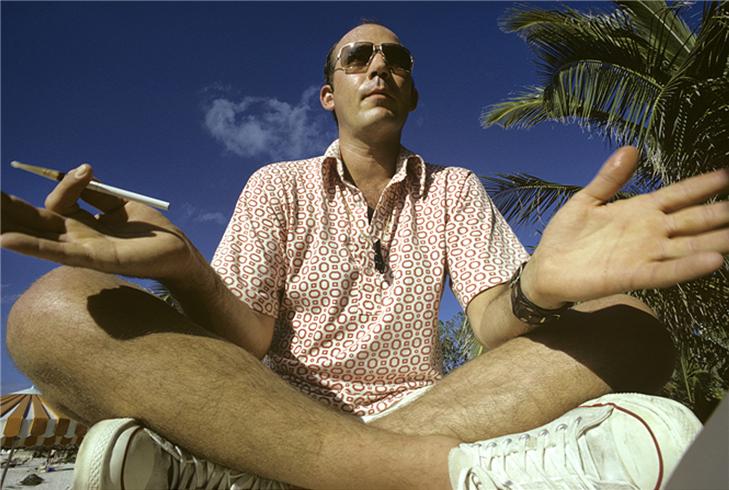
And they’ve all gone to look for America.
Simon & Garfunkel
***
Those of us who are not American but have an interest in the state of Western culture have of necessity spent a great deal of time trying to understand Americans.
Not America. We’ll take it at its word that it is a proposition nation, and propositions are not difficult to understand. To gauge Americans themselves, we must turn to the American writer. More specifically, the American journalist.
America has produced the finest journalism in the Anglophone world. Its masters – and mistresses, such as Dorothy Parker (some readers may be triggered by her Judophilia, but she was a very fine writer) – approached the journalistic art precisely as though it is, or should be, an art, and two of the greatest proponents of that art were Hunter S. Thompson and Tom Wolfe.
Thompson is remembered as the father of “Gonzo journalism”, which combined cynicism, political acumen, intoxication, and unique humor. Wolfe was a much more urbane writer whose acidic wit enabled him to present Americans – and American types – as though they were anatomical dissections splayed out on a slab in a biology laboratory. Wolfe deals mercilessly with the American bourgeoisie. Two of these writers’ lesser-known books serve as an introduction to their respective mastery of their profession: Hunter S. Thompson’s 1966 book, Hell’s Angels: A Strange and Terrible Saga, and Tom Wolfe’s short 1980 collection, In Our Time, superbly illustrated with the author’s cartoons.
Wolfe is among the best satirists of the 20th century. He did for journalism what Tom Lehrer did for song lyrics. His best observations are as brief and acute as Defoe or Dickens, and delivered with the insouciance of a Wilde or a Coward. Here, he is considering the increasing relaxation of marijuana laws in the USA, and the likely causes. He is listening to a group of the well-heeled burghers of New York lamenting the antics of their offspring, and notes a common theme to their tales of woe:
Somehow I knew at that moment it was only a matter of time before the smoking of marijuana was legalized in the United States, and it had nothing to do with medical facts, juridical reasoning, or the Epicurean philosophies of the weed’s proponents. It had to do solely with the fact that people of wealth and influence were getting tired of having to extract their children from the legal machinery.
Wolfe read his own culture like it was a glossy magazine published by a literary salon with a philosophical bent. He seems to capture entire cultural moments on which essays could be written as though it were the text for a tattoo. Nietzsche writes somewhere about trying to say in a few sentences what everyone else says in a book. What everyone else does not say in a book, the German adds. Wolfe achieves both. Casting his gimlet eye over Nixon’s downfall, Wolfe focuses on the aftermath, not in the political arena, but that of publishing, and the rush of books on that most famous of Gates (bar Bill): “The Watergate book was one of the decade’s new glamour industries.”
Wolfe has the same knack of placing his country’s (then) recent economic history into the most compact of nutshells: “America’s extraordinary boom began in the early 1940s, but it was not until the 1960s that the new masses began to regard it as a permanent condition.”
And philosophically, Wolfe is no slouch. One of the knottiest problems in Nietzsche’s canon is the transvaluation of all values. It was to have been his life’s work but for the fact that, rather inconveniently, insanity effectively ended Nietzsche’s life in 1889, when he went mad in Turin. (Now, English football supporters take care of that sort of thing). But Wolfe feeds the imagination with an aside concerning the German:
We are in that curious interlude of the twentieth century that Nietzsche foretold in the 1880s: the time of the reevaluation, the devising of new values to replace the osteoporotic skeletons of the old. God is dead, and forty new gods live, prancing like mummers.
Wolfe’s illustrations to In Our Time are breathtakingly good – I had no idea he was such an artistic talent – and if you are a fan of political and metapolitical cartoons, you should see this for the drawings alone. It has a distinct feel of Hablot Knight Browne (known as “Phiz”), who illustrated the novels of Charles Dickens.
As for Hunter S. Thompson, the great Gonzo hacked his way up the regular journo tree, as it was in the States at the time. This was actually a period of a very free press in the States, the Oz trials notwithstanding. So it was that real journalists, the ones who had balls rather than merely attending them, got to do some real journalism. Hunter S. Thompson decided to become what war journalists call “embedded”. It’s where you go behind enemy lines, get the story, and hope you get back okay. Thompson hung out with the Hell’s Angels for a year, and wrote about it. And that, ladies and gentlemen, is journalism. Thompson introduces the new barbarians: “The concept of the ‘motorcycle outlaw’ was as uniquely American as jazz. Nothing like them had ever existed.”
Thompson shows the Hell’s Angels as they were, a rampaging gang of sociopathic maniacs who rode into towns on powerful motorbikes and proceeded to a drink and drug-fueled Bacchanalia, cracking heads, stealing women, and generally acting like the biggest gang of yahoos in America. Physically disgusting, psychologically sociopathic if not psychopathic, violent and ruthless, these were the classical Furies on choppers, stripped-down Harley D. hogs. Even given that the threat of the Angels was exaggerated by newspapers looking for sensationalist copy, fear is real whether its object exists or not. The townsfolk of anywhere in America whose home had been chosen as the target of a “run” must have felt much as the population of some hamlet on the Germanic border of the fading Roman Empire felt when a runner arrived to tell of the approach of a bunch of Visigoths who did not appear in the sunniest of moods.
A point Thompson draws out is the role of the media, not in actually creating the Hell’s Angels, but in amplifying their presence. After Time ran a big, sensationalist splash on the bikers in 1965, awareness of the gangs was magnified in proportion to the popularity and distribution of the famous magazine:
The significant thing about Time’s view of the Angels was not its crabwise approach to reality, but its impact. At the beginning of March 1965 the Hell’s Angels were virtually nonexistent… If the ‘Hell’s Angels Saga’ proved any one thing, it was the awesome power of the New York press establishment. The Hell’s Angels as they exist today were virtually created by Time, Newsweek and The New York Times.
We think of the “far right” in Britain and Europe today, and the boogeyman of “white supremacy” in the Biden-era US, and we hope, perhaps, that the power of the media may have the same effect of a self-fulfilling prophecy. The effect on the Angels of this sudden press saturation was, naturally and in the most traditionally American way, to try and make a buck out of it. When TV companies came sniffing around, the Angels offered, for $100 apiece, to terrorize any town the TV people selected. What a strange power to have, as a TV producer. Eeny, Meeny, Miney, Mo… Ooh, that’s where my ex-wife lives. Some of the Angels, Thompson notes, ended up with press agents.
Thompson’s respect for the Angels is as a social phenomenon, and certainly not as individuals, once away from their bikes:
A Hell’s Angel on foot can look pretty foolish. Their sloppy histrionics and inane conversations can be interesting for a few hours, but beyond the initial strangeness, their everyday scene is as tedious and depressing as a costume ball for demented children.
One Angel for whom Thompson had a stated respect, however, was Sonny Barger, leader of the Oakland Angels. He would go on to become famous in 1969 in the aftermath of the ill-fated Altamont Speedway free concert given by The Rolling Stones, the real end of the sixties in the States, the revenge of the British, perhaps, for the impertinence of the Boston Tea Party… Thompson has a quiet respect for this relatively quiet generalissimo, who had an idea of his own about the political attitudes of the Angels: “Actually we’re conformists. To be an Angel, you have to conform to the rules of our society.”
I would say that I had met Sonny Barger, but buying his book, Hell’s Angel, and waiting in line to have him sign it is not really what “meeting” conjures up. There is a photo of me and him at the signing tucked in the book, somewhere. I have proof! At that time (2000), he had a vocalizer in his throat after a tracheotomy for throat cancer, but I didn’t feel as though I was looking at the mighty fallen. I just saw a man who took a strange path, got white line fever and a big motorcycle, and then got another fever he just could not get out of his head. Thompson brings Sonny Barger quite brilliantly to life.
As for the Angels’ association with Nazism, that was pure theater, the same way punk rockers would use the swastika in London in 1976, to shock and provoke. Thompson finds a very different political ethic from Nazism at the heart of the biker gangs: “Despite their swastika fetish, the fiscal relationship between Angels is close to pure communism: ‘from each according to his abilities and to each according to his needs’.”
The Hell’s Angels’ “Mamas” were women affiliated to a bike chapter, but not exclusive to any one member. Writing of a report on the gangs, Thompson’s humor is shown as always subtly present, despite not having bloomed into the raucous style of the “Gonzo” period to come: “A widely quoted section of the Lynch report says these girls are called ‘sheep,’ but I have never heard an Angel use that word. It sounds like the creation of some police inspector with intensely rural memories.”
As conceptual humor goes, Thompson is flying Lennie Bruce class, not economy.
The Angels were the “make and mend” type, too: “Frequently they have been observed to wear belts made of a length of polished motorcycle drive chain which can be unhooked and used as a flexible bludgeon.”
An early version of the multi-purpose tool, perhaps. All part of the everyday paraphernalia of the self-respecting Hell’s Angel, “this animal crowd on big wheels, going somewhere public, all noise and hair and bust-out raping instincts.”
In a type of Marxist appraisal of the place of the Angels in American society, Thompson imagines their successors:
Perhaps the Angels will one day follow the Freemasons into bourgeois senility, but by then some other group will be making outrage headlines: a Hovercraft gang, or maybe some once-bland fraternal group tooling up even now for whatever the future might force on them.
The fact that the Angels, although they seem to be sociopathic outriders – literally – are very much a part of the fabric of American society, is underscored by their relationship with the police:
But the fact of the thing is obvious to anyone who has ever seen a routine confrontation or sat in on a friendly police check at one of the Angel bars. Apart, they curse each other savagely, and the brittle truce is often jangled by high-speed chases and brief, violent clashes that rarely make the papers. Yet behind the sound and fury, they are both playing the same game, and usually by the same rules.
And they work, too. Being an Angel without a press agent means some hard graft:
They are longshoremen, warehousemen, truck drivers, mechanics, clerks and casual laborers at any work that pays quick wages and requires no allegiance… but most of the Angels work sporadically at the kind of jobs that will soon be taken over by machines.
Given that the Angels are wedded to machines of their own, this is ironic, in the modern sense of the world. There is an eerie similarity between Thompson’s summing-up of the Angels’ status as criminals and the situation we find ourselves in today, particularly in the UK:
It may be that America is developing a whole new category of essentially social criminals … persons who threaten the police and the traditional social structure even when they are breaking no law … because they view The Law with contempt and the police with distrust, and this abiding resentment can explode without warning at the slightest provocation.
And where the Angels and Thompson were concerned, it exploded. The bikers were always leery of journalists, and things went wrong in a bar for Thompson. Half-a-dozen Angels stomped him good.
The beating dispelled whatever trace-element of affection Thompson might have had for the Angels, and he ends the book on a brutally realistic note culminating in a dark literary reference familiar to all:
It had been a bad trip… fast and wild in some moments, slow and dirty in others, but on balance it looked like a bummer. On my way back to San Francisco, I tried to compose a fitting epitaph. I wanted something original, but there was no escaping the echo of Mistah Kurtz’ final words from the heart of darkness: “The horror! The horror! Exterminate all the brutes!
Tom Wolfe dressed and acted like an English gentleman of the 1930s, and cut an impeccable figure. Hunter S. Thompson, on the other hand, was a notoriously crazed alcoholic and drug fiend with a gun. Much like Hunter Biden, in fact. Given to a booze diet that saw him begin the working day with cocktails – one of which Wolfe might have nibbled at during luncheon – and a willingness to consider any narcotic as fair game, Thompson often wiled away the long evenings with a bottle of Jack in one hand and a shotgun in the other. Perhaps that was the place he had to visit to get in shape for seeing life’s underbelly, a dark and scaly thing never more sharply observed by the great Gonzo than in Hell’s Angels. Thompson’s spite is spat out, however, while Wolfe’s has a silk lining. Wolfe’s put-downs were arch and subtle. Thompson’s were bombastic and often fantastically funny. For proof, let us look at what may be the greatest literary rejection letter in history.
Anthony Burgess was an English novelist respected for far more than his most notorious novel, A Clockwork Orange. Commissioned by Rolling Stone magazine to write a travel piece while in Italy, Burgess was having a spot of writer’s block. He cabled the magazine’s desk editor explaining that his travelogue was not presently forthcoming, and asking politely whether Rolling Stone might be interested in his new novella instead, which was “all about la condition humaine, etc”. Unfortunately for Burgess, the desk editor at that time was Hunter S. Thompson. Here is an excerpt from that desk editor’s reply:
What kind of lame, half-mad bullshit are you trying to sneak over on us? When Rolling Stone asks for ‘a thinkpiece’, goddamnit, we want a fucking Thinkpiece [sic]… and don’t try to weasel out with any of your limey bullshit about a ‘50,000 word novella about the condition humaine, etc.’
Do you take us for a gang of brainless lizards? Rich hoodlums? Dilettante thugs?
Read, as they say, the whole thing.
I like journalism to do the three tasks the BBC set up as their remit in 1922 but no longer fulfil: to inform, educate, and entertain. Those values are positively antiquarian regarding the current state of the BBC, now a propaganda arm for the establishment, and there is precious little of it about in the media. I also warm to writers some of whose sentences I re-read purely for pleasure, as with the great novelists. Wolfe and Thompson are both in that category. We need better, more entertaining journalism. Entertainment is the delivery system for ideology.
I often see media events and think, what would Hunter S. Thompson have made of that? What would the great Gonzo make of Elon Musk’s reversal of fortune with the left, and the fire-bombing of Tesla showrooms? That statue of the fat black woman that has just beamed down smack dab in the middle of Times Square? How might Tom Wolfe have approached an appraisal of that piece of statuary? He was something of an expert in the plastic arts.
I believe that if your journalism is flat and lifeless, so is your culture. The zeal and panache have gone from the journalistic art. It’s the equivalent of eating processed food. It bears a visible resemblance to a sausage, or cheese, but the taste is bland, not natural and toothsome. It tastes as though all the nutrients have been taken out.
Thompson and Wolfe, wert thou were living still.
8 comments
It’s an interesting feeling to look around and no longer recognize your own people. When I see yet another instance of Americans sheepishly submitting to some indignity, I wonder what happened to the old Americans, the kind who wore a suit and hat but were quick to respond to any upstart with “Now look here, buster…!” and a bit of old-fashioned aggression? Now we’re meek and mild, but the Bible is wrong about who will inherit the Earth. My father jumped into a freezing river in a Connecticut winter to save someone from drowning, but now the best you can hope for is to have your death recorded from a dozen angles and uploaded to social media.
I suppose such collapses in social norms and confidence have happened before in history, but I suspect they have never been so rapid, so complete, and so widely broadcast for all to see…
An excellent point well made. What interests me is tha the Angels introduced order, albeit their order. So did the Kray Twins in London. At what point does anarchy become an arbiter?
Yes, I was impressed by that quote you shared: “Actually we’re conformists. To be an Angel, you have to conform to the rules of our society.” It’s not what I would expect a Hell’s Angel to say. And perhaps something like the Hell’s Angels is what we need today: men with the fortitude to establish, protect, and maintain a parallel society, that can serve as a seed for a new order to germinate and grow within the dying shell of the old order – hopefully something less barbaric than a biker gang.
Then again, if “the Hell’s Angels… were virtually created by Time, Newsweek, and The New York Times,” then maybe what we really need is friendly media coverage. 😛 I donno. I guess I’m just along for the ride…
I can’t remember the Stones movie post-Altamont. It might be One Plus One. But Sonny Barger goes on the radio and makes Jagger look stupid. You have to consider one big question. Does a healthy society need more Mick Jaggers or more Sonny Bargers? It has produced both. Which is worth more as social capital?
Wolfe’s put-downs were arch and subtle. Thompson’s were bombastic and often fantastically funny.
I respectfully disagree. I’ve read three of Thompson’s books and don’t recall laughing a single time. Hells Angels was definitely interesting from a cultural and historical perspective, and I would say is his crowning achievement. Fear and Loathing in Las Vegas, however, read like a guy trying way too hard to shock all the “squares” instead of writing a decent book. And therein lies my problem with him–his self-consciously “extreme” and “rebellious” behavior just comes off as incredibly trite now. His philosophy became the establishment, whether it materialized as he intended or not, and that fact shows in his later work (such as Better Than Sex, which is complete garbage).
Another view:
https://counter-currents.com/2022/07/hunter-s-thompson-the-father-of-fake-news-part-1/
It’s not easy becoming an Angel, and sadly, the apostrophe didn’t make the cut.
Thompson was a hilarious guy. Until he killed himself while on the phone with his wife. Then his entire oeuvre lost most of its savor.
Comments are closed.
If you have a Subscriber access,
simply login first to see your comment auto-approved.
Note on comments privacy & moderation
Your email is never published nor shared.
Comments are moderated. If you don't see your comment, please be patient. If approved, it will appear here soon. Do not post your comment a second time.