Counter-Currents
  • Advertise
  • Private Events
  • T&C
  • About
  • Contact
  • RSS
    • Main feed
    • Podcast feed
    • Videos feed
    • Comments feed
  • Welcome
  • Webzine
  • Books
  • Merch
  • Podcasts
  • Videos
  • Donate
  • Patrons
  • Subscribe
  • Crypto

LEVEL2

Donate Now Mailing list
Upcoming podcasts
  • Rob Rundo on Counter-Currents Radio

    Rob Rundo on Counter-Currents Radio

    Counter-Currents Radio

    06/13/2026 — 3 pm EST / 9 pm CET
  • Daniel Tyrie on Counter-Currents Radio

    Daniel Tyrie on Counter-Currents Radio

    Counter-Currents Radio

    06/20/2026 — 3 pm EST / 9 pm CET

Writers of May

(2 votes) Morris van de Camp David M. Zsutty Derek Stark Jayant Bhandari Greg Johnson

Articles of May

The Lunch Wars by David M. Zsutty Heidegger on Nietzsche, Part One by Collin Cleary 2 votes
  • Welcome
  • Webzine
  • Books
  • Merch
  • Podcasts
  • Videos
  • Donate
  • Patrons
  • Subscribe
  • Crypto
    • Why White Advocates Should Avoid “Based Blacks”

      Dani Vypont

    • Nietzsche & Race

      Mark Gullick

    • Editor’s Update
      Rob Rundo Rescheduled to Next Week on Counter-Currents Radio;
      Tonight Greg Johnson & David Zsutty Answer Your Questions;
      Fundraiser Update & a New $20,000 Matching Grant

      Greg Johnson

    • The Counter-Currents 2026 Fundraiser
      Lifetime Subscriber Welcome Packages Extended

      Greg Johnson

    • Nationalism This Week
      Who’s Looking Back?

      Greg Johnson

      21

    • China’s Threat to American Security:
      Food, Farmland, Foreign Control, & Energy Policy

      Lipton Matthews

      1

    • The Bitter End of Western Metaphysics:
      Heidegger on Nietzsche, Part Two

      Collin Cleary

      11

    • The Killing of Henry Nowak

      Mark Gullick

      28

    • The Crisis of Chinese Technology Thieves

      Morris van de Camp

      1

    • The Strange World of Gender Bender Fiction:
      & What This Genre Tells Us About Autosexuality

      Dani Vypont

      3

    • Watching the Watchers:
      The Dark Triad Question

      David M. Zsutty

      14

    • The Remigration Movement Solidifies

      F. Roger Devlin

      1

    • Casting Aspersions:
      The Fatal Consequences of Race-Swapped Casting, From Helen of Troy to Henry of Southampton

      Steven Tucker

      20

    • The Murder of Henry Nowak

      Millennial Woes

      23

    • Don’t Forget to Vote in Our Writer & Article of the Month Poll

      Greg Johnson

    • The Robot Hotdog Stand

      Greg Johnson

      35

    • Laughing Our Way to Victory

      Dave Chambers

      7

    • The Zodiac Killer

      Mark Gullick

      11

    • Jared Taylor: What Rome Means to Me

      Jared Taylor

      1

    • An Interview with Endeavour:
      My Way of Life Is an Adventure!

      Ondrej Mann

      6

    • José Pedro Zúquete’s The Identitarians

      Greg Johnson

      3

    • Editor’s Update
      Fundraiser Update & How to Watch the Remigration Summit

      Greg Johnson

      5

    • The Bitter End of Western Metaphysics:
      Heidegger on Nietzsche, Part One

      Collin Cleary

      11

    • Berlin: City of Stones

      Spencer J. Quinn

      6

    • True Folk-Horror Is Horror of Your Own Folk:
      Mark Gatiss vs the Brexit Blind Dead  

      Steven Tucker

      4

    • Counter-Currents Radio Podcast No. 689
      Thomas Massie, the America 2050 Bust, the Need for Whites to Divest from America, the AI Economic Apocalypse, & Pro-White Project Pitches to Billionaires

      Counter-Currents Radio

      7

    • Nationalism This Week
      Remigration is Inevitable, Part 3

      Greg Johnson

      27

    • Why Billionaires Should Fund White Identity Politics

      Lipton Matthews

      8

    • How Cold War Two Came About

      Morris van de Camp

      5

    • Now Available for Pre-Order at a Special Price!
      Greg Johnson’s The Philosopher Is In

      Greg Johnson

    • David Zsutty’s Elevator Pitch to a Billionaire

      David M. Zsutty

      1

    • Headbanging Lite

      Mark Gullick

      5

    • White Advocacy Past and Present

      Peter Bradley

      13

    • The Lunch Wars

      David M. Zsutty

      47

    • The Russians are Coming/The Russians are Coming

      Steven Clark

      1

    • Peak Fatigue in Fort Wayne

      Gabriel Anderson

      24

    • Keith Woods’ Elevator Pitch to a Billionaire

      Keith Woods

    • The Cruelty of Kindness

      Morris van de Camp

      9

    • Predation Wearing the Mask of Civilization

      Jayant Bhandari

      13

    • The Mandalorian & Grogu

      Trevor Lynch

      24

    • Editor’s Update
      Fundraiser Update & a New $20,000 Matching Grant
      Greg Johnson & David Zsutty Discuss Thomas Massie on Counter-Currents Radio

      Greg Johnson

      2

    • How the Jews Defeated Thomas Massie—& Themselves

      David M. Zsutty

      25

    • Jared Taylor’s Elevator Pitch to a Billionaire

      Jared Taylor

      15

    • Nationalism This Week
      Remigration Is Inevitable, Part 2

      Greg Johnson

      8

    • Could Fascism Work?

      Mark Gullick

      40

    • Jonathan Bowden’s Deliverance
      Part 7

      Jonathan Bowden

    • China’s Quiet Hand:
      Influence, Infiltration, & the Western Blind Spot

      Lipton Matthews

      9

    • Counter-Currents Radio Podcast No. 688
      Tyler Dykes on Running for US Congress in South Carolina

      Counter-Currents Radio

      3

    • Lothrop Stoddard’s The Revolt Against Civilization

      Spencer J. Quinn

      14

    • Lewis Strauss Did Nothing Wrong:
      How the politics of the Atom Bomb during the early Cold War Apply to Artificial Intelligence Today

      Morris van de Camp

      14

    • AdamMil

      Who’s Looking Back?

      Massive hardware. To run something like Grok you'd need terabytes of GPU memory. That said, for...

    • AdamMil

      Who’s Looking Back?

      Don’t be too sure. There have already been multiple experiments showing that modern AIs may turn on...

    • Hi-ya!

      Who’s Looking Back?

      I use the following commands if I feel ai is getting to wound up, yes I got it from ai but it’s...

    • Collin Cleary

      Heidegger on Nietzsche, Part Two

      Oh no, not so. For the Overman, truth is entirely relative and subjective. Remember: he gets to...

    • Connor McDowell

      Who’s Looking Back?

      HAL9000 in 2001 was never truly “sentient”. “His” programming had a conflict that couldn’t be...

    • Will Williams

      Nationalism This Week: Victory First

      There are several C-C essays that mention Gaza, but this appears to be the only one where comments...

    • Observer

      Heidegger on Nietzsche, Part Two

      In Platonism, we find the insistence that being, true being, is identical with “the forms.” The...

    • JBP

      Heidegger on Nietzsche, Part Two

      Thanks. Unfortunately I must fall into the 95% that Jane refers to. My brain is not putting the...

    • Will Williams

      Who’s Looking Back?

      Vauquelin: June 7, 2026 ...You must judge AI/LLM based on those who control it. With the likes of...

    • Hi-ya!

      Heidegger on Nietzsche, Part Two

      Love to engage in this with more attention ; I’ve never seen “clearing” in presocratics and my hot...

    • Vauquelin

      Who’s Looking Back?

      You must judge AI/LLM based on those who control it. With the likes of Sam Altman and Alex Karp...

    • Chud

      Who’s Looking Back?

      There's another dangerous option where homebrew AI models scale up and the consumers get their...

    • Gabe

      Who’s Looking Back?

      Boom. Nailed it.

    • Joe Gould

      The Killing of Henry Nowak

      This is a good article. The only thing I want to add is, above all we must guard ourselves against...

    • Greg Johnson

      Who’s Looking Back?

      Thank you I also wonder if these AI bots are being used to gather intelligence on influential...

    • E_Perez

      Heidegger on Nietzsche, Part Two

      "Philosophy helps Western man understand how we got to where we are, and where things went wrong...

    • Chud

      Who’s Looking Back?

      I'll try to give a rundown. AI is a language learning model (LLM) that uses floating point...

    • Will Williams

      How the Jews Defeated Thomas Massie—And Themselves

      Massie to Honor USS Liberty Crew on House Floor [email protected]  June 6, 2026  thomas...

    • JBP

      Editor’s Update

      Sorry but... Wrong, wrong wrong and wrong. The current momentum of history will not change with a...

    • Will Williams

      The SPLC Indictment

      The indictment of the Southern Poverty Law Center by the Department of Justice on 21 April is...

    • Earth Day Special

      John Morgan

      12

    • A Robertson Roundup
      Remembering Wilmot Robertson
      (April 16, 1915 – July 8, 2005)

      Margot Metroland

      13

    • The Paranoid Style in White Nationalism

      Greg Johnson

      30

    • Join the Dance!

      Andrew Hamilton

      1

    • We Can’t Save the Earth Without Reducing African Birth Rates

      James Dunphy

      36

    • “I’m Not a Conspiracy Theorist, but . . .”:
      Jeffrey Epstein’s Death Gives New Life to “Conspiracy Theories”

      Greg Johnson

      22

    • Sylvia Plath: Stasis in Darkness

      Vic Olvir

      17

    • Vanguardism, Vantardism, & Mainstreaming

      Greg Johnson

      80

    • Aviation, Geography, & Race

      Charles Lindbergh

      3

    • Some Thoughts on Yule

      Collin Cleary

      4

    • Living in Truth:
      A Yuletide Homily

      Jef Costello

      7

    • John Kennedy Toole’s A Confederacy of Dunces

      Greg Johnson

      20

    • On Aleksandr Solzhenitsyn’s Warning to the West

      Spencer J. Quinn

      7

    • Elitism, British Modernism, & Wyndham Lewis

      Jonathan Bowden

      6

    • Philip K. Dick’s Do Androids Dream of Electric Sheep? as Anti-Semitic/Christian-Gnostic Allegory

      Greg Johnson

      20

    • “Conspiracy Theory” or Conspiracy?

      Andrew Hamilton

      21

    • Remembering H. P. Lovecraft
      (August 20, 1890–March 15, 1937)

      Greg Johnson

      3

    • Who Are We?
      Nordics, Aryans, & Whites

      Greg Johnson

      71

    • Remembering William Gayley Simpson
      (July 23, 1892–December 31, 1990)
      A Pleasant Afternoon with Harriet & Bill Simpson

      Margot Metroland

      18

    • Here are the Young Men
      Remembering Ian Curtis
      (July 15, 1956–May 18, 1980)

      Mark Gullick

      18

    • Percy Grainger
      Artist of the Right

      Alex Graham

      7

    • Remembering Revilo Oliver
      (July 7, 1908–August 20, 1994)

      Greg Johnson

      18

    • The Meaning of July 4th for the White Man

      Gregory Hood

      13

    • The Front National’s Evolution

      Bruno Mégret

    • Merwin K. Hart
      Forgotten American Hero & Man of the Right

      Morris van de Camp

      10

    • George Orwell’s Nineteen Eighty-Four

      Jonathan Bowden

      8

    • Carleton S. Coon
      Scientist & Reluctant White Advocate

      Morris van de Camp

      3

    • The Kwanzaa Absurdity Will Be Dwarfed by Juneteenth

      Robert Hampton

      10

    • Stravinsky

      Alex Graham

      7

    • Like the Roman:
      Remembering Enoch Powell (1912-1998)

      Mark Gullick

      23

    • Neo-Fascism in Film
      Part 5

      Karel Veliky

      15

    • The Game of Tarot

      Mark Gullick

      1

    • Institutions Cannot Be Transplanted

      Jayant Bhandari

      5

    • Jonathan Bowden’s Deliverance
      Part 5

      Jonathan Bowden

    • Crosstown Traffic:
      Jimi Hendrix & The Post-War Rock ‘N’ Roll Revolution

      Mark Gullick

      1

    • Slaves from the North:
      Finns & Karelians in the East European Slave Trade, 900–1600

      Lipton Matthews

      14

    • Neo-Fascism in Film
      Part 4

      Karel Veliky

      2

    • David Lean’s A Passage to India

      Spencer J. Quinn

      1

    • Elites are Essential to Development

      Lipton Matthews

      7

    • Jonathan Bowden’s Deliverance
      Part 4

      Jonathan Bowden

    • Neo-Fascism in Film
      Part 3

      Karel Veliky

      6

    • E. M. Forster’s A Passage to India & the Indian Mentality

      Spencer J. Quinn

      25

    • Jonathan Bowden’s Deliverance
      Part 3

      Jonathan Bowden

    • The Rest Is Silence
      Heidegger’s Quietism

      Mark Gullick

      2

    • Dispelling the Historical Fallacy of Indian Nationalism

      Lipton Matthews

      8

    • Neo-Fascism in Film
      Part 2

      Karel Veliky

      8

    • Jonathan Bowden’s Deliverance
      Part 2

      Jonathan Bowden

    • Life of a Klansman

      Mark Gullick

      8

    • Jonathan Bowden’s Deliverance, Part 1

      Jonathan Bowden

    • Decolonial Ideas are Holding Back Developing Countries

      Lipton Matthews

      8

    • Neo-fascism in Film, Part 1

      Karel Veliky

      21

    • Jonathan Bowden’s Onslaught, Part 8
      Divigations on Decadence

      Jonathan Bowden

    • Jonathan Bowden’s Onslaught, Part 7
      Intrigues in the National Front

      Jonathan Bowden

      1

    • Rotten to the Core

      Mark Gullick

      8

    • Strauss on Husserl’s “Philosophy as Rigorous Science”

      Greg Johnson

    • Jonathan Bowden’s Onslaught, Part 6
      Francis Bacon & Right-Wing Nihilism

      Jonathan Bowden

    • London After (& Before) Midnight:
      Aleister Crowley, The Landlord’s Worst Nightmare

      James J. O'Meara

      2

    • Jonathan Bowden’s Onslaught, Part 5
      The Post-War British Far Right

      Jonathan Bowden

    • No Rules: Rollerball

      Mark Gullick

      4

    • Jonathan Bowden’s Onslaught, Part 3
      Brett Easton Ellis’ American Psycho

      Jonathan Bowden

    • András László
    • Derek Hawthorne
    • Beau Albrecht
    • Alain de Benoist
    • Kerry Bolton
    • Jonathan Bowden
    • Collin Cleary
    • Jef Costello
    • Savitri Devi
    • Julius Evola
    • Jim Goad
    • Gregory Hood
    • Juleigh Howard-Hobson
    • Greg Johnson
    • Charles Krafft
    • Anthony M. Ludovici
    • Trevor Lynch
    • H. L. Mencken
    • J. A. Nicholl
    • James J. O’Meara
    • Christopher Pankhurst
    • Tito Perdue
    • Michael Polignano
    • Spencer J. Quinn
    • Fenek Solère
    • Irmin Vinson
    • Leo Yankevich
    • Francis Parker Yockey
    • Multiple authors
  • Editor-in-Chief

    • Greg Johnson, Ph.D.

    Featured Writers

    • Beau Albrecht
    • Gunnar Alfredsson
    • Collin Cleary, Ph.D.
    • Jef Costello
    • Morris V. de Camp
    • F. Roger Devlin, Ph.D.
    • Stephen Paul Foster, Ph.D.
    • Jim Goad
    • Alex Graham
    • Mark Gullick, Ph.D.
    • Greg Johnson, Ph.D.
    • Travis LeBlanc
    • Trevor Lynch
    • Margot Metroland
    • James J. O’Meara
    • Angelo Plume
    • Spencer J. Quinn
    • Fred Reed
    • Clarissa Schnabel
    • Michael Walker
    • David M. Zsutty

    Frequent Writers

    • Asier Abadroa
    • Aquilonius
    • Alain de Benoist
    • Kerry Bolton, Ph.D.
    • Dave Chambers
    • Steven Clark
    • James Dunphy
    • Endeavour
    • Richard Houck
    • Jason Kessler
    • Titus Livius
    • Ondrej Mann
    • Lipton Matthews
    • Mark Mazari
    • John Morgan
    • Jaroslav Ostrogniew
    • Kathryn S.
    • Christian Secor
    • Anne Wilson Smith
    • Thomas Steuben
    • William De Vere
    • Kenneth Vinther
    • Max West

    Classic Authors

    • Maurice Bardèche
    • Jonathan Bowden
    • Julius Evola
    • Guillaume Faye
    • Ernst Jünger
    • Kevin MacDonald, Ph.D.
    • D. H. Lawrence
    • Charles Lindbergh
    • Jack London
    • H. P. Lovecraft
    • Anthony M. Ludovici
    • Sir Oswald Mosley
    • National Vanguard
    • Friedrich Nietzsche
    • Revilo Oliver
    • William Pierce
    • Ezra Pound
    • Saint-Loup
    • Savitri Devi
    • Carl Schmitt
    • Miguel Serrano
    • Oswald Spengler
    • P. R. Stephensen
    • Jean Thiriart
    • John Tyndall
    • Dominique Venner
    • Leo Yankevich
    • Francis Parker Yockey

    Other Authors

    • Howe Abbott-Hiss
    • Michael Bell
    • Giles Corey
    • Jack Donovan
    • Richardo Duchesne, Ph.D.
    • Emile Durand
    • Guillaume Durocher
    • Mark Dyal
    • Tom Goodroch
    • Andrew Hamilton
    • Robert Hampton
    • Huntley Haverstock
    • Derek Hawthorne
    • Gregory Hood
    • Juleigh Howard-Hobson
    • Alexander Jacob
    • Ruuben Kaalep
    • Tobias Langdon
    • Julian Langness
    • Patrick Le Brun
    • G A Malvicini
    • John Michael McCloughlin
    • Millennial Woes
    • Michael O’Meara
    • Christopher Pankhurst
    • Michael Polignano
    • J. J. Przybylski
    • Quintilian
    • Edouard Rix
    • C. B. Robertson
    • C. F. Robinson
    • Herve Ryssen
    • Alan Smithee
    • Fenek Solere
    • Ann Sterzinger
    • Robert Steuckers
    • Tomislav Sunic
    • Donald Thoresen
    • Marian Van Court
    • Irmin Vinson
    • Book Reviews
    • Movie Reviews
    • TV Reviews
    • Music Reviews
    • Art Criticism
    • Graphic Novels & Comics
    • Video Game Reviews
    • Fiction
    • Poems
    • Interviews
    • Videos
    • English Translations
    • Other Languages
      • Arabic
      • Bulgarian
      • Croatian
      • Czech
      • Danish
      • Dutch
      • Estonian
      • Finnish
      • French
      • German
      • Greek
      • Hungarian
      • Italian
      • Lithuanian
      • Norwegian
      • Polish
      • Portuguese
      • Romanian
      • Russian
      • Slovak
      • Spanish
      • Swedish
      • Ukrainian
    • Commemorations
    • Why We Write
  • Archives
  • Top 100 Commenters
  • The Looney Bin
  • Advertise
  • Private Events
  • T&C
  • About
  • Contact
  • RSS
    • Main feed
    • Podcast feed
    • Videos feed
    • Comments feed
Sponsored Links
Europa.com Above Time Coffee Antelope Hill Publishing Paul Waggener IHR-Store Spencer J. Quinn American Renaissance Jim Goad The Occidental Observer
Print January 15, 2025 2 comments

James Edwards & Pat Buchanan Discuss Churchill, Hitler, & the Unnecessary War

James Edwards

2,012 words

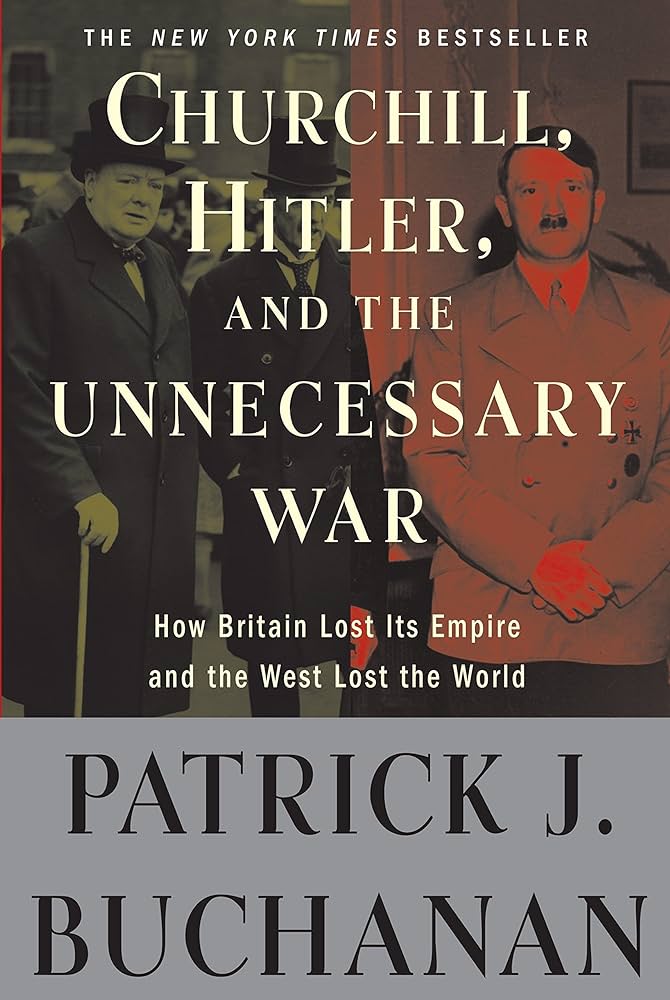
What follows is an edited transcript of an interview conducted by talk radio host James Edwards with Patrick J. Buchanan several years ago about Pat’s book Churchill, Hitler, and the Unnecessary War: How Britain Lost Its Empire and the West Lost the World. This transcript has never before appeared online.

James Edwards: Churchill, Hitler, and the Unnecessary War might be your most provocative book. What compelled you to write it?

Patrick J. Buchanan: There were several things. First, it is a phenomenal story. What happened to the Western nation that ruled the entire world in 1914? Thirty years later, all of Europe was in ashes or aflame. Communists had half of Europe, and all the great Western empires had been destroyed. I went back to try and locate the historic blunders that were made, and I think we located eight of them.

Secondly, it’s a cautionary tale for the United States. The arrogance and hubris you see of these monarchs and all their retainers just before World War I, we see emulated and copied today, frankly, by some folks in post-Cold War America. So, it was to try and tell a cautionary tale to prevent what happened to Great Britain and the British Empire from happening to us.

Edwards: What are the parallels between the United Kingdom during the years between the world wars and the United States today?

Buchanan: One of the greatest is the British decision to alienate friends like Japan, which had been an old ally in World War I. The Brits broke the treaty with them at the demand of the United States for no good reason whatsoever. Japan was driven into isolation, anger, and rage, and eventually returned to her imperial policy and collided with Great Britain.

Even Benito Mussolini, who loathed Adolf Hitler, was driven into Hitler’s arms by the British/French decision to sanction them over a colonial war in Ethiopia. That was a mistake.

Finally, there is this war guarantee that the British gave to Poland, unsolicited, even though Poland had participated in the rape of Czechoslovakia – at least the regime had.

You see all these decisions replicated with the United States handing out war guarantees in this century to the Baltic republics and Ukraine and elsewhere. I see the same pattern repeating itself again and again. I believe the gentleman who said that people do not learn from history was right.

Edwards: What are some of the myths that hold up Winston Churchill as a hero?

Buchanan: There is no question that Winston Churchill was a heroic figure in 1940 when he took over the premiership in Great Britain, just as the Germans were breaking through in the Ardennes. He defied Hitler. He defied the Germans. He fought on and inspired his people. He was the leader during the Battle of Britain. Americans watched that from across the ocean and there was an indelible impression that there was a defiant bulldog who represented the British people at their best. That’s a true story. That’s not just a myth.

However, there was another Churchill who, in 1942, 1943, and 1944, slipped into Moscow to divide Europe with Josef Stalin and groveled to Stalin in a way that would make Neville Chamberlain look like Davy Crockett. He was writing off the Poles, for whom the British had gone to war. If you go all the way back to 1913 and 1914, he was lusting for war far more than the Kaiser who was trying to avoid war.

These are the myths we have been raised on since we were kids, and this is one reason I wrote the book. At least the new generation coming up, who is not saturated or marinated in these myths, can understand why it was that our grandfathers and fathers destroyed Western civilization.

Edwards: What is it about World War II that your detractors don’t seem to understand?

Buchanan: The book is dedicated to four of my uncles who were Greatest Generation Americans and fought in Europe, one of whom came back from Anzio with a Silver Star. But I think it’s the idea that this was a good war, a war where pure good fought pure evil, a war that had to be fought and was necessary, and there are no doubts or qualms about it. But that is not true.

And that’s why I, in effect, am dispelling some of the great myths by which Americans live when I say that Chamberlain and Churchill blundered serially, again and again, to bring about a war with Germany. Hitler didn’t want war with the West. He didn’t want war with Poland. He didn’t want a world war. He wasn’t even prepared for a world war.

To say that Hitler did horrible things in wartime is correct, but, as I say, had there been no war, there would have been no Holocaust, and I’m not sure there would have been a war if the British hadn’t issued this insane war guarantee to Poland.

Edwards: History is like a Sunday buffet. People take what they want and leave the rest on the table. Of course, it has been lost to antiquity that most Americans stood with Charles A. Lindbergh and the America First Committee in opposition to our entry into World War II before the attack on Pearl Harbor.

Buchanan: Well, good for you. Good for you for bringing up Col. Lindbergh’s name because his reputation has been blackened because of a single speech he made and a couple of paragraphs in it where he mentioned three forces are moving for war.

Of course, one of them is the Roosevelt Administration. The other is the British, which was clearly true. They had a man called “Intrepid,” William Stephenson, who tried to find ways to get the Americans into war by putting out propaganda and, frankly, blackmailing senators.

And then he said the Jewish community was beating the drums for war, but this was going to be a disaster for the Jewish community if we got into war. That was verboten to say, but no one has claimed what he said was palpably untrue. Before December 7, 1941, the America First Committee wanted to put up a resolution in Congress saying, “We declare war on Germany,” and have it voted up or down, but don’t sneak us by a back door into war.

Edwards: Had Divine Providence seen fit for Pearl Harbor to have never occurred, the United States stays home, and Germany proceeds to defeat Stalin, what would have happened to America? Would Hitler have come over here and taken us out?

Buchanan: Hitler did not war in the West. That’s why he didn’t demand the return of Alsace-Lorraine from France whereas he did want the return of Danzig from Poland and the League of Nations. He did not want war with Britain. Never did. He wanted to see the British Empire preserved. He was a great admirer of it. He thought Britain was a natural ally of Germany because they had no conflicts. So, I think, if the British hadn’t given the war guarantee, I don’t know if there would have even been a war with Poland because the German offer was not outrageous when asking for political control of their city, Danzig, with the Poles having economic control.

I don’t even know if there would have been a war with the Soviet Union then because Germany wouldn’t have had a border with the Soviet Union. They would have had to get permission from Romania, Poland, or Hungary to invade the Soviet Union. If Hitler had not declared war on the United States, I still think he might have been stopped in Russia, but the outcome of that war would have been in doubt because all the equipment we gave to Stalin enabled him to sustain his war effort and mount that enormous offensive the Russians had coming into Europe. I do think that if Germany had not gotten into the war by 1943, Stalin would have been on the Rhine.

Edwards: Hopefully a lot of American blood would have been spared.

Buchanan: There was a wonderful thing that the America First people did, and I was criticized for saying it, but they kept us out of war until after Hitler made his fatal blunder of invading Russia. This meant the Russians bore the burden of battle, and hundreds of thousands – if not millions – of American soldiers lived who would not have lived if we had had to fight Germany from the west without the Soviet Union in the war.

Edwards: How did you go about researching for this book? Who did you primarily consult with and reference when writing it?

Buchanan: After I wrote A Republic, Not an Empire, I got that good letter from George Kennan, the great geo-strategist in the Cold War. He agreed with me on a point that I’ve been really torn apart for. I said that, after the Battle of Britain, if the Germans couldn’t get air superiority over the British Isles, they certainly couldn’t get it over the Atlantic. If they couldn’t land in England, they weren’t going to land in the United States.

It’s preposterous. There was no threat. I was attacked for that, and I sort of determined that, at some point, I’m going to expand on this argument because I think it’s true. So, I started reading more and more books. I was going to write a book on the war guarantee, and then you go back and ask, well, how did we get there?

Then you have to keep going back, and I had to cut it off in 1905. But I’ve got about 120 books, ranging from histories to biographies. I must have quoted six of Churchill’s books and six books by Andrew Roberts, a British historian and a friend of mine.

I just kept reading them and decided, here are the key decisions and pivot points that decided the history of the century.

One, of course, was the assassination of the archduke in World War I, Versailles was another, and I decided that the British breaking their treaty with Japan was yet another. Then I discovered that Mussolini allegedly despised Hitler and wanted an alliance with the West, so you had the Stresa Front agreement of 1935.

Then there are the familiar ones: Rhineland, the Anschluss, and Munich, but the key one is the war guarantee. That’s the soul of the book. If people can only read one chapter, read that one because it shows how leaders in panic, haste, and folly, who have been knocked on their heels by being humiliated, can make a horrendous decision that cost them everything. The whole British Empire and the British nation was put on the line in an insane war guarantee that the British could not honor and did not honor.

Edwards: If people want to learn more, they’ll have to buy the book, right, Pat?

Buchanan: Yes, sir.

Edwards: Last question. What might future wars look like?

Buchanan: In the coming world, I think the wars of race, ethnicity, and culture are going to replace the old wars of ideology, dynasty, and empire. I see that coming, and it’s not a pleasant sight. Pat Moynihan sort of saw it coming, and so did Dr. Arthur Schlesinger. I have read a number of columns on this, and you see the divisions in our society increasingly on the lines of race and ethnicity, and I don’t think it’s a pleasant prospect that our kids and grandkids will have to confront.

I am going to try to address it and see if there is any way it can be resolved short of some sort of Balkanization of America.

When not interviewing newsmakers, James Edwards has often found himself in the spotlight as a commentator, including many national television appearances. Over the past 20 years, his radio work has been featured in hundreds of newspapers and magazines worldwide. Media Matters has listed Edwards as a “right-wing media fixture” and Hillary Clinton personally named him as an “extremist” who would shape our country. For more information, please visit www.thepoliticalcesspool.org.

James Edwards & Pat Buchanan Discuss Churchill, Hitler, & the Unnecessary War

James%20Edwards%20andamp%3B%20Pat%20Buchanan%20Discuss%20Churchill%2C%20Hitler%2C%20andamp%3B%20the%20Unnecessary%20War%0A

Share

  • Gab

Enjoyed this article?

Be the first to leave a tip in the jar!

Instant Echeck GreenPay™

Related

  • How Cold War Two Came About

  • Counter-Currents Radio Podcast No. 668

  • A Tale of Two Reparations

  • A First Biography of Sam Francis

  • Did Hitler Take Credit for the Holocaust?

  • Winning the War, Losing Our Neighborhoods

  • The First Hundred Days of Second Trump

  • Nationalism Doesn’t Need National Socialism

Tags

Churchill Hitler and the Unnecessary WarJames EdwardsPat BuchananSecond World War

Previous

« Victims: Real and Invented

Next

» Hooking Up

2 comments

  1. AdamMil says:
    January 17, 2025 at 6:12 am

    Thank you for this.

    0
    0
  2. Scott says:
    January 19, 2025 at 5:55 pm

    Buchanan: There is no question that Winston Churchill was a heroic figure in 1940 when he took over the premiership in Great Britain, just as the Germans were breaking through in the Ardennes. He defied Hitler. He defied the Germans. He fought on and inspired his people. He was the leader during the Battle of Britain. Americans watched that from across the ocean and there was an indelible impression that there was a defiant bulldog who represented the British people at their best. That’s a true story. That’s not just a myth.

    When Churchill took over as Prime Minister in 1940 from First Lord of the Admiralty, he knew from top secret intelligence assessments that the German Kreigsmarine was already a spent force after supporting the German occupation of Denmark and Norway to prevent an Allied occupation, and that the German Army would therefore never make it across the “moat” to threaten Albion’s shores.

    Plus, the Wehrmacht was materially equipped for Blitzkrieg ─ a term they did not actually use, but a complex doctrine for a “war of movement” utilizing armored vehicle and motorized infantry spearheads, directed from frontline commanders via wireless technology, and also employing heavy Luftwaffe air-support. German commanders could call in near instantaneous strikes as aerial artillery.

    The motorized Panzer spearheads bypassed strong points and penetrated deep behind enemy lines to destroy their lines of communication. Horse-driven infantry and engineers then followed behind the shock troops to take prisoners and digest these pockets. Such “Infiltration” or “Storm Troop” tactics had been being developed since 1918 and Hitler had an especially good grasp on the 1940 Ardennes campaign and he was its chief originator. These tactics worked well in Russia in 1941 until the Winter and the almost complete logistical breakdown of the Wehrmacht.

    “Blitzkreig” as we call it today was a doctrine used to defeat larger armies with movement and encirclements rather than one designed for siege by land, air, and sea. These kinds of operations worked well in Poland and France and in the initial invasion of Russia and were design to economize German materiel demands with short and decisive battles and campaigns followed by long recovery periods that would not break German industry and manpower.

    The Kriegsmarine had been several years short of Admiral Raeder’s preparation as a blue-water navy capable of a long war with Great Britain when the war came already in 1939. The best that could be done by 1940 was perform the role of a fleet-in-being with Dönitz’s excellent U-Boat arm and with massively-deficient naval air support from the Luftwaffe.

    The Luftwaffe also had been prepared for tactical ground support and not for strategic bombing. Germany did not even have a capable strategic bomber and never really got one into mass-production.

    Most analysts blame this on Göring if they are not blaming it on Hitler ─ but the fact is that Germany had to choose what eggs went into its war basket, and a Blitzkrieg doctrine with a tactical air force that had very little sustained strategic capability was what had to be done. Unlike, the United States, Germany did not have the resources to build four or more types of strategic bombers. The cost of developing the B-29 strategic bomber rivalled that of developing the atomic bomb or the German V2 rocket.

    So Göring’s Luftwaffe strategy conceptrating on dive-bombers and medium-range strike aircraft served well in the early part of the war ─ but a Luftwaffe without any strategic and logistical capabilities save for an intrepid fleet of Ju 52 “flying boxcars” was deficient in support of the Kreigsmarine throughout the war and strategically in General. By the end of the war without sufficient trained pilots and superlative fighter aircraft in both quality and numbers, German skies became a vulnernable front.

    But the strategic situation was the opposite for the Allies. During the London “Blitz,” Churchill knew without a doubt that it was not going to be decisive fpr the Germans, not even as a diplomatic bluff.

    In his memoirs Sir Arthur “Bomber” Harris even took credit for defeating the fanciful German invasion of England after sending RAF bombers to attack the German troop barges assembling (for show) on the continental coast.

    A German invasion of England wasn’t happening and the top English leaders knew it.

    What about the German bombing? The Luftwaffe bombers only had a range of about a third of the country in the first place and supporting German aerial superiority fighters only had combat time of about ten minutes at best over London before they had to fade back to French bases or run out of fuel.

    So the RAF was able to retreat into the interior and concentrate resources against the “Blitz” which was not sustainable for the Luftwaffe, even after they switched to nighttime bombing raids, which was even less effective ─ a few accidental disasters like Coventry to the contrary.

    In 1944-45, Allied aircraft had free range of targets to Berlin and back, and on strafing on the deck, even with the Luftwaffe concentrating on a Fighter-focused and FLAK defensive effort and even introducing some advanced jet aircraft.

    Furthermore, Churchill had an ace up his sleeve with an American guarantee that he could count on in spite of President Roosevelt publicly pretending to promote peace before Pearl Harbor.

    Buchanan: And that’s why I, in effect, am dispelling some of the great myths by which Americans live when I say that Chamberlain and Churchill blundered serially, again and again, to bring about a war with Germany. Hitler didn’t want war with the West. He didn’t want war with Poland. He didn’t want a world war. He wasn’t even prepared for a world war.

    There is simply no way that the Germans could ever have made peace terms with Albion short of sending atomic bombs mounted on jets or V-missiles ─ or killing Hitler and surrendering unconditionally (and thereby inviting Soviet hegemony substantially westward).

    Buchanan: If Hitler had not declared war on the United States, I still think he might have been stopped in Russia, but the outcome of that war would have been in doubt because all the equipment we gave to Stalin enabled him to sustain his war effort and mount that enormous offensive the Russians had coming into Europe. I do think that if Germany had not gotten into the war by 1943, Stalin would have been on the Rhine.

    I agree except that the United States was already effectively at war with Germany prior to Pearl Harbor. They were sending massive Lend-Lease to supply the Allied war-effort and the Soviets with bottomess war materiel and even shooting at German ships on sight.

    Little was gained by the decaration of war against the United States but it was hardly a faux pas for Hitler. Japan’s actual contribution to the war-effort from the German perspective was an unknown quantity ─ nor could it be known that the Americans had the unfathomable luxury to concentrate 80 percent of their war-effort on defeating Germany.

    Also, it is correct that not fighting the Soviet Union would have lost the continent or nearly so sooner than later.

    The Soviet arms buildup was massively worse than the worst German estimates already. By launching the invasion on June 1941, and being able to create some tactical surprise as the Wehrmacht enveloped massive Red armies on the Eastern Front, it was nevertheless almost too late for Germany to prevail.

    And there would have been no way to appease the Soviet Union beforehand so long as Germany was still nominally at war in the West.

    So the fact is that Hitler launching Operation Barbarossa against the Soviet Union in late June of 1941 (the earliest possible date) was not only not a mistake, it was a proverbial Hail Mary Pass that almost paid off against bleak odds. Also, the USSR after Pearl Harbor could safely send its Far Eastern divisions into the fight against Germany as there was now no threat from Japan as it was concentrated on a Pacific War and in China.

    As the late Holocaust Revisionist Friedrich Paul Berg once quipped, only Hitler’s fight and the deterrence of the atomic bomb saved our asses from the Commies.

    🙂

    0
    0

Comments are closed.

If you have a Subscriber access,
simply login first to see your comment auto-approved.

Note on comments privacy & moderation

Your email is never published nor shared.

Comments are moderated. If you don't see your comment, please be patient. If approved, it will appear here soon. Do not post your comment a second time.

Upcoming podcasts
  • Rob Rundo on Counter-Currents Radio

    Rob Rundo on Counter-Currents Radio

    Counter-Currents Radio

    Sat, Jun 13th — 3 pm EST / 9 pm CET
  • Daniel Tyrie on Counter-Currents Radio

    Daniel Tyrie on Counter-Currents Radio

    Counter-Currents Radio

    Sat, Jun 20th — 3 pm EST / 9 pm CET

Writers of May

(2 votes) Morris van de Camp David M. Zsutty Derek Stark Jayant Bhandari Greg Johnson

Articles of May

The Lunch Wars by David M. Zsutty Heidegger on Nietzsche, Part One by Collin Cleary 2 votes
    • Why White Advocates Should Avoid “Based Blacks”

      Dani Vypont

    • Nietzsche & Race

      Mark Gullick

    • Editor’s Update
      Rob Rundo Rescheduled to Next Week on Counter-Currents Radio;
      Tonight Greg Johnson & David Zsutty Answer Your Questions;
      Fundraiser Update & a New $20,000 Matching Grant

      Greg Johnson

    • The Counter-Currents 2026 Fundraiser
      Lifetime Subscriber Welcome Packages Extended

      Greg Johnson

    • Nationalism This Week
      Who’s Looking Back?

      Greg Johnson

      21

    • China’s Threat to American Security:
      Food, Farmland, Foreign Control, & Energy Policy

      Lipton Matthews

      1

    • The Bitter End of Western Metaphysics:
      Heidegger on Nietzsche, Part Two

      Collin Cleary

      11

    • The Killing of Henry Nowak

      Mark Gullick

      28

    • The Crisis of Chinese Technology Thieves

      Morris van de Camp

      1

    • The Strange World of Gender Bender Fiction:
      & What This Genre Tells Us About Autosexuality

      Dani Vypont

      3

    • Watching the Watchers:
      The Dark Triad Question

      David M. Zsutty

      14

    • The Remigration Movement Solidifies

      F. Roger Devlin

      1

    • Casting Aspersions:
      The Fatal Consequences of Race-Swapped Casting, From Helen of Troy to Henry of Southampton

      Steven Tucker

      20

    • The Murder of Henry Nowak

      Millennial Woes

      23

    • Don’t Forget to Vote in Our Writer & Article of the Month Poll

      Greg Johnson

    • The Robot Hotdog Stand

      Greg Johnson

      35

    • Laughing Our Way to Victory

      Dave Chambers

      7

    • The Zodiac Killer

      Mark Gullick

      11

    • Jared Taylor: What Rome Means to Me

      Jared Taylor

      1

    • An Interview with Endeavour:
      My Way of Life Is an Adventure!

      Ondrej Mann

      6

    • José Pedro Zúquete’s The Identitarians

      Greg Johnson

      3

    • Editor’s Update
      Fundraiser Update & How to Watch the Remigration Summit

      Greg Johnson

      5

    • The Bitter End of Western Metaphysics:
      Heidegger on Nietzsche, Part One

      Collin Cleary

      11

    • Berlin: City of Stones

      Spencer J. Quinn

      6

    • True Folk-Horror Is Horror of Your Own Folk:
      Mark Gatiss vs the Brexit Blind Dead  

      Steven Tucker

      4

    • Counter-Currents Radio Podcast No. 689
      Thomas Massie, the America 2050 Bust, the Need for Whites to Divest from America, the AI Economic Apocalypse, & Pro-White Project Pitches to Billionaires

      Counter-Currents Radio

      7

    • Nationalism This Week
      Remigration is Inevitable, Part 3

      Greg Johnson

      27

    • Why Billionaires Should Fund White Identity Politics

      Lipton Matthews

      8

    • How Cold War Two Came About

      Morris van de Camp

      5

    • Now Available for Pre-Order at a Special Price!
      Greg Johnson’s The Philosopher Is In

      Greg Johnson

    • David Zsutty’s Elevator Pitch to a Billionaire

      David M. Zsutty

      1

    • Headbanging Lite

      Mark Gullick

      5

    • White Advocacy Past and Present

      Peter Bradley

      13

    • The Lunch Wars

      David M. Zsutty

      47

    • The Russians are Coming/The Russians are Coming

      Steven Clark

      1

    • Peak Fatigue in Fort Wayne

      Gabriel Anderson

      24

    • Keith Woods’ Elevator Pitch to a Billionaire

      Keith Woods

    • The Cruelty of Kindness

      Morris van de Camp

      9

    • Predation Wearing the Mask of Civilization

      Jayant Bhandari

      13

    • The Mandalorian & Grogu

      Trevor Lynch

      24

    • Editor’s Update
      Fundraiser Update & a New $20,000 Matching Grant
      Greg Johnson & David Zsutty Discuss Thomas Massie on Counter-Currents Radio

      Greg Johnson

      2

    • How the Jews Defeated Thomas Massie—& Themselves

      David M. Zsutty

      25

    • Jared Taylor’s Elevator Pitch to a Billionaire

      Jared Taylor

      15

    • Nationalism This Week
      Remigration Is Inevitable, Part 2

      Greg Johnson

      8

    • Could Fascism Work?

      Mark Gullick

      40

    • Jonathan Bowden’s Deliverance
      Part 7

      Jonathan Bowden

    • China’s Quiet Hand:
      Influence, Infiltration, & the Western Blind Spot

      Lipton Matthews

      9

    • Counter-Currents Radio Podcast No. 688
      Tyler Dykes on Running for US Congress in South Carolina

      Counter-Currents Radio

      3

    • Lothrop Stoddard’s The Revolt Against Civilization

      Spencer J. Quinn

      14

    • Lewis Strauss Did Nothing Wrong:
      How the politics of the Atom Bomb during the early Cold War Apply to Artificial Intelligence Today

      Morris van de Camp

      14

    • AdamMil

      Who’s Looking Back?

      Massive hardware. To run something like Grok you'd need terabytes of GPU memory. That said, for...

    • AdamMil

      Who’s Looking Back?

      Don’t be too sure. There have already been multiple experiments showing that modern AIs may turn on...

    • Hi-ya!

      Who’s Looking Back?

      I use the following commands if I feel ai is getting to wound up, yes I got it from ai but it’s...

    • Collin Cleary

      Heidegger on Nietzsche, Part Two

      Oh no, not so. For the Overman, truth is entirely relative and subjective. Remember: he gets to...

    • Connor McDowell

      Who’s Looking Back?

      HAL9000 in 2001 was never truly “sentient”. “His” programming had a conflict that couldn’t be...

    • Will Williams

      Nationalism This Week: Victory First

      There are several C-C essays that mention Gaza, but this appears to be the only one where comments...

    • Observer

      Heidegger on Nietzsche, Part Two

      In Platonism, we find the insistence that being, true being, is identical with “the forms.” The...

    • JBP

      Heidegger on Nietzsche, Part Two

      Thanks. Unfortunately I must fall into the 95% that Jane refers to. My brain is not putting the...

    • Will Williams

      Who’s Looking Back?

      Vauquelin: June 7, 2026 ...You must judge AI/LLM based on those who control it. With the likes of...

    • Hi-ya!

      Heidegger on Nietzsche, Part Two

      Love to engage in this with more attention ; I’ve never seen “clearing” in presocratics and my hot...

    • Vauquelin

      Who’s Looking Back?

      You must judge AI/LLM based on those who control it. With the likes of Sam Altman and Alex Karp...

    • Chud

      Who’s Looking Back?

      There's another dangerous option where homebrew AI models scale up and the consumers get their...

    • Gabe

      Who’s Looking Back?

      Boom. Nailed it.

    • Joe Gould

      The Killing of Henry Nowak

      This is a good article. The only thing I want to add is, above all we must guard ourselves against...

    • Greg Johnson

      Who’s Looking Back?

      Thank you I also wonder if these AI bots are being used to gather intelligence on influential...

    • E_Perez

      Heidegger on Nietzsche, Part Two

      "Philosophy helps Western man understand how we got to where we are, and where things went wrong...

    • Chud

      Who’s Looking Back?

      I'll try to give a rundown. AI is a language learning model (LLM) that uses floating point...

    • Will Williams

      How the Jews Defeated Thomas Massie—And Themselves

      Massie to Honor USS Liberty Crew on House Floor [email protected]  June 6, 2026  thomas...

    • JBP

      Editor’s Update

      Sorry but... Wrong, wrong wrong and wrong. The current momentum of history will not change with a...

    • Will Williams

      The SPLC Indictment

      The indictment of the Southern Poverty Law Center by the Department of Justice on 21 April is...

    • Earth Day Special

      John Morgan

      12

    • A Robertson Roundup
      Remembering Wilmot Robertson
      (April 16, 1915 – July 8, 2005)

      Margot Metroland

      13

    • The Paranoid Style in White Nationalism

      Greg Johnson

      30

    • Join the Dance!

      Andrew Hamilton

      1

    • We Can’t Save the Earth Without Reducing African Birth Rates

      James Dunphy

      36

    • “I’m Not a Conspiracy Theorist, but . . .”:
      Jeffrey Epstein’s Death Gives New Life to “Conspiracy Theories”

      Greg Johnson

      22

    • Sylvia Plath: Stasis in Darkness

      Vic Olvir

      17

    • Vanguardism, Vantardism, & Mainstreaming

      Greg Johnson

      80

    • Aviation, Geography, & Race

      Charles Lindbergh

      3

    • Some Thoughts on Yule

      Collin Cleary

      4

    • Living in Truth:
      A Yuletide Homily

      Jef Costello

      7

    • John Kennedy Toole’s A Confederacy of Dunces

      Greg Johnson

      20

    • On Aleksandr Solzhenitsyn’s Warning to the West

      Spencer J. Quinn

      7

    • Elitism, British Modernism, & Wyndham Lewis

      Jonathan Bowden

      6

    • Philip K. Dick’s Do Androids Dream of Electric Sheep? as Anti-Semitic/Christian-Gnostic Allegory

      Greg Johnson

      20

    • “Conspiracy Theory” or Conspiracy?

      Andrew Hamilton

      21

    • Remembering H. P. Lovecraft
      (August 20, 1890–March 15, 1937)

      Greg Johnson

      3

    • Who Are We?
      Nordics, Aryans, & Whites

      Greg Johnson

      71

    • Remembering William Gayley Simpson
      (July 23, 1892–December 31, 1990)
      A Pleasant Afternoon with Harriet & Bill Simpson

      Margot Metroland

      18

    • Here are the Young Men
      Remembering Ian Curtis
      (July 15, 1956–May 18, 1980)

      Mark Gullick

      18

    • Percy Grainger
      Artist of the Right

      Alex Graham

      7

    • Remembering Revilo Oliver
      (July 7, 1908–August 20, 1994)

      Greg Johnson

      18

    • The Meaning of July 4th for the White Man

      Gregory Hood

      13

    • The Front National’s Evolution

      Bruno Mégret

    • Merwin K. Hart
      Forgotten American Hero & Man of the Right

      Morris van de Camp

      10

    • George Orwell’s Nineteen Eighty-Four

      Jonathan Bowden

      8

    • Carleton S. Coon
      Scientist & Reluctant White Advocate

      Morris van de Camp

      3

    • The Kwanzaa Absurdity Will Be Dwarfed by Juneteenth

      Robert Hampton

      10

    • Stravinsky

      Alex Graham

      7

    • Like the Roman:
      Remembering Enoch Powell (1912-1998)

      Mark Gullick

      23

    • Neo-Fascism in Film
      Part 5

      Karel Veliky

      15

    • The Game of Tarot

      Mark Gullick

      1

    • Institutions Cannot Be Transplanted

      Jayant Bhandari

      5

    • Jonathan Bowden’s Deliverance
      Part 5

      Jonathan Bowden

    • Crosstown Traffic:
      Jimi Hendrix & The Post-War Rock ‘N’ Roll Revolution

      Mark Gullick

      1

    • Slaves from the North:
      Finns & Karelians in the East European Slave Trade, 900–1600

      Lipton Matthews

      14

    • Neo-Fascism in Film
      Part 4

      Karel Veliky

      2

    • David Lean’s A Passage to India

      Spencer J. Quinn

      1

    • Elites are Essential to Development

      Lipton Matthews

      7

    • Jonathan Bowden’s Deliverance
      Part 4

      Jonathan Bowden

    • Neo-Fascism in Film
      Part 3

      Karel Veliky

      6

    • E. M. Forster’s A Passage to India & the Indian Mentality

      Spencer J. Quinn

      25

    • Jonathan Bowden’s Deliverance
      Part 3

      Jonathan Bowden

    • The Rest Is Silence
      Heidegger’s Quietism

      Mark Gullick

      2

    • Dispelling the Historical Fallacy of Indian Nationalism

      Lipton Matthews

      8

    • Neo-Fascism in Film
      Part 2

      Karel Veliky

      8

    • Jonathan Bowden’s Deliverance
      Part 2

      Jonathan Bowden

    • Life of a Klansman

      Mark Gullick

      8

    • Jonathan Bowden’s Deliverance, Part 1

      Jonathan Bowden

    • Decolonial Ideas are Holding Back Developing Countries

      Lipton Matthews

      8

    • Neo-fascism in Film, Part 1

      Karel Veliky

      21

    • Jonathan Bowden’s Onslaught, Part 8
      Divigations on Decadence

      Jonathan Bowden

    • Jonathan Bowden’s Onslaught, Part 7
      Intrigues in the National Front

      Jonathan Bowden

      1

    • Rotten to the Core

      Mark Gullick

      8

    • Strauss on Husserl’s “Philosophy as Rigorous Science”

      Greg Johnson

    • Jonathan Bowden’s Onslaught, Part 6
      Francis Bacon & Right-Wing Nihilism

      Jonathan Bowden

    • London After (& Before) Midnight:
      Aleister Crowley, The Landlord’s Worst Nightmare

      James J. O'Meara

      2

    • Jonathan Bowden’s Onslaught, Part 5
      The Post-War British Far Right

      Jonathan Bowden

    • No Rules: Rollerball

      Mark Gullick

      4

    • Jonathan Bowden’s Onslaught, Part 3
      Brett Easton Ellis’ American Psycho

      Jonathan Bowden

    • András László
    • Derek Hawthorne
    • Beau Albrecht
    • Alain de Benoist
    • Kerry Bolton
    • Jonathan Bowden
    • Collin Cleary
    • Jef Costello
    • Savitri Devi
    • Julius Evola
    • Jim Goad
    • Gregory Hood
    • Juleigh Howard-Hobson
    • Greg Johnson
    • Charles Krafft
    • Anthony M. Ludovici
    • Trevor Lynch
    • H. L. Mencken
    • J. A. Nicholl
    • James J. O’Meara
    • Christopher Pankhurst
    • Tito Perdue
    • Michael Polignano
    • Spencer J. Quinn
    • Fenek Solère
    • Irmin Vinson
    • Leo Yankevich
    • Francis Parker Yockey
    • Multiple authors
  • Editor-in-Chief

    • Greg Johnson, Ph.D.

    Featured Writers

    • Beau Albrecht
    • Gunnar Alfredsson
    • Collin Cleary, Ph.D.
    • Jef Costello
    • Morris V. de Camp
    • F. Roger Devlin, Ph.D.
    • Stephen Paul Foster, Ph.D.
    • Jim Goad
    • Alex Graham
    • Mark Gullick, Ph.D.
    • Greg Johnson, Ph.D.
    • Travis LeBlanc
    • Trevor Lynch
    • Margot Metroland
    • James J. O’Meara
    • Angelo Plume
    • Spencer J. Quinn
    • Fred Reed
    • Clarissa Schnabel
    • Michael Walker
    • David M. Zsutty

    Frequent Writers

    • Asier Abadroa
    • Aquilonius
    • Alain de Benoist
    • Kerry Bolton, Ph.D.
    • Dave Chambers
    • Steven Clark
    • James Dunphy
    • Endeavour
    • Richard Houck
    • Jason Kessler
    • Titus Livius
    • Ondrej Mann
    • Lipton Matthews
    • Mark Mazari
    • John Morgan
    • Jaroslav Ostrogniew
    • Kathryn S.
    • Christian Secor
    • Anne Wilson Smith
    • Thomas Steuben
    • William De Vere
    • Kenneth Vinther
    • Max West

    Classic Authors

    • Maurice Bardèche
    • Jonathan Bowden
    • Julius Evola
    • Guillaume Faye
    • Ernst Jünger
    • Kevin MacDonald, Ph.D.
    • D. H. Lawrence
    • Charles Lindbergh
    • Jack London
    • H. P. Lovecraft
    • Anthony M. Ludovici
    • Sir Oswald Mosley
    • National Vanguard
    • Friedrich Nietzsche
    • Revilo Oliver
    • William Pierce
    • Ezra Pound
    • Saint-Loup
    • Savitri Devi
    • Carl Schmitt
    • Miguel Serrano
    • Oswald Spengler
    • P. R. Stephensen
    • Jean Thiriart
    • John Tyndall
    • Dominique Venner
    • Leo Yankevich
    • Francis Parker Yockey

    Other Authors

    • Howe Abbott-Hiss
    • Michael Bell
    • Giles Corey
    • Jack Donovan
    • Richardo Duchesne, Ph.D.
    • Emile Durand
    • Guillaume Durocher
    • Mark Dyal
    • Tom Goodroch
    • Andrew Hamilton
    • Robert Hampton
    • Huntley Haverstock
    • Derek Hawthorne
    • Gregory Hood
    • Juleigh Howard-Hobson
    • Alexander Jacob
    • Ruuben Kaalep
    • Tobias Langdon
    • Julian Langness
    • Patrick Le Brun
    • G A Malvicini
    • John Michael McCloughlin
    • Millennial Woes
    • Michael O’Meara
    • Christopher Pankhurst
    • Michael Polignano
    • J. J. Przybylski
    • Quintilian
    • Edouard Rix
    • C. B. Robertson
    • C. F. Robinson
    • Herve Ryssen
    • Alan Smithee
    • Fenek Solere
    • Ann Sterzinger
    • Robert Steuckers
    • Tomislav Sunic
    • Donald Thoresen
    • Marian Van Court
    • Irmin Vinson
    • Book Reviews
    • Movie Reviews
    • TV Reviews
    • Music Reviews
    • Art Criticism
    • Graphic Novels & Comics
    • Video Game Reviews
    • Fiction
    • Poems
    • Interviews
    • Videos
    • English Translations
    • Other Languages
      • Arabic
      • Bulgarian
      • Croatian
      • Czech
      • Danish
      • Dutch
      • Estonian
      • Finnish
      • French
      • German
      • Greek
      • Hungarian
      • Italian
      • Lithuanian
      • Norwegian
      • Polish
      • Portuguese
      • Romanian
      • Russian
      • Slovak
      • Spanish
      • Swedish
      • Ukrainian
    • Commemorations
    • Why We Write
  • Archives
  • Top 100 Commenters
  • The Looney Bin
Sponsored Links
Europa.com Above Time Coffee Antelope Hill Publishing Paul Waggener IHR-Store Spencer J. Quinn American Renaissance Jim Goad The Occidental Observer
Donate Now Mailing list
Books for sale
  • The Philosopher Is In
  • Sexual Utopia in Power (Expanded Edition)
  • In Defense of Prejudice
  • Loving Our Own
  • Tyranny & Wisdom
  • The Populist Moment
  • Is America Doomed?
  • To all books
Copyright © 2026 Counter-Currents Publishing, Ltd.

Paywall Access


Please enter your email address.

Lost your password?

Edit your comment

Writer & Article of the Month May 2026

Voting for this month has concluded. Here are the final results!

Top Writers

  • #1 Morris van de Camp 2 votes
  • #2 David M. Zsutty 2 votes
  • #3 Derek Stark 2 votes
  • #4 Jayant Bhandari 2 votes
  • #5 Greg Johnson 2 votes
  • #6 Jared Taylor 1 vote
  • #7 Collin Cleary 1 vote
  • #8 Spencer J. Quinn 1 vote
  • #9 Mark Gullick 1 vote
  • #10 Lipton Matthews 1 vote
  • #11 Keith Woods 1 vote
  • #12 Steven Tucker 1 vote

Top Articles

  • #1 The Lunch Wars 2 votes
  • #2 Heidegger on Nietzsche, Part One 2 votes
  • #3 Could Fascism Work? 1 vote
  • #4 Jared Taylor's Elevator Pitch to a Billionaire 1 vote
  • #5 Predation Wearing the Mask of Civilization 1 vote
  • #6 Peak Fatigue in Fort Wayne 1 vote
  • #7 Keith Wood's Elevator Pitch to a Billionaire 1 vote
  • #8 Do You Want to Play a Game? 1 vote
  • #9 Why Billionaires Should Fund White Identity Politics 1 vote
  • #10 The 1970s: The Golden Age of Hijacking 1 vote
  • #11 True Folk-Horror Is Horror of Your Own Folk 1 vote
  • #12 Finding Atlantis Part 4 1 vote
  • #13 Berlin: City of Stones 1 vote
  • #14 The Ghost of the Confederacy 1 vote
  • #15 Lothrop Stoddard’s The Revolt Against Civilization 1 vote

Total votes cast: 17