Counter-Currents
  • Advertise
  • Private Events
  • T&C
  • About
  • Contact
  • RSS
    • Main feed
    • Podcast feed
    • Videos feed
    • Comments feed
  • Welcome
  • Webzine
  • Books
  • Merch
  • Podcasts
  • Videos
  • Donate
  • Patrons
  • Subscribe
  • Crypto

LEVEL2

Donate Now Mailing list

Writers of May

(2 votes) Morris van de Camp David M. Zsutty Derek Stark Jayant Bhandari Greg Johnson

Articles of May

The Lunch Wars by David M. Zsutty Heidegger on Nietzsche, Part One by Collin Cleary 2 votes
  • Welcome
  • Webzine
  • Books
  • Merch
  • Podcasts
  • Videos
  • Donate
  • Patrons
  • Subscribe
  • Crypto
    • Interview with Gerhard Hallstatt of Allerseelen:
      The Gesamtkunstwerk of the Future!

      Ondrej Mann

    • The Doxing of Austin Franco

      David M. Zsutty

      1

    • Small Is Beautiful:
      The Napoleon of Notting Hill and G. K. Chesterton Upon Defending One’s Homeland from Others—and Itself

      Steven Tucker

      2

    • The Psychology Behind MrBeast’s Moronic Thought Experiment

      Endeavour

      9

    • On the Roots of Anti-Immigrant Sentiment in Contemporary Britain

      Lipton Matthews

      7

    • Remembering Enoch Powell:
      June 16, 1912–February 8, 1998

      Greg Johnson

      17

    • Counter-Currents Radio Podcast No. 691
      Rob Rundo Returns

      Counter-Currents Radio

    • The Fragile Polity that is Syria

      Morris van de Camp

      2

    • Nigel Farage Calls Britain a Two-Tier State

      Mark Gullick

      4

    • Nationalism This Week
      Letter to J. D. Vance

      Greg Johnson

      32

    • Lost In Trans-Mission:
      How the Media Fails To Reveal the Inconvenient Truth About the Usual Suspects

      Steven Tucker

      10

    • Liar, Liar, Pants on Fire!

      Beau Albrecht

      7

    • Editor’s Update
      Rob Rundo on Counter-Currents Radio, Fundraiser Update, & a New $20,000 Matching Grant

      Greg Johnson

    • The Bitter End of Western Metaphysics:
      Heidegger on Nietzsche, Part Three

      Collin Cleary

      10

    • Uncivil War

      Mark Gullick

      50

    • Exclusive Interview with Karel Veliky:
      The Final Chapter in the Film Series! Part II

      Ondrej Mann

      2

    • Happy Birthday to Us!

      Greg Johnson

      6

    • Zsutty’s Maximum

      David M. Zsutty

      16

    • Exclusive Interview with Karel Veliky:
      The Final Chapter in the Film Series! Part I

      Ondrej Mann

      2

    • The Union Jackal, June 2026

      Mark Gullick

      23

    • The Inferiority Behind Immigrant Superiority

      Jayant Bhandari

      15

    • Counter-Currents Radio Podcast No. 690
      Greg Johnson & David Zsutty Discuss Current Things: AI, Henry Nowak, the Iran Crisis, & More

      Counter-Currents Radio

      7

    • Collin Cleary: What Rome Means to Me

      Collin Cleary

      4

    • Paul Krugman: Closet Bolshevik

      Spencer J. Quinn

      21

    • Fugue of Ideas:
      Ibram X. Kendi’s Chain of Ideas

      Greg Johnson

      19

    • Based Blacks

      Lipton Matthews

      24

    • Black Intellectual Fatigue

      Derek Stark

      41

    • Why White Advocates Should Avoid “Based Blacks”

      Dani Vypont

      32

    • Nietzsche & Race

      Mark Gullick

    • Editor’s Update
      Rob Rundo Rescheduled to Next Week on Counter-Currents Radio;
      Tonight Greg Johnson & David Zsutty Answer Your Questions;
      Fundraiser Update & a New $20,000 Matching Grant

      Greg Johnson

    • The Counter-Currents 2026 Fundraiser
      Lifetime Subscriber Welcome Packages Extended

      Greg Johnson

    • Nationalism This Week
      Who’s Looking Back?

      Greg Johnson

      29

    • China’s Threat to American Security:
      Food, Farmland, Foreign Control, & Energy Policy

      Lipton Matthews

      5

    • The Bitter End of Western Metaphysics:
      Heidegger on Nietzsche, Part Two

      Collin Cleary

      16

    • The Killing of Henry Nowak

      Mark Gullick

      38

    • The Crisis of Chinese Technology Thieves

      Morris van de Camp

      1

    • The Strange World of Gender Bender Fiction:
      & What This Genre Tells Us About Autosexuality

      Dani Vypont

      3

    • Watching the Watchers:
      The Dark Triad Question

      David M. Zsutty

      14

    • The Remigration Movement Solidifies

      F. Roger Devlin

      2

    • Casting Aspersions:
      The Fatal Consequences of Race-Swapped Casting, From Helen of Troy to Henry of Southampton

      Steven Tucker

      20

    • The Murder of Henry Nowak

      Millennial Woes

      23

    • Don’t Forget to Vote in Our Writer & Article of the Month Poll

      Greg Johnson

    • The Robot Hotdog Stand

      Greg Johnson

      37

    • Laughing Our Way to Victory

      Dave Chambers

      7

    • The Zodiac Killer

      Mark Gullick

      11

    • Jared Taylor: What Rome Means to Me

      Jared Taylor

      1

    • An Interview with Endeavour:
      My Way of Life Is an Adventure!

      Ondrej Mann

      6

    • José Pedro Zúquete’s The Identitarians

      Greg Johnson

      3

    • Editor’s Update
      Fundraiser Update & How to Watch the Remigration Summit

      Greg Johnson

      5

    • The Bitter End of Western Metaphysics:
      Heidegger on Nietzsche, Part One

      Collin Cleary

      12

    • Will Williams

      Is the Anti-Defamation League a Hate Group?

      Bertrand russell: June 18, 2026  Read False Flags by the late Michael Collins Piper, available...

    • JBP

      The Doxing of Austin Franco

      Thanks. Let the (((doxxing))) begin.

    • Joe Gould

      On the Roots of Anti-Immigrant Sentiment in Contemporary Britain

      It's too late to discuss whether the antiwhitism, hypocrisy, and injustice of the ruling...

    • Bertrand russell

      Is the Anti-Defamation League a Hate Group?

      Read False Flags by the late Michael Collins Piper, available at Unz Review and Archive.org. Piper...

    • Beau Albrecht

      Remembering Enoch Powell

      At the time, Britain was still only experiencing the thin end of the wedge as far as migration goes...

    • Peter Quint

      Remembering Enoch Powell

      Okay, so he has two White Nationalist speeches to his credit. 🦈

    • CC Reader

      Remembering Enoch Powell

      The best Prime Minister England never had. Powell went on the Dick Cavett show and was treated...

    • Livla

      The Psychology Behind MrBeast’s Moronic Thought Experiment

      From a biological perspective, this thought experiment is the equivalent of a selection event that...

    • Adrian Roberts

      Remembering Enoch Powell

      In Mein Kampf, Hitler argued that the side which makes war inevitable is the side most responsible...

    • Adrian Roberts

      Remembering Enoch Powell

      So the English owe everybody reparations? Damn.

    • Wasili

      The Psychology Behind MrBeast’s Moronic Thought Experiment

      Great article!  Indeed, the following point can’t be emphasized enough: The [insert non-white...

    • Will Williams

      On the Roots of Anti-Immigrant Sentiment in Contemporary Britain

      Ecological experts call the replacement of one species by another as habitat succession. In my...

    • Douglas Mercer

      Remembering Enoch Powell

      In 1977 Powell gave a speech called The Road To National Suicide: “On the other hand there are at...

    • JayeRyanOD

      The Fragile Polity that is Syria

      I strongly support ex Syrian President Assad supported by my kinsmen the Russians . Before the...

    • Joe Gould

      The Psychology Behind MrBeast’s Moronic Thought Experiment

      I don’t see the decline of real, useful work as alarming or surprising, rather it is inevitable.We...

    • E_Perez

      On the Roots of Anti-Immigrant Sentiment in Contemporary Britain

      A little soft, the article, especially when its title promised to go to the roots. "The...

    • Elear

      Small Is Beautiful: The Napoleon of Notting Hill

      A wonderful essay about things so small yet so precious. Fighting off the invaders is meaningless if...

    • Quu

      The Psychology Behind MrBeast’s Moronic Thought Experiment

      Thank you, yes, it's very interesting, revealing a predisposition that isn't globally normal, and...

    • The Laughing cavalier

      Remembering Enoch Powell

      It was England who declared war - both times - and neither time was England under any threat. It'...

    • TheLau ghin gCavalier

      The Psychology Behind MrBeast’s Moronic Thought Experiment

      A version of this scenario did the rounds on 4chan where red was "nothing happens" and blue was "50...

    • Earth Day Special

      John Morgan

      12

    • A Robertson Roundup
      Remembering Wilmot Robertson
      (April 16, 1915 – July 8, 2005)

      Margot Metroland

      13

    • The Paranoid Style in White Nationalism

      Greg Johnson

      30

    • Join the Dance!

      Andrew Hamilton

      1

    • We Can’t Save the Earth Without Reducing African Birth Rates

      James Dunphy

      36

    • “I’m Not a Conspiracy Theorist, but . . .”:
      Jeffrey Epstein’s Death Gives New Life to “Conspiracy Theories”

      Greg Johnson

      22

    • Sylvia Plath: Stasis in Darkness

      Vic Olvir

      17

    • Vanguardism, Vantardism, & Mainstreaming

      Greg Johnson

      80

    • Aviation, Geography, & Race

      Charles Lindbergh

      3

    • Some Thoughts on Yule

      Collin Cleary

      4

    • Living in Truth:
      A Yuletide Homily

      Jef Costello

      7

    • John Kennedy Toole’s A Confederacy of Dunces

      Greg Johnson

      20

    • On Aleksandr Solzhenitsyn’s Warning to the West

      Spencer J. Quinn

      7

    • Elitism, British Modernism, & Wyndham Lewis

      Jonathan Bowden

      6

    • Philip K. Dick’s Do Androids Dream of Electric Sheep? as Anti-Semitic/Christian-Gnostic Allegory

      Greg Johnson

      20

    • “Conspiracy Theory” or Conspiracy?

      Andrew Hamilton

      21

    • Remembering H. P. Lovecraft
      (August 20, 1890–March 15, 1937)

      Greg Johnson

      3

    • Who Are We?
      Nordics, Aryans, & Whites

      Greg Johnson

      71

    • Remembering William Gayley Simpson
      (July 23, 1892–December 31, 1990)
      A Pleasant Afternoon with Harriet & Bill Simpson

      Margot Metroland

      18

    • Here are the Young Men
      Remembering Ian Curtis
      (July 15, 1956–May 18, 1980)

      Mark Gullick

      18

    • Percy Grainger
      Artist of the Right

      Alex Graham

      7

    • Remembering Revilo Oliver
      (July 7, 1908–August 20, 1994)

      Greg Johnson

      18

    • The Meaning of July 4th for the White Man

      Gregory Hood

      13

    • The Front National’s Evolution

      Bruno Mégret

    • Merwin K. Hart
      Forgotten American Hero & Man of the Right

      Morris van de Camp

      10

    • George Orwell’s Nineteen Eighty-Four

      Jonathan Bowden

      8

    • Carleton S. Coon
      Scientist & Reluctant White Advocate

      Morris van de Camp

      3

    • The Kwanzaa Absurdity Will Be Dwarfed by Juneteenth

      Robert Hampton

      10

    • Stravinsky

      Alex Graham

      7

    • Like the Roman:
      Remembering Enoch Powell (1912-1998)

      Mark Gullick

      23

    • About Film “From the Right”

      Karel Veliky

    • The 1970s: The Golden Age of Hijacking

      Morris van de Camp

      21

    • Jonathan Bowden’s Deliverance
      Part 6

      Jonathan Bowden

    • Do You Want to Play a Game?

      Mark Gullick

      1

    • Sexually Incontinent on the Indian Subcontinent:
      Who Rapes More Animals, Indians or Pakistanis? The Battle Continues!

      Steven Tucker

      3

    • Neo-Fascism in Film
      Part 5

      Karel Veliky

      15

    • The Game of Tarot

      Mark Gullick

      2

    • Institutions Cannot Be Transplanted

      Jayant Bhandari

      5

    • Jonathan Bowden’s Deliverance
      Part 5

      Jonathan Bowden

    • Crosstown Traffic:
      Jimi Hendrix & The Post-War Rock ‘N’ Roll Revolution

      Mark Gullick

      1

    • Slaves from the North:
      Finns & Karelians in the East European Slave Trade, 900–1600

      Lipton Matthews

      14

    • Neo-Fascism in Film
      Part 4

      Karel Veliky

      2

    • David Lean’s A Passage to India

      Spencer J. Quinn

      1

    • Elites are Essential to Development

      Lipton Matthews

      7

    • Jonathan Bowden’s Deliverance
      Part 4

      Jonathan Bowden

    • Neo-Fascism in Film
      Part 3

      Karel Veliky

      6

    • E. M. Forster’s A Passage to India & the Indian Mentality

      Spencer J. Quinn

      25

    • Jonathan Bowden’s Deliverance
      Part 3

      Jonathan Bowden

    • The Rest Is Silence
      Heidegger’s Quietism

      Mark Gullick

      2

    • Dispelling the Historical Fallacy of Indian Nationalism

      Lipton Matthews

      8

    • Neo-Fascism in Film
      Part 2

      Karel Veliky

      8

    • Jonathan Bowden’s Deliverance
      Part 2

      Jonathan Bowden

    • Life of a Klansman

      Mark Gullick

      8

    • Jonathan Bowden’s Deliverance, Part 1

      Jonathan Bowden

    • Decolonial Ideas are Holding Back Developing Countries

      Lipton Matthews

      8

    • Neo-fascism in Film, Part 1

      Karel Veliky

      21

    • Jonathan Bowden’s Onslaught, Part 8
      Divigations on Decadence

      Jonathan Bowden

    • Jonathan Bowden’s Onslaught, Part 7
      Intrigues in the National Front

      Jonathan Bowden

      1

    • Rotten to the Core

      Mark Gullick

      8

    • Strauss on Husserl’s “Philosophy as Rigorous Science”

      Greg Johnson

    • András László
    • Derek Hawthorne
    • Beau Albrecht
    • Alain de Benoist
    • Kerry Bolton
    • Jonathan Bowden
    • Collin Cleary
    • Jef Costello
    • Savitri Devi
    • Julius Evola
    • Jim Goad
    • Gregory Hood
    • Juleigh Howard-Hobson
    • Greg Johnson
    • Charles Krafft
    • Anthony M. Ludovici
    • Trevor Lynch
    • H. L. Mencken
    • J. A. Nicholl
    • James J. O’Meara
    • Christopher Pankhurst
    • Tito Perdue
    • Michael Polignano
    • Spencer J. Quinn
    • Fenek Solère
    • Irmin Vinson
    • Leo Yankevich
    • Francis Parker Yockey
    • Multiple authors
  • Editor-in-Chief

    • Greg Johnson, Ph.D.

    Featured Writers

    • Beau Albrecht
    • Gunnar Alfredsson
    • Collin Cleary, Ph.D.
    • Jef Costello
    • Morris V. de Camp
    • F. Roger Devlin, Ph.D.
    • Stephen Paul Foster, Ph.D.
    • Jim Goad
    • Alex Graham
    • Mark Gullick, Ph.D.
    • Greg Johnson, Ph.D.
    • Travis LeBlanc
    • Trevor Lynch
    • Margot Metroland
    • James J. O’Meara
    • Angelo Plume
    • Spencer J. Quinn
    • Fred Reed
    • Clarissa Schnabel
    • Michael Walker
    • David M. Zsutty

    Frequent Writers

    • Asier Abadroa
    • Aquilonius
    • Alain de Benoist
    • Kerry Bolton, Ph.D.
    • Dave Chambers
    • Steven Clark
    • James Dunphy
    • Endeavour
    • Richard Houck
    • Jason Kessler
    • Titus Livius
    • Ondrej Mann
    • Lipton Matthews
    • Mark Mazari
    • John Morgan
    • Jaroslav Ostrogniew
    • Kathryn S.
    • Christian Secor
    • Anne Wilson Smith
    • Thomas Steuben
    • William De Vere
    • Kenneth Vinther
    • Max West

    Classic Authors

    • Maurice Bardèche
    • Jonathan Bowden
    • Julius Evola
    • Guillaume Faye
    • Ernst Jünger
    • Kevin MacDonald, Ph.D.
    • D. H. Lawrence
    • Charles Lindbergh
    • Jack London
    • H. P. Lovecraft
    • Anthony M. Ludovici
    • Sir Oswald Mosley
    • National Vanguard
    • Friedrich Nietzsche
    • Revilo Oliver
    • William Pierce
    • Ezra Pound
    • Saint-Loup
    • Savitri Devi
    • Carl Schmitt
    • Miguel Serrano
    • Oswald Spengler
    • P. R. Stephensen
    • Jean Thiriart
    • John Tyndall
    • Dominique Venner
    • Leo Yankevich
    • Francis Parker Yockey

    Other Authors

    • Howe Abbott-Hiss
    • Michael Bell
    • Giles Corey
    • Jack Donovan
    • Richardo Duchesne, Ph.D.
    • Emile Durand
    • Guillaume Durocher
    • Mark Dyal
    • Tom Goodroch
    • Andrew Hamilton
    • Robert Hampton
    • Huntley Haverstock
    • Derek Hawthorne
    • Gregory Hood
    • Juleigh Howard-Hobson
    • Alexander Jacob
    • Ruuben Kaalep
    • Tobias Langdon
    • Julian Langness
    • Patrick Le Brun
    • G A Malvicini
    • John Michael McCloughlin
    • Millennial Woes
    • Michael O’Meara
    • Christopher Pankhurst
    • Michael Polignano
    • J. J. Przybylski
    • Quintilian
    • Edouard Rix
    • C. B. Robertson
    • C. F. Robinson
    • Herve Ryssen
    • Alan Smithee
    • Fenek Solere
    • Ann Sterzinger
    • Robert Steuckers
    • Tomislav Sunic
    • Donald Thoresen
    • Marian Van Court
    • Irmin Vinson
    • Book Reviews
    • Movie Reviews
    • TV Reviews
    • Music Reviews
    • Art Criticism
    • Graphic Novels & Comics
    • Video Game Reviews
    • Fiction
    • Poems
    • Interviews
    • Videos
    • English Translations
    • Other Languages
      • Arabic
      • Bulgarian
      • Croatian
      • Czech
      • Danish
      • Dutch
      • Estonian
      • Finnish
      • French
      • German
      • Greek
      • Hungarian
      • Italian
      • Lithuanian
      • Norwegian
      • Polish
      • Portuguese
      • Romanian
      • Russian
      • Slovak
      • Spanish
      • Swedish
      • Ukrainian
    • Commemorations
    • Why We Write
  • Archives
  • Top 100 Commenters
  • The Looney Bin
  • Advertise
  • Private Events
  • T&C
  • About
  • Contact
  • RSS
    • Main feed
    • Podcast feed
    • Videos feed
    • Comments feed
Sponsored Links
Europa.com Above Time Coffee Antelope Hill Publishing Paul Waggener IHR-Store Spencer J. Quinn American Renaissance Jim Goad The Occidental Observer
Print March 23, 2023 2 comments

The Fabulous Pleven Boys

P. J. Collins

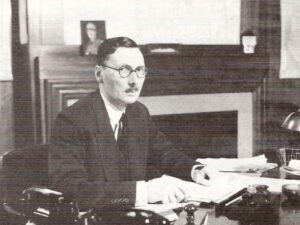
London days, c. 1940. René Pleven looking deceptively mousy.

4,258 words

Many, many years ago — say, during the Nixon administration — I was peripherally involved with kiddy television. Kiddy TV was very hot just then, particularly up in Boston, where they had at least four “educational” kiddy shows running concurrently.

There was an Englishman named Chris Sarson who came up with the idea of having a kiddy show that was entirely written by kids. That sounded like a pretty rotten idea to me — a TV show written and sort-of produced by 7-to-12-year-olds. But what did I know? Not only did this ZOOM thing attract a steady following, there were all sorts of people lining up, trying to conceive and produce their own shows along similar formulas.

I recall one old guy, maybe 30 but looking 40, who didn’t even own a TV, had never seen ZOOM, in fact hadn’t watched much television since the Spin and Marty days, and had no connection at all to modern kids (not on any normal, healthy level, anyway). Yet, he nevertheless promoted himself as a producer/writer of his own forthcoming educational kiddy show: “Just like ZOOM but more intellectual” — and it would be called Tops for Tweens!

“Sounds like a t-shirt fashion show,” a lady friend told him. So he came up with other names, equally silly, though none with the same sizzle. I believe he was unemployed at this point.

But our aspiring producer wasn’t entirely without professional experience in the kiddy-show realm. Oh, no. For three or four weeks he’d been a staff writer for a children’s “science show” on the educational channel in Boston. The presenter was a hokey old “cowboy” host who’d been doing this sort of thing since 1947. Our new staff writer’s contributions were thought to be quite weird, but that was the point: He’d been brought in to come up with new and offbeat ideas. He proposed that Cowboy Duke’s Science Show do a segment on astrology. He’d invite an astrologer onto the program to show how it all worked. This horrified his midwit colleagues, because their high school teachers had taught them that astrology “wasn’t true” because “there are only twelve signs and there are more than twelve kinds of people.”

A debatable point. At any rate, the contretemps amused rather than alarmed Cowboy Duke because, as I say, Cowboy Duke was looking to shake the show up a little.[1] And then the new writer proposed bringing General Patton’s daughter onto the show — because, he said, he’d met her and she was a witch. Or at least she said she was a witch — she lived in Ipswich, after all — and the kids at home would surely love to learn all about witchcraft.

It was at this point that the co-producers took Cowboy Duke aside and told him he had hired a madman. And so ended a promising career, so far as I know.

Down in New York we had Sesame Street, which had more or less kicked off the whole educational-kiddy-TV rage in 1969. It was nationally broadcast via PBS, but it was born and bred in Manhattan, hence its charming conceit of having a studio set that looked like a tenement block in Harlem, with a lot of colored people. Sesame Street was initially conceived as a kind of “Head Start”-style learning boost for poor “inner city” (i.e., black) preschoolers, but it became quickly accepted as a variety program for kids and stoners of all ages. (“Oh man, this is near . . . and this is far! Dig it!”)[2]

The producers eventually cleaned up the slum aspect, at least a little, and also fired Its star Muppet personality, Kermit the Frog. They said Kermit was “too commercial.” It seems he’d made one TV commercial, in Canada. That went against the PBS brand, I guess.[3] Like a blacklisted filmmaker, Kermit took refuge in England, where he eventually found his footing when he compèred The Muppet Show.

The Electric Factory

In the meantime the Sesame Street people, Children’s Television Workshop, cloned the basic format — rapid-fire segments mixed with song and humor, just the sort of thing kids with attention deficit disorder (ADHD) like (or is that what causes ADHD in kids?) — and came up with a program that was neither set in a slum nor aimed at preschoolers. Six-to-12-year-olds were now the target audience. Like Sesame Street, this new show was shot in a commercial videotape facility way up on the Upper West Side, on Broadway near Zabar’s. When I visited the studio, I’d refer to the new show as The Electric Factory, which was almost its name, but not quite. The assistant producer, Pat, would always look at me quizzically when I called it that. He’d smile, and correct me. So I kept doing it. I assumed that my position in such enterprises was sort of like being a one-kid “focus group,” an expert on what modern pre-adolescents were thinking — a subject on which I did not have a clue, as I’d put those days behind me.

Pat was a good-looking, slender, dark-haired fellow in his 30s. Great wife, cute kids. He had a very slight foreign accent, hard to identify. He was, or had been, French — Breton, actually. It was an accent so subtle you might not notice it at first.  I guess he’d lived in Paris during the War, after which his widowed mother married an American songwriter in New York (1946). By happenstance the songwriter was Cole Porter’s first cousin once removed, though he was scarcely as famous, rich, or talented as Cole. He was a fairly normal guy, though, so it all balanced out.

Pat went off to prep school in Pennsylvania and college in Upstate New York. After that, he followed a career that was almost entirely in television production and film distribution. He produced a “circuses of the world” prime-time show that you may remember, hosted by Don Ameche. He then worked in soap operas and daytime programming. Memorably, he was on the production team of the famous “gothic” soap opera of the late 1960s. It was sort of the Law & Order of its era, in that just about any aspiring actor could get a chance to appear in it. When I look at its cast list today, I see Marsha Mason, Harvey Keitel, Abe Vigoda, Conrad Bain . . . even Wilmot Robertson’s first cousin, Cavada Humphrey, daughter of his mother’s sister and a one-armed Romanian nobleman.

A couple of Pat’s friends or colleagues had an off-putting way of taking me aside and telling me that there was a Big Secret That You Must Never Tell Another Soul. I suspected The Big Secret was cockamamie rubbish, although it took me 30 or 40 years to sort it out. The really creepy aspect was: How come, if it was such a hush-hush Big Secret, they were telling it to me, a14-year-old near-total stranger? Although I met Pat and his family a few times, and even went with his wife and kids to pick out a Christmas tree one December, way the hell up Fifth Avenue, I didn’t know them well and I was hardly deserving of dark confidences from third parties.

The “Big Secret”

So now we come to the Big Secret which, I again remind you, is untrue. Pat’s father had purportedly been Minister of the Interior in the Vichy France government during the War, and “they” shot him afterwards, after so-called “Liberation.” Only it’s not so; it didn’t happen. He died, but he didn’t die that way.

Today you say, “What the hell, why would anyone care to make up stories like that?” Well, we were still only twenty-something years after the War, you see. Imagine that someone today was telling you about a dark secret from 1997.

The Big Secret was impossible to verify. Back in the early 1970s, it was much harder to research things than it is today, especially information about obscure things like the various ministries of the Pétain years. Today you can go to Google or Wikipedia and be fed all kinds of disinformation, but at least that disinformation generally has a trail of references you can chase down. For Pat’s father, there was nothing at all. Nothing. You couldn’t look him up in the encyclopedia or in The Reader’s Guide to Periodical Literature; he was too obscure. Besides, I didn’t even know what his name was. It was like being Inspector Lebel in The Day of the Jackal.
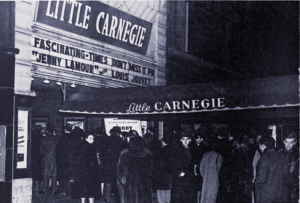
The closest thing to useful information was something I got from a French movie that had just opened at the Little Carnegie movie theater on West 57th Street. French movies were big that year. This one was called Le Souffle au coeur (Murmur of the Heart). It’s a semi-autobiographical film by Louis Malle, set in the spring and summer 1954. This was the time of Dien Bien Phu, when the French finally gave up the ghost in Indochine. The movie’s mainly about adolescents, but at dinner adults are talking politics: “You know what’s happened? Pleven’s seized L’Express. You think the government will fall?”[4]

You can buy Francis Parker Yockey’s The Enemy of Europe here.

This Pleven would have to be René Pleven, at that time France’s Defense Minister. A highly verifiable name: He was at other times Finance Minister or Foreign Minister, or Minister for Colonies . . . as well as being Prime Minister twice. Definitely in the encyclopedia, however sparsely. As these were ministries during the musical-chairs governments of the Fourth Republic, René held some of those posts for only six months.

He was on the outs with the Gaullists when the Fifth Republic came in, but during the Pompidou era of 1969-73, he turned up as Justice Minister. He distinguished himself early in that term by signing a pardon for Henri Charriere, the escapee from French Guiana prisons whose “creative non-fiction” memoir, Papillon, had been topping the bestseller lists.

René Pleven was in all the reference books, but none of them ever said he had a brother, let alone a nephew. And, strangely for a public figure and prominent statesman, he neither wrote a memoir of his public life nor saw a biography published during his lifetime. Even now, his travels and adventures are best gleaned from biographies of Charles De Gaulle or histories of the Fourth Republic. Most eminent people donate their private papers to a public archive or university library long before they die, but René Pleven did not. There doesn’t even seem to be much at the Archives Nationales.[5]

So if the figure of René Pleven has never been on your radar, that’s probably the way he wanted it.

And we must assume René was being careful and cagey all along, destroying most of his papers, or at least embargoing them till after his death. I am put in mind of June 1940, when the Germans were approaching Paris, and at the Quai d’Orsay the Foreign Ministry was busy incinerating decades’ worth of confidential documents in the courtyard. Leave no incriminating scraps or bordereaux behind! This instinct must have become embedded in French officialdom.

The only biography of him that I know of was published in 1994, a year after he died, age 91: René Pleven, un français libre en politique, written by a fellow Breton, Christian Bougeard. The author tells us at the front of the book that this is indeed the première biographie. Although it’s a rather circumlocutory and speculative biography, we do finally locate the mysterious brother. His sad story erupts briefly in Chapter VII, when René finally returns to France in late August 1944.

At this point René has spent the last four years with Charles De Gaulle, Jean Monnet, and the other Free French in London, as well as in America and Africa. René now pays a visit to his mother in Dinan. He learns that his younger brother, Hervé, has been arrested and is in prison at Fresnes, south of Paris. A few weeks later, Hervé Pleven meets with misadventure. He is beaten to death or crushed by a crowd until he suffocates.

How Ya Fixed for Ciné Film, Monsieur?

So Hervé had indeed been in a government ministry, though he was hardly high-profile. He was an undersecretary at a minor Vichy ministry, the Ministry of Information. Not literally in Vichy; it wasn’t actually down south with the spas and casinos. Like most ministries and administrative offices, it was based in Paris.

In spring 1942 we find the following notice in a number of newspapers: «M. Hervé Pleven est nommé chef de cabinet au secretariat general a l’information.» So, he was Chief of Staff to the Secretariat of Information — the Information Ministry. Some papers add the additional information that “M. Pleven, who is also a lawyer, has specialized for many years in matters pertaining to the cinema.”

Hervé had in fact been a prominent film executive. We’ll come to that. In 1942-1944, he was merely a bureaucrat, and thus very small fry indeed.

Hervé’s remit at the ministry was ostensibly film distribution and censorship, but I doubt he needed to censor anything. French cinema during the Occupation was not only apolitical, it tended to be fantastical, otherworldly.[6] Besides, according to a colleague in the ministry, Leon Gaultier, M. Pleven’s job actually consisted mostly of helping filmmakers who all had the same problem: They couldn’t get any film.[7]

And now — as the late Paul Harvey would say — the rest . . . of the story.

Bousculade

Biographer Christian Bougeard explains that the Minister of Information, Paul Marion, was a notorious “ultra,” a former member of Jacques Doriot’s PPF (Parti Populaire Français), a hard-Right pro-Milice collaborationist faction. Not only that, but Marion actively promoted recruitment of Frenchmen into the Waffen-SS, and at least one member of his ministry (Leon Gaultier) joined. All this would help to explain why Hervé was rounded up in the épuration.

The circumstances of his death are explained in Bougeard as «Il mourut tragiquement en prison à l’automne 1944, “étouffé dans une bousculade”»: “Died tragically in prison [27 September 1944], ‘suffocated in a stampede.'”

Presumably that’s taken from the prison’s death register. Was it during a prison riot? A targeted killing? The screws at Fresnes, probably under Red control in September 1944, wouldn’t say or didn’t know. And René and his mother are unlikely to have investigated Hervé’s tragic end. After all, Hervé had been one of the “Vichy people” (as De Gaulle would say), and in 1944 and 1945 they were shooting people like that. The less said the better.

Action Française and RKO France

Hervé’s career can be assembled only from the tiniest scraps and oddments, mainly from newspapers, film journals, and Ancestry.com. He was born in Rennes in December 1903 and buried at Père-Lachaise circa October 1944. Like his brother, he had been a fan of Charles Maurras and Action Française (AF) when he was young. But while René is (suspiciously) insistent in the Bougeard biography that he never joined the AF, younger brother Hervé became quite active in the society’s student arm. In an early 1921 issue of the AF student paper, L’Étudiant français, we learn that “[i]n Le Mans, Hervé Pleven will be speaking at the next conference, 13 Feb 21.” Hervé was then 17.[8]

His pre-war career was an impressive one. Like René he went to law school, became an avocat, then worked as a business executive, mostly for American corporations. During the 1930s Hervé was head of, or at least general counsel for, RKO France. We can only speculate about how this happened.

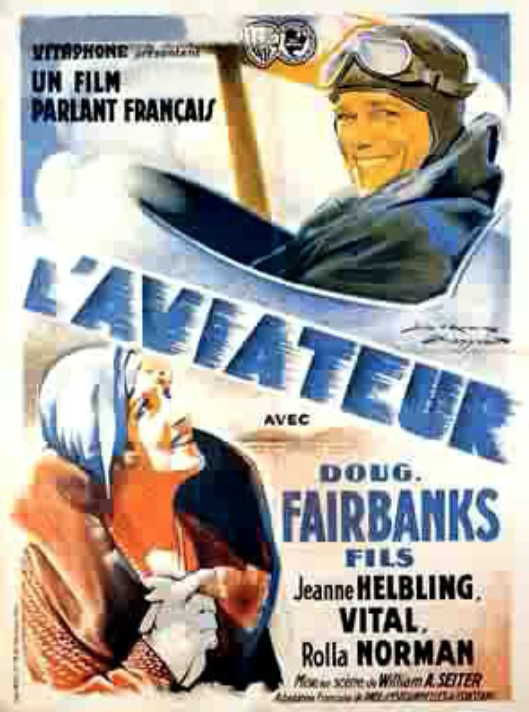
In America, RKO was a movie studio and theater chain that Joseph P. Kennedy and David Sarnoff assembled in the late 1920s, RKO Radio Films. JPK bought up a chain of 700 vaudeville houses so they could be wired for Sarnoff’s Photophone optical sound system. Thus, almost overnight, around 1928, the industry converted to talkies.[9] And this American consortium apparently lucked into finding a very young Breton lawyer, fluent in both French and English, to help set up RKO France’s operations.[10] They were producing films at least by 1931 (e.g., L’Aviateur, with Douglas Fairbanks Jr. and a mostly French cast), but they seemed to have been few and far between. Perhaps their main business was distribution, not production.
There is no clear record of how Hervé got involved with RKO, but his brother’s business connections suggest René had a hand in it. For a few years after law school, René worked with Jean Monnet for an American investment bank called Blair & Co.[11][12] This eventually led to René taking a job with a London subsidiary of one of Blair’s clients, the Automatic Telephone Company.[13] Meanwhile, Blair & Co. was also financing motion-picture industry offerings and acquisitions for Joseph P. Kennedy and associates in Hollywood. While Blair as a company name was absorbed into Bank of America and Transamerica in 1929, by that point RKO Radio Pictures (or RKO Pathé, as it was sometimes styled) was up and running. So it’s reasonable to assume Hervé became acquainted with RKO through the Blair/René connection.

Big Brother, Little Brother

You can buy Tito Perdue’s The Philatelist here.

Having no real facility for languages, I find a deeper wonderment in how the Pleven brothers gained fluency in English. I can barely stagger through Christian Bougeard’s biography of René, and that’s written in perfectly clear French. Presumably the Plevens learned English while growing up in Little Britain (Bretagne), where I expect the folk instinctively keep a weather eye out against the Paris-French hordes. Remember what they did to us in 1793, lads! You love your land, but you never know when you might have to jump «La Manche». As, indeed, René might have in June 1940, if he and his wife and children weren’t already living in London.

Back when René had to write his thesis as a final qualification for his law degree, he was persuaded to write it on — and I quote — “the social policy of the Lloyd George government as demonstrated by the situation of agricultural laborers in England during and after the [1914-18] war.”[14] What an odd and dreary topic! I gather his advisor was a professor of rural economics and wanted a fluent English reader to tackle this recondite subject. Same old story of professors getting their grad students to do hard research for them. But it suggests that  René gained a fuller knowledge than most Englishmen of certain corners of English society and politics.

René versus Hervé: The two brothers appear to have been very dissimilar physically. If you see a picture of René where he’s seated, he looks like this little mousy, milquetoast character. “Oh, he’s the Minister of Economics and Finance? Yes, I can believe that.” Then you see him standing, and it turns out he’s built like a linebacker: big-headed, big-boned, nearly as tall as the 6’5″ Charles De Gaulle (that’s about 195cm in French) himself. I have no pictures of Hervé and do not have the gall to ask his relatives, but from a 1929 passenger manifest I find him to have been doll-like in comparison: a mere 5’8″ (173cm), scarcely taller than most of the officers and ministers you see here, whom René Pleven and Charles De Gaulle just tower over in 1940s photos. From 1943:
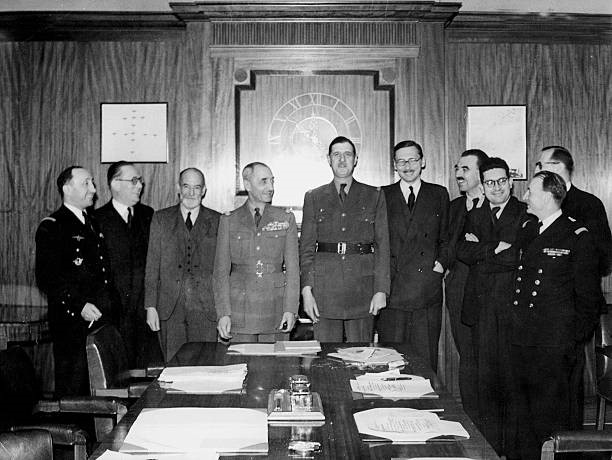
The last session of the French National Committee in London before its departure for Algiers, May 1943. The unmistakable and unusually merry Charles De Gaulle and René Pleven tower over most of the others.

After the fall of France in June 1940, René in London joined up with his old mentor and colleague from Blair & Co., Jean Monnet, and set about managing the  non-existent finances of General De Gaulle’s new cause. Monnet found De Gaulle difficult and impractical, so he soon sloped off to Washington, DC, where he was a popular advisor to President Roosevelt and his administration.

For René, things were different. De Gaulle kept him very busy, sending him off to America to help raise awareness and maybe funds for the newly-christened “Free French.” The excursion was not a total disaster, but neither was it a shining success. While FDR liked Jean Monnet very much, he refused to meet René because he perceived him as a drum-beater for De Gaulle. Fair enough. President Roosevelt was appointing a very capable ambassador to Vichy France (Admiral William Leahy, later to be FDR’s Chief of Staff), and relations with the Pétain people were stable and good. Objectively, FDR was right. Pétain’s government, from any reasonable diplomatic perspective, was the legitimate government of France — and most of the possible recruits whom René met were cranks or otherwise unworkable.[15]

After Liberation, René’s public career is pretty much a matter of public record, and I’ve summarized most of it above: Minister for Colonies, as well as for economics and finance; Premier (or president du conseil — literally, head boy at the ministers’ table) twice; Foreign Minister, Defense Minister, etc. etc. A Swiss Army knife of a politician or bureaucrat. His major initiative is remembered as the “Pleven Plan,” a Western European defense community that the US State Department, and certain British politicians (mainly Winston Churchill), had been encouraging. Unlike NATO, this “European Defence Community” would not have included the United States or the United Kingdom. France would be the dominant nation. Nevertheless the plan was rejected by the French Assembly in 1954, not long after Dien Bien Phu and the fall of the government in which René had been Defense Minister. As the Gaullists had turned against him because of Indochina, René went into eclipse for the next 15 years, till Pompidou made him Justice Minister in 1969.

His nephew, Hervé’s son, continued to work in television and film production and distribution. By the 1990s he wound up as an executive, or bureaucrat, with the New York City Mayor’s Office for Film, Theater, and Broadcasting. Mainly it was all about facilitating filmmaking in the city, basically doing what his father had been doing in Paris 50 years earlier: making sure movie-makers had access to locations — and, I suppose, enough film.

* * *

Like all journals of dissident ideas, Counter-Currents depends on the support of readers like you. Help us compete with the censors of the Left and the violent accelerationists of the Right with a donation today. (The easiest way to help is with an e-check donation. All you need is your checkbook.)

GreenPay™ by Green Payment

Select donation type

Select or enter an amount to give

Select or enter an amount to give monthly

For other ways to donate, click here.

Notes

[1] Cowboy Duke’s Science Show was not actually the program name, but people familiar with the Boston educational channel in those days will know what I’m talking about. Tops for Tweens! is also a made-up proxy title, as silly as the real ones. ZOOM, of course, was a real name for a real show that ran from 1972 until 1980, and then was revived in 1999.

[2] And inspired the second-most brilliant comedy show I ever saw on Broadway, Avenue Q.

[3] TIME magazine, November 23, 1970 (Stefan Kanfer cover story): “Kermit the Frog is being canned for commercialism.”

[4] Jean-Jacques Servan-Schreiber at L’Express published a secret report about military operations in Indochina, whereupon the magazine’s operations were suspended and all copies of the offending issue were seized. Servan-Schreiber was a persistent opponent of the war in Indochina. A court later ruled that the publication had not violated the penal code. (Source: New York Times, July 10, 1954.) And yes, the (Joseph Laniel) government did fall, in June 1954, as a direct result of Dien Bien Phu, to be succeeded by that of Pierre Mendes-France.

From René Pleven’s obituary in the Independent, 16 January 1993:

Pleven was Minister of Defence at the time of the fall of the French army base at Dien Bien Phu to Vietnamese guerrillas in 1954. He was manhandled by Gaullists at the Arc de Triomphe and was referred to dismissively as the ‘Duc de Dien Bien Phu’ for some time after.

[5] Archives Nationales has papers from René’s late-career stint as Justice Minister, but they didn’t come from René. Their inventory date is 1995, with a note that these papers were entered into the Archives by “donations from Michel Worms de Romilly and Louis Andlauer and Patrick Pleven” (nephew and in-laws).

[6] Notable French films of the period from 1940 to 1944 include La Nuit Fantastique, Le Corbeau, and Les Enfants du Paradis.

[7] Leon Gaultier, Siegfried et le Berrichon: Parcours d’un “collabo,” 1991. Gaultier served in the Information Ministry with Paul Marion and Hervé Pleven and joined the Milice, and later, the Waffen-SS.

[8] L’Etudiant français (Action française’s student paper), issue date of February 15, 1921.

[9] Kennedy himself soon sold off his interest in RKO and got out of the film business by 1930, except for occasional advisory work for Paramount and others. The story is told in many places; one is Cari Beauchamp’s Joseph P. Kennedy Presents: His Hollywood Years (2010).

[10] I cannot tell when Hervé joined RKO France. In 1935, however, we find him as general counsel, on a business trip to New York, in a trade publication: Film Daily for Friday, April 5, 1935.

[11] Jean Monnet (1888-1979) was a polymath financier, diplomat, and politician, often called a founding father of the European Economic Community/European Union.

[12] There seem to have been many financial institutions with the approximate name Blair & Co. This one, a New York-based investment bank, merged with Bank of America/Transamerica in 1929. Like J. P. Morgan & Co., Blair specialized in international loans to foreign governments. As an interesting aside, biographer Bougeard notes that the young John Foster Dulles advised Blair & Co. (including Jean Monnet and René Pleven) when negotiating a loan to Warsaw. Dulles and Pleven would again meet up during the Fourth Republic, when Pleven was variously Prime Minister, Foreign Minister, or Defense Minister, and Dulles was Eisenhower’s Secretary of State. There is a famous but unsubstantiated legend that in 1954 Dulles offered «deux bombes atomique» to Foreign Minister Georges Bidault, who refused the offer on the grounds that the bombs would kill the whole French garrison. M. Bidault claims this in the Peter Davis documentary, Hearts and Minds (1974).

[13] Automatic Telephone Company, Europe, was the London-based subsidiary of an American firm that pioneered telephone switching equipment for direct dialing. I have read that René also worked in Canada, and perhaps America, but the record is unclear whether he worked in situ or simply reported there or attended business meetings.

[14] Christian Bougeard, René Pleven: Un Français libre en politique (Presses universitaires de Rennes, 1994).

[15] William R. Keylor, Charles De Gaulle: A Thorn in the Side of Six American Presidents (Rowan & Littlefield, 2020). A good description of what proved to be René’s fool’s errand in America 1940, in one of the few books on De Gaulle that give more than a brief mention of René Pleven.

The Fabulous Pleven Boys

The%20Fabulous%20Pleven%20Boys

Share

  • Gab

Enjoyed this article?

Be the first to leave a tip in the jar!

Instant Echeck GreenPay™

Related

  • Exclusive Interview with Karel Veliky Part 2

  • Barbara Will’s Unlikely Collaboration, Part 2

  • Barbara Will’s Unlikely Collaboration

  • Neo-Fascism in Film, Part 3

  • E. M. Forster’s A Passage to India & the Indian Mentality

  • Jonathan Bowden’s Deliverance, Part 3

  • The Rest Is Silence: Heidegger’s Quietism

  • Dispelling the Historical Fallacy of Indian Nationalism

Tags

Action FrançaiseCharles De Gaullechildren's televisionChristian BougeardDark ShadowsDien Bien PhuFranceFrench Fourth RepublicHenri CharriereHervé PlevenHollywoodJean MonnetJoseph P. KennedyKermit the FrogLouis MalleMurmur of the HeartP. J. CollinsPapillonpaywallPBSPleven PlanRené PlevenRKO FranceSesame Streetthe Free Frenchthe Waffen-SSVichy FranceWilmot RobertsonZoom

2 comments

  1. Greg Johnson says:
    March 23, 2023 at 3:59 pm

    What a fascinating yarn combined with real historical spadework. Thank you, P.J., for a wonderful read.


    0
    0
    1. P. J. Collins says:
      March 23, 2023 at 10:18 pm

      Thank you. I was always worried about offending members of the family by even delving into this, but perhaps I have helped some earnest grad student in history!

      0
      0

Comments are closed.

If you have a Subscriber access,
simply login first to see your comment auto-approved.

Note on comments privacy & moderation

Your email is never published nor shared.

Comments are moderated. If you don't see your comment, please be patient. If approved, it will appear here soon. Do not post your comment a second time.

Writers of May

(2 votes) Morris van de Camp David M. Zsutty Derek Stark Jayant Bhandari Greg Johnson

Articles of May

The Lunch Wars by David M. Zsutty Heidegger on Nietzsche, Part One by Collin Cleary 2 votes
    • Interview with Gerhard Hallstatt of Allerseelen:
      The Gesamtkunstwerk of the Future!

      Ondrej Mann

    • The Doxing of Austin Franco

      David M. Zsutty

      1

    • Small Is Beautiful:
      The Napoleon of Notting Hill and G. K. Chesterton Upon Defending One’s Homeland from Others—and Itself

      Steven Tucker

      2

    • The Psychology Behind MrBeast’s Moronic Thought Experiment

      Endeavour

      9

    • On the Roots of Anti-Immigrant Sentiment in Contemporary Britain

      Lipton Matthews

      7

    • Remembering Enoch Powell:
      June 16, 1912–February 8, 1998

      Greg Johnson

      17

    • Counter-Currents Radio Podcast No. 691
      Rob Rundo Returns

      Counter-Currents Radio

    • The Fragile Polity that is Syria

      Morris van de Camp

      2

    • Nigel Farage Calls Britain a Two-Tier State

      Mark Gullick

      4

    • Nationalism This Week
      Letter to J. D. Vance

      Greg Johnson

      32

    • Lost In Trans-Mission:
      How the Media Fails To Reveal the Inconvenient Truth About the Usual Suspects

      Steven Tucker

      10

    • Liar, Liar, Pants on Fire!

      Beau Albrecht

      7

    • Editor’s Update
      Rob Rundo on Counter-Currents Radio, Fundraiser Update, & a New $20,000 Matching Grant

      Greg Johnson

    • The Bitter End of Western Metaphysics:
      Heidegger on Nietzsche, Part Three

      Collin Cleary

      10

    • Uncivil War

      Mark Gullick

      50

    • Exclusive Interview with Karel Veliky:
      The Final Chapter in the Film Series! Part II

      Ondrej Mann

      2

    • Happy Birthday to Us!

      Greg Johnson

      6

    • Zsutty’s Maximum

      David M. Zsutty

      16

    • Exclusive Interview with Karel Veliky:
      The Final Chapter in the Film Series! Part I

      Ondrej Mann

      2

    • The Union Jackal, June 2026

      Mark Gullick

      23

    • The Inferiority Behind Immigrant Superiority

      Jayant Bhandari

      15

    • Counter-Currents Radio Podcast No. 690
      Greg Johnson & David Zsutty Discuss Current Things: AI, Henry Nowak, the Iran Crisis, & More

      Counter-Currents Radio

      7

    • Collin Cleary: What Rome Means to Me

      Collin Cleary

      4

    • Paul Krugman: Closet Bolshevik

      Spencer J. Quinn

      21

    • Fugue of Ideas:
      Ibram X. Kendi’s Chain of Ideas

      Greg Johnson

      19

    • Based Blacks

      Lipton Matthews

      24

    • Black Intellectual Fatigue

      Derek Stark

      41

    • Why White Advocates Should Avoid “Based Blacks”

      Dani Vypont

      32

    • Nietzsche & Race

      Mark Gullick

    • Editor’s Update
      Rob Rundo Rescheduled to Next Week on Counter-Currents Radio;
      Tonight Greg Johnson & David Zsutty Answer Your Questions;
      Fundraiser Update & a New $20,000 Matching Grant

      Greg Johnson

    • The Counter-Currents 2026 Fundraiser
      Lifetime Subscriber Welcome Packages Extended

      Greg Johnson

    • Nationalism This Week
      Who’s Looking Back?

      Greg Johnson

      29

    • China’s Threat to American Security:
      Food, Farmland, Foreign Control, & Energy Policy

      Lipton Matthews

      5

    • The Bitter End of Western Metaphysics:
      Heidegger on Nietzsche, Part Two

      Collin Cleary

      16

    • The Killing of Henry Nowak

      Mark Gullick

      38

    • The Crisis of Chinese Technology Thieves

      Morris van de Camp

      1

    • The Strange World of Gender Bender Fiction:
      & What This Genre Tells Us About Autosexuality

      Dani Vypont

      3

    • Watching the Watchers:
      The Dark Triad Question

      David M. Zsutty

      14

    • The Remigration Movement Solidifies

      F. Roger Devlin

      2

    • Casting Aspersions:
      The Fatal Consequences of Race-Swapped Casting, From Helen of Troy to Henry of Southampton

      Steven Tucker

      20

    • The Murder of Henry Nowak

      Millennial Woes

      23

    • Don’t Forget to Vote in Our Writer & Article of the Month Poll

      Greg Johnson

    • The Robot Hotdog Stand

      Greg Johnson

      37

    • Laughing Our Way to Victory

      Dave Chambers

      7

    • The Zodiac Killer

      Mark Gullick

      11

    • Jared Taylor: What Rome Means to Me

      Jared Taylor

      1

    • An Interview with Endeavour:
      My Way of Life Is an Adventure!

      Ondrej Mann

      6

    • José Pedro Zúquete’s The Identitarians

      Greg Johnson

      3

    • Editor’s Update
      Fundraiser Update & How to Watch the Remigration Summit

      Greg Johnson

      5

    • The Bitter End of Western Metaphysics:
      Heidegger on Nietzsche, Part One

      Collin Cleary

      12

    • Will Williams

      Is the Anti-Defamation League a Hate Group?

      Bertrand russell: June 18, 2026  Read False Flags by the late Michael Collins Piper, available...

    • JBP

      The Doxing of Austin Franco

      Thanks. Let the (((doxxing))) begin.

    • Joe Gould

      On the Roots of Anti-Immigrant Sentiment in Contemporary Britain

      It's too late to discuss whether the antiwhitism, hypocrisy, and injustice of the ruling...

    • Bertrand russell

      Is the Anti-Defamation League a Hate Group?

      Read False Flags by the late Michael Collins Piper, available at Unz Review and Archive.org. Piper...

    • Beau Albrecht

      Remembering Enoch Powell

      At the time, Britain was still only experiencing the thin end of the wedge as far as migration goes...

    • Peter Quint

      Remembering Enoch Powell

      Okay, so he has two White Nationalist speeches to his credit. 🦈

    • CC Reader

      Remembering Enoch Powell

      The best Prime Minister England never had. Powell went on the Dick Cavett show and was treated...

    • Livla

      The Psychology Behind MrBeast’s Moronic Thought Experiment

      From a biological perspective, this thought experiment is the equivalent of a selection event that...

    • Adrian Roberts

      Remembering Enoch Powell

      In Mein Kampf, Hitler argued that the side which makes war inevitable is the side most responsible...

    • Adrian Roberts

      Remembering Enoch Powell

      So the English owe everybody reparations? Damn.

    • Wasili

      The Psychology Behind MrBeast’s Moronic Thought Experiment

      Great article!  Indeed, the following point can’t be emphasized enough: The [insert non-white...

    • Will Williams

      On the Roots of Anti-Immigrant Sentiment in Contemporary Britain

      Ecological experts call the replacement of one species by another as habitat succession. In my...

    • Douglas Mercer

      Remembering Enoch Powell

      In 1977 Powell gave a speech called The Road To National Suicide: “On the other hand there are at...

    • JayeRyanOD

      The Fragile Polity that is Syria

      I strongly support ex Syrian President Assad supported by my kinsmen the Russians . Before the...

    • Joe Gould

      The Psychology Behind MrBeast’s Moronic Thought Experiment

      I don’t see the decline of real, useful work as alarming or surprising, rather it is inevitable.We...

    • E_Perez

      On the Roots of Anti-Immigrant Sentiment in Contemporary Britain

      A little soft, the article, especially when its title promised to go to the roots. "The...

    • Elear

      Small Is Beautiful: The Napoleon of Notting Hill

      A wonderful essay about things so small yet so precious. Fighting off the invaders is meaningless if...

    • Quu

      The Psychology Behind MrBeast’s Moronic Thought Experiment

      Thank you, yes, it's very interesting, revealing a predisposition that isn't globally normal, and...

    • The Laughing cavalier

      Remembering Enoch Powell

      It was England who declared war - both times - and neither time was England under any threat. It'...

    • TheLau ghin gCavalier

      The Psychology Behind MrBeast’s Moronic Thought Experiment

      A version of this scenario did the rounds on 4chan where red was "nothing happens" and blue was "50...

    • Earth Day Special

      John Morgan

      12

    • A Robertson Roundup
      Remembering Wilmot Robertson
      (April 16, 1915 – July 8, 2005)

      Margot Metroland

      13

    • The Paranoid Style in White Nationalism

      Greg Johnson

      30

    • Join the Dance!

      Andrew Hamilton

      1

    • We Can’t Save the Earth Without Reducing African Birth Rates

      James Dunphy

      36

    • “I’m Not a Conspiracy Theorist, but . . .”:
      Jeffrey Epstein’s Death Gives New Life to “Conspiracy Theories”

      Greg Johnson

      22

    • Sylvia Plath: Stasis in Darkness

      Vic Olvir

      17

    • Vanguardism, Vantardism, & Mainstreaming

      Greg Johnson

      80

    • Aviation, Geography, & Race

      Charles Lindbergh

      3

    • Some Thoughts on Yule

      Collin Cleary

      4

    • Living in Truth:
      A Yuletide Homily

      Jef Costello

      7

    • John Kennedy Toole’s A Confederacy of Dunces

      Greg Johnson

      20

    • On Aleksandr Solzhenitsyn’s Warning to the West

      Spencer J. Quinn

      7

    • Elitism, British Modernism, & Wyndham Lewis

      Jonathan Bowden

      6

    • Philip K. Dick’s Do Androids Dream of Electric Sheep? as Anti-Semitic/Christian-Gnostic Allegory

      Greg Johnson

      20

    • “Conspiracy Theory” or Conspiracy?

      Andrew Hamilton

      21

    • Remembering H. P. Lovecraft
      (August 20, 1890–March 15, 1937)

      Greg Johnson

      3

    • Who Are We?
      Nordics, Aryans, & Whites

      Greg Johnson

      71

    • Remembering William Gayley Simpson
      (July 23, 1892–December 31, 1990)
      A Pleasant Afternoon with Harriet & Bill Simpson

      Margot Metroland

      18

    • Here are the Young Men
      Remembering Ian Curtis
      (July 15, 1956–May 18, 1980)

      Mark Gullick

      18

    • Percy Grainger
      Artist of the Right

      Alex Graham

      7

    • Remembering Revilo Oliver
      (July 7, 1908–August 20, 1994)

      Greg Johnson

      18

    • The Meaning of July 4th for the White Man

      Gregory Hood

      13

    • The Front National’s Evolution

      Bruno Mégret

    • Merwin K. Hart
      Forgotten American Hero & Man of the Right

      Morris van de Camp

      10

    • George Orwell’s Nineteen Eighty-Four

      Jonathan Bowden

      8

    • Carleton S. Coon
      Scientist & Reluctant White Advocate

      Morris van de Camp

      3

    • The Kwanzaa Absurdity Will Be Dwarfed by Juneteenth

      Robert Hampton

      10

    • Stravinsky

      Alex Graham

      7

    • Like the Roman:
      Remembering Enoch Powell (1912-1998)

      Mark Gullick

      23

    • About Film “From the Right”

      Karel Veliky

    • The 1970s: The Golden Age of Hijacking

      Morris van de Camp

      21

    • Jonathan Bowden’s Deliverance
      Part 6

      Jonathan Bowden

    • Do You Want to Play a Game?

      Mark Gullick

      1

    • Sexually Incontinent on the Indian Subcontinent:
      Who Rapes More Animals, Indians or Pakistanis? The Battle Continues!

      Steven Tucker

      3

    • Neo-Fascism in Film
      Part 5

      Karel Veliky

      15

    • The Game of Tarot

      Mark Gullick

      2

    • Institutions Cannot Be Transplanted

      Jayant Bhandari

      5

    • Jonathan Bowden’s Deliverance
      Part 5

      Jonathan Bowden

    • Crosstown Traffic:
      Jimi Hendrix & The Post-War Rock ‘N’ Roll Revolution

      Mark Gullick

      1

    • Slaves from the North:
      Finns & Karelians in the East European Slave Trade, 900–1600

      Lipton Matthews

      14

    • Neo-Fascism in Film
      Part 4

      Karel Veliky

      2

    • David Lean’s A Passage to India

      Spencer J. Quinn

      1

    • Elites are Essential to Development

      Lipton Matthews

      7

    • Jonathan Bowden’s Deliverance
      Part 4

      Jonathan Bowden

    • Neo-Fascism in Film
      Part 3

      Karel Veliky

      6

    • E. M. Forster’s A Passage to India & the Indian Mentality

      Spencer J. Quinn

      25

    • Jonathan Bowden’s Deliverance
      Part 3

      Jonathan Bowden

    • The Rest Is Silence
      Heidegger’s Quietism

      Mark Gullick

      2

    • Dispelling the Historical Fallacy of Indian Nationalism

      Lipton Matthews

      8

    • Neo-Fascism in Film
      Part 2

      Karel Veliky

      8

    • Jonathan Bowden’s Deliverance
      Part 2

      Jonathan Bowden

    • Life of a Klansman

      Mark Gullick

      8

    • Jonathan Bowden’s Deliverance, Part 1

      Jonathan Bowden

    • Decolonial Ideas are Holding Back Developing Countries

      Lipton Matthews

      8

    • Neo-fascism in Film, Part 1

      Karel Veliky

      21

    • Jonathan Bowden’s Onslaught, Part 8
      Divigations on Decadence

      Jonathan Bowden

    • Jonathan Bowden’s Onslaught, Part 7
      Intrigues in the National Front

      Jonathan Bowden

      1

    • Rotten to the Core

      Mark Gullick

      8

    • Strauss on Husserl’s “Philosophy as Rigorous Science”

      Greg Johnson

    • András László
    • Derek Hawthorne
    • Beau Albrecht
    • Alain de Benoist
    • Kerry Bolton
    • Jonathan Bowden
    • Collin Cleary
    • Jef Costello
    • Savitri Devi
    • Julius Evola
    • Jim Goad
    • Gregory Hood
    • Juleigh Howard-Hobson
    • Greg Johnson
    • Charles Krafft
    • Anthony M. Ludovici
    • Trevor Lynch
    • H. L. Mencken
    • J. A. Nicholl
    • James J. O’Meara
    • Christopher Pankhurst
    • Tito Perdue
    • Michael Polignano
    • Spencer J. Quinn
    • Fenek Solère
    • Irmin Vinson
    • Leo Yankevich
    • Francis Parker Yockey
    • Multiple authors
  • Editor-in-Chief

    • Greg Johnson, Ph.D.

    Featured Writers

    • Beau Albrecht
    • Gunnar Alfredsson
    • Collin Cleary, Ph.D.
    • Jef Costello
    • Morris V. de Camp
    • F. Roger Devlin, Ph.D.
    • Stephen Paul Foster, Ph.D.
    • Jim Goad
    • Alex Graham
    • Mark Gullick, Ph.D.
    • Greg Johnson, Ph.D.
    • Travis LeBlanc
    • Trevor Lynch
    • Margot Metroland
    • James J. O’Meara
    • Angelo Plume
    • Spencer J. Quinn
    • Fred Reed
    • Clarissa Schnabel
    • Michael Walker
    • David M. Zsutty

    Frequent Writers

    • Asier Abadroa
    • Aquilonius
    • Alain de Benoist
    • Kerry Bolton, Ph.D.
    • Dave Chambers
    • Steven Clark
    • James Dunphy
    • Endeavour
    • Richard Houck
    • Jason Kessler
    • Titus Livius
    • Ondrej Mann
    • Lipton Matthews
    • Mark Mazari
    • John Morgan
    • Jaroslav Ostrogniew
    • Kathryn S.
    • Christian Secor
    • Anne Wilson Smith
    • Thomas Steuben
    • William De Vere
    • Kenneth Vinther
    • Max West

    Classic Authors

    • Maurice Bardèche
    • Jonathan Bowden
    • Julius Evola
    • Guillaume Faye
    • Ernst Jünger
    • Kevin MacDonald, Ph.D.
    • D. H. Lawrence
    • Charles Lindbergh
    • Jack London
    • H. P. Lovecraft
    • Anthony M. Ludovici
    • Sir Oswald Mosley
    • National Vanguard
    • Friedrich Nietzsche
    • Revilo Oliver
    • William Pierce
    • Ezra Pound
    • Saint-Loup
    • Savitri Devi
    • Carl Schmitt
    • Miguel Serrano
    • Oswald Spengler
    • P. R. Stephensen
    • Jean Thiriart
    • John Tyndall
    • Dominique Venner
    • Leo Yankevich
    • Francis Parker Yockey

    Other Authors

    • Howe Abbott-Hiss
    • Michael Bell
    • Giles Corey
    • Jack Donovan
    • Richardo Duchesne, Ph.D.
    • Emile Durand
    • Guillaume Durocher
    • Mark Dyal
    • Tom Goodroch
    • Andrew Hamilton
    • Robert Hampton
    • Huntley Haverstock
    • Derek Hawthorne
    • Gregory Hood
    • Juleigh Howard-Hobson
    • Alexander Jacob
    • Ruuben Kaalep
    • Tobias Langdon
    • Julian Langness
    • Patrick Le Brun
    • G A Malvicini
    • John Michael McCloughlin
    • Millennial Woes
    • Michael O’Meara
    • Christopher Pankhurst
    • Michael Polignano
    • J. J. Przybylski
    • Quintilian
    • Edouard Rix
    • C. B. Robertson
    • C. F. Robinson
    • Herve Ryssen
    • Alan Smithee
    • Fenek Solere
    • Ann Sterzinger
    • Robert Steuckers
    • Tomislav Sunic
    • Donald Thoresen
    • Marian Van Court
    • Irmin Vinson
    • Book Reviews
    • Movie Reviews
    • TV Reviews
    • Music Reviews
    • Art Criticism
    • Graphic Novels & Comics
    • Video Game Reviews
    • Fiction
    • Poems
    • Interviews
    • Videos
    • English Translations
    • Other Languages
      • Arabic
      • Bulgarian
      • Croatian
      • Czech
      • Danish
      • Dutch
      • Estonian
      • Finnish
      • French
      • German
      • Greek
      • Hungarian
      • Italian
      • Lithuanian
      • Norwegian
      • Polish
      • Portuguese
      • Romanian
      • Russian
      • Slovak
      • Spanish
      • Swedish
      • Ukrainian
    • Commemorations
    • Why We Write
  • Archives
  • Top 100 Commenters
  • The Looney Bin
Sponsored Links
Europa.com Above Time Coffee Antelope Hill Publishing Paul Waggener IHR-Store Spencer J. Quinn American Renaissance Jim Goad The Occidental Observer
Donate Now Mailing list
Books for sale
  • The Philosopher Is In
  • Sexual Utopia in Power (Expanded Edition)
  • In Defense of Prejudice
  • Loving Our Own
  • Tyranny & Wisdom
  • The Populist Moment
  • Is America Doomed?
  • To all books
Copyright © 2026 Counter-Currents Publishing, Ltd.

Paywall Access


Please enter your email address.

Lost your password?

Edit your comment

Writer & Article of the Month May 2026

Voting for this month has concluded. Here are the final results!

Top Writers

  • #1 Morris van de Camp 2 votes
  • #2 David M. Zsutty 2 votes
  • #3 Derek Stark 2 votes
  • #4 Jayant Bhandari 2 votes
  • #5 Greg Johnson 2 votes
  • #6 Jared Taylor 1 vote
  • #7 Collin Cleary 1 vote
  • #8 Spencer J. Quinn 1 vote
  • #9 Mark Gullick 1 vote
  • #10 Lipton Matthews 1 vote
  • #11 Keith Woods 1 vote
  • #12 Steven Tucker 1 vote

Top Articles

  • #1 The Lunch Wars 2 votes
  • #2 Heidegger on Nietzsche, Part One 2 votes
  • #3 Lothrop Stoddard’s The Revolt Against Civilization 1 vote
  • #4 Could Fascism Work? 1 vote
  • #5 Jared Taylor's Elevator Pitch to a Billionaire 1 vote
  • #6 Predation Wearing the Mask of Civilization 1 vote
  • #7 Peak Fatigue in Fort Wayne 1 vote
  • #8 Keith Wood's Elevator Pitch to a Billionaire 1 vote
  • #9 Do You Want to Play a Game? 1 vote
  • #10 Why Billionaires Should Fund White Identity Politics 1 vote
  • #11 The 1970s: The Golden Age of Hijacking 1 vote
  • #12 True Folk-Horror Is Horror of Your Own Folk 1 vote
  • #13 Finding Atlantis Part 4 1 vote
  • #14 Berlin: City of Stones 1 vote
  • #15 The Ghost of the Confederacy 1 vote

Total votes cast: 17