
Plato by L. Vorsterman after Peter Paul Rubens
5,055 words
Socrates and Plato were enemies of tyranny. Indeed, in book 9 of Plato’s Republic, Socrates sets forth one of history’s oldest and most influential denunciations of tyrants and tyranny. Yet some of their best friends and students were tyrants.
Socrates was a friend and teacher of Alcibiades, a would-be tyrant, and of Critias and Charmides, who were actual members of the Thirty Tyrants who ruled Athens in 404–403 BCE.
Plato had even closer connections with the Thirty. He was a cousin of Critias and a nephew of Charmides. Plato initially supported the Thirty.[1] His older brother Glaucon may have supported them as well.[2]
Plato also knew four tyrants of Syracuse: Dionysius I; his son and successor, Dionysius II; Dion, who was the son-in-law of Dionysius I and the brother-in-law of Dionysius II; and Calippus.[3] Plato sought the favor of Dionysius I because he wished to advise him. But they quickly became enemies when Plato hectored him about the evils of tyranny. Plato, however, became close friends with Dion. When Dionysius II came to power, Plato sought to make him a better ruler but found him ineducable.
Dionysius II exiled Dion, who spent most of this time in Athens in the company of Plato and his school. With the help of Plato’s nephew, Speusippus, Dion deposed Dionysius II and became tyrant in his place. Although Dion sought to rule lawfully, in accordance with Platonic principles, he found that impossible and was later assassinated by Calippus, another student of Plato. Calippus then ruled Syracuse for a year as tyrant before fleeing to become a mercenary captain.
Tyrants were dangerous men to know. Indeed, Socrates’ associations with Alcibiades, Charmides, and Critias were the chief cause of his trial and execution on the charges of impiety and corrupting the youth. Plato, moreover, was imprisoned and sold into slavery by Dionysius I and could well have lost his life in the conflict between Dionysius II and Dion.
Why, then, did wise men like Socrates and Plato associate with tyrants?
Ancient Greek city states were both small and rife with tyrants and would-be tyrants. So any freeborn Greek could be only a few degrees of separation from tyrants without even trying. This was certainly the case with Plato, who was born into the family of Critias and Charmides.
But Socrates and Plato actively courted tyrants. Plato’s Greater Alcibiades depicts Socrates intentionally befriending Alcibiades and offering to help realize his dreams of universal tyranny. Plato, moreover, intentionally cultivated relationships with the tyrants of Syracuse. Socrates and Plato were not fools, so they must have thought such relationships were worth the risk.
To explain this, we must first define tyranny. Tyranny is a form of one-man rule. But so is monarchy. What is the difference? The word “tyrant” originally had the sense of “usurper,” as opposed to a legitimate king. But some tyrants established dynasties, and their successors were styled tyrants as well, not kings. For instance, in the sixth century BCE, Peisistratus became tyrant of Athens, and his sons Hippias and Hipparchus followed him. This pattern was followed in Plato’s time by Dionysius I and II in Syracuse. Thus some Greeks—like Aeschylus and Sophocles—used “king” and “tyrant” interchangeably.
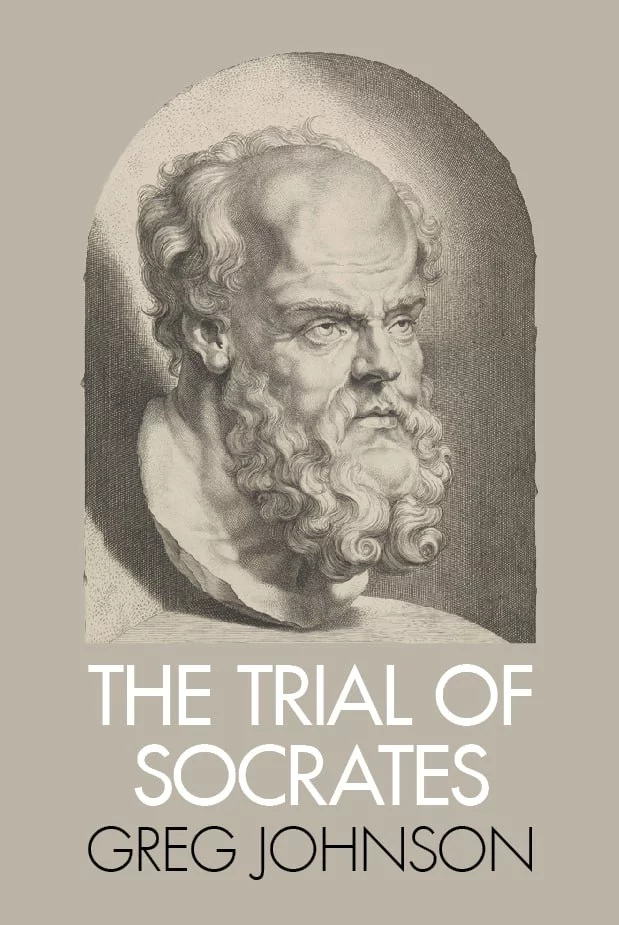
You can buy Greg Johnson’s The Trial of Socrates here.
Plato understood that, at first glance, tyrants and kings might be indistinguishable. They both share the pomps and prerogatives of one-man rule. For Plato, however, tyrants and kings can be distinguished quite cleanly in terms of the inner character of the ruler, the aim of the regime, and the effects they have on society. A monarch is a virtuous man who rules for the common good, whereas a tyrant is a vicious man who rules for his own interests. Thus, a tyranny and a monarchy may look the same at the beginning. But, since character is destiny, with the passage of time, the consequences diverge ever more radically. Monarchical regimes will be happy, harmonious, and stable. Tyrannical regimes will be unhappy, fractious, and fleeting.
In the Republic, Plato develops a systematic analogy between the human soul and the city. The human soul has three parts: reason, which loves truth; spiritedness (thumos), which loves honor; and desire, which loves the gratification of physical appetites. The different parts of the soul can come into conflict. For instance, desires can be unreasonable or dishonorable. Honor can be unreasonable or undesirable. Ideas can be dishonorable or undesirable. There are three basic kinds of men, depending on which part of the soul wins out in such conflicts: rational men, in whom reason triumphs over spiritedness and desire; spirited men, in whom honor trumps reason and desire; and appetitive men, in whom desire rules over both reason and spiritedness.
The political regime corresponding to the rational man is the rule of philosopher-kings. The political regime corresponding to the spirited man is a warrior aristocracy. (Historically speaking, monarchies also correspond to the rule of the spirited element.) There are three regimes based on the rule of desire: oligarchy (where the rich rule), democracy (where the many rule), and tyranny, in which we return to one-man rule, but this time desire is in control, not reason or spirit.
Desire, in principle, is infinite, i.e., open-ended. You can always want more. Order, however, is a matter of limits. The sovereignty of desire, therefore, subverts order. The passage from oligarchy to democracy is accompanied by increasing spiritual and social disorder, which leads to tyranny. Tyranny is a form of disorder, but it also feeds upon a desire to reassert order by concentrating power into the hands of a single man. Unfortunately, a leader cannot impose order if he lacks it in himself, and the tyrannical man is even more desire-driven than ordinary democrats, for he has the means to gratify even the most extravagant and depraved fantasies.
If both the tyrannical and democratic types are ruled by desire, what is the difference? What allows a tyrannical man to rise to power in a democracy? For Plato, tyrants are rare because superior gifts are required to seize control of a society. Thus, as Roger Boesche puts it, Plato had “a certain disconsolate admiration for the tyrant” because he saw tyrants as men with great potential who had gone bad.[4] As Socrates says in the Republic:
Won’t we say for souls . . . that . . . those with the best natures become exceptionally bad when they get bad instruction? Or do you suppose an ordinary nature is the source of great injustices and unmixed villainy? Don’t you suppose, rather, that it’s a vigorous one corrupted by its rearing, while a weak nature will never be the cause of great things either good or bad?[5]
What makes tyrants genuinely tragic is that their superior gifts are harnessed by their desires and the desire-driven society they must rule over, leading to the ruin of everyone involved. The greater the gifts, the greater the ruin.
Thus far, we have an explanation for why Socrates and Plato regarded tyrants as philosophically and psychologically interesting figures fit for tragic drama. But all these traits can be safely appreciated at a distance. So why get closer? Why would they personally associate with such people? What could overcome their inevitable feelings of fear and revulsion?
Socrates and Plato were not just interested in tyranny but in one-man rule in general. They were idealists who wanted to radically reform a corrupt and fallen society in which self-interest had completely eclipsed the common good, so nothing good could emerge by leaving individuals at liberty. They believed that the only way to save such a society is to concentrate all power in the hands of one man.
But one-man rule cannot regenerate society unless the ruler is wise and good. This is the origin of the idea of the “philosopher-king.” As Socrates puts it in the Republic:
Unless . . . the philosophers rule as kings or those now called kings and chiefs genuinely and adequately philosophize, and political power and philosophy coincide in the same place, while the many natures making their way to either apart from the other are by necessity excluded, there is no rest from ills for the cities . . . nor I think for humankind . . .[6]
You can buy Greg Johnson’s From Plato to Postmodernism here
Plato’s idea of the philosopher-king sounds outlandish at first. But it is not merely a thought-experiment in the Republic. Plato thought that philosopher-kings could actually exist. Plato makes this clear in his own voice in his Seventh Letter, which explains why he became involved with politics in Syracuse.[7]
Philosopher-kings may be unlikely, but they are not impossible. Indeed, there are two ways to create them: to make philosophers into kings and to make kings into philosophers.
Granted, most philosophers lack the urbanity and prudence necessary for political careers. The image of Thales gazing at the stars and falling down a well immediately springs to mind. But, as G.R.F. Ferrari has noted, Plato himself knew of philosophers who became lawgivers and rulers, including the sophist Protagoras of Abdera and the Pythagorean Archytas of Tarentum.[8]
But, as a rule, turning existing kings into philosophers seems the likelier path to success. And, since what is essential is one-man rule, Plato’s Athenian Stranger points out in the Laws that a tyrant will do just as well as a king, provided that he is “young, with a good memory, quick to learn, courageous, and by nature high-minded.”[9] In fact, because tyrants are less beholden to laws and traditions than kings, they are even better positioned to effect radical change.
By making a tyrant into a philosopher, we simultaneously make him into a king, for Platonic kings and philosophers both live virtuously and aim at the common good. But how can a tyrant become a king? He can become a king instantaneously simply by vowing to rule for the common good, not his own personal interest. But such a decision is possible only if the tyrant’s character has not been irredeemably corrupted.
How could one become a tyrant without being corrupt? The most likely route is simply to inherit tyranny, preferably when one is relatively young and unformed, then come under the tutelage of a Platonic philosopher. Clearly, this is what Plato hoped for when he sought out Dionysius II of Syracuse. But Plato found that he had already been hopelessly corrupted by sensuous self-indulgence and the flattery of courtiers.
In sum, both Socrates and Plato regarded tyranny as a disease of the soul and society at large. Thus they had no sympathy for tyrants or tyranny as such. However, they invested great hope in the kingship of the wise and virtuous, which at least at the start can be mistaken for tyranny. Moreover, they saw tyrants as men of rare ability. They believed that such men could be turned toward good or evil, depending upon how they were educated. Thus when Socrates and Plato encountered able men with tyrannical ambitions, they sought to turn them toward the good. Finally, as Plato’s voyages to Syracuse showed, he was willing to take great personal risks to influence existing tyrants toward lawful rule.
Plato describes his own interactions with tyrants in his Letters.[10] Plato depicts Socrates’ interactions with tyrants and would-be tyrants in a number of dialogues. Alcibiades appears in the Greater Alcibiades, Lesser Alcibiades, Protagoras, and Symposium.[11] Critias and Charmides appear in the Charmides, and Critias may appear in the Timaeus and Critias as well.[12] In the Gorgias, Socrates squares off against Polus and Callicles, both of whom praise the tyrannical life. Plato’s most extensive critique of tyranny is found in the Republic, where Socrates battles the sophist Thrasymachus, who is an apologist of tyranny. But the main focus of the Republic is the education of Plato’s older brother Glaucon, a highly spirited and politically ambitious youth who sought to harangue the Athenian assembly before he came of age at twenty. (Even Alcibiades was willing to wait until he turned twenty.)[13]
I have published detailed commentaries on the Greater Alcibiades and the Gorgias. The ancient Neoplatonists placed these two dialogues at the start of their Plato curriculum, and with good reason.[14] Together, they are an excellent introduction to Plato. First of all, the Greater Alcibiades is not just an introduction to Platonic philosophy but to philosophy as such. It belongs to a genre known as the “protreptic” speech, the purpose of which is to convert the listener to a new way of life. Second, the Greater Alcibiades and the Gorgias offer an overview of the central themes of Platonic moral philosophy.
These dialogues, moreover, dramatize historically significant encounters. The Greater Alcibiades is the first conversation of Athens’ most famous philosopher and her most infamous traitor. The Gorgias depicts Socrates’ first encounter with the great philosopher and rhetorician Gorgias.
Beyond that, the Greater Alcibiades and the Gorgias are the best introduction to Plato’s treatment of tyranny. The Gorgias, in particular, reads like a preliminary sketch of the Republic, where Plato gives his fullest treatment of tyranny.
Plato’s Greater Alcibiades
In the Greater Alcibiades, Alcibiades is just shy of twenty, the age when he can embark upon a political career. We learn that Socrates has been observing young Alcibiades for years. But he never spoke to him until he noticed a change in Alcibiades’ character. Formerly, Alcibiades was notable for his smug self-satisfaction and complacency. He did not need anything from anyone. This is a deeply apolitical character. Indeed, in his self-sufficiency, Alcibiades more resembles a philosopher of the purely contemplative type. Like Aristotle’s Unmoved Mover, Alcibiades was the object of other people’s desires but needed nothing from them.
But now Alcibiades is possessed by an immense and boundless longing which is deeply political. He wishes to be known and honored by all nations as a leader. He wishes to seize their acclaim by force of personality and force of arms. In short, Alcibiades wishes to become a tyrant, first over Athens and then over all the known world.
Alcibiades is the scion of an aristocratic family in a democratic society. As an aristocrat, he has inherited high expectations and the genes and connections necessary to realize them. As a democrat, he has grown up with an ethos of self-indulgence, saying and doing whatever pops into his head.[15] But his education has been shockingly neglected, which is particularly dangerous, for as Socrates says in the Republic: “. . . unless a man has a transcendent nature, he would never become good if from earliest childhood his play isn’t noble and all his practices aren’t as well.”[16] This wasn’t a problem while Alcibiades was focused entirely on himself. But now that his gifts are paired with the ambition to make a mark on the world, for good or ill, Socrates has come forward to help guide him toward the good.
Socrates does not approach Alcibiades as a philosopher but as a political advisor. Socrates unfolds the full measure of Alcibiades’ ambitions and then tells him: you can’t do this without me. Alcibiades won’t admit to tyrannical ambitions, but he is intrigued. He wants to know more.
You can buy Greg Johnson’s Graduate School with Heidegger here
Socrates is acting as a good citizen when he offers his guidance to Alcibiades. For without guidance, Alcibiades’ natural gifts, social connections, and overweening ambition are a danger to Athens. But Socrates has a secondary patriotic motive: if Alcibiades can be turned into a philosopher-statesman, he can be a great blessing to Athens. Alcibiades has grown up to be a powerful force. Depending on who influences him, he can do great good or great evil.
Unfortunately, these philanthropic aims are only clear to those who think about what Socrates is doing. The vast majority of readers, however, are superficial. And at first glance, Socrates simply appears as a friend and teacher of tyrants. Indeed, he might even be seen as implanting tyrannical ambitions in a previously apolitical youth. Corrupting him, as it were. This case of mistaken identity ultimately cost Socrates his life. Thus Plato depicts Socrates as innocent of the charge of corrupting the youth, but he also shows why it was virtually inevitable that he would be accused and convicted of this crime anyway.[17]
Socrates patiently and methodically demonstrates to Alcibiades that he doesn’t know anything about politics. He doesn’t know what justice means. He doesn’t even know what expediency means. But Alcibiades isn’t convinced that he needs to know such things to win power, because his Athenian rivals aren’t any better educated than he is, so he thinks he can beat them simply based on looks and connections. To counter this complacency, Socrates lauds the careful cultivation and vast wealth of Alcibiades’ true rivals: the kings of Sparta and the Great King of Persia.
Ultimately, Alcibiades’ problem is a lack of self-knowledge. He’s not just ignorant of justice or the power of Athens’ enemies, he’s ignorant of his own ignorance. Once Alcibiades recognizes the need to pursue self-knowledge, Socrates identifies self-knowledge with moderation (sophrosyne). This makes sense, because to know oneself is to know one’s limits. But knowing one’s limits reins-in one’s ambitions and desires. Oligarchy, democracy, and tyranny are inherently unstable systems because they are built on the sands of infinite desire. Alcibiades has infinite desires because he doesn’t yet know his limits. The philosophical quest for self-knowledge and virtue is thus anti-tyrannical at its core. Alcibiades places himself in Socrates’ tutelage, but Socrates knows that he has a powerful rival pulling Alcibiades in the opposite direction, namely the people of Athens. In the end, the city triumphed over Socrates and Alcibiades alike.
In the Gorgias, Socrates’s approach is very different. Alcibiades is inarticulate and philosophically naïve. Thus the Greater Alcibiades is primarily an exhortation to pursue philosophy. The Gorgias, however, is a philosophical discussion from the start.
Socrates is in the company of accomplished intellectuals. Gorgias is a renowned philosopher and sophist. Polus is a student of Gorgias and a sophist in his own right. Callicles is a wealthy Athenian student of the sophists. He has political ambitions and a tough-mindedness and radicalism that point to a philosophical soul.
Polus and Callicles are articulate defenders of tyranny. Callicles, moreover, actually offers philosophical arguments for the superiority of the tyrannical life to the philosophical life. Socrates’ old friend Chaerephon is also present, along with an unknown number of people who have gathered to hear Gorgias speak. Typically, such men would be drawn from the Athenian elite, with a preponderance of ambitious young men on their way up.
Plato’s Gorgias
The core of the Gorgias’ critique of tyranny is Socrates’ long conversation with Callicles. Polus praises tyranny, but he is not a potential tyrant, certainly not in Athens, where he is a foreigner. Callicles, however, is a citizen of Athens. He is, moreover, wealthy, ambitious, and obviously highly intelligent. He could be a threat—or an asset.
The Gorgias, like the Republic, focuses on the question of which life is the most choiceworthy: in this case, the philosophical life or the tyrannical one. This binary choice is framed by Callicles. It makes sense given who is debating. Socrates merely works within that frame. Neither the Gorgias nor the historical record indicate which option Callicles chose in the end.[18]
But perhaps it was best that Plato left that question unanswered, because contemplating the enigma draws us into conversation, and ultimately what matters most is not the fate of Callicles but our own fateful encounters with the ideas he debates with Socrates.
Some readers will choose philosophy, others will choose tyranny, but the most philosophical will question the whole framework. Doesn’t Callicles leave out a range of non-tyrannical political options? Beyond that, doesn’t he ignore the possibility of a synthesis: the philosopher-statesman? Socrates works within Callicles’ framing, but along the way, he offers plenty of clues that it might be inadequate. Callicles, however, never picks up on them.
Callicles’ idea of philosophy is distinctly “pre-Socratic.” In fact, his depiction of Socrates owes a lot to the “pre-Socratic” Socrates of Aristophanes’ Clouds: a politically naïve student of nature.[19] This is a highly questionable conception of philosophy. We shall see, moreover, that Callicles himself shares many ideas with the Socrates of the Clouds. These ideas should be questioned as well.
Working within Callicles’ private and apolitical vision of philosophy, Socrates paints a very bleak picture of the possibility of a philosopher attaining power in a democratic society without fundamental moral compromises. Of course this leaves out the other possibility: a statesman becoming philosophical. But how could a statesman attain power in a democracy without becoming hopelessly corrupt and thus incapable of becoming a philosopher? Of course this is more an argument for rejecting democracy than the idea of a philosopher-king. Non-democratic regimes might be more amenable to the rise of philosopher-statesmen.
Callicles’ image of Socrates as essentially private and apolitical is belied by the action of the dialogue. At the beginning of the Gorgias, we learn that Socrates missed an indoor speech by Gorgias by tarrying outdoors in the agora.[20] Now, outside Gorgias’ lecture hall and in the presence of many members of the audience, Socrates engages in a philosophical battle with Gorgias, Polus, and Callicles. Gorgias’ audience is full of ambitious young men like Callicles, who aim to make their mark on public life. Socrates throughout the conversation is grandstanding to this crowd. In short, this is a very public and political way to philosophize. And, because of Plato’s artistry, Socrates’ audience and influence will continue to grow as long as his works survive.
In the Gorgias as in the Greater Alcibiades, the key to Socrates’ critique of tyranny is the virtue of moderation, through which reason imposes order on the infinity of desire and thus establishes its sovereignty in the soul. But Socrates’ arguments in the Gorgias go well beyond a critique of ancient Greek tyranny. Indeed, the Gorgias offers a critique of all forms of desire-based politics, including modern liberalism.
In the Gorgias, we learn that sophistry is not just the art of persuasion, for in a democracy, persuasion is the route to political power. The Greek word for “art” here is “techne,” from which we get such words as technique, technology, and technocracy. Once one has political power, one can literally enslave the practitioners of all the other arts. Thus sophistry is a master art, encompassing and subordinating all other arts to those who wield it.[21] This master art, moreover, is value neutral. It is a means to many ends, good or evil. Here we have the precursors of the modern liberal idea of the state as a morally neutral technocracy.
For Socrates, however, all of life should be ruled by wisdom. Wisdom is like art insofar as it is also practical. But unlike art, wisdom is not morally neutral. Indeed, wisdom is about the right use of all other things, including arts like persuasion and politics. Every true statesmen, therefore, is guided by knowledge of the good.
In the Gorgias, Polus and Callicles defend a very liberal and modern-sounding idea of freedom as doing what one pleases. This is what modern liberals call “negative liberty.” Socrates, by contrast, defends what we call “positive liberty,” which is doing what one really wants.
To understand the difference, we must know what Socrates means by “what we really want.” According to Socrates, we all want the same thing, namely to attain happiness or wellbeing. The fact that so many of us fail to do so means that we can be mistaken about what makes us happy. Thus we can do what we please but fail to do what we really want. Negative liberty is basically acting on opinions not truths about what leads to happiness.
For Socrates, we are not free if we are not doing what we really want, even though we think we want it and feel free when we pursue it. A simple example is drug addiction. It feels like happiness, but in fact it leads to misery. It feels like freedom, but in truth it leads to slavery. Indeed, if we are forced not to take drugs, that makes us freer, because it makes it easier to do what we really want. In short, we can be forced to be free.
The sophists were moral subjectivists, meaning that the good is whatever we say it is. Even Callicles, who speaks of what is “right by nature,” simply means that the strongest people by nature are the ones who get to arbitrarily declare what is right and wrong for the rest of us. In short, he believes that “might makes right.” Socrates, by contrast, held that the good is objective, thus propositions about the good are established by showing that they correspond to reality, not by winning an arm-wrestling contest.
Unsurprisingly, Callicles also defends hedonism: the idea that the pleasant is the good. Hedonism is rife in modern society as well, even though Socrates destroyed it as a philosophical thesis in the Gorgias.
For Callicles, the purpose of life is not just pleasure but unlimited pleasure: the unending pursuit of one desire after another that ceases only in death. The Greeks called the desire for ever more stuff pleonexia. It too is one of the foundations of modern liberalism. Socrates, by contrast, believed that the purpose of politics is inculcating virtue, which is founded on the limitation of desire.
Callicles put a huge premium on vulgar success—wealth and power—over and above the cultivation of moral character. He justified injustice and vice, as long as they produce wealth and power. Socrates, by contrast, measured everything by the effect that it has on one’s character. He thought it was a bad deal to lose one’s soul, even if one gains the whole world.
Callicles constantly harps on self-preservation, even at the expense of one’s honor. He thinks a long and comfortable life is the most important thing. This is basically the bourgeois value system that reigns today. Socrates, however, is an eloquent exponent of the aristocratic ethos that puts a virtuous life above mere life. Thus, when forced to choose between death and dishonor, he prefers death.
If Socrates offered powerful responses to all these sophistical views, why do we live in a world where sophistry seems to have triumphed? One reason, surely, is that people don’t know enough about dialogues like the Greater Alcibiades and the Gorgias. You can begin remedying that today.
The Greater Alcibiades: Part 1 here, Part 2 here, Part 3 here, Part 4 here, Part 5 here, Part 6 here, Part 7 here.
The Gorgias: Part 1 here, Part 2 here, Part 3 here, Part 4 here, Part 5 here, Part 6 here, Part 7 here, Part 8 here, Part 9 here, Part 10 here, Part 11 here, Part 12 here, Part 13 here, Part 14 here, Part 15 here, Part 16 here, Part 17 here, Part 18 here, Part 19 here, Part 20 here.
Notes
[1] Plato, Seventh Letter, 324b–c.
[2] This is central to Jacob Howland’s Glaucon’s Fate: History, Myth, and Character in Plato’s Republic (Philadelphia: Paul Dry Books, 2018). See also Mark Munn, The School of History: Athens in the Age of Socrates (Berkeley: University of California Press, 2000), p. 239.
[3] James Romm, Plato and the Tyrant: The Fall of Greece’s Greatest Dynasty and the Making of a Philosophic Masterpiece (New York: Norton, 2025).
[4] Roger Boesche, Theories of Tyranny from Plato to Arendt (University Park: Penn State Press, 1996), p. 33.
[5] Plato, The Republic of Plato, trans. Allan Bloom (New York: Basic Books, 1968), 491d–e.
[6] Plato, Republic, trans. Bloom, 473c–d.
[7] Plato, Seventh Letter, 326a–b.
[8] Plato, The Republic, ed. G.R.S. Ferrari, trans. Tom Giffith (Cambridge: Cambridge University Press, 2000), p. xx. Archytas may have been the basis for Plato’s depiction of the Pythagorean philosopher-statesman Timaeus.
[9] Plato, Laws, trans. C.D.C. Reeve (Indianapolis: Hackett, 2022), 709e.
[10] For extensive discussions of the Letters and their historical context, see James Romm, Plato and the Tyrant. See also Plato’s Letters: The Political Challenges of the Philosophic Life, ed. and trans. Ariel Helfer (Ithaca: Cornell University Press, 2023).
[11] Xenophon’s, Memorabilia, book I, chapter 2, also contains useful information on Socrates’ relationships with Alcibiades and Critias.
[12] Warman Welliver argues that the Critias in the Timaeus-Critias is actually the grandfather of Critias the tyrant. But his argument hinges on two questionable assumptions. First, he assumes that the setting of the Timaeus-Critias is a specific year, but this is not necessarily the case. For instance, dialogues like the Gorgias and the Lesser Alcibiades are set anachronistically over a span of decades. Second, he assumes that Critias the grandfather of the tyrant is lying about his memories without considering the possibility that it would be perfectly in keeping with the character of Critias the tyrant to tell even more blatant lies about his memories. See Warman Welliver, Character, Plot, and Thought in Plato’s Timaeus-Critias (Leiden: E.J. Brill, 1977), pp. 50–57.
[13] See my lecture, “Introduction to Plato’s Republic,” in From Plato to Postmodernism (San Francisco: Counter-Currents, 2019). According to Xenophon’s Memorabilia III.6., Glaucon’s family and friends were unable to dissuade him from politics, but Socrates was. Plato’s Republic can be read as an enormous extension of the brief conversation that Xenophon relates.
[14] Iamblichus (c. 245–c. 325 CE) placed the Alcibiades I and the Gorgias at the head of his curriculum, followed by the Phaedo, Cratylus, Theaetetus, Sophist, Statesman, Phaedrus, Symposium, and Philebus. This canon was followed for more than two centuries by thinkers like Proclus (412–485 CE) and Olympiodorus (c. 495–505, died after 565 CE).
[15] Plato, Republic, 561c–d.
[16] Plato, Republic, trans. Bloom, 558b.
[17] The Alcibiades I and the Gorgias both give ample evidence that Socrates did not follow the gods of Athens, thus he was guilty of impiety by the letter of the law. However, if the purpose of legislating piety is to protect the city, Socrates’ heterodox religion is in keeping with the spirit of the law because it promotes virtue, whereas the ancestral gods of Athens were actually quite vicious: guilty of parricide, adultery, theft, and a host of other crimes and vices. See my lecture on Plato’s Euthyphro in The Trial of Socrates (San Francisco: Counter-Currents, 2023).
[18] Plato mentions several associates of Callicles—Demus, Tisander, Andron, and Nausicydes—who are corroborated by other historical records, but Callicles is not.
[19] See my extensive discussion of the Clouds in The Trial of Socrates.
[20] Compare this to Xenophon’s claim in Memorabilia I.1.10 that Socrates was always in public. Cf. Memorabilia I.6.14 for what appear to be more private goings on.
[21] In Plato’s Protagoras, the great sophist Protagoras claims that he teaches “politike techne” and “how to make men good citizens” (318e).
14 comments
Apropos of philosopher-kings, how does one measure wisdom? Traditionally, wisdom is measured by age. But is there any other yardstick to measure it?
Age doesn’t necessarily bring wisdom, hence we have “old fools.”
For Plato, the only real measure of wisdom would be human wellbeing. All men desire to live well, but few do because they either don’t know what will make them happy or they misuse what fortune brings them. For Plato, wisdom is basically the ability to make “right use” of all things.
I explain this in more detail in my essay “The Relevance of Philosophy to Political Change”: https://counter-currents.com/2012/12/the-relevance-of-philosophy-to-political-change/
As my boss used to say, the wisdom will come with the age, but sometimes the age comes alone.
“Ironically, the monarch was generally considered the friend of the masses against the nobility / oligarchy throughout history. The monarch would intercede on behalf of the people at large against the exploitation’s of petty oligarchs and landlords [And Parliamentarians]. The historian David Carpenter writes about how the Magna Carta was actually harmful for the peasants, because it delivered special protections to the barons from the king which allowed them to exploit their peasants more directly without royal interference.
Even in Plato, the tyrant who opposes the oligarchy of rentier elites, or “drones,” is the regime that is most closely associated with democracy. It is an enormous travesty that England and America have appropriated the word “democracy” given that liberal states have always been the least populist, being more connected with rentier elites, oligarchs, and the merchant class than with the mass of people. (“Reflection” — Guzziferno)
I had no idea that was the end result of the Magna Carta. King John was probably not that bad after all then?
The problems with Parliaments or Congresses have always been the same. They are also fallible when they are driven by immoral goals of personal power and enrichment even more so than some totalitarians who cannot operate with the same stealth within a crowd body. Singular interest versus the betterment of “the whole”.
Alternatively, the importance of Statism or central government was already being contemplated as early as the 1700’s in quotes by John Adams, Alexander Hamilton, and Andrew Jackson who realized that as president he represented the wider needs of the nation as opposed to the individual needs of his congressional constituents,, despite the simultaneous expulsion of the British monarchy. In fact, it was not the absolute power of British monarchy that imposed economic stress on the colonies;
“ The “taxation without representation” we refer to primarily took the form of the Townsend Acts introduced by the British Chancellor of the Exchequer, Charles Townshend. King George III made no such demands. He was a constitutional monarch. The British Prime Minister and Parliament governed at this point, and had done so since 1721. They [their demands] were mostly abandoned due to protests from the American colonists, although the tax on tea was retained in order to demonstrate to the colonists that Parliament held the sovereign authority to tax its colonies. This tea tax was reinforced with the Tea Act 1773, which the British Prime Minister, Lord North, introduced in order to reduce the massive amount of tea held by the financially troubled British East India Company in its London warehouses and undercut the price of illegal tea, smuggled into Britain’s North American colonies“, This private corporate power among others being the true primary ruling power or “legislative authority” influencing British policy, laws and government.”
Those parliamentarians who once carried the petitions to the king then taking royal, or now executive decision making powers into their own hands, and in exactly who’s best interest? And as we see today within the new realm of legal lobbies or legal bribery now openly practiced in the halls of Congress, the problem not only persists but becomes more unmanageable as it is dangerous.
The problem of a monarch (or any ruler) is to prevent his own usurpation. Arrogating power into his own hands whilst fomenting the multitude against potential rivals is a time-honoured method to achieve this.
I agree, but this applies to all types of authority which come in many forms, be it one man or a group. The difference is not in the structure but in the goals or nature of each, individually. “Absolute power may corrupt absolutely”, whether it be monarch, political party, or party of authoritative powers of finance. For each, certain directions or “ends justify the means” what should be focused on is “what justifies their ends”.
Colors, flags, and titles can be deceiving, what men do defines who they truly are.
It seems that the alchemists trying to turn lead into gold has a prestigious history.
In our individual societies history is presented to us all in many selective and limited puzzle pieces, very rarely as the entire picture. Over time the eager can learn much on their own, when we turn a 100 years of age we will be much smarter.
Socrate’s argument in which he contrasts the misery of the Tyrant consuming his own tail in vain pursuit of pleasure with the sense of well-being experienced by the temperate man whose Soul is harmoniously united under the rule of Reason depends ultimately upon the notion that humans are possessed of an immortal Soul.
Inasmuch as Plato acknowledges that much Greek wisdom derived from Egyptian religion and that the tomb paintings depict a scales in which the heart of the deceased sits on the pan on one side of a scale and a feather on the other, we may surmise that this Soul ultimately undergoes a Judgement in the afterlife.
Socrates makes much of the notion that a man must safeguard, above all, the reputation of his Soul. It is his most valued possession. His life must be a burnishing of it–a notion which Jung borrowed.
None of this makes any sense to a person who doesn’t believe in the immortal Soul. It is a complete waste of time, as Socrate’s antagonists point out to him. Childish maunderings.
But if we are all possessed of a Soul and if we do indeed live beyond the grave then how different shall things be when we are called upon to give an accounting of all that we had been up to during our venture here on Earth. Then there will be much “gnashing of teeth” and lamentation over time wasted and opportunities ignored. Those pleasures, the satisfaction of which preoccupied most of our time here on Earth, will have vanished like smoke.
Honor and reputation will be all. To be regarded, in the minds of one’s fellow citizens, as having been of Sterling character, untainted by corruption, shall be a crowning virtue. How different from the person consumed by the desire to accumulate ever more possessions and sensuous pleasures.
For this then, there must be a coherent racial identity which endures through time. Thus, the belief in an immortal Soul the memory of which will serve as a touchstone in the Mind of the collective necessarily implies continuity of a people bound together by racial common interest. This is why the Left hates Plato. This is why statues honoring the heroes of one’s cultural enemies must be toppled, their temples destroyed, their manuscripts burned.
“Honor and reputation will be all. To be regarded, in the minds of one’s fellow citizens, as having been of Sterling character, untainted by corruption, shall be a crowning virtue. How different from the person consumed by the desire to accumulate ever more possessions and sensuous pleasures.”
Yes but that should also be contrasted with Virtue Signalling, one of the keys to understanding the Liberal mind.
🙂
Seems like Liberals and now especially today’s “Conservatives” [?],, could not only project much more virtue signaling, but engage in more serious virtue practice, regardless if it is for contemplating our eternal soul, or just marking our short lives…..
“Honor Super Omnia”
There is an interesting treatment of the would be Tyrant and his Tyro son in the Starz series Spartacus3 War of the Damned.
Crassus and his older son Tiberius hunt down the Slave rebel and his band of Gauls Germans etc across the leg of Italy.
Spartacus is a sort of philosopher King overthrowing Rome and Crassus is a cold calculating mirror of him, a hyper skilled oligarch who seeks to rule and Tyrannize Rome.
If you have a Subscriber access,
simply login first to see your comment auto-approved.
Note on comments privacy & moderation
Your email is never published nor shared.
Comments are moderated. If you don't see your comment, please be patient. If approved, it will appear here soon. Do not post your comment a second time.