Counter-Currents
  • Advertise
  • Private Events
  • T&C
  • About
  • Contact
  • RSS
    • Main feed
    • Podcast feed
    • Videos feed
    • Comments feed
  • Welcome
  • Webzine
  • Books
  • Merch
  • Podcasts
  • Videos
  • Donate
  • Patrons
  • Subscribe
  • Crypto

LEVEL2

Donate Now Mailing list

Writers of May

(2 votes) Morris van de Camp David M. Zsutty Derek Stark Jayant Bhandari Greg Johnson

Articles of May

Heidegger on Nietzsche, Part One by Collin Cleary The Lunch Wars by David M. Zsutty 2 votes
  • Welcome
  • Webzine
  • Books
  • Merch
  • Podcasts
  • Videos
  • Donate
  • Patrons
  • Subscribe
  • Crypto
    • Small Is Beautiful:
      The Napoleon of Notting Hill and G. K. Chesterton Upon Defending One’s Homeland from Others—and Itself

      Steven Tucker

      1

    • The Psychology Behind MrBeast’s Moronic Thought Experiment

      Endeavour

      4

    • On the Roots of Anti-Immigrant Sentiment in Contemporary Britain

      Lipton Matthews

      4

    • Remembering Enoch Powell:
      June 16, 1912–February 8, 1998

      Greg Johnson

      10

    • Counter-Currents Radio Podcast No. 691
      Rob Rundo Returns

      Counter-Currents Radio

    • The Fragile Polity that is Syria

      Morris van de Camp

      1

    • Nigel Farage Calls Britain a Two-Tier State

      Mark Gullick

      4

    • Nationalism This Week
      Letter to J. D. Vance

      Greg Johnson

      32

    • Lost In Trans-Mission:
      How the Media Fails To Reveal the Inconvenient Truth About the Usual Suspects

      Steven Tucker

      10

    • Liar, Liar, Pants on Fire!

      Beau Albrecht

      7

    • Editor’s Update
      Rob Rundo on Counter-Currents Radio, Fundraiser Update, & a New $20,000 Matching Grant

      Greg Johnson

    • The Bitter End of Western Metaphysics:
      Heidegger on Nietzsche, Part Three

      Collin Cleary

      10

    • Uncivil War

      Mark Gullick

      50

    • Exclusive Interview with Karel Veliky:
      The Final Chapter in the Film Series! Part II

      Ondrej Mann

      2

    • Happy Birthday to Us!

      Greg Johnson

      6

    • Zsutty’s Maximum

      David M. Zsutty

      16

    • Exclusive Interview with Karel Veliky:
      The Final Chapter in the Film Series! Part I

      Ondrej Mann

      2

    • The Union Jackal, June 2026

      Mark Gullick

      23

    • The Inferiority Behind Immigrant Superiority

      Jayant Bhandari

      15

    • Counter-Currents Radio Podcast No. 690
      Greg Johnson & David Zsutty Discuss Current Things: AI, Henry Nowak, the Iran Crisis, & More

      Counter-Currents Radio

      7

    • Collin Cleary: What Rome Means to Me

      Collin Cleary

      4

    • Paul Krugman: Closet Bolshevik

      Spencer J. Quinn

      21

    • Fugue of Ideas:
      Ibram X. Kendi’s Chain of Ideas

      Greg Johnson

      19

    • Based Blacks

      Lipton Matthews

      24

    • Black Intellectual Fatigue

      Derek Stark

      41

    • Why White Advocates Should Avoid “Based Blacks”

      Dani Vypont

      32

    • Nietzsche & Race

      Mark Gullick

    • Editor’s Update
      Rob Rundo Rescheduled to Next Week on Counter-Currents Radio;
      Tonight Greg Johnson & David Zsutty Answer Your Questions;
      Fundraiser Update & a New $20,000 Matching Grant

      Greg Johnson

    • The Counter-Currents 2026 Fundraiser
      Lifetime Subscriber Welcome Packages Extended

      Greg Johnson

    • Nationalism This Week
      Who’s Looking Back?

      Greg Johnson

      29

    • China’s Threat to American Security:
      Food, Farmland, Foreign Control, & Energy Policy

      Lipton Matthews

      5

    • The Bitter End of Western Metaphysics:
      Heidegger on Nietzsche, Part Two

      Collin Cleary

      16

    • The Killing of Henry Nowak

      Mark Gullick

      38

    • The Crisis of Chinese Technology Thieves

      Morris van de Camp

      1

    • The Strange World of Gender Bender Fiction:
      & What This Genre Tells Us About Autosexuality

      Dani Vypont

      3

    • Watching the Watchers:
      The Dark Triad Question

      David M. Zsutty

      14

    • The Remigration Movement Solidifies

      F. Roger Devlin

      2

    • Casting Aspersions:
      The Fatal Consequences of Race-Swapped Casting, From Helen of Troy to Henry of Southampton

      Steven Tucker

      20

    • The Murder of Henry Nowak

      Millennial Woes

      23

    • Don’t Forget to Vote in Our Writer & Article of the Month Poll

      Greg Johnson

    • The Robot Hotdog Stand

      Greg Johnson

      37

    • Laughing Our Way to Victory

      Dave Chambers

      7

    • The Zodiac Killer

      Mark Gullick

      11

    • Jared Taylor: What Rome Means to Me

      Jared Taylor

      1

    • An Interview with Endeavour:
      My Way of Life Is an Adventure!

      Ondrej Mann

      6

    • José Pedro Zúquete’s The Identitarians

      Greg Johnson

      3

    • Editor’s Update
      Fundraiser Update & How to Watch the Remigration Summit

      Greg Johnson

      5

    • The Bitter End of Western Metaphysics:
      Heidegger on Nietzsche, Part One

      Collin Cleary

      12

    • Berlin: City of Stones

      Spencer J. Quinn

      6

    • True Folk-Horror Is Horror of Your Own Folk:
      Mark Gatiss vs the Brexit Blind Dead  

      Steven Tucker

      4

    • Peter Quint

      Small Is Beautiful: The Napoleon of Notting Hill

      The Secret People G. K. ChestertonThey have given us into the hands of new unhappy lords,Lords...

    • Douglas Mercer

      Remembering Enoch Powell

      The UK now has 19 percent non-White which is more than double what it had in 2001 which was 8...

    • Lexi

      Letter to J. D. Vance

      They irrationally love Trump; their support for JDV is only an extension of this. Who loves JDV for...

    • Adrian Roberts

      The Psychology Behind MrBeast’s Moronic Thought Experiment

      I puzzled over the thought experiment for several minutes before reading the rest of the article....

    • Scott

      Remembering Enoch Powell

      I'm not an expert on postwar Albion, but I think the impressive colored invasion there is mostly a...

    • Scott

      Remembering Enoch Powell

      London unequivocally started the war.The Entente were determined after the “embarassment at Munich...

    • Peter Quint

      Remembering Enoch Powell

      How did he deter population replacement; it seems to me that it has been proceeding right-on-time...

    • Peter Quint

      The Psychology Behind MrBeast’s Moronic Thought Experiment

      Great article! I would press red. 🦈

    • Beau Albrecht

      Remembering Enoch Powell

      His speech deterred population replacement migration for two decades.  By that, he did more for...

    • Stronza

      The Psychology Behind MrBeast’s Moronic Thought Experiment

      Re MrBeast and other youtubers' success. Does anyone here not find it alarming that fewer and...

    • Peter Quint

      Remembering Enoch Powell

      Great article! I am not belittling Powell, but other than the Rivers of Blood speech what did...

    • KV

      On the Roots of Anti-Immigrant Sentiment in Contemporary Britain

      Multiculturalism isn’t a “failed experiment,” the Jews and the degenerate libtard traitor class that...

    • Homeland

      On the Roots of Anti-Immigrant Sentiment in Contemporary Britain

      FIFA is also part of the anti-white industrial complex. The World Cup risks becoming a parody of...

    • Will Williams

      On the Roots of Anti-Immigrant Sentiment in Contemporary Britain

      To answer the question posed in the title of this piece, the root of anti-immigrant sentiment in...

    • Ondrej Mann

      The Psychology Behind MrBeast’s Moronic Thought Experiment

      Good point. But what if it weren’t universal? For example, what if it only applied to writers on our...

    • Dr X

      Letter to J. D. Vance

      Speaking of  "wrecking the economy" - I lack a good understanding of how money was created in the...

    • Moss

      On the Roots of Anti-Immigrant Sentiment in Contemporary Britain

      The multicultural project hasn't failed, it's doing what it is supposed to do - destroy white people...

    • Moss

      Remembering Enoch Powell

      A titan of a man.

    • Joe Gould

      Nigel Farage Calls Britain a Two-Tier State

      We owe Nigel Farage nothing. Instead of thanking him we should congratulate ourselves on spreading...

    • Adrian Roberts

      Remembering Enoch Powell

      I don’t carry a torch for Britain’s involvement in WW2, but von Papen said something to the effect...

    • Earth Day Special

      John Morgan

      12

    • A Robertson Roundup
      Remembering Wilmot Robertson
      (April 16, 1915 – July 8, 2005)

      Margot Metroland

      13

    • The Paranoid Style in White Nationalism

      Greg Johnson

      30

    • Join the Dance!

      Andrew Hamilton

      1

    • We Can’t Save the Earth Without Reducing African Birth Rates

      James Dunphy

      36

    • “I’m Not a Conspiracy Theorist, but . . .”:
      Jeffrey Epstein’s Death Gives New Life to “Conspiracy Theories”

      Greg Johnson

      22

    • Sylvia Plath: Stasis in Darkness

      Vic Olvir

      17

    • Vanguardism, Vantardism, & Mainstreaming

      Greg Johnson

      80

    • Aviation, Geography, & Race

      Charles Lindbergh

      3

    • Some Thoughts on Yule

      Collin Cleary

      4

    • Living in Truth:
      A Yuletide Homily

      Jef Costello

      7

    • John Kennedy Toole’s A Confederacy of Dunces

      Greg Johnson

      20

    • On Aleksandr Solzhenitsyn’s Warning to the West

      Spencer J. Quinn

      7

    • Elitism, British Modernism, & Wyndham Lewis

      Jonathan Bowden

      6

    • Philip K. Dick’s Do Androids Dream of Electric Sheep? as Anti-Semitic/Christian-Gnostic Allegory

      Greg Johnson

      20

    • “Conspiracy Theory” or Conspiracy?

      Andrew Hamilton

      21

    • Remembering H. P. Lovecraft
      (August 20, 1890–March 15, 1937)

      Greg Johnson

      3

    • Who Are We?
      Nordics, Aryans, & Whites

      Greg Johnson

      71

    • Remembering William Gayley Simpson
      (July 23, 1892–December 31, 1990)
      A Pleasant Afternoon with Harriet & Bill Simpson

      Margot Metroland

      18

    • Here are the Young Men
      Remembering Ian Curtis
      (July 15, 1956–May 18, 1980)

      Mark Gullick

      18

    • Percy Grainger
      Artist of the Right

      Alex Graham

      7

    • Remembering Revilo Oliver
      (July 7, 1908–August 20, 1994)

      Greg Johnson

      18

    • The Meaning of July 4th for the White Man

      Gregory Hood

      13

    • The Front National’s Evolution

      Bruno Mégret

    • Merwin K. Hart
      Forgotten American Hero & Man of the Right

      Morris van de Camp

      10

    • George Orwell’s Nineteen Eighty-Four

      Jonathan Bowden

      8

    • Carleton S. Coon
      Scientist & Reluctant White Advocate

      Morris van de Camp

      3

    • The Kwanzaa Absurdity Will Be Dwarfed by Juneteenth

      Robert Hampton

      10

    • Stravinsky

      Alex Graham

      7

    • Like the Roman:
      Remembering Enoch Powell (1912-1998)

      Mark Gullick

      23

    • The 1970s: The Golden Age of Hijacking

      Morris van de Camp

      21

    • Jonathan Bowden’s Deliverance
      Part 6

      Jonathan Bowden

    • Do You Want to Play a Game?

      Mark Gullick

      1

    • Sexually Incontinent on the Indian Subcontinent:
      Who Rapes More Animals, Indians or Pakistanis? The Battle Continues!

      Steven Tucker

      3

    • Neo-Fascism in Film
      Part 5

      Karel Veliky

      15

    • The Game of Tarot

      Mark Gullick

      2

    • Institutions Cannot Be Transplanted

      Jayant Bhandari

      5

    • Jonathan Bowden’s Deliverance
      Part 5

      Jonathan Bowden

    • Crosstown Traffic:
      Jimi Hendrix & The Post-War Rock ‘N’ Roll Revolution

      Mark Gullick

      1

    • Slaves from the North:
      Finns & Karelians in the East European Slave Trade, 900–1600

      Lipton Matthews

      14

    • Neo-Fascism in Film
      Part 4

      Karel Veliky

      2

    • David Lean’s A Passage to India

      Spencer J. Quinn

      1

    • Elites are Essential to Development

      Lipton Matthews

      7

    • Jonathan Bowden’s Deliverance
      Part 4

      Jonathan Bowden

    • Neo-Fascism in Film
      Part 3

      Karel Veliky

      6

    • E. M. Forster’s A Passage to India & the Indian Mentality

      Spencer J. Quinn

      25

    • Jonathan Bowden’s Deliverance
      Part 3

      Jonathan Bowden

    • The Rest Is Silence
      Heidegger’s Quietism

      Mark Gullick

      2

    • Dispelling the Historical Fallacy of Indian Nationalism

      Lipton Matthews

      8

    • Neo-Fascism in Film
      Part 2

      Karel Veliky

      8

    • Jonathan Bowden’s Deliverance
      Part 2

      Jonathan Bowden

    • Life of a Klansman

      Mark Gullick

      8

    • Jonathan Bowden’s Deliverance, Part 1

      Jonathan Bowden

    • Decolonial Ideas are Holding Back Developing Countries

      Lipton Matthews

      8

    • Neo-fascism in Film, Part 1

      Karel Veliky

      21

    • Jonathan Bowden’s Onslaught, Part 8
      Divigations on Decadence

      Jonathan Bowden

    • Jonathan Bowden’s Onslaught, Part 7
      Intrigues in the National Front

      Jonathan Bowden

      1

    • Rotten to the Core

      Mark Gullick

      8

    • Strauss on Husserl’s “Philosophy as Rigorous Science”

      Greg Johnson

    • Jonathan Bowden’s Onslaught, Part 6
      Francis Bacon & Right-Wing Nihilism

      Jonathan Bowden

    • András László
    • Derek Hawthorne
    • Beau Albrecht
    • Alain de Benoist
    • Kerry Bolton
    • Jonathan Bowden
    • Collin Cleary
    • Jef Costello
    • Savitri Devi
    • Julius Evola
    • Jim Goad
    • Gregory Hood
    • Juleigh Howard-Hobson
    • Greg Johnson
    • Charles Krafft
    • Anthony M. Ludovici
    • Trevor Lynch
    • H. L. Mencken
    • J. A. Nicholl
    • James J. O’Meara
    • Christopher Pankhurst
    • Tito Perdue
    • Michael Polignano
    • Spencer J. Quinn
    • Fenek Solère
    • Irmin Vinson
    • Leo Yankevich
    • Francis Parker Yockey
    • Multiple authors
  • Editor-in-Chief

    • Greg Johnson, Ph.D.

    Featured Writers

    • Beau Albrecht
    • Gunnar Alfredsson
    • Collin Cleary, Ph.D.
    • Jef Costello
    • Morris V. de Camp
    • F. Roger Devlin, Ph.D.
    • Stephen Paul Foster, Ph.D.
    • Jim Goad
    • Alex Graham
    • Mark Gullick, Ph.D.
    • Greg Johnson, Ph.D.
    • Travis LeBlanc
    • Trevor Lynch
    • Margot Metroland
    • James J. O’Meara
    • Angelo Plume
    • Spencer J. Quinn
    • Fred Reed
    • Clarissa Schnabel
    • Michael Walker
    • David M. Zsutty

    Frequent Writers

    • Asier Abadroa
    • Aquilonius
    • Alain de Benoist
    • Kerry Bolton, Ph.D.
    • Dave Chambers
    • Steven Clark
    • James Dunphy
    • Endeavour
    • Richard Houck
    • Jason Kessler
    • Titus Livius
    • Ondrej Mann
    • Lipton Matthews
    • Mark Mazari
    • John Morgan
    • Jaroslav Ostrogniew
    • Kathryn S.
    • Christian Secor
    • Anne Wilson Smith
    • Thomas Steuben
    • William De Vere
    • Kenneth Vinther
    • Max West

    Classic Authors

    • Maurice Bardèche
    • Jonathan Bowden
    • Julius Evola
    • Guillaume Faye
    • Ernst Jünger
    • Kevin MacDonald, Ph.D.
    • D. H. Lawrence
    • Charles Lindbergh
    • Jack London
    • H. P. Lovecraft
    • Anthony M. Ludovici
    • Sir Oswald Mosley
    • National Vanguard
    • Friedrich Nietzsche
    • Revilo Oliver
    • William Pierce
    • Ezra Pound
    • Saint-Loup
    • Savitri Devi
    • Carl Schmitt
    • Miguel Serrano
    • Oswald Spengler
    • P. R. Stephensen
    • Jean Thiriart
    • John Tyndall
    • Dominique Venner
    • Leo Yankevich
    • Francis Parker Yockey

    Other Authors

    • Howe Abbott-Hiss
    • Michael Bell
    • Giles Corey
    • Jack Donovan
    • Richardo Duchesne, Ph.D.
    • Emile Durand
    • Guillaume Durocher
    • Mark Dyal
    • Tom Goodroch
    • Andrew Hamilton
    • Robert Hampton
    • Huntley Haverstock
    • Derek Hawthorne
    • Gregory Hood
    • Juleigh Howard-Hobson
    • Alexander Jacob
    • Ruuben Kaalep
    • Tobias Langdon
    • Julian Langness
    • Patrick Le Brun
    • G A Malvicini
    • John Michael McCloughlin
    • Millennial Woes
    • Michael O’Meara
    • Christopher Pankhurst
    • Michael Polignano
    • J. J. Przybylski
    • Quintilian
    • Edouard Rix
    • C. B. Robertson
    • C. F. Robinson
    • Herve Ryssen
    • Alan Smithee
    • Fenek Solere
    • Ann Sterzinger
    • Robert Steuckers
    • Tomislav Sunic
    • Donald Thoresen
    • Marian Van Court
    • Irmin Vinson
    • Book Reviews
    • Movie Reviews
    • TV Reviews
    • Music Reviews
    • Art Criticism
    • Graphic Novels & Comics
    • Video Game Reviews
    • Fiction
    • Poems
    • Interviews
    • Videos
    • English Translations
    • Other Languages
      • Arabic
      • Bulgarian
      • Croatian
      • Czech
      • Danish
      • Dutch
      • Estonian
      • Finnish
      • French
      • German
      • Greek
      • Hungarian
      • Italian
      • Lithuanian
      • Norwegian
      • Polish
      • Portuguese
      • Romanian
      • Russian
      • Slovak
      • Spanish
      • Swedish
      • Ukrainian
    • Commemorations
    • Why We Write
  • Archives
  • Top 100 Commenters
  • The Looney Bin
  • Advertise
  • Private Events
  • T&C
  • About
  • Contact
  • RSS
    • Main feed
    • Podcast feed
    • Videos feed
    • Comments feed
Sponsored Links
Europa.com Above Time Coffee Antelope Hill Publishing Paul Waggener IHR-Store Spencer J. Quinn American Renaissance Jim Goad The Occidental Observer
Print March 31, 2022

Robert Brasillach & Notre avant-guerre: Brasillach at Nuremberg in 1937
Remembering Robert Brasillach, March 31, 1909–February 6, 1945

Margot Metroland

Robert Brasillach

4,453 words

This continues the translation of Robert Brasillach’s Notre avant-guerre, portions of which have appeared here in three earlier installments.

Preface

In our last episode, Brasillach was taking a motor tour of war-torn Spain in 1938 with two friends (Maurice Bardèche and Pierre Cousteau). On leaving Spain he begins to reflect on his visit to Germany the previous year, and the narrative suddenly jumps back to when he went to the Nuremberg party congress with Annie Jamet, Pierre Cousteau, and other journalists and intellectuals of the French Right.[1]

Unlike the Spanish episode, which was filled with funny anecdotes and unexpected dark comedy, this German reminiscence seems sedate and familiar. It is taken from an article Brasillach published in the Revue Universelle in October 1937, “One Hundred Hours with Hitler.” It is mainly a reflection on the strangeness of the new order in Germany, and poses the question of whether the National Socialist regime has any lessons for France. He likes the general idea of national revivification and youthful patriotism, but is put off by the occultism and ritualism that colored so much of National Socialism. Some of his ponderings here are so dense and personal it appears that Brasillach was deliberately avoiding clarity. But as he explains herein, he simply found too much to unpack, and didn’t wish to seem like a naïve enthusiast.

As the end of this section, Brasillach bemoans the ineffectuality of the various Rightist parties and leagues that had formed in France in the mid-1930s, and is sadly disappointed in the amiable but abstracted Count of Paris, hero of monarchists and pretender to the throne.

We pick up from last time with Brasillach and companions continuing their tour of museums, a day or so before the Nuremberg festivities start.

From Notre avant-guerre

What I found most amusing was the Anti-Masonic Exhibition in Erlangen. It is in a Masonic lodge that was surrounded and captured a few years ago, before the Venerable Masters had time to move it. Now it’s a museum, where you walk through black-lined corridors, see initiation rooms, coffins, skulls — the whole paraphernalia of Masonry.

There were some ingenious tableaux showing the history of the world from a Masonic angle. They go all the way back to Hiram and Solomon, then we see them playing their important role in the Revolution of 1789. And also — rather curious here in the land of the Protestant Reformation — their influence on Luther, Calvin, and Zwingli. Showcases display Masonic jewelry, photographs of officers in pointed helmets and insignia (the German army was very Mason-icized before the war), correspondence with foreign lodges, and an Iron Cross intertwined with a triangle.
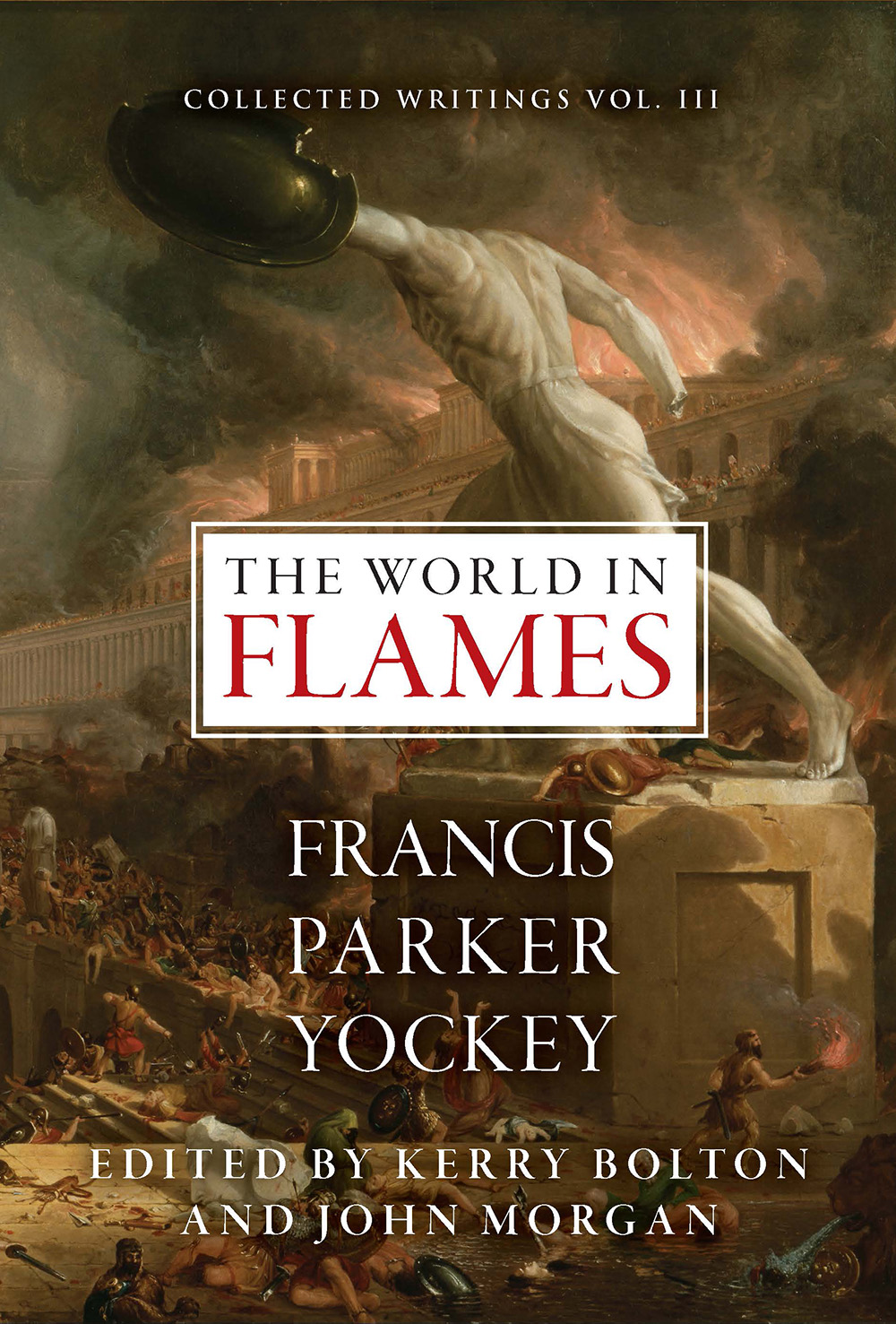
You can buy The World in Flames: The Shorter Writings of Francis Parker Yockey here.

A learned professor who wore Hitlerian insignia, Roman fasces, and five Falangist arrows on his lapel guided us through these rooms and performed the initiation in French. Next to him was a chart listing the Masonic ranks. We immediately looked for one that said “Sublime Prince of the Royal Secret.” The whole scene was enormously funny, I must say.

These museums and exhibits, and all the villages getting ready for the grand fete, were a pretty fair introduction to Germany. But now it was time to enter the magical amphitheater and see the Hitler pageant unfold.

It really is like a religious ceremony. Visitors always comment on that. It all begins with parades through the city, but that’s not the main part. One evening, from the grand hotel in Nuremberg, we tirelessly watched groups of SA in brown uniforms passing under the windows, lit only by the light of torches. Elsewhere, it would just be a village torchlight procession. Here it is something else, with a different gravitas, different sentiments.

At the Zeppelin field outside the city a huge stadium had been built, in the almost Mycenaean architectural style beloved of the Third Reich. In the bleachers it can seat 100,000 people; in the arena it holds 200-300,000. The banners with the hooked cross snap and shine under the blazing Sun.

And now come the labor battalions, the Arbeitskorp, 18 ranks of them. Music and flags at the front, shovels on the shoulders. They leave the stadium, they come back in, and the leaders of the labor service follow them, bare-chested. And then the young girls. Shovels are presented — and the Holy Mass of labor begins.

“Are you ready to nourish German soil?”
“We are ready!”

They sing, the drum rolls, the dead are remembered, the soul of party and nation is fused into one. Finally, the master manages to stir up this enormous crowd and make it into a single being, and he speaks. By the time the stadium has slowly emptied itself of officials and spectators, we begin to understand what the new Germany is.

We understood it even better the next day, at that extraordinary ceremony which bore the banal name of “roll call of political leaders” (politischen Leiter). It was night. The huge stadium was barely lit by a few searchlights that revealed the massive and motionless battalions of the SA dressed in brown. Between their ranks, spaces were provided. One of them, wider than the others, formed a sort of avenue leading from the stadium entrance to the tribune stand, along which the Führer was to pass.

At exactly eight o’clock the latter entered, followed by his staff. He took his place, with a burst of acclamations from the crowd. Those who shouted the loudest were the Austrians. We saw them at all the parades, shouting their rhythmic call:

Austria salutes her Führer!

Bavarians smiled, eyed the tribune stand, and applauded.

At the precise moment when Hitler crossed the stadium, a thousand spotlights were lit all around the enclosure, aimed vertically at the sky. They were like a thousand blue pillars all around, like a mysterious cage. Out in the countryside they would be seen shining all night long, designating the sacred place of national mystery. The organizers named this stupefying fairyland Licht-dom: the cathedral of light.

Now the man was standing on his platform. Now the flags unfurled. No song, no drum roll. The most extraordinary silence reigned as the first ranks of standard-bearers appeared, at the edge of the stadium, in front of each of the spaces separating the SA groups. The only light was that of the unreal, blue cathedral, beyond which we saw butterflies, airplanes perhaps, or maybe just dust. But the gaze of a searchlight arose on the flags, highlighting their mass of red, following them as they moved forward. Moving forward? It was more like a flow, a flow of purple lava, in an enormous and slow slide, filling these interstices prepared in advance in the brown granite. This majestic advance lasted nearly 20 minutes. Only when they were close to us did we hear the muffled sound of footsteps. Silence reigned until the moment when they came to rest at the foot of the standing Chancellor. A stony, supernatural silence, like something astronomers would observe on another planet. Under the blue-striped vault up to the clouds, the wide, flowing roads were at last calmed. I do not think I have seen in my life a more prodigious spectacle.

To wrap up: before and after Hitler’s speech — along with waves of outstretched arms — came the singing. There was the Deutschland über alles, and the Horst Wessel (in which comrades killed by the Red Front and Reaction march on in spirit), and the song of the soldiers of war:

I had a comrade;
Better, I will not have . . .

And then even more songs, written for the rally and blending together this cool night, this solemn hour, these beautiful multifaceted somber voices, into that musical enchantment without which Germany cannot conceive of anything: neither religion, nor country, nor war, nor politics, nor sacrifice.

During my remaining stay in this surprising country — which seemed farther away than the most distant Orient — it occurred to me again and again that I had no clear understanding of those minutes. Not because what had gone on was void of meaning, but rather because it was terribly significant, something based on a doctrine. And it’s because these ceremonies and these songs do mean something, that we must pay close attention to them.

First, they stand for the youth of the country. It is to them that everything is addressed. One is almost astonished to discover, in the SA which fill the streets, these debonair Bavarians– plump, small, peaceful — so that their uniforms are merely the garments of a tranquil national guard. One could easily forget that there were Germans over the age of 25, and it was they who had made National Socialism. But while they may have created it, now the movement is for the youth.

And we wished to see it, too, this jeunesse allemande. Through the countryside, in the small villages, and in the woods (the tree is the German divinity par excellence), we’d talk with our guides. On one occasion I was reminded of a remark of Monsieur de Ribbentrop, who cited Charles Maurras on the deep historical consciousness of the Germans.

Our guide didn’t talk about swastikas. No, he talked about the Thirty Years’ War:

This is the key to German history. There were 25 million Germans before, only five after. We had to rebuild. From the Rhine, Bavaria, or Austria, the axis shifted to northern Prussia. And we built Germanism, a Germanism which is above all else a [nationalist] particularism, something that does not want to impose itself as a universal rule.

I leave the responsibility for these historical reveries to this young German. I simply wish to point out that they are being made.

But now, along a little sunken road, we arrived at a village of wooden houses. No more discussion of historical controversies. We saw before us a labor camp, like thousands in Germany. 15 of its residents were delegated to take part in yesterday’s parade of shovels. The rest were still there, 80 or 100 19-year-old boys. We crossed through the gate, saw an empty courtyard surrounded by barracks and clumps of flowers. The garçons, we were told, were at the back of the camp.

And there they were, indeed, under the tall birches, sitting in the sand, their shovels in the distance . . . and they were singing. These young people dressed in brown, under the trees, composed so natural a picture of eternal Germany at rest that we halted ourselves, a little shocked. Then we were told:

It’s the singing lesson.

No prettiness or frivolity here, merely seriousness, truth, and a hard and powerful love of the fatherland. A total devotion, expressed in this language of songs and chorus which is the true native tongue of Germany.

We questioned some of these young people in front of us. They were almost all out of Saxony and Franconia. In a moment we’d hear their program for their day: getting up at five o’clock, going to bed at ten; a very strict military program. Except that in the relations between these boys (they belong to all social classes), and in the relations between chiefs and the subordinates, there was a kind of unity, of camaraderie.

This undeniable novelty of the Third Reich is Germany’s most formidable force. The Hitlerjugend, the SS sleep on their mats in their bivouacs. Here in the labor camp there are beds, rooms of rigorous cleanliness, decorated with a large cross (I mean a crucifix, not a hooked cross). And naturally, everywhere, these boys destined for the afterlife have built flowerbeds.

We left the camp under the trees while an orchestra played dance tunes for us. And next day there was another orchestra, when we arrived in the morning mist and on a ground tempered by the rain of the night at the great camp of Hitlerjugend tents, which had been visited by the youth leader Baldur von Schirach. From the top of a wooden tower we gazed in the distance, over this plain beside the woods, and looked down at these light shelters wherein Hitlerian adolescence was practiced. Except for the number — several thousand youngsters are sheltered here — nothing differed significantly from a boy scout camp. They rushed towards the orchestra, eager to sing, with a sort of starving ardor which would perhaps be unknown to French youth. Nearby on a wooden memorial were inscribed the names of the hundreds of children of the party who had fallen under the Marxist bullets. A flame burned, while a child stood watch. We silently saluted the young dead.

Here again, what struck us was the character of the discipline. The militarization of childhood in Germany was not at all what we thought. Those who came to talk to us approach us joyfully, without fear, and by themselves. I confessed that I find that much more important, from the point of view of German power, than a dry authoritarianism.

But soon night fell, and we were to go to Nuremberg to dine at the SS bivouac. We were received there by Monsieur Himmler, head of the SS, master of the Gestapo; while Monsieur Goebbels would emcee the dinner himself. The camp looked picturesque, with its tents reserved for the Führer‘s personal guard, but that was merely a naïve perception. The atmosphere of the grand maneuvers is the same in all the countries of the world — and that of official banquets too, even if they consist only of sauerkraut, Bavarian sausages, and dry Franconian wine. All this would be of little interest if we had not been led, on leaving, to the camp flag. It was the hour when the colors were brought in, a little later than on warships. A bugler played a wistful tune, and slowly the flag came down. Such a spectacle is beautiful in all countries, no doubt, but here it took its place in an ensemble. After the party, as after the game, after the daily routine, it is now the habit for Germany as a group to suddenly recall the most serious thoughts which direct its nation and its race. Even after this official banquet, which might have been merely pleasant and easygoing, we were reminded that there was this other, graver, aspect of rendering the honor due the symbol of their empire.

But it is France that we are thinking of now. There are many things in Germany that are different from what we need, that we have the right not to like. But from now on, can we really tell ourselves that such soaring emotions are incomprehensible to France, that we could not pass them on to French youth, or embrace them at home, in our own fashion? This kind of regretful thinking haunts us whenever we consider what democracy has done to France. This brief stay in Germany does not fill us with naïve wonder for the brusque grace of Hitlerism, but if our feelings about this phenomenon from across the Rhine are complex, it is precisely because there is too much to say.

I wondered what my impression would be in front of the man who supports on his shoulders not only this empire, this Reich, but also this new religion. Again, the complexity of the impressions is so great that we cannot, in good faith, draw valid conclusions from them, and we must content ourselves with trying to sort them out a little.

I remembered having often listened to Hitler, during his electoral campaign in 1933, on the radio or in the cinema. Today he speaks much more calmly. Admittedly, the Germans always get excited to hear him, and applaud fervently when he promises them that their sacrifices will lead to power. Certainly his voice took on emotion at times, as it did the other day at the Politischen Leiter parade, when he proclaimed that he was sacrificing everything to Germany, and that he would give his life if necessary. But on the whole he gives us the impression of greater moderation. He no longer makes any gestures, or speaks with his hands crossed, while the loudspeakers echo the end of his sentences. Admittedly, the foreigner is a little surprised and wonders about the enthusiasm of those who listen to him.

As it happens, I had just seen him, up close, two hours earlier. 80 to 100 foreign guests had been invited by Monsieur de Ribbentrop to a tea at which the Chancellor was to appear. Rudolf Hess, the Führer’s right arm and colleague from the beginning (even for Mein Kampf, they say), had initially received us. Hess is a man with an energetic face, with sunken and hard eyes. He briefly expressed his satisfaction at seeing foreigners taking an interest in the new Germany.

Then we were led to another room, where we discovered, in a kind of disorderly crowd, the man who is the master of 70 million people. The usual uniform — surprising, somehow — with the yellowish jacket and black trousers. The lock of hair. A tired face. Also sadder than we thought. You can only see his smile up close. An almost childlike smile, as leaders of men so often have. “He’s so nice,” say the people who work with him. We introduce him to a few people, he shakes hands with an absent look, answers with a few words. And we remain there, amazed.

You can buy Savitri Devi’s The Lightning and the Sun here.

However, you have to look at his eyes. In this face, they’re all that really matters. They are eyes from another world, foreign eyes, of a deep blue and black where one can barely distinguish the pupil. How to guess what is going on in them? What is there but a prodigious dream, an unlimited love for Deutschland, the German land, the real one and the one still to be built? What do we have in common with these eyes? And above all, the first impression, the most astonishing, remains: those serious eyes. An almost insurmountable agony, an unheard-of anxiety remains there. We guess in a flash: the present difficulties, the possible war, the economic crisis, the religious crisis, all the concerns of the responsible leader. We feel strongly, physically, what a terrible ordeal it is to lead a nation, and to lead Germany towards its all-consuming destiny. Especially when this chief is charged with transforming it so that a “new man,” as he says it at every moment, can be born there and live there.

We don’t want to be romantic. Yet this man with the distant gaze, who is a god for his country, one June day descended from the sky, like the archangel of death, to suppress by duty some of his oldest companions.[2] And we can see that what happened on that June 30 was a palace revolution. But it means something more, because this man made a sacrifice for what he judged his duty, and his personal peace, and friendship. And he would sacrifice all — human happiness, his own, and that of his people on top of the bargain — if the mysterious duty which he obeys commanded him. Hitler cannot be judged as an ordinary head of state. He is also a reformer, called to a mission which he believes to be divine, and his eyes tell us that he bears the terrible weight of it. This is what can, at any moment, be called into question.

I do believe I’ll never forget the color and sadness in Hitler’s eyes, mysterious beyond doubt. Certainly, I do not claim to judge him on this impression, although it was felt by many others during these solemn days in Nuremberg. Above all we asked ourselves, we French folk who were witness to these extraordinary shows: Of all this, what can we possibly have in common one day?

On Sunday, the most singular ceremony of the Third Reich took place, that of the consecration of the flags. The “flag of blood” was brought before the Führer, the flag borne by the demonstrators during the failed putsch of 1923, in front of the Feldherrenhalle in Munich.

In Munch, there were several
When the bullets hit them . . .

The Chancellor seized in one hand the Blood Flag, and in the other the new standards he was to consecrate. Through it, an unknown fluid must pass, so that the blessing of the martyrs would henceforth extend to the new symbols of the German fatherland. A purely symbolic ceremony? I don’t believe it.

In Hitler’s thought, as in that of the Germans, there seems to be the idea of a mystical transfusion, analogous to that of the blessing of water by the priest — if not, dare we say it, to that of the Eucharist. Whoever does not see in the consecration of the flag the analogue of the consecration of bread, and thereby a kind of German sacrament, runs the strong risk of understanding nothing about Hitlerism.

And it is then that we are worried. In front of these grave and delicious decorations, this antique romanticism, this immense flowering of the flags, these crosses coming from the east — I wondered, on the final day, if all this was really possible. You can give a people new vigor, but can we transform everything to the point of inventing new rites, which penetrate the lives and hearts of citizens? The French, who do not understand foreigners anyway, do not understand and are merely astonished.

The flag itself accentuates this weird oriental impression. So surprised are we at the impressions of expatriation and exoticism that one needs to make an effort to realize that some of the virtues brought back into honor — work, sacrifice, love of the fatherland — are part of the common heritage of all peoples. There seems to be some irony of fate in emphasizing the oriental appearances of these myths, in a country that rejects everything that seems to it to come from the East. But Hitler, founder of the Walpurgis nights of May 1,[3] of pagan festivals, of the consecration of flags, is in reality faithful to the profound vocation of Germany, which from Goethe to Nietzsche and Keyserling[4] has always been turned towards the Sun of the east. In many aspects of this new policy, we want to say rather about this poetry, all, certainly, is not for us, and we do not need to insist on saying it.

But what is for us, what is a constant call to order, and without a doubt a kind of regret, is this sustained preaching that is given to the youth for faith, sacrifice, and honor. Just as Jacques Bainville[5] returned as a monarchist from pre-war Germany, so every Frenchman returns from the Germany of today convinced that his country, his youth, could do at least as well as our neighbors if we were restoring, first of all, certain universal virtues. And this is a valid lesson for all.

This is the final impression that we take away: beautiful shows, beautiful youth, life easier than they say, but above all a surprising mythology of a new religion. When one tries to remember those days so full — that one evokes the nocturnal ceremonies lit at an angle by the glow of torches and searchlights; German children playing like wolves around gleams of memories of civil war and sacrifice; the Leader raising in large swells, with plaintive cries, this subdued crowd — we say to ourselves, in effect, from this country so close to us, that it is — first and foremost, in the full sense of the word, and prodigiously and profoundly — a strange country.

And what was France doing? It lived under the regime of the Popular Front, sometimes under socialist leadership, sometimes under radical leadership, under the perpetual threat of Communist blackmail. But in youth one could also see, without forcing things, this pre-fascist spirit taking shape which was perhaps born, in spite of everything, around February 6, 1934.[6] We found it, this spirit, in the leagues, as long as there were leagues, sometimes among certain members of the PSF,[7] despite the cups of tea, in the Parti Populaire Francais of Doriot,[8] and in the crowd of non-parties.

All was not happy in the career of the young nationalist. We had generally followed with sympathy the efforts of the Comte de Paris[9] to make himself known to the French: He was an aviator, which pleased the crowds; he had been married in Palermo with a beautiful and famed princess; he had many lovely children. He wanted to start a journal, the Courrier Royal; he signed articles and books, where we found this alliance of the social and the national which seemed essential to us. I went one day in 1936 to see him in Brussels with Annie Jamet, who wanted to organize one or two conferences under its auspices. I saw him again during the trip I made the following month. His presentation seemed to me, as in 1930, fine, moving, seductive. He always listened admiringly. He spoke wise and fair words. However, if he happened to speak of the workers, of French working-class life, one sensed, unfortunately, that all that was far from him, that he had no direct knowledge, that he was unaware of the men of his country. His reasonings were excited, but a misty, impalpable je ne sais quoi interposed itself between reality and him. It was, of course, difficult to tell him, and what was most solid in him was precisely a strong self-confidence, the confidence in his destiny. But the conversation was more awkward than one might think given the kindness of his welcome.

*  *  *

Counter-Currents has extended special privileges to those who donate $120 or more per year.

  • First, donor comments will appear immediately instead of waiting in a moderation queue. (People who abuse this privilege will lose it.)
  • Second, donors will have immediate access to all Counter-Currents posts. Non-donors will find that one post a day, five posts a week will be behind a “paywall” and will be available to the general public after 30 days.

To get full access to all content behind the paywall, sign up here:

Paywall Gift Subscriptions

If you are already behind the paywall and want to share the benefits, Counter-Currents also offers paywall gift subscriptions. We need just five things from you:

  • your payment
  • the recipient’s name
  • the recipient’s email address
  • your name
  • your email address

To register, just fill out this form and we will walk you through the payment and registration process. There are a number of different payment options.

Notes

[1] Annie Jamet was the founder of the Cercle Rive Gauche which hosted Rightist salons and conferences in the pre-war years. A mother of six, she suddenly died in 1938. Her widower, Henri Jamet, founded the Librairie Rive Gauche (bookshop) on Blvd. St-Michel during the War. Pierre Cousteau, 1906-1958, brother of explorer Jacques Cousteau, was a Rightist journalist, part of Brasillach’s circle at Je suis partout.

[2] At his most circumlocutory, Brasillach means the “Night of the Long Knives.”

[3] Walpurgisnacht, or St. Walpurga’s Eve, the “night of witches,” is actually April 30, the eve of May Day. Brasillach seems to be alluding to a notion popular among critics of National Socialism that Hitler and his regime reveled in witchcraft and the occult, but the specific reference is unclear.

[4] Hermann von Keyserling, Baltic German philosopher, first to use the word Führerprinzip.

[5] Jacques Bainville (1879-1936), French historian, monarchist, and leading figure in the Action Française.

[6] February 6, 1934 was the date of a massive rally of veterans and nationalist leagues near the Chamber of Deputies, following the Stavisky affair (q.v.).

[7] The Parti Social Français, a nationalist political party founded 1936.

[8] The Parti Populaire Français was another nationalist political party, founded by Jacques Doriot in 1936 in opposition to the Popular Front government.

[9] Henri, Duke of Orleans (1908-1999), was a pretender to the French throne through the Bourbon Orleanist branch, and a descendant of Louis Philippe I (King, 1830-1848).

Robert Brasillach & Notre avant-guerre: Brasillach at Nuremberg in 1937 Remembering Robert Brasillach, March 31, 1909–February 6, 1945

Robert%20Brasillach%20and%23038%3B%20Notre%20avant-guerre%3A%20Brasillach%20at%20Nuremberg%20in%201937%20Remembering%20Robert%20Brasillach%2C%20March%2031%2C%201909%E2%80%93February%206%2C%201945

Share

  • Gab
  • Remembering Robert Brasillach, March 31, 1909–February 6, 1945 &body=%0D%0A%0D%0A%0D%0A%0D%0A%0D%0A%0D%0Ahttps://counter-currents.com/2022/03/remembering-robert-brasillach/%0D%0A%0D%0A%0D%0A%0D%0A">

Enjoyed this article?

Be the first to leave a tip in the jar!

Instant Echeck GreenPay™

Related

  • Remembering Enoch Powell

  • Exclusive Interview with Karel Veliky Part 1

  • Nietzsche & Race

  • Berlin: City of Stones

  • Could Fascism Work?

  • Remembering Julius Evola

  • Finding Atlantis Part 4

  • Barbara Will’s Unlikely Collaboration

Tags

1937 Nuremberg rallyAdolf HitlerAnnie JametCercle Rive GauchecommemorationsComte de ParisFranceFreemasonryFrench fascismGermanyHeinrich HimmlerHenri Duke of OrleansHitler YouthJacques BainvilleJoseph GoebbelsMargot MetrolandNational SocialismNotre avant-guerreNuremberg ralliesParti Populaire FrancaisParti Social FrancaispaywallReich Labor ServiceRobert BrasillachRudolf HessWalpurgisnacht

Writers of May

(2 votes) Morris van de Camp David M. Zsutty Derek Stark Jayant Bhandari Greg Johnson

Articles of May

Heidegger on Nietzsche, Part One by Collin Cleary The Lunch Wars by David M. Zsutty 2 votes
    • Small Is Beautiful:
      The Napoleon of Notting Hill and G. K. Chesterton Upon Defending One’s Homeland from Others—and Itself

      Steven Tucker

      1

    • The Psychology Behind MrBeast’s Moronic Thought Experiment

      Endeavour

      4

    • On the Roots of Anti-Immigrant Sentiment in Contemporary Britain

      Lipton Matthews

      4

    • Remembering Enoch Powell:
      June 16, 1912–February 8, 1998

      Greg Johnson

      10

    • Counter-Currents Radio Podcast No. 691
      Rob Rundo Returns

      Counter-Currents Radio

    • The Fragile Polity that is Syria

      Morris van de Camp

      1

    • Nigel Farage Calls Britain a Two-Tier State

      Mark Gullick

      4

    • Nationalism This Week
      Letter to J. D. Vance

      Greg Johnson

      32

    • Lost In Trans-Mission:
      How the Media Fails To Reveal the Inconvenient Truth About the Usual Suspects

      Steven Tucker

      10

    • Liar, Liar, Pants on Fire!

      Beau Albrecht

      7

    • Editor’s Update
      Rob Rundo on Counter-Currents Radio, Fundraiser Update, & a New $20,000 Matching Grant

      Greg Johnson

    • The Bitter End of Western Metaphysics:
      Heidegger on Nietzsche, Part Three

      Collin Cleary

      10

    • Uncivil War

      Mark Gullick

      50

    • Exclusive Interview with Karel Veliky:
      The Final Chapter in the Film Series! Part II

      Ondrej Mann

      2

    • Happy Birthday to Us!

      Greg Johnson

      6

    • Zsutty’s Maximum

      David M. Zsutty

      16

    • Exclusive Interview with Karel Veliky:
      The Final Chapter in the Film Series! Part I

      Ondrej Mann

      2

    • The Union Jackal, June 2026

      Mark Gullick

      23

    • The Inferiority Behind Immigrant Superiority

      Jayant Bhandari

      15

    • Counter-Currents Radio Podcast No. 690
      Greg Johnson & David Zsutty Discuss Current Things: AI, Henry Nowak, the Iran Crisis, & More

      Counter-Currents Radio

      7

    • Collin Cleary: What Rome Means to Me

      Collin Cleary

      4

    • Paul Krugman: Closet Bolshevik

      Spencer J. Quinn

      21

    • Fugue of Ideas:
      Ibram X. Kendi’s Chain of Ideas

      Greg Johnson

      19

    • Based Blacks

      Lipton Matthews

      24

    • Black Intellectual Fatigue

      Derek Stark

      41

    • Why White Advocates Should Avoid “Based Blacks”

      Dani Vypont

      32

    • Nietzsche & Race

      Mark Gullick

    • Editor’s Update
      Rob Rundo Rescheduled to Next Week on Counter-Currents Radio;
      Tonight Greg Johnson & David Zsutty Answer Your Questions;
      Fundraiser Update & a New $20,000 Matching Grant

      Greg Johnson

    • The Counter-Currents 2026 Fundraiser
      Lifetime Subscriber Welcome Packages Extended

      Greg Johnson

    • Nationalism This Week
      Who’s Looking Back?

      Greg Johnson

      29

    • China’s Threat to American Security:
      Food, Farmland, Foreign Control, & Energy Policy

      Lipton Matthews

      5

    • The Bitter End of Western Metaphysics:
      Heidegger on Nietzsche, Part Two

      Collin Cleary

      16

    • The Killing of Henry Nowak

      Mark Gullick

      38

    • The Crisis of Chinese Technology Thieves

      Morris van de Camp

      1

    • The Strange World of Gender Bender Fiction:
      & What This Genre Tells Us About Autosexuality

      Dani Vypont

      3

    • Watching the Watchers:
      The Dark Triad Question

      David M. Zsutty

      14

    • The Remigration Movement Solidifies

      F. Roger Devlin

      2

    • Casting Aspersions:
      The Fatal Consequences of Race-Swapped Casting, From Helen of Troy to Henry of Southampton

      Steven Tucker

      20

    • The Murder of Henry Nowak

      Millennial Woes

      23

    • Don’t Forget to Vote in Our Writer & Article of the Month Poll

      Greg Johnson

    • The Robot Hotdog Stand

      Greg Johnson

      37

    • Laughing Our Way to Victory

      Dave Chambers

      7

    • The Zodiac Killer

      Mark Gullick

      11

    • Jared Taylor: What Rome Means to Me

      Jared Taylor

      1

    • An Interview with Endeavour:
      My Way of Life Is an Adventure!

      Ondrej Mann

      6

    • José Pedro Zúquete’s The Identitarians

      Greg Johnson

      3

    • Editor’s Update
      Fundraiser Update & How to Watch the Remigration Summit

      Greg Johnson

      5

    • The Bitter End of Western Metaphysics:
      Heidegger on Nietzsche, Part One

      Collin Cleary

      12

    • Berlin: City of Stones

      Spencer J. Quinn

      6

    • True Folk-Horror Is Horror of Your Own Folk:
      Mark Gatiss vs the Brexit Blind Dead  

      Steven Tucker

      4

    • Peter Quint

      Small Is Beautiful: The Napoleon of Notting Hill

      The Secret People G. K. ChestertonThey have given us into the hands of new unhappy lords,Lords...

    • Douglas Mercer

      Remembering Enoch Powell

      The UK now has 19 percent non-White which is more than double what it had in 2001 which was 8...

    • Lexi

      Letter to J. D. Vance

      They irrationally love Trump; their support for JDV is only an extension of this. Who loves JDV for...

    • Adrian Roberts

      The Psychology Behind MrBeast’s Moronic Thought Experiment

      I puzzled over the thought experiment for several minutes before reading the rest of the article....

    • Scott

      Remembering Enoch Powell

      I'm not an expert on postwar Albion, but I think the impressive colored invasion there is mostly a...

    • Scott

      Remembering Enoch Powell

      London unequivocally started the war.The Entente were determined after the “embarassment at Munich...

    • Peter Quint

      Remembering Enoch Powell

      How did he deter population replacement; it seems to me that it has been proceeding right-on-time...

    • Peter Quint

      The Psychology Behind MrBeast’s Moronic Thought Experiment

      Great article! I would press red. 🦈

    • Beau Albrecht

      Remembering Enoch Powell

      His speech deterred population replacement migration for two decades.  By that, he did more for...

    • Stronza

      The Psychology Behind MrBeast’s Moronic Thought Experiment

      Re MrBeast and other youtubers' success. Does anyone here not find it alarming that fewer and...

    • Peter Quint

      Remembering Enoch Powell

      Great article! I am not belittling Powell, but other than the Rivers of Blood speech what did...

    • KV

      On the Roots of Anti-Immigrant Sentiment in Contemporary Britain

      Multiculturalism isn’t a “failed experiment,” the Jews and the degenerate libtard traitor class that...

    • Homeland

      On the Roots of Anti-Immigrant Sentiment in Contemporary Britain

      FIFA is also part of the anti-white industrial complex. The World Cup risks becoming a parody of...

    • Will Williams

      On the Roots of Anti-Immigrant Sentiment in Contemporary Britain

      To answer the question posed in the title of this piece, the root of anti-immigrant sentiment in...

    • Ondrej Mann

      The Psychology Behind MrBeast’s Moronic Thought Experiment

      Good point. But what if it weren’t universal? For example, what if it only applied to writers on our...

    • Dr X

      Letter to J. D. Vance

      Speaking of  "wrecking the economy" - I lack a good understanding of how money was created in the...

    • Moss

      On the Roots of Anti-Immigrant Sentiment in Contemporary Britain

      The multicultural project hasn't failed, it's doing what it is supposed to do - destroy white people...

    • Moss

      Remembering Enoch Powell

      A titan of a man.

    • Joe Gould

      Nigel Farage Calls Britain a Two-Tier State

      We owe Nigel Farage nothing. Instead of thanking him we should congratulate ourselves on spreading...

    • Adrian Roberts

      Remembering Enoch Powell

      I don’t carry a torch for Britain’s involvement in WW2, but von Papen said something to the effect...

    • Earth Day Special

      John Morgan

      12

    • A Robertson Roundup
      Remembering Wilmot Robertson
      (April 16, 1915 – July 8, 2005)

      Margot Metroland

      13

    • The Paranoid Style in White Nationalism

      Greg Johnson

      30

    • Join the Dance!

      Andrew Hamilton

      1

    • We Can’t Save the Earth Without Reducing African Birth Rates

      James Dunphy

      36

    • “I’m Not a Conspiracy Theorist, but . . .”:
      Jeffrey Epstein’s Death Gives New Life to “Conspiracy Theories”

      Greg Johnson

      22

    • Sylvia Plath: Stasis in Darkness

      Vic Olvir

      17

    • Vanguardism, Vantardism, & Mainstreaming

      Greg Johnson

      80

    • Aviation, Geography, & Race

      Charles Lindbergh

      3

    • Some Thoughts on Yule

      Collin Cleary

      4

    • Living in Truth:
      A Yuletide Homily

      Jef Costello

      7

    • John Kennedy Toole’s A Confederacy of Dunces

      Greg Johnson

      20

    • On Aleksandr Solzhenitsyn’s Warning to the West

      Spencer J. Quinn

      7

    • Elitism, British Modernism, & Wyndham Lewis

      Jonathan Bowden

      6

    • Philip K. Dick’s Do Androids Dream of Electric Sheep? as Anti-Semitic/Christian-Gnostic Allegory

      Greg Johnson

      20

    • “Conspiracy Theory” or Conspiracy?

      Andrew Hamilton

      21

    • Remembering H. P. Lovecraft
      (August 20, 1890–March 15, 1937)

      Greg Johnson

      3

    • Who Are We?
      Nordics, Aryans, & Whites

      Greg Johnson

      71

    • Remembering William Gayley Simpson
      (July 23, 1892–December 31, 1990)
      A Pleasant Afternoon with Harriet & Bill Simpson

      Margot Metroland

      18

    • Here are the Young Men
      Remembering Ian Curtis
      (July 15, 1956–May 18, 1980)

      Mark Gullick

      18

    • Percy Grainger
      Artist of the Right

      Alex Graham

      7

    • Remembering Revilo Oliver
      (July 7, 1908–August 20, 1994)

      Greg Johnson

      18

    • The Meaning of July 4th for the White Man

      Gregory Hood

      13

    • The Front National’s Evolution

      Bruno Mégret

    • Merwin K. Hart
      Forgotten American Hero & Man of the Right

      Morris van de Camp

      10

    • George Orwell’s Nineteen Eighty-Four

      Jonathan Bowden

      8

    • Carleton S. Coon
      Scientist & Reluctant White Advocate

      Morris van de Camp

      3

    • The Kwanzaa Absurdity Will Be Dwarfed by Juneteenth

      Robert Hampton

      10

    • Stravinsky

      Alex Graham

      7

    • Like the Roman:
      Remembering Enoch Powell (1912-1998)

      Mark Gullick

      23

    • The 1970s: The Golden Age of Hijacking

      Morris van de Camp

      21

    • Jonathan Bowden’s Deliverance
      Part 6

      Jonathan Bowden

    • Do You Want to Play a Game?

      Mark Gullick

      1

    • Sexually Incontinent on the Indian Subcontinent:
      Who Rapes More Animals, Indians or Pakistanis? The Battle Continues!

      Steven Tucker

      3

    • Neo-Fascism in Film
      Part 5

      Karel Veliky

      15

    • The Game of Tarot

      Mark Gullick

      2

    • Institutions Cannot Be Transplanted

      Jayant Bhandari

      5

    • Jonathan Bowden’s Deliverance
      Part 5

      Jonathan Bowden

    • Crosstown Traffic:
      Jimi Hendrix & The Post-War Rock ‘N’ Roll Revolution

      Mark Gullick

      1

    • Slaves from the North:
      Finns & Karelians in the East European Slave Trade, 900–1600

      Lipton Matthews

      14

    • Neo-Fascism in Film
      Part 4

      Karel Veliky

      2

    • David Lean’s A Passage to India

      Spencer J. Quinn

      1

    • Elites are Essential to Development

      Lipton Matthews

      7

    • Jonathan Bowden’s Deliverance
      Part 4

      Jonathan Bowden

    • Neo-Fascism in Film
      Part 3

      Karel Veliky

      6

    • E. M. Forster’s A Passage to India & the Indian Mentality

      Spencer J. Quinn

      25

    • Jonathan Bowden’s Deliverance
      Part 3

      Jonathan Bowden

    • The Rest Is Silence
      Heidegger’s Quietism

      Mark Gullick

      2

    • Dispelling the Historical Fallacy of Indian Nationalism

      Lipton Matthews

      8

    • Neo-Fascism in Film
      Part 2

      Karel Veliky

      8

    • Jonathan Bowden’s Deliverance
      Part 2

      Jonathan Bowden

    • Life of a Klansman

      Mark Gullick

      8

    • Jonathan Bowden’s Deliverance, Part 1

      Jonathan Bowden

    • Decolonial Ideas are Holding Back Developing Countries

      Lipton Matthews

      8

    • Neo-fascism in Film, Part 1

      Karel Veliky

      21

    • Jonathan Bowden’s Onslaught, Part 8
      Divigations on Decadence

      Jonathan Bowden

    • Jonathan Bowden’s Onslaught, Part 7
      Intrigues in the National Front

      Jonathan Bowden

      1

    • Rotten to the Core

      Mark Gullick

      8

    • Strauss on Husserl’s “Philosophy as Rigorous Science”

      Greg Johnson

    • Jonathan Bowden’s Onslaught, Part 6
      Francis Bacon & Right-Wing Nihilism

      Jonathan Bowden

    • András László
    • Derek Hawthorne
    • Beau Albrecht
    • Alain de Benoist
    • Kerry Bolton
    • Jonathan Bowden
    • Collin Cleary
    • Jef Costello
    • Savitri Devi
    • Julius Evola
    • Jim Goad
    • Gregory Hood
    • Juleigh Howard-Hobson
    • Greg Johnson
    • Charles Krafft
    • Anthony M. Ludovici
    • Trevor Lynch
    • H. L. Mencken
    • J. A. Nicholl
    • James J. O’Meara
    • Christopher Pankhurst
    • Tito Perdue
    • Michael Polignano
    • Spencer J. Quinn
    • Fenek Solère
    • Irmin Vinson
    • Leo Yankevich
    • Francis Parker Yockey
    • Multiple authors
  • Editor-in-Chief

    • Greg Johnson, Ph.D.

    Featured Writers

    • Beau Albrecht
    • Gunnar Alfredsson
    • Collin Cleary, Ph.D.
    • Jef Costello
    • Morris V. de Camp
    • F. Roger Devlin, Ph.D.
    • Stephen Paul Foster, Ph.D.
    • Jim Goad
    • Alex Graham
    • Mark Gullick, Ph.D.
    • Greg Johnson, Ph.D.
    • Travis LeBlanc
    • Trevor Lynch
    • Margot Metroland
    • James J. O’Meara
    • Angelo Plume
    • Spencer J. Quinn
    • Fred Reed
    • Clarissa Schnabel
    • Michael Walker
    • David M. Zsutty

    Frequent Writers

    • Asier Abadroa
    • Aquilonius
    • Alain de Benoist
    • Kerry Bolton, Ph.D.
    • Dave Chambers
    • Steven Clark
    • James Dunphy
    • Endeavour
    • Richard Houck
    • Jason Kessler
    • Titus Livius
    • Ondrej Mann
    • Lipton Matthews
    • Mark Mazari
    • John Morgan
    • Jaroslav Ostrogniew
    • Kathryn S.
    • Christian Secor
    • Anne Wilson Smith
    • Thomas Steuben
    • William De Vere
    • Kenneth Vinther
    • Max West

    Classic Authors

    • Maurice Bardèche
    • Jonathan Bowden
    • Julius Evola
    • Guillaume Faye
    • Ernst Jünger
    • Kevin MacDonald, Ph.D.
    • D. H. Lawrence
    • Charles Lindbergh
    • Jack London
    • H. P. Lovecraft
    • Anthony M. Ludovici
    • Sir Oswald Mosley
    • National Vanguard
    • Friedrich Nietzsche
    • Revilo Oliver
    • William Pierce
    • Ezra Pound
    • Saint-Loup
    • Savitri Devi
    • Carl Schmitt
    • Miguel Serrano
    • Oswald Spengler
    • P. R. Stephensen
    • Jean Thiriart
    • John Tyndall
    • Dominique Venner
    • Leo Yankevich
    • Francis Parker Yockey

    Other Authors

    • Howe Abbott-Hiss
    • Michael Bell
    • Giles Corey
    • Jack Donovan
    • Richardo Duchesne, Ph.D.
    • Emile Durand
    • Guillaume Durocher
    • Mark Dyal
    • Tom Goodroch
    • Andrew Hamilton
    • Robert Hampton
    • Huntley Haverstock
    • Derek Hawthorne
    • Gregory Hood
    • Juleigh Howard-Hobson
    • Alexander Jacob
    • Ruuben Kaalep
    • Tobias Langdon
    • Julian Langness
    • Patrick Le Brun
    • G A Malvicini
    • John Michael McCloughlin
    • Millennial Woes
    • Michael O’Meara
    • Christopher Pankhurst
    • Michael Polignano
    • J. J. Przybylski
    • Quintilian
    • Edouard Rix
    • C. B. Robertson
    • C. F. Robinson
    • Herve Ryssen
    • Alan Smithee
    • Fenek Solere
    • Ann Sterzinger
    • Robert Steuckers
    • Tomislav Sunic
    • Donald Thoresen
    • Marian Van Court
    • Irmin Vinson
    • Book Reviews
    • Movie Reviews
    • TV Reviews
    • Music Reviews
    • Art Criticism
    • Graphic Novels & Comics
    • Video Game Reviews
    • Fiction
    • Poems
    • Interviews
    • Videos
    • English Translations
    • Other Languages
      • Arabic
      • Bulgarian
      • Croatian
      • Czech
      • Danish
      • Dutch
      • Estonian
      • Finnish
      • French
      • German
      • Greek
      • Hungarian
      • Italian
      • Lithuanian
      • Norwegian
      • Polish
      • Portuguese
      • Romanian
      • Russian
      • Slovak
      • Spanish
      • Swedish
      • Ukrainian
    • Commemorations
    • Why We Write
  • Archives
  • Top 100 Commenters
  • The Looney Bin
Sponsored Links
Europa.com Above Time Coffee Antelope Hill Publishing Paul Waggener IHR-Store Spencer J. Quinn American Renaissance Jim Goad The Occidental Observer
Donate Now Mailing list
Books for sale
  • The Philosopher Is In
  • Sexual Utopia in Power (Expanded Edition)
  • In Defense of Prejudice
  • Loving Our Own
  • Tyranny & Wisdom
  • The Populist Moment
  • Is America Doomed?
  • To all books
Copyright © 2026 Counter-Currents Publishing, Ltd.

Paywall Access


Please enter your email address.

Lost your password?

Edit your comment

Writer & Article of the Month May 2026

Voting for this month has concluded. Here are the final results!

Top Writers

  • #1 Morris van de Camp 2 votes
  • #2 David M. Zsutty 2 votes
  • #3 Derek Stark 2 votes
  • #4 Jayant Bhandari 2 votes
  • #5 Greg Johnson 2 votes
  • #6 Jared Taylor 1 vote
  • #7 Collin Cleary 1 vote
  • #8 Spencer J. Quinn 1 vote
  • #9 Mark Gullick 1 vote
  • #10 Lipton Matthews 1 vote
  • #11 Keith Woods 1 vote
  • #12 Steven Tucker 1 vote

Top Articles

  • #1 Heidegger on Nietzsche, Part One 2 votes
  • #2 The Lunch Wars 2 votes
  • #3 The 1970s: The Golden Age of Hijacking 1 vote
  • #4 True Folk-Horror Is Horror of Your Own Folk 1 vote
  • #5 Finding Atlantis Part 4 1 vote
  • #6 Berlin: City of Stones 1 vote
  • #7 The Ghost of the Confederacy 1 vote
  • #8 Lothrop Stoddard’s The Revolt Against Civilization 1 vote
  • #9 Could Fascism Work? 1 vote
  • #10 Jared Taylor's Elevator Pitch to a Billionaire 1 vote
  • #11 Predation Wearing the Mask of Civilization 1 vote
  • #12 Peak Fatigue in Fort Wayne 1 vote
  • #13 Keith Wood's Elevator Pitch to a Billionaire 1 vote
  • #14 Do You Want to Play a Game? 1 vote
  • #15 Why Billionaires Should Fund White Identity Politics 1 vote

Total votes cast: 17