Counter-Currents
  • Advertise
  • Private Events
  • T&C
  • About
  • Contact
  • RSS
    • Main feed
    • Podcast feed
    • Videos feed
    • Comments feed
  • Welcome
  • Webzine
  • Books
  • Merch
  • Podcasts
  • Videos
  • Donate
  • Patrons
  • Subscribe
  • Crypto

LEVEL2

Donate Now Mailing list

Writer of June

(4 votes) David M. Zsutty

Article of June

Why White Advocates Should Avoid “Based Blacks” by Dani Vypont 4 votes
  • Welcome
  • Webzine
  • Books
  • Merch
  • Podcasts
  • Videos
  • Donate
  • Patrons
  • Subscribe
  • Crypto
    • Replacement Migration & Hypergamy

      F. Roger Devlin

      32

    • Kurds of a Feather Flock Together:
      Europe’s “Racist” Parakeet Tweet-Storm

      Steven Tucker

      1

    • Elevator Pitch to a Billionaire
      Money, Money, Money

      Ondrej Mann

      2

    • All Hail Rhodesia

      Spencer J. Quinn

      3

    • Nationalism This Week
      Disenfranchisement

      Greg Johnson

      31

    • The Murder of Ann Widdecombe

      Lipton Matthews

      9

    • Disclosure Day
      Please, Keep It Undisclosed

      Francisco Albanese

      12

    • Remembering Carl Schmitt
      July 11, 1888–April 7, 1985

      Greg Johnson

      1

    • Editor’s Update
      Fundraiser Update & New Books

      Greg Johnson

      1

    • Third Homeland Institute Poll on the Great Replacement

      David M. Zsutty

      12

    • The Bitter End of Western Metaphysics:
      Heidegger on Nietzsche, Part Five (Conclusion)

      Collin Cleary

      9

    • Fraudulent Black British History

      Mark Gullick

      7

    • A White Nationalist Response to Scott Greer

      Dave Chambers

      25

    • The Miami Mall Incident:
      Black Youths or Black Extraterrestrials?

      Dominic Fox

      6

    • The Theology of Three Populisms

      Morris van de Camp

      2

    • The Dangers of Skilled Immigration

      Lipton Matthews

      25

    • The Brotherhood of the Bell

      Beau Albrecht

      16

    • Endeavor: What Rome Means to Me

      Endeavour

    • When the Family Becomes Predation

      Jayant Bhandari

      5

    • RICU: The Gentle Art of Persuasion

      Mark Gullick

      7

    • Mind of Darkness:
      A Review of Lipton Matthews’s Busting African Delusions

      Derek Stark

      12

    • Remembering Revilo Oliver
      July 7, 1908–August 20, 1994

      Greg Johnson

      2

    • Some Advantages of Irish Nationalism

      Greg Johnson

      31

    • America at 250 from the National Cathedral

      Gabriel Anderson

      18

    • Why Not Stop All the Clocks?
      Modern Conservatism’s Flagging Commitment Towards Turning Back Time

      Steven Tucker

      3

    • Remembering Jean Raspail
      July 5, 1925–June 13, 2020

      Greg Johnson

      2

    • Editor’s Update
      Fundraiser Update & New Books

      Greg Johnson

    • The Ethnic Reality of FIFA 2026

      Samuel Valleus

      13

    • Nationalism This Week
      Tucker’s New Party

      Greg Johnson

      30

    • Ethiopia Against Italy
      How the Italo-Ethiopian Wars were part of the conflict between Eastern & Western Christiandom

      Morris van de Camp

    • Please Vote in Our Writer & Article of the Month Poll

      Greg Johnson

    • Available for Pre-Order!
      F. Roger Devlin’s Not Hooking Up

      F. Roger Devlin

    • Kolberg: The Last Nazi (or Prussian?) Film

      Steven Clark

      2

    • America 250 & The Fate of Empires

      Richard Houck

      20

    • Available for Pre-Order!
      Greg Johnson’s The Battle of the Books

      Greg Johnson

    • Why All the Silence About Blacks Being Kicked Out of South Africa?
      Because It’s Other Blacks That Are Doing It.

      Steven Tucker

      10

    • Zelensky, the Jewish Conspiracy Narrative, & the Demographic Replacement of Ukraine:
      A Critical Analysis of a Disinformation Discourse within the European Identitarian Right

      Luís Graça

      30

    • The Original Congressional Debate on Birthright Citizenship

      Alex Graham

      13

    • America at 250
      Unmanifested Destiny  

      David M. Zsutty

      32

    • The Normies are Waking Up:
      The Alliance for Responsible Citizenship Conference, London 2026

      Lipton Matthews

      2

    • Ethnic Vigilantism: The Movie

      Mark Gullick

      15

    • Lothrop Stoddard’s The Revolt against Civilization

      Kevin MacDonald

      2

    • David Zsutty on Political Organizing

      David M. Zsutty

    • PC-Incompatible Gaming:
      Plantation Simulator and the “Problem” of Racist Video Games

      Steven Tucker

      3

    • Remembering Lothrop Stoddard
      June 29, 1883–May 1, 1950

      Greg Johnson

      1

    • Editor’s Update
      Fundraiser Update & Upcoming Projects

      Greg Johnson

    • Nationalism This Week
      Metapolitics Wins:
      Scott Greer’s Whitepill

      Greg Johnson

      8

    • Remembering Colin Wilson
      June 26, 1931–December 5, 2013

      Greg Johnson

      3

    • Kevin Deanna on Political Organizing

      Kevin Deanna

      1

    • The Bitter End of Western Metaphysics:
      Heidegger on Nietzsche, Part Four

      Collin Cleary

      6

    • Joe Gould

      Replacement Migration and Hypergamy

      When you go Black we don't want you back. This is a good rule, with wide application. It works...

    • Bigfoot

      Elevator Pitch to a Billionaire: Money, Money, Money

      From what I understand about Pantera, the latest version of it anyway, they no longer display the...

    • Greg Johnson

      Disenfranchisement

      The underlying assumption of this is that we have created a government with the will to separation...

    • Bigfoot

      Replacement Migration and Hypergamy

      Another factor that influences interracial couples and marriages are white females that serve in the...

    • Josephus Cato

      Disenfranchisement

      I thought Greg was exaggerating about the numbers of guest workers in Qatar but lo he is right.  If...

    • Peter Quint

      Replacement Migration and Hypergamy

      the proportion who mix is higher than marriage stats would lead people to believe. That’s the actual...

    • Scott

      Some Advantages of Irish Nationalism

      Well, one of caveats against Kennedy's "A Nation of Immigrants" hubris (and that is what it was) is...

    • Dani Vypont

      Replacement Migration and Hypergamy

      One case from American history has always especially impressed me. Pretty much all the sources agree...

    • Dani Vypont

      Replacement Migration and Hypergamy

      You constantly post the most controversial and self-defeating thing possible under articles. This...

    • Peter Quint

      Replacement Migration and Hypergamy

      White women are the most racially disloyal women of all races. I always assume any White female I...

    • Scott

      Disclosure Day

      Dennis Weaver seemed miscast to me. I liked his shtick as McCloud, the New Mexico cowboy marshal,...

    • Ondrej Mann

      Replacement Migration and Hypergamy

      Young white men in Norway have only one option: to band together in gangs that reject...

    • Joseph C.

      Replacement Migration and Hypergamy

      I visited Oslo a year ago, for a week, and I'm going this october again (for a week as well). My...

    • Connor McDowell

      Replacement Migration and Hypergamy

      I’ve seen this OKCupid miscegenation argument before, and while much of my evidence is anecdotal, I...

    • Dominic Fox

      Disenfranchisement

      Even a real community will consist mostly of people who are only somewhat similar in character/...

    • Dani Vypont

      Replacement Migration and Hypergamy

      @JamesSunderland With regard to one of your earlier posts, I did some research, and it is ...

    • Dani Vypont

      Replacement Migration and Hypergamy

      What parts of the United States would you say have the most and least interracial relationships?It...

    • Dave Chambers

      All Hail Rhodesia

      Rhodesia is an inspiration to all of us whose families have had to flee the neighborhoods and...

    • Hairy Iranian Dude

      Replacement Migration and Hypergamy

      Boy, you are one Negative Nancy to interpret my post in such a cynical vein!

    • Gabe

      Replacement Migration and Hypergamy

      No doubt. And unscrupulous music (“record”) companies.

    • Earth Day Special

      John Morgan

      12

    • A Robertson Roundup
      Remembering Wilmot Robertson
      (April 16, 1915 – July 8, 2005)

      Margot Metroland

      13

    • The Paranoid Style in White Nationalism

      Greg Johnson

      30

    • Join the Dance!

      Andrew Hamilton

      1

    • We Can’t Save the Earth Without Reducing African Birth Rates

      James Dunphy

      36

    • “I’m Not a Conspiracy Theorist, but . . .”:
      Jeffrey Epstein’s Death Gives New Life to “Conspiracy Theories”

      Greg Johnson

      22

    • Sylvia Plath: Stasis in Darkness

      Vic Olvir

      17

    • Vanguardism, Vantardism, & Mainstreaming

      Greg Johnson

      80

    • Aviation, Geography, & Race

      Charles Lindbergh

      3

    • Some Thoughts on Yule

      Collin Cleary

      4

    • Living in Truth:
      A Yuletide Homily

      Jef Costello

      7

    • John Kennedy Toole’s A Confederacy of Dunces

      Greg Johnson

      20

    • On Aleksandr Solzhenitsyn’s Warning to the West

      Spencer J. Quinn

      7

    • Elitism, British Modernism, & Wyndham Lewis

      Jonathan Bowden

      6

    • Philip K. Dick’s Do Androids Dream of Electric Sheep? as Anti-Semitic/Christian-Gnostic Allegory

      Greg Johnson

      20

    • “Conspiracy Theory” or Conspiracy?

      Andrew Hamilton

      21

    • Remembering H. P. Lovecraft
      (August 20, 1890–March 15, 1937)

      Greg Johnson

      3

    • Who Are We?
      Nordics, Aryans, & Whites

      Greg Johnson

      71

    • Remembering William Gayley Simpson
      (July 23, 1892–December 31, 1990)
      A Pleasant Afternoon with Harriet & Bill Simpson

      Margot Metroland

      18

    • Here are the Young Men
      Remembering Ian Curtis
      (July 15, 1956–May 18, 1980)

      Mark Gullick

      18

    • Percy Grainger
      Artist of the Right

      Alex Graham

      7

    • Remembering Revilo Oliver
      (July 7, 1908–August 20, 1994)

      Greg Johnson

      18

    • The Meaning of July 4th for the White Man

      Gregory Hood

      13

    • The Front National’s Evolution

      Bruno Mégret

    • Merwin K. Hart
      Forgotten American Hero & Man of the Right

      Morris van de Camp

      10

    • George Orwell’s Nineteen Eighty-Four

      Jonathan Bowden

      8

    • Carleton S. Coon
      Scientist & Reluctant White Advocate

      Morris van de Camp

      4

    • The Kwanzaa Absurdity Will Be Dwarfed by Juneteenth

      Robert Hampton

      12

    • Stravinsky

      Alex Graham

      7

    • Like the Roman:
      Remembering Enoch Powell (1912-1998)

      Mark Gullick

      23

    • Exclusive Interview with Karel Veliky:
      The Final Chapter in the Film Series! Part II

      Ondrej Mann

      2

    • Exclusive Interview with Karel Veliky:
      The Final Chapter in the Film Series! Part I

      Ondrej Mann

      2

    • Nietzsche & Race

      Mark Gullick

    • The Crisis of Chinese Technology Thieves

      Morris van de Camp

      1

    • The Zodiac Killer

      Mark Gullick

      12

    • José Pedro Zúquete’s The Identitarians

      Greg Johnson

      3

    • Berlin: City of Stones

      Spencer J. Quinn

      6

    • Headbanging Lite

      Mark Gullick

      5

    • The Russians are Coming/The Russians are Coming

      Steven Clark

      2

    • The Cruelty of Kindness

      Morris van de Camp

      11

    • Jonathan Bowden’s Deliverance
      Part 7

      Jonathan Bowden

    • Lothrop Stoddard’s The Revolt Against Civilization

      Spencer J. Quinn

      15

    • About Film “From the Right”

      Karel Veliky

    • The 1970s: The Golden Age of Hijacking

      Morris van de Camp

      21

    • Jonathan Bowden’s Deliverance
      Part 6

      Jonathan Bowden

    • Do You Want to Play a Game?

      Mark Gullick

      1

    • Sexually Incontinent on the Indian Subcontinent:
      Who Rapes More Animals, Indians or Pakistanis? The Battle Continues!

      Steven Tucker

      3

    • Neo-Fascism in Film
      Part 5

      Karel Veliky

      15

    • The Game of Tarot

      Mark Gullick

      2

    • Institutions Cannot Be Transplanted

      Jayant Bhandari

      5

    • Jonathan Bowden’s Deliverance
      Part 5

      Jonathan Bowden

    • Crosstown Traffic:
      Jimi Hendrix & The Post-War Rock ‘N’ Roll Revolution

      Mark Gullick

      1

    • Slaves from the North:
      Finns & Karelians in the East European Slave Trade, 900–1600

      Lipton Matthews

      14

    • Neo-Fascism in Film
      Part 4

      Karel Veliky

      2

    • David Lean’s A Passage to India

      Spencer J. Quinn

      1

    • Elites are Essential to Development

      Lipton Matthews

      7

    • Jonathan Bowden’s Deliverance
      Part 4

      Jonathan Bowden

    • Neo-Fascism in Film
      Part 3

      Karel Veliky

      6

    • E. M. Forster’s A Passage to India & the Indian Mentality

      Spencer J. Quinn

      25

    • Jonathan Bowden’s Deliverance
      Part 3

      Jonathan Bowden

    • András László
    • Derek Hawthorne
    • Beau Albrecht
    • Alain de Benoist
    • Kerry Bolton
    • Jonathan Bowden
    • Collin Cleary
    • Jef Costello
    • Savitri Devi
    • Julius Evola
    • Jim Goad
    • Gregory Hood
    • Juleigh Howard-Hobson
    • Greg Johnson
    • Charles Krafft
    • Anthony M. Ludovici
    • Trevor Lynch
    • H. L. Mencken
    • J. A. Nicholl
    • James J. O’Meara
    • Christopher Pankhurst
    • Tito Perdue
    • Michael Polignano
    • Spencer J. Quinn
    • Fenek Solère
    • Irmin Vinson
    • Leo Yankevich
    • Francis Parker Yockey
    • Multiple authors
  • Editor-in-Chief

    • Greg Johnson, Ph.D.

    Featured Writers

    • Beau Albrecht
    • Gunnar Alfredsson
    • Collin Cleary, Ph.D.
    • Jef Costello
    • Morris V. de Camp
    • F. Roger Devlin, Ph.D.
    • Stephen Paul Foster, Ph.D.
    • Jim Goad
    • Alex Graham
    • Mark Gullick, Ph.D.
    • Greg Johnson, Ph.D.
    • Travis LeBlanc
    • Trevor Lynch
    • Margot Metroland
    • James J. O’Meara
    • Angelo Plume
    • Spencer J. Quinn
    • Fred Reed
    • Clarissa Schnabel
    • Michael Walker
    • David M. Zsutty

    Frequent Writers

    • Asier Abadroa
    • Aquilonius
    • Alain de Benoist
    • Kerry Bolton, Ph.D.
    • Dave Chambers
    • Steven Clark
    • James Dunphy
    • Endeavour
    • Richard Houck
    • Jason Kessler
    • Titus Livius
    • Ondrej Mann
    • Lipton Matthews
    • Mark Mazari
    • John Morgan
    • Jaroslav Ostrogniew
    • Kathryn S.
    • Christian Secor
    • Anne Wilson Smith
    • Thomas Steuben
    • William De Vere
    • Kenneth Vinther
    • Max West

    Classic Authors

    • Maurice Bardèche
    • Jonathan Bowden
    • Julius Evola
    • Guillaume Faye
    • Ernst Jünger
    • Kevin MacDonald, Ph.D.
    • D. H. Lawrence
    • Charles Lindbergh
    • Jack London
    • H. P. Lovecraft
    • Anthony M. Ludovici
    • Sir Oswald Mosley
    • National Vanguard
    • Friedrich Nietzsche
    • Revilo Oliver
    • William Pierce
    • Ezra Pound
    • Saint-Loup
    • Savitri Devi
    • Carl Schmitt
    • Miguel Serrano
    • Oswald Spengler
    • P. R. Stephensen
    • Jean Thiriart
    • John Tyndall
    • Dominique Venner
    • Leo Yankevich
    • Francis Parker Yockey

    Other Authors

    • Howe Abbott-Hiss
    • Michael Bell
    • Giles Corey
    • Jack Donovan
    • Richardo Duchesne, Ph.D.
    • Emile Durand
    • Guillaume Durocher
    • Mark Dyal
    • Tom Goodroch
    • Andrew Hamilton
    • Robert Hampton
    • Huntley Haverstock
    • Derek Hawthorne
    • Gregory Hood
    • Juleigh Howard-Hobson
    • Alexander Jacob
    • Ruuben Kaalep
    • Tobias Langdon
    • Julian Langness
    • Patrick Le Brun
    • G A Malvicini
    • John Michael McCloughlin
    • Millennial Woes
    • Michael O’Meara
    • Christopher Pankhurst
    • Michael Polignano
    • J. J. Przybylski
    • Quintilian
    • Edouard Rix
    • C. B. Robertson
    • C. F. Robinson
    • Herve Ryssen
    • Alan Smithee
    • Fenek Solere
    • Ann Sterzinger
    • Robert Steuckers
    • Tomislav Sunic
    • Donald Thoresen
    • Marian Van Court
    • Irmin Vinson
    • Book Reviews
    • Movie Reviews
    • TV Reviews
    • Music Reviews
    • Art Criticism
    • Graphic Novels & Comics
    • Video Game Reviews
    • Fiction
    • Poems
    • Interviews
    • Videos
    • English Translations
    • Other Languages
      • Arabic
      • Bulgarian
      • Croatian
      • Czech
      • Danish
      • Dutch
      • Estonian
      • Finnish
      • French
      • German
      • Greek
      • Hungarian
      • Italian
      • Lithuanian
      • Norwegian
      • Polish
      • Portuguese
      • Romanian
      • Russian
      • Slovak
      • Spanish
      • Swedish
      • Ukrainian
    • Commemorations
    • Why We Write
  • Archives
  • Top 100 Commenters
  • The Looney Bin
  • Advertise
  • Private Events
  • T&C
  • About
  • Contact
  • RSS
    • Main feed
    • Podcast feed
    • Videos feed
    • Comments feed
Sponsored Links
Europa.com Above Time Coffee Antelope Hill Publishing Paul Waggener IHR-Store Spencer J. Quinn American Renaissance Jim Goad The Occidental Observer
Print July 13, 2020 2 comments

The Birds
Or: Everything You Always Wanted to Know About Coronavirus (But Were Afraid to Ask Hitchcock & Heidegger), Part Eight

Derek Hawthorne

5,468 words

Part 1, Part 2, Part 3, Part 4, Part 5, Part 6, Part 7

At first, we hear the sound of birds singing. The sound is pretty and harmless. Is it the lovebirds in the kitchen? Then we hear fluttering and flapping. This grows louder and louder and the pretty singing of a moment before is replaced by angry cawing and screeching. It is one of the most interesting scenes in the entire film. This is especially true if one watches it with the sound off. All the characters behave in ways that are completely understandable, but also completely irrational.

Lydia rises from her chair, clawing the wall next to her as if she is trying to climb it. Cathy leaves Melanie and rushes into her mother’s arms. Then the two of them, in embrace, begin moving along the walls, from corner to corner within the room, in a futile attempt to seek shelter against a threat that is (so far) invisible. Hitchcock shoots Tippi Hedren from a low angle as she backs into the sofa, terrified. Then she sits, as far back to the wall as she can possibly get, drawing her legs up onto the cushions. Her small hands clutch at the arm of the sofa and the wall behind her. Meanwhile, Mitch leaps into action, and begins madly throwing log after log onto the fire — determined to do something, anything.

I do, in fact, encourage readers to watch the scene a second time with the sound muted. Without the sound effects of the attacking birds, the behavior of the characters seems neurotic to the point of insanity, given that nothing is there. It is worthwhile quoting at length Hitchcock’s remarks to Francois Truffaut about shooting this scene (which does not occur in Evan Hunter’s screenplay):

I can tell you the emotions I went through. I’ve always boasted that I never look at a script while I’m shooting. I know the whole film by heart. I’ve always been afraid of improvising on the set because, although one might have the time to get a new idea, there isn’t sufficient time in the studio to examine the value of such an idea. . . . But I was quite tense and this is unusual for me because as a rule I have a lot of fun during the shooting. When I went home to my wife at night, I was still tense and upset. Something happened that was altogether new in my experience: I began to study the scenario as we went along, and I saw that there were weaknesses in it. This emotional siege I went through served to bring out an additional creative sense in me. I began to improvise. For instance, the whole scene of the outside attack on the house by birds that are not seen was done spontaneously, right on the set. I’d almost never done anything like that before, but I made up my mind and quickly designed the movements of the people inside the room. I decided that the mother and the little girl would dart around to search for shelter. There was no place to run for cover, so I made them move about in contradictory directions, a little like rats scurrying into corners. I deliberately shot Melanie Daniels from a distance because I wanted to make it clear that she was recoiling from nothing at all. What could she be drawing back from? She cringes back into the sofa and she doesn’t even know what she’s recoiling from.

Since the actors needed something to react to, Hitchcock brought in a drummer. Tippi Hedren later recalled,

When we arrived on the set we saw this drummer sitting there with a huge drum. We didn’t know Hitch had planned this. In the scene, the tension is supposed to slowly build as the birds start to attack the house. Even Hitchcock, as fine a director as he is, couldn’t get a bunch of birds to act that way, so he got the idea of using the drum roll to help us react and to build up the tension. For me, it was the most effective scene in the film.

This reminds me of the sort of techniques that were used to elicit reactions from performers in silent films (and one of the keys to understanding Hitchcock is that he remained a silent film director throughout his entire career). Like the characters, the audience is forced to use its imagination — to try to visualize the attack.

The scene also fits in with the mood of “existential angst” I have argued (in previous installments) pervades the entire film. Melanie is indeed, as Hitchcock says, “recoiling from nothing” — or is it from the nothing? Her world — in Heidegger’s sense of “world” — has ended, and a new one is taking shape. This change is absolutely unintelligible. It comes from out of depths unfathomed by the human mind. Whither is it going? That too is a great, terrible blank. The mysterious change in the birds comes out of the abyss, and now our characters face a future which is also abyssal. What is to come, now that everything they thought they knew has been overturned? Who can say? And so they seal their house, turning it (ironically) into a cage, then climb the furniture and careen around the room, driven mad by fear of nothing.

But let us now consider the sound created for this sequence, for it is highly interesting in itself. From the beginning of the bird attack to the very end, not a line of dialogue is spoken by the actors. Instead, the audio is entirely focused upon the artificial bird sounds Sala and Gassmann created using the Trautonium (see part one of this series.) In a previous installment, I mentioned that as the story progresses, these sound effects become more and more artificial — in other words, less and less like the sounds of actual birds. In this scene, the artificiality becomes so extreme that the soundtrack seems more like an avant-garde electronic music score.

There are moments where the effects are reminiscent of something created for Doctor Who by the BBC Radiophonic Workshop. This is especially the case in the two or three seconds preceding the moment when the first birds actually break through one of the windows. There is a high-pitched whirring, whizzing noise followed by a rushing sound — just before we hear breaking glass, as a gull penetrates one of the shutters Mitch thought he had securely closed. These electronic sounds depict nothing; in other words, they are not re-creations of any actual sounds made by birds. They are simply terrifying. The scene is so compelling that even on multiple viewings it does not occur to us that real birds cannot make these sounds.

As already mentioned, one gull and then another manages to get behind the shutter Mitch had closed over the living room window, and to break the glass. There follows a very realistic struggle, wherein Mitch pushes the birds out and tries to get the shutter closed again. There is one shot where we simply see Mitch’s hand trying to grasp the knob on the shutter as his flesh is attacked by the gulls. In this shot, the hand does not belong to Rod Taylor but to Ray Berwick, the trainer of the birds. The blood here looks fake, but in fact it was entirely real, as the angry gulls mercilessly pecked their trainer’s hand with their sharp beaks.

Mitch finally succeeds in fastening the shutter closed by tying the knob to the window using an electrical cord from a table lamp. Then he briefly tends to his mother, still clutching Cathy, who seems terrified to the point of madness. Melanie has meanwhile crawled up the sofa and has begun to slither, for lack of a better word, along the fireplace mantel. Unlike Lydia, however, she is not completely paralyzed with fear, and has the presence of mind to try and tend to Mitch’s wounds. Wordlessly, he bids her to sit back down on the sofa, then disappears into the bathroom to get bandages. Hitchcock shows him moving down the corridor, at the end of which is what appears to be the main door to the house. The director holds this shot as Mitch enters the bathroom, and we see that large chunks of the door are being pecked out by the birds. (This shot was established once, earlier, when Mitch was struggling with the gulls.) The effect was accomplished by building parts of the door out of balsa wood and having crew members knock out bits of it from the other side with hammers and chisels.

Emerging from the bathroom, Mitch sees what is happening and nearly panics. He grabs a tall, antique mirrored coatrack and puts it in front of the door, then begins securing it in place with a hammer and nails. Just as he rejoins the others, there is an extremely loud screech from the birds (once again, very artificial) and suddenly the lights go out. The suggestion is that one or more birds have impacted the power lines, or a transformer, and have been electrocuted. Proving himself ever resourceful, Mitch immediately grabs a large flashlight from another room, though the living room is still illuminated by the light from the fire. Melanie and Mitch watch in horror as the birds now begin pecking through the side door. Then, just as we have seen before, the attack suddenly. . . stops. The sounds of the birds decrease in number and intensity and begin to fade, suggesting that they are leaving the area.

There follows what is, for me, the most striking series of shots in the entire film — and one of the most impressive sequences in all of Hitchcock’s work. We see the ceiling shot from a very low angle. Mitch slowly steps into frame, from the right. “They’re going,” he says. Then, the ceiling again, from a similar angle. Melanie now steps into view, from the left side of the frame, eyes full of expectancy. Then, a third shot of the ceiling, Lydia stepping into view from the right, her eyes scanning the ceiling warily. Finally, the camera slowly dollies back from Lydia to encompass all three actors, their faces illuminated by the glow of the fire.

The ceiling represents the threat from above, from the outside world. That threat has been mostly suggested for the last ten minutes; the birds themselves were seen only in Mitch’s brief struggle with the gulls at the window. The powerful effect of this sequence of three shots is hard to put into words. “Suspense” is not right, as the suspense is now over: the attack has ended. I can only resort to a word I have probably used too often in this series: we feel we are in the presence of the uncanny. Whenever I watch this sequence of shots, I notice that I have forgotten to breathe. It is cinema artistry at its absolute best.

We now dissolve to much later in the night — near dawn, in fact. There is a closeup of the fire, just as one of the logs burns through and collapses, suggesting it has been a while since the fire was tended to. Then we see a medium shot of Lydia, perfectly framed, sitting on the bench before the piano. She is sound asleep, head drooping, arms in her lap, looking much older than she did earlier in the film. The camera pans to show the rest of the room. Cathy is sleeping on the sofa, curled up under a blanket. Mitch is dozing in an upholstered chair, arm now bandaged. Melanie, however, sits wide awake on the sofa, at Cathy’s feet.

Suddenly, she hears the unmistakable sound of wings fluttering. Furthermore, it sounds like it is coming from somewhere inside the house. Melanie looks around, then hears the fluttering again. “Mitch?” she says, gently trying to wake him. But seeing that he is sound asleep, she decides to investigate matters on her own. Melanie takes the large flashlight from the coffee table and switches it on. Thinking that the sound might be the lovebirds, she moves to the kitchen and shines the light into their cage. As Melanie looks at them, sitting perched in the cage and perfectly still, we hear the fluttering once more. She turns, and her flashlight illuminates the stairs to the attic. (We should note that “attic” really refers to the upper floor of the house, which seems to contain more than one bedroom.) As she moves towards the stairs, the suspense mounts: Melanie is now doing exactly what the audience does not want her to do.

Hitchcock intercuts shots of Melanie with her point of view, the flashlight casting an eerie bare, white glow on the stairs. We are sure that some horror is to come. The camera now focusses on the door at the top of the stairs. Eyes full of apprehension, Melanie begins to slowly ascend the staircase and to move toward that door. Then she stands before it. She reaches out to turn the knob, then hears fluttering again and hesitates. Melanie turns her head in the direction of the floor below, as if she is considering whether it might be a smarter idea to go and wake Mitch after all. But she decides against it. Melanie slowly turns the knob. She must, she simply must see what is on the other side.

Melanie looks up at the door as she slowly pushes it open, her face solemn. She steps in. The room is almost completely dark, but there is a pale light coming from above. With a gasp, Melanie registers the fact that a hole has been torn in the rafters. The sky is exposed, the light of dawn seeping in. Just as she registers this, Melanie steps further into the room and then lifts the flashlight, illuminating a canopied bed — covered in birds!

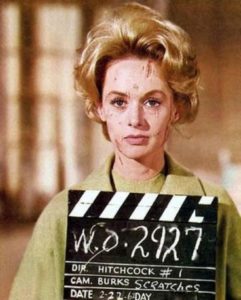
A makeup man applies blood to Tippi’s face during the filming of the attic scene.

Immediately, they take flight and hurl themselves toward her. Melanie jumps back, but as she does she impacts the door, shutting herself inside the room. Hundreds of birds, seemingly of all species, now descend upon Melanie. Hunter’s script included a small, eerie detail: the first thing she illuminates with her flashlight is an owl, sitting perched in the room and staring directly at her. It flies at Melanie and strikes her, causing her to fall against the door, slamming it shut. This detail was dropped, for whatever reason, and I can’t recall seeing any owls in the film at all.

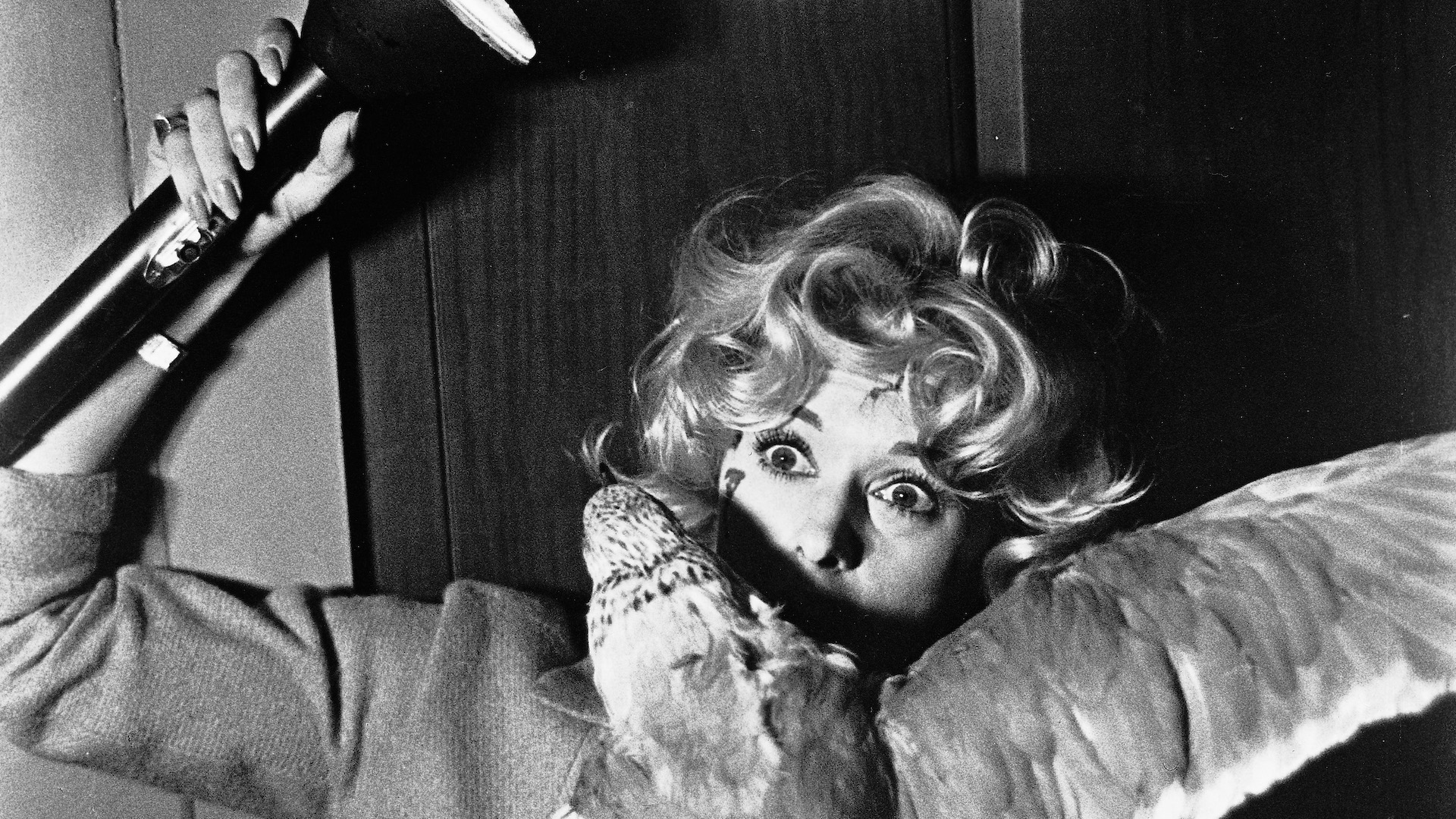
In the script, the sound of the door slamming shut quickly summons Mitch, who nonetheless has a difficult time getting the door open after Melanie collapses against it. In the film, a great deal more time passes before Mitch arrives on the scene to rescue her. Hitchcock intercuts shots of the birds flying at Melanie, with her batting them away, with her grasping at the doorknob behind her, trying to escape. The editing here is extremely rapid, with the longest shots lasting a mere three seconds. As the birds relentlessly attack Melanie, her hitherto immaculate green suit (which had not acquired a single wrinkle or stain in three days of wear) is ripped and torn. Her legs and arms are bloodied. In three disturbing shots, birds come dangerously close to Melanie’s eyes. We cannot help but think of Dan Fawcett and Annie.
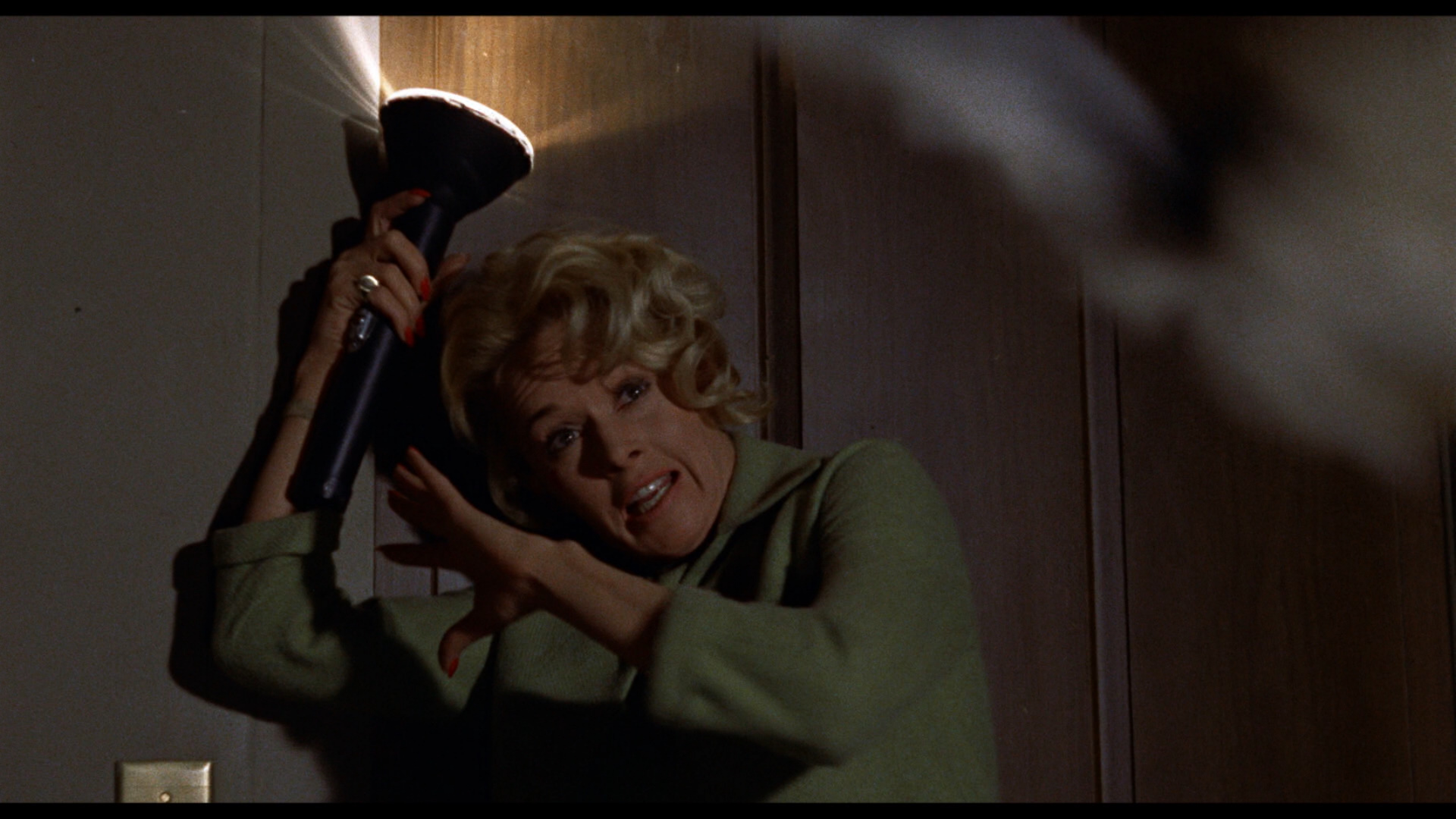
Some shots clearly involve fake birds, and today’s cynical, jaded audiences are likely to infer that the entire thing was fakery. This would be much to Miss Hedren’s chagrin, since almost the entire sequence involved real birds, and placed her in considerable danger. Hedren recalled,

The morning we were to start the scene, the assistant director, Jim Brown, came into my dressing room and seemed to be avoiding looking at me. I said, “What’s the matter with you?” and he mumbled, “We can’t use the mechanical birds.” [N.b.: Because Hitchcock realized they looked too fake.] I said, “Uh, well, what are we going to use?” He answered, “There’s a bunch of ravens and crows.” When I walked out on the set, I saw that they had built a huge cage around it — to keep the birds from flying up into the rafters — and inside the set were prop men with big, thick leather gloves up to their elbows to protect themselves from being bitten when they held the birds and hurled them at me.

The scene took a week to film. Hedren continues,

By Wednesday of the shooting week, I was tired. By Thursday, I was noticeably nervous. On Friday they had me down on the floor with the birds tied loosely to me with elastic bands, which were attached through the peck-holes in my dress. Well, one of the birds clawed my eye and that did it; I just sat and cried. It was an incredible physical ordeal. It was very hard for Hitch at this time, too. He wouldn’t come out of his office until we were absolutely ready to shoot because he couldn’t stand to watch it. I’ll never forget the day Cary Grant came on the set during a break from shooting That Touch of Mink. He was stunned by what I was going through and said to me, “You’re one brave lady.” I then considered the possibility that maybe this was one of the reasons why Hitchcock had chosen an unknown for the part — there was an element of danger in it, since the birds were not all nice guys.

After Hedren broke down crying, she went to take a nap in her dressing room. When it proved impossible for the crew to wake her, a doctor was summoned. The diagnosis was nervous exhaustion, and a full week of rest was prescribed. When Hitchcock protested, saying that there was nothing else left to shoot, the doctor responded, “Are you trying to kill her?” Hedren got her week off, then returned to the set to finish what was left of the scene. The entire sequence lasts just over two minutes and while it is masterful, it is two of the most unbearable minutes in the history of film.

Melanie whimpers and cries, but never screams. A large gash appears on her forehead.  It seems like all the birds in the world are in that room, attacking her. The sound of their fluttering becomes a roar. After a while, exhausted, Melanie almost ceases trying to fight them off. She gives up her feeble attempts to open the door behind her and slumps against it, then begins sliding down to the floor. She calls out once, to Mitch, very softly. Then, just before she loses consciousness, she cries, “Get Cathy and get out of here . . . !” This line is almost inaudible. The subtitles in the version I watched attribute the line to Lydia, but do not actually give the line, referring to it as “indistinct.” In the script, Lydia is heard from behind the door speaking to Mitch, saying “Mitch, get her out of there!” But in the film, it is clearly Hedren’s voice, and Hedren’s mouth is moving; moreover, “Cathy” is distinctly audible.
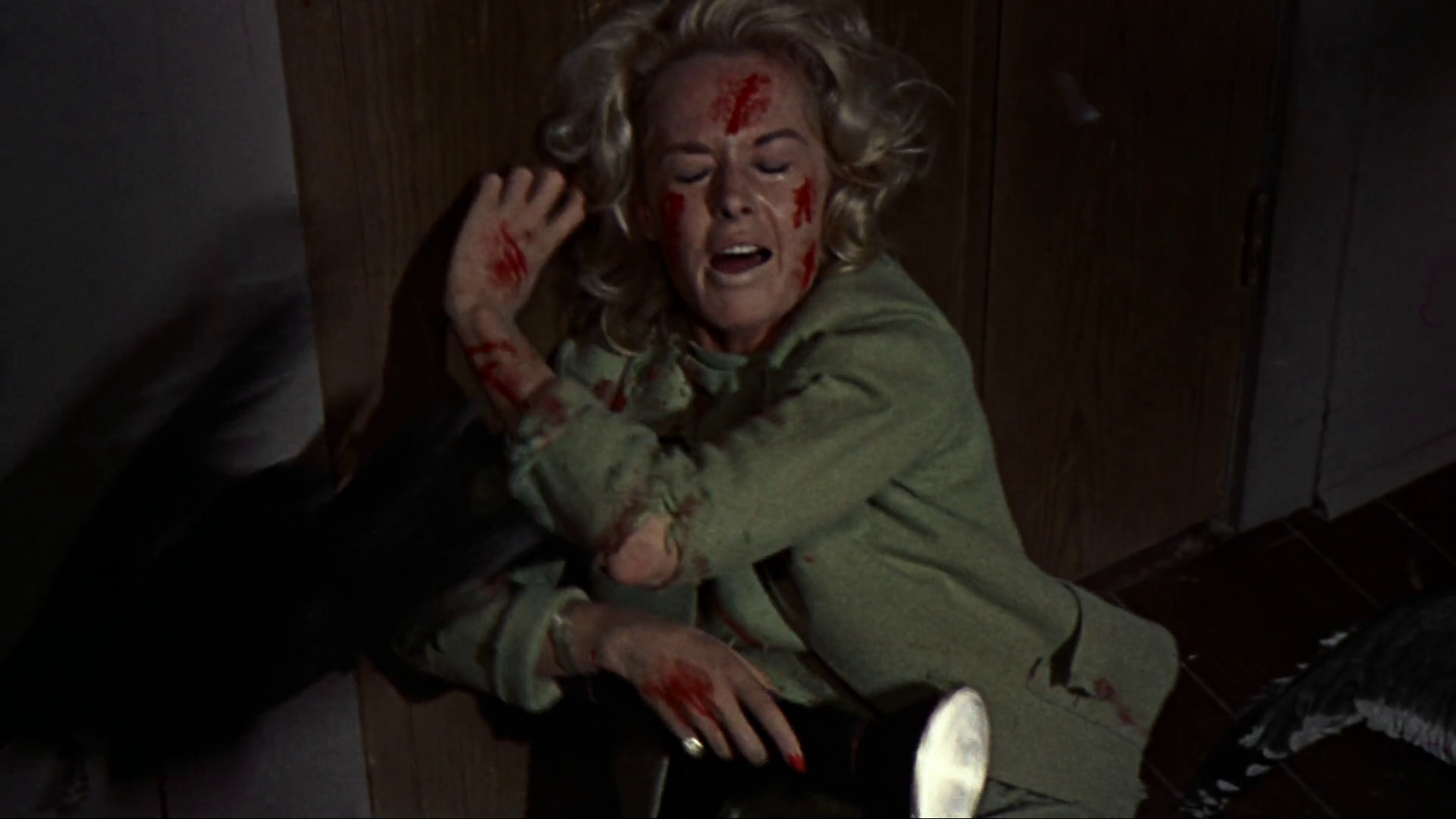
It is just about when Melanie loses consciousness that we finally hear Mitch at the door. “Melanie! Melanie!” he cries frantically. Mitch tries pushing the door open, but Melanie’s unconscious body is firmly wedged against it. He persists, succeeding in rolling her forward a bit, then grabs at her dress, trying to pull her out. Finally, he manages to roll her body a foot or so away from the door, and we see that Lydia is in the corridor behind him. Immediately, the birds descend upon Mitch. Now he must defend himself and try to lift Melanie up at the same time. When he finally succeeds in getting a good grip on her dress, the birds attack his hand without mercy. We see that Lydia is doing her part as well, hitting at the birds as they try to exit the room. Finally, we breathe a great sigh of relief as Mitch succeeds in pulling Melanie out the door and shutting it.

So what are we to make of this strange and harrowing scene? It presents a puzzle for the simple reason that it is not logical: there appears to be no logical reason why Melanie goes to that room.

As I noted in part six, Hunter included material in his original screenplay that was intended specifically to convey to the audience that Melanie was not in any way the cause or focus of the bird attacks. Hitchcock not only deleted this material, but had Hunter insert new dialogue that raised suspicions about Melanie. Specifically, I am referring to the crazed woman’s lines in the Tides Restaurant: “They said when you got here the whole thing started. . . . I think you’re the cause of all this. . . .” But how exactly could Melanie be the focus or “cause” of all this? Hunter sarcastically suggested that Hitchcock left the audience to imagine that “what happened . . . may have been an isolated experience brought on by God knows what — Melanie’s flighty earlier days? Lydia’s rejection of her? Who knows?” I submit that this suggestion actually deserves to be taken seriously.

In an earlier installment, I noted that The Birds prominently features dysfunctional, modern relationships between men and women, and parents and children. Melanie’s mother “ditched” her when she was eleven (note that Cathy turns eleven in the film). Is this the reason that she spends her time on mischief, jumping into fountains and playing destructive practical jokes? Mitch certainly thinks it may be, when he half-jokingly says to her, “You need a mother’s care, my child.” (This remark precipitates the revelation about Melanie’s mother.) Certainly, her status as a child of affluence has only made matters worse. She is, in every way, a modern woman: spoiled, entitled, unserious, self-involved, vain, cosmopolitan, deracinated (“we’re sending a little Korean boy through school”), and trivial. She is also a feminist of sorts: it is she who pursues Mitch, and not the other way around.

Like a female bird with gender dysphoria, Melanie comes to Bodega Bay and does a little mating dance outside the Oedipal nest Mitch has made with his mother and is unable to leave. Because of his mother’s jealousy, he cannot make a real connection with another woman. Both mother and son are made perverse by this relationship. He is unable to grow as a man, and she becomes the “anti-mother,” placing her own needs above those of her son. Mitch calls his mother “dear” and “darling,” as a husband would. Cathy is a bit of a brat (though Camille Paglia despises her as sugar and spice and everything nice). Cathy sasses her mother (“I know all that democracy jazz”) and seems to be seeking something from Melanie that Lydia cannot give her.

As I noted in part three, the development of these characters has been arrested; they play the wrong roles, or roles have been reversed. They are, in a word, unnatural. Thus, nature enters, in the form of the birds, to “realign” these lives. In this process, Melanie is absolutely central. The Mitch-Lydia relationship can only be put right by a woman whose need of Mitch is so absolute that Lydia simply must release him. But this cannot occur until Melanie abandons all her guile, her malignant mischief, and, especially, her “feminist” independence. Then Mitch, who had initially seemed like he needed saving, can save her. And it is only if Melanie can release herself in this way that she herself can grow and be healed. In effect, she must return to being the helpless eleven-year-old girl abandoned by her mother. This is what is accomplished by her encounter with the birds in the attic. (In the next installment, I will say more about how the encounter changes Lydia, and transforms her relationship with Melanie.)

In Hunter’s original script, Melanie goes up the stairs and heads straight for that one door, just as she does in the finished film. In his story conferences with Hunter, however, Hitchcock pressed the writer on exactly why Melanie does this. Years later, Hunter recalled,

I had her going up to the attic after she heard a bird peeping. Hitch asked, “If she hears birds in the house, why doesn’t she wake Mitch?” I said, “Because she’s not sure there are birds in the house.” Hitch persisted. “But if she thinks there are birds in that room, why would she open the door?” I had no answer. He said, “All right, it’s a good scene, but let’s take the curse off it. Let’s have her open a lot of doors and find no birds anyplace and therefore opens the last door believing it’s safe to do so.”

Even though the pair agreed to this change, and it was incorporated into the script, when it came time to shoot the scene, Hitchcock reverted to Hunter’s original idea: Melanie opens only one door, the one that has the birds behind it. Hedren apparently also did not understand why Melanie opens that door. When she asked Hitchcock why she does this, according to legend he responded, “Because I tell you to.”

Yes, there is no logical answer to why Melanie acts as she does, and Hitchcock was right to press Hunter on this. In the end, however, he realized that the attack on Melanie was necessary to provide a climax to the film, one which would provide a psychological resolution to the problems of these characters. This was doubly necessary because, in fact, it is the only resolution provided by the film. (As we will see in the next installment, the ending is indefinite or ambiguous.) By having Melanie go up the stairs and open only that door, Hitchcock suggests that there is an inevitability to her final encounter with the birds. Note how Hitchcock’s camera focusses on that door, and only that door, as Melanie ascends the stairs. He intercuts shots of Melanie moving up the stairs with her point of view, moving us, the audience, closer and closer to the door. We are left with the sense this encounter had to come; that there had to come a moment when Melanie, and only Melanie, confronted the birds.

In the end, it is hard to escape the impression that Melanie has offered herself to the birds, in an act of self-sacrifice — one which, as I have said, in the end “puts right” all of the characters, including herself. We have already seen one act of self-sacrifice by a character in the film: Annie redeems herself by saving Cathy from the birds, at the cost of her own life. That Melanie’s act is also a form of self-sacrifice, that she has overcome her frivolous egocentrism, is underscored by the insertion of the line “Get Cathy and get out of here” as she slumps to the floor, unconscious.

You see, it really was all about Melanie from the very beginning. The crazed woman was right when she said, “I think you’re the cause of all this.” Such a claim would have incensed the literal-minded Evan Hunter. But Melanie is not the “cause” in any literal or logical sense. This is a film in which what happens can only be understood in terms of psychology, and metaphysics.

I have offered the psychological explanation, so what of metaphysics? Here we must recognize that the film operates on multiple levels. On one level, Melanie’s encounter with the birds brings about a psychological resolution. But keep in mind that I have argued that the characters in the film represent modernity, or modern “types.” And here I do not have in mind only Melanie, Annie, and the Brenners, but also the other significant characters in the film, especially Mrs. Bundy. As we have seen, Hitchcock stated on more than one occasion that the theme of the film is “complacency.” I have argued in this series that the film depicts an encounter between complacent, modern man and the uncanny. The bird attacks represent the arrival of a Heideggerean “event” (Ereignis): a fundamental shift in the meaning, or being of things. As I discussed in part four, for Heidegger we do not control such “events”; we do not make them happen, they happen to us.

Ultimately, the origins of meaning/being are mysterious. But this is, of course, an affront to the mentality of modern man. We believe that we have laid bare the meaning of things, and have tamed the surrounding world, which we conceptualize as raw material for the satisfaction of our desires. The coming of the birds is a rebuke to that modern hubris — and a complete overturning of the world we thought we had built. Initially, modern man, speaking through Mrs. Bundy, declares all of this “impossible,” “ridiculous,” unimaginable,” on the basis of something we called “logic,” but that suddenly seems no longer to function. In the face of this great unknown, when it manifests itself (always manifesting, as Heidegger might say, in its essential hiddenness) we have two choices. We can try, for a while, to deny mystery, to deny the intrinsic hiddenness of being, as Mrs. Bundy does (until she is stunned into repentant silence); or we can surrender to mystery. This is what Melanie does when she enters that dark room in the attic. This is the metaphysical meaning of The Birds.

But there is one further element that may be in play in this climactic confrontation. As I have mentioned several times in this series, blindness is a theme that comes up repeatedly in the film, even (indirectly) in Annie’s reference to Oedipus. This is one of the most frightening aspects of The Birds. It is hard to imagine anything more awful than being blinded. As fates worse than death, it is right up there with castration. The film puts us in fear of blindness early on when Mitch tells the others “Cover your eyes!” as the birds rush down the chimney and into the Brenner living room. Then, in possibly the most grisly scene in any Hitchcock film, Farmer Fawcett is found blinded. Then Annie is blinded. Three times in the attic scene, Hitchcock’s camera shows Hedren in closeup, with wide-open eyes as birds come dangerously near those beautiful eyes. Once, the camera shows us Melanie’s point of view, and a bird flies directly into the lens, as if flying into Melanie’s eyes.

I argued in part five that the real “blindness” showcased in the film is the blindness of modern human beings relentlessly pursuing their desire to “see”: to know; to make all that exists fully transparent and manipulable. Tiresias warns Oedipus to give up his quest to find his father’s murderer, because some things are best not known. But Oedipus persists, with devastating consequences. His real blindness is much like the blindness of modern man: not perceiving the limits of knowledge, or the unintended consequences of its relentless pursuit. In The Birds, this blindness is principally represented by Mrs. Bundy. But we see it in the other characters as well. Lydia is compelled, against her better judgment, to move down the dark corridor in Dan Fawcett’s house and to make her traumatic discovery of his body, by her irresistible desire to see. And could this also be the reason Melanie climbs those stairs to the attic?

As I put it earlier, Melanie must, she simply must see what is on the other side of that door. The situation is mythic — she becomes Pandora (see part six), or Bluebeard’s last wife. What does she find on the other side? The revelation — the apocalypse (see part five). The opening of a new vision; a fundamental shift in the meaning of things; a human hubris-crushing Heideggerean “event.” In surrendering to the great unknown – the great abyss beyond human reason, from which spring all the “events,” all the epochs of being – the eyes of Melanie Daniel’s soul are opened for the first time, as the birds relentlessly pursue the stubbornly unseeing eyes in her head. As Tiresias says of Oedipus, she had eyes but she did not see.
But for now, we must end this metaphysical reverie and return to our story, for there is more to be learned here. To be continued in our next — and positively last — installment. . .

If you want to support our work, please send us a donation by going to our Entropy page and selecting “send paid chat.” Entropy allows you to donate any amount from $3 and up. All comments will be read and discussed in the next episode of Counter-Currents Radio, which airs every Friday.

Don’t forget to sign up for the twice-monthly email Counter-Currents Newsletter for exclusive content, offers, and news.


The Birds Or: Everything You Always Wanted to Know About Coronavirus (But Were Afraid to Ask Hitchcock & Heidegger), Part Eight

The%20Birds%20Or%3A%20Everything%20You%20Always%20Wanted%20to%20Know%20About%20Coronavirus%20%28But%20Were%20Afraid%20to%20Ask%20Hitchcock%20and%23038%3B%20Heidegger%29%2C%20Part%20Eight

Share

  • Gab
  • Or: Everything You Always Wanted to Know About Coronavirus (But Were Afraid to Ask Hitchcock Heidegger), Part Eight &body=%0D%0A%0D%0A%0D%0A%0D%0A%0D%0A%0D%0Ahttps://counter-currents.com/2020/07/the-birds-or-everything-you-always-wanted-to-know-about-coronavirus-but-were-afraid-to-ask-hitchcock-heidegger-part-eight/%0D%0A%0D%0A%0D%0A%0D%0A">

Enjoyed this article?

Be the first to leave a tip in the jar!

Instant Echeck GreenPay™

Related

  • Heidegger on Nietzsche, Part Five (Conclusion)

  • Heidegger on Nietzsche, Part Four

  • Remembering Giambattista Vico

  • Heidegger on Nietzsche Part Three

  • Heidegger on Nietzsche, Part Two

  • Heidegger on Nietzsche, Part One

  • Finding Atlantis Part 4

  • Do You Want to Play a Game?

Tags

Alfred Hitchcockbeingdas EreignisDaseinDerek Hawthornedie LichtungfeminismMartin Heideggermodernitymovie reviewsphilosophyThe Birdsthe uncanny

2 comments

  1. Petronius says:
    July 13, 2020 at 5:21 pm

    The attic scene parallels the shower scene in “Psycho”, sharp beaks substituted for the point of the sharp knife. Even the editing is similar, and isn’t it maybe again “mother” killing off an attractive female threat to her oedipal relationship? Norman Bates famously kept dozens of stuffed birds in his home…

    For me, the most eerie part of this scene is the relentless sound of the fluttering wings, while Melanie is almost silent during the attack. This is different from the shower scene, with the famous violin shrills and the victim screaming…

    I think the Pandora’s box or Bluebeard’s chamber analogy is sufficient to explain why Melanie enters the attic room. It works perfectly on an emotional level, as it is also the paradox of fear that draws you magnetically in as much as it repels you. That’s also a reason why we watch horror movies. Also fairly tales often have such moments. It was a perfect choice to stick to Hunter’s original script and not make the scene more “rationally” motivated.

    0
    0
    1. Derek Hawthorne says:
      July 13, 2020 at 6:54 pm

      Yes, one thing I have not talked about in the series is parallels to Psycho. Psycho is one of the reasons The Birds was made at all: Hitchcock felt he had to “top” it with a film that was as frightening, or more. The Birds was advertised in the US (and in Europe) with posters quoting Hitch saying “It may be the most terrifying picture I’ve ever made.” This implies (I believe) that after Psycho Hitch came to be known to younger audiences as a maker of horror films. Prior to Psycho he did not have the reputation of making “terrifying” films, not at all. Just suspenseful ones. The parallels you draw between the shower scene and the attic scene are valid. And Hitch really “topped” both of these with the rape-strangulation scene in Frenzy — which I think is the most repellent scene in any of his films. Much harder to watch than the shower scene in Psycho. Is my Pandora/Bluebeard’s wife explanation sufficient to explain why Melanie enters the attic? On one level, yes. It gives her a motivation, of a kind. But I’ve argued that it is dramatically and psychologically necessary, to provide a kind of resolution to the perverse life situation of the characters. And, of course, I also think there is a metaphysical climax here, where she, in essence, “offers” herself to the unknown. I believe the whole film is really about disabusing us of our claims to know. For me, as I will make clear in part nine, what really “clinches” this argument is the ending that is really no ending. We, the audience, demand that there be a resolution and an explanation — because we cannot tolerate mystery/not knowing. In 1963, audiences reacted by saying “was that it?” as the lights went up. They didn’t get that they were Mrs. Bundy.

      0
      0

Comments are closed.

If you have a Subscriber access,
simply login first to see your comment auto-approved.

Note on comments privacy & moderation

Your email is never published nor shared.

Comments are moderated. If you don't see your comment, please be patient. If approved, it will appear here soon. Do not post your comment a second time.

Writer of June

(4 votes) David M. Zsutty

Article of June

Why White Advocates Should Avoid “Based Blacks” by Dani Vypont 4 votes
    • Replacement Migration & Hypergamy

      F. Roger Devlin

      32

    • Kurds of a Feather Flock Together:
      Europe’s “Racist” Parakeet Tweet-Storm

      Steven Tucker

      1

    • Elevator Pitch to a Billionaire
      Money, Money, Money

      Ondrej Mann

      2

    • All Hail Rhodesia

      Spencer J. Quinn

      3

    • Nationalism This Week
      Disenfranchisement

      Greg Johnson

      31

    • The Murder of Ann Widdecombe

      Lipton Matthews

      9

    • Disclosure Day
      Please, Keep It Undisclosed

      Francisco Albanese

      12

    • Remembering Carl Schmitt
      July 11, 1888–April 7, 1985

      Greg Johnson

      1

    • Editor’s Update
      Fundraiser Update & New Books

      Greg Johnson

      1

    • Third Homeland Institute Poll on the Great Replacement

      David M. Zsutty

      12

    • The Bitter End of Western Metaphysics:
      Heidegger on Nietzsche, Part Five (Conclusion)

      Collin Cleary

      9

    • Fraudulent Black British History

      Mark Gullick

      7

    • A White Nationalist Response to Scott Greer

      Dave Chambers

      25

    • The Miami Mall Incident:
      Black Youths or Black Extraterrestrials?

      Dominic Fox

      6

    • The Theology of Three Populisms

      Morris van de Camp

      2

    • The Dangers of Skilled Immigration

      Lipton Matthews

      25

    • The Brotherhood of the Bell

      Beau Albrecht

      16

    • Endeavor: What Rome Means to Me

      Endeavour

    • When the Family Becomes Predation

      Jayant Bhandari

      5

    • RICU: The Gentle Art of Persuasion

      Mark Gullick

      7

    • Mind of Darkness:
      A Review of Lipton Matthews’s Busting African Delusions

      Derek Stark

      12

    • Remembering Revilo Oliver
      July 7, 1908–August 20, 1994

      Greg Johnson

      2

    • Some Advantages of Irish Nationalism

      Greg Johnson

      31

    • America at 250 from the National Cathedral

      Gabriel Anderson

      18

    • Why Not Stop All the Clocks?
      Modern Conservatism’s Flagging Commitment Towards Turning Back Time

      Steven Tucker

      3

    • Remembering Jean Raspail
      July 5, 1925–June 13, 2020

      Greg Johnson

      2

    • Editor’s Update
      Fundraiser Update & New Books

      Greg Johnson

    • The Ethnic Reality of FIFA 2026

      Samuel Valleus

      13

    • Nationalism This Week
      Tucker’s New Party

      Greg Johnson

      30

    • Ethiopia Against Italy
      How the Italo-Ethiopian Wars were part of the conflict between Eastern & Western Christiandom

      Morris van de Camp

    • Please Vote in Our Writer & Article of the Month Poll

      Greg Johnson

    • Available for Pre-Order!
      F. Roger Devlin’s Not Hooking Up

      F. Roger Devlin

    • Kolberg: The Last Nazi (or Prussian?) Film

      Steven Clark

      2

    • America 250 & The Fate of Empires

      Richard Houck

      20

    • Available for Pre-Order!
      Greg Johnson’s The Battle of the Books

      Greg Johnson

    • Why All the Silence About Blacks Being Kicked Out of South Africa?
      Because It’s Other Blacks That Are Doing It.

      Steven Tucker

      10

    • Zelensky, the Jewish Conspiracy Narrative, & the Demographic Replacement of Ukraine:
      A Critical Analysis of a Disinformation Discourse within the European Identitarian Right

      Luís Graça

      30

    • The Original Congressional Debate on Birthright Citizenship

      Alex Graham

      13

    • America at 250
      Unmanifested Destiny  

      David M. Zsutty

      32

    • The Normies are Waking Up:
      The Alliance for Responsible Citizenship Conference, London 2026

      Lipton Matthews

      2

    • Ethnic Vigilantism: The Movie

      Mark Gullick

      15

    • Lothrop Stoddard’s The Revolt against Civilization

      Kevin MacDonald

      2

    • David Zsutty on Political Organizing

      David M. Zsutty

    • PC-Incompatible Gaming:
      Plantation Simulator and the “Problem” of Racist Video Games

      Steven Tucker

      3

    • Remembering Lothrop Stoddard
      June 29, 1883–May 1, 1950

      Greg Johnson

      1

    • Editor’s Update
      Fundraiser Update & Upcoming Projects

      Greg Johnson

    • Nationalism This Week
      Metapolitics Wins:
      Scott Greer’s Whitepill

      Greg Johnson

      8

    • Remembering Colin Wilson
      June 26, 1931–December 5, 2013

      Greg Johnson

      3

    • Kevin Deanna on Political Organizing

      Kevin Deanna

      1

    • The Bitter End of Western Metaphysics:
      Heidegger on Nietzsche, Part Four

      Collin Cleary

      6

    • Joe Gould

      Replacement Migration and Hypergamy

      When you go Black we don't want you back. This is a good rule, with wide application. It works...

    • Bigfoot

      Elevator Pitch to a Billionaire: Money, Money, Money

      From what I understand about Pantera, the latest version of it anyway, they no longer display the...

    • Greg Johnson

      Disenfranchisement

      The underlying assumption of this is that we have created a government with the will to separation...

    • Bigfoot

      Replacement Migration and Hypergamy

      Another factor that influences interracial couples and marriages are white females that serve in the...

    • Josephus Cato

      Disenfranchisement

      I thought Greg was exaggerating about the numbers of guest workers in Qatar but lo he is right.  If...

    • Peter Quint

      Replacement Migration and Hypergamy

      the proportion who mix is higher than marriage stats would lead people to believe. That’s the actual...

    • Scott

      Some Advantages of Irish Nationalism

      Well, one of caveats against Kennedy's "A Nation of Immigrants" hubris (and that is what it was) is...

    • Dani Vypont

      Replacement Migration and Hypergamy

      One case from American history has always especially impressed me. Pretty much all the sources agree...

    • Dani Vypont

      Replacement Migration and Hypergamy

      You constantly post the most controversial and self-defeating thing possible under articles. This...

    • Peter Quint

      Replacement Migration and Hypergamy

      White women are the most racially disloyal women of all races. I always assume any White female I...

    • Scott

      Disclosure Day

      Dennis Weaver seemed miscast to me. I liked his shtick as McCloud, the New Mexico cowboy marshal,...

    • Ondrej Mann

      Replacement Migration and Hypergamy

      Young white men in Norway have only one option: to band together in gangs that reject...

    • Joseph C.

      Replacement Migration and Hypergamy

      I visited Oslo a year ago, for a week, and I'm going this october again (for a week as well). My...

    • Connor McDowell

      Replacement Migration and Hypergamy

      I’ve seen this OKCupid miscegenation argument before, and while much of my evidence is anecdotal, I...

    • Dominic Fox

      Disenfranchisement

      Even a real community will consist mostly of people who are only somewhat similar in character/...

    • Dani Vypont

      Replacement Migration and Hypergamy

      @JamesSunderland With regard to one of your earlier posts, I did some research, and it is ...

    • Dani Vypont

      Replacement Migration and Hypergamy

      What parts of the United States would you say have the most and least interracial relationships?It...

    • Dave Chambers

      All Hail Rhodesia

      Rhodesia is an inspiration to all of us whose families have had to flee the neighborhoods and...

    • Hairy Iranian Dude

      Replacement Migration and Hypergamy

      Boy, you are one Negative Nancy to interpret my post in such a cynical vein!

    • Gabe

      Replacement Migration and Hypergamy

      No doubt. And unscrupulous music (“record”) companies.

    • Earth Day Special

      John Morgan

      12

    • A Robertson Roundup
      Remembering Wilmot Robertson
      (April 16, 1915 – July 8, 2005)

      Margot Metroland

      13

    • The Paranoid Style in White Nationalism

      Greg Johnson

      30

    • Join the Dance!

      Andrew Hamilton

      1

    • We Can’t Save the Earth Without Reducing African Birth Rates

      James Dunphy

      36

    • “I’m Not a Conspiracy Theorist, but . . .”:
      Jeffrey Epstein’s Death Gives New Life to “Conspiracy Theories”

      Greg Johnson

      22

    • Sylvia Plath: Stasis in Darkness

      Vic Olvir

      17

    • Vanguardism, Vantardism, & Mainstreaming

      Greg Johnson

      80

    • Aviation, Geography, & Race

      Charles Lindbergh

      3

    • Some Thoughts on Yule

      Collin Cleary

      4

    • Living in Truth:
      A Yuletide Homily

      Jef Costello

      7

    • John Kennedy Toole’s A Confederacy of Dunces

      Greg Johnson

      20

    • On Aleksandr Solzhenitsyn’s Warning to the West

      Spencer J. Quinn

      7

    • Elitism, British Modernism, & Wyndham Lewis

      Jonathan Bowden

      6

    • Philip K. Dick’s Do Androids Dream of Electric Sheep? as Anti-Semitic/Christian-Gnostic Allegory

      Greg Johnson

      20

    • “Conspiracy Theory” or Conspiracy?

      Andrew Hamilton

      21

    • Remembering H. P. Lovecraft
      (August 20, 1890–March 15, 1937)

      Greg Johnson

      3

    • Who Are We?
      Nordics, Aryans, & Whites

      Greg Johnson

      71

    • Remembering William Gayley Simpson
      (July 23, 1892–December 31, 1990)
      A Pleasant Afternoon with Harriet & Bill Simpson

      Margot Metroland

      18

    • Here are the Young Men
      Remembering Ian Curtis
      (July 15, 1956–May 18, 1980)

      Mark Gullick

      18

    • Percy Grainger
      Artist of the Right

      Alex Graham

      7

    • Remembering Revilo Oliver
      (July 7, 1908–August 20, 1994)

      Greg Johnson

      18

    • The Meaning of July 4th for the White Man

      Gregory Hood

      13

    • The Front National’s Evolution

      Bruno Mégret

    • Merwin K. Hart
      Forgotten American Hero & Man of the Right

      Morris van de Camp

      10

    • George Orwell’s Nineteen Eighty-Four

      Jonathan Bowden

      8

    • Carleton S. Coon
      Scientist & Reluctant White Advocate

      Morris van de Camp

      4

    • The Kwanzaa Absurdity Will Be Dwarfed by Juneteenth

      Robert Hampton

      12

    • Stravinsky

      Alex Graham

      7

    • Like the Roman:
      Remembering Enoch Powell (1912-1998)

      Mark Gullick

      23

    • Exclusive Interview with Karel Veliky:
      The Final Chapter in the Film Series! Part II

      Ondrej Mann

      2

    • Exclusive Interview with Karel Veliky:
      The Final Chapter in the Film Series! Part I

      Ondrej Mann

      2

    • Nietzsche & Race

      Mark Gullick

    • The Crisis of Chinese Technology Thieves

      Morris van de Camp

      1

    • The Zodiac Killer

      Mark Gullick

      12

    • José Pedro Zúquete’s The Identitarians

      Greg Johnson

      3

    • Berlin: City of Stones

      Spencer J. Quinn

      6

    • Headbanging Lite

      Mark Gullick

      5

    • The Russians are Coming/The Russians are Coming

      Steven Clark

      2

    • The Cruelty of Kindness

      Morris van de Camp

      11

    • Jonathan Bowden’s Deliverance
      Part 7

      Jonathan Bowden

    • Lothrop Stoddard’s The Revolt Against Civilization

      Spencer J. Quinn

      15

    • About Film “From the Right”

      Karel Veliky

    • The 1970s: The Golden Age of Hijacking

      Morris van de Camp

      21

    • Jonathan Bowden’s Deliverance
      Part 6

      Jonathan Bowden

    • Do You Want to Play a Game?

      Mark Gullick

      1

    • Sexually Incontinent on the Indian Subcontinent:
      Who Rapes More Animals, Indians or Pakistanis? The Battle Continues!

      Steven Tucker

      3

    • Neo-Fascism in Film
      Part 5

      Karel Veliky

      15

    • The Game of Tarot

      Mark Gullick

      2

    • Institutions Cannot Be Transplanted

      Jayant Bhandari

      5

    • Jonathan Bowden’s Deliverance
      Part 5

      Jonathan Bowden

    • Crosstown Traffic:
      Jimi Hendrix & The Post-War Rock ‘N’ Roll Revolution

      Mark Gullick

      1

    • Slaves from the North:
      Finns & Karelians in the East European Slave Trade, 900–1600

      Lipton Matthews

      14

    • Neo-Fascism in Film
      Part 4

      Karel Veliky

      2

    • David Lean’s A Passage to India

      Spencer J. Quinn

      1

    • Elites are Essential to Development

      Lipton Matthews

      7

    • Jonathan Bowden’s Deliverance
      Part 4

      Jonathan Bowden

    • Neo-Fascism in Film
      Part 3

      Karel Veliky

      6

    • E. M. Forster’s A Passage to India & the Indian Mentality

      Spencer J. Quinn

      25

    • Jonathan Bowden’s Deliverance
      Part 3

      Jonathan Bowden

    • András László
    • Derek Hawthorne
    • Beau Albrecht
    • Alain de Benoist
    • Kerry Bolton
    • Jonathan Bowden
    • Collin Cleary
    • Jef Costello
    • Savitri Devi
    • Julius Evola
    • Jim Goad
    • Gregory Hood
    • Juleigh Howard-Hobson
    • Greg Johnson
    • Charles Krafft
    • Anthony M. Ludovici
    • Trevor Lynch
    • H. L. Mencken
    • J. A. Nicholl
    • James J. O’Meara
    • Christopher Pankhurst
    • Tito Perdue
    • Michael Polignano
    • Spencer J. Quinn
    • Fenek Solère
    • Irmin Vinson
    • Leo Yankevich
    • Francis Parker Yockey
    • Multiple authors
  • Editor-in-Chief

    • Greg Johnson, Ph.D.

    Featured Writers

    • Beau Albrecht
    • Gunnar Alfredsson
    • Collin Cleary, Ph.D.
    • Jef Costello
    • Morris V. de Camp
    • F. Roger Devlin, Ph.D.
    • Stephen Paul Foster, Ph.D.
    • Jim Goad
    • Alex Graham
    • Mark Gullick, Ph.D.
    • Greg Johnson, Ph.D.
    • Travis LeBlanc
    • Trevor Lynch
    • Margot Metroland
    • James J. O’Meara
    • Angelo Plume
    • Spencer J. Quinn
    • Fred Reed
    • Clarissa Schnabel
    • Michael Walker
    • David M. Zsutty

    Frequent Writers

    • Asier Abadroa
    • Aquilonius
    • Alain de Benoist
    • Kerry Bolton, Ph.D.
    • Dave Chambers
    • Steven Clark
    • James Dunphy
    • Endeavour
    • Richard Houck
    • Jason Kessler
    • Titus Livius
    • Ondrej Mann
    • Lipton Matthews
    • Mark Mazari
    • John Morgan
    • Jaroslav Ostrogniew
    • Kathryn S.
    • Christian Secor
    • Anne Wilson Smith
    • Thomas Steuben
    • William De Vere
    • Kenneth Vinther
    • Max West

    Classic Authors

    • Maurice Bardèche
    • Jonathan Bowden
    • Julius Evola
    • Guillaume Faye
    • Ernst Jünger
    • Kevin MacDonald, Ph.D.
    • D. H. Lawrence
    • Charles Lindbergh
    • Jack London
    • H. P. Lovecraft
    • Anthony M. Ludovici
    • Sir Oswald Mosley
    • National Vanguard
    • Friedrich Nietzsche
    • Revilo Oliver
    • William Pierce
    • Ezra Pound
    • Saint-Loup
    • Savitri Devi
    • Carl Schmitt
    • Miguel Serrano
    • Oswald Spengler
    • P. R. Stephensen
    • Jean Thiriart
    • John Tyndall
    • Dominique Venner
    • Leo Yankevich
    • Francis Parker Yockey

    Other Authors

    • Howe Abbott-Hiss
    • Michael Bell
    • Giles Corey
    • Jack Donovan
    • Richardo Duchesne, Ph.D.
    • Emile Durand
    • Guillaume Durocher
    • Mark Dyal
    • Tom Goodroch
    • Andrew Hamilton
    • Robert Hampton
    • Huntley Haverstock
    • Derek Hawthorne
    • Gregory Hood
    • Juleigh Howard-Hobson
    • Alexander Jacob
    • Ruuben Kaalep
    • Tobias Langdon
    • Julian Langness
    • Patrick Le Brun
    • G A Malvicini
    • John Michael McCloughlin
    • Millennial Woes
    • Michael O’Meara
    • Christopher Pankhurst
    • Michael Polignano
    • J. J. Przybylski
    • Quintilian
    • Edouard Rix
    • C. B. Robertson
    • C. F. Robinson
    • Herve Ryssen
    • Alan Smithee
    • Fenek Solere
    • Ann Sterzinger
    • Robert Steuckers
    • Tomislav Sunic
    • Donald Thoresen
    • Marian Van Court
    • Irmin Vinson
    • Book Reviews
    • Movie Reviews
    • TV Reviews
    • Music Reviews
    • Art Criticism
    • Graphic Novels & Comics
    • Video Game Reviews
    • Fiction
    • Poems
    • Interviews
    • Videos
    • English Translations
    • Other Languages
      • Arabic
      • Bulgarian
      • Croatian
      • Czech
      • Danish
      • Dutch
      • Estonian
      • Finnish
      • French
      • German
      • Greek
      • Hungarian
      • Italian
      • Lithuanian
      • Norwegian
      • Polish
      • Portuguese
      • Romanian
      • Russian
      • Slovak
      • Spanish
      • Swedish
      • Ukrainian
    • Commemorations
    • Why We Write
  • Archives
  • Top 100 Commenters
  • The Looney Bin
Sponsored Links
Europa.com Above Time Coffee Antelope Hill Publishing Paul Waggener IHR-Store Spencer J. Quinn American Renaissance Jim Goad The Occidental Observer
Donate Now Mailing list
Books for sale
  • Not Hooking Up
  • The Battle of the Books
  • The Philosopher Is In
  • Sexual Utopia in Power (Expanded Edition)
  • In Defense of Prejudice
  • Loving Our Own
  • Tyranny & Wisdom
  • To all books
Copyright © 2026 Counter-Currents Publishing, Ltd.

Paywall Access


Please enter your email address.

Lost your password?

Edit your comment

Writer & Article of the Month June 2026

Voting for this month has concluded. Here are the final results!

Top Writers

  • #1 David M. Zsutty 4 votes
  • #2 Mark Gullick 3 votes
  • #3 Morris van de Camp 2 votes
  • #4 Ondrej Mann 2 votes
  • #5 Dani Vypont 2 votes
  • #6 Greg Johnson 2 votes
  • #7 Collin Cleary 1 vote
  • #8 Millennial Woes 1 vote
  • #9 Beau Albrecht 1 vote
  • #10 Dave Chambers 1 vote
  • #11 Steven Tucker 1 vote
  • #12 Jayant Bhandari 1 vote

Top Articles

  • #1 Why White Advocates Should Avoid “Based Blacks” 4 votes
  • #2 Zsutty’s Maximum 3 votes
  • #3 The Murder of Henry Nowak 2 votes
  • #4 Uncivil War 1 vote
  • #5 Liar, Liar, Pants on Fire! 1 vote
  • #6 Small Is Beautiful: The Napoleon of Notting Hill 1 vote
  • #7 Interview with Gerhard Hallstatt of Allerseelen 1 vote
  • #8 Monkeys and Typewriters 1 vote
  • #9 The Remigration Movement Solidifies  1 vote
  • #10 I’m Glad He Failed 1 vote
  • #11 The Killing of Henry Nowak 1 vote
  • #12 Alex Jones’ Endgame: Blueprint for Global Enslavement, Part 4 1 vote
  • #13 China’s Threat to American Security 1 vote
  • #14 Ethnic Vigilantism: The Movie 1 vote
  • #15 The Inferiority Behind Immigrant Superiority 1 vote

Total votes cast: 21