 2,804 words
Rita Abrahamsen, Jean-François Drolet, Michael C. Williams, Srdjan Vucetic, Karin Narita, & Alexandra Gheciu
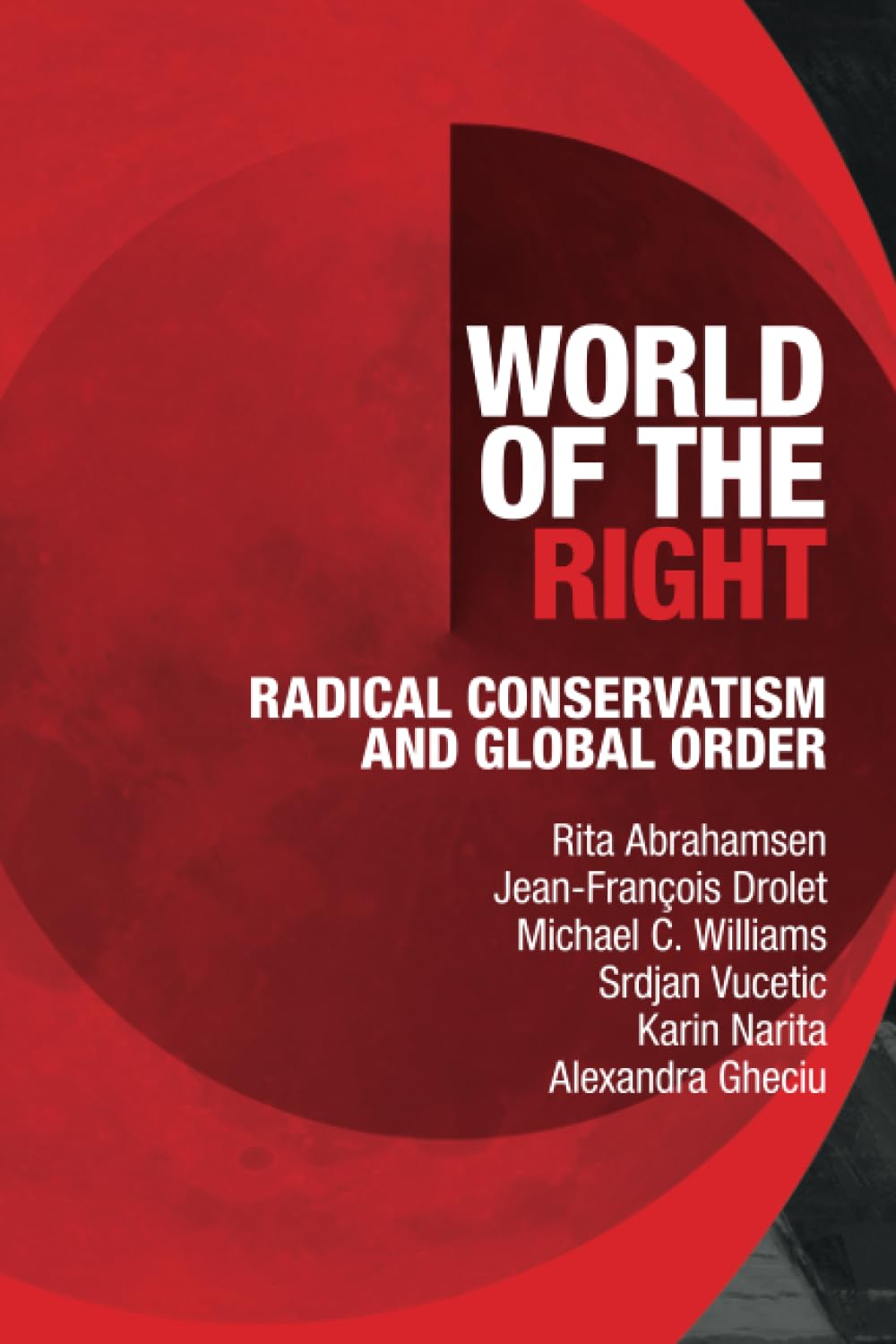
World of the Right: Radical Conservatism and Global Order
Cambridge: Cambridge University Press, 2024
If you ever try to convince a political “normie” that White Nationalism is the best political option, you are going to face some questions and objections: Who is white? Isn’t White Nationalism “racist,” i.e., evil? Do you envision one white state or many? How will you separate from non-whites? Etc.
Basically, you must convince people that White Nationalism is meaningful, moral, and practicable. You need to answer these questions persuasively before White Nationalism is going to make political headway. Answering these questions is what we in the movement call “metapolitics.”
In the Anglosphere and Western Europe, metapolitics is not just the Right’s best option, it is basically our only option. We don’t have the money to win elections or the guns and numbers to mount a revolution. Our enemies vastly outmatch us in terms of guns and money. Their great weakness is intellectual: their system is built on lies and delusions about human nature and society. Thus it can produce only misery and destruction.
Our strengths and weaknesses are a mirror image of those of our enemies. We lack money and force of arms or numbers. Our great strength is intellectual: we know the truth about human nature and society. Thus only we can solve the political problems of our time.
It is folly to attack our enemy on the grounds where he is strongest, and we are weakest. Instead, we must attack where we are strongest, and they are weakest: on the ideological front. That means metapolitics. When we convert more people to our side, then money, power, and political change will follow.
If you were to ask me how to create a first-rate academic book on New Right metapolitics, just about the last thing I would suggest is to call together six International Relations scholars, three from England and three from Canada. Whoever heard of a good book written by a committee? Yet somehow World of the Right is one of the best books on our movement written by outsiders.
As researchers, the authors of World of the Right are admirably thorough and objective. As writers, they are seldom tendentious. But they are hardly disinterested. They clearly share a Left-wing and globalist agenda. They don’t want the Right to succeed. But they are forced to admit that New Right metapolitics is highly effective. Because this is in effect a declaration “against interest,” the authors of World of the Right make an even more convincing case for New Right metapolitics than its partisans.
World of the Right is divided into five chapters. Chapter 1, the introduction, is entitled “A Diverse and Global Right,” which I guess means it’s a good thing. Here the authors outline the book’s argument. They also make it clear that they are not discussing the center-Right, but the “radical Right,” which ranges from the European New Right and North American White Nationalists, including writers at Counter-Currents and American Renaissance, to American paleoconservatives as well as Italy’s Lega Nord, Hungary’s Fidesz, Germany’s Alternativ für Deutschland, France’s Rassemblement National (formerly the Front National), and Trumpism (p. 25). (The authors sometimes speak of this whole spectrum as the radical Right and sometimes divide it into the radical Right and the extreme Right [p. 25].) The authors also characterize the far Right as “populist” and “nationalist” as opposed to the center-Right, which is as “elitist” and “globalist” as the rest of the political establishment.
But anti-globalism is itself a global phenomenon, and given that the authors are International Relations scholars, it makes sense for them to study the radical Right in the global context.
This book seeks to explain how this recognisably populist vision of the world has become so widespread. Rather than a conventional political ideology, this is a form of thinking and speaking that promotes Right-wing politics on a scale that is global rather than geographically confined and that is radical in both methods and tactics. To fight liberalism, it has turned the left-wing hero Antonio Gramsci on his head and engaged in a carefully crafted counter-hegemonic struggle. This is no mere posturing or the ephemeral operation of a thin ideology; it reflects a relatively novel and revolutionary intellectual orientation. This “radical Right,” as we call it, has developed an international political sociology with the power both to identify a common enemy—the new class of international “managerial elites”—and to mobilize “the people” against it. These movements are not just national: in fact, the global is a crucial part of the radical Right’s intellectual foundations and political strategies. (pp. 2–3)
The radical Right is global in at least three senses. First, Right-wingers, nationalists, and populists of all nations have certain common ideas, goals, methods, and enemies. Second, based on these commonalities, they work together across borders, sharing ideas and building networks and alliances. Third, the Right thinks about global issues; it both opposes the current international order and has ideas about what will come after it.
Our authors stress two other important features of the Right: (1) its lack of hierarchy and centralization which makes possible (2) a diversity of opinions and tactics. This allows the Right to convert and mobilize many different constituencies.
The global radical Right does not consist of an overarching, universal theory, ideology, or objective that all adherents must subscribe to. Nor does it have centralised controlling institutions. Instead, these counter-hegemonic ideologies enable a range of actors and agendas to find common cause despite their different contexts and concerns. (p. 30)
This “multiplicity is in part the radical Right’s strength” (p. 142).
The unity of the Right is not to be found in centralized organizations or common intellectual premises, although various approaches share analogies, family resemblances, and connections with one another. Instead, the Right is unified by common enemies and common goals. “Uniformity, unanimity, conceptual precision, or centralised organization are not required in order to craft such performatively loosely shared but still salient and impactful political identities, discourses, and alliances” (p. 20). I have long argued for such an approach in essays like “Against Right-Wing Sectarianism,” “Redefining the Mainstream,” and “A Winning Ethos.”
The authors are clearly mindful that their approach (to take the Right seriously) and their broad conclusion (that the Right’s metapolitical strategy is working) might be seen as an endorsement of the Right:
In seeking to take the radical Right, their ideas, and their supporters seriously and subject them to careful academic analysis, we are mindful that some might accuse us of popularising, and possibly naively legitimising them. However, we are convinced that it is essential to take their analytical and political strategies seriously. (p. 29).
The authors, however, defend their method in terms of their ultimate goal, which is “to counter the rise of the radical Right and to achieve a less destructively polarized politics” by means of “understand[ing] their ideas and their attractions for large sections of the population” (p. 4).
But even though World of the Right does not endorse the Right wholesale, it does endorse metapolitics as a successful approach. Frankly, I find passages like this quite encouraging:
. . . today’s radical Right . . . contains a systematic and sustained philosophic enterprise that over several decades developed a narrative about globalisation that could equip a renewed radical Right with an analytic, strategic, and affective foundation for its return to political prominence, and even power. (p. 25)
Chapter 2, “The Gramscian Right, or Turning Gramsci on his Head,” deals with metapolitics. Antonio Gramsci (1891–1937) was an Italian Marxist theorist and politician who in the 1960s inspired Alain de Benoist and the European New Right. The New Right did not turn Gramsci on his head, however, but simply brought him to the other side of the aisle, appropriating him for the Right.
The metaphor of turning a thinker upside down of course refers to Marx’s appropriation of Hegel. Hegel was an idealist, who believed that history was a record of mankind’s struggle for self-consciousness and recognition. Ideas come first. Marx put Hegel on his head by embracing cultural materialism, claiming that ideas follow and reflect technological, economic, and political change.
But Marxist cultural materialism was always a form of “false consciousness,” for Marxism was an ideological movement from the start, and its victories never arose from the dialectic of material forces but rather from the dialectic of ideas. Gramsci simply owned up to this fact, putting Hegel back on his feet. The same is true of the Frankfurt School, the useful core of which is a return to German Idealist thinking about culture and cultivation as a tool for the cultural critique of liberalism and modernity. The New Right has always been idealist, not materialist, thus to the extent that we use thinkers like Gramsci and the Frankfurt School, we are only reclaiming our rightful heritage.
According to World of the Right, “. . . what distinguished Gramsci from other left-wing thinkers was the non-egalitarian potential of his theory of cultural power, along with the organisational lessons that conservative forces could derive from it in their struggle against liberal modernity” (p. 43).
Gramsci’s most important idea is ideological “hegemony.” He believed that social systems maintain their power through hegemonic ideas that legitimize them. Hegemonic ideas are those that are not debated or politically challenged. They are accepted by virtually everyone, even people who think of themselves as dissidents. To create political change, we must challenge the system’s hegemonic ideas by criticizing them and promoting a new hegemony, a counter-hegemony. This is what we mean by New Right metapolitics.
Counter-hegemonic struggles also involve infiltrating or setting up educational and cultural institutions to promote new ideas. To describe this process, German New Leftist Rudi Dutschke coined the phrase the “long march through the institutions,” a phrase that is today more likely to be uttered by the Right than the Left, for the Left now controls the leading institutions of society, and the Right seeks to dislodge them.
The authors of World of the Right quote an impressively long list of Right-wing advocates of Gramscian metapolitics, beginning with Alain de Benoist and including Viktor Orbán, Javier Milei, Jair Bolsonaro, Guillaume Faye, Sam Francis, Paul Gottfried, Thomas Fleming, Marion Maréchal, Eric Zemmour, Thierry Baudet, Andrew Breitbart, Steve Bannon, Olavo de Carvahlo in Brazil, Makis Voridis in Greece, Ram Madhav in India, and “Greg Johnson, a leading figure of the North American New Right” (pp. 53–54).
Counter-Currents appears in World of the Right 34 times. Kerry Bolton appears 4 times for his work with Counter-Currents. James J. O’Meara appears 3 times. My alter ego Trevor Lynch is mentioned once, as is Buttercup Dew. My name appears 32 times, generally in good company:
. . . in the United States, a similar agenda [to the European New Right] has been promoted actively in more recent years by cultural enablers such as Greg Johnson, Michael O’Meara, Jared Taylor, Kevin MacDonald, Richard Spencer, and other ideological entrepreneurs gravitating around the publishing and media platforms of the Alt-Right, the North American New Right, American Renaissance, and other agents of white nationalism. The New Right in the US is also closely related to the earlier development of the paleoconservative movement led by intellectuals such as Paul Gottfried, Samuel T. Francis, Thomas Fleming, Clyde L. Wilson, and Donald Livingston. (p. 26)
I was pleased to see Donald Livingston’s name mentioned, because his important metapolitical work as a philosopher and as the founder of the Abbeville Institute is underappreciated. But I must object to the phrase “cultural enablers,” which smacks of journalistic snark.
The most extensive discussion of Counter-Currents and my work is in chapter 4, “The War of Position: Towards a Right Common Sense.” The concept of a “war of position” must be contrasted to a “war of movement.” A war of movement is a confrontation of power against power, for instance, an armed revolutionary struggle. A “war of position” is a battle of ideas; it refers to the use of metapolitics to undermine hegemonic ideas and create a new counter-hegemonic “common sense,” which will give rise to political change. A war of position is a long-term strategy, requiring patience and self-discipline: “Such a war, takes decades and requires considerable economic and cultural resources, as well as organisational structures and strategies” (p. 143).
The authors acknowledge the metapolitical importance of the Right’s “transgressive and often offensive use of digital communication and social media.” Online battles are, of course, a form of metapolitics. But they are more akin to a war of movement than a war of position, since they usually focus on immediate events, not building institutions for long-term educational projects.
Since social media memes and “shitposting” have been widely analyzed by other scholars, our authors instead focus on:
. . . equally important but often overlooked efforts to capture the traditional institutions of cultural and political domination via academic publishing, universities, and policy institutes. While diverse and uncoordinated [sic], we argue that these various initiatives serve to create a new legitimacy and acceptability for radical Right ideas, explicitly rewriting intellectual history from a radical conservative perspective and reclaiming it from the academic mainstream. (p. 32)
In publishing, Counter-Currents is discussed alongside Arktos and Encounter Books, which has close ties to the Claremont Institute. The authors also discuss Hillsdale College, New College in Florida, and the University of Austin in the United States; Steve Bannon’s failed attempt to create a ridiculously named “Academy of the Judeo-Christian West” in Italy; the Ludovika University of Public Service, the Danube Institute, and the Matthias Corvinus Collegium in Hungary, all of which are lavishly funded; Policy Exchange in the UK; the Institute of Social Sciences, Economics, and Politics in France; and Poland’s Collegium Intermarium.
These institutions “Demonstrate the importance the radical Right itself assigns to the less overtly transgressive, more long-term intellectual struggle for hegemony” (p. 110). Sadly, not that many people in the White Nationalist sphere treat institution building and long-term intellectual and cultural work seriously. But it is heartening to see what is happening in Central and Eastern Europe, especially in Hungary, where the Right enjoys state power and Viktor Orbán has a deep appreciation of metapolitics. Long may he reign.
The discussion of Counter-Currents in this chapter runs from page 114 to 117 and is accurate but marred by tendentious swipes. For instance, “the Old Right refers to Fascism, National Socialism, totalitarianism, terrorism, imperialism, and genocide, which Johnson claims to denounce” (p. 115, emphasis added). This is silly, because there’s no shortage of hair-raising heresies I frankly avow, so if I endorsed any of these horrors, I would actually say so. Later they say my approach “purports to advance a pluralist world.” Again, why the insinuation of delusion or dishonesty? I advocate sovereign homelands for all peoples. That level of pluralism gives globalists hives. My advocacy of metapolitics is characterized as “seemingly less violent” than advocating for violent revolution. Seriously? Later, they speak of Counter-Currents’ “seemingly lighthearted cultural stream, focused on art, music, film, and popular culture.” No doubt, they would watch someone reading Jim Goad, Trav LeBlanc, or Beau Albrecht and observe that the subjects “seem” to be laughing. It’s all so tiresome.
The silliest swipe in the book occurs on page 60, where we read of “the theorists of the French Nouvelle Droite . . . Alexander Dugin in Russia and Greg Johnson and his acolytes in American Renaissance . . .” No, sorry, my “acolytes” are at Counter-Currents. And why call them acolytes? Why not minions? The whole thing is laughable. Cults of personality exist because people with defective personalities encourage them, thus attracting people with complimentary defects. No such dynamic exists at Counter-Currents—or American Renaissance, for that matter—because neither I nor Jared Taylor want such a thing.
Chapter 3, “Deconstructing the Global Administrative State,” deals with the enemy of the radical Right, which is “globalists.” This is essentially correct, but the authors put too much emphasis on “managerialism.” There is definitely a strand of Burnham-influenced elite theorizing in our circles. Sam Francis devoted enormous energies to this topic, particularly in his unfinished and posthumously published book Leviathan and Its Critics. I understand why this sort of thing excites people with Marxist assumptions, but my sense is that elite theory is marginal within our circles. For instance, I was deeply influenced by Francis, but I always rejected Burnham as too Marxist.
Chapter 5, “The Right World,” deals with the geopolitics of the Right, specifically such concepts as “multipolarity” and the “civilization state.” I understand why International Relations scholars focus on such ideas, and there is very little pushback against them within our circles. But there should be, because these concepts are inconsistent with ethnonationalism. Indeed, they are widely promoted by Kremlin operatives to create support for Russian imperial revanchism. But even this is a testament to the importance of metapolitics.
World of the Right offers a powerful defense of Right-wing metapolitics. Sometimes I wish that my fellow White Nationalists appreciated the battle of ideas as much as our enemies do.
7 comments
I wonder how many leftists have read this book.
Very interesting. One gets so used to seeing the way outfits like the SPLC describe us (i.e., always dirtying up even the most matter-of-fact description of an org or person), that something like this really does read more like a mere FYI piece that would be written about any other less-threatening ideology (cited instances of snark notwithstanding).
Great article! While the information in this book is not as accurate, or laudatory as you would like, it may attract new adherents to our cause. 🙃
Well, well, the good folks at Cambridge University Press taking notice of us. We must be doing something right. Keep up the good work.
They are running scared.
First, they dismiss you as beneath contempt; then they study you; lastly, they succumb–for nothing can stop an idea whose time is coming.
What do we aim for if not a change in culture? If your opponents call you a ‘cultural enabler’ you must be doing something right. Keep it up!
And why call them acolytes? Why not minions? Yeah, we’re all disciples of the underworld around here with possessed red eyes wearing Eyes Wide Shut ritual robes to praise the Master, ‘extreme’ right-wing jim jones. God, these people suck. The nerve of them to dare call us enablers while they enable the most monstrous crimes against the most vulnerable of ours and animals. Classic projection. You’d think there would be just one leftist/liberal/democrat with some sense to not just follow the jogscript and have a ‘hmmmm…’ moment. The most ‘dissenting’ move of theirs is to switch republican, support the Riley Gaines cause, maybe desert lgbt, and assert the most milquetoast youtube-approved opinions on the baseline periphery of not openly criticizing White people? That’s really the farthest they’re willing to go? For a group not shy about embracing lunatic ideas I would expect a democrat ship-jumper who’s not cooked to be more daring and maybe WN flirtatious in their beliefs by now. If Jack London did it, why can’t they dare to be more truly rebellious-as-racialists than just content with mainstream palestinian support?
If you have a Subscriber access,
simply login first to see your comment auto-approved.
Note on comments privacy & moderation
Your email is never published nor shared.
Comments are moderated. If you don't see your comment, please be patient. If approved, it will appear here soon. Do not post your comment a second time.