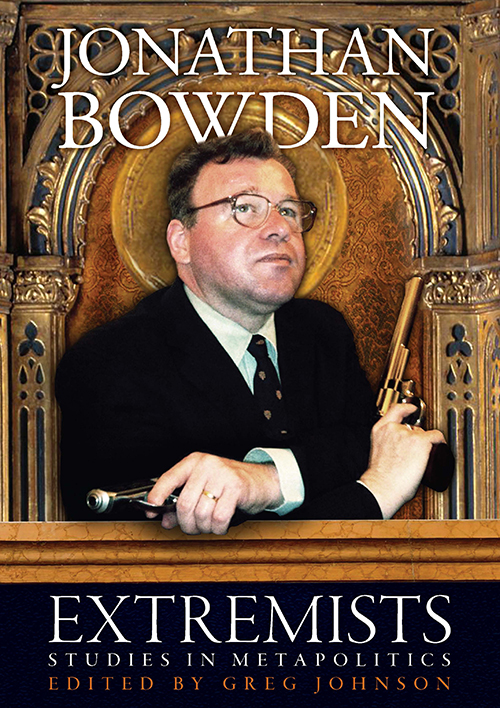
You can buy Jonathan Bowden’s Extremists: Studies in Metapolitics here.
10,194 words
Part 2 of 3 (Part 1 here).
Edited by Greg Johnson and Peter Jacobi
This installment of Fury is a long letter to an “absent relative.” Everything in this letter could be fictional, including the addressee. But, as with other texts by Bowden, the fictions might be overlaid on actual people. If you have any guesses about the real identity of the addressee or such characters as Geraldo, Simon David, the Pole, Anthony Rollover, Etonian Cretin, Vamp, Mountebank Brinkley, and Drunk & Disabled, please comment below or email me at [email protected]. — GregJohnson
Dear —,
I think that we must always be aware of the fact that our conversations have a certain falsity, a certain necessary redundance in relation to both style and content. We speak past one another most of the time or at the very best we seek to annul the effects of the past, to render ourselves oblivious to a certain fate. Ultimately our form of communication is a type of shadowboxing; a delirious entrance into the possibility of a conversation which might have occurred. As a result, the communication which takes place between us is riddled with a certain ennui, a degree to which all communication between us partakes of the falsity which I have described. We are alone with each other. In short, we are in a void going nowhere, a passage between two dimly lit rooms, at once remote and yet near to hand, purblind and yet exalted. I think the truth of the matter is that we suffer from an absence in communication or if not an absence then a certain lacunae; a momentary indecision. It is as if part of our past has been lost somewhere and we are trying to retrieve it without understanding that it cannot be retrieved. Indeed, necessarily the purpose of our conversations is that something is missing; something is not said. It is essentially finely and highly regarded, but also of no consequence. We might say, therefore, that our conversations are moments of futility which redeem themselves by virtue of the fact that certain things are not declared. They are undeclared and lacking in passion, if not in reason. While ultimately the whole purpose of these conversations is to talk without distraction, to commune without saying anything whatsoever.
All of which is reminiscent of the holiday home Buda down on the Kent coast and the nature of the trips we used to have there, trips which you always loathed and attempted to boycott. In fact, most of the time you regarded work as a form of holiday and the holiday, when it came, as the most appalling form of work which you had to “get through” as quickly as possible. As a result, these holidays in Kent became an exercise in survival as far as you were concerned; a form of survivalism. This was an activity which can only be described as a task; an offering—although not a propitiation. It was something which you had to live and suffer under, as the hands of the clock moved round the face of the dial until they read zero. Buda itself, of course, was an extraordinary house which lay back from the cliff’s edge and that presented two storeys, three if you include the garret at the top, which looked out to sea. While another storey, essentially the first floor—a crude basement of a sort—lay behind the cliff and was only contactable from the rest of the house down an iron stair-well of uncertain provenance. Nevertheless, there was also a secret passage or channel of communication between the two dwellings, in the form of a sealed stairway. This was a concealed servant chute which had been closed over—if not exactly bricked up—with a crude ply-wood structure; a weak form of timber to restrain the musings of the past. The high point of the house, however, was its central room, i.e., the second storey, which looked out through a decaying porch and conservatory onto the sea which crashed against the pebble beach beyond. The conservatory itself was musty, befuddled, and alternately damp or sultry, and it also contained a large number of dead and decaying plants, most of them in rotted or stunted flower-pots, purple and brackish, which lay against the side of the glass enclosure in full view of a painful sun. While the beach it overlooked; a sort of terminal beach to use the imagery of J. G. Ballard; contained no sand whatsoever and was strewn with particles of refuse, spare timber—thankfully no beer cans—but occasionally oil slicks. (I distinctly remember an oil slick in nineteen seventy-three.)—As well as occasional faeces, mounds of shit, to use a basic term, which the government or the powers that be find necessary to dump in the sea off the Kent coast. The main room, however, is the room which I wish to refer to; and it was a striking room in just about every way; a striking and somewhat alarming room, at least when you saw it first, and it resembled a cross between a Hammer Horror set and the average West London drawing room. In that it was painted jet-black—the walls, the door, the floor, and the ceiling were all pitch black, dark and purposeful, with violently red, even blood red, drapes, curtains, hanging objects, and other hidden booths and recesses. All of which led to a vertiginous feeling; a gulf in the spirit, a type of emotion that we might describe as political ambidexterity; a form of political confusion. When you take in the vista of the red and the black; anarchism and Nazism—complete opposites of each other—which touch and ramify with one another in all sorts of strange ways. Yet the room itself appeared to have been an amphitheatre of perversion; a vestibule of the Black Mass according to my mother. Whether or not the Black Mass was celebrated was another matter. Indeed, at the time I was only around six years of age and I had no conception as to what the Black Mass was if it was anything at all. It just sounded vaguely sinister and spectral—at once powerful and yet much further off, capable of resolution and yet essentially mysterious, beyond the beck and call of reason and desire. As a result, only a browsing through the works of Montague Summers at a later date would reveal to me the nature of the Black Mass—the truth about its inversion of sacramental norms; and the reason why the main room at Buda may have been used for these officiations.
Another peculiar thing about Buda was the strange family downstairs which consisted of a mad inventor and his wife together with a brood of adult children who did not seem to want to fly the nest. The garden which existed downstairs beneath the cliff as you looked out towards Hythe was bestrewn with a large number of inventions, such as rotting motors, decrepit valves, pieces of purposeless machinery, and other technological bric-à-brac—as the sun glinted off metal sheeting, alternative dynamos, residual generators, and strange, lifeless windmills which turned aimlessly in the breeze. The family themselves were even more eccentric, and they consisted of an old man—a sort of amateur King Lear—with a large white beard and a rubicund complexion together with a “spinsterish” wife and a sallow, rather unfulfilled daughter, with a lankish demeanour. All the members of the family, with the sole exception of the old man, used to congregate around a strange object in the centre of the garden next to the washing-line which stretched perpendicularly towards the house and in front of a neatly mown stretch of lawn. The nature of this mysterious structure was never entirely made clear to me. On the one hand, it could have been a greenhouse or misplaced conservatory, an innocent enough contraption. While, on the other hand, it could have been something genuinely mysterious, such as a sunken metallic tomb, the entrance to a concealed laboratory which existed under the cliff, or quite possibly some secret Reichian device, such as an orgone accumulator. In any case, this strange receptacle, masked by a curtain, was the object of imprecations and unusual gestures by the household down below—all of whom seemed to arrange the curtain outside the “shrine” with considerable devotion or so it seemed to my childish mind. If we move back to the house itself, however, then we come across more items of strangeness; the desiderata of wonder—such as a large oil-painting of a tournament in the Circus Flavius, the Roman colosseum. Where a chariot race was depicted in heavy and somewhat garish tones. In a manner that was reminiscent of a Victorian print of Charlton Heston, the “beefsteak” actor, in his part as Ben Hur in the Hollywood epic. All of which was depicted in a high-flown and yet fleshily Victorian manner; a manner which was neo-classical, mid-century rather than Decadent, redolent of clean limbs and Christianity particularly of the muscular variety, on an engraving which could have accompanied a novel by Bulwer Lytton. Moreover, the picture was massive—with its scene of horses and drivers panicking and throwing up mud. It must have spanned at least twenty feet in my childish recollection, and it was contained in an enormous gilt-frame, so heavy that it had to be literally chained to the wall.
All in all, Buda was reminiscent of the stock of Colin Wilson books which were discovered beneath one of the beds in the attic. This was a room which you ascended to gingerly up a dark, ebony staircase which creaked continuously. The novels themselves were in a bad condition, many had the covers ripped off, and they resembled remaindered editions, at once mildewed, beaten down, and bronzed with age, particularly given the cheap paper in most paperback books. As a result, these copies resembled strange, stunted abortions—little more than proofing editions—with pale pink, red, and occasionally blue covers, which peered at you knowingly from cardboard cartons under the bed.
Wilson himself was an unusual author who had not been accepted by the artistic establishment, primarily because he was a working-class autodidact who possessed little grace or tact when dealing with his betters. Indeed, Wilson’s work was a strange amalgam of different tendencies, some advanced and others relatively retarded. As the author attempted to show that he was a functioning intellectual, on the one hand, whilst remaining a middle-brow celebrity, a Sunday supplement writer, on the other. We might say, therefore, that Wilson’s work was divided into two distinct halves; the one wry, relatively humorous, and quite ironic—remarkably English in fact—while the other was opinionated, bombastic, and self-congratulatory in tone. It was as if Wilson wrote intellectual books in a popular vein, without admitting that he was doing this, and without laying his head on the block in contrition for populist tendencies. Nevertheless, Wilson will often take four or five sides to make a point which could have been made in a paragraph, and this only confirms the latent insecurity of the autodidact, no matter how gifted. Moreover, Colin Wilson’s views, romantic and wistful as they were, placed him on the Right politically—at least in a metapolitical and cultural sense—and for a while at any rate he was part of Sir Oswald Mosley’s intellectual “kitchen cabinet.” (Something which was bound to doom him in the eyes of the liberal intelligentsia.)
Other features of Buda were the creaking noises at night as the large amount of wood which the house contained gradually contracted throughout the evening as the house cooled. The holiday-house, for this is essentially what it was, stood to one side of a tawdry block of flats, mostly council house dwellings (so it appeared) which looked out to the seafront amidst the smell of salt-spray. Further along from the house, up the coast travelling in an easterly direction, was the somewhat dilapidated seaside town of Folkestone, replete with coastal townhouses, wide boulevards, and hotels, some of dubious repute, rather like a French town on the other side of the Channel. Indeed, I once remember a most disconcerting experience which took place in Folkestone when I was around six years of age and that involved the department store “Bobby’s,” a large multi-purpose department store, which later became part of the John Lewis Partnership. The incident, which appeared terrifying to me as a child, was when I became lost from my parents and began to circle the various departments of the store—cosmetics, perfumes, women’s underwear, kitchen utensils, knick-knacks, children’s toys, and lamps, et cetera—in an increasingly desperate attempt to find my parents. Ultimately, I remember running through the store in a state of “high anxiety”; at once despondent, anxious, and alone. Partly fearing that I would never see my parents again, partly wishing, due to their intense and never-ending rows, that this would be the case. Finally, I recall what we might describe as a Joycean epiphany; a moment of wonder, even self-surrender, a form of cathartic ennoblement in reverse; a singular and partly distressing experience—in that when my parents found me, I was alone and silent, even gibbering, in a corner of the children’s book department. Where I was to be found glaring intently at a copy of Alexander Dumas’ The Man in the Iron Mask, particularly at the cover, a crude oil-painting which depicted the man in the iron mask; or at least a man in the iron mask. This was not Iron Man, in relation to the Marvel Comic of that name which I used to read avidly, but a sort of sado-masochistic image; a codification, if not an abstention of identity; a mask covering the face which denied the personality beneath—something which in turn led to the realization that all faces are masks, even when they appear not to be so.
This was something which I associated—in a manner which resembles the Freudian description of unconscious transference—with a comic-book which I used to read called The Mummy and my mother’s (no pun intended) desire to possess a large number of Victorian and Edwardian dolls, vainglorious toys, spectral behemoths, stunted and warped children. They are things which we may call Mongol dollies—the Downs Syndrome archetypes of the past (if not the future)—with their plaster-cast and egg-shell exteriors occasionally punctured to reveal the clockwork mechanisms within, the redundant gestures of machine civilization. This is something which I associated with evil, with emptiness, at least with the codification of absence, the sinister. Particularly when you turned the dolls, the identikit babies, upside-down, and the doll rattled, as the dilation device, the metallic muscles behind the lens, moved the eyeball out of its socket in a single slurried moment as the doll resembled an infant without eyes, a blind foetus. This was something which led me to examine the face, the physiognomy of the self, in my pictures. All of which are transcriptions of the nature of the face, of the visages of people known to me—psychic portraits; representational facades. Images which do not reveal what the people look like, but what they are; psychological portraits (if you like), forms of psycho-art which are based on the non-representational aspect of the features, all of which are gathered in my art books, such as Joy.
If I might refer to something we have talked about before, Paul Steadman had his experience at the English Review confirmed by an unexpected source when Steely Romantic’s boss at This England confirmed Paul’s suspicions about his host. Namely that the individual of indeterminate sex who conducted the interview in the sitting room with a large black hat, gauntlets and lipstick, not to mention a hairnet indoors, was actually a man dressed up as a woman—and apparently this transvestism is well known in such circles. After all, both magazines are essentially in the same area and they both deal with a vision of England which is fustian, anachronistic, and behind the times. Indeed, it is not surprising that the editor of one knows the other, because they are both a quaint mixture of Elysian fields, strong English marmalade with plenty of rind, village cricket, Georgian poetry, A. E. Houseman, and nostalgia. All of which has come as a great source of relief to Paul who was tormented, particularly late at night, with visions of Edwardian inversion, the use of the Victorian policeman’s truncheon, and the stiff-collared pedantry of Radclyffe Hall. When Radclyffe Hall, whose famous Sapphic novel The Well of Loneliness was banned in 1928, gave the impression of a Conservative man; a good country squire replete with lacquered hair, monocle, pipe, tweed jacket, and a bulldog called Henry. Indeed, the creature whom Paul depicted in his visit to Oxford resembled the Prima Belladonna, the lascivious creature of the Opera house, the divine diva to whom J. G. Ballard bequeaths some of his best stories. Particularly when these are short stories in various collections, such as The Terminal Beach, Vermillion Sands, and The Three-Dimensional Nightmare—all of which depict the dwindling prospects and career of a faded star, a doomed Callas, who lives alone—usually on a soundstage—an echo of her past; with an intermediary who relates the story. While the diva herself wears a collection of gowns and hieratic headgear. Indeed, she is depicted in slightly reptilian terms, with pale skin, large, dilated eyes surrounded by purple and green makeup, together with a mouth which is stained with scented cigarettes, gin, and cheap cocaine. Of course, all of J. G. Ballard’s stories are essentially scenescapes of the imagination. In a sense they are entirely visual, although they happen to be written in prose, and the words are almost redundant or unnecessary. Indeed, Ballard admits that he is most moved by technical journals, on the one hand, and psychic landscapes of the imagination—particularly indebted to Surrealism—on the other. And Ballard has carved out for himself an unusual area; a type of fiction which is peculiarly his own, in which he speaks of the breakdown of technological society, the perverse pleasures to be had from contemporary paranoia, and the entropy which lurks at the heart of industrial society. In a sense his stories, none of which ever depict a well-drawn psychological portrait (in the manner of the traditional novel) are dreams of dissolution, decay, and even pornographic violence, witness Crash—all of which relates to the empty and hallucinatory struggle for life in the Japanese Prisoner of War camp which he experienced as a child, and this gave Ballard his somewhat jaundiced view of human affairs. When he saw a situation in which all the normal rules had collapsed. Interestingly, Ballard rejects the charge that his stories are cold and impersonal—on the contrary, he stutters intensely during a television interview—and he regards his books as only cold and clinical in a particular manner. Namely that they possess the balance, objectivity, and sense of self-control of an autopsy report on the body of a raped child!
Be that as it may, I was pleased to hear of Gabriella’s recovery from the clinical depression which she has been suffering from, and this is the more remarkable in that it was due to a near-death incident. Namely when her car was hit by another vehicle at a particularly bad T-junction and spun over several times before it came to a standstill as a complete wreck which had to be written off. Indeed, the very severity of this experience may be the saving grace, because coming so close to death could snap her out of her sense of morbidity, foreboding, and sense of dread. In short, such a moment may have convinced her to live more fully than before.
If I might change the subject completely, however, I have just seen a ridiculous programme on the History of Art from the Open University, sort of sub-Marxist effort, the sort of programme which Sir Keith Joseph castigated in the 1970s. It was one of those programmes which has been unaffected by the slight “rightwards” drift at the OU during the eighties. When a rightwards drift, of course, does not mean a re-orientation to the Right in any sense, merely the incorporation of right-wing liberal or libertarian ideas from the right of the liberal consensus. This is primarily due to a swing to the right within liberalism during this period, a renaissance of functionalist ideas in sociology (à la Max Weber, Durkheim, Pareto, and Talcott Parsons), together with a renewed interest in behavioural psychology, the work of H. J. Eysenck, for example, and the importance of post-Keynesian economic theory, as in the work of Friedrich Hayek and Milton Friedman (both of whom were awarded the Nobel prize in the early 80s). The documentary purported to show, in a very simplistic way, that modern art and in particular modernist art was the product of certain social forces in advanced capitalist society, a sort of pseudo-Marxist analysis. While the purely formalist or functional art criticism of the Museum of Modern Art was seen as a reflection of a modernizing corporate mentality which governed America’s rulers, nearly all of whom were trustees of the museum. In actual fact, in relation to the interpretation of art, a social and historical understanding is required, as well as some interest in the formal dynamic of modern painting and sculpture. Although it has to be stressed that this network of appreciation and belief is secondary. It is after the fact—even parasitical on major artistic concerns. Particularly when we remember that art is not created for purely technical reasons, nor is it reducible to a set of political and economic forces, to the ramifications of social structure. In that it ultimately has to do with transcendent values—possibly forms of transcendent immanence. But, in any case, these are values which are elitist, hierarchical, hieratic, inegalitarian, and spiritual—they speak of a hierarchy of spiritual values in relation to art.
Of course, there is always a touch of decadence in such a perspective. As is seen in Picasso’s pictures of the clown or mountebank—not to mention Toulouse Lautrec’s pictures—or the compositions of de Chirico. All of which had a disturbing resemblance to Paul Steadman’s experience, namely to his experience in Oxford, which involved Eonism, the tincture of the immoral, talcum powder, hairnets, Edwardian compacts, eyeliner, tubes of black lipstick, and movable bed-pans—in short, an element of the macabre. Indeed, there is always a particular flourish, what we might call a distasteful moment, in the role of the clown; the pathos of the idiot, the sexual confusion of the mountebank. This is the degree to which the court jester may be a truth teller, but he is also the butt of everyone else’s amusement. All of which has a connexion with the lush charms of Derek Jarman’s cinema, a cinema which is overripe—genuinely interesting, to be sure—and yet foetid; unduly luxuriant, rotten, and somewhat syphilitic at the core. As when you cut into a peach when the ripeness has gone and all that remains is a canker at the centre of the fruit, a certain rottenness which results from too great a ripening. Ultimately Jarman’s films are afflicted with a particular species of Gay Radicalism—what we may call a cultural form of “outing,” a situation in which homosexualism (not homosexuality) is backed, if you excuse the pun, to the detriment of the art in question. In essence, Jarman’s films lean heavily on a type of English traditionalism; a living and truly genuine form of romanticism, a romanticism for our time as we might call it. This is something which has a great deal to do with the films of Ken Russell and Powell and Pressburger. Russell, in particular, is a very interesting if scorned filmmaker, a true bête noire of the British Film Institute, the British cinema establishment, and most received critical opinion, which is continuously exasperated by Russell’s fertility—almost a film a year—and success. (The connexion between Russell and Jarman is that the latter has worked with the former on several occasions and has admitted to learning a lot of his film-craft from the master.) Russell’s films, in an ultimate sense, are a torrent of unreason; a fetishisation of the senses. They are deeply lurid, penny dreadful productions on the big screen, and their originality lies precisely in their absence of intellectual decor. This is the fact that Russell is the complete opposite of Godard as a filmmaker. Indeed Russell’s cinema is almost completely anti-intellectual, and his originality lies in the treatment he brings to the work, his bravura performance as a director, and as a result his films are personal scores, achievements of his own spirit—as a mass of material is fed into the computer, only to appear on the screen or to be fed out again with the Russell imprimatur. It is as if Russell is a grand synthesiser; a pedagogue of the cinema, a spiritual light-foot who alights on a mass of disorganised material, turns it around, re-orders it, rejects some of it, and then begins shooting with his faithful film crew. As a result, a stream of material keeps escaping from the Russell stable, such as a camped-up Gothic—a loose Audrey Beardsley adaptation of the circumstances in which Mary Shelley’s Frankenstein was composed; a sort of Byronic interlude, through to his latest offering Whore. This is a film which seems to restrict Russell with its tacky realism, although a certain throwback to elements of Powell’s Peeping Tom is well in evidence.—Despite the fact that the film involves a slightly distasteful aspect, a sort of psychic pimping of his own daughter, Theresa Russell, in the main role.
Russell’s cinema is also characterised by an encyclopaedic knowledge of English literature, in particular the highways and byways of English literature. These are works such as Wilde’s Salome, which Russell filmed replete with eye liner, lush sensual interiors, and the stare of dead fish eyes, together with Bram Stoker’s novel, The Lair of the White Worm, which Russell also translated to the big screen. Bram Stoker’s novel was one of the minor efforts by the creator of Dracula, one of those period pieces which Russell can always turn to his advantage, and it was filmed with an ambient blue; a texture which was at once grey and white. As the worm—a sort of village folk-demon—a disembodied priapus—burrowed in the earth, leaving a trail of stickiness behind.
Jarman’s cinema is of a similar order, but it will always offend a mainstream (i.e., heterosexual) audience, primarily because it takes as its focal point the nature of inversion. When this is a dispensation of the brain, a negative characteristic of the hypothalamus, and as a consequence, Jarman cannot raise his efforts—whether in the cinema, literature (such as The Last of England), or painting—above the level set by the nature of his own genital impulses. It is as if Jarman cannot raise his cultural level above the urinal; above the politics of the genitalia which Gay Liberation represents. Notwithstanding the fact that there is a remarkable fascination with sexuality, inversion, death and the nature of violence in many forms of popular culture. Although they are dealt with in a very unsophisticated way. One only has to visit Tottenham Court Road, as I will probably do later this evening, to see a world turned upside down; a festival of flagrant abnormality, a sort of cross-class transvestism, whether middle-class or working-class, as the very subcultures of the fringe of popular music, rockers all, vie to gain attention with one another. It is a situation in which Goths, mega-Goths, punks, skinheads, hardcore thrash types, and the devotees of heavy metal strut their stuff in an attempt to show who can be more lurid and unacceptable. Ultimately this type of dressing up is assimilated into the concept of youth; of youth with a capital Y—what we may call a Cult of Youth; an initiatory rite in relation to dress, a sort of passage before the middle course, namely adulthood.
There is also a degree to which violence has a particular appeal for this world. Hence, we see its fascination with horror and the macabre, as in the work of various horror novelists such as Clive Barker, Stephen King, Graham Masterton, and so on, even a work like Fear by L. Ron Hubbard, the founder of Scientology. In any event, violence, particularly violence to the body, has a particular appeal and it excites a certain wonder; a degree of plenitude; an abundance of sperm—what we may call a celebration of the crepuscular; a movement of tissue, flesh, and various liquids in accordance with nothing but a higher law. All of which relates most significantly to a novel like Dalton Trumbo’s Johnny Got His Gun—a sado-masochistic foray into various realms of darkness which most people would prefer to remain uncovered. Dalton Trumbo’s work, which was marketed in Britain by the socialist publisher Journeyman because of the pacifist angle, purported to be a critique of the American love of guns, weaponry, and war-fare, together with the type of masculinity which was held to underpin them. In the novel, if it can be described as such, Trumbo has the adolescent Johnny return from the war a basket-chair case—in fact, the worst type of invalid, the most irretrievable form of spastic who is without limbs or a face as a result of gross injuries suffered at the front. Clearly the entire book, which was written in a deceptively simple style in order to capture the nature of Johnny’s thoughts, was a pacifist or anti-war novel. It was a slightly more lurid and melodramatic version of the genre which Erich Maria Remarque made famous with his novel All Quiet on the Western Front. Trumbo himself was a communist or at the very least a fellow traveller, and so the novel definitely has a propagandistic intent despite the fact that communism is a warlike ideology. particularly in the realm of class warfare. The fact that the book is sheer propaganda is seen by the fact that Johnny would have been killed if he had actually sustained such injuries in battle. Nevertheless, it is interesting to note that various rock bands of the more extreme variety, particularly those that may have Satanist connections (no matter how puerile), have used Trumbo’s Johnny Got His Gun in their own propaganda, usually as videos which accompany their lyrics. Since Dalton Trumbo’s novel, which essentially began as a screenplay, was eventually filmed, albeit as a B movie, a warm-up feature with pacifist overtones. It was shot in grainy black-and-white, a sort of cinematographical equivalent of Ernest Friedrich’s War Against War!, a collection of extreme left German pacifist pieces, such as black-and-white still photographs of the maimed and mutilated from the Great War. The film which resulted mingled a horror of war with a sort of erotic displacement; a type of placebo effect; a redundant nadir—an after-taste of emptiness. As this trunk, this mere torso of a man attempted to come to terms with the nature of his bereavement, the uncertainty of his bodily displacement. Ultimately the film, unlike the book, became an analysis of the moral questions concerned with euthanasia. Particularly when one of the staff nurses takes pity on Trumbo’s creation and seeks to end his life with his active participation and encouragement. During the scene in which she ends his life, however, the carcass rears up in the bed prone and defenceless—as if aping the act of sexual intercourse with the nurse, the admittedly nubile nurse, who leans across him, in order to disconnect the life-support machine. All of which indicates the radical commingling that popular culture often relies on in order to achieve its effects—when this involves the nearness of moral and personal extremity, on the one hand, and sexuality and death, on the other.
For instance, a large part of popular culture presently animated by the issue of cannibalism real or imagined—particularly in relation to Thomas Packenham’s[1] best-selling novel Silence of the Lambs and the film starring Anthony Hopkins which was made out of it. A similar event was reported by the Soviet media in relation to an escaped convict from Kirgizia in Central Asia, now the independent Republic of Kirgizstan, and this concerned a man who was both a murderer and a cannibal. Whereas another American mass murderer or serial killer, Geoffrey Dahmer, has come to light in Milwaukee; one of the three centres of the homosexual sub-culture in the United States, who reportedly ate his victims or at least some parts of their anatomy after he had dispatched them with an axe. All of these developments are relatively easy to discern, however, and they all have to do with the fascination which a relatively stuffed, comfortable, bourgeois, liberal and materialist society—a “soft society”—as one of the doyens of GRECE and the French New Right would have it—has for its nether depths. Such a society is incredibly interested in its opposite, in a violent counterpoint to itself and its own smugness. In short, mainstream society—the Walt Disney and Coca-Cola society as we might dub it—is radically drawn to the prospect of violent death and sexual emptiness—if not its own death, then the repetition within the mind of a million deaths, a million comic-book deaths or quasi-mortalities. Where the villain is blasted into nothingness only to return to fight another day, and this represents the endless desire for destruction and renewal in the “soft society,” all of which permeates its culture, its Pop Culture.
As a consequence, you have a new division in society between those who accept bourgeois liberalism and those who don’t. It is less between Left and Right than between those who were born to affluence and who do not accept it, on the one hand, and those who were born to accept it whether they were affluent or not, on the other—all of which necessitates a split between liberal and illiberal elements, authoritarian and permissive forms of belief. When the former are remarkably heterogenous in spirit—as are the latter—in that the oppositional forces can be secular or religious, political or profoundly unconcerned with society. They can, in short, be religious cults like Scientology, the Process, the Unification Church, and so on; anti-materialist art movements like the Grey Movement, modelled on the New Slovenian Art Movement, or political tendencies, such as the cadre; the revolutionary wing of the National Front (now split into Third Way and Third Position); a Catholic-Islamicist sect; a neo-medievalist vanguard, who once declared in their journal Nationalism Today: “Those who are against the existing society, even on the radical left, are with us.”
Cannibalism, on the other hand, is something which has always fascinated human beings because it is the ultimate taboo, as Freud would have understood that term. In short, it is completely outré—beyond the range of what is acceptable, whether now or tomorrow. When human beings start to consume themselves, as it were, they break a sacred thread which ties us to the animal Kingdom, at the same time as it differentiates us from other animals. After all, we are not natural herbivores like most of the dinosaurs. We are carnivores, natural meat-eaters, hence the redundancy of vegetarianism as a moral gesture. It is a gesture we cannot afford particularly when we are prone to set our teeth on another’s flesh—hence the redundancy of vegetarianism and veganism (the desire never to be reliant on flesh). Since they are both inhumane; ultimately too humanist, too humane, for the animal who lurks within man. They are, in short, untrue to the brutality of the human condition which is at least half-animal. In Thomas Packenham’s[2] Silence of the Lambs we are confronted with the character Dr. Hannibal Lector who is the psychopath with whom the protagonist, a female detective, has to deal. Indeed, Lector is considered so dangerous by the authorities that he is locked up in a dungeon twenty-four hours a day. Moreover, the dungeon concerned is deep underground where Lector will never be able to see “a field, grass, or the sky” (as he puts it). In actual fact, the cage within which Lector is incarcerated is modelled on the prison in which most of the defendants at the Nuremberg trials were housed, prior to the proceedings which sent many of them to their death. Moreover, the woman who designed the set for the film wished to capture something truly dark, truly forbidding—if not ferocious—and she sought to achieve this by making a comparison, no matter how shallow, with Nazism. Also, she wished to turn the tables on the depiction of Lector, certainly on the surroundings in which he was housed on his last screen outing in the film Manhunter, which was directed by the individual who went on to found the lurid and pretentious Miami Vice.[3] The important question, however, is not the decor with which Lector was surrounded, but whether his personality is at all real. Are his characteristics realistic? Do the various components of his personality hang together? Or is he just an Aunt Sally?—a manufactured villain, a visage to frighten children. An individual who is somewhat reminiscent of Ned Kelly, the Australian folk-hero and bogeyman, captured in paint by Sidney Nolan. Ultimately his personality is only coherent if there is a meaning to his cannibalism—a dire purpose—what we might call a dramatic sense of reasoning; a palpitating moment, a strange desire, neither auto-sexualist or contingent, and certainly not reducible to a plotline. In actual fact, Lector is only real if he has to eat people. Obviously, they have to be dead beforehand—that is a necessity, a somewhat regrettable necessity, but he has to have his flesh, his meat, and for that purpose the cadaver, fresh but dead meat, is a necessity. Yet he can only wish to consume others in order to fulfil a sense of internal grandeur, to empower himself by virtue of another’s flesh. In short, he wishes to distinguish himself, to exalt himself, as part of a monumental conceit. Indeed, as the Marquis de Sade once remarked, behind all crimes, particularly monstrous ones, there lies a monumental egotism. It is a sense of conceit, a dark and satanic arrogance, what we might call the first pricks of a Luciferian pride or hubris. If Lector takes into himself the flesh, the physical tissue of others, it is because he wishes to conquer them—to absorb them into himself, completely and absolutely. In short, he wishes to gain complete ascendancy over his victims. He wishes not only to master them—to kill or exterminate them—but also to consume them, to take them into himself, to completely annihilate them. Yet why did he do this? Why did he not stop at murder before he descended to cannibalism? And the reason has to be insecurity, the fear of mess or dirt, the desire to quaff the last morsel, to finally drain the cup; or more accurately, to sanitise and particularise the remains. All of which has to be accomplished by a prissy, fastidious and unduly controlled personality, a deeply insecure and school-masterly persona which had succeeded in controlling itself, the way in fact in which Anthony Hopkins plays the part. Ultimately, however, all forms of extreme violence are acts of arrested communication—as in a drama by Harold Pinter, Lector’s sexuality is essentially a form of violence. In short, he wanted their skins, and that is an end to it. A similar line of reasoning can be pursued in relation to the choice of victim—since feminism believes that a woman is always chosen as a victim for primarily sexual reasons. When, in actual fact, this is not the case—and these acts are attempts at communication, verbal or otherwise, which find themselves twisted and misused, unable to take normal channels and therefore able to find some form of ventilation in the infliction of pain. Partly because there is a naturally sadistic quality to all animals, particularly human beings, and also because all forms of sadomasochism are due to impotence or the fear of impotence. Ultimately, they are forms of abstraction, reified insecurity, over the inability to penetrate, sexually or otherwise, to communicate in an adult or emotionally responsive manner. If you like, murder is a result of hatred and frustration and it essentially involves a type of energy which is dammed up, misdirected and then misapplied. In other words, it ventilates itself in an inappropriate manner once its natural vehicle has been denied it.
All of which can be seen at the end of Harold Pinter’s play The Caretaker—when the lines of force, the dissonant currents of energy, which exist between the main protagonists, the three characters, Aston, Mick, and Davies, come to a head, when Mick smashes the buddha to pieces on the gas stove—hence relieving the tension, the stored up energy, as well as providing a catharsis end to the piece. Another relevant fact about The Caretaker, however, is how it tackles the issue of communication. This is something which Pinter took over lock, stock, and barrel from his mentor Samuel Beckett, and this involves the threat of violence—even when enacted with a vacuum-cleaner nozzle or a rusty bread knife—as a form of communication or in lieu of any contact whatsoever. So the play essentially involves three men in a room. Three lonely men, as we might say, who attempt to communicate with one another but who are driven to anxiety and despair as a result of their failure of communication, due to solipsism, introversion, and inadequacy. In a sense, therefore, Pinter’s play—his first work to have any impact—was a nihilistic, existential, and somewhat sadistic rendition of Jerome K. Jerome’s Three Men in a Boat, this time involving three men in a room who had nothing to say to one another.
In actual fact, a controversy is raging at the moment in the press over the publication of the major works of de Sade for the first time in Britain. Three volumes, all facsimiles or identical reprints from the Grove Press editions in the 1960s, are being printed by Arrow paperback books which is the paperback arm of Hutchinson, a mainstream British publisher. Apparently, a female critic who is not regarded as a feminist and who has centre-right connexions, such as journalistic contacts with The Daily Telegraph, is waging a one-woman campaign against the publication of Sade’s novels. In particular, she is concerned with the publication of Justine rather than Juliette or The 120 Days of Sodom, primarily because Justine deals with the role of woman as victim. Whereas The 120 Days of Sodom is essentially a catalogue of all the vices (à la Krafft-Ebing); and Juliette is a portrait of the female in licentious and criminal terms. Although this journalist has gained the support of several prominent academics, such as George Steiner, who believe that the publication should not go ahead, it is doubtful if they support her in a totally unreserved way—since they know as well as anybody that de Sade has always been published, particularly underground. Indeed, it is arguable that Steiner is not demanding Juliette’s suppression, merely that this “ugly and degenerate filth” should be published in a surreptitious fashion, in the way that it always has been. In a sense, therefore, it could be argued that such books lose their flavour, their savoir-faire, once they are available in mass paperback editions in every bookstore. It is almost the clandestine nature of these books which gives them their sense of importance in the first place, and once they are revealed to the light of day they begin to take on a tawdry, musty, and somewhat mildewed quality which had not been readily discernible before. It is as if disclosure ruins these works. Whereas a certain amount of deception and deceit keeps them alive, at least the mind of subsequent generations, who have to read them by candlelight or who alternatively have to purchase them down dripping alleys and in Soho basements.
One interesting factor emerges from all of this, however, in relation to the nature of my own work, and this is its studied morbidity; its sense of delirium or absence of hyper-tension—what we might call its horrific content, its concern with the dark side—what Jung would call the shadow—the part of the mind which is attracted towards the possibility of death and the nature of destruction. If you like, this is the reverse side of romanticism; a dark and unhallowed romanticism—what we might call the trough on either side of the promontory (at least in relation to an average sine-curve) and romanticism is up or down, ecstatic or decadent, a form of consciousness which worships life, on the one hand, and prepares for the prospect of death, on the other. All of which can be seen in the comments made by Iain Sinclair about artistic creation—when in correspondence with the poet B. Caitlin, he declares that you have to go with the flow of the subconscious mind. You can certainly will it or insist that it moves in a particular way—more accurately, you can determine the nature of the absence of a move, in turn, the degree to which you are not in control, which is merely a restatement of the fact that you have to lose your will in order to gain it, but that you never lose it anyway, since a triumph over the absence of one’s will is a form of will. As a consequence, poets themselves have capacities of an oracular nature, abilities which we may call occultistic, certainly premonitory. Although it is important to point out that tarot card reading, turning-tables, mesmerism hallucinatory high-jinks, ouija boards, wicca ceremonies, satanist masses, chants from the grimoires, and the alleged redemptive properties of gems and jewels are reflections of the talent, embodiments of imaginative energy, conduits for the psyche, rather than an expression of forces external to the psyche (which are raised by it) or internal to the psyche (and illustrative of its will). In short, all occult and magical powers exist solely in the mind, but they can affect the external world, because they alter the relationship between what is outside and what is inside, between the external world and our comprehension of it. Particularly if we are part of the world which we comprehend and we know that it adjusts to our every move and perception (at least in our mind). This is something which is not to say that reality is heedlessly Idealist or solipsistic, merely to say that it is semi-solipsist and all-inclusive. While our imaginations communicate what is real, what happens to be emotionally true. Whereas our reason helps understand what we mean by the nature of that communication, and as a consequence, scientific exploration is the epistemology of emotional intent.
For his part, Iain Sinclair is definitely a poet of the dark side, particularly in relation to the power, the intensity and mesmeric allure of the City, particularly the East End. Like Dickens, Sinclair sees the East End as a matted cypress of blood and tears—strong, sinuous, ugly and defeated, yet passionate. It is as if he sees the interconnected network of Bethnal Green, Mile End, Bow, Globe Town, Shoreditch, Whitechapel, Aldgate, Stepney, Stepney Green, Shadwell, Limehouse, Bishopsgate, and Wapping as a storehouse of meaning; a tabernacle of unreason; a forcing house of the flesh; in short, a death rattle—a tale of the dead hamlets; the hamlets of the Tower of London; Tower Hamlets.
All of which provides a nice pretext to discuss the case of Alexander Mousaka, whose father has been mentioned before in this narrative, and Alexander has always claimed to be an Occultist; in fact, a neo-Crowleyanite. Alexander himself is a fabulous character; a mixture of showman, acrobat, sensualist, mendacious storyteller and Anglo-Italian wizard. He is a sort of tragic clown, a man who inevitably carries his own version of the Commedia dell’arte with him wherever he goes. Alexander is in turn possessed of a profound nervousness; a spasmodic twitch, and the effortless desire to continue talking about himself when everyone has heard the story in question a million times before. It is as if a certain melancholy, a certain constancy, clings to his personality and renders it unique, frozen and congealed, unable to develop either forward or back and prone to mystification. When by mystification we mean the creation of myths, personal stories, as in the case of George Sorel’s social theory, which are necessary for continued existence. Indeed, his favourite topic of conversation is always himself; namely Alexander Mousaka, and his personality resembles an out-board motor; a dynamo without prior purpose. It is as if he is not entirely aware of the engine which he was destined to occupy. In a sense Alexander’s personality, arabesques and all, is a type of stylized poetry. It is a concentric artifice, a type of concrete poetry—quite possibly a séance in reverse—and his personality resembles several large pieces of a jigsaw which are stuck together with bits of Sellotape, not to mention the crumpled nature of the corners, their bedraggled nature, and the coffee stains which penetrate the whole thing. Yet the roles which Alexander has adopted for his personality have remained static. They have shifted and moved with time, as he has proceeded through the various guises which he has sought fit to adopt, such as student, mountebank, artiste (at the London Dungeon), security-guard, cappuccino and espresso maker, cleaner, and Victorian vagabond. He has also been adept at finding various characters with whom he can “hang out.” Individuals with whom he can express the nature of his personality.—Above all else, its need to keep changing, to never be at rest, while all the time remaining exactly what it has always been.
Unlike Delirium Tremens, a character we have mentioned before, Alexander was in no sense a neurotic wreck; a depressive invert—tormented and unhappy individual. In that his neuroticism, such as it was, was more in keeping with the fibre of his being; it was energetic and yet tough; adaptable and yet grounded in reality. While most of the characters that he knew were ancillary to his personality; appendages to the nature of his own will, as fluid as that was. These were individuals such as Josephine,[4] his long-time consort and common-law wife (the schizophrenic daughter of the right-wing historian David Irving) and Geraldo,[5] a Spanish existentialist, a man who believed in compelling experience to its nethermost limits. In short, a man who believed in retaining control of his own life, even when suffering from hallucinogens; while another such character was Simon David;[6] an Anglo-Indian, part-Sikh and part-Christian, going nowhere and partly educationally retarded, a man who went out of Toynbee Hall one day and named himself after a department store. Alexander himself had been an habitué of Toynbee Hall in East London where he rubbed shoulders with the great and the good such as John Profumo, Edward Heath, the Queen Mother, Roy Jenkins. and Michael Foot. This was where he learned to play the piano in the most rudimentary way on a priceless machine—a Steinberg—inset with panels by Burne-Jones, the Pre-Raphaelite painter. At this time Alexander was to be seen gallivanting around the East End in a frock-coat and tails; a top hat, heavy great coat stick with brass ferrule, fob and watch-chain, and all the paraphernalia of a Victorian gentlemen—all of which he picked up for next to nothing at Brick Lane Market every Sunday, between around six in the morning and two in the afternoon. He was accompanied in his antics by another character another bohemian aristocrat of the gutter, this time a Pole who later joined the Foreign Legion, only to leave it after the initial training and become a qualified male nurse, not to mention an evangelical Christian.[7] In a sense one can visualise the scene as Alexander and his comrade, this desperate duo, traversed the hot and dusty streets of the East. They moved down Brick Lane, underneath the arch of Shoreditch station, past the Bengali cake sellers, rotten vegetables, and damp newsprint which you trod on as you moved ahead in great haste towards Whitechapel High Street. This was across from the chimney of the London Hospital into which Alexander’s father had shovelled coke all those years ago and into New Street towards Hawksmoor’s Gothic Church which stands out as a promontory, a lightning conductor, better known as the Church of Spitalfields in the East. Alexander was brought up in a terraced house, a dwelling owned by the London City Corporation, which existed off a side street several streets away from Hawksmoor’s Church and the graveyard behind it—an ossuary from which most of the bodies have been excavated and removed. While some of the head stones which lay against the white walls for considerable period have left their mark on these walls; a sort of eerie silhouette, a lapidary valediction. It is not difficult to understand therefore, how Alexander developed an interest in the occult, given the nature of the East. This is its psychic aura; its undeniable strength of character—in many ways, a compound of nothingness—which is built-up of its legacy of feet endlessly stamping on pavements, the collected bad breath of history—an urban halitosis which consists of a mixture of plague, fire, crime, over-crowding, sweat-shops, wave after wave of immigrants, rotten vegetables, fruit and bagels, the hint of political extremism, and the nature of the dead.
Although Alexander can engage in feuds with various people, they nearly all end quietly, like the feuds which Delirium Tremens is engaged in with all his immediate circle, with the sole exception of myself. In particular Tremens has fallen out rather badly with Anthony Rollover,[8] his student companion from Oxford, over a drink-driving incident in West London, in Notting Hill to be precise. When the police stopped Tremens “driving” Rollover’s car in the dead of night, actually around three o”clock in the morning, with no idea how to drive properly and no papers whatsoever in the vehicle. Rollover insisted on being supercilious with the police, an Australian’s revenge on the Poms (if you will), and he was promptly thrown in the cells to cool off. While Tremens was interviewed regarding the car, the absence of papers, his drunkenness, and his actual relationship to the car. Tremens had sobered up considerably by this point and was anxious to oblige the police (almost too anxious). Although he did lie to prevent his friend from further prosecution when asked whether he”d been allowed to drive the vehicle or not. He replied like a white man, as Anthony would have it, and refused to confess that Anthony had given him permission to use the vehicle in a drunken state. Although the police were interested in the fact that they had found a false passport, one of Anthony’s in fact, on the back seat.
Anthony Rollover, for his part, is an expatriate Australian; a rather dishevelled, dirty, and bohemian figure—albeit a gentleman of the gutter—who Tremens met while he was at Oxford University. Rollover has a keen mind, he read law at Sydney, although he is primarily interested in raconteurship and reading, together with consuming booze. Rollover has a malicious streak in his personality, a slight taste for blood in his meat, and the slightly disconcerting habit of turning on those close to him (such as Tremens)—all of which is laughed off as essentially a defect in character. When in actual fact it is a medley of boredom, compulsion, and the desire to entertain. When we remember that Anthony’s role in life is essentially that of an entertainer, a professional bachelor with rumours of a wife and child hidden away in the background. He is, in short, a mountebank; a “straight” bohemian, a man who is part of the social system he habitually despises. Indeed, it was Anthony Rollover’s compulsive desire to entertain which led him to divulge the drink-drive incident—all of which was delivered in high gusto, in rollicking good spirits, to Etonian Cretin,[9] a long-time friend of Delirium’s and an ex-Oxonian, but now a bitter personal enemy. The Etonian–Delirium feud, however, is of relatively recent vintage, and has to do with Etonian’s upcoming marriage to Vamp.[10] She is a woman who is a likeable (if somewhat manipulative) post-debutante who took an instant dislike to Tremens, so this neurotic imagines, and attempted to break up his relationship with Etonian. In a sense Delirium is just reacting like a put-out Queen, a man who cannot come to terms with the fact that homosexuality is essentially lonesome, unrequited, selfish, and pornographic in spirit. As a consequence, Tremens cannot adjust to the reality that many of the heterosexuals he knows will marry and move away. They will form couples, partnerships, in relation to which he will be redundant, relatively valueless, and excluded. It is as if Tremens cannot come to terms with the nature of his own identity—something which is made more galling by the fact that Etonian habitually refers to Vamp, his fiancée, in the manner most people reserve for a puppy-dog with a pink bowtie around its neck. Most of Etonian’s friends, however, believe that Vamp has the whip-hand, literally as well as metaphorically, for a plastic imitation whip (a simulacrum for cowhide or leather) was found underneath their bed upstairs at Carbuncle Court, off Holland Street, West Eight. Although the image of Vamp as Cruella, the masterful Transylvanian mistress, is somewhat misplaced. Since any tendency she may have to be a Sacher-Masoch maidenette is more than compensated for by Etonian’s natural stupidity, his resourcefulness, his Etonian back-chat—what we might call a certain resilience, a type of stubbornness which masquerades as depth of character depending on your point of view. While Tremens has used his dispute with Rollover to fall out with Mountebank Brinkley,[11] another old friend from his days at the Reading Chronicle. (When he had left his mother’s house, his father being dead, and lived alone in a squalid bed-sit in Reading waiting for his chance to make it as a journalist.) The excuse for the break with Mountebank Brinkley came when Anthony revealed that Etonian had set up a sweepstake; a bet on the scale of the fine which the Magistrate’s court would impose on Tremens. This was something which Delirium had proposed himself in relation to Etonian’s drunkenness behind the wheel. All of which was a little unfair on Brinkley, in that he had engaged in the sweepstake with considerable reluctance, but Tremens was essentially punishing him for his emotional obtuseness, his inability to understand the nature of his depression, the fact that Mountebank Brinkley did not have it in him to in play the role of the amateur psychologist, the witch-doctor manqué. Tremens is not severing relations with everyone, however, in that he has found a new lease of life in Drunk & Disabled,[12] a long-standing school friend and confirmed wastrel. (They had both attended Pilsner College, a Catholic grammar school in Reading, in the nineteen seventies.) Drunk & Disabled has apparently traced the root of his failure in life to alcohol, the demon drink, which he now chooses to blame for all the omissions and commissions of his past life. When these include his shafts of superficial wit, his general gregariousness, and the debility which led to the discovery of spanking magazines underneath his bed, publications of a corrective nature such as Janus—the two-faced (if not the two-horned) God. Drunk & Disabled now receives considerable pleasure in recounting his inadequacy, in posing as an alcoholic, in attending Alcoholics Anonymous (AA) and declaring, boldly and unequivocally, to the assembled company: “I am an alcoholic…” While someone like Anthony Rollover can merely scoff in the background—as he downs half a bottle of Southern Comfort, a whiskey liquor mixed with cubes of icing sugar diluted in water.
WITH BEST WISHES,
JB
Leyton, East London
(late 1991)
Notes
[1] The Silence of the Lambs was written by Thomas Harris. Thomas Pakenham (without a “c”), 8th Earl of Longford, is an Anglo-Irish peer and the author of a number of books on trees as well as on Irish and African history.
[2] Thomas Harris.
[3] Miami Vice the TV series ran from 1984–1989. Manhunter was released in 1986. Both were directed by Michael Mann.
[4] Josephine Irving, the daughter of David Irving, suffered from schizophrenia and committed suicide in 1999 at the age of 32 by jumping from the window of her London flat.
[5] Who is Geraldo?
[6] Who is Simon David?
[7] Who is this Pole?
[8] Who is Anthony Rollover?
[9] Who is Etonian Cretin?
[10] Who is Vamp?
[11] Who is Mountebank Brinkley?
[12] Who is Drunk & Disabled?
1 comment
‘Despite the fact that the film involves a slightly distasteful aspect, a sort of psychic pimping of his own daughter, Theresa Russell, in the main role.’
Theresa Russell is not Ken Russell’s daughter.
Comments are closed.
If you have a Subscriber access,
simply login first to see your comment auto-approved.
Note on comments privacy & moderation
Your email is never published nor shared.
Comments are moderated. If you don't see your comment, please be patient. If approved, it will appear here soon. Do not post your comment a second time.