2,434 words
Part 1 here
Critical Thinking and Critical Theory
First up we have an operating definition:
Critical Theory is a scholarly approach that analyzes social conditions within their historical, cultural, and ideological contexts. Critical Theory is a complex theoretical perspective, and mastery requires ongoing study and practice.
This is cultural Marxism 1.0, formulated by the Frankfurt School. (In case you were wondering, yes they are.) As an example, the book discusses the present common notion that everyone was a flat Earther until the Columbus voyage. This wasn’t actually true, but it’s not enough to chalk it up to a modern misunderstanding. Run through the critical theory filter, we get this:
Considering the first dimension of thinking critically (acquisition of new information), we would first seek new knowledge about other societies and their contributions (such as ancient Indigenous, Indian, and Islamic scientists). Now considering the second dimension of thinking critically (the meaning given to that “flat Earth until Columbus” knowledge), we would ask questions about the social and historical context of that knowledge. For example, in what contexts has the knowledge of societies other than European been hidden? Critical thinkers might argue that obscuring this knowledge promotes the idea of progress as a line moving from ancient and non-European societies (Indigenous, Indian, Islamic) to European and then to North American societies.
Sure, let’s play this game. We’ll stipulate that this is no innocent historical misconception, like George Washington chopping down a cherry tree. Who first told this silly lie to push an agenda? Suppose it went all the way back to King Ferdinand and Queen Isabella:
“Hey, Izzy, I have a secret plan to promote Eurocentric hegemony. We knew all along the world is round, right? Of course los indios and los moros also figured it out – but get this – we’ll obscure their knowledge! So let’s start a rumor that until Señor Cristóbal Colón returned, everyone was a flat-earther, including us!”
“But Ferdie, that trivial tall tale doesn’t really seem a very effective way of convincing the world that Western civilization is número uno. Oh, and why tell everyone that we Spaniards were flat-earthers too?”
“Yes, that of course defeats the purpose of making our knowledge seem superior. Moreover, I certainly wouldn’t waste precious lives and good silver on commissioning a voyage, if I expected they’d just sail off the edge of the Earth. Still, we’ll go with that story even though it makes no sense, eh?”
More seriously, these cultural Marxist creative narratives always assume malice, or at least that some group deliberately benefits illegitimately. Like the example above, they’re often petty and far-fetched. (That one’s too improbable, lame, and boring even to call it a half-baked conspiracy theory.) Another example is Frances Cress Welsing’s bizarre sports notions, a product of her impish resentment. This kind of snotty critical theory spin-doctoring is basically Freudian projection; the cultural Marxists are the liars who try to make their targets – usually white males – look bad. Of course, disputing these narratives is always “white fragility.”
Next up, she discusses the illustrious Frankfurt School. I’ll add the (((echoes))) meme for clarity:
You may recognize the names of some of these scholars, such as (((Max Horkheimer))), (((Theodor Adorno))), Jürgen Habermas, (((Walter Benjamin))), and (((Herbert Marcuse))).
Those were the big bananas. I’ll helpfully fill in some other notables: (((Erich Fromm))), director (((Carl Grünberg))), (((Otto Kirchheimer))), (((Leo Löwenthal))), double agent (((Franz Leopold Neumann))), (((Friedrich Pollock))), and their money man (((Felix Weil))). So Habermas is the token garden-variety German, and the rest are coincidences.
An explanatory note says:
From a critical social justice framework, informed knowledge does not refer exclusively to academic scholarship, but also includes the lived experiences and perspectives that marginalized groups bring to bear on an issue, due to their insider standing. However, scholarship can provide useful language with which marginalized groups can frame their experiences within the broader society.
That’s all kinds of special given the earlier chapter’s remarks, disparaging contrarian personal observations as mere anecdotal evidence powerless to contradict The Narrative. It seems the key distinction is whether or not it agrees with the leftist academic magisterium. Next up it mentions some oxygen-wasting French graphomaniacs called postmodernists, forming another branch of critical theory. Then:
This work merges in the North American context of the 1960s with antiwar, feminist, gay rights, Black [sic] power, Indigenous peoples, The Chicano Movement, disability rights, and other movements for social justice.
So that’s the entire cultural Marxism layered burrito, although it doesn’t explicitly name a few exotic flavors like fat studies, kid-lib, prison-lib, fart-lib, furries, bronies, otherkin, and habitual nose-pickers. Then this:
Many of these revolutionary movements were led by young activists, and their ideas were in part informed by the theoretical and scholarly literature they were studying in universities. The politics of the social justice movements aligned with academic research showing that society is structured in ways that marginalize some to the benefit of others.
Winner, winner, chicken dinner. Up next is a fairly tame subsection, “Why Theory Matters,” followed by a capsule summary of a position developed by pinko professors long ago:
One of the key contributions of critical theorists concerns the production of knowledge. Given that the transmission of knowledge is an integral activity in schools, critical scholars in the field of education have been especially concerned with how knowledge is produced. These scholars argue that a key element of social injustice involves the claim that particular knowledge is objective, neutral, and universal. An approach based on critical theory calls into question the idea that objectivity is desirable or even possible.
Have it your way, then, but remember – two can play that game! If we’re going to deconstruct the positivist concept of objective, neutral, and universal knowledge, then do remind me of something. When a priesthood of agenda-pushing Ivory Tower leftoids sings from their peer-reviewed hymnal, why am I supposed to be impressed with their authority? This is one of the ways that Is Everyone Really Equal? hoists itself by its own petard.
The idea that knowledge is a product as if it were a manufactured commodity seems, well, remarkably weird. I guess I’ll have to keep grappling! As for the rest, where do I even begin with this heap of subjectivist fairy dust? Sure, agendas exist – yes, even in peer reviewed journals – but at some point, you’ve got to be able to get down to brass tacks. If not, it’s a waste of time debating anyone unwilling to commit to fixed principles. Moreover, if one considers objective truth to be an elusive phantom, and everything is subject to reinterpretation, this conception of reality as a cosmic floating abstraction won’t get anyone very far. This is exceptionally slippery, and finding enough common ground to have a meaningful debate is impossible on these epistemological shifting sands lacking a bedrock foundation. For cultural Marxists and postmodernists, this is a feature, not a bug. Still, where does one even go from there? Well, for starters:
In these ways educators who teach from a critical perspective guide their students in an examination of the relationship between their frames of reference and the knowledge they accept and reproduce.
It’s hardly difficult to read between the lines on that one! More follows about the nature of knowledge (especially the socially constructed kind), the magic of peer review, and that “grappling” thing.
Culture and Socialization
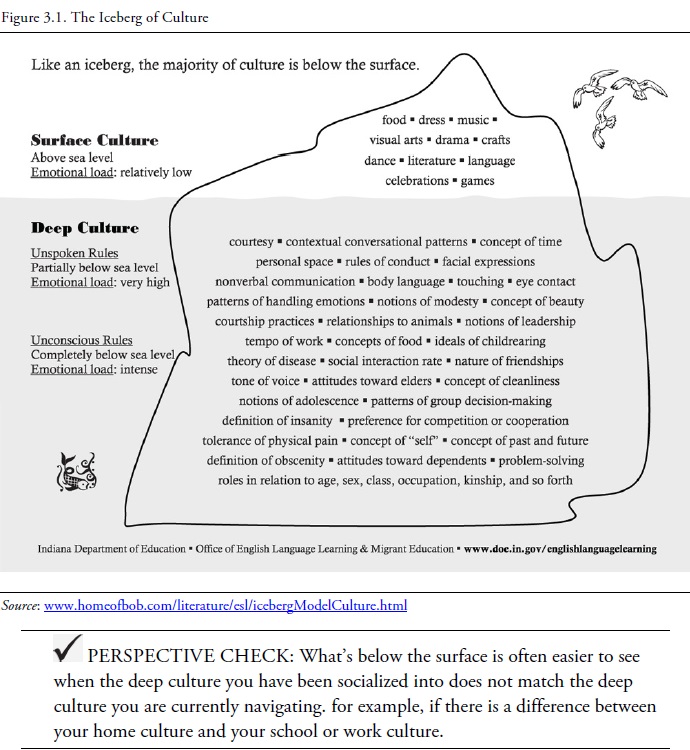
This opens with a few example statements, illustrating how our reactions may vary according to our perspectives. Then culture and socialization are defined. The “culture iceberg” illustration appears, a variant of which appears in one of the other DiAngelo books.
Again, I’ll note the irony that it subverts multiculturalism by illustrating dozens of possible points of contention when different races and ethnic groups are crowded together without the first thought about how well they’ll get along. For any big city, multiply this by scores of cultures from all corners of the Earth rubbing elbows in close proximity. I can think of several other trends and cultural attitudes which liberal and globalist social engineers overlook: civility, aesthetic taste, noise levels, acceptable public behavior, other matters of “vibrancy,” property rights, clannishness, ethnic nepotism, conflict resolution styles, fertility rates, welfare consumption, the rule of law, tolerance of other religions, ideology, truculence, etc. Disregarding compatibility is how your government might flood your country with diverse unassimilables who think they own the place the moment they step off the boat.
After that is the gender studies 101 talk. This stuff was much fresher back in 2011; it’s been done to death since it went big time around 2015. First it decouples sex from gender expression. As usual, there’s a hidden axiom that objective biological characteristics don’t determine anything. With the waters sufficiently muddied, a miracle happens: personal self-concept now makes someone male, female, or something unknown to mammalian biology. (Unfortunately, it doesn’t explain that most impetus for this weird ideology came from autogynephilic sexual fetishists as well as confused teens ensnared in a social contagion. Then the trend hitched a ride on the cultural Marxism bus, becoming a fashionable politically correct fad.) Often nonstandard gender presentation will counter cultural expectations. Two paragraphs follow discussing female armpit hair. Yawn. . . I’m just too 1970s for that to bother me. Besides, what does female mean anyway, when there are no objective criteria these days? (See what I mean by exceptionally slippery?) Then this:
We live in a culture that teaches us that human objectivity (or independence from socialization) is not only possible, but that it can be readily attained through simple choice. In other words, if I want to be an individual who is not influenced by the forces of socialization around me, then I can just decide that I am an individual who is not influenced by those forces; it is presumed that this decision is all that it takes to break away from the undertow of socialization. Yet this breakaway from socialization is much more challenging than it may appear.
Now wait just one minute – if I can become a woman simply by identifying as one, then why can’t I become a rugged individualist the same way?
Next up is a discussion of hiring discrimination, and not the supposedly benign “goal system” variety:
While the qualifications on the resumes were consistent, they randomly assigned stereotypically White-sounding names, such as Emily Walsh or Greg Baker, to half of the resumes, and stereotypically Black[sic]-sounding names, such as Lakisha Washington or Jamal Jones to the other half.
You already know where this is going, right? (Unfortunately, the study didn’t control for whether or not the business owners had any negative lived experiences with Lakishas and Jamals. Moreover, Jim Kalb once argued persuasively that monocultural work environments are more harmonious, therefore discrimination isn’t simply about irrational prejudice.) Then the book says that the HR personnel were discriminating but don’t realize it. This seems odd, since HR departments were bastions of woke long before diversity commissars became the new corporate fad. Still, if the authors are indeed right, then there’s lots of unconscious hypocrisy going on driven by messages absorbed in socialization. I wouldn’t bet my life on it though; after all, we’ve got to consider what positionality standpoint the studies backing these ideas come from and who stands to gain from the findings, eh?
Then it goes in further depth on other commonly-considered categories: “race, class, gender, sexuality, ability status/exceptionality, religion, and nationality.” Then comes the old chestnut:
Race is a socially constructed system of classifying humans based on particular phenotypical characteristics (skin color, hair texture, and bone structure).
The book doesn’t mention that it’s about biology, of course. The “socially constructed” line misleads people into thinking race is meaningless, unfairly categorizing people over superficial characteristics. This leads to the usual time-worn, lachrymose pieties – “discriminated against only because of the color of their skin” and all the rest of it. Despite all that, biology is part of what produces national character, or writ large, racial differences in behavior. In effect, society is a racial construct.
Then the discussion of ethnicity reminds us:
As well, British can refer to citizens of Great Britain who may have racial and ethnic heritages other than English, Scottish, or Welsh—such as African, Asian, or Arab.
Oh, sure, of course. The rest of the chapter is sort of an “intersectionality lite” discussion, followed by some recommended classroom exercises.
Prejudice and Discrimination
This begins with a discussion of stereotypes. The book notes that although they may apply to some in a given group, there are inevitable exceptions, and are therefore invalid. “When we assign character values, our stereotypes have moved into prejudice.” They’re inevitable, since we pick them up through socialization. (But what about those lived experiences?) This leads to discrimination, “when we act on our prejudices.”
What can be done about it then? It will help to become more knowledgeable about other particularistic categories toward which we have prejudices. A passing familiarity with some members will only do so much. Instead, “ongoing study and education, while also building wide-ranging and authentic relationships” is necessary for better results. The example the book uses is a blind person, though surely it’s meant as applicable in other cases too.
To me, it’s all well and good to study other cultures and social groups. Still, there are practical limits to pan-Gaeic cosmopolitanism; not even anthropologists can keep up with every society out there. It’s indeed quite important to learn about the customs of the Arabs, Hmong, Japanese, Cambodians, and undoubtedly many others if you’re going to interact with them without causing serious gaffes. Travelers certainly need to know these things. Does everyone else have the reciprocal requirement to accept us and understand us just as we are? Assuming so won’t end well!
More to the point, if constant study is necessary to have any hope of getting along in our own country with lots of groups that have nothing to do with the founding population – not that we were ever asked if we wanted them here, of course – then why do they belong here? William Pierce once put it more bluntly, as usual – something to the effect that if we should “walk a mile in our enemies’ moccasins,” we’ll be at it for ages. This is a reason why the big cities in white countries that became a racial goulash (which is almost all of them by now) are so dysfunctional. One solution is for the majority culture to be normative and in control, while others are expected to adapt – something that Is Everyone Really Equal? strongly denounces. The better solution is to send incompatibles back to where they belong. They’ll be happier and so will we.
6 comments
From a critical social justice framework, informed knowledge does not refer exclusively to academic scholarship, but also includes the lived experiences and perspectives that marginalized groups bring to bear on an issue…
Note the use of weasel words such as “lived experiences” and “marginalized groups.”
These terms are repeated endlessly as part of a word salad to provide ideological justification for the power grab by the Cultural Marxists. Given that they control considerable sectors of academia, media, corporate HR, district attorney offices, and (at least until Trump came along) the armed forces, Cultural Marxists are the ones with the real privilege. And if white people were so “privileged,” then why have they rolled over and ceded control of many institutions to the Cultural Marxists? In a white privileged world, the authors of “Is Everyone Really Equal?” would quickly become the permanent guests of a mental institution.
The so-called marginalized groups are in fact the recipients of very real privileges, used in the correct sense of the word as private law: affirmative action, government-corporate contracts, the backing of court decisions (from Shelley vs Kraemer 1948 onwards), two-tier justice systems, and the right to organize on and off campus. They are effectively the front groups and enforcers for the regime to be used against the majority white citizenry.
Again, if white people were really privileged, or even had equal rights under the law, then we would see white student associations, white studies departments and white professional organizations to promote white interests. Such organizations do not exist, of course, at least not as even a marginal force. Just consider the great big hammer which came down on the activists who put up flyers which proclaimed “It’s OK To Be White.”
It comes down to multicultural societies being inherently unworkable. When minority racial groups become strong enough, they will contest the majority race. The ideology of Cultural Marxist was invented to mobilize the minorities and demonize the majority.
Whether or not the Cultural Marxists believe that “everyone is really equal” is largely irrelevant. What counts is the ideology which works to justify the seizure of power by the Cultural Marxists.
It is an error for white activists to get defensive and start apologizing by saying, “But white people really do not have any privilege in this society.” The Cultural Marxists know that white people lack any organized power. That is why they are able to push cultural marxism across formerly white controlled institutions.
One approach is to take the infowar offensive: “Yes, white people do have privilege, and they deserve more of it because they create vastly superior civilizations. As for inequalities, this is owing largely to genetic differences among the races…” (i.e., the prevailing scientific view until the mid-20th century).
A slogan: “Cancel Cultural Marxist Privilege!”
Gain allies in a sector of the elites looking to contest the dominance of the Cultural Marxists. Mobilize the masses who are fed up with the DiAngelos of the world.
If an ideology as vapid as Cultural Marxism can create support among widespread sectors of society, then an ideology based on the solid realities of race can gain the high ground and defeat that Schmittian enemy.
Some things to think about in the continuing if one-sided racial chaos…
Marxism or rather socialism does contribute respectable logic in the way of governing tools. It is designed to provide and spark some degree of logic and not emotional anger, which tends to fall in the illogical arenas (aka medieval McCarthyism).
It is weasel mentality to corner terms like “lived experiences” and “marginalized groups” as divisive.
It is also not an attack on the white community since today a great part of our white community falls into the category of the minimally educated working class – who can only reflect on and provide from “lived experiences”, and are now part of the larger “marginalized groups”. It is our tax dollars that feed all the grand crusades and private pockets of your ring masters who sell the tickets to a show that we are only spectators in (and whose final cost is yet to be determined).
“Marxism or rather socialism does contribute respectable logic in the way of governing tools.”
To the contrary:
“Marxism consists of thousands of truth, but they all boil down to one sentence: It is right to rebel.” (Mao Zedong, communist killer of tens of millions)
It is also not an attack on the white community…Horseshit. Anyone who wears the name tag of marxist and publicly belches their geekspeak argot invoking ‘human rights’, ‘anti-racism’, ‘liberation’, ‘freedom fighters’, and ‘equity’ are always antiWhite scum. The so-called exceptions do not exist, any more than the proWhite zionist jew or the Fascist negro garveyist calling for permanent racial divorce via black-to-kaffrika. “Lived experience” and “marginalized groups” are on the same tier as “my truth”- mawkish and hokey cringeducing babble for privileged coloreds and pampered feminists to hoard more gibs while wailing ‘poor oppressed me.’
I would differ on that one. At least with the Ivory Tower types, word games are pretty much all they have to offer. If it were really about alleviating poverty in general, I wouldn’t find it too objectionable.
The “privilege” business is just fast talk to convince the audience that the group in question is getting it tough from society. The purpose is to angle for extra goodies and accommodations – which ironically is real privilege. At no point should we mistake it for an honest attempt at dialogue or negotiation.
Comments are closed.
If you have a Subscriber access,
simply login first to see your comment auto-approved.
Note on comments privacy & moderation
Your email is never published nor shared.
Comments are moderated. If you don't see your comment, please be patient. If approved, it will appear here soon. Do not post your comment a second time.