
Counter-Currents
  • Advertise
  • Private Events
  • T&C
  • About
  • Contact
  • RSS
    • Main feed
    • Podcast feed
    • Videos feed
    • Comments feed
  • Welcome
  • Webzine
  • Books
  • Merch
  • Podcasts
  • Videos
  • Donate
  • Patrons
  • Subscribe
  • Crypto

LEVEL2

Donate Now Mailing list

Writers of May

(2 votes) Morris van de Camp David M. Zsutty Derek Stark Jayant Bhandari Greg Johnson

Articles of May

Heidegger on Nietzsche, Part One by Collin Cleary The Lunch Wars by David M. Zsutty 2 votes
  • Welcome
  • Webzine
  • Books
  • Merch
  • Podcasts
  • Videos
  • Donate
  • Patrons
  • Subscribe
  • Crypto
    • Nationalism This Week
      Letter to J. D. Vance

      Greg Johnson

      3

    • Lost In Trans-Mission:
      How the Media Fails To Reveal the Inconvenient Truth About the Usual Suspects

      Steven Tucker

      4

    • Liar, Liar, Pants on Fire!

      Beau Albrecht

      4

    • Editor’s Update
      Rob Rundo on Counter-Currents Radio, Fundraiser Update, & a New $20,000 Matching Grant

      Greg Johnson

    • The Bitter End of Western Metaphysics:
      Heidegger on Nietzsche, Part Three

      Collin Cleary

      10

    • Uncivil War

      Mark Gullick

      40

    • Exclusive Interview with Karel Veliky:
      The Final Chapter in the Film Series! Part II

      Ondrej Mann

      2

    • Happy Birthday to Us!

      Greg Johnson

      6

    • Zsutty’s Maximum

      David M. Zsutty

      15

    • Exclusive Interview with Karel Veliky:
      The Final Chapter in the Film Series! Part I

      Ondrej Mann

      2

    • The Union Jackal, June 2026

      Mark Gullick

      23

    • The Inferiority Behind Immigrant Superiority

      Jayant Bhandari

      15

    • Counter-Currents Radio Podcast No. 690
      Greg Johnson & David Zsutty Discuss Current Things: AI, Henry Nowak, the Iran Crisis, & More

      Counter-Currents Radio

      7

    • Collin Cleary: What Rome Means to Me

      Collin Cleary

      4

    • Paul Krugman: Closet Bolshevik

      Spencer J. Quinn

      21

    • Fugue of Ideas:
      Ibram X. Kendi’s Chain of Ideas

      Greg Johnson

      19

    • Based Blacks

      Lipton Matthews

      22

    • Black Intellectual Fatigue

      Derek Stark

      41

    • Why White Advocates Should Avoid “Based Blacks”

      Dani Vypont

      32

    • Nietzsche & Race

      Mark Gullick

    • Editor’s Update
      Rob Rundo Rescheduled to Next Week on Counter-Currents Radio;
      Tonight Greg Johnson & David Zsutty Answer Your Questions;
      Fundraiser Update & a New $20,000 Matching Grant

      Greg Johnson

    • The Counter-Currents 2026 Fundraiser
      Lifetime Subscriber Welcome Packages Extended

      Greg Johnson

    • Nationalism This Week
      Who’s Looking Back?

      Greg Johnson

      29

    • China’s Threat to American Security:
      Food, Farmland, Foreign Control, & Energy Policy

      Lipton Matthews

      5

    • The Bitter End of Western Metaphysics:
      Heidegger on Nietzsche, Part Two

      Collin Cleary

      16

    • The Killing of Henry Nowak

      Mark Gullick

      38

    • The Crisis of Chinese Technology Thieves

      Morris van de Camp

      1

    • The Strange World of Gender Bender Fiction:
      & What This Genre Tells Us About Autosexuality

      Dani Vypont

      3

    • Watching the Watchers:
      The Dark Triad Question

      David M. Zsutty

      14

    • The Remigration Movement Solidifies

      F. Roger Devlin

      1

    • Casting Aspersions:
      The Fatal Consequences of Race-Swapped Casting, From Helen of Troy to Henry of Southampton

      Steven Tucker

      20

    • The Murder of Henry Nowak

      Millennial Woes

      23

    • Don’t Forget to Vote in Our Writer & Article of the Month Poll

      Greg Johnson

    • The Robot Hotdog Stand

      Greg Johnson

      37

    • Laughing Our Way to Victory

      Dave Chambers

      7

    • The Zodiac Killer

      Mark Gullick

      11

    • Jared Taylor: What Rome Means to Me

      Jared Taylor

      1

    • An Interview with Endeavour:
      My Way of Life Is an Adventure!

      Ondrej Mann

      6

    • José Pedro Zúquete’s The Identitarians

      Greg Johnson

      3

    • Editor’s Update
      Fundraiser Update & How to Watch the Remigration Summit

      Greg Johnson

      5

    • The Bitter End of Western Metaphysics:
      Heidegger on Nietzsche, Part One

      Collin Cleary

      12

    • Berlin: City of Stones

      Spencer J. Quinn

      6

    • True Folk-Horror Is Horror of Your Own Folk:
      Mark Gatiss vs the Brexit Blind Dead  

      Steven Tucker

      4

    • Counter-Currents Radio Podcast No. 689
      Thomas Massie, the America 2050 Bust, the Need for Whites to Divest from America, the AI Economic Apocalypse, & Pro-White Project Pitches to Billionaires

      Counter-Currents Radio

      7

    • Nationalism This Week
      Remigration is Inevitable, Part 3

      Greg Johnson

      27

    • Why Billionaires Should Fund White Identity Politics

      Lipton Matthews

      8

    • How Cold War Two Came About

      Morris van de Camp

      5

    • Now Available for Pre-Order at a Special Price!
      Greg Johnson’s The Philosopher Is In

      Greg Johnson

    • David Zsutty’s Elevator Pitch to a Billionaire

      David M. Zsutty

      1

    • Headbanging Lite

      Mark Gullick

      5

    • Peter Quint

      Lost In Trans-Mission:
      How the Media Fails To Reveal the Inconvenient Truth About the Usual Suspects

      Great article! All he got was 28 months; he should have been locked away in a psycho ward for the...

    • Peter Quint

      Nationalism This Week
      Letter to J. D. Vance

      Great article! I don’t want Vance to be president; he gives me the creeps; I don’t think he has our...

    • Dominic Fox

      Liar, Liar, Pants on Fire!

      I’m still flabbergasted how someone can lie that egregiously and shamelessly. Do words have no...

    • Dominic Fox

      Liar, Liar, Pants on Fire!

      The Christian ideas of repentance and “prodigial sons” give dysfunctional and anti-social...

    • Dominic Fox

      Nationalism This Week
      Letter to J. D. Vance

      "There was virtually no chance that this scenario would work. It was stewed up with bogus...

    • Zarathustra

      Nationalism This Week
      Letter to J. D. Vance

      A peace deal with Iran has finally been agreed. Let's see how Israel manages to sabotage it.

    • Will Williams

      Based Blacks

      Weave: June 15, 2026  Thank you for completely proving my point, which is that if we aren’t as...

    • Fred C. Dobbs

      Lost In Trans-Mission:
      How the Media Fails To Reveal the Inconvenient Truth About the Usual Suspects

      Great article. We’re all used to the media using lies of omission. The “teens” is most commonly used...

    • Fred C. Dobbs

      Liar, Liar, Pants on Fire!

      Father Merrin “he mixes lies with the truth to confuse us.” Excellent piece. We’ve all experienced...

    • Adrian Roberts

      Lost In Trans-Mission:
      How the Media Fails To Reveal the Inconvenient Truth About the Usual Suspects

      What about all the people who've been born in the wrong bodies and don't even know it?

    • Weave

      Based Blacks

      Thank you for completely proving my point, which is that if we aren’t as “pure” as you then we are...

    • Joe Gould

      Lost In Trans-Mission:
      How the Media Fails To Reveal the Inconvenient Truth About the Usual Suspects

      Philosophy matters. Bad philosophy backed by media, money, and state power is a disaster. The dogma...

    • Joe Gould

      Uncivil War

      I think that your phone (any brand, not just an iPhone) will give up all sorts of information on you...

    • YT

      Uncivil War

      So you’re advocating leaving your iPhone at home as it can be used for geographic location purposes...

    • Will Williams

      Nationalism This Week
      The SPLC Indictment

      I bump this comment because Christian conservative reporter Tyler O'Neil is on the SPLC  beat again...

    • Peter Quint

      Why White Advocates Should Avoid “Based Blacks”

      Why would you tell a little parable like that? Are you trying to tell us to judge blacks by the  “...

    • Will Williams

      Based Blacks

      Uncle Semantic: June 14, 2026  Will, I’m curious if your racial journey to where you stand now...

    • Angela Mercy

      Paul Krugman: Closet Bolshevik

      Things don't look bright for Republican party and it's voters but they can only blame Donald Trump...

    • S Dane

      Paul Krugman: Closet Bolshevik

      Krugman is the creep who was caught with kiddie porn a few years ago and was able to get off with a...

    • Will Williams

      Based Blacks

      Uncle Semantic: June 14, 2026  Do you think blacks would be more palatable to the proWhite...

    • Earth Day Special

      John Morgan

      12

    • A Robertson Roundup
      Remembering Wilmot Robertson
      (April 16, 1915 – July 8, 2005)

      Margot Metroland

      13

    • The Paranoid Style in White Nationalism

      Greg Johnson

      30

    • Join the Dance!

      Andrew Hamilton

      1

    • We Can’t Save the Earth Without Reducing African Birth Rates

      James Dunphy

      36

    • “I’m Not a Conspiracy Theorist, but . . .”:
      Jeffrey Epstein’s Death Gives New Life to “Conspiracy Theories”

      Greg Johnson

      22

    • Sylvia Plath: Stasis in Darkness

      Vic Olvir

      17

    • Vanguardism, Vantardism, & Mainstreaming

      Greg Johnson

      80

    • Aviation, Geography, & Race

      Charles Lindbergh

      3

    • Some Thoughts on Yule

      Collin Cleary

      4

    • Living in Truth:
      A Yuletide Homily

      Jef Costello

      7

    • John Kennedy Toole’s A Confederacy of Dunces

      Greg Johnson

      20

    • On Aleksandr Solzhenitsyn’s Warning to the West

      Spencer J. Quinn

      7

    • Elitism, British Modernism, & Wyndham Lewis

      Jonathan Bowden

      6

    • Philip K. Dick’s Do Androids Dream of Electric Sheep? as Anti-Semitic/Christian-Gnostic Allegory

      Greg Johnson

      20

    • “Conspiracy Theory” or Conspiracy?

      Andrew Hamilton

      21

    • Remembering H. P. Lovecraft
      (August 20, 1890–March 15, 1937)

      Greg Johnson

      3

    • Who Are We?
      Nordics, Aryans, & Whites

      Greg Johnson

      71

    • Remembering William Gayley Simpson
      (July 23, 1892–December 31, 1990)
      A Pleasant Afternoon with Harriet & Bill Simpson

      Margot Metroland

      18

    • Here are the Young Men
      Remembering Ian Curtis
      (July 15, 1956–May 18, 1980)

      Mark Gullick

      18

    • Percy Grainger
      Artist of the Right

      Alex Graham

      7

    • Remembering Revilo Oliver
      (July 7, 1908–August 20, 1994)

      Greg Johnson

      18

    • The Meaning of July 4th for the White Man

      Gregory Hood

      13

    • The Front National’s Evolution

      Bruno Mégret

    • Merwin K. Hart
      Forgotten American Hero & Man of the Right

      Morris van de Camp

      10

    • George Orwell’s Nineteen Eighty-Four

      Jonathan Bowden

      8

    • Carleton S. Coon
      Scientist & Reluctant White Advocate

      Morris van de Camp

      3

    • The Kwanzaa Absurdity Will Be Dwarfed by Juneteenth

      Robert Hampton

      10

    • Stravinsky

      Alex Graham

      7

    • Like the Roman:
      Remembering Enoch Powell (1912-1998)

      Mark Gullick

      23

    • The 1970s: The Golden Age of Hijacking

      Morris van de Camp

      21

    • Jonathan Bowden’s Deliverance
      Part 6

      Jonathan Bowden

    • Do You Want to Play a Game?

      Mark Gullick

      1

    • Sexually Incontinent on the Indian Subcontinent:
      Who Rapes More Animals, Indians or Pakistanis? The Battle Continues!

      Steven Tucker

      3

    • Neo-Fascism in Film
      Part 5

      Karel Veliky

      15

    • The Game of Tarot

      Mark Gullick

      2

    • Institutions Cannot Be Transplanted

      Jayant Bhandari

      5

    • Jonathan Bowden’s Deliverance
      Part 5

      Jonathan Bowden

    • Crosstown Traffic:
      Jimi Hendrix & The Post-War Rock ‘N’ Roll Revolution

      Mark Gullick

      1

    • Slaves from the North:
      Finns & Karelians in the East European Slave Trade, 900–1600

      Lipton Matthews

      14

    • Neo-Fascism in Film
      Part 4

      Karel Veliky

      2

    • David Lean’s A Passage to India

      Spencer J. Quinn

      1

    • Elites are Essential to Development

      Lipton Matthews

      7

    • Jonathan Bowden’s Deliverance
      Part 4

      Jonathan Bowden

    • Neo-Fascism in Film
      Part 3

      Karel Veliky

      6

    • E. M. Forster’s A Passage to India & the Indian Mentality

      Spencer J. Quinn

      25

    • Jonathan Bowden’s Deliverance
      Part 3

      Jonathan Bowden

    • The Rest Is Silence
      Heidegger’s Quietism

      Mark Gullick

      2

    • Dispelling the Historical Fallacy of Indian Nationalism

      Lipton Matthews

      8

    • Neo-Fascism in Film
      Part 2

      Karel Veliky

      8

    • Jonathan Bowden’s Deliverance
      Part 2

      Jonathan Bowden

    • Life of a Klansman

      Mark Gullick

      8

    • Jonathan Bowden’s Deliverance, Part 1

      Jonathan Bowden

    • Decolonial Ideas are Holding Back Developing Countries

      Lipton Matthews

      8

    • Neo-fascism in Film, Part 1

      Karel Veliky

      21

    • Jonathan Bowden’s Onslaught, Part 8
      Divigations on Decadence

      Jonathan Bowden

    • Jonathan Bowden’s Onslaught, Part 7
      Intrigues in the National Front

      Jonathan Bowden

      1

    • Rotten to the Core

      Mark Gullick

      8

    • Strauss on Husserl’s “Philosophy as Rigorous Science”

      Greg Johnson

    • Jonathan Bowden’s Onslaught, Part 6
      Francis Bacon & Right-Wing Nihilism

      Jonathan Bowden

    • András László
    • Derek Hawthorne
    • Beau Albrecht
    • Alain de Benoist
    • Kerry Bolton
    • Jonathan Bowden
    • Collin Cleary
    • Jef Costello
    • Savitri Devi
    • Julius Evola
    • Jim Goad
    • Gregory Hood
    • Juleigh Howard-Hobson
    • Greg Johnson
    • Charles Krafft
    • Anthony M. Ludovici
    • Trevor Lynch
    • H. L. Mencken
    • J. A. Nicholl
    • James J. O’Meara
    • Christopher Pankhurst
    • Tito Perdue
    • Michael Polignano
    • Spencer J. Quinn
    • Fenek Solère
    • Irmin Vinson
    • Leo Yankevich
    • Francis Parker Yockey
    • Multiple authors
  • Editor-in-Chief

    • Greg Johnson, Ph.D.

    Featured Writers

    • Beau Albrecht
    • Gunnar Alfredsson
    • Collin Cleary, Ph.D.
    • Jef Costello
    • Morris V. de Camp
    • F. Roger Devlin, Ph.D.
    • Stephen Paul Foster, Ph.D.
    • Jim Goad
    • Alex Graham
    • Mark Gullick, Ph.D.
    • Greg Johnson, Ph.D.
    • Travis LeBlanc
    • Trevor Lynch
    • Margot Metroland
    • James J. O’Meara
    • Angelo Plume
    • Spencer J. Quinn
    • Fred Reed
    • Clarissa Schnabel
    • Michael Walker
    • David M. Zsutty

    Frequent Writers

    • Asier Abadroa
    • Aquilonius
    • Alain de Benoist
    • Kerry Bolton, Ph.D.
    • Dave Chambers
    • Steven Clark
    • James Dunphy
    • Endeavour
    • Richard Houck
    • Jason Kessler
    • Titus Livius
    • Ondrej Mann
    • Lipton Matthews
    • Mark Mazari
    • John Morgan
    • Jaroslav Ostrogniew
    • Kathryn S.
    • Christian Secor
    • Anne Wilson Smith
    • Thomas Steuben
    • William De Vere
    • Kenneth Vinther
    • Max West

    Classic Authors

    • Maurice Bardèche
    • Jonathan Bowden
    • Julius Evola
    • Guillaume Faye
    • Ernst Jünger
    • Kevin MacDonald, Ph.D.
    • D. H. Lawrence
    • Charles Lindbergh
    • Jack London
    • H. P. Lovecraft
    • Anthony M. Ludovici
    • Sir Oswald Mosley
    • National Vanguard
    • Friedrich Nietzsche
    • Revilo Oliver
    • William Pierce
    • Ezra Pound
    • Saint-Loup
    • Savitri Devi
    • Carl Schmitt
    • Miguel Serrano
    • Oswald Spengler
    • P. R. Stephensen
    • Jean Thiriart
    • John Tyndall
    • Dominique Venner
    • Leo Yankevich
    • Francis Parker Yockey

    Other Authors

    • Howe Abbott-Hiss
    • Michael Bell
    • Giles Corey
    • Jack Donovan
    • Richardo Duchesne, Ph.D.
    • Emile Durand
    • Guillaume Durocher
    • Mark Dyal
    • Tom Goodroch
    • Andrew Hamilton
    • Robert Hampton
    • Huntley Haverstock
    • Derek Hawthorne
    • Gregory Hood
    • Juleigh Howard-Hobson
    • Alexander Jacob
    • Ruuben Kaalep
    • Tobias Langdon
    • Julian Langness
    • Patrick Le Brun
    • G A Malvicini
    • John Michael McCloughlin
    • Millennial Woes
    • Michael O’Meara
    • Christopher Pankhurst
    • Michael Polignano
    • J. J. Przybylski
    • Quintilian
    • Edouard Rix
    • C. B. Robertson
    • C. F. Robinson
    • Herve Ryssen
    • Alan Smithee
    • Fenek Solere
    • Ann Sterzinger
    • Robert Steuckers
    • Tomislav Sunic
    • Donald Thoresen
    • Marian Van Court
    • Irmin Vinson
    • Book Reviews
    • Movie Reviews
    • TV Reviews
    • Music Reviews
    • Art Criticism
    • Graphic Novels & Comics
    • Video Game Reviews
    • Fiction
    • Poems
    • Interviews
    • Videos
    • English Translations
    • Other Languages
      • Arabic
      • Bulgarian
      • Croatian
      • Czech
      • Danish
      • Dutch
      • Estonian
      • Finnish
      • French
      • German
      • Greek
      • Hungarian
      • Italian
      • Lithuanian
      • Norwegian
      • Polish
      • Portuguese
      • Romanian
      • Russian
      • Slovak
      • Spanish
      • Swedish
      • Ukrainian
    • Commemorations
    • Why We Write
  • Archives
  • Top 100 Commenters
  • The Looney Bin
  • Advertise
  • Private Events
  • T&C
  • About
  • Contact
  • RSS
    • Main feed
    • Podcast feed
    • Videos feed
    • Comments feed
Sponsored Links
Europa.com Above Time Coffee Antelope Hill Publishing Paul Waggener IHR-Store Spencer J. Quinn American Renaissance Jim Goad The Occidental Observer
Print June 28, 2024 12 comments

Unlocking Yockey’s Word-Hoard

James J. O'Meara

Francis Parker Yockey (right). Date, location, & friend unknown.

3,945 words

IT will be seen that this mere painstaking burrower and grub-worm of a poor devil of a Sub-Sub appears to have gone through the long Vaticans and street-stalls of the earth, picking up whatever random allusions to whales he could anyways find in any book whatsoever, sacred or profane. . . . — Herman Melville, “Extracts (SUPPLIED BY A SUB-SUB-LIBRARIAN),” Moby Dick

The intimate revelations of young men, or at least the terms in which they express them, are usually plagiaristic and marred by obvious suppressions. – F. Scott Fitzgerald, The Great Gatsby

Having recently been given the privilege, and pleasure, of preparing an index for the forthcoming Centennial Edition of Francis Parker Yockey’s magnum opus, Imperium, I thought there might be some interest in detailing a few of the linguistic oddities that turned up.

Of course, in themselves, these may be just trivia, cocktail party bons mots. But the word trivia is derived from the mediaeval trivium, the basis for higher intellectual pursuits.[1] This information might, or should, be the basis for additional research on Yockey’s thought process.

The story of the unique circumstances of its genesis are detailed in the Preface by the General Editor, Greg Johnson, as well as Willis Carto’s legendary Introduction to the Noonday Press edition, which has been retained in this, the first truly scholarly edition.

Briefly, Yockey sought refuge in Brittas Bay, Ireland, where, with only a handful of his most important books — including the works of Spengler, of course — and entirely without notes, produced the 600-plus pages of Imperium in about six months. Despite these handicaps, Yockey appears to have been able to quote what he needed from memory, with remarkable, in some cases word-for-word accuracy.[2]

Yockey, in short, was quite the wordsmith. His status as the Emmanuel Goldstein of the post-war American Right, as its brain, for lack of a better word or a better candidate, lies less in his philosophy of history — derived rather too reverently from Spengler, referred to throughout in hushed tones as “the Philosopher”[3] — than in its judicious — tactful, as the Philosopher might say — applications to the post-war scene, but perhaps above all in its rhetoric. In reading Imperium, I was sometimes reminded of someone’s description of Hegel’s Preface to The Phenomenology of Spirit: “It roars like a Romantic symphony.”[4] Perhaps, then, Imperium is as worthy of a word study as any ancient classic — including, perhaps, that other Bible.

* * *
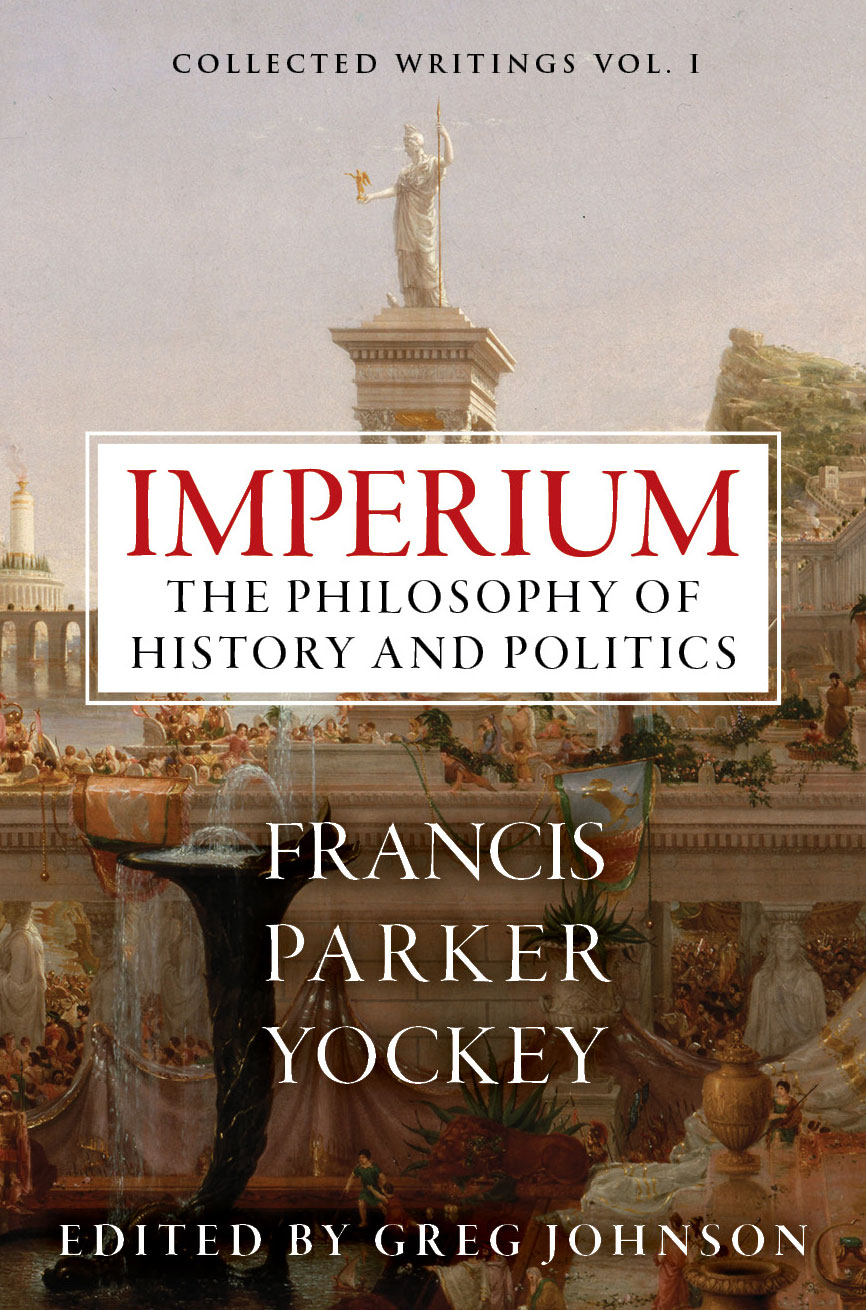
You can pre-order the Centennial Edition of Francis Parker Yockey’s Imperium here.

Like all good Americans,[5] Yockey spends a lot of time and space on his homeland, devoting the entirety of one of the six divisions of the book, over a hundred pages and 13 chapters, in addition to many references throughout the remainder. Also like all good Americans, he calls his homeland America, over 500 times.

It’s always been a bit of a bother to the rest of the residents of North America, as well as the rest of the New World, that Americans have colonized the words America and Americans for themselves alone.

Latin Americans are little better, referring to us as Norte-americanos, as if Canada had lost the War of 1812. However, they do have the handy term Estadounidense, from the Spanish Estados Unidos. However, “Unitedstaters” just doesn’t work. Ayn Rand’s role model, Frank Lloyd Wright, proposed the similar formation Usonian, and though he used it for a style of housing, it never caught on.[6]

In any event, the striking thing is that Yockey stubbornly refuses to use the term “United States” at all; it appears only four times, less than 1% of the uses of “America”:

Beginning around 1880, the Jews embarked upon what Hilaire Belloc aptly termed an invasion of the United States.

Thus America decided, in the middle of the nineteenth century, that a Chinaman born in the United States thereby acquired exactly the same American citizenship as the white native population of European derivation.

The failure to arouse excitement, despite the propaganda bombardment, led to the thesis that Europe was planning to invade the United States with fleets and armies.

As was noted in the outline of the general thesis of Culture-distortion as a form of Culture-pathology, the Russian anti-Semitic outbreaks after the Russo-Japanese War, 1904–1905, brought about a rupture of diplomatic relations with the United States.

Did Yockey slip up, deviating from his overwhelming preference for “America,” or is there some pattern here? The first three are in contexts referring to invasions, by immigrants or armies; the first and fourth refer to Jews, and as we’ll see, Jews seem to have a perturbing effect on Yockey’s vocabulary. The first is a paraphrase from Belloc’s The Jews, and indeed perhaps the rest are derived from hazy memories of something he read somewhere, a rather common occurrence in Imperium.

Also of interest and possible value is a single reference to “The United States of North America.” This is a usage that I’ve only ever seen once before, in Schopenhauer’s essay, published in English as “Government.”[7] Yockey would have found Schopenhauer’s contempt for the Rationalist/Utilitarian/Protestant roots of America to be congenial with his own views, and one must again speculate if this hapax legomenon came from pleasant memories of an afternoon reading the great Pessimist.

* * *
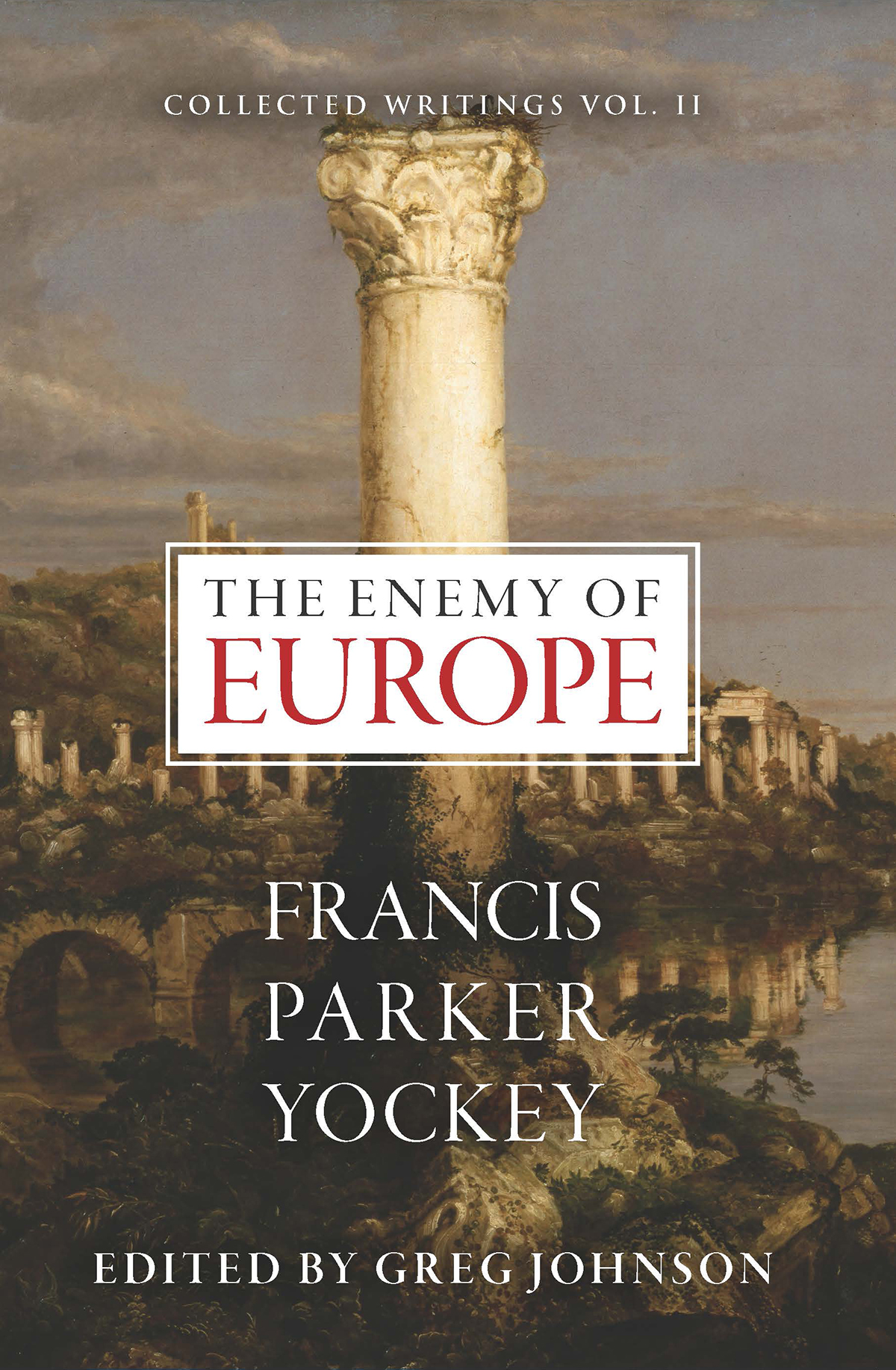
You can buy Francis Parker Yockey’s The Enemy of Europe here.

Say what you will, Yockey gives equal time to the other power threatening Europe, naming them consistently as “Russia.” You might imagine Yockey pounding the table, ranting about those dirty Soviet bastards, but in fact he never uses the phrase Soviet Union or Soviets, not once.[8] If necessary to distinguish his target from the previous regime, he prefers Bolshevik Russia or Bolshevik regime. Communists is an all-purpose word, referring to the political ideology, which therefore can be French Communists or German Communists, Communist parties, or Communist propaganda, but never Russians in particular.

Ironically, this gives the text a rather modern flavor. In the Anglosphere, efforts were made at times to distinguish the evil Soviet Union from the downtrodden Russians — perhaps honestly, perhaps only for propaganda purposes. After the implosion of the Soviet Union and the emergence of the Russian Federation, the latter became known, at least informally, as Russia as well, and thus its citizens — even Moslem Chechens — as Russians (as with Americans), and only Boomers who came of age during the Cold War would reflexively say things like “When the Soviets invaded Ukraine . . .”

Yockey operates with a somewhat different distinction in mind. For him, Russians are not an oppressed people yearning to breath free, but a horde of barbarian Mongols, ready to sweep over the Western World in an orgy of mindless destruction. Atop this horde rides the Petrine stratum, i.e. the post-Peter elite who take the West as their model. The October Revolution merely replaced this failed elite with Bolsheviks hoping to use Western technology to destroy the West, under the direction of the Jews.[9] Today the Petrine stratum seems to have returned, in the form of Westernizers or “Liberals,” while former Communists are often found making common cause with Patriots or Nationalists as representatives of “Russia.”[10]

* * *

“What then of the Jews?” I hear you shout. Well, they certainly get their fair share of attention throughout Imperium. Interestingly, and appropriately, Zionism is another hapax legomenon, occurring only once in the entire text, where Yockey mentions it merely as one means used by the Jews to resist assimilation.[11] The idea is also implied once, where Yockey speaks of Russia’s post-war policy of negating American policy at every point except support for “the question of partitioning of Palestine,” which he calls “a part of the world of Islam.”[12] I suppose he’s just not that interested in the subject in 1948, which obviously became more pertinent after his death in 1960.

Jews also seem to provoke another eccentricity, but first I have to back up to a more general topic. Yockey writes in a rather Germanic style, influenced no doubt by Spengler, and is fond of forming compound nouns such as “Culture-distorter.” However, as in German (or Sanskrit), these can take on far more units than is customary in English. In any case, they give some clue to his conceptual networks.

Perhaps Yockey’s favorite grouping is “Race, People, Nation, State,” which get their own chapter. But when he comes to compounding them throughout the text, then all bets are off. Yockey uses 12 variations of this phrase, changing the order and sometimes adding Culture, Church, Empire, or Religion, with no obvious difference in meaning, and usually once only:

Culture-Nation-State-People-Race

Culture-State-Nation-People-Race

Culture-State-Nation-People-Race-Empire

Culture-State-Nation-People-Religion-Race

Culture-State-Nation-Race-People

Culture-State-Nation-Religion-People-Race

Nation, Church, State, People, Race, and Culture

Nation, People, Race, Culture

People, Race, Nation, State, Society, Will and economy [sic]

race, nation, and Culture [sic]

Race, People, Nation, State, Culture

Moreover, and to return to the subject of the Jews, he has seven more variations, each used only once or twice, and only when discussing the Jews:

Church-State-Nation-People-Race (twice)

Church-State-People-Nation

Culture-Nation-State-Church-People-Race

Culture-Nation-State-Race (twice)

Culture-State-Nation-Church-Race

Culture-State-Nation-People-Religion-Race

Culture-State-Nation-Race

You’ll notice the extra perversity of only using “Church” to refer to the Jews.

What are we to make of all this?

* * *
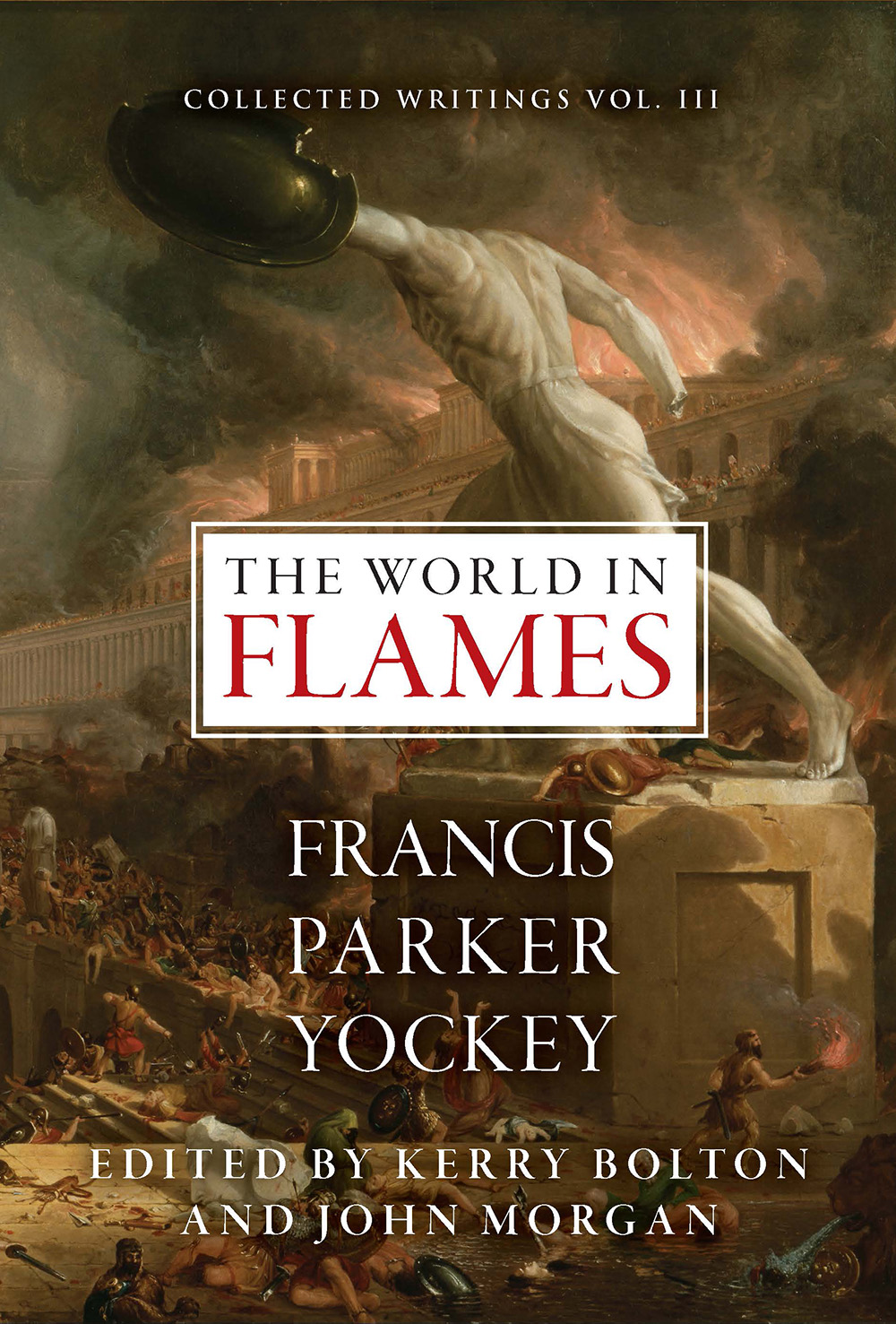
You can buy The World in Flames: The Shorter Writings of Francis Parker Yockey here.

One might attribute, or write off, this terminological uncertainty to the aforementioned conditions of its composition — one might allude to Dr. (Samuel) Johnson and say that the miracle is that the book exists at all, much less has any consistency[13] — but this almost quantum level of indeterminacy is found even in more considered works.

For example, in The Proclamation of London, a deliberate condensation of Imperium, which one might consider as the Communist Manifesto to the latter’s Das Kapital, we find the Jews referred to on one page as a Culture-State-Nation-Race-People-Society, while on the next page they are reduced to as a mere State-Nation-Race.[14]

But there is a way to understand Yockey as having a method — and appreciate it! I suggest considering what Bernardo Kastrup says concerning his attempt to “decode” Schopenhauer’s metaphysics and liberate it from modern “scholars” who decry its supposed “contradictions”:

Those who hope to truly understand Schopenhauer do not expect from him the kind of rigorous, consequent, consistent use of terms that is today characteristic of analytic philosophers. His intended denotations of key terms are context-dependent.

To understand Schopenhauer’s metaphysics, one must read him charitably, always looking for the particular one, amongst the various possible denotations of a term which fits most coherently into his overall scheme.[15] The interpretational flexibility this requires is familiar to every non-philosopher in everyday conversation: despite often loose use of words by one’s interlocutor, one knows what is meant because of the context. Indeed, what makes Schopenhauer so delightful to read is precisely that he writes in a colloquial manner, as if he were trying to verbally explain something to the reader in person. This is perfectly feasible because Schopenhauer is delightfully verbose: he repeatedly recapitulates and summarizes — using different words and constructs — what he has already said. So we must reciprocate and interpret him with equally colloquial flexibility.[16]

Of course, Yockey could hardly be described as “conversational,” but I think the hermeneutic principle holds.

Although written in conditions of isolation, Imperium was not written as an academic treatise or a journal article, nor was it something like Marcus Aurelius’ Meditations (titled in Greek as “To Himself”). But it was also more than a barroom conversation. It was an attempt to communicate a call to action in conditions of cultural emergency, an emergency that almost everyone was ignoring, denying, or celebrating. He combines and recombines his major concepts, trying out one or the other, until something clicks in the reader’s mind and he gets it.

General Editor Greg Johnson clues us in:

Why, then, did Yockey publish Imperium? Yockey was not primarily a philosopher. He was a man of action. He wrote Imperium (or wrote it down) because he wanted to have an impact on his time. This book was not written as a work of scholarship. It was forged as a tool — or a weapon. [17]

Perhaps this is the point where the Indexer needs to rejoin the public, stepping back to take in the work as a whole — an organic whole, as Yockey would insist.[18]

Is this whole our Whale, published a hundred years later, by another long-voyaging Isolato?[19] In that case, what does Melville, and perhaps Yockey, advise your humble servant in this matter?

So fare thee well, poor devil of a Sub-Sub . . . Thou belongest to that hopeless, sallow tribe which no wine of this world will ever warm; and for whom even Pale Sherry would be too rosy-strong; but with whom one sometimes loves to sit, and feel poor-devilish, too; and grow convivial upon tears; and say to them bluntly, with full eyes and empty glasses, and in not altogether unpleasant sadness — Give it up, Sub-Subs!

A word to the wise guy.

Notes

[1] “In medieval times, the word Trivium referred to the threefold education curriculum encompassing Grammar, Logic, and Rhetoric — as opposed to the Quadrivium, which included Arithmetic, Music, Geometry, and Astronomy. The Trivium was regarded as a prerequisite of sorts for the Quadrivium, and as the foundation of a liberal arts education. In the word’s earliest use, trivial described what belonged to the Trivium. Merriam-Webster, here.

[2] The editors of the Centennial Edition have sought to identify and verify all of Yockey’s quotes and verbal allusions.

[3] Greg Johnson summarizes “Yockey’s central ideas” as “openly derived from Spengler, whom Yockey styles simply as ‘the Philosopher.’ Imperium takes its very title and topic from Spengler’s concept of imperialism. Yockey’s discussion of the nine High Cultures and their organic life-cycles comes entirely from Spengler. So too does the contrast between Causality thinking and Destiny thinking. Also Spenglerian are Yockey’s ideas on pessimism, the nature of race, the relationship of race and culture, the limits of Darwinism, the cultural alienness of Jews, war and peace, democracy and oligarchy, Prussian socialism vs. Marxism, the ‘German Michel’ problem, and the ‘outer revolt’ of the colored races against the West.” Imperium: The Philosophy of History & Politics (Centennial Edition Publishing, 2024), page xvii.

[4] Although the phrase has stayed with me, I cannot recall who said it. It was from a blurb printed on the back cover of Walter Kaufmann’s translation and commentary thereon, contained in his Hegel: Reinterpretation, Texts and Commentary when it was republished as a separate paperback by Anchor Press in the 1960s. I have long since lost the book and it no longer appears on the later editions (if, indeed, it ever did).

[5] I’ve always thought it was out of character for David to drink anything as corrupt as whiskey.

Out of character for him to be murdered, too.

Yes, wasn’t it? But good Americans usually die young on the battlefield, don’t they? Well, the Davids of this world merely occupy space, which is why he was the perfect victim for the perfect murder. —Rope (Alfred Hitchcock, 1948)

[6] From Wikipedia: “Usonia (/juːˈsoʊniə/) is a word that was used by the American architect Frank Lloyd Wright to refer to the United States in general (in preference over America), and more specifically to his vision for the landscape of the country, including the planning of cities and the architecture of buildings. Wright proposed the use of the adjective Usonian to describe the particular New World character of the American landscape as distinct and free of previous architectural conventions . . .

“The word Usonian appears to have been coined by James Duff Law, a Scottish writer born in 1865. In a miscellaneous collection, Here and There in Two Hemispheres (1903), Law quoted a letter of his own (dated June 18, 1903) that begins ‘We of the United States, in justice to Canadians and Mexicans, have no right to use the title “Americans” when referring to matters pertaining exclusively to ourselves.’ He went on to acknowledge that some author had proposed ‘Usona’ (United States of North America), but that he preferred the form ‘Usonia’. Perhaps the earliest published use by Wright was in 1927:

“‘But why this term ‘America’ has become representative as the name of these United States at home and abroad is past recall. Samuel Butler fitted us with a good name. He called us Usonians, and our Nation of combined States, Usonia.’

“However, this may be a misattribution, as there is as yet no other published evidence that Butler ever used the word.”

[7] First published in English among The Essays of Arthur Schopenhauer; On Human Nature in 1897. It’s not very complementary: “The United States of North America exhibit the attempt to proceed without any such arbitrary basis [as in a monarchy]; that is to say, to allow abstract right to prevail pure and unalloyed. But the result is not attractive. For with all the material prosperity of the country what do we find? The prevailing sentiment is a base Utilitarianism with its inevitable companion, ignorance; and it is this that has paved the way for a union of stupid Anglican bigotry, foolish prejudice, coarse brutality, and a childish veneration of women. Even worse things are the order of the day: most iniquitous oppression of the black freemen, lynch law, frequent assassination often committed with entire impunity, duels of a savagery elsewhere unknown, now and then open scorn of all law and justice, repudiation of public debts, abominable political rascality towards a neighbouring State, followed by a mercenary raid on its rich territory,—afterwards sought to be excused, on the part of the chief authority of the State, by lies which every one in the country knew to be such and laughed at—an ever-increasing ochlocracy, and finally all the disastrous influence which this abnegation of justice in high quarters must have exercised on private morals. This specimen of a pure constitution on the obverse side of the planet says very little for republics in general, but still less for the imitations of it in Mexico, Guatemala, Colombia and Peru.”

[8] As for “Red” or “Reds,” he refers once to Red Spain, once to the Red Terror in Kiev (likely because of the book, Red Terror in Kiev), and even misremembers, for once, a quote (from Gen. MacArthur), replacing “Red Army” with “Russian Army.”

[9] For example: “Thus, there are two Russias: the Bolshevik regime and the true Russia underneath. Bolshevism, with its worship of Western technology and of a silly foreign theory of class war, does not express the soul of the true Russia. This broke out in the insurrection of the Streltsy against Peter the Great and of Pugachev against Catherine the Great.” Imperium, pp. 541-42. And again: “There it is the purely negative will to destroy Culture that has prevented assimilation of Russia by the West, despite the fact that Peter the Great and his dynasty after him tried by every means to Westernize Russia for three centuries. The outburst of 1918 was primarily an expression of the great fact of the failure of the Petrine effort — it had been only superficially successful and had not penetrated to the depths of this powerful negative soul. The Western Culture is the great barrier that also prevents racial assimilation either way in large numbers” — Imperium, p. 301.

[10] Readers may be surprised to learn that the latter consider Putin to be an arch-Westernizer, rather than a knight of Russian Orthodoxy opposing the West. Speaking of Peter, my new favorite conspiracy theory, popular among said Russian patriots, is that the so-called Peter Romanov who returned from the West to become “Peter the Great” was an imposter. “For one thing, the doppelgänger forgot Russian, brutalized his wife, executed his son, grew an extra meter in height, hated Russia and made war on the historic Russia. Peter apologists claim that he was like a Stalin of his time, brutally enforcing his great love for the Russian people to ‘civilize’ them, despite their selfish ingratitude.” For more, there is a video online.

[11] On page 287, where Yockey italicizes his characterization of it: “To halt it, the leaders of the Jews evolved the program of Zionism, which was solely an expedient for maintaining the unity of the Jewish race and maintaining its continued existence as such.”

[12] On page 543. This is part of Yockey’s evidence for “the presence of the distorter [i.e., the Jew] in Russia.” Later, Yockey would conclude from the 1952 Prague treason trial that Stalin had turned against the Jews. See “What Is Behind the Hanging of the Eleven Jews in Prague” in The World in Flames: The Shorter Writings of Francis Parker Yockey, ed. by Kerry Bolton & John Morgan (Centennial Edition Publishing, 2020), pp. 252-263. I’m not sure how Yockey’s subsequent support of Stalinist Russia fits into his Russian views expressed above.

[13] “Sir, a woman’s preaching is like a dog’s walking on his hind legs. It is not done well; but you are surprised to find it done at all.” Boswell’s Life of Samuel Johnson (1791), Vol. I, July 31, 1763.

[14] See pages 99 and 100 in The World in Flames: The Shorter Writings of Francis Parker Yockey.

[15] While Schopenhauer is certainly not writing in their rather constipated style, it would also be charitable to note that it is analytic philosophers who formulated the principle, however they may deviate from it in practice.

[16] Decoding Schopenhauer’s Metaphysics: The Key to Understanding How It Solves the Hard Problem of Consciousness and the Paradoxes of Quantum Mechanics (Iff Books, 2020), pp. 5-6. Years ago, the great Canadian Neoplatonist, John Deck, made a similar recommendation for students of Plotinus: “Plotinus’s philosophy does not, generally speaking, contain demonstrations in Aristotle’s meaning of the word. Nor do his writings, in most cases, seem to reproduce any genuine avenue of discovery. . . . His presentation . . .  is ‘spiral’ rather than linear. In many places he does not so much prove his propositions and notions as accustom his hearers and readers to their truth. The result is that it often seems that he is proving conclusions by premises and premises by conclusion, when in fact he is elaborating an intuition, building up its specific conceptual apparatus, connecting it with the other parts of his thought, and rendering it plausible and acceptable.” John N. Deck, Nature, Contemplation, and the One: A Study in the Philosophy of Plotinus (University of Toronto Press, 1969; Toronto Heritage series, 2017)

[17] Imperium, p. xix. Yockey’s emergency bulletin might recall the siege mentality of a very different writer — although also a Spengler enthusiast and word-hoarder — William Burroughs: “I offer you nothing. I am not a politician. These are conditions of total emergency. And these are my instructions for total emergency if carried out now could avert the total disaster now on tracks . . . LISTEN TO MY LAST WORDS anywhere. Listen to my last words any world. Listen all you boards syndicates and governments of the earth. And you powers behind what filth consummated in what lavatory to take what is not yours. To sell the ground from unborn feet forever — ‘Don’t let them see us. Don’t tell them what we are doing — Not the ovens — ‘Are these the words of the all-powerful boards and syndicates of the earth?. . . . These are the words of liars cowards collaborators traitors. Liars who want time for more lies . . . The purpose of my writing is to expose and arrest Nova Criminals: In Naked Lunch, Soft Machine and Nova Express I show who they are and what they are doing and what they will do if they are not arrested . . .” The opening of Nova Express, somewhat “cut-up.”

[18] “Yeah. It’s got its own system though. It all makes sense when you look at it right. You just have to step back from it, you know?” The Usual Suspects (Bryan Singer, Christopher McQuarrie, 1995)

[19] Both were published as multivolume works, in small print runs of between 500 and 1,000, at the midpoint in each of their centuries: “In chapter 27 of Moby Dick, Melville coins the word ‘isolatoes’ to describe the crew of the Pequod, and thereby the quintessential solitary (his emphasis): ‘They were nearly all Islands on the Pequod, Isolatoes too, I call such, not acknowledging the common continent of men, but each Isolato living on a separate continent of his own.’” The Hermitary.

Unlocking Yockey’s Word-Hoard

Unlocking%20Yockeyand%238217%3Bs%20Word-Hoard

Share

  • Gab

Enjoyed this article?

Be the first to leave a tip in the jar!

Instant Echeck GreenPay™

*  *  *

Counter-Currents has extended special privileges to those who donate at least $10/month or $120/year.

  1. Donors will have immediate access to all Counter-Currents posts. Everyone else will find that one post a day, five posts a week will be behind a “paywall” and will be available to the general public after 30 days. Naturally, we do not grant permission to other websites to repost paywall content before 30 days have passed.
  2. Paywall member comments will appear immediately instead of waiting in a moderation queue. (People who abuse this privilege will lose it.)
  3. Paywall members have the option of editing their comments.
  4. Paywall members get an Badge badge on their comments.
  5. Paywall members can “like” comments.
  6. Paywall members can “commission” a yearly article from Counter-Currents. Just send a question that you’d like to have discussed to [email protected]. (Obviously, the topics must be suitable to Counter-Currents and its broader project, as well as the interests and expertise of our writers.)

To get full access to all content behind the paywall, please visit our redesigned Paywall page. 

Related

  • Nietzsche & Race

  • Counter-Currents Radio Podcast No. 687

  • A Novel Approach: Roberto Bolaño’s 2666

  • Restoring American Deterrence through Innovation and Industry

  • Interview with Greg Johnson for the Awakening Conference

  • E. M. Forster’s A Passage to India & the Indian Mentality

  • The Theology Behind Ruby Ridge

  • The Rest Is Silence: Heidegger’s Quietism

Tags

Arthur Schopenhauerbook reviewsCulture-distortersFrancis Parker YockeyHerman MelvilleImperiumJames J. O'MearaJewsRussiaThe Proclamation of Londonthe Soviet Union

12 comments

  1. NND says:
    June 29, 2024 at 2:54 am

    Again: the author of Imperium’s intro is not Carto, but Revilo P. Oliver. For some reason RPO wasn’t interested in being associated with Yockey/Imperium, and allowed Carto to use his material.

    Maybe Margot could confirm once and for all.

    0
    0
  2. DarkPlato says:
    June 29, 2024 at 4:56 am

    That was impressive verbally.  I wonder, as I have not yet read Imperium, I would like someone to explain to me why Yockey referred to Jews as “culture distorters”?  What did he mean by this? Just the usual junk or did he have something more specific in mind? I’ve never heard it properly explained.  Come to think of it, would that be a good essay for counter currents?

    I have some weird theories about Yockey, but I’m gonna spare you guys for the time being.

    0
    0
    1. Beau Albrecht says:
      June 29, 2024 at 9:39 am

      One of the fundamental ideas is that populations constitute a life form, an idea similar to Jung’s concept of the collective consciousness.  Each population will therefore have its own conditions favorable to it, as well as its own natural priorities.

      Basically, culture distortion is when a population lives within another population, and then gets its hosts to serve its own interests rather than their own natural interests.  This sort of thing is fundamentally destructive, since it diverts the host population from pursuing their natural goals, wastes their energy, and might even be quite detrimental.

      1
      1
      • DarkPlato
      1. DarkPlato says:
        June 29, 2024 at 1:43 pm

        Many populations, like Chinese can be quite placid and non offensive.
        all of this was well before the Zionist wars, I wonder like what sort of data does he give? What evidence does he Marshall up for his position.

        0
        0
        1. Beau Albrecht says:
          June 29, 2024 at 3:28 pm

          He does indeed mention Chinese-Americans.  We generally regard them as a model minority now, different but civilized.  Back in Yockey’s day, there was more of a historical memory from earlier times when they were associated with gangs and the opium trade – apparently they weren’t sending their best back in the late 1800s!  That said, this illustrates what he meant by culture distortion:

          “The Chinese parasitic group in America was never able to attain to the level of Culture distortion, but let us suppose it had. If it had possessed public power in America at a time when, let us say, England was marking out spheres of influence for itself in China, the Chinese element in America would have inevitably worked for a war by America against England. If its degree of public power had been sufficient, it would have succeeded. This would have been distortion of the international life of the Western Civilization. It would have been an intra-Western war on a Chinese issue.”

          Immediately after that, he does mention Zionist influence – not in so many words at times, but it’s clear what he means.  The influence wasn’t as powerful as it was now, nor were they as haughty – that would’ve been impractical at the time – but it was there.  “Distortion was always masked by Western ideals—freedom, democracy, liberty, and the like.”  This sort of slipped in under the radar because Europeans were thinking in terms of countries, rather than ethnicities the way that “Arabians” (Semites) do.  As far as specifics:

          “Within each nation it worked for the adoption of constitutions, the attenuation of the old aristocratic forms, the spread of “democracy,” the rule of parties, the extension of the franchise, the breaking down of the old exclusiveness of the West. All of these transformations are quantitative, the negation of quality. The democratization of a land was a prerequisite to the conquest of power therein. If the resistance was too great within, other nations where power had already been gained were mobilized against the recalcitrant nation, and war was the result.”

          As a small example, he also mentions “the Mortara child”, a Jewish orphan who’d been raised Catholic and ended up preferring Catholicism.  The upbringing of one kid was enough to cause an international incident.

          As for Zio-wars, he mentions how they dogpiled on Imperial Russia.  Later they spread Communism there.  I’ll add that American involvement in the First World War was a quid pro quo in service of Zionist interests (namely, getting the Balfour Declaration arranged).  As for the Second World War, that one is a no-brainer.

          1
          1
          • DarkPlato
          1. Kök Böri says:
            June 30, 2024 at 4:39 am

            different but civilized


            Yes, a civilized Fifth Column.

            0
            0
  3. Kök Böri says:
    June 30, 2024 at 4:38 am

    The United States of North America was term popular in Russian Empire before the Revolution, and also in early Soviet Era (abbreviated in Russian as SASh), some Russian imperialists use it even now in ironical sence.

    1
    1
    • Adrian Roberts
  4. Kök Böri says:
    June 30, 2024 at 4:43 am

    “There it is the purely negative will to destroy Culture that has prevented assimilation of Russia by the West, despite the fact that Peter the Great and his dynasty after him tried by every means to Westernize Russia for three centuries.”

    Yes, here FPY is totally correct, the Westernization was the biggest tragedy for Russians and another peoples on the Russian territory. The West was and is an enemy of all peoples of Northern Eurasia.


    0
    0
  5. Kök Böri says:
    June 30, 2024 at 4:49 am

    Speaking of Peter, my new favorite conspiracy theory, popular among said Russian patriots, is that the so-called Peter Romanov who returned from the West to become “Peter the Great” was an imposter.


    Even the name of adventurer, who was a puppet of pro-Western elite in Russia, is known. Jaan Moesj or Jaan Musch. This “Peter I” could not even write Russian, and when he tried, he wrote just as a Dutchman would write. As I know both languages, Russian and Dutch, I see this, and I am not a “Russian patriot” (i.e. imperialist). This “new” conspiracy theory is not new at all, but more than 300 years old.

    0
    0
    1. Beau Albrecht says:
      July 1, 2024 at 2:49 pm

      On a distantly related note, I’ve heard that Yugoslavia’s Tito wasn’t who he said he was.  Any thoughts on that?

      0
      0
  6. Adrian Roberts says:
    July 1, 2024 at 11:39 am

    Speaking as a Brit, I make a point these days of using ‘Britain’ and ‘America’ in preference to UK and US. If this offends anyone then they are probably the sort of people we ought to offend. 

    0
    0
    1. Beau Albrecht says:
      July 1, 2024 at 2:50 pm

      Some people get their kicks by being offended.  We should give them what they want 🙂

      1
      1
      • Adrian Roberts

Comments are closed.

If you have a Subscriber access,
simply login first to see your comment auto-approved.

Note on comments privacy & moderation

Your email is never published nor shared.

Comments are moderated. If you don't see your comment, please be patient. If approved, it will appear here soon. Do not post your comment a second time.

Writers of May

(2 votes) Morris van de Camp David M. Zsutty Derek Stark Jayant Bhandari Greg Johnson

Articles of May

Heidegger on Nietzsche, Part One by Collin Cleary The Lunch Wars by David M. Zsutty 2 votes
    • Nationalism This Week
      Letter to J. D. Vance

      Greg Johnson

      3

    • Lost In Trans-Mission:
      How the Media Fails To Reveal the Inconvenient Truth About the Usual Suspects

      Steven Tucker

      4

    • Liar, Liar, Pants on Fire!

      Beau Albrecht

      4

    • Editor’s Update
      Rob Rundo on Counter-Currents Radio, Fundraiser Update, & a New $20,000 Matching Grant

      Greg Johnson

    • The Bitter End of Western Metaphysics:
      Heidegger on Nietzsche, Part Three

      Collin Cleary

      10

    • Uncivil War

      Mark Gullick

      40

    • Exclusive Interview with Karel Veliky:
      The Final Chapter in the Film Series! Part II

      Ondrej Mann

      2

    • Happy Birthday to Us!

      Greg Johnson

      6

    • Zsutty’s Maximum

      David M. Zsutty

      15

    • Exclusive Interview with Karel Veliky:
      The Final Chapter in the Film Series! Part I

      Ondrej Mann

      2

    • The Union Jackal, June 2026

      Mark Gullick

      23

    • The Inferiority Behind Immigrant Superiority

      Jayant Bhandari

      15

    • Counter-Currents Radio Podcast No. 690
      Greg Johnson & David Zsutty Discuss Current Things: AI, Henry Nowak, the Iran Crisis, & More

      Counter-Currents Radio

      7

    • Collin Cleary: What Rome Means to Me

      Collin Cleary

      4

    • Paul Krugman: Closet Bolshevik

      Spencer J. Quinn

      21

    • Fugue of Ideas:
      Ibram X. Kendi’s Chain of Ideas

      Greg Johnson

      19

    • Based Blacks

      Lipton Matthews

      22

    • Black Intellectual Fatigue

      Derek Stark

      41

    • Why White Advocates Should Avoid “Based Blacks”

      Dani Vypont

      32

    • Nietzsche & Race

      Mark Gullick

    • Editor’s Update
      Rob Rundo Rescheduled to Next Week on Counter-Currents Radio;
      Tonight Greg Johnson & David Zsutty Answer Your Questions;
      Fundraiser Update & a New $20,000 Matching Grant

      Greg Johnson

    • The Counter-Currents 2026 Fundraiser
      Lifetime Subscriber Welcome Packages Extended

      Greg Johnson

    • Nationalism This Week
      Who’s Looking Back?

      Greg Johnson

      29

    • China’s Threat to American Security:
      Food, Farmland, Foreign Control, & Energy Policy

      Lipton Matthews

      5

    • The Bitter End of Western Metaphysics:
      Heidegger on Nietzsche, Part Two

      Collin Cleary

      16

    • The Killing of Henry Nowak

      Mark Gullick

      38

    • The Crisis of Chinese Technology Thieves

      Morris van de Camp

      1

    • The Strange World of Gender Bender Fiction:
      & What This Genre Tells Us About Autosexuality

      Dani Vypont

      3

    • Watching the Watchers:
      The Dark Triad Question

      David M. Zsutty

      14

    • The Remigration Movement Solidifies

      F. Roger Devlin

      1

    • Casting Aspersions:
      The Fatal Consequences of Race-Swapped Casting, From Helen of Troy to Henry of Southampton

      Steven Tucker

      20

    • The Murder of Henry Nowak

      Millennial Woes

      23

    • Don’t Forget to Vote in Our Writer & Article of the Month Poll

      Greg Johnson

    • The Robot Hotdog Stand

      Greg Johnson

      37

    • Laughing Our Way to Victory

      Dave Chambers

      7

    • The Zodiac Killer

      Mark Gullick

      11

    • Jared Taylor: What Rome Means to Me

      Jared Taylor

      1

    • An Interview with Endeavour:
      My Way of Life Is an Adventure!

      Ondrej Mann

      6

    • José Pedro Zúquete’s The Identitarians

      Greg Johnson

      3

    • Editor’s Update
      Fundraiser Update & How to Watch the Remigration Summit

      Greg Johnson

      5

    • The Bitter End of Western Metaphysics:
      Heidegger on Nietzsche, Part One

      Collin Cleary

      12

    • Berlin: City of Stones

      Spencer J. Quinn

      6

    • True Folk-Horror Is Horror of Your Own Folk:
      Mark Gatiss vs the Brexit Blind Dead  

      Steven Tucker

      4

    • Counter-Currents Radio Podcast No. 689
      Thomas Massie, the America 2050 Bust, the Need for Whites to Divest from America, the AI Economic Apocalypse, & Pro-White Project Pitches to Billionaires

      Counter-Currents Radio

      7

    • Nationalism This Week
      Remigration is Inevitable, Part 3

      Greg Johnson

      27

    • Why Billionaires Should Fund White Identity Politics

      Lipton Matthews

      8

    • How Cold War Two Came About

      Morris van de Camp

      5

    • Now Available for Pre-Order at a Special Price!
      Greg Johnson’s The Philosopher Is In

      Greg Johnson

    • David Zsutty’s Elevator Pitch to a Billionaire

      David M. Zsutty

      1

    • Headbanging Lite

      Mark Gullick

      5

    • Peter Quint

      Lost In Trans-Mission:
      How the Media Fails To Reveal the Inconvenient Truth About the Usual Suspects

      Great article! All he got was 28 months; he should have been locked away in a psycho ward for the...

    • Peter Quint

      Nationalism This Week
      Letter to J. D. Vance

      Great article! I don’t want Vance to be president; he gives me the creeps; I don’t think he has our...

    • Dominic Fox

      Liar, Liar, Pants on Fire!

      I’m still flabbergasted how someone can lie that egregiously and shamelessly. Do words have no...

    • Dominic Fox

      Liar, Liar, Pants on Fire!

      The Christian ideas of repentance and “prodigial sons” give dysfunctional and anti-social...

    • Dominic Fox

      Nationalism This Week
      Letter to J. D. Vance

      "There was virtually no chance that this scenario would work. It was stewed up with bogus...

    • Zarathustra

      Nationalism This Week
      Letter to J. D. Vance

      A peace deal with Iran has finally been agreed. Let's see how Israel manages to sabotage it.

    • Will Williams

      Based Blacks

      Weave: June 15, 2026  Thank you for completely proving my point, which is that if we aren’t as...

    • Fred C. Dobbs

      Lost In Trans-Mission:
      How the Media Fails To Reveal the Inconvenient Truth About the Usual Suspects

      Great article. We’re all used to the media using lies of omission. The “teens” is most commonly used...

    • Fred C. Dobbs

      Liar, Liar, Pants on Fire!

      Father Merrin “he mixes lies with the truth to confuse us.” Excellent piece. We’ve all experienced...

    • Adrian Roberts

      Lost In Trans-Mission:
      How the Media Fails To Reveal the Inconvenient Truth About the Usual Suspects

      What about all the people who've been born in the wrong bodies and don't even know it?

    • Weave

      Based Blacks

      Thank you for completely proving my point, which is that if we aren’t as “pure” as you then we are...

    • Joe Gould

      Lost In Trans-Mission:
      How the Media Fails To Reveal the Inconvenient Truth About the Usual Suspects

      Philosophy matters. Bad philosophy backed by media, money, and state power is a disaster. The dogma...

    • Joe Gould

      Uncivil War

      I think that your phone (any brand, not just an iPhone) will give up all sorts of information on you...

    • YT

      Uncivil War

      So you’re advocating leaving your iPhone at home as it can be used for geographic location purposes...

    • Will Williams

      Nationalism This Week
      The SPLC Indictment

      I bump this comment because Christian conservative reporter Tyler O'Neil is on the SPLC  beat again...

    • Peter Quint

      Why White Advocates Should Avoid “Based Blacks”

      Why would you tell a little parable like that? Are you trying to tell us to judge blacks by the  “...

    • Will Williams

      Based Blacks

      Uncle Semantic: June 14, 2026  Will, I’m curious if your racial journey to where you stand now...

    • Angela Mercy

      Paul Krugman: Closet Bolshevik

      Things don't look bright for Republican party and it's voters but they can only blame Donald Trump...

    • S Dane

      Paul Krugman: Closet Bolshevik

      Krugman is the creep who was caught with kiddie porn a few years ago and was able to get off with a...

    • Will Williams

      Based Blacks

      Uncle Semantic: June 14, 2026  Do you think blacks would be more palatable to the proWhite...

    • Earth Day Special

      John Morgan

      12

    • A Robertson Roundup
      Remembering Wilmot Robertson
      (April 16, 1915 – July 8, 2005)

      Margot Metroland

      13

    • The Paranoid Style in White Nationalism

      Greg Johnson

      30

    • Join the Dance!

      Andrew Hamilton

      1

    • We Can’t Save the Earth Without Reducing African Birth Rates

      James Dunphy

      36

    • “I’m Not a Conspiracy Theorist, but . . .”:
      Jeffrey Epstein’s Death Gives New Life to “Conspiracy Theories”

      Greg Johnson

      22

    • Sylvia Plath: Stasis in Darkness

      Vic Olvir

      17

    • Vanguardism, Vantardism, & Mainstreaming

      Greg Johnson

      80

    • Aviation, Geography, & Race

      Charles Lindbergh

      3

    • Some Thoughts on Yule

      Collin Cleary

      4

    • Living in Truth:
      A Yuletide Homily

      Jef Costello

      7

    • John Kennedy Toole’s A Confederacy of Dunces

      Greg Johnson

      20

    • On Aleksandr Solzhenitsyn’s Warning to the West

      Spencer J. Quinn

      7

    • Elitism, British Modernism, & Wyndham Lewis

      Jonathan Bowden

      6

    • Philip K. Dick’s Do Androids Dream of Electric Sheep? as Anti-Semitic/Christian-Gnostic Allegory

      Greg Johnson

      20

    • “Conspiracy Theory” or Conspiracy?

      Andrew Hamilton

      21

    • Remembering H. P. Lovecraft
      (August 20, 1890–March 15, 1937)

      Greg Johnson

      3

    • Who Are We?
      Nordics, Aryans, & Whites

      Greg Johnson

      71

    • Remembering William Gayley Simpson
      (July 23, 1892–December 31, 1990)
      A Pleasant Afternoon with Harriet & Bill Simpson

      Margot Metroland

      18

    • Here are the Young Men
      Remembering Ian Curtis
      (July 15, 1956–May 18, 1980)

      Mark Gullick

      18

    • Percy Grainger
      Artist of the Right

      Alex Graham

      7

    • Remembering Revilo Oliver
      (July 7, 1908–August 20, 1994)

      Greg Johnson

      18

    • The Meaning of July 4th for the White Man

      Gregory Hood

      13

    • The Front National’s Evolution

      Bruno Mégret

    • Merwin K. Hart
      Forgotten American Hero & Man of the Right

      Morris van de Camp

      10

    • George Orwell’s Nineteen Eighty-Four

      Jonathan Bowden

      8

    • Carleton S. Coon
      Scientist & Reluctant White Advocate

      Morris van de Camp

      3

    • The Kwanzaa Absurdity Will Be Dwarfed by Juneteenth

      Robert Hampton

      10

    • Stravinsky

      Alex Graham

      7

    • Like the Roman:
      Remembering Enoch Powell (1912-1998)

      Mark Gullick

      23

    • The 1970s: The Golden Age of Hijacking

      Morris van de Camp

      21

    • Jonathan Bowden’s Deliverance
      Part 6

      Jonathan Bowden

    • Do You Want to Play a Game?

      Mark Gullick

      1

    • Sexually Incontinent on the Indian Subcontinent:
      Who Rapes More Animals, Indians or Pakistanis? The Battle Continues!

      Steven Tucker

      3

    • Neo-Fascism in Film
      Part 5

      Karel Veliky

      15

    • The Game of Tarot

      Mark Gullick

      2

    • Institutions Cannot Be Transplanted

      Jayant Bhandari

      5

    • Jonathan Bowden’s Deliverance
      Part 5

      Jonathan Bowden

    • Crosstown Traffic:
      Jimi Hendrix & The Post-War Rock ‘N’ Roll Revolution

      Mark Gullick

      1

    • Slaves from the North:
      Finns & Karelians in the East European Slave Trade, 900–1600

      Lipton Matthews

      14

    • Neo-Fascism in Film
      Part 4

      Karel Veliky

      2

    • David Lean’s A Passage to India

      Spencer J. Quinn

      1

    • Elites are Essential to Development

      Lipton Matthews

      7

    • Jonathan Bowden’s Deliverance
      Part 4

      Jonathan Bowden

    • Neo-Fascism in Film
      Part 3

      Karel Veliky

      6

    • E. M. Forster’s A Passage to India & the Indian Mentality

      Spencer J. Quinn

      25

    • Jonathan Bowden’s Deliverance
      Part 3

      Jonathan Bowden

    • The Rest Is Silence
      Heidegger’s Quietism

      Mark Gullick

      2

    • Dispelling the Historical Fallacy of Indian Nationalism

      Lipton Matthews

      8

    • Neo-Fascism in Film
      Part 2

      Karel Veliky

      8

    • Jonathan Bowden’s Deliverance
      Part 2

      Jonathan Bowden

    • Life of a Klansman

      Mark Gullick

      8

    • Jonathan Bowden’s Deliverance, Part 1

      Jonathan Bowden

    • Decolonial Ideas are Holding Back Developing Countries

      Lipton Matthews

      8

    • Neo-fascism in Film, Part 1

      Karel Veliky

      21

    • Jonathan Bowden’s Onslaught, Part 8
      Divigations on Decadence

      Jonathan Bowden

    • Jonathan Bowden’s Onslaught, Part 7
      Intrigues in the National Front

      Jonathan Bowden

      1

    • Rotten to the Core

      Mark Gullick

      8

    • Strauss on Husserl’s “Philosophy as Rigorous Science”

      Greg Johnson

    • Jonathan Bowden’s Onslaught, Part 6
      Francis Bacon & Right-Wing Nihilism

      Jonathan Bowden

    • András László
    • Derek Hawthorne
    • Beau Albrecht
    • Alain de Benoist
    • Kerry Bolton
    • Jonathan Bowden
    • Collin Cleary
    • Jef Costello
    • Savitri Devi
    • Julius Evola
    • Jim Goad
    • Gregory Hood
    • Juleigh Howard-Hobson
    • Greg Johnson
    • Charles Krafft
    • Anthony M. Ludovici
    • Trevor Lynch
    • H. L. Mencken
    • J. A. Nicholl
    • James J. O’Meara
    • Christopher Pankhurst
    • Tito Perdue
    • Michael Polignano
    • Spencer J. Quinn
    • Fenek Solère
    • Irmin Vinson
    • Leo Yankevich
    • Francis Parker Yockey
    • Multiple authors
  • Editor-in-Chief

    • Greg Johnson, Ph.D.

    Featured Writers

    • Beau Albrecht
    • Gunnar Alfredsson
    • Collin Cleary, Ph.D.
    • Jef Costello
    • Morris V. de Camp
    • F. Roger Devlin, Ph.D.
    • Stephen Paul Foster, Ph.D.
    • Jim Goad
    • Alex Graham
    • Mark Gullick, Ph.D.
    • Greg Johnson, Ph.D.
    • Travis LeBlanc
    • Trevor Lynch
    • Margot Metroland
    • James J. O’Meara
    • Angelo Plume
    • Spencer J. Quinn
    • Fred Reed
    • Clarissa Schnabel
    • Michael Walker
    • David M. Zsutty

    Frequent Writers

    • Asier Abadroa
    • Aquilonius
    • Alain de Benoist
    • Kerry Bolton, Ph.D.
    • Dave Chambers
    • Steven Clark
    • James Dunphy
    • Endeavour
    • Richard Houck
    • Jason Kessler
    • Titus Livius
    • Ondrej Mann
    • Lipton Matthews
    • Mark Mazari
    • John Morgan
    • Jaroslav Ostrogniew
    • Kathryn S.
    • Christian Secor
    • Anne Wilson Smith
    • Thomas Steuben
    • William De Vere
    • Kenneth Vinther
    • Max West

    Classic Authors

    • Maurice Bardèche
    • Jonathan Bowden
    • Julius Evola
    • Guillaume Faye
    • Ernst Jünger
    • Kevin MacDonald, Ph.D.
    • D. H. Lawrence
    • Charles Lindbergh
    • Jack London
    • H. P. Lovecraft
    • Anthony M. Ludovici
    • Sir Oswald Mosley
    • National Vanguard
    • Friedrich Nietzsche
    • Revilo Oliver
    • William Pierce
    • Ezra Pound
    • Saint-Loup
    • Savitri Devi
    • Carl Schmitt
    • Miguel Serrano
    • Oswald Spengler
    • P. R. Stephensen
    • Jean Thiriart
    • John Tyndall
    • Dominique Venner
    • Leo Yankevich
    • Francis Parker Yockey

    Other Authors

    • Howe Abbott-Hiss
    • Michael Bell
    • Giles Corey
    • Jack Donovan
    • Richardo Duchesne, Ph.D.
    • Emile Durand
    • Guillaume Durocher
    • Mark Dyal
    • Tom Goodroch
    • Andrew Hamilton
    • Robert Hampton
    • Huntley Haverstock
    • Derek Hawthorne
    • Gregory Hood
    • Juleigh Howard-Hobson
    • Alexander Jacob
    • Ruuben Kaalep
    • Tobias Langdon
    • Julian Langness
    • Patrick Le Brun
    • G A Malvicini
    • John Michael McCloughlin
    • Millennial Woes
    • Michael O’Meara
    • Christopher Pankhurst
    • Michael Polignano
    • J. J. Przybylski
    • Quintilian
    • Edouard Rix
    • C. B. Robertson
    • C. F. Robinson
    • Herve Ryssen
    • Alan Smithee
    • Fenek Solere
    • Ann Sterzinger
    • Robert Steuckers
    • Tomislav Sunic
    • Donald Thoresen
    • Marian Van Court
    • Irmin Vinson
    • Book Reviews
    • Movie Reviews
    • TV Reviews
    • Music Reviews
    • Art Criticism
    • Graphic Novels & Comics
    • Video Game Reviews
    • Fiction
    • Poems
    • Interviews
    • Videos
    • English Translations
    • Other Languages
      • Arabic
      • Bulgarian
      • Croatian
      • Czech
      • Danish
      • Dutch
      • Estonian
      • Finnish
      • French
      • German
      • Greek
      • Hungarian
      • Italian
      • Lithuanian
      • Norwegian
      • Polish
      • Portuguese
      • Romanian
      • Russian
      • Slovak
      • Spanish
      • Swedish
      • Ukrainian
    • Commemorations
    • Why We Write
  • Archives
  • Top 100 Commenters
  • The Looney Bin
Sponsored Links
Europa.com Above Time Coffee Antelope Hill Publishing Paul Waggener IHR-Store Spencer J. Quinn American Renaissance Jim Goad The Occidental Observer
Donate Now Mailing list
Books for sale
  • The Philosopher Is In
  • Sexual Utopia in Power (Expanded Edition)
  • In Defense of Prejudice
  • Loving Our Own
  • Tyranny & Wisdom
  • The Populist Moment
  • Is America Doomed?
  • To all books
Copyright © 2026 Counter-Currents Publishing, Ltd.

Paywall Access


Please enter your email address.

Lost your password?

Edit your comment

Writer & Article of the Month May 2026

Voting for this month has concluded. Here are the final results!

Top Writers

  • #1 Morris van de Camp 2 votes
  • #2 David M. Zsutty 2 votes
  • #3 Derek Stark 2 votes
  • #4 Jayant Bhandari 2 votes
  • #5 Greg Johnson 2 votes
  • #6 Jared Taylor 1 vote
  • #7 Collin Cleary 1 vote
  • #8 Spencer J. Quinn 1 vote
  • #9 Mark Gullick 1 vote
  • #10 Lipton Matthews 1 vote
  • #11 Keith Woods 1 vote
  • #12 Steven Tucker 1 vote

Top Articles

  • #1 Heidegger on Nietzsche, Part One 2 votes
  • #2 The Lunch Wars 2 votes
  • #3 The 1970s: The Golden Age of Hijacking 1 vote
  • #4 True Folk-Horror Is Horror of Your Own Folk 1 vote
  • #5 Finding Atlantis Part 4 1 vote
  • #6 Berlin: City of Stones 1 vote
  • #7 The Ghost of the Confederacy 1 vote
  • #8 Lothrop Stoddard’s The Revolt Against Civilization 1 vote
  • #9 Could Fascism Work? 1 vote
  • #10 Jared Taylor's Elevator Pitch to a Billionaire 1 vote
  • #11 Predation Wearing the Mask of Civilization 1 vote
  • #12 Peak Fatigue in Fort Wayne 1 vote
  • #13 Keith Wood's Elevator Pitch to a Billionaire 1 vote
  • #14 Do You Want to Play a Game? 1 vote
  • #15 Why Billionaires Should Fund White Identity Politics 1 vote

Total votes cast: 17