Counter-Currents
  • Advertise
  • Private Events
  • T&C
  • About
  • Contact
  • RSS
    • Main feed
    • Podcast feed
    • Videos feed
    • Comments feed
  • Welcome
  • Webzine
  • Books
  • Merch
  • Podcasts
  • Videos
  • Donate
  • Patrons
  • Subscribe
  • Crypto

LEVEL2

Donate Now Mailing list

Writer of June

(4 votes) David M. Zsutty

Article of June

Why White Advocates Should Avoid “Based Blacks” by Dani Vypont 4 votes
  • Welcome
  • Webzine
  • Books
  • Merch
  • Podcasts
  • Videos
  • Donate
  • Patrons
  • Subscribe
  • Crypto
    • Replacement Migration & Hypergamy

      F. Roger Devlin

      12

    • Kurds of a Feather Flock Together:
      Europe’s “Racist” Parakeet Tweet-Storm

      Steven Tucker

      1

    • Elevator Pitch to a Billionaire
      Money, Money, Money

      Ondrej Mann

      1

    • All Hail Rhodesia

      Spencer J. Quinn

      2

    • Nationalism This Week
      Disenfranchisement

      Greg Johnson

      28

    • The Murder of Ann Widdecombe

      Lipton Matthews

      9

    • Disclosure Day
      Please, Keep It Undisclosed

      Francisco Albanese

      10

    • Remembering Carl Schmitt
      July 11, 1888–April 7, 1985

      Greg Johnson

      1

    • Editor’s Update
      Fundraiser Update & New Books

      Greg Johnson

      1

    • Third Homeland Institute Poll on the Great Replacement

      David M. Zsutty

      11

    • The Bitter End of Western Metaphysics:
      Heidegger on Nietzsche, Part Five (Conclusion)

      Collin Cleary

      9

    • Fraudulent Black British History

      Mark Gullick

      7

    • A White Nationalist Response to Scott Greer

      Dave Chambers

      25

    • The Miami Mall Incident:
      Black Youths or Black Extraterrestrials?

      Dominic Fox

      6

    • The Theology of Three Populisms

      Morris van de Camp

      2

    • The Dangers of Skilled Immigration

      Lipton Matthews

      25

    • The Brotherhood of the Bell

      Beau Albrecht

      16

    • Endeavor: What Rome Means to Me

      Endeavour

    • When the Family Becomes Predation

      Jayant Bhandari

      5

    • RICU: The Gentle Art of Persuasion

      Mark Gullick

      7

    • Mind of Darkness:
      A Review of Lipton Matthews’s Busting African Delusions

      Derek Stark

      12

    • Remembering Revilo Oliver
      July 7, 1908–August 20, 1994

      Greg Johnson

      2

    • Some Advantages of Irish Nationalism

      Greg Johnson

      30

    • America at 250 from the National Cathedral

      Gabriel Anderson

      18

    • Why Not Stop All the Clocks?
      Modern Conservatism’s Flagging Commitment Towards Turning Back Time

      Steven Tucker

      3

    • Remembering Jean Raspail
      July 5, 1925–June 13, 2020

      Greg Johnson

      2

    • Editor’s Update
      Fundraiser Update & New Books

      Greg Johnson

    • The Ethnic Reality of FIFA 2026

      Samuel Valleus

      13

    • Nationalism This Week
      Tucker’s New Party

      Greg Johnson

      30

    • Ethiopia Against Italy
      How the Italo-Ethiopian Wars were part of the conflict between Eastern & Western Christiandom

      Morris van de Camp

    • Please Vote in Our Writer & Article of the Month Poll

      Greg Johnson

    • Available for Pre-Order!
      F. Roger Devlin’s Not Hooking Up

      F. Roger Devlin

    • Kolberg: The Last Nazi (or Prussian?) Film

      Steven Clark

      2

    • America 250 & The Fate of Empires

      Richard Houck

      20

    • Available for Pre-Order!
      Greg Johnson’s The Battle of the Books

      Greg Johnson

    • Why All the Silence About Blacks Being Kicked Out of South Africa?
      Because It’s Other Blacks That Are Doing It.

      Steven Tucker

      10

    • Zelensky, the Jewish Conspiracy Narrative, & the Demographic Replacement of Ukraine:
      A Critical Analysis of a Disinformation Discourse within the European Identitarian Right

      Luís Graça

      30

    • The Original Congressional Debate on Birthright Citizenship

      Alex Graham

      13

    • America at 250
      Unmanifested Destiny  

      David M. Zsutty

      32

    • The Normies are Waking Up:
      The Alliance for Responsible Citizenship Conference, London 2026

      Lipton Matthews

      2

    • Ethnic Vigilantism: The Movie

      Mark Gullick

      15

    • Lothrop Stoddard’s The Revolt against Civilization

      Kevin MacDonald

      2

    • David Zsutty on Political Organizing

      David M. Zsutty

    • PC-Incompatible Gaming:
      Plantation Simulator and the “Problem” of Racist Video Games

      Steven Tucker

      3

    • Remembering Lothrop Stoddard
      June 29, 1883–May 1, 1950

      Greg Johnson

      1

    • Editor’s Update
      Fundraiser Update & Upcoming Projects

      Greg Johnson

    • Nationalism This Week
      Metapolitics Wins:
      Scott Greer’s Whitepill

      Greg Johnson

      8

    • Remembering Colin Wilson
      June 26, 1931–December 5, 2013

      Greg Johnson

      3

    • Kevin Deanna on Political Organizing

      Kevin Deanna

      1

    • The Bitter End of Western Metaphysics:
      Heidegger on Nietzsche, Part Four

      Collin Cleary

      6

    • Dani Vypont

      Replacement Migration and Hypergamy

      I once had a Norwegian nationalist ask me to tell him the degree of mixing between White women &...

    • Dani Vypont

      Replacement Migration and Hypergamy

      Both of those sources rely on marriage data. The first one is titled "Intermarriage in America Post-...

    • James Sunderland

      Replacement Migration and Hypergamy

      Here is analysis conducted using U.S. Census Data. You can't get better than this: https://www....

    • Hairy Iranian Dude

      Replacement Migration and Hypergamy

      I love Norway. It’s a real country (used to be?). I was there for six days in 2018: Oslo and Bergen...

    • Dani Vypont

      Replacement Migration and Hypergamy

      In the U.S., white woman have the lowest rate of miscegenation across all intersections of race and...

    • Glide Ratio 0:1

      Replacement Migration and Hypergamy

      This is one hundred percent my observations moving from England to the USA. White American females...

    • Fionn McCool

      Replacement Migration and Hypergamy

      It would have been good if FRD had offered some statistics to support his claim rather than mere...

    • Greg Johnson

      Disenfranchisement

      People constantly bemoan the fact that old politicians send young men to die in wars. I guess that...

    • Peter Quint

      Replacement Migration and Hypergamy

      Sounds like Norway needs its own Casa Pound. 🦈

    • Peter Quint

      Replacement Migration and Hypergamy

      Maybe, it is because White American women have had to deal with it for a much longer time than the...

    • Glide Ratio 0:1

      Disenfranchisement

      Like Radbod said "I would rather spend eternity in hell with my ancestors than in heaven with...

    • Greg Johnson

      Disenfranchisement

      The first step is to document this in an article. Then we will get it circulating. It will bring...

    • Beau Albrecht

      Replacement Migration and Hypergamy

      I can't even begin to finish reading this.  I'll just say that the orcs need to be sent back to...

    • Beau Albrecht

      Europe’s “Racist” Parakeet Tweet-Storm

      This is for real?  It seems that leftist ideology has become a parody of itself.  The pearl-...

    • Beau Albrecht

      All Hail Rhodesia

      The author is spot-on with this.  Rhodesia did at one time have an offer to join South Africa, but...

    • James Sunderland

      Replacement Migration and Hypergamy

      “Speaking more generally, women are less loyal to the tribe into which they are born than are men...

    • Peter Quint

      All Hail Rhodesia

      Great article! Instead of writing novels about time travelers meeting Enoch Powell, and going back...

    • Gabe

      Replacement Migration and Hypergamy

      “Seeing themselves on the bottom of the local totem pole, some of these Norwegian boys have actually...

    • Mcdringle

      Some Advantages of Irish Nationalism

      'Their progenitors were born into a world that could not feed their flesh other with the almighty...

    • Will Martin

      Disenfranchisement

      Can't even pass the SAVE act, but again, declining Whites are somehow going to disenfranchise...

    • Earth Day Special

      John Morgan

      12

    • A Robertson Roundup
      Remembering Wilmot Robertson
      (April 16, 1915 – July 8, 2005)

      Margot Metroland

      13

    • The Paranoid Style in White Nationalism

      Greg Johnson

      30

    • Join the Dance!

      Andrew Hamilton

      1

    • We Can’t Save the Earth Without Reducing African Birth Rates

      James Dunphy

      36

    • “I’m Not a Conspiracy Theorist, but . . .”:
      Jeffrey Epstein’s Death Gives New Life to “Conspiracy Theories”

      Greg Johnson

      22

    • Sylvia Plath: Stasis in Darkness

      Vic Olvir

      17

    • Vanguardism, Vantardism, & Mainstreaming

      Greg Johnson

      80

    • Aviation, Geography, & Race

      Charles Lindbergh

      3

    • Some Thoughts on Yule

      Collin Cleary

      4

    • Living in Truth:
      A Yuletide Homily

      Jef Costello

      7

    • John Kennedy Toole’s A Confederacy of Dunces

      Greg Johnson

      20

    • On Aleksandr Solzhenitsyn’s Warning to the West

      Spencer J. Quinn

      7

    • Elitism, British Modernism, & Wyndham Lewis

      Jonathan Bowden

      6

    • Philip K. Dick’s Do Androids Dream of Electric Sheep? as Anti-Semitic/Christian-Gnostic Allegory

      Greg Johnson

      20

    • “Conspiracy Theory” or Conspiracy?

      Andrew Hamilton

      21

    • Remembering H. P. Lovecraft
      (August 20, 1890–March 15, 1937)

      Greg Johnson

      3

    • Who Are We?
      Nordics, Aryans, & Whites

      Greg Johnson

      71

    • Remembering William Gayley Simpson
      (July 23, 1892–December 31, 1990)
      A Pleasant Afternoon with Harriet & Bill Simpson

      Margot Metroland

      18

    • Here are the Young Men
      Remembering Ian Curtis
      (July 15, 1956–May 18, 1980)

      Mark Gullick

      18

    • Percy Grainger
      Artist of the Right

      Alex Graham

      7

    • Remembering Revilo Oliver
      (July 7, 1908–August 20, 1994)

      Greg Johnson

      18

    • The Meaning of July 4th for the White Man

      Gregory Hood

      13

    • The Front National’s Evolution

      Bruno Mégret

    • Merwin K. Hart
      Forgotten American Hero & Man of the Right

      Morris van de Camp

      10

    • George Orwell’s Nineteen Eighty-Four

      Jonathan Bowden

      8

    • Carleton S. Coon
      Scientist & Reluctant White Advocate

      Morris van de Camp

      4

    • The Kwanzaa Absurdity Will Be Dwarfed by Juneteenth

      Robert Hampton

      12

    • Stravinsky

      Alex Graham

      7

    • Like the Roman:
      Remembering Enoch Powell (1912-1998)

      Mark Gullick

      23

    • Exclusive Interview with Karel Veliky:
      The Final Chapter in the Film Series! Part II

      Ondrej Mann

      2

    • Exclusive Interview with Karel Veliky:
      The Final Chapter in the Film Series! Part I

      Ondrej Mann

      2

    • Nietzsche & Race

      Mark Gullick

    • The Crisis of Chinese Technology Thieves

      Morris van de Camp

      1

    • The Zodiac Killer

      Mark Gullick

      12

    • José Pedro Zúquete’s The Identitarians

      Greg Johnson

      3

    • Berlin: City of Stones

      Spencer J. Quinn

      6

    • Headbanging Lite

      Mark Gullick

      5

    • The Russians are Coming/The Russians are Coming

      Steven Clark

      2

    • The Cruelty of Kindness

      Morris van de Camp

      11

    • Jonathan Bowden’s Deliverance
      Part 7

      Jonathan Bowden

    • Lothrop Stoddard’s The Revolt Against Civilization

      Spencer J. Quinn

      15

    • About Film “From the Right”

      Karel Veliky

    • The 1970s: The Golden Age of Hijacking

      Morris van de Camp

      21

    • Jonathan Bowden’s Deliverance
      Part 6

      Jonathan Bowden

    • Do You Want to Play a Game?

      Mark Gullick

      1

    • Sexually Incontinent on the Indian Subcontinent:
      Who Rapes More Animals, Indians or Pakistanis? The Battle Continues!

      Steven Tucker

      3

    • Neo-Fascism in Film
      Part 5

      Karel Veliky

      15

    • The Game of Tarot

      Mark Gullick

      2

    • Institutions Cannot Be Transplanted

      Jayant Bhandari

      5

    • Jonathan Bowden’s Deliverance
      Part 5

      Jonathan Bowden

    • Crosstown Traffic:
      Jimi Hendrix & The Post-War Rock ‘N’ Roll Revolution

      Mark Gullick

      1

    • Slaves from the North:
      Finns & Karelians in the East European Slave Trade, 900–1600

      Lipton Matthews

      14

    • Neo-Fascism in Film
      Part 4

      Karel Veliky

      2

    • David Lean’s A Passage to India

      Spencer J. Quinn

      1

    • Elites are Essential to Development

      Lipton Matthews

      7

    • Jonathan Bowden’s Deliverance
      Part 4

      Jonathan Bowden

    • Neo-Fascism in Film
      Part 3

      Karel Veliky

      6

    • E. M. Forster’s A Passage to India & the Indian Mentality

      Spencer J. Quinn

      25

    • Jonathan Bowden’s Deliverance
      Part 3

      Jonathan Bowden

    • András László
    • Derek Hawthorne
    • Beau Albrecht
    • Alain de Benoist
    • Kerry Bolton
    • Jonathan Bowden
    • Collin Cleary
    • Jef Costello
    • Savitri Devi
    • Julius Evola
    • Jim Goad
    • Gregory Hood
    • Juleigh Howard-Hobson
    • Greg Johnson
    • Charles Krafft
    • Anthony M. Ludovici
    • Trevor Lynch
    • H. L. Mencken
    • J. A. Nicholl
    • James J. O’Meara
    • Christopher Pankhurst
    • Tito Perdue
    • Michael Polignano
    • Spencer J. Quinn
    • Fenek Solère
    • Irmin Vinson
    • Leo Yankevich
    • Francis Parker Yockey
    • Multiple authors
  • Editor-in-Chief

    • Greg Johnson, Ph.D.

    Featured Writers

    • Beau Albrecht
    • Gunnar Alfredsson
    • Collin Cleary, Ph.D.
    • Jef Costello
    • Morris V. de Camp
    • F. Roger Devlin, Ph.D.
    • Stephen Paul Foster, Ph.D.
    • Jim Goad
    • Alex Graham
    • Mark Gullick, Ph.D.
    • Greg Johnson, Ph.D.
    • Travis LeBlanc
    • Trevor Lynch
    • Margot Metroland
    • James J. O’Meara
    • Angelo Plume
    • Spencer J. Quinn
    • Fred Reed
    • Clarissa Schnabel
    • Michael Walker
    • David M. Zsutty

    Frequent Writers

    • Asier Abadroa
    • Aquilonius
    • Alain de Benoist
    • Kerry Bolton, Ph.D.
    • Dave Chambers
    • Steven Clark
    • James Dunphy
    • Endeavour
    • Richard Houck
    • Jason Kessler
    • Titus Livius
    • Ondrej Mann
    • Lipton Matthews
    • Mark Mazari
    • John Morgan
    • Jaroslav Ostrogniew
    • Kathryn S.
    • Christian Secor
    • Anne Wilson Smith
    • Thomas Steuben
    • William De Vere
    • Kenneth Vinther
    • Max West

    Classic Authors

    • Maurice Bardèche
    • Jonathan Bowden
    • Julius Evola
    • Guillaume Faye
    • Ernst Jünger
    • Kevin MacDonald, Ph.D.
    • D. H. Lawrence
    • Charles Lindbergh
    • Jack London
    • H. P. Lovecraft
    • Anthony M. Ludovici
    • Sir Oswald Mosley
    • National Vanguard
    • Friedrich Nietzsche
    • Revilo Oliver
    • William Pierce
    • Ezra Pound
    • Saint-Loup
    • Savitri Devi
    • Carl Schmitt
    • Miguel Serrano
    • Oswald Spengler
    • P. R. Stephensen
    • Jean Thiriart
    • John Tyndall
    • Dominique Venner
    • Leo Yankevich
    • Francis Parker Yockey

    Other Authors

    • Howe Abbott-Hiss
    • Michael Bell
    • Giles Corey
    • Jack Donovan
    • Richardo Duchesne, Ph.D.
    • Emile Durand
    • Guillaume Durocher
    • Mark Dyal
    • Tom Goodroch
    • Andrew Hamilton
    • Robert Hampton
    • Huntley Haverstock
    • Derek Hawthorne
    • Gregory Hood
    • Juleigh Howard-Hobson
    • Alexander Jacob
    • Ruuben Kaalep
    • Tobias Langdon
    • Julian Langness
    • Patrick Le Brun
    • G A Malvicini
    • John Michael McCloughlin
    • Millennial Woes
    • Michael O’Meara
    • Christopher Pankhurst
    • Michael Polignano
    • J. J. Przybylski
    • Quintilian
    • Edouard Rix
    • C. B. Robertson
    • C. F. Robinson
    • Herve Ryssen
    • Alan Smithee
    • Fenek Solere
    • Ann Sterzinger
    • Robert Steuckers
    • Tomislav Sunic
    • Donald Thoresen
    • Marian Van Court
    • Irmin Vinson
    • Book Reviews
    • Movie Reviews
    • TV Reviews
    • Music Reviews
    • Art Criticism
    • Graphic Novels & Comics
    • Video Game Reviews
    • Fiction
    • Poems
    • Interviews
    • Videos
    • English Translations
    • Other Languages
      • Arabic
      • Bulgarian
      • Croatian
      • Czech
      • Danish
      • Dutch
      • Estonian
      • Finnish
      • French
      • German
      • Greek
      • Hungarian
      • Italian
      • Lithuanian
      • Norwegian
      • Polish
      • Portuguese
      • Romanian
      • Russian
      • Slovak
      • Spanish
      • Swedish
      • Ukrainian
    • Commemorations
    • Why We Write
  • Archives
  • Top 100 Commenters
  • The Looney Bin
  • Advertise
  • Private Events
  • T&C
  • About
  • Contact
  • RSS
    • Main feed
    • Podcast feed
    • Videos feed
    • Comments feed
Sponsored Links
Europa.com Above Time Coffee Antelope Hill Publishing Paul Waggener IHR-Store Spencer J. Quinn American Renaissance Jim Goad The Occidental Observer
Print August 17, 2021 7 comments

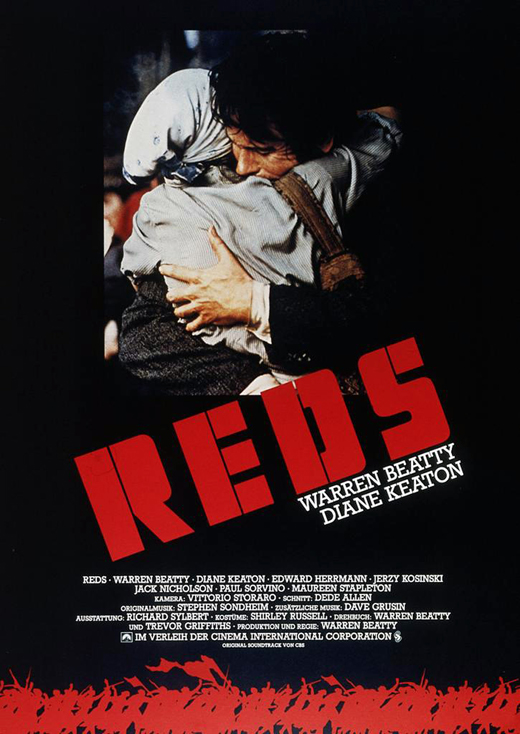
Warren Beatty’s Reds

Travis LeBlanc

3,490 words

Reds is a movie that I was badly wanting not to like. This 1981 historical epic about the life of degenerate American journalist and Communist activist John Reed (played by Warren Beatty) and his equally degenerate journalist wife Louise Bryant (Diane Keaton) is definitely pro-Communist. Additionally, I have always found Reds’ writer/director/producer/star Warren Beatty to be a rather distasteful character in his own right. And yet I can’t deny that much of Reds is objectively excellent. It is wonderfully written, directed, casted, performed, and shot. Whatever I may feel about the characters or its message, the whole film is just so well executed that I have no choice but to enjoy it in spite of everything.

Reds clocks in at a mammoth three hours and fifteen minutes, divided into two halves and separated by an intermission. The first half deals with the beginning of Reed and Bryant’s tumultuous on-again off-again romance during the First World War and climaxes with the Bolshevik Revolution, which Reed and Bryant were both on hand to witness. The second half covers the events of Reed’s life after the publication of Ten Days That Shook the World, his firsthand account of the revolution, until his premature death in 1920 at age 32. Throughout the movie, we are treated to interview excerpts from some very old people who were personally acquainted with Reed and Bryant, most of whom were Communist activists. The only one I recognized was Adela St. Johns, as she was also prominently featured in Kevin Brownlow’s documentary series Hollywood: A Celebration of the American Silent Film.

The movie opens in 1915 in Portland, Oregon. Louise Bryant is a feminist and progressive journalist. She is married to Paul Trullinger, a dentist by trade and a relative square compared to his free-spirited wife. Paul is annoyed by his wife’s antics, including her posing for risqué “art” photos, but is willing to indulge her flights of fancy nonetheless.

John Reed, a Portland hometown hero, comes back to visit. By this time, Reed is a celebrated journalist after his reporting on riding with Pancho Villa’s army as well as covering the Great War from both sides of the front. Louise talks Reed into an interview, which takes place at her private studio. Once there, Reed asks Louise if she is married, and she lies by saying that she does not believe in marriage.

Once the interview starts, Reed becomes a tidal wave of commie babble:

All right, Miss Bryant, do you want an interview? Write this down. Are you naïve enough to think containing German militarism has anything to do with this war? Don’t you understand that England and France own the world economy and Germany just wants a piece of it? Keep writing, Miss Bryant. Miss Bryant, can’t you grasp that J. P. Morgan has loaned England and France a billion dollars? And if Germany wins, he won’t get it back! More coffee? America’d be entering the war to protect J. P. Morgan’s money. If he loses, we’ll have a depression. So the real question is, why do we have an economy where the poor have to pay so the rich won’t lose money?

They meet again the next day at a dinner party, and Reed learns that Louise is in fact married after all. She is embarrassed and afraid that Reed now thinks she is a poseur, a square playing at being a radical. After the party, Louise propositions Reed for sex on the front lawn of the house to prove to prove her credibility as a non-conformist and a “modern woman.”

Reed and Bryant then begin a sexual affair, and as Reed is about to leave Portland, he invites Louise to come back to New York with him. Louise asks, “What as? Your girlfriend? Your mistress? Your paramour? Your concubine?”

This is foreshadowing. John Reed is comfortable with his degeneracy, but Louise Bryant, while sexually liberal by the standards of her time, is not actually psychologically equipped to be a true nihilist and still requires some level of emotional security. This becomes a source of conflict throughout the movie.

Louise does end up leaving her husband and moving to Greenwich Village in New York City. Reed shows her around and introduces her to his famous friends. Here, Louise starts to develop something of an inferiority complex. While she may have been a radical by Portland standards, once she is around some real East Coast alpha-bohemians. she feels positively conventional by comparison. She is a mediocrity as a writer and she has nothing like the intellectual chops of Reed’s more sophisticated friends. At a party, she tries to engage anarchist radical Emma Goldman (played by Maureen Stapleton, who won an Oscar for the role) in a debate over the efficacy of voting, and is made to feel stupid for having done so.

On top of this, she comes to resent living in Reed’s shadow. Reed is constantly travelling around the country for his journalism, while Louise’s writing career falters. And while she intellectually likes the idea of “free love,” emotionally she struggles with it.

Louise lands a role in a play written by rising poet/playwright Eugene O’Neill (Jack Nicholson). Eugene becomes fond of Louise. An old-school romantic, Eugene also senses Louise’s dissatisfaction with her open relationship and makes his move. “If you were mine, I wouldn’t share you with anybody or anything,” he tells her. “It’d be just you and me. We’d be the center of it all. I know it would feel a lot more like love than being left alone with your work.”

Beatty said he cast Nicholson in the role of Eugene O’Neill because Nicholson was the only person he could imagine stealing a girl from him. Which is a very Warren Beatty thing to say.

When Reed returns home, he learns of Louise’s affair with Eugene and a competitive love triangle ensues. It is a competition between Reed, the intellectual ideologue, and O’Neill the romantic artist. In order to secure victory, both men end up having to compromise on their principles. Eugene offer Louise an open relationship and Reed offers her marriage. Louise ends up choosing both. She marries Reed but continues carrying on an affair with O’Neill as well.

This eventually comes to a head one night. Reed tells Louise that he is aware of her affair with Eugene and doesn’t care. He also lets slip that he also slept with other women. Louise flips out and decides to leave him. On the surface, this seems like the ultimate in hypocrisy. My interpretation is that Louise is mad that Reed doesn’t care that she had an affair, and also that her affair with Eugene had at least some real substance to it. There were some deep feelings involved between her and Eugene, whereas Reed is just a narcissist. He is not capable of developing any substantive emotional attachment to anyone. He is just out there banging sluts and probably considers his own wife just another slut — albeit one he lives with when he is not busy being a travelling Communist.

Louise manages to get a job as a war correspondent in France while John Reed becomes ill and has to have a kidney removed. As he is recovering, he learns that Louise was fired from her writing job for being a shitty writer but that she is staying in France nonetheless. At the same time, he hears of happenings in Russia: The Kerensky government is crumbling and the Bolsheviks are gaining momentum on their promise to get Russia out of the war.

Reed then tracks down Louise in France and asks her to go to Russia with him and his interpreter. The revolution is imminent, and ends up being one of the biggest stories of all time. Louise still hates Reed’s guts at this point, but as an aspiring writer, she realizes that this is an offer she can’t refuse.

Once in Russia, they follow the rapidly-changing developments and attend speeches by Lenin, Trotsky, and the rest of the gang. Reed also takes a more active role in mentoring Louise as a writer. They attend a meeting where factory workers are debating whether Russia should withdraw from the war. Some argue that pulling out of the war would be a betrayal of workers in Britain, France, and America. John Reed gets on the stage and tells the crowd that Russia should get out of the war, saying that the workers in America do not want to be fighting, either, and are looking to the Russian workers to set an example. The crowd cheers. This is a turning point for John Reed, as it is here that he crosses the threshold from merely being an observer of the Bolshevik Revolution to an active participant.

The first half ends with Reed and Bryant rekindling their romance while the Bolsheviks seize power. The Bolsheviks are shown marching triumphantly through the streets, John and Louise marching alongside them. There is an air of optimism, and it feels like a new world is unfolding.

While the first half was a love letter to Communism, showing the commies to be idealistic and altruistic, Reds redeems itself in the second half by showing its ugly side. They are shown to be stubborn, petty, purity spiraling, and callous.

John and Louise return to America full of optimism for a new era of man. The Communist spark has started a fire in Russia, and they are confident that it will spread all over the world. Ten Days That Shook the World is published and causes a sensation. Everything looks to be coming up roses for the commies.

But then things start to go south almost immediately. The Bolshevik Revolution is extremely unpopular in America, and the first Red Scare begins. The Socialist Party of America expels the pro-Bolshevik faction, and then the pro-Bolsheviks themselves split into two factions, one led by Italian immigrant Louis Fraina (Paul Sorvino) and the other led by Reed. The two then comically create two competing Communist parties: The Communist Party of America and The Communist Labor Party of America. One is reminded of the blood feud between the Judean People’s Front and the People’s Front of Judea in Monty Python’s Life of Brian.

Reed ends up going back to Moscow to try to gain official recognition for his party. Louise is dead-set against this idea. For one, they just got back together, and Reed is now planning to run off on another adventure. On top of this, Louise married a writer who is now transforming into a politician. Interestingly, she is alarmed that Reed is expressing nativist sentiments when he implies that the American Communist movement should be led by American-born people, not immigrants like his rival Fraina. She tells him that if he goes to Russia that she might not be waiting when he comes back.

Reed leaves for Russia anyway, promising to return by Christmas. It is illegal for him to go there, so he has to travel first to Europe with a fake passport, and because there is a blockade of the Soviet Union, he has to take a convoluted and dangerous route through Finland to get there. Once he gets to Moscow, he ends up butting heads with Comintern head Grigory Zinoviev — whose real name was (((Hirsch Apfelbaum))).

Zinoviev tells Reed that the Soviets will not recognize his party, and instead orders the two competing parties to merge. This invalidates the entire purpose of Reed’s trip. When he tells Zinoviev that he must go back to America to keep his promise to his wife, Zinoviev guilt-trips him for putting his personal commitments ahead of the revolution.

With Reed gone, Louise pays Eugene O’Neill a visit, but finds Eugene is still very bitter about her choosing Reed over him. He becomes further annoyed when the conversation turns to events in Russia, about which Eugene is entirely cynical. Eugene sees through Reed and Bryant’s idealistic bullshit. This scene has some great dialogue as masterly performed by Jack Nicholson:

Louise: Are you really that cynical, or are you angry with me?

Eugene: I’m really that cynical. Why would I be angry with you?

Louise: Gene, if you’d been to Russia, you’d never be cynical about anything again. You would have seen people transformed. Ordinary people.

Eugene: Louise, something in me tightens when an American intellectual’s eyes shine and they start to talk to me about the Russian people. Something in me says, “Watch it. A new version of Irish Catholicism is being offered for your faith.”

Louise: It’s not like that.

Eugene: And I wonder why a lovely wife like Louise Reed, who’s just seen the brave new world, is sitting around with a cynical bastard like me instead of trotting all over Russia with her idealistic husband. It’s almost worth being converted.

Louise: Well, I was wrong to come.

Eugene: You and Jack have a lot of middle-class dreams for two radicals. Jack dreams that he can hustle the American working man, whose one dream is to be rich enough not to have to work, into a revolution led by his party. And you dream that if you discuss the revolution with a man before you go to bed with him, it’ll be missionary work rather than sex. I’m sorry to see you and Jack so serious about your sports. It’s particularly disappointing in you, Louise. You had a lighter touch when you were touting free love.

Louise: Boy, you’ve become quite the critic, haven’t you, Gene? Just leaned back and analyzed us all.

Eugene: Duplicitous women who tout free love and then get married, power-mad journalists who join the revolution instead of observing it, middle-class radicals who come looking for sex and then talk about Russia.

Louise: It must seem so contemptible to a man like you, who has the courage to sit on his ass and observe human inadequacy from the inside of a bottle. Well, I’ve never seen you do anything for anyone. I’ve never seen you give anything to anyone, so I can understand why you might suspect the motives of those who have. But whatever Jack’s motives are, how–

Eugene: I seem to have touched a wound.

Louise: You’re a wounded son-of-a-bitch, and whatever I’ve done to you, you’ve made me pay for it.

Earlier in the movie, one is left with the impression that Eugene was the romantic and Reed was the nihilist. With this scene, the movie tries to flip the script and show Eugene as the self-centered one and Reed as the romantic committed to a cause higher than himself. It was a good effort, but I still ended up liking Jack Nicholson’s Eugene O’Neill far better than Warren Beatty’s John Reed.

Reed leaves Moscow for America. Unfortunately, he is arrested in Finland en route. The American consulate has no interest in helping him, but Reed manages to get word to a friend in America. When Louise Bryant learns of Reed’s arrest, she leaves America (again, illegally) to try to help him. But before she can get there, Finland releases Reed as part of a prisoner exchange with the Soviet Union.

Reed’s problems with the Bolsheviks continue. He has difficulties making them understand the situation on the ground in America. He wants to make English the official language of the American Communist party to avoid the cumbersome use of interpreters, but the Soviets deny his request. They make impossible and impractical demands, such as ordering Reed to infiltrate institutions that he believes are impervious to subversion. As he later remarks, “You know, I can argue with cops, I can fight with generals. I can’t deal with a bureaucrat.”

Reed reunites with Emma Goldman, who had been deported to Russia during the Red Scare (although she was never a Communist, she was an anarchist). Goldman has become completely disillusioned with the Bolsheviks:

Jack, I think we have to face it. The dream that we had is dying in Russia. If Bolshevism means the peasants taking the land, the workers taking the factories, Russia’s one place where there’s no Bolshevism. . . . The Soviets have no more local autonomy. The central state has all the power. All the power is in the hands of a few men and they are destroying the revolution. They are destroying any hope of real communism in Russia. They’re putting people like me in jail. My understanding of revolution is not a continual extermination of political dissenters, and I want no part of it. Every single newspaper’s been shut down or taken over by the party. Anyone even vaguely suspected of being a counter-revolutionary can be taken out and shot without a trial. Where does that end? Is any nightmare justifiable in the name of defense against counter-revolution?

I must say that I had some sympathy for Emma Goldman here. I can relate to her situation, having seen the 2016 dream of Trump and the Alt Right crumble and turn to dust. It’s not a good feeling — and the dream of 2016 didn’t go nearly as badly as the dream of 1917.

Reed, however, is still not ready to let go, and keeps making excuses for the Bolsheviks. When Goldman tells him of the four million people who died the previous year, Reed answers:

They died because of a French, British, and American blockade that cut off all food and medical supplies and because counter-revolutionaries have sabotaged the factories and the railroads and the telephones, and because the people — the poor, ignorant, superstitious, illiterate people — are trying to run things themselves, just as you always said that they should, but they don’t know how to run them yet. Did you really think things would work right away? Did you really expect social transformation to be anything other than a murderous process? It’s a war and we gotta fight it like we fight a war, with discipline, with terror, with firing squads, or we just give it up.

Goldman counters, “Those four million people didn’t die fighting a war. They died from a system that cannot work!”

Reed ends up being sent to Baku to attend the Congress of the Peoples of the East. There, he gives a speech to a crowd of Muslims that is translated by an interpreter. The speech receives a rapturous response. However, Reed learns that the Bolsheviks mistranslated his speech, and that the interpreter told them the revolution is a holy war against Western infidels, when what Reed actually said was that it is a class war.

Reed is furious and chews out Zinoviev on the train ride back to Moscow. Zinoviev tells Reed that he altered his speech for the sake of utility and questions Reed’s loyalty for objecting. Reed is having none of it:

Zinoviev, you don’t think a man can be an individual and be true to the collective, or speak for his own country and the international at the same time, or love his wife and still be faithful to the revolution! You don’t have a self to give! When you separate a man from what he loves the most, what you do is purge what’s unique in him. And when you purge what’s unique in him, you purge dissent. And when you purge dissent, you kill the revolution! Revolution is dissent! You don’t rewrite what I write!

This scene is a testament to Reed’s narcissism. Reed was able to casually shrug off millions of deaths, but what really blackpilled him on the revolution was when they edited his speech.

Reed returns to Russia, where Louise is waiting for him, but by now Reed’s health is failing badly. There is a scene near the end where Reed is in bed with Louise by his side, and they talk about returning to America together. Louise once again asks, “What as?” and Reed answers, “As comrades.” He dies shortly afterwards.

It’s a good movie. Diane Keaton and Jack Nicholson both give magnificent performances. Even Warren Beatty, with his infinitely punchable face, gives a very strong performance

Flaws can be found. This movie takes a lot of creative liberties with the historical facts. One notable thing is that all the actors are much older than the people they are portraying. When John Reed met Louise Bryan in December 1915, Reed was 28, Eugene O’Neill was 27, and Louise Bryant had just turned 30. However, when Reds began filming in 1979, Warren Beatty and Jack Nicholson were both 42 and Diane Keaton was 33. If the movie had cast actors who were closer in age to the people they were playing, it would have been a very different movie. Their political beliefs and personal failings could then have been seen as a reflection of their youthful naïveté.

Still, doing that would have made the movie a less gripping drama, and from Beatty’s point of view, less effective as propaganda. The film is an odd mix of pro- and anti-Communist messages. In the end, the message boils down to, “Real Communism has never been tried.”

*  *  *

Counter-Currents has extended special privileges to those who donate $120 or more per year.

  • First, donor comments will appear immediately instead of waiting in a moderation queue. (People who abuse this privilege will lose it.)
  • Second, donors will have immediate access to all Counter-Currents posts. Non-donors will find that one post a day, five posts a week will be behind a “paywall” and will be available to the general public after 30 days.

To get full access to all content behind the paywall, sign up here:

Warren Beatty’s Reds

Warren%20Beattyand%238217%3Bs%20Reds

Share

  • Gab

Enjoyed this article?

Be the first to leave a tip in the jar!

Instant Echeck GreenPay™

Related

  • AI Will Destroy Capitalism, Not Save It

  • The Robot Hotdog Stand

  • Berlin: City of Stones

  • Lothrop Stoddard’s The Revolt Against Civilization

  • Politics Without God

  • David Lean’s A Passage to India

  • Neo-Fascism in Film, Part 2

  • Neo-fascism in Film, Part 1

Tags

CommunismDiane KeatonEmma GoldmanEugene O'NeillfilmGrigory ZinovievJohn ReedLouise Bryantmovie reviewsRedsthe Bolshevik RevolutionTravis LeBlancWarren Beatty

7 comments

  1. Beau Albrecht says:
    August 17, 2021 at 10:27 am

    John Reed was something else – a journalist who actually didn’t pretend he wasn’t a pinko!  It’s been ages since I saw that one.  If I recall, his unwillingness to go with the flow got him in hot water and he barely made it out of there.

    0
    0
  2. Lord Snooty says:
    August 17, 2021 at 11:17 pm

    Though Emma Goldman was a Jewish anarchist terrorist (three strikes and you’re out) she belonged to a former generation of lefty thinkers that is still worth reading.

    H. L. Mencken was a fan. He admired her independent spirit.

    Emma was a feminist who opposed women getting the vote! She had no idealistic delusions about the nature of women (or men, of course).

    She deserves credit for being one of the first (in 1923) to raise the alarm about the consequences of the October Revolution. The penny dropped when a Bolshevik official told her he thought free speech was “a bourgeois superstition”.

    But yeah, I’ve never liked Warren Beatty.


    0
    0
    1. Peter Quint says:
      August 18, 2021 at 6:45 am

      But yeah, I’ve never liked Warren Beatty.


      Especially, after he revealed himself to be a negrophile with the making of “Bulworth.”

      0
      0
    2. Gregor Huysmans says:
      August 19, 2021 at 11:04 am

      I believe Kerry Bolton’s Black House Press published one of her works a long time ago.

      0
      0
  3. Peter Quint says:
    August 18, 2021 at 6:42 am

    I like the scene where Warren Beatty is giving a speech in the Kremlin (I think that is where it was held), and the audience starts arguing about what he said, that is when Beatty realizes that his audience does not understand him–the look on his face.

    0
    0
  4. Don says:
    August 18, 2021 at 4:31 pm

    I saw this movie when it first came out 40 years ago and I almost lost consciousness watching it.  Three hours of of hot air from morally and intellectually confused people who defended the torturers and murderers who ran 20th Century communism.

    Now I read this  review and I almost lost consciousness reading it.  There is nothing redeeming about Hollywood liberals who support the torturers and murderers who ran 20th Century communism.  Nothing.


    0
    0
  5. S. Clark says:
    August 21, 2021 at 11:37 am

    I remember seeing Reds, and maybe saw it twenty years ago. I appreciate Leblanc’s essay, and how he showed a lot of the dialogue, which helps to understand why this many good parts as a film.  It was pretty iconic when it came out…three hours with an intermission! They never do that, and if it had been in the sixties, we’d have had the usual intermission music, like in Dr. Zhivago.

    The film got me interested, and I was reading Miles Williams Mathis’s website, and in his 2016 writings, he ‘exposes’ John Reed, claiming  he was actually a spy for the U.S. with high connections that let him into Russia. Mathis claims a lot of events and people have been staged and are fake, but the readers might like to visit the website.

    It is curious Reed was from a wealthy family, and as Mathis said, people like that don’t usually become revolutionaries. (Jeb Bush…for the people!)  Same with Louise Bryant. She was also wealthy, and perhaps the reason she stayed on in so many writing jobs when she couldn’t write was an example of her connections. See Mathis.

    Back to the film, I thought it had a good, epic quality, and was obviously a swipe at Reagan. One thing I thought didn’t help was you had all these old people recalling Reed, BUT WHO THE HELL WERE THEY?  Names would have helped. Also, the hagiographic way Reed was portrayed. He’s not  great hero, but is interesting.

    I wish the film could have showed him in Mexico. His account of the revolution there is very stimulating reading.

    I also liked Jack Nicholson. He played a moody O’Neill very well, and the dialogue he had with Louise was effective when he called her out. Perhaps his sense that Louise and John weren’t exactly what they claimed to be might support Mathis’s research.

    The line I remembered most when when Emma Goldman and Reed had their parting of the ways over the revolution. She said it was a mistake, and Reed shot back; “Then what was it all for?”  That meaning the belief justifies whatever happens. Reflects a certain personality that will go along with evil because it simply is the program. Think of Covid, of Fauci ordering vaccines till the end of time, because that’s what he’s apparently been waiting for all his life.

    Beatty was far too handsome as Reed. Diane Keaton…well, she seemed to wind up playing flakes; Annie Hall made her, so, she went with the typecasting. But Beatty had a kind of smarmy charm of a rich kid that worked when playing Reed. It seemed to imply how the rich and the reds actually work together. When I was in the anti-war movement in Central America in the 80’s, I noticed the amount of very rich involved. Went to a fund-raising party featuring the Nicaraguan ambassador  hosted by a Rockefeller. But more than a few people have noted how marxism and capitalism have more than a few similarities.

    There is a song in the USSR: “John Reed.” I heard the Red Army chorus sing it, of Reed valiantly going forth to tell the truth, etc.

    Again, Mathis notes why Reed would rise so high in the Soviet leadership since he wasn’t Russian. Are there jewish roots we don’t know?

    Interesting too that Beatty was always a pretty boy in Hollywood. When a movie was being made of PT 109, JFK’s WWII heroism (propaganda), Kennedy originally wanted Beatty to play him. Instead, Cliff Robertson got the part.

    0
    0

Comments are closed.

If you have a Subscriber access,
simply login first to see your comment auto-approved.

Note on comments privacy & moderation

Your email is never published nor shared.

Comments are moderated. If you don't see your comment, please be patient. If approved, it will appear here soon. Do not post your comment a second time.

Writer of June

(4 votes) David M. Zsutty

Article of June

Why White Advocates Should Avoid “Based Blacks” by Dani Vypont 4 votes
    • Replacement Migration & Hypergamy

      F. Roger Devlin

      12

    • Kurds of a Feather Flock Together:
      Europe’s “Racist” Parakeet Tweet-Storm

      Steven Tucker

      1

    • Elevator Pitch to a Billionaire
      Money, Money, Money

      Ondrej Mann

      1

    • All Hail Rhodesia

      Spencer J. Quinn

      2

    • Nationalism This Week
      Disenfranchisement

      Greg Johnson

      28

    • The Murder of Ann Widdecombe

      Lipton Matthews

      9

    • Disclosure Day
      Please, Keep It Undisclosed

      Francisco Albanese

      10

    • Remembering Carl Schmitt
      July 11, 1888–April 7, 1985

      Greg Johnson

      1

    • Editor’s Update
      Fundraiser Update & New Books

      Greg Johnson

      1

    • Third Homeland Institute Poll on the Great Replacement

      David M. Zsutty

      11

    • The Bitter End of Western Metaphysics:
      Heidegger on Nietzsche, Part Five (Conclusion)

      Collin Cleary

      9

    • Fraudulent Black British History

      Mark Gullick

      7

    • A White Nationalist Response to Scott Greer

      Dave Chambers

      25

    • The Miami Mall Incident:
      Black Youths or Black Extraterrestrials?

      Dominic Fox

      6

    • The Theology of Three Populisms

      Morris van de Camp

      2

    • The Dangers of Skilled Immigration

      Lipton Matthews

      25

    • The Brotherhood of the Bell

      Beau Albrecht

      16

    • Endeavor: What Rome Means to Me

      Endeavour

    • When the Family Becomes Predation

      Jayant Bhandari

      5

    • RICU: The Gentle Art of Persuasion

      Mark Gullick

      7

    • Mind of Darkness:
      A Review of Lipton Matthews’s Busting African Delusions

      Derek Stark

      12

    • Remembering Revilo Oliver
      July 7, 1908–August 20, 1994

      Greg Johnson

      2

    • Some Advantages of Irish Nationalism

      Greg Johnson

      30

    • America at 250 from the National Cathedral

      Gabriel Anderson

      18

    • Why Not Stop All the Clocks?
      Modern Conservatism’s Flagging Commitment Towards Turning Back Time

      Steven Tucker

      3

    • Remembering Jean Raspail
      July 5, 1925–June 13, 2020

      Greg Johnson

      2

    • Editor’s Update
      Fundraiser Update & New Books

      Greg Johnson

    • The Ethnic Reality of FIFA 2026

      Samuel Valleus

      13

    • Nationalism This Week
      Tucker’s New Party

      Greg Johnson

      30

    • Ethiopia Against Italy
      How the Italo-Ethiopian Wars were part of the conflict between Eastern & Western Christiandom

      Morris van de Camp

    • Please Vote in Our Writer & Article of the Month Poll

      Greg Johnson

    • Available for Pre-Order!
      F. Roger Devlin’s Not Hooking Up

      F. Roger Devlin

    • Kolberg: The Last Nazi (or Prussian?) Film

      Steven Clark

      2

    • America 250 & The Fate of Empires

      Richard Houck

      20

    • Available for Pre-Order!
      Greg Johnson’s The Battle of the Books

      Greg Johnson

    • Why All the Silence About Blacks Being Kicked Out of South Africa?
      Because It’s Other Blacks That Are Doing It.

      Steven Tucker

      10

    • Zelensky, the Jewish Conspiracy Narrative, & the Demographic Replacement of Ukraine:
      A Critical Analysis of a Disinformation Discourse within the European Identitarian Right

      Luís Graça

      30

    • The Original Congressional Debate on Birthright Citizenship

      Alex Graham

      13

    • America at 250
      Unmanifested Destiny  

      David M. Zsutty

      32

    • The Normies are Waking Up:
      The Alliance for Responsible Citizenship Conference, London 2026

      Lipton Matthews

      2

    • Ethnic Vigilantism: The Movie

      Mark Gullick

      15

    • Lothrop Stoddard’s The Revolt against Civilization

      Kevin MacDonald

      2

    • David Zsutty on Political Organizing

      David M. Zsutty

    • PC-Incompatible Gaming:
      Plantation Simulator and the “Problem” of Racist Video Games

      Steven Tucker

      3

    • Remembering Lothrop Stoddard
      June 29, 1883–May 1, 1950

      Greg Johnson

      1

    • Editor’s Update
      Fundraiser Update & Upcoming Projects

      Greg Johnson

    • Nationalism This Week
      Metapolitics Wins:
      Scott Greer’s Whitepill

      Greg Johnson

      8

    • Remembering Colin Wilson
      June 26, 1931–December 5, 2013

      Greg Johnson

      3

    • Kevin Deanna on Political Organizing

      Kevin Deanna

      1

    • The Bitter End of Western Metaphysics:
      Heidegger on Nietzsche, Part Four

      Collin Cleary

      6

    • Dani Vypont

      Replacement Migration and Hypergamy

      I once had a Norwegian nationalist ask me to tell him the degree of mixing between White women &...

    • Dani Vypont

      Replacement Migration and Hypergamy

      Both of those sources rely on marriage data. The first one is titled "Intermarriage in America Post-...

    • James Sunderland

      Replacement Migration and Hypergamy

      Here is analysis conducted using U.S. Census Data. You can't get better than this: https://www....

    • Hairy Iranian Dude

      Replacement Migration and Hypergamy

      I love Norway. It’s a real country (used to be?). I was there for six days in 2018: Oslo and Bergen...

    • Dani Vypont

      Replacement Migration and Hypergamy

      In the U.S., white woman have the lowest rate of miscegenation across all intersections of race and...

    • Glide Ratio 0:1

      Replacement Migration and Hypergamy

      This is one hundred percent my observations moving from England to the USA. White American females...

    • Fionn McCool

      Replacement Migration and Hypergamy

      It would have been good if FRD had offered some statistics to support his claim rather than mere...

    • Greg Johnson

      Disenfranchisement

      People constantly bemoan the fact that old politicians send young men to die in wars. I guess that...

    • Peter Quint

      Replacement Migration and Hypergamy

      Sounds like Norway needs its own Casa Pound. 🦈

    • Peter Quint

      Replacement Migration and Hypergamy

      Maybe, it is because White American women have had to deal with it for a much longer time than the...

    • Glide Ratio 0:1

      Disenfranchisement

      Like Radbod said "I would rather spend eternity in hell with my ancestors than in heaven with...

    • Greg Johnson

      Disenfranchisement

      The first step is to document this in an article. Then we will get it circulating. It will bring...

    • Beau Albrecht

      Replacement Migration and Hypergamy

      I can't even begin to finish reading this.  I'll just say that the orcs need to be sent back to...

    • Beau Albrecht

      Europe’s “Racist” Parakeet Tweet-Storm

      This is for real?  It seems that leftist ideology has become a parody of itself.  The pearl-...

    • Beau Albrecht

      All Hail Rhodesia

      The author is spot-on with this.  Rhodesia did at one time have an offer to join South Africa, but...

    • James Sunderland

      Replacement Migration and Hypergamy

      “Speaking more generally, women are less loyal to the tribe into which they are born than are men...

    • Peter Quint

      All Hail Rhodesia

      Great article! Instead of writing novels about time travelers meeting Enoch Powell, and going back...

    • Gabe

      Replacement Migration and Hypergamy

      “Seeing themselves on the bottom of the local totem pole, some of these Norwegian boys have actually...

    • Mcdringle

      Some Advantages of Irish Nationalism

      'Their progenitors were born into a world that could not feed their flesh other with the almighty...

    • Will Martin

      Disenfranchisement

      Can't even pass the SAVE act, but again, declining Whites are somehow going to disenfranchise...

    • Earth Day Special

      John Morgan

      12

    • A Robertson Roundup
      Remembering Wilmot Robertson
      (April 16, 1915 – July 8, 2005)

      Margot Metroland

      13

    • The Paranoid Style in White Nationalism

      Greg Johnson

      30

    • Join the Dance!

      Andrew Hamilton

      1

    • We Can’t Save the Earth Without Reducing African Birth Rates

      James Dunphy

      36

    • “I’m Not a Conspiracy Theorist, but . . .”:
      Jeffrey Epstein’s Death Gives New Life to “Conspiracy Theories”

      Greg Johnson

      22

    • Sylvia Plath: Stasis in Darkness

      Vic Olvir

      17

    • Vanguardism, Vantardism, & Mainstreaming

      Greg Johnson

      80

    • Aviation, Geography, & Race

      Charles Lindbergh

      3

    • Some Thoughts on Yule

      Collin Cleary

      4

    • Living in Truth:
      A Yuletide Homily

      Jef Costello

      7

    • John Kennedy Toole’s A Confederacy of Dunces

      Greg Johnson

      20

    • On Aleksandr Solzhenitsyn’s Warning to the West

      Spencer J. Quinn

      7

    • Elitism, British Modernism, & Wyndham Lewis

      Jonathan Bowden

      6

    • Philip K. Dick’s Do Androids Dream of Electric Sheep? as Anti-Semitic/Christian-Gnostic Allegory

      Greg Johnson

      20

    • “Conspiracy Theory” or Conspiracy?

      Andrew Hamilton

      21

    • Remembering H. P. Lovecraft
      (August 20, 1890–March 15, 1937)

      Greg Johnson

      3

    • Who Are We?
      Nordics, Aryans, & Whites

      Greg Johnson

      71

    • Remembering William Gayley Simpson
      (July 23, 1892–December 31, 1990)
      A Pleasant Afternoon with Harriet & Bill Simpson

      Margot Metroland

      18

    • Here are the Young Men
      Remembering Ian Curtis
      (July 15, 1956–May 18, 1980)

      Mark Gullick

      18

    • Percy Grainger
      Artist of the Right

      Alex Graham

      7

    • Remembering Revilo Oliver
      (July 7, 1908–August 20, 1994)

      Greg Johnson

      18

    • The Meaning of July 4th for the White Man

      Gregory Hood

      13

    • The Front National’s Evolution

      Bruno Mégret

    • Merwin K. Hart
      Forgotten American Hero & Man of the Right

      Morris van de Camp

      10

    • George Orwell’s Nineteen Eighty-Four

      Jonathan Bowden

      8

    • Carleton S. Coon
      Scientist & Reluctant White Advocate

      Morris van de Camp

      4

    • The Kwanzaa Absurdity Will Be Dwarfed by Juneteenth

      Robert Hampton

      12

    • Stravinsky

      Alex Graham

      7

    • Like the Roman:
      Remembering Enoch Powell (1912-1998)

      Mark Gullick

      23

    • Exclusive Interview with Karel Veliky:
      The Final Chapter in the Film Series! Part II

      Ondrej Mann

      2

    • Exclusive Interview with Karel Veliky:
      The Final Chapter in the Film Series! Part I

      Ondrej Mann

      2

    • Nietzsche & Race

      Mark Gullick

    • The Crisis of Chinese Technology Thieves

      Morris van de Camp

      1

    • The Zodiac Killer

      Mark Gullick

      12

    • José Pedro Zúquete’s The Identitarians

      Greg Johnson

      3

    • Berlin: City of Stones

      Spencer J. Quinn

      6

    • Headbanging Lite

      Mark Gullick

      5

    • The Russians are Coming/The Russians are Coming

      Steven Clark

      2

    • The Cruelty of Kindness

      Morris van de Camp

      11

    • Jonathan Bowden’s Deliverance
      Part 7

      Jonathan Bowden

    • Lothrop Stoddard’s The Revolt Against Civilization

      Spencer J. Quinn

      15

    • About Film “From the Right”

      Karel Veliky

    • The 1970s: The Golden Age of Hijacking

      Morris van de Camp

      21

    • Jonathan Bowden’s Deliverance
      Part 6

      Jonathan Bowden

    • Do You Want to Play a Game?

      Mark Gullick

      1

    • Sexually Incontinent on the Indian Subcontinent:
      Who Rapes More Animals, Indians or Pakistanis? The Battle Continues!

      Steven Tucker

      3

    • Neo-Fascism in Film
      Part 5

      Karel Veliky

      15

    • The Game of Tarot

      Mark Gullick

      2

    • Institutions Cannot Be Transplanted

      Jayant Bhandari

      5

    • Jonathan Bowden’s Deliverance
      Part 5

      Jonathan Bowden

    • Crosstown Traffic:
      Jimi Hendrix & The Post-War Rock ‘N’ Roll Revolution

      Mark Gullick

      1

    • Slaves from the North:
      Finns & Karelians in the East European Slave Trade, 900–1600

      Lipton Matthews

      14

    • Neo-Fascism in Film
      Part 4

      Karel Veliky

      2

    • David Lean’s A Passage to India

      Spencer J. Quinn

      1

    • Elites are Essential to Development

      Lipton Matthews

      7

    • Jonathan Bowden’s Deliverance
      Part 4

      Jonathan Bowden

    • Neo-Fascism in Film
      Part 3

      Karel Veliky

      6

    • E. M. Forster’s A Passage to India & the Indian Mentality

      Spencer J. Quinn

      25

    • Jonathan Bowden’s Deliverance
      Part 3

      Jonathan Bowden

    • András László
    • Derek Hawthorne
    • Beau Albrecht
    • Alain de Benoist
    • Kerry Bolton
    • Jonathan Bowden
    • Collin Cleary
    • Jef Costello
    • Savitri Devi
    • Julius Evola
    • Jim Goad
    • Gregory Hood
    • Juleigh Howard-Hobson
    • Greg Johnson
    • Charles Krafft
    • Anthony M. Ludovici
    • Trevor Lynch
    • H. L. Mencken
    • J. A. Nicholl
    • James J. O’Meara
    • Christopher Pankhurst
    • Tito Perdue
    • Michael Polignano
    • Spencer J. Quinn
    • Fenek Solère
    • Irmin Vinson
    • Leo Yankevich
    • Francis Parker Yockey
    • Multiple authors
  • Editor-in-Chief

    • Greg Johnson, Ph.D.

    Featured Writers

    • Beau Albrecht
    • Gunnar Alfredsson
    • Collin Cleary, Ph.D.
    • Jef Costello
    • Morris V. de Camp
    • F. Roger Devlin, Ph.D.
    • Stephen Paul Foster, Ph.D.
    • Jim Goad
    • Alex Graham
    • Mark Gullick, Ph.D.
    • Greg Johnson, Ph.D.
    • Travis LeBlanc
    • Trevor Lynch
    • Margot Metroland
    • James J. O’Meara
    • Angelo Plume
    • Spencer J. Quinn
    • Fred Reed
    • Clarissa Schnabel
    • Michael Walker
    • David M. Zsutty

    Frequent Writers

    • Asier Abadroa
    • Aquilonius
    • Alain de Benoist
    • Kerry Bolton, Ph.D.
    • Dave Chambers
    • Steven Clark
    • James Dunphy
    • Endeavour
    • Richard Houck
    • Jason Kessler
    • Titus Livius
    • Ondrej Mann
    • Lipton Matthews
    • Mark Mazari
    • John Morgan
    • Jaroslav Ostrogniew
    • Kathryn S.
    • Christian Secor
    • Anne Wilson Smith
    • Thomas Steuben
    • William De Vere
    • Kenneth Vinther
    • Max West

    Classic Authors

    • Maurice Bardèche
    • Jonathan Bowden
    • Julius Evola
    • Guillaume Faye
    • Ernst Jünger
    • Kevin MacDonald, Ph.D.
    • D. H. Lawrence
    • Charles Lindbergh
    • Jack London
    • H. P. Lovecraft
    • Anthony M. Ludovici
    • Sir Oswald Mosley
    • National Vanguard
    • Friedrich Nietzsche
    • Revilo Oliver
    • William Pierce
    • Ezra Pound
    • Saint-Loup
    • Savitri Devi
    • Carl Schmitt
    • Miguel Serrano
    • Oswald Spengler
    • P. R. Stephensen
    • Jean Thiriart
    • John Tyndall
    • Dominique Venner
    • Leo Yankevich
    • Francis Parker Yockey

    Other Authors

    • Howe Abbott-Hiss
    • Michael Bell
    • Giles Corey
    • Jack Donovan
    • Richardo Duchesne, Ph.D.
    • Emile Durand
    • Guillaume Durocher
    • Mark Dyal
    • Tom Goodroch
    • Andrew Hamilton
    • Robert Hampton
    • Huntley Haverstock
    • Derek Hawthorne
    • Gregory Hood
    • Juleigh Howard-Hobson
    • Alexander Jacob
    • Ruuben Kaalep
    • Tobias Langdon
    • Julian Langness
    • Patrick Le Brun
    • G A Malvicini
    • John Michael McCloughlin
    • Millennial Woes
    • Michael O’Meara
    • Christopher Pankhurst
    • Michael Polignano
    • J. J. Przybylski
    • Quintilian
    • Edouard Rix
    • C. B. Robertson
    • C. F. Robinson
    • Herve Ryssen
    • Alan Smithee
    • Fenek Solere
    • Ann Sterzinger
    • Robert Steuckers
    • Tomislav Sunic
    • Donald Thoresen
    • Marian Van Court
    • Irmin Vinson
    • Book Reviews
    • Movie Reviews
    • TV Reviews
    • Music Reviews
    • Art Criticism
    • Graphic Novels & Comics
    • Video Game Reviews
    • Fiction
    • Poems
    • Interviews
    • Videos
    • English Translations
    • Other Languages
      • Arabic
      • Bulgarian
      • Croatian
      • Czech
      • Danish
      • Dutch
      • Estonian
      • Finnish
      • French
      • German
      • Greek
      • Hungarian
      • Italian
      • Lithuanian
      • Norwegian
      • Polish
      • Portuguese
      • Romanian
      • Russian
      • Slovak
      • Spanish
      • Swedish
      • Ukrainian
    • Commemorations
    • Why We Write
  • Archives
  • Top 100 Commenters
  • The Looney Bin
Sponsored Links
Europa.com Above Time Coffee Antelope Hill Publishing Paul Waggener IHR-Store Spencer J. Quinn American Renaissance Jim Goad The Occidental Observer
Donate Now Mailing list
Books for sale
  • Not Hooking Up
  • The Battle of the Books
  • The Philosopher Is In
  • Sexual Utopia in Power (Expanded Edition)
  • In Defense of Prejudice
  • Loving Our Own
  • Tyranny & Wisdom
  • To all books
Copyright © 2026 Counter-Currents Publishing, Ltd.

Paywall Access


Please enter your email address.

Lost your password?

Edit your comment

Writer & Article of the Month June 2026

Voting for this month has concluded. Here are the final results!

Top Writers

  • #1 David M. Zsutty 4 votes
  • #2 Mark Gullick 3 votes
  • #3 Morris van de Camp 2 votes
  • #4 Ondrej Mann 2 votes
  • #5 Dani Vypont 2 votes
  • #6 Greg Johnson 2 votes
  • #7 Collin Cleary 1 vote
  • #8 Millennial Woes 1 vote
  • #9 Beau Albrecht 1 vote
  • #10 Dave Chambers 1 vote
  • #11 Steven Tucker 1 vote
  • #12 Jayant Bhandari 1 vote

Top Articles

  • #1 Why White Advocates Should Avoid “Based Blacks” 4 votes
  • #2 Zsutty’s Maximum 3 votes
  • #3 The Murder of Henry Nowak 2 votes
  • #4 China’s Threat to American Security 1 vote
  • #5 Ethnic Vigilantism: The Movie 1 vote
  • #6 The Inferiority Behind Immigrant Superiority 1 vote
  • #7 Uncivil War 1 vote
  • #8 Liar, Liar, Pants on Fire! 1 vote
  • #9 Small Is Beautiful: The Napoleon of Notting Hill 1 vote
  • #10 Interview with Gerhard Hallstatt of Allerseelen 1 vote
  • #11 Monkeys and Typewriters 1 vote
  • #12 The Remigration Movement Solidifies  1 vote
  • #13 I’m Glad He Failed 1 vote
  • #14 The Killing of Henry Nowak 1 vote
  • #15 Alex Jones’ Endgame: Blueprint for Global Enslavement, Part 4 1 vote

Total votes cast: 21