In summer 1789, King Louis XVI of France summoned the Estates General to Versailles in order to solve France’s deepening financial crisis. The Estates General consisted of the First Estate representing the clergy, the Second Estate representing the nobility, and the Third Estate representing everyone else. (more…)
Tag: the Bolshevik Revolution
-
2,875 words
Part 2 of 2 (Part 1 here)
No Russian Leaders
The London Morning Post correspondent then tried to determine who the Bolsheviks were who had terrorized Kiev. His findings were:
In the first place, as Kiev knew the Bolsheviki, they are utter aliens — Letts, Finns, internationalized Jews, Rumanians, anything except actual Russians. (more…)
-
1,851 words
Part 1 of 2 (Part 2 here)
Sometimes a timely warning comes from an unlikely place. A footnote in Francis Parker Yockey’s Imperium led to a shocking find in what was, even in his day, a dusty tome on some university library shelves. The emended citation is Current History, Vol. XI, Part 1, no. 3, published in December 1919. (more…)
-
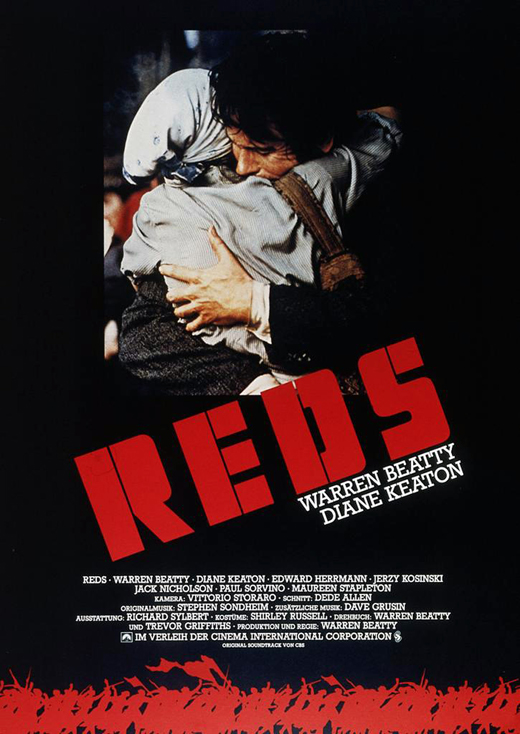
Reds is a movie that I was badly wanting not to like. This 1981 historical epic about the life of degenerate American journalist and Communist activist John Reed (played by Warren Beatty) and his equally degenerate journalist wife Louise Bryant (Diane Keaton) is definitely pro-Communist. Additionally, I have always found Reds’ writer/director/producer/star Warren Beatty to be a rather distasteful character in his own right. And yet I can’t deny that much of Reds is objectively excellent. It is wonderfully written, directed, casted, performed, and shot. Whatever I may feel about the characters or its message, the whole film is just so well executed that I have no choice but to enjoy it in spite of everything. (more…)
-
August 16, 2012 Julius Evola
Baron von Ungern-Sternberg
English original here
V polední době se objevila spousta spisů o postavě, o níž se, i přes její mimořádný význam ve vřavách první světové války, ví jen málo: mluvím o Romanu Mikolaji Maximilianu von Ungern-Sternbergovi.
Ferdinand Ossendowski byl prvním, kdo o něm, s využitím patřičných dramatizačních efektů, psal ve svém slavném a docela kontroverzním díle Bestie, lidé a bohové. (more…)
-
4,492 words
Editor’s Note:
The following two chapters from Ferdinand Ossendowski’s Beasts, Men, and Gods
give a good sense of Baron Roman Nikolai Maximilian von Ungern-Sternberg’s qualities and vision. Ossendowski joined the baron’s army as a commanding officer of one of his self-defense troops. He also briefly became Ungern-Sternberg’s political advisor and chief of intelligence. Ungern-Sternberg sent Ossendowski on a diplomatic mission to Japan and the United States, and when the baron’s regime collapsed, Ossendowski stayed on in the United States and wrote Beasts, Men, and Gods, which was published in 1922.
-
1,598 words
Translated by Greg Johnson
Czech translation here
Translator’s Note:
The following text, published in 1942 or 1943 under the title “Baron von Ungern Venerated in Mongolian Temples,” deals with one of the 20th century’s most enigmatic figures whom I first encountered in the pages of Ferdinand Ossendowski’s brilliant Beasts, Men, and Gods.