Counter-Currents
  • Advertise
  • Private Events
  • T&C
  • About
  • Contact
  • RSS
    • Main feed
    • Podcast feed
    • Videos feed
    • Comments feed
  • Welcome
  • Webzine
  • Books
  • Merch
  • Podcasts
  • Videos
  • Donate
  • Patrons
  • Subscribe
  • Crypto

LEVEL2

Donate Now Mailing list

Writer of June

(4 votes) David M. Zsutty

Article of June

Why White Advocates Should Avoid “Based Blacks” by Dani Vypont 4 votes
  • Welcome
  • Webzine
  • Books
  • Merch
  • Podcasts
  • Videos
  • Donate
  • Patrons
  • Subscribe
  • Crypto
    • Replacement Migration & Hypergamy

      F. Roger Devlin

      22

    • Kurds of a Feather Flock Together:
      Europe’s “Racist” Parakeet Tweet-Storm

      Steven Tucker

      1

    • Elevator Pitch to a Billionaire
      Money, Money, Money

      Ondrej Mann

      1

    • All Hail Rhodesia

      Spencer J. Quinn

      3

    • Nationalism This Week
      Disenfranchisement

      Greg Johnson

      29

    • The Murder of Ann Widdecombe

      Lipton Matthews

      9

    • Disclosure Day
      Please, Keep It Undisclosed

      Francisco Albanese

      11

    • Remembering Carl Schmitt
      July 11, 1888–April 7, 1985

      Greg Johnson

      1

    • Editor’s Update
      Fundraiser Update & New Books

      Greg Johnson

      1

    • Third Homeland Institute Poll on the Great Replacement

      David M. Zsutty

      12

    • The Bitter End of Western Metaphysics:
      Heidegger on Nietzsche, Part Five (Conclusion)

      Collin Cleary

      9

    • Fraudulent Black British History

      Mark Gullick

      7

    • A White Nationalist Response to Scott Greer

      Dave Chambers

      25

    • The Miami Mall Incident:
      Black Youths or Black Extraterrestrials?

      Dominic Fox

      6

    • The Theology of Three Populisms

      Morris van de Camp

      2

    • The Dangers of Skilled Immigration

      Lipton Matthews

      25

    • The Brotherhood of the Bell

      Beau Albrecht

      16

    • Endeavor: What Rome Means to Me

      Endeavour

    • When the Family Becomes Predation

      Jayant Bhandari

      5

    • RICU: The Gentle Art of Persuasion

      Mark Gullick

      7

    • Mind of Darkness:
      A Review of Lipton Matthews’s Busting African Delusions

      Derek Stark

      12

    • Remembering Revilo Oliver
      July 7, 1908–August 20, 1994

      Greg Johnson

      2

    • Some Advantages of Irish Nationalism

      Greg Johnson

      30

    • America at 250 from the National Cathedral

      Gabriel Anderson

      18

    • Why Not Stop All the Clocks?
      Modern Conservatism’s Flagging Commitment Towards Turning Back Time

      Steven Tucker

      3

    • Remembering Jean Raspail
      July 5, 1925–June 13, 2020

      Greg Johnson

      2

    • Editor’s Update
      Fundraiser Update & New Books

      Greg Johnson

    • The Ethnic Reality of FIFA 2026

      Samuel Valleus

      13

    • Nationalism This Week
      Tucker’s New Party

      Greg Johnson

      30

    • Ethiopia Against Italy
      How the Italo-Ethiopian Wars were part of the conflict between Eastern & Western Christiandom

      Morris van de Camp

    • Please Vote in Our Writer & Article of the Month Poll

      Greg Johnson

    • Available for Pre-Order!
      F. Roger Devlin’s Not Hooking Up

      F. Roger Devlin

    • Kolberg: The Last Nazi (or Prussian?) Film

      Steven Clark

      2

    • America 250 & The Fate of Empires

      Richard Houck

      20

    • Available for Pre-Order!
      Greg Johnson’s The Battle of the Books

      Greg Johnson

    • Why All the Silence About Blacks Being Kicked Out of South Africa?
      Because It’s Other Blacks That Are Doing It.

      Steven Tucker

      10

    • Zelensky, the Jewish Conspiracy Narrative, & the Demographic Replacement of Ukraine:
      A Critical Analysis of a Disinformation Discourse within the European Identitarian Right

      Luís Graça

      30

    • The Original Congressional Debate on Birthright Citizenship

      Alex Graham

      13

    • America at 250
      Unmanifested Destiny  

      David M. Zsutty

      32

    • The Normies are Waking Up:
      The Alliance for Responsible Citizenship Conference, London 2026

      Lipton Matthews

      2

    • Ethnic Vigilantism: The Movie

      Mark Gullick

      15

    • Lothrop Stoddard’s The Revolt against Civilization

      Kevin MacDonald

      2

    • David Zsutty on Political Organizing

      David M. Zsutty

    • PC-Incompatible Gaming:
      Plantation Simulator and the “Problem” of Racist Video Games

      Steven Tucker

      3

    • Remembering Lothrop Stoddard
      June 29, 1883–May 1, 1950

      Greg Johnson

      1

    • Editor’s Update
      Fundraiser Update & Upcoming Projects

      Greg Johnson

    • Nationalism This Week
      Metapolitics Wins:
      Scott Greer’s Whitepill

      Greg Johnson

      8

    • Remembering Colin Wilson
      June 26, 1931–December 5, 2013

      Greg Johnson

      3

    • Kevin Deanna on Political Organizing

      Kevin Deanna

      1

    • The Bitter End of Western Metaphysics:
      Heidegger on Nietzsche, Part Four

      Collin Cleary

      6

    • Connor McDowell

      Replacement Migration and Hypergamy

      I’ve seen this OKCupid miscegenation argument before, and while much of my evidence is anecdotal, I...

    • Dominic Fox

      Disenfranchisement

      Even a real community will consist mostly of people who are only somewhat similar in character/...

    • Dani Vypont

      Replacement Migration and Hypergamy

      @JamesSunderland With regard to one of your earlier posts, I did some research, and it is ...

    • Dani Vypont

      Replacement Migration and Hypergamy

      What parts of the United States would you say have the most and least interracial relationships?It...

    • Dave Chambers

      All Hail Rhodesia

      Rhodesia is an inspiration to all of us whose families have had to flee the neighborhoods and...

    • CC reader

      Disclosure Day

      Duel was a very good movie, and it was made for tv. Good suspense, camera work, musical score, and...

    • WU

      Replacement Migration and Hypergamy

      I visited Norway 3 years ago, and the experience was so strange it is worth relating. In Bergen,...

    • Dave Chambers

      Replacement Migration and Hypergamy

      What parts of the United States would you say have the most and least interracial relationships?

    • CC reader

      Third Homeland Institute Poll on the Great Replacement

      If a white ethnostate is carved out, the 67% who voted against returning to 60% white or higher...

    • Zarathustra

      Replacement Migration and Hypergamy

      MTV and Hollywood are partly to blame for this.

    • Dani Vypont

      Replacement Migration and Hypergamy

      I once had a Norwegian nationalist ask me to tell him the degree of mixing between White women &...

    • James Sunderland

      Replacement Migration and Hypergamy

      With regard to one of your earlier posts, I did some research, and it is possible to determine the...

    • Glide Ratio 0:1

      Replacement Migration and Hypergamy

      Maybe the NSDAP were correct about Persians (you could be Arab?) being Aryan. You seem to suffer...

    • Fionn McCool

      Replacement Migration and Hypergamy

      Dani, for what it’s worth, your 92% figure refers to biracial children born to black fathers and...

    • Dani Vypont

      Replacement Migration and Hypergamy

      Both of those sources rely on marriage data. The first one is titled “Intermarriage in America Post-...

    • Fionn McCool

      Replacement Migration and Hypergamy

      Most people are the most attracted to individuals of their own race. Regardless, the broader...

    • James Sunderland

      Replacement Migration and Hypergamy

      Here is analysis conducted using U.S. Census Data. You can't get better than this: https://www....

    • Hairy Iranian Dude

      Replacement Migration and Hypergamy

      I love Norway. It’s a real country (used to be?). I was there for six days in 2018: Oslo and Bergen...

    • Dani Vypont

      Replacement Migration and Hypergamy

      In the U.S., white woman have the lowest rate of miscegenation across all intersections of race and...

    • Glide Ratio 0:1

      Replacement Migration and Hypergamy

      This is one hundred percent my observations moving from England to the USA. White American females...

    • Earth Day Special

      John Morgan

      12

    • A Robertson Roundup
      Remembering Wilmot Robertson
      (April 16, 1915 – July 8, 2005)

      Margot Metroland

      13

    • The Paranoid Style in White Nationalism

      Greg Johnson

      30

    • Join the Dance!

      Andrew Hamilton

      1

    • We Can’t Save the Earth Without Reducing African Birth Rates

      James Dunphy

      36

    • “I’m Not a Conspiracy Theorist, but . . .”:
      Jeffrey Epstein’s Death Gives New Life to “Conspiracy Theories”

      Greg Johnson

      22

    • Sylvia Plath: Stasis in Darkness

      Vic Olvir

      17

    • Vanguardism, Vantardism, & Mainstreaming

      Greg Johnson

      80

    • Aviation, Geography, & Race

      Charles Lindbergh

      3

    • Some Thoughts on Yule

      Collin Cleary

      4

    • Living in Truth:
      A Yuletide Homily

      Jef Costello

      7

    • John Kennedy Toole’s A Confederacy of Dunces

      Greg Johnson

      20

    • On Aleksandr Solzhenitsyn’s Warning to the West

      Spencer J. Quinn

      7

    • Elitism, British Modernism, & Wyndham Lewis

      Jonathan Bowden

      6

    • Philip K. Dick’s Do Androids Dream of Electric Sheep? as Anti-Semitic/Christian-Gnostic Allegory

      Greg Johnson

      20

    • “Conspiracy Theory” or Conspiracy?

      Andrew Hamilton

      21

    • Remembering H. P. Lovecraft
      (August 20, 1890–March 15, 1937)

      Greg Johnson

      3

    • Who Are We?
      Nordics, Aryans, & Whites

      Greg Johnson

      71

    • Remembering William Gayley Simpson
      (July 23, 1892–December 31, 1990)
      A Pleasant Afternoon with Harriet & Bill Simpson

      Margot Metroland

      18

    • Here are the Young Men
      Remembering Ian Curtis
      (July 15, 1956–May 18, 1980)

      Mark Gullick

      18

    • Percy Grainger
      Artist of the Right

      Alex Graham

      7

    • Remembering Revilo Oliver
      (July 7, 1908–August 20, 1994)

      Greg Johnson

      18

    • The Meaning of July 4th for the White Man

      Gregory Hood

      13

    • The Front National’s Evolution

      Bruno Mégret

    • Merwin K. Hart
      Forgotten American Hero & Man of the Right

      Morris van de Camp

      10

    • George Orwell’s Nineteen Eighty-Four

      Jonathan Bowden

      8

    • Carleton S. Coon
      Scientist & Reluctant White Advocate

      Morris van de Camp

      4

    • The Kwanzaa Absurdity Will Be Dwarfed by Juneteenth

      Robert Hampton

      12

    • Stravinsky

      Alex Graham

      7

    • Like the Roman:
      Remembering Enoch Powell (1912-1998)

      Mark Gullick

      23

    • Exclusive Interview with Karel Veliky:
      The Final Chapter in the Film Series! Part II

      Ondrej Mann

      2

    • Exclusive Interview with Karel Veliky:
      The Final Chapter in the Film Series! Part I

      Ondrej Mann

      2

    • Nietzsche & Race

      Mark Gullick

    • The Crisis of Chinese Technology Thieves

      Morris van de Camp

      1

    • The Zodiac Killer

      Mark Gullick

      12

    • José Pedro Zúquete’s The Identitarians

      Greg Johnson

      3

    • Berlin: City of Stones

      Spencer J. Quinn

      6

    • Headbanging Lite

      Mark Gullick

      5

    • The Russians are Coming/The Russians are Coming

      Steven Clark

      2

    • The Cruelty of Kindness

      Morris van de Camp

      11

    • Jonathan Bowden’s Deliverance
      Part 7

      Jonathan Bowden

    • Lothrop Stoddard’s The Revolt Against Civilization

      Spencer J. Quinn

      15

    • About Film “From the Right”

      Karel Veliky

    • The 1970s: The Golden Age of Hijacking

      Morris van de Camp

      21

    • Jonathan Bowden’s Deliverance
      Part 6

      Jonathan Bowden

    • Do You Want to Play a Game?

      Mark Gullick

      1

    • Sexually Incontinent on the Indian Subcontinent:
      Who Rapes More Animals, Indians or Pakistanis? The Battle Continues!

      Steven Tucker

      3

    • Neo-Fascism in Film
      Part 5

      Karel Veliky

      15

    • The Game of Tarot

      Mark Gullick

      2

    • Institutions Cannot Be Transplanted

      Jayant Bhandari

      5

    • Jonathan Bowden’s Deliverance
      Part 5

      Jonathan Bowden

    • Crosstown Traffic:
      Jimi Hendrix & The Post-War Rock ‘N’ Roll Revolution

      Mark Gullick

      1

    • Slaves from the North:
      Finns & Karelians in the East European Slave Trade, 900–1600

      Lipton Matthews

      14

    • Neo-Fascism in Film
      Part 4

      Karel Veliky

      2

    • David Lean’s A Passage to India

      Spencer J. Quinn

      1

    • Elites are Essential to Development

      Lipton Matthews

      7

    • Jonathan Bowden’s Deliverance
      Part 4

      Jonathan Bowden

    • Neo-Fascism in Film
      Part 3

      Karel Veliky

      6

    • E. M. Forster’s A Passage to India & the Indian Mentality

      Spencer J. Quinn

      25

    • Jonathan Bowden’s Deliverance
      Part 3

      Jonathan Bowden

    • András László
    • Derek Hawthorne
    • Beau Albrecht
    • Alain de Benoist
    • Kerry Bolton
    • Jonathan Bowden
    • Collin Cleary
    • Jef Costello
    • Savitri Devi
    • Julius Evola
    • Jim Goad
    • Gregory Hood
    • Juleigh Howard-Hobson
    • Greg Johnson
    • Charles Krafft
    • Anthony M. Ludovici
    • Trevor Lynch
    • H. L. Mencken
    • J. A. Nicholl
    • James J. O’Meara
    • Christopher Pankhurst
    • Tito Perdue
    • Michael Polignano
    • Spencer J. Quinn
    • Fenek Solère
    • Irmin Vinson
    • Leo Yankevich
    • Francis Parker Yockey
    • Multiple authors
  • Editor-in-Chief

    • Greg Johnson, Ph.D.

    Featured Writers

    • Beau Albrecht
    • Gunnar Alfredsson
    • Collin Cleary, Ph.D.
    • Jef Costello
    • Morris V. de Camp
    • F. Roger Devlin, Ph.D.
    • Stephen Paul Foster, Ph.D.
    • Jim Goad
    • Alex Graham
    • Mark Gullick, Ph.D.
    • Greg Johnson, Ph.D.
    • Travis LeBlanc
    • Trevor Lynch
    • Margot Metroland
    • James J. O’Meara
    • Angelo Plume
    • Spencer J. Quinn
    • Fred Reed
    • Clarissa Schnabel
    • Michael Walker
    • David M. Zsutty

    Frequent Writers

    • Asier Abadroa
    • Aquilonius
    • Alain de Benoist
    • Kerry Bolton, Ph.D.
    • Dave Chambers
    • Steven Clark
    • James Dunphy
    • Endeavour
    • Richard Houck
    • Jason Kessler
    • Titus Livius
    • Ondrej Mann
    • Lipton Matthews
    • Mark Mazari
    • John Morgan
    • Jaroslav Ostrogniew
    • Kathryn S.
    • Christian Secor
    • Anne Wilson Smith
    • Thomas Steuben
    • William De Vere
    • Kenneth Vinther
    • Max West

    Classic Authors

    • Maurice Bardèche
    • Jonathan Bowden
    • Julius Evola
    • Guillaume Faye
    • Ernst Jünger
    • Kevin MacDonald, Ph.D.
    • D. H. Lawrence
    • Charles Lindbergh
    • Jack London
    • H. P. Lovecraft
    • Anthony M. Ludovici
    • Sir Oswald Mosley
    • National Vanguard
    • Friedrich Nietzsche
    • Revilo Oliver
    • William Pierce
    • Ezra Pound
    • Saint-Loup
    • Savitri Devi
    • Carl Schmitt
    • Miguel Serrano
    • Oswald Spengler
    • P. R. Stephensen
    • Jean Thiriart
    • John Tyndall
    • Dominique Venner
    • Leo Yankevich
    • Francis Parker Yockey

    Other Authors

    • Howe Abbott-Hiss
    • Michael Bell
    • Giles Corey
    • Jack Donovan
    • Richardo Duchesne, Ph.D.
    • Emile Durand
    • Guillaume Durocher
    • Mark Dyal
    • Tom Goodroch
    • Andrew Hamilton
    • Robert Hampton
    • Huntley Haverstock
    • Derek Hawthorne
    • Gregory Hood
    • Juleigh Howard-Hobson
    • Alexander Jacob
    • Ruuben Kaalep
    • Tobias Langdon
    • Julian Langness
    • Patrick Le Brun
    • G A Malvicini
    • John Michael McCloughlin
    • Millennial Woes
    • Michael O’Meara
    • Christopher Pankhurst
    • Michael Polignano
    • J. J. Przybylski
    • Quintilian
    • Edouard Rix
    • C. B. Robertson
    • C. F. Robinson
    • Herve Ryssen
    • Alan Smithee
    • Fenek Solere
    • Ann Sterzinger
    • Robert Steuckers
    • Tomislav Sunic
    • Donald Thoresen
    • Marian Van Court
    • Irmin Vinson
    • Book Reviews
    • Movie Reviews
    • TV Reviews
    • Music Reviews
    • Art Criticism
    • Graphic Novels & Comics
    • Video Game Reviews
    • Fiction
    • Poems
    • Interviews
    • Videos
    • English Translations
    • Other Languages
      • Arabic
      • Bulgarian
      • Croatian
      • Czech
      • Danish
      • Dutch
      • Estonian
      • Finnish
      • French
      • German
      • Greek
      • Hungarian
      • Italian
      • Lithuanian
      • Norwegian
      • Polish
      • Portuguese
      • Romanian
      • Russian
      • Slovak
      • Spanish
      • Swedish
      • Ukrainian
    • Commemorations
    • Why We Write
  • Archives
  • Top 100 Commenters
  • The Looney Bin
  • Advertise
  • Private Events
  • T&C
  • About
  • Contact
  • RSS
    • Main feed
    • Podcast feed
    • Videos feed
    • Comments feed
Sponsored Links
Europa.com Above Time Coffee Antelope Hill Publishing Paul Waggener IHR-Store Spencer J. Quinn American Renaissance Jim Goad The Occidental Observer
Print July 7, 2014

Background to Treason, Part 2:
Zionism, the Paris Peace Conference, & the Bolshevik Revolution

William Pierce
Woodrow Wilson

Woodrow Wilson

6,038 words

Editor’s Note:

The following text by William Pierce is an excerpt from a longer text, “Background to Treason: A Brief History of U.S. Policy in the Middle East, Part 2: From the Balfour Declaration to the Roosevelt Era.” I simply reserved everything after the discussion of the Bolshevik Revolution for later publication. The subtitle is my own creation.

In presenting his plan to use an anticipated war among the Gentile nations for the furtherance of Jewish goals, Theodor Herzl had announced at the first meeting of the Zionist Congress, in August 1897: “After the great European war is ended, the peace conference will assemble. We must be ready for that time.”[1]

When the Paris Peace Conference finally did assemble, on January 18, 1919, the Jews were more than ready: they had stacked the conference in their favor more thoroughly than any riverboat gambler had ever stacked a deck of cards. All the delegates of the Allied powers — especially those of Great Britain and the United States — had been approached beforehand, many of them repeatedly, and been harangued, badgered, bribed, threatened, and coaxed to support the Zionists’ demand that Palestine be taken from Turkey and given to them.

Jews also had taken a hand in the preparation of background material used for briefing the delegates on the historical, political, and economic facts relevant to their deliberations. Thus, a set of recommendations prepared by the “Intelligence Section” of the U.S. delegation to the conference suggested that “the Jews be invited to return to Palestine and settle there” and that future policy should be “to recognize Palestine as a Jewish state as soon as it is a Jewish state in fact.”[2]

Finally, most of the top Zionist leaders converged on Paris, so that they could follow the proceedings at the conference closely and do any personal arm twisting needed to keep the delegates in line. Louis Brandeis was in and out; his protégé Felix Frankfurter was there whenever he was not; Chaim Weizmann commuted between London and Paris; Rabbi Stephen Wise came from New York; and Bernard Baruch, a wealthy Wall Street commodities speculator who had come to have as strong an influence on President Wilson as that exercised by Brandeis, was an official delegate of the U.S. government.[3]

A few of the Allied political leaders undoubtedly had a sympathy for the Zionist position based on their childhood inculcation with Sunday School tales of the “chosen people” and the “promised land.” During the first years of this century such beliefs were still fairly common among otherwise intelligent and sophisticated men in America and Britain. This apparently was the case with British Prime Minister Lloyd George, for example, who was known to lecture his colleagues in Parliament on the Old Testament from time to time.

Biblical superstitions were not what the Jews were counting on, however. Money and political influence, the latter exercised through their growing control of the press, were their principal arguments in persuading the delegates to give them what they wanted. Their influence was strongest among the British and the Americans, with their virtual domination of the weak and confused Woodrow Wilson being their trump card.

Rabbi Wise has related a conversation he had with Wilson while the conference was in session: “‘Mr. President,’ I said, ‘world Jewry counts upon you in its hour of need and hope.’ Placing his hand on my shoulder, he quietly and firmly said, ‘Have no fear, Palestine will be yours.’” [4]

Such a commitment to the Jews was, of course, completely contradictory to Wilson’s loudly and widely professed principle of “self-determination for all peoples,” since the Palestine he proposed to give to the Jews already was inhabited by a people hoping for their own self-determination. The truth of the matter is that Wilson seems to have been much more concerned with the rhetorical impact of his famous “Fourteen Points,” which enumerated the principles he asserted would govern America’s policy at the peace conference and which he had announced to the world on January 8, 1918, than with their actual meaning.

He had an abundance of lawyerly cleverness with words, and he was brimful of all the latest liberal platitudes about the desirability of “peace without victory” and making “the world safe for democracy,” but he seems to have had little understanding of, and less concern for, the realities of the situation to which his Fourteen Points — and his “Four Principles” (announced February 11, 1918), “Four Ends” (July 4, 1918), and “Five Particulars” (September 27, 1918) — supposedly were addressed.

The very first of the Fourteen Points, for example, called for an end to all secret diplomatic negotiations and demanded that “diplomacy shall proceed always frankly and in the public view.” One can only wonder what the man had been smoking when he came up with that idea, so contrary to common sense and human nature is it. Indeed, Wilson himself became so conspicuous in ignoring his own injunction the following year, when he carried on most of his peace negotiations in Paris behind closed doors, that Robert Lansing, his secretary of state, had to warn him about the bad impression this secrecy was making on the public.

ECONOMIC section of the American delegation to the Paris Peace Conference: Bernard Baruch is seated second from the right. Standing third from the right is “Colonel” Edward Mandel House.

ECONOMIC section of the American delegation to the Paris Peace Conference: Bernard Baruch is seated second from the right. Standing third from the right is “Colonel” Edward Mandel House.

The sixth of Wilson’s Fourteen Points, calling for all nations to adopt a hands-off policy toward the Bolsheviks in Russia, who were then in the process of taking over that country and liquidating their “class enemies” in the most brutal fashion, bears the unmistakable imprint of Brandeis and Baruch. The Allies were concerned about the Bolsheviks for two reasons: first, because they sapped Russia’s ability to continue fighting Germany (the Bolsheviks, in fact, made a separate peace with Germany in March 1918 and put up no effective resistance to the continued German presence in Russia thereafter); and second, because they were afraid that Bolshevism might spread to their own countries if it were permitted to succeed in Russia. These concerns had led to a limited amount of Allied military help for the White (i.e., anti-Bolshevik) Russian forces. Wilson, who had welcomed the revolution in Russia from the start,[5] strenuously opposed this help, and, despite the pleas of the Allies, refused to send more than a token U.S. military force to Russia, where its role was limited to observation.

If one did not know better, one might attribute Wilson’s insistence on non-interference with the Bolsheviks to an almost incredible degree of naiveté; he was, after all, the woolliest-minded of democracy mongers, and if he really believed that the purpose of America’s involvement in the First World War was to make the world safe for democracy, then it is conceivable that he may also have believed that the success of the Bolsheviks in Russia would be a gain “for freedom in the world, for justice, and for peace.” But, of course, he really believed neither of those things. He took America into the war, because the people who supported him and flattered him, who touted him in their newspapers as a “champion of the people” and guided his political career for him, told him to. And he sabotaged the Allied move to aid the White Russians against the Bolsheviks, because the same people told him to do that too.

The historians who still excuse Wilson’s stand on the Bolsheviks as mere liberal woolly-mindedness (many liberals shared Wilson’s optimistic views on the Bolshevik Revolution at the time) are belied by an abundance of documentary evidence. The United States had diplomatic personnel in Russia who kept the secretary of state back in Washington closely informed of what was happening there, and the American military observers who had been sent to Russia as a sop to the Allies also submitted copious reports. The message that came back to Washington from every American source in Russia was the same: most of the Bolsheviks were not members of the “great, generous Russian people” but were Jews; they were opposed by most Russians; they were ruining Russia and destroying the best of her people; and they were a menace to the world which ought to be stamped out immediately.

The National Archives in Washington contain an abundance of State Department and War Department reports with this message. Many of the State Department reports have long since been gathered up, reprinted in bound volumes, and made available to the public; those which have not can still be located relatively easily by any diligent researcher.

Two weeks before Wilson read his war message to Congress and nearly 10 months before he announced the Fourteen Points, information had been sent to Washington indicating who was behind the budding revolution in Russia, then in its “Provisional Government” phase. On March 19, 1917, U.S. Ambassador David Rowland Francis sent a telegram from Moscow to Secretary of State Robert Lansing. In it he said: “Immeasurably important to the Jews that revolution succeed. If Jews make such advances, however, great discretion should be exercised lest revolution assume a phase which would arouse opposition… [of] anti-Semitics [sic] who are numerous here.” [6]

On May 2, 1918, the U.S. consul general in Moscow sent a telegram to Lansing which reported: “…Jews predominant in local Soviet government, anti-Jewish feeling growing among population which tends to regard oncoming Germans as deliverers…. German, Ukraine troops closing in actively on Bryansk which is Red Army staff headquarters but Red Army lacking in discipline and morale, flees before enemy without fighting and plunders local population which is prepared [to] welcome Germans as deliverers….” [7]

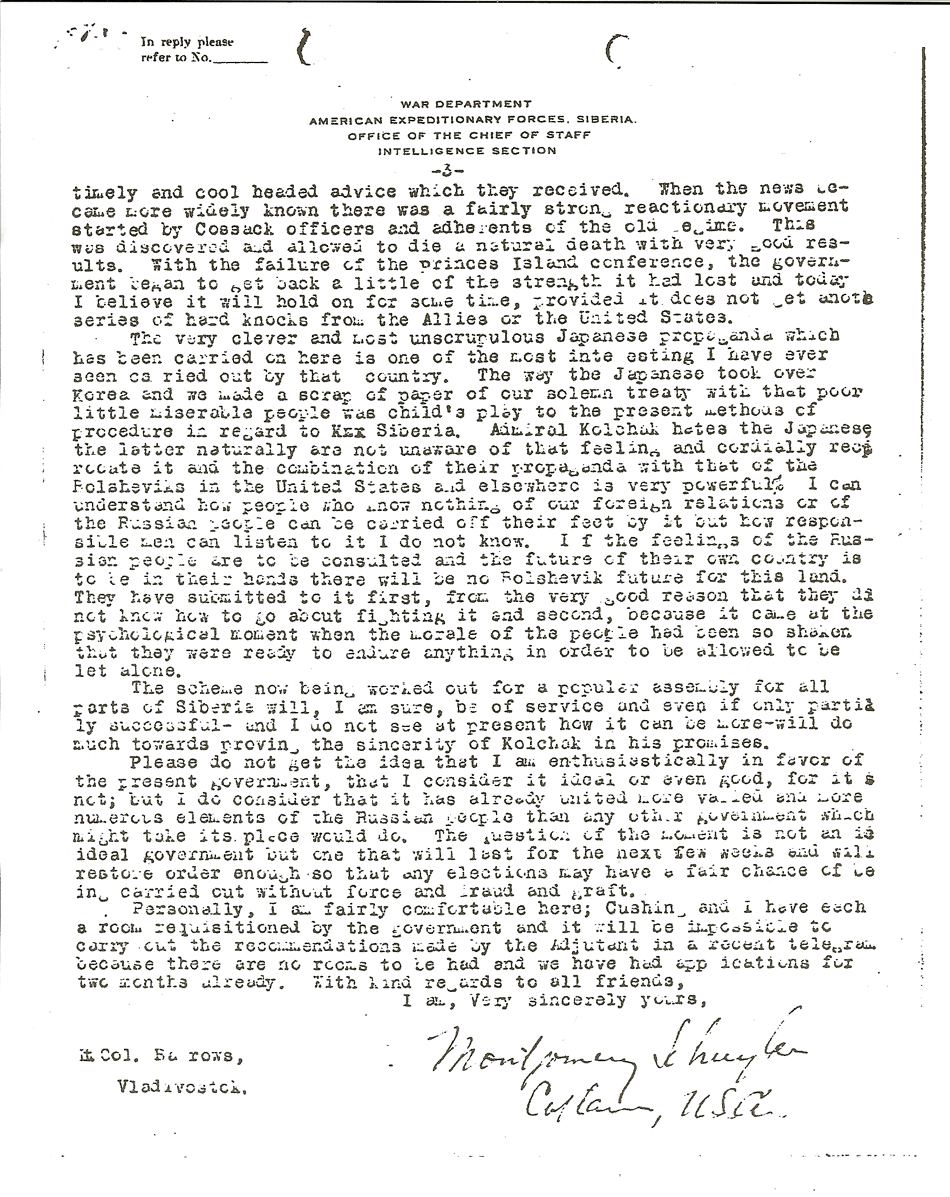
The following Military Intelligence report of March 1, 1919, photographically reproduced below, by U.S. Army Captain Montgomery Schuyler is typical, rather than exceptional, of the accounts of Bolshevik activity which were received in Washington from American diplomatic, commercial, and military observers in Russia in the years 1917-1919. Note the reference in the third paragraph to orders not to interfere in local affairs. President Wilson had grudgingly permitted a few American military personnel to be sent into revolution-torn Russia at Allied insistence, but they were under orders not to help the White Russians or to hinder the Bolsheviks. Wilson made a great pretense of humanitarianism and of concern for freedom and human rights, but the documentary record proves him a fraud.

He justified the U.S. intervention in the First World War on the basis of making the world “safe for democracy,” destroying the “autocratic power” of the German government, and giving the German people “self-determination.” Why, then, did he insist on non-intervention in Russia, when it was quite clear that the Bolsheviks were establishing a regime a thousand times more obnoxious to any humanitarian — or even to a genuine liberal — than that of the German Kaiser? Furthermore, a determined Allied effort in Russia could have put down the Bolsheviks at a relatively small cost in lives, while Wilson’s policy of intervention against Germany resulted in the deaths of three million more combatants, including 115,000 Americans, and a vastly greater destruction of Europe’s cultural heritage, by prolonging the First World War nearly two years.

Every major foreign-policy move Wilson made — taking America into the war, blocking Allied intervention against the Bolsheviks, backing a British mandate over Palestine — forced him to repudiate some lofty principle or other he had proclaimed earlier, but every move also served the purposes of his Jewish advisers and boosters. Woodrow Wilson willingly sacrificed the lives of millions of his own people in order to please these unspeakably evil men and retain their support. (The full text of this report is included in the Appendix at the end of this article.)
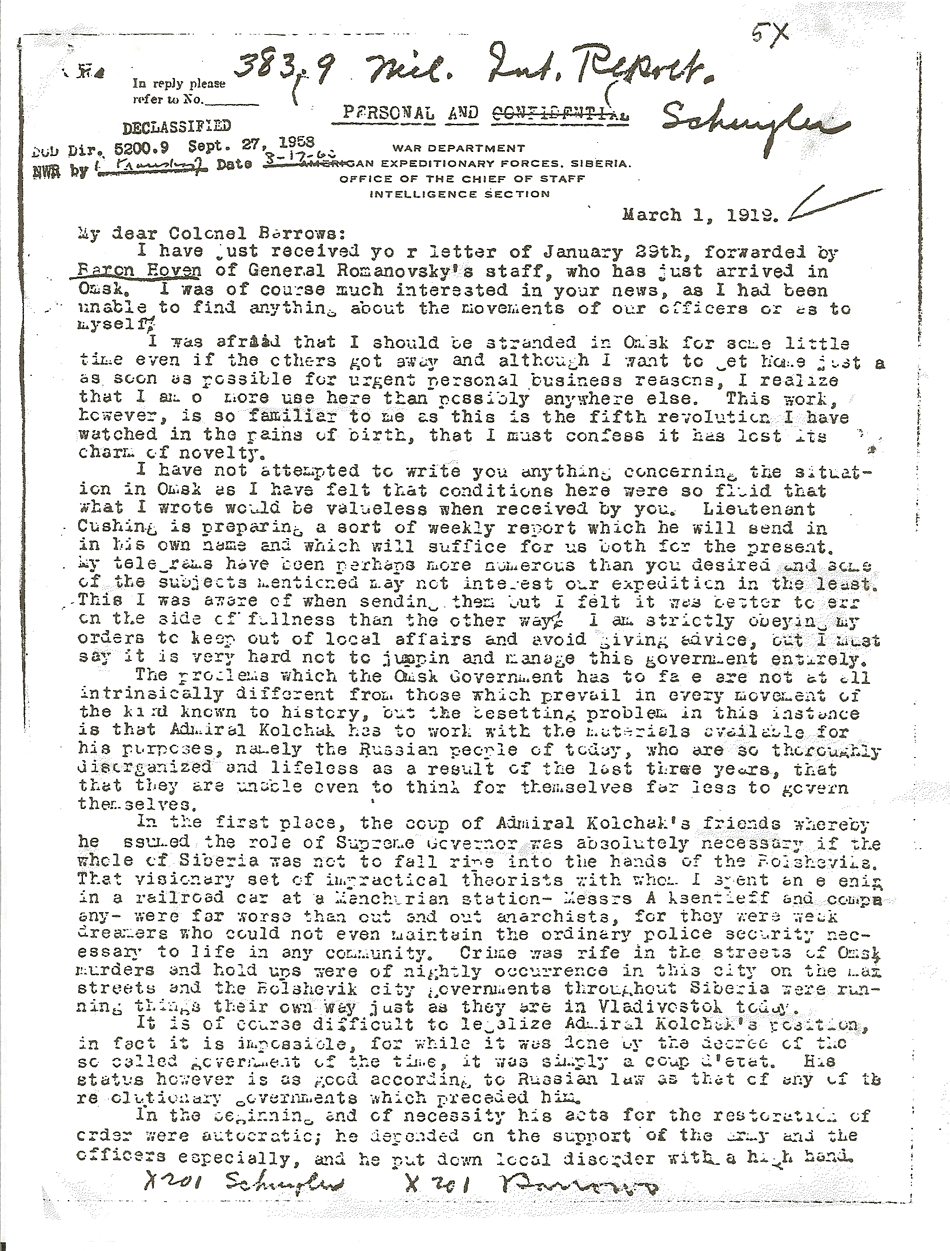
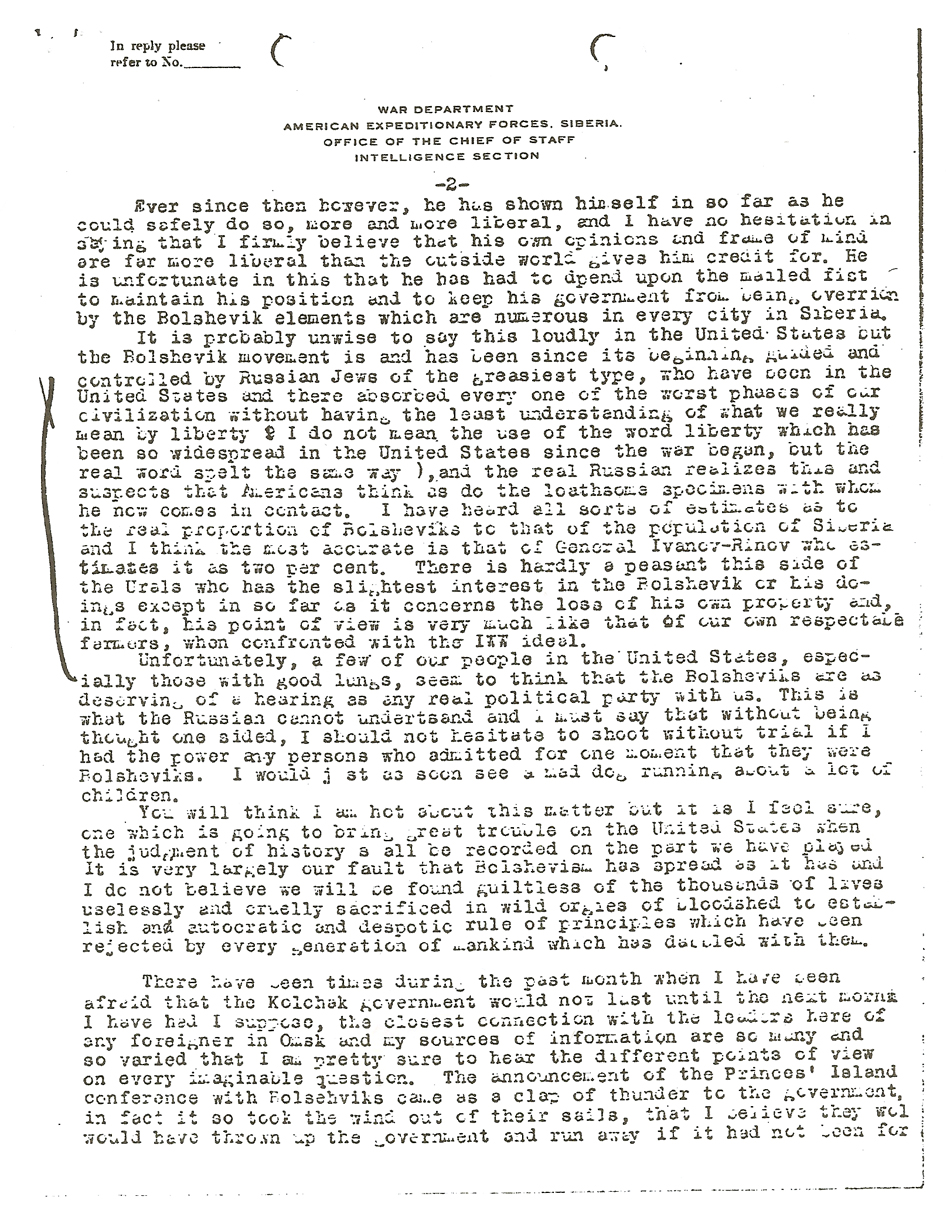
schuylerletterpage1fullschuylerletterpage2fullschuylerletterpage3full

On July 5, 1918, Lansing received a lengthy telegram from the U.S. consul in Vladivostok, John Kenneth Caldwell. It contained a report by an American commercial representative who had traveled throughout Russia during the preceding 13 months, and it described in detail the suffering of the Russian people at the hands of the Bolsheviks whom Wilson was so anxious to protect: “…Bolsheviks in every city I have resided are simply robbing, murdering, and burning. Practically every business is ruined…. Fifty per cent of Soviet government in each town consists of Jews of worst type, many of whom are anarchists…. The great mass of Russian people prefer even German tyranny to Bolshevik terrorism. I suggest careful consideration Ally [sic] intervention….” [9]

On October 5, 1918, a dispatch was sent to Washington from the U.S. Embassy in London. It contained an eyewitness report written by a Dutch diplomat who had recently returned from Petrograd (formerly St. Petersburg, now Leningrad). After describing some of the mass arrests, starvation, and massacres being inflicted on the Russian people by the Bolsheviks, the report concluded: “The foregoing report will indicate the extremely critical nature of the present situation. The danger is now so great that I feel it my duty to call the attention of the British and all other governments to the fact that if an end is not put to Bolshevism in Russia at once the civilization of the whole world will be threatened…. I consider that the immediate suppression of Bolshevism is the greatest issue now before the world, not even excluding the war which is still raging, and unless as above stated Bolshevism is nipped in the bud immediately it is bound to spread in one form or another over Europe and the whole world as it is organized and worked by Jews who have no nationality, and whose one object is to destroy for their own ends the existing order of things. The only manner in which this danger could be averted would be collective action on the part of all powers.” [9]

“Immeasurably important to the Jews that revolution succeed”: that was the most important message from revolution-torn Russia in determining Woodrow Wilson’s policy of non-interference with the Bolsheviks. In his message to Congress calling for war against Germany, Wilson praised the overthrow of Czarist rule by the “great, generous Russian people.” In fact, however, Wilson, in connivance with his Jewish advisers, helped a tiny, alien minority fasten a new tyranny immeasurably worse that Czarism on the Russian people. Above, Lenin, who was at most one-fourth Russian, harangues a communist mob in May 1920. Below him on the steps of the platform are Jewish commissars Trotsky and Kamenev, who were rivals for the number-two spot in the Bolshevik hierarchy.

On November 12, 1918, the American legation in Copenhagen forwarded to Washington a report by an American bank official, R.R. Stevens, the representative in Russia of the National City Bank of New York, who had just finished an extended journey in Bolshevik territory. Stevens repeated what every other observer had stressed: “It is very important to note that from the smallest districts up to the very head the government is composed almost entirely of Jews….” He described the suffering and death of the Russian people under the Bolsheviks, and then he, too, called for intervention: “All humanity cries out against it; all humanity should rise and demand a decent government where every man and all classes should have a right to exist…. The only solution which can be made of the Russian problem is international intervention on humanitarian grounds, backed by whatever military force is required.”

None of this had the least effect on Wilson. He refused to criticize the horror in Russia in any way, and he continued to insist that the Bolsheviks be left free to work their will on the prostrate Russian people without interference from the West, which was exactly the way the Jews wanted things to stay — in Russia, that is. In Palestine, on the other hand, they very much wanted Western intervention, and again Wilson was their compliant tool.

The 12th of Wilson’s Fourteen Points asserted that the “nationalities which are now under Turkish rule should be assured an undoubted security of life and an absolutely unmolested opportunity of autonomous development.” That promise of autonomy was a continuation of the war propaganda begun by the British to win the support of the peoples of the Middle East for the Allied side. It had worked well, causing Arab uprisings against the Turks and delivering much of the eastern Mediterranean area into British hands.

Wilson’s promise meant no more than the earlier British promises, however, in the face of Jewish demands. Arab autonomy was the last thing the Jews wanted. The Zionist leaders at the peace conference did not even want Jewish autonomy, in fact, because that would have left them with many responsibilities they were unwilling to accept — including the responsibility for defending themselves from the Palestinians whose land they wanted.

The Zionist plan was for Turkish rule over Palestine to be replaced by British rule; the Jews would then be given free rein to begin occupying the land and building up all the infrastructure of a Jewish state, while the British would maintain law and order, keep the buses running, deliver the mail, and protect the Jews from the inevitable wrath of the Palestinians. When the Jews had become strong enough, they would take over de jure rule from the British. That was the way Weizmann spelled it out for Lansing and for Lloyd George in Paris. [10]

And that was largely the way things finally came out at the peace conference. To be sure, the Jews did not get quite everything they demanded — but they demanded a great deal. The territory they wanted Britain to administer for them as a future Jewish state included not only all of Palestine, but also a third of Lebanon; the entire East Bank of the Jordan, right up to the outskirts of Amman; and sizable chunks of Egypt and Syria as well.[11] Jehovah, it seems, had promised all of that to them.

When it became clear that the Palestine Mandate would actually comprise only about half of the territory the Jews were claiming, Brandeis was brazen enough to send a telegram to the conference importuning the “Christian nations” to keep their “solemn promise to Israel” by enlarging the Mandate.[12] Until 1922, when the League of Nations formally approved the Palestine Mandate, specifically excluding the East Bank (Transjordan) from the territory covered, the Jews still thought they might get most of the land they coveted.

The Jews also did not approve of an inter-Allied commission of inquiry, the so-called King-Crane Commission, whose task was to determine the wishes of the inhabitants of the proposed Mandate and report back to the peace conference. They urged Wilson to hurry up with the signing of the treaty, before the commission could give its report.

When that report finally was presented, in August 1919, it opposed Jewish aims right down the line. It concluded that subjecting the inhabitants of Palestine “to unlimited Jewish immigration, and to steady financial and social pressure to surrender the land, would be a gross violation of the principle [of self-determination]….”[13] By that time, however, the treaty had been signed at Versailles (on June 28), and Wilson had returned to America to receive the cheers of the crowds, his crusade for the right of “self-determination for all peoples” conveniently forgotten.

A great deal could be written about events in Palestine subsequent to the signing of the Versailles Treaty: about Jewish immigration and the taking over of the land, about conflict with the Palestinians, and about Jewish chicanery in dealing with their British protectors. This is not a history of Zionism per se, however, but an account of the way in which the Jews, using Zionism as a unifying and organizing principle, gained control of the government of the United States and then used that control to advance their own ends, to the incalculably great detriment of the American and European peoples. Therefore, events in Palestine will be sketched only in broad outline, and the focus will remain on Jewish activity in America and Europe.

As was demonstrated in the first article of this series, the Jews built their bridgehead in America during the 35 years from about 1880 to the First World War, carrying out during the latter half of that period a specific plan to gain and use political influence in the United States. Their plan involved three elements: a general buildup of numbers, financial resources, and media control; finding a proper tool through which they could work their will; and then bringing all of their strength into play at a decisive moment — namely, at the peace conference following the long-anticipated war between the goyim.

The plan, as far as it went, worked quite well. Not only did the Jews get most of what they wanted at the peace conference, but the strength they had developed in finance and the media could now be used for other purposes. Woodrow Wilson was of no use to them after the peace conference (he suffered a complete breakdown in September 1919, which left him an invalid until his death in 1924), but the singularly vulgar form of democracy which had emerged in America by the first part of this century was ideally suited for bringing to the fore new men whom they could control as completely as they had controlled Wilson.

From National Vanguard magazine (March, 1983), transcribed by Michael Olanich

Notes

1. For the context of Herzl’s announcement, see National Vanguard No. 91, p. 12.

2. My Diary at the Conference of Paris, David Hunter Miller (New York, 1924), v. IV, pp. 254-267. A more recent work, covering not only the Paris Peace Conference but the entire period from 1914 to 1948, is The Palestine Diary, Robert John and Sami Hadawi (New York, 1970). This latter work is probably the most valuable single source available in English today on the Zionist intrigues which led to the dispossession of the Palestinian people and the formation of the state of Israel.

3. Bernard M. Baruch (1870-1965), of mixed Sephardic and Ashkenazic ancestry, began his career as a runner for a Wall Street broker. Then he began peddling stocks on the side and giving advice on buying and selling. He bought a seat on the New York Stock Exchange in 1898, and by 1910 he had amassed an enormous fortune through speculation. He always seemed to know before anyone else when a stock was ready to soar or plunge. President Wilson appointed him chairman of the War Industries Board in 1918, making him virtually an economic czar of the United States during the last phase of the First World War.

Serving under Baruch on the War Industries Board was another self-made Jewish stock speculator, Eugene Meyer, later to become owner of the Washington Post (and father of the present owner, Katherine Meyer Graham).

4. Challenging Years, Stephen S. Wise (New York, 1949), p. 197. Wise (1874-1949), who was born in Hungary, came to the United States in 1875, in the vanguard of the Jewish invasion force. He became the leader of one of the largest Jewish congregations in New York City and exerted great influence in the Democratic Party political machine there. He attended the second Zionist Congress in 1898 in Basle, and in the same year he became one of the principal founders of the Zionist Organization of America. During the First World War he organized the American Jewish Congress and became its first president. Later he promoted the World Jewish Congress and was president of that organization also.

Although Wise shared with Brandeis and Baruch the task of guiding Wilson during the post-World War I peace negotiations, his greatest and most destructive role came during the presidency of Franklin Roosevelt. From 1933 until his death he exerted a powerful influence over the policies of the U.S. government, and he was one of the foremost promoters of the anti-German propaganda which led the United States into the Second World War.

5. In Wilson’s address to the Congress on April 2, 1917, calling for a U.S. declaration of war against Germany, he had referred to the recent outbreak of revolution in Russia thus:

“Does not every American feel that assurance has been added to our hope for the future peace of the world by the wonderful and heartening [sic!] things that have been happening within the last few weeks in Russia? Russia was known by those who knew it best to have been always in fact democratic at heart, in all the vital habits of her thought, in all the intimate relationships of her people that spoke their natural instinct, their habitual attitude toward life. The autocracy that crowned the summit of her political structure, long as it had stood and terrible as was the reality of its power, was not in fact Russian in origin, character, or purpose; and now it has been shaken off and the great, generous Russian people have been added in all their naive majesty and might to the forces that are fighting for freedom in the world, for justice, and for peace. Here is a fit partner for a League of Honor.”

The effect of the revolution was, of course, exactly opposite to that predicted by Wilson: instead of adding Russia to the Allied forces (Czarist Russia was already one of the Allies), it took Russia out of the war.

6.  Papers Relating to the Foreign Relations of the United States, 1918, Russia (Washington, 1931) v. 1, p. 7.

7. Ibid., v. I, p. 518.

8. Ibid., v. II, pp. 239-241.

9. Ibid., v. I, pp. 674-679.

10. Memoirs of the Peace Conference, David Lloyd George (New Haven, 1939), p. 748.

11. Palestine Diary, v. I, pp. 123-125.

12. Ibid., pp. 142-143.

13. Ibid., p. 139.

Appendix

Capt. Schuyler’s letter:

[handwritten across top of page:] 383.9 Mil. Int. Report, Schuyler

In reply please
refer to No _______

[stamped]

DECLASSIFIED
DoD Dlr. 5200.9 Sept . 27, 1958
NWR by [signature] Date 8-17-60

PERSONAL AND CONFIDENTIAL

WAR DEPARTMENT
AMERICAN EXPEDITIONARY FORCES. SIBERIA .
OFFICE OF THE CHIEF OF STAFF
INTELLIGENCE SECTION

My dear Colonel Barrows :                                                                                                                                                             March 1, 1919.

I have just received your letter of January 29th, forwarded by Baron Hoven of General Romanovsky’s staff, who has just arrived in Omsk, I was of course much interested in your news, as I had been unable to find anything about the movements of our officers or as to myself.

I was afraid that I should be stranded in Omsk for some little time even if the others got away and although I want to get home just as soon as possible for urgent personal business reasons, I realize that I am of more use here than possibly anywhere else. This work, however, is so familiar to me as this is the fifth revolution I have watched in the pains of birth, that I must confess it has lost its charm of novelty.

I have not attempted to write you anything concerning the situation here in Omsk as I have felt that conditions here were so fluid that  what I wrote would be valueless when received by you. Lieutenant Cushing is preparing a sort of weekly report which he will send in in his own name and which will suffice for us both for the present. My telegrams have been perhaps more numerous than you desired and some of the subjects mentioned may not interest our expedition in the least.  This I was aware of when sending them, but I felt it was better to err on the side of fullness than the other way. I am strictly obeying my orders to keep out of local affairs and avoid giving advice, but I must say that it is very hard not to jump in and manage this government entirely.

The problems which the Omsk government has to face are not at all intrinsically different from those which prevail in every movement of the kind known to history, but the besetting problem in this instance is that Admiral Kolchak has to work with the materials available for his purposes, namely the Russian people of today, who are so thoroughly disorganized and lifeless as a result of the last three years , that they are unable even to think for themselves far less govern themselves.

In the first place, the coup of Admiral Kolchak’s friends whereby he assumed the role of Supreme Governor was absolutely necessary if the whole of Siberia was not to fall ripe into the hands of the Bolsheviks. That visionary set of impractical theorists with whom I spent an evening in a railroad car at a Manchurian station — Messrs Avksentiev [former Minister of Interior in the Kerensky Cabinet] and company — were far worse than out and out anarchists, for they were weak dreamers who could not even maintain the ordinary police security necessary to life in any community. Crime was rife in the streets of Omsk, murders and hold ups were of nightly occurrence in this city on the [?] streets and the Bolshevik city governments throughout Siberia were running things their own way just as they are in Vladivostok today.

It is of course difficult to legalize Admiral Kolchak’s position, in fact it is impossible, for while it was done by the decree of the so called government of the time, it was simply a coup d’etat. His status however is as good according to Russian law as that of any of the revolutionary governments which preceded him.

In the beginning and of necessity his acts for the restoration of order were autocratic; he depended on the support of the army and the officers especially, and he put down local disorder with a high hand…

[page 2]

Ever since then however, he has shown himself in so far as he could safely do so, more and more liberal, and I have no hesitation is saying that I firmly believe that his own opinions and frame of mind are far more liberal than the outside world gives him credit for. He is unfortunate in this that he has had to depend upon the mailed fist to maintain his position and to keep his government from being overridden by the Bolshevik elements which are numerous in every city in Siberia.

It is probably unwise to say this loudly in the United, States, but the Bolshevik movement is and has been since its beginning guided and controlled by Russian Jews of the greasiest type, who have been in the United States and there absorbed every one of the worst phases of our civilization without having the least understanding of what we really mean by liberty. (I do not mean the use of the word liberty which has been so widespread in the United States since the war began, but the real word spelt the same way), and the real Russian realizes this and suspects that Americans think as do the loathsome specimens with whom he now comes in contact. I have heard all sorts of estimates as to the real proportion of Bolsheviks to that of the population of Siberia and I think the most accurate is that of General Ivanov-Rinov who estimates it as two per cent. There is hardly a peasant this side of the Urals who has the slightest interest in the Bolshevik or his doings except in so far as it concerns the loss of his own property and, in fact, his point of view is very much like that of our own respectable farmers, when confronted with the I [?] ideal.

Unfortunately, a few of our people in the United States, especially those with good lungs, seem to think that the Bolsheviks are as deserving of a hearing as any real political party with us. This is what the Russian cannot understand and I must say that without being thought one sided, I should not hesitate to shoot without trial if I had the power, any persons who admitted for one moment that they were Bolsheviks. I would just as soon see a mad dog running about a lot of children.

You will think I am hot about this matter but it is, I feel sure, one which is going to bring great trouble on the United States when the judgment of history shall be recorded on the part we have played . It is very largely our fault that Bolshevism has spread as it has and I do not believe we will be found guiltless of the thousands of lives uselessly and cruelly sacrificed in wild orgies of bloodshed to establish an autocratic and despotic rule of principles which have been rejected by every generation of mankind which has dabbled with them.

There have been times during the past month when I have been  afraid that the Kolchak government would not last until the next morning. I have had I suspect, the closest connection with the leaders here of any foreigner in Omsk and my sources of information are so many and so varied that I am pretty sure to hear the different points of view on every imaginable question. The announcement of the Princes’s Island conference with Bolsheviks came as a clap of thunder to the government, in fact it so took the wind out of their sails, that I believe they would have thrown up the government and run away if it had not been for [page 3] timely and cool headed advice which they received. Then the news became more widely known there was a fairly strong reactionary movement started by Cossack officers and adherents of the old regime. This was discovered and allowed to die a natural death with very good results. With the failure of the Princes Island conference, the government began to get back a little of the strength it had lost and today I believe it will hold on for some time,. provided it does not get another series of hard knocks from the Allies or the United States.

The very clever and most unscrupulous Japanese propaganda which has been carried on here is one of the most interesting I have ever seen carried out by that country. The way the Japanese took over Korea and we made a scrap of paper of our solemn treaty with that poor little miserable people was child’s play to the present methods of procedure in regard to K_x Siberia. Admiral Kolchak hates the Japanese, the latter naturally are not unaware of that feeling and cordially reciprocate it and the combination of their propaganda with that of the Bolsheviks in the United States and elsewhere is very powerful. I can understand how people who know nothing of our foreign relations or of the Russian people can be carried off their feet by it, but how responsible men can listen to it I do not know. If the feelings of the Russian people are to be consulted and the future of their own country is to be in their hands, there will be no Bolshevik future for this land. They have submitted to it first, from the very good reason that they did not know how to go about fighting it and second, because it came at the psychological moment when the morale of the people had been so shaken that they were ready to endure anything in order to be allowed to be let alone.

The scheme now being worked out for a popular assembly for all parts of Siberia will, I am sure, be of service and even if only partially successful — and I do not see at present how it can be more — will do much towards proving the sincerity of Kolchak in his promises.

Please do not get the idea that I am enthusiastically in favor of the present government, that I consider it ideal or even good, for it is not; but I do consider that it has already united more varied and more numerous elements of the Russian people than any other government which might take its place would do. The question of the moment is not an ideal government but one that will last for the next few weeks and will restore order enough so that any elections may have a fair chance of being carried out without force and fraud and graft.

Personally, I am fairly comfortable here; Cushing and I have each a room requisitioned by the government and it will be impossible to carry out the recommendations made by the Adjutant in a recent telegram because there are no rooms to be had and we have had applications for two months already. With kind regards to all friends,

I am, Very sincerely yours,

[signed:]
Montgomery Schuyler

Captain, USA

Lt. Col. Barrows,  Vladivostok

Source: http://nationalvanguard.org/2014/06/background-to-treason-part-2/


Background to Treason, Part 2:Zionism, the Paris Peace Conference, & the Bolshevik Revolution

Background%20to%20Treason%2C%20Part%202%3AZionism%2C%20the%20Paris%20Peace%20Conference%2C%20and%23038%3B%20the%20Bolshevik%20Revolution

Share

  • Gab
  • Zionism, the Paris Peace Conference, the Bolshevik Revolution
    &body=%0D%0A%0D%0A%0D%0A%0D%0A%0D%0A%0D%0Ahttps://counter-currents.com/2014/07/background-to-treason-2/%0D%0A%0D%0A%0D%0A%0D%0A">

Enjoyed this article?

Be the first to leave a tip in the jar!

Instant Echeck GreenPay™

Related

  • The Forgotten Sin: America’s Treatment of Germans

  • Lewis Strauss Did Nothing Wrong:

  • America’s Century of Humiliation has Begun

  • Dispatches from the Fallout Shelter

  • The Rest Is Silence: Heidegger’s Quietism

  • Against Conspiracism Part 1

  • Not Just Evil But Stupid

  • Twilight of the Meme States

Tags

American foreign policyBalfour DeclarationBernard BaruchBolshevik RevolutionDavid Lloyd GeorgeIsraelPalestinethe Jewish questionTheodor HerzlWilliam PierceWoodrow WilsonWorld War IZionism

Writer of June

(4 votes) David M. Zsutty

Article of June

Why White Advocates Should Avoid “Based Blacks” by Dani Vypont 4 votes
    • Replacement Migration & Hypergamy

      F. Roger Devlin

      22

    • Kurds of a Feather Flock Together:
      Europe’s “Racist” Parakeet Tweet-Storm

      Steven Tucker

      1

    • Elevator Pitch to a Billionaire
      Money, Money, Money

      Ondrej Mann

      1

    • All Hail Rhodesia

      Spencer J. Quinn

      3

    • Nationalism This Week
      Disenfranchisement

      Greg Johnson

      29

    • The Murder of Ann Widdecombe

      Lipton Matthews

      9

    • Disclosure Day
      Please, Keep It Undisclosed

      Francisco Albanese

      11

    • Remembering Carl Schmitt
      July 11, 1888–April 7, 1985

      Greg Johnson

      1

    • Editor’s Update
      Fundraiser Update & New Books

      Greg Johnson

      1

    • Third Homeland Institute Poll on the Great Replacement

      David M. Zsutty

      12

    • The Bitter End of Western Metaphysics:
      Heidegger on Nietzsche, Part Five (Conclusion)

      Collin Cleary

      9

    • Fraudulent Black British History

      Mark Gullick

      7

    • A White Nationalist Response to Scott Greer

      Dave Chambers

      25

    • The Miami Mall Incident:
      Black Youths or Black Extraterrestrials?

      Dominic Fox

      6

    • The Theology of Three Populisms

      Morris van de Camp

      2

    • The Dangers of Skilled Immigration

      Lipton Matthews

      25

    • The Brotherhood of the Bell

      Beau Albrecht

      16

    • Endeavor: What Rome Means to Me

      Endeavour

    • When the Family Becomes Predation

      Jayant Bhandari

      5

    • RICU: The Gentle Art of Persuasion

      Mark Gullick

      7

    • Mind of Darkness:
      A Review of Lipton Matthews’s Busting African Delusions

      Derek Stark

      12

    • Remembering Revilo Oliver
      July 7, 1908–August 20, 1994

      Greg Johnson

      2

    • Some Advantages of Irish Nationalism

      Greg Johnson

      30

    • America at 250 from the National Cathedral

      Gabriel Anderson

      18

    • Why Not Stop All the Clocks?
      Modern Conservatism’s Flagging Commitment Towards Turning Back Time

      Steven Tucker

      3

    • Remembering Jean Raspail
      July 5, 1925–June 13, 2020

      Greg Johnson

      2

    • Editor’s Update
      Fundraiser Update & New Books

      Greg Johnson

    • The Ethnic Reality of FIFA 2026

      Samuel Valleus

      13

    • Nationalism This Week
      Tucker’s New Party

      Greg Johnson

      30

    • Ethiopia Against Italy
      How the Italo-Ethiopian Wars were part of the conflict between Eastern & Western Christiandom

      Morris van de Camp

    • Please Vote in Our Writer & Article of the Month Poll

      Greg Johnson

    • Available for Pre-Order!
      F. Roger Devlin’s Not Hooking Up

      F. Roger Devlin

    • Kolberg: The Last Nazi (or Prussian?) Film

      Steven Clark

      2

    • America 250 & The Fate of Empires

      Richard Houck

      20

    • Available for Pre-Order!
      Greg Johnson’s The Battle of the Books

      Greg Johnson

    • Why All the Silence About Blacks Being Kicked Out of South Africa?
      Because It’s Other Blacks That Are Doing It.

      Steven Tucker

      10

    • Zelensky, the Jewish Conspiracy Narrative, & the Demographic Replacement of Ukraine:
      A Critical Analysis of a Disinformation Discourse within the European Identitarian Right

      Luís Graça

      30

    • The Original Congressional Debate on Birthright Citizenship

      Alex Graham

      13

    • America at 250
      Unmanifested Destiny  

      David M. Zsutty

      32

    • The Normies are Waking Up:
      The Alliance for Responsible Citizenship Conference, London 2026

      Lipton Matthews

      2

    • Ethnic Vigilantism: The Movie

      Mark Gullick

      15

    • Lothrop Stoddard’s The Revolt against Civilization

      Kevin MacDonald

      2

    • David Zsutty on Political Organizing

      David M. Zsutty

    • PC-Incompatible Gaming:
      Plantation Simulator and the “Problem” of Racist Video Games

      Steven Tucker

      3

    • Remembering Lothrop Stoddard
      June 29, 1883–May 1, 1950

      Greg Johnson

      1

    • Editor’s Update
      Fundraiser Update & Upcoming Projects

      Greg Johnson

    • Nationalism This Week
      Metapolitics Wins:
      Scott Greer’s Whitepill

      Greg Johnson

      8

    • Remembering Colin Wilson
      June 26, 1931–December 5, 2013

      Greg Johnson

      3

    • Kevin Deanna on Political Organizing

      Kevin Deanna

      1

    • The Bitter End of Western Metaphysics:
      Heidegger on Nietzsche, Part Four

      Collin Cleary

      6

    • Connor McDowell

      Replacement Migration and Hypergamy

      I’ve seen this OKCupid miscegenation argument before, and while much of my evidence is anecdotal, I...

    • Dominic Fox

      Disenfranchisement

      Even a real community will consist mostly of people who are only somewhat similar in character/...

    • Dani Vypont

      Replacement Migration and Hypergamy

      @JamesSunderland With regard to one of your earlier posts, I did some research, and it is ...

    • Dani Vypont

      Replacement Migration and Hypergamy

      What parts of the United States would you say have the most and least interracial relationships?It...

    • Dave Chambers

      All Hail Rhodesia

      Rhodesia is an inspiration to all of us whose families have had to flee the neighborhoods and...

    • CC reader

      Disclosure Day

      Duel was a very good movie, and it was made for tv. Good suspense, camera work, musical score, and...

    • WU

      Replacement Migration and Hypergamy

      I visited Norway 3 years ago, and the experience was so strange it is worth relating. In Bergen,...

    • Dave Chambers

      Replacement Migration and Hypergamy

      What parts of the United States would you say have the most and least interracial relationships?

    • CC reader

      Third Homeland Institute Poll on the Great Replacement

      If a white ethnostate is carved out, the 67% who voted against returning to 60% white or higher...

    • Zarathustra

      Replacement Migration and Hypergamy

      MTV and Hollywood are partly to blame for this.

    • Dani Vypont

      Replacement Migration and Hypergamy

      I once had a Norwegian nationalist ask me to tell him the degree of mixing between White women &...

    • James Sunderland

      Replacement Migration and Hypergamy

      With regard to one of your earlier posts, I did some research, and it is possible to determine the...

    • Glide Ratio 0:1

      Replacement Migration and Hypergamy

      Maybe the NSDAP were correct about Persians (you could be Arab?) being Aryan. You seem to suffer...

    • Fionn McCool

      Replacement Migration and Hypergamy

      Dani, for what it’s worth, your 92% figure refers to biracial children born to black fathers and...

    • Dani Vypont

      Replacement Migration and Hypergamy

      Both of those sources rely on marriage data. The first one is titled “Intermarriage in America Post-...

    • Fionn McCool

      Replacement Migration and Hypergamy

      Most people are the most attracted to individuals of their own race. Regardless, the broader...

    • James Sunderland

      Replacement Migration and Hypergamy

      Here is analysis conducted using U.S. Census Data. You can't get better than this: https://www....

    • Hairy Iranian Dude

      Replacement Migration and Hypergamy

      I love Norway. It’s a real country (used to be?). I was there for six days in 2018: Oslo and Bergen...

    • Dani Vypont

      Replacement Migration and Hypergamy

      In the U.S., white woman have the lowest rate of miscegenation across all intersections of race and...

    • Glide Ratio 0:1

      Replacement Migration and Hypergamy

      This is one hundred percent my observations moving from England to the USA. White American females...

    • Earth Day Special

      John Morgan

      12

    • A Robertson Roundup
      Remembering Wilmot Robertson
      (April 16, 1915 – July 8, 2005)

      Margot Metroland

      13

    • The Paranoid Style in White Nationalism

      Greg Johnson

      30

    • Join the Dance!

      Andrew Hamilton

      1

    • We Can’t Save the Earth Without Reducing African Birth Rates

      James Dunphy

      36

    • “I’m Not a Conspiracy Theorist, but . . .”:
      Jeffrey Epstein’s Death Gives New Life to “Conspiracy Theories”

      Greg Johnson

      22

    • Sylvia Plath: Stasis in Darkness

      Vic Olvir

      17

    • Vanguardism, Vantardism, & Mainstreaming

      Greg Johnson

      80

    • Aviation, Geography, & Race

      Charles Lindbergh

      3

    • Some Thoughts on Yule

      Collin Cleary

      4

    • Living in Truth:
      A Yuletide Homily

      Jef Costello

      7

    • John Kennedy Toole’s A Confederacy of Dunces

      Greg Johnson

      20

    • On Aleksandr Solzhenitsyn’s Warning to the West

      Spencer J. Quinn

      7

    • Elitism, British Modernism, & Wyndham Lewis

      Jonathan Bowden

      6

    • Philip K. Dick’s Do Androids Dream of Electric Sheep? as Anti-Semitic/Christian-Gnostic Allegory

      Greg Johnson

      20

    • “Conspiracy Theory” or Conspiracy?

      Andrew Hamilton

      21

    • Remembering H. P. Lovecraft
      (August 20, 1890–March 15, 1937)

      Greg Johnson

      3

    • Who Are We?
      Nordics, Aryans, & Whites

      Greg Johnson

      71

    • Remembering William Gayley Simpson
      (July 23, 1892–December 31, 1990)
      A Pleasant Afternoon with Harriet & Bill Simpson

      Margot Metroland

      18

    • Here are the Young Men
      Remembering Ian Curtis
      (July 15, 1956–May 18, 1980)

      Mark Gullick

      18

    • Percy Grainger
      Artist of the Right

      Alex Graham

      7

    • Remembering Revilo Oliver
      (July 7, 1908–August 20, 1994)

      Greg Johnson

      18

    • The Meaning of July 4th for the White Man

      Gregory Hood

      13

    • The Front National’s Evolution

      Bruno Mégret

    • Merwin K. Hart
      Forgotten American Hero & Man of the Right

      Morris van de Camp

      10

    • George Orwell’s Nineteen Eighty-Four

      Jonathan Bowden

      8

    • Carleton S. Coon
      Scientist & Reluctant White Advocate

      Morris van de Camp

      4

    • The Kwanzaa Absurdity Will Be Dwarfed by Juneteenth

      Robert Hampton

      12

    • Stravinsky

      Alex Graham

      7

    • Like the Roman:
      Remembering Enoch Powell (1912-1998)

      Mark Gullick

      23

    • Exclusive Interview with Karel Veliky:
      The Final Chapter in the Film Series! Part II

      Ondrej Mann

      2

    • Exclusive Interview with Karel Veliky:
      The Final Chapter in the Film Series! Part I

      Ondrej Mann

      2

    • Nietzsche & Race

      Mark Gullick

    • The Crisis of Chinese Technology Thieves

      Morris van de Camp

      1

    • The Zodiac Killer

      Mark Gullick

      12

    • José Pedro Zúquete’s The Identitarians

      Greg Johnson

      3

    • Berlin: City of Stones

      Spencer J. Quinn

      6

    • Headbanging Lite

      Mark Gullick

      5

    • The Russians are Coming/The Russians are Coming

      Steven Clark

      2

    • The Cruelty of Kindness

      Morris van de Camp

      11

    • Jonathan Bowden’s Deliverance
      Part 7

      Jonathan Bowden

    • Lothrop Stoddard’s The Revolt Against Civilization

      Spencer J. Quinn

      15

    • About Film “From the Right”

      Karel Veliky

    • The 1970s: The Golden Age of Hijacking

      Morris van de Camp

      21

    • Jonathan Bowden’s Deliverance
      Part 6

      Jonathan Bowden

    • Do You Want to Play a Game?

      Mark Gullick

      1

    • Sexually Incontinent on the Indian Subcontinent:
      Who Rapes More Animals, Indians or Pakistanis? The Battle Continues!

      Steven Tucker

      3

    • Neo-Fascism in Film
      Part 5

      Karel Veliky

      15

    • The Game of Tarot

      Mark Gullick

      2

    • Institutions Cannot Be Transplanted

      Jayant Bhandari

      5

    • Jonathan Bowden’s Deliverance
      Part 5

      Jonathan Bowden

    • Crosstown Traffic:
      Jimi Hendrix & The Post-War Rock ‘N’ Roll Revolution

      Mark Gullick

      1

    • Slaves from the North:
      Finns & Karelians in the East European Slave Trade, 900–1600

      Lipton Matthews

      14

    • Neo-Fascism in Film
      Part 4

      Karel Veliky

      2

    • David Lean’s A Passage to India

      Spencer J. Quinn

      1

    • Elites are Essential to Development

      Lipton Matthews

      7

    • Jonathan Bowden’s Deliverance
      Part 4

      Jonathan Bowden

    • Neo-Fascism in Film
      Part 3

      Karel Veliky

      6

    • E. M. Forster’s A Passage to India & the Indian Mentality

      Spencer J. Quinn

      25

    • Jonathan Bowden’s Deliverance
      Part 3

      Jonathan Bowden

    • András László
    • Derek Hawthorne
    • Beau Albrecht
    • Alain de Benoist
    • Kerry Bolton
    • Jonathan Bowden
    • Collin Cleary
    • Jef Costello
    • Savitri Devi
    • Julius Evola
    • Jim Goad
    • Gregory Hood
    • Juleigh Howard-Hobson
    • Greg Johnson
    • Charles Krafft
    • Anthony M. Ludovici
    • Trevor Lynch
    • H. L. Mencken
    • J. A. Nicholl
    • James J. O’Meara
    • Christopher Pankhurst
    • Tito Perdue
    • Michael Polignano
    • Spencer J. Quinn
    • Fenek Solère
    • Irmin Vinson
    • Leo Yankevich
    • Francis Parker Yockey
    • Multiple authors
  • Editor-in-Chief

    • Greg Johnson, Ph.D.

    Featured Writers

    • Beau Albrecht
    • Gunnar Alfredsson
    • Collin Cleary, Ph.D.
    • Jef Costello
    • Morris V. de Camp
    • F. Roger Devlin, Ph.D.
    • Stephen Paul Foster, Ph.D.
    • Jim Goad
    • Alex Graham
    • Mark Gullick, Ph.D.
    • Greg Johnson, Ph.D.
    • Travis LeBlanc
    • Trevor Lynch
    • Margot Metroland
    • James J. O’Meara
    • Angelo Plume
    • Spencer J. Quinn
    • Fred Reed
    • Clarissa Schnabel
    • Michael Walker
    • David M. Zsutty

    Frequent Writers

    • Asier Abadroa
    • Aquilonius
    • Alain de Benoist
    • Kerry Bolton, Ph.D.
    • Dave Chambers
    • Steven Clark
    • James Dunphy
    • Endeavour
    • Richard Houck
    • Jason Kessler
    • Titus Livius
    • Ondrej Mann
    • Lipton Matthews
    • Mark Mazari
    • John Morgan
    • Jaroslav Ostrogniew
    • Kathryn S.
    • Christian Secor
    • Anne Wilson Smith
    • Thomas Steuben
    • William De Vere
    • Kenneth Vinther
    • Max West

    Classic Authors

    • Maurice Bardèche
    • Jonathan Bowden
    • Julius Evola
    • Guillaume Faye
    • Ernst Jünger
    • Kevin MacDonald, Ph.D.
    • D. H. Lawrence
    • Charles Lindbergh
    • Jack London
    • H. P. Lovecraft
    • Anthony M. Ludovici
    • Sir Oswald Mosley
    • National Vanguard
    • Friedrich Nietzsche
    • Revilo Oliver
    • William Pierce
    • Ezra Pound
    • Saint-Loup
    • Savitri Devi
    • Carl Schmitt
    • Miguel Serrano
    • Oswald Spengler
    • P. R. Stephensen
    • Jean Thiriart
    • John Tyndall
    • Dominique Venner
    • Leo Yankevich
    • Francis Parker Yockey

    Other Authors

    • Howe Abbott-Hiss
    • Michael Bell
    • Giles Corey
    • Jack Donovan
    • Richardo Duchesne, Ph.D.
    • Emile Durand
    • Guillaume Durocher
    • Mark Dyal
    • Tom Goodroch
    • Andrew Hamilton
    • Robert Hampton
    • Huntley Haverstock
    • Derek Hawthorne
    • Gregory Hood
    • Juleigh Howard-Hobson
    • Alexander Jacob
    • Ruuben Kaalep
    • Tobias Langdon
    • Julian Langness
    • Patrick Le Brun
    • G A Malvicini
    • John Michael McCloughlin
    • Millennial Woes
    • Michael O’Meara
    • Christopher Pankhurst
    • Michael Polignano
    • J. J. Przybylski
    • Quintilian
    • Edouard Rix
    • C. B. Robertson
    • C. F. Robinson
    • Herve Ryssen
    • Alan Smithee
    • Fenek Solere
    • Ann Sterzinger
    • Robert Steuckers
    • Tomislav Sunic
    • Donald Thoresen
    • Marian Van Court
    • Irmin Vinson
    • Book Reviews
    • Movie Reviews
    • TV Reviews
    • Music Reviews
    • Art Criticism
    • Graphic Novels & Comics
    • Video Game Reviews
    • Fiction
    • Poems
    • Interviews
    • Videos
    • English Translations
    • Other Languages
      • Arabic
      • Bulgarian
      • Croatian
      • Czech
      • Danish
      • Dutch
      • Estonian
      • Finnish
      • French
      • German
      • Greek
      • Hungarian
      • Italian
      • Lithuanian
      • Norwegian
      • Polish
      • Portuguese
      • Romanian
      • Russian
      • Slovak
      • Spanish
      • Swedish
      • Ukrainian
    • Commemorations
    • Why We Write
  • Archives
  • Top 100 Commenters
  • The Looney Bin
Sponsored Links
Europa.com Above Time Coffee Antelope Hill Publishing Paul Waggener IHR-Store Spencer J. Quinn American Renaissance Jim Goad The Occidental Observer
Donate Now Mailing list
Books for sale
  • Not Hooking Up
  • The Battle of the Books
  • The Philosopher Is In
  • Sexual Utopia in Power (Expanded Edition)
  • In Defense of Prejudice
  • Loving Our Own
  • Tyranny & Wisdom
  • To all books
Copyright © 2026 Counter-Currents Publishing, Ltd.

Paywall Access


Please enter your email address.

Lost your password?

Edit your comment

Writer & Article of the Month June 2026

Voting for this month has concluded. Here are the final results!

Top Writers

  • #1 David M. Zsutty 4 votes
  • #2 Mark Gullick 3 votes
  • #3 Morris van de Camp 2 votes
  • #4 Ondrej Mann 2 votes
  • #5 Dani Vypont 2 votes
  • #6 Greg Johnson 2 votes
  • #7 Collin Cleary 1 vote
  • #8 Millennial Woes 1 vote
  • #9 Beau Albrecht 1 vote
  • #10 Dave Chambers 1 vote
  • #11 Steven Tucker 1 vote
  • #12 Jayant Bhandari 1 vote

Top Articles

  • #1 Why White Advocates Should Avoid “Based Blacks” 4 votes
  • #2 Zsutty’s Maximum 3 votes
  • #3 The Murder of Henry Nowak 2 votes
  • #4 Uncivil War 1 vote
  • #5 Liar, Liar, Pants on Fire! 1 vote
  • #6 Small Is Beautiful: The Napoleon of Notting Hill 1 vote
  • #7 Interview with Gerhard Hallstatt of Allerseelen 1 vote
  • #8 Monkeys and Typewriters 1 vote
  • #9 The Remigration Movement Solidifies  1 vote
  • #10 I’m Glad He Failed 1 vote
  • #11 The Killing of Henry Nowak 1 vote
  • #12 Alex Jones’ Endgame: Blueprint for Global Enslavement, Part 4 1 vote
  • #13 China’s Threat to American Security 1 vote
  • #14 Ethnic Vigilantism: The Movie 1 vote
  • #15 The Inferiority Behind Immigrant Superiority 1 vote

Total votes cast: 21