Mean Streets
Posted By Trevor Lynch On In North American New Right | Comments Disabled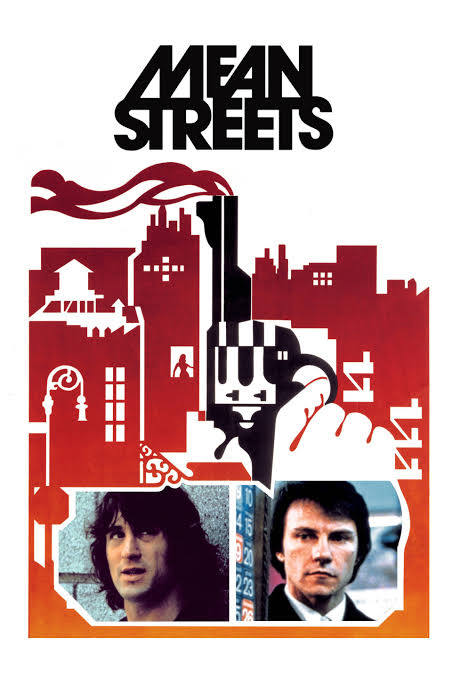 [1]1,188 words
Martin Scorsese is best known for his gangster films: Goodfellas (1990), Casino (1995), Gangs of New York [2](2002), The Departed (2006), The Irishman (2019), and Killers of the Flower Moon [3] (2023). Aside from Gangs of New York, these films unsparingly demythologize organized crime.
Thus Scorsese’s first foray into the mafia genre, 1973’s Mean Streets, is something of a surprise, for its depiction of New York’s Italian mafia may be on a much smaller canvas than Francis Ford Coppola’s The Godfather [4] (1972), but in some ways it is even more romanticized.
The main character is Charlie Cappa (Harvey Keitel), a young Sicilian-American from Manhattan’s Little Italy. Charlie is an intelligent and sensitive young man of 25. He dresses very well. He reads authors like Hemingway, Hardy, and Dreiser. Charlie is also intensely Catholic but in a nearly blasphemous way. When he quotes Jesus, he sounds like he identifies with him a bit too much, like Charlie himself is the savior of mankind. He feels intense guilt because his family is involved in the mafia. But he rejects the Church’s path to redemption: confession and penance. Hence the voiceover that begins the film:
You don’t make up for your sins in church.
You do it in the streets. You do it at home.
The rest is bullshit, and you know it.
Charlie thinks he can redeem himself through acts of kindness, like Jesus ministering to the afflicted.
Charlie’s uncle, Giovanni Cappa (Cesare Danova), is a powerful mafioso who has taken Charlie under his wing. Giovanni’s criminal acts are all off screen. On screen, he is depicted as a consummate old-world gentleman. When a restauranteur who owes Giovanni money is behind on his payments, Giovanni’s advice is not to be impatient but simply to wait. When an impulsive young man shoots someone in order to ingratiate himself with the mob, Giovanni wants nothing to do with him and urges the lad’s father to send him to Miami until the heat dies down. When Charlie mentions that he was present at the shooting, his uncle tells him, “No you weren’t” and wants no further discussion.
Giovanni is also very protective of Charlie’s reputation. Thus he doesn’t approve of Charlie’s association with “Johnny Boy” Civello (Robert Deniro) and his cousin Teresa. The situation is delicate, however, and Giovanni is admirably sensitive to its moral complexities. First of all, Giovanni is “cumpari” with their family. Johnny Boy is even named after him. But he doesn’t want Charlie to associate with them because Johnny Boy is a bit crazy, and Teresa has epilepsy, which to Giovanni connotes madness. Second, Giovanni understands that Charlie feels sorry for them and wants to be nice. He even thinks this is to Charlie’s credit. Giovanni also knows they are neighbors, so Charlie can’t simply snub them. But still, he needs to disengage, because “Honorable men go with honorable men.”
The conflict of the film is that Charlie is already too involved with Johnny Boy and Teresa. Charlie is sleeping with Teresa, and he has vouched for Johnny Boy to Michael Longo, a loan shark. Like Giovanni, Michael is a patient man. But Johnny Boy has borrowed a lot of money from him and has been ducking his payments.
Johnny Boy Civello is a brilliant role for Robert Deniro. It is a compelling portrayal of an infantile parasite and con artist. He likes to gamble, whore around, and drink. But he doesn’t like to work. To fund his lifestyle, he cons people. Charlie has foolishly vouched for him, and when a mafioso vouches for a guy, that opens up a lot of loans. Maybe Charlie hoped Johnny Boy would turn his life around, but he’s basically an addict. He’ll drain everybody who associates with him of their money and reputations. The kinder they are, the more they will be victimized. When Johnny Boy runs out of people to con, he will turn to force. He’s already shown himself to be impulsively violent. Eventually, he’ll end up homeless, in jail, or dead, maybe all three.
Johnny Boy Civello is the first version of a character that turns up in other Scorsese films: Tommy De Vito in Goodfellas and Nicky Santoro in Casino, both played by Joe Pesci. All three characters are obnoxious, impulsive, sociopathic lowlifes who cause trouble for their friends, all of whom are sorely tempted to get rid of them. Both of Pesci’s characters end up getting killed by their long-suffering associates.
Johnny Boy’s most loathsome moment comes near the end of the film, when he blackmails Charlie by threatening to tell Giovanni just how entangled they are. Frankly, Charlie should have whacked him on the spot, with an extra bullet for the sheer moral obscenity.
Unfortunately, Charlie stays by Johnny Boy’s side until Michael the loan shark finally runs out of patience. When Johnny Boy threatens Michael with a gun, we learn that Michael isn’t quite the gentleman Giovanni is. He’s much younger, for one thing, and earlier we are treated to a really petty con, where he steals cash from a couple of kids from the suburbs who want to buy fireworks.
As Charlie and Teresa try to drive Johnny Boy out of town, Michael pulls alongside, and a gunman sprays their car with bullets. Johnny Boy is hit in the neck, Charlie in the arm. Teresa is injured when the car crashes. All three survive, though, and Johnny Boy scurries like a rat into an alleyway to an unknown fate. Things would be a lot simpler for everyone if he bled out amid the trash cans.
Charlie will clearly have some explaining to do to his uncle Giovanni. Charlie is lucky that his uncle is a patient man. Still, Charlie has created a beef between Giovanni and Michael Longo that may prove very costly to all parties, all because he did not follow his uncle’s advice. Let’s hope Charlie learns a lesson from this. I guess Scorsese’s message is that the mafia would be a nice gentlemanly business if you could just stay away from the impulsive psychotic lowlifes.
Mean Streets has a deeply conservative message. The authority figures are right about everything. Uncle Giovanni was right about not associating with Johnny Boy and Teresa. The church is right about keeping redemption within its walls, not in the streets. Charlie’s mistakes spring from his grandiose secularized Christianity. He’s a libtard, in short.
Charlie, Teresa, and Charlie’s friend Tony all have “first-generation college student” auras. They have inflated egos, identity crises, and are deaf to the wisdom of their elders.
Tony, like Charlie, has an uncle in the mafia. Tony manages one of his uncle’s bars, where he and Charlie hang out, drink and carouse, and exchange literary and musical allusions. Tony buys a panther as a pet, but he wishes he could buy a tiger like in the William Blake poem.
Their respective uncles were strong men who created good times. Charlie and Tony are the weak men created by good times (and college educations in the late 1960s). Mean Streets ends with the sort of hard times you’d expect from weak men, but I found myself really rooting for Charlie Cappa and everybody else who takes this cautionary tale to heart.
I highly recommend Mean Streets. Although it is Scorsese’s third feature film, it was his breakthrough, establishing all the classic Scorsese tropes and launching one of American cinema’s most distinguished and enduring careers.