1,842 words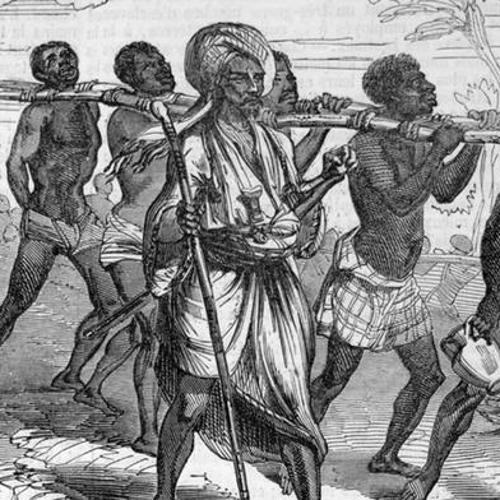
John Wright
The Trans-Saharan Slave Trade
Routledge, 2007
The trans-Saharan slave trade is one of the most frequently ignored systems of human trafficking in global history. Public discussion normally centres the Trans-Atlantic trade, whose principal actors were European and American merchants and plantation societies. Yet the older and more enduring slave trade across the Sahara had nothing to do with white players. It was organised and maintained by Islamic states, Berber desert merchants, Saharan nomadic groups, and North African commercial networks.
John Wright’s The Trans-Saharan Slave Trade brings this forgotten world into focus and dismantles the convenient idea that slavery in Africa was primarily the work of Europeans. Long before the Atlantic trade began, the Islamic world had made slavery a central institution, sanctioned by law and embedded across societies from Morocco to Egypt. Wright’s account forces readers to confront the reality that the Sahara itself was one of the great corridors of coerced labour for over a millennium.
One of the most striking contributions of Wright’s work is his explanation of the Islamic legal framework around slavery. Islam never attempted to abolish slavery. It accepted the institution as natural and legitimate so long as certain rules were observed, particularly that only non-Muslims captured in war or purchased from non-Muslims could be enslaved. In theory, Muslims could not enslave other Muslims. In practice black Muslims were routinely enslaved throughout the medieval and early modern periods. Slave raiders and merchants in the Sahel frequently declared that African Muslims were not true believers or that their conversion post-dated their capture. This manoeuvre allowed traders to bypass religious constraints whenever profit required it.
Wright’s synthesis of medieval Arabic geographers and 19th century consular reports makes it clear that Islamification in the Sahel was uneven and that ambiguity was deliberately exploited by traffickers. Entire regions were labelled “lands of war” to justify slaving expeditions even when their populations professed Islam. This was not simply a matter of interpretation but an expression of racial ideology, reflected clearly in Ibn Khaldun’s argument that black Africans were naturally servile. Wright is explicit about the racial assumptions that shaped the Islamic world’s engagement with sub-Saharan Africa.
Wright’s coverage of the medieval trans-Saharan commercial system is especially valuable. He details how the essential operators of the early trade were Berber merchants from Ibadi communities in the central Sahara. These groups, based in oasis towns such as Ghat and Ghadames, possessed the logistical knowledge necessary to navigate the desert. Their caravans linked the Maghreb with the Sahel and carried salt, textiles and beads southwards while returning with gold, ivory, ostrich feathers, and above all slaves. The commercialisation of camel-based transport and the development of stable caravan routes created what Wright describes as a corridor economy in which oases served as staging points for inspecting, sorting, and redirecting slaves to different markets. This system’s longevity is one of Wright’s central themes. It remained remarkably stable for centuries, surviving dynastic changes, shifting political alliances, and the rise and fall of empires such as Ghana, Mali, and Songhai.
While Muslims dominated the desert crossings, Wright also highlights the significant role played by Jewish merchants in the Maghreb. Using documentary evidence from Mediterranean archives, he shows that Jewish financiers and brokers were deeply involved in the coastal commercial networks that received slaves after the desert journey. Operating in cities such as Tripoli, Tunis, and Fes, these merchants provided credit, guaranteed caravans, purchased slaves for resale, and handled the administrative side of Mediterranean shipments. Their participation did not introduce slavery into North Africa, but it did help maintain the trade’s financial infrastructure. This complicates any simplistic attempt to portray the trans-Saharan trade as exclusively Muslim. It was an economic system that drew in whichever groups were commercially capable, much like the Atlantic world where Christians, Jews, and Muslims alike participated.
Wright’s treatment of the Saharan tribes who drove the caravans across the desert adds a tragic dimension to the narrative. Among these groups, the Tebu were particularly feared for their brutality. European travellers in the nineteenth century, whose reports Wright uses extensively, described scenes of unbearable cruelty. Slaves were tied together by ropes around the neck and forced to march across unforgiving terrain. They were also notorious for raping girls as young as four or five. These harrowing experiences made the desert journal not merely difficult but lethal. Mortality rates were appallingly high, sometimes claiming a fifth or even half of the caravan’s human cargo. The desert functioned much like the Atlantic during the Middle Passage: it was a killing field created by a combination of physical environment and human indifference. Wright underscores that the drivers were not mindless brutes but rational economic actors who calculated that stopping to bury the dead or aid the weak might threaten the entire caravan and reduce profits. The Sahara’s dunes thus became a long, silent grave for countless enslaved Africans.
Islamic societies demanded a very different slave population from that of the Americas. Wright details how Muslim households overwhelmingly preferred female slaves. Women performed domestic labour, childcare, cooking, and entertainment, and were frequently kept as concubines. The absence of large agricultural plantations in most of the Islamic world meant that household service, not field labour, dominated. As a result, the trade’s sex ratio was heavily skewed, often two women for every man. Men were employed as soldiers, porters, guards, or oasis farmers, but women commanded higher prices and filled more diverse social roles. The system was therefore not strictly economic; it was social and reproductive in a very particular sense. Yet, as scholars like Paul Lovejoy and Ralph Austen have shown, slave populations in Islamic societies did not reproduce themselves biologically. Austen emphasises that because these populations failed to reproduce naturally, new slaves had to be imported at an annual rate of around 15 per cent of the existing servile population simply to ensure population stability.
Slave populations remained demographically fragile due to a litany of factors. Many slaves were transferred at a young and vulnerable age from one disease environment to another, leaving them exposed to new pathogens against which they had no immunity. Their nutrition was poor, their workloads demanding, and they typically occupied the harshest living quarters within a household or settlement. In addition, the severe imbalance between men and women in most slave populations made the formation of families rare and biological replacement impossible. Together, these conditions ensured that death rates routinely outstripped birth rates, reinforcing the system’s dependence on continual importation.
Wright also reminds readers that the trans-Saharan trade was not exclusively black. The Islamic world purchased and exploited large numbers of white slaves as well, taken primarily by Ottoman or North African corsairs. Circassians, Slavs, Greeks, Italians, and other Europeans were captured in raids or wars and sold into markets stretching from Cairo to Istanbul. Some entered elite military units while others became eunuchs or domestic servants. The existence of these white slaves demonstrates that the Islamic slave system was not strictly racial, though racial hierarchy certainly shaped its African dimensions. Instead the system reflected geographic opportunity, political weakness, and commercial demand. Nevertheless black Africans made up the overwhelming majority of slaves trafficked across the Sahara, because the political fragmentation of the Sahel and the proximity of sub-Saharan societies made them the most accessible targets.
A particularly horrifying episode recounted by Wright is the catastrophe of 1849, documented in British consular statistics. In that year approximately one thousand six hundred slaves died during the journey northwards. The cause was not a battle or natural disaster but simple neglect. Traders failed to provide adequate water, either to save money or because wells had been overused. Their decision condemned hundreds to death. Wright shows that such tragedies were not rare. Mortality spikes occurred throughout the 1840s and 1850s, often because traders prioritised profit over human life. When considered alongside the finding that a slave’s average service life in Islamic societies was roughly seven years from final sale to death, the human cost of the system becomes staggering. Wright argues convincingly that the trade was not only morally catastrophic but wasteful in some contexts. It consumed human capital without producing enduring prosperity.
This point becomes especially clear in Wright’s discussion of Tripoli. Despite serving as one of the principal transit cities for the nineteenth-century slave trade, Tripoli never became wealthy. Its economy remained primitive, dependent on petty commerce, taxation, and occasional Ottoman support. Other historic slaving regions such as Egypt and Libya likewise failed to achieve developed status in the modern period. Slavery did not produce the economic foundations necessary for long-term development. It concentrated wealth in the hands of a few while impoverishing the broader society. Wright invites readers to compare this with modern economic geography. Many regions shaped by the trans-Saharan trade remain underdeveloped today, a legacy of centuries of extraction and demographic depletion.
Furthermore, Wright draws extensively on James Richardson’s 1846 report to the Foreign Office, which provides some of the most detailed eyewitness evidence of the trade in its final decades. Richardson observed caravans leaving Ghat and Ghadames, recorded the condition of enslaved people, and described the corruption and complicity of local authorities. His accounts confirmed abolitionist suspicions that the desert crossing was a prolonged ordeal comparable in horror to the Atlantic Middle Passage. Wright uses Richardson’s testimony not simply to document suffering but to show the administrative networks that allowed the trade to continue long after international treaties had proscribed it.
Abolition itself forms one of the final themes of Wright’s book. The British played a central role in attempting to suppress the trade through diplomacy, consular pressure, and naval enforcement. Yet their influence was uneven. In Ottoman-ruled Tripoli and Tunis British consuls could exert pressure on governors and collect data on slave imports. In independent Morocco their leverage was far weaker. Morocco became one of the last strongholds of legal slavery in the Islamic world. Its political fragmentation, tribal autonomy, and religious conservatism made abolition extremely difficult. Slave markets in Marrakesh continued to operate well into the late nineteenth century, and manumission remained rare. Wright shows that abolition in Morocco required not only diplomatic pressure but a fundamental restructuring of political authority.
John Wright’s The Trans-Saharan Slave Trade succeeds in restoring the trans-Saharan system to its rightful place in global history. It demonstrates that slavery was not a uniquely European phenomenon nor were Africans merely passive victims of external intrusion. The Sahara was the site of a vast and sustained market in human beings, shaped by Islamic law, African politics, Berber commerce, Jewish finance, and Ottoman administration. Wright’s careful use of statistics, primary sources, and long-term analysis makes the book one of the most authoritative accounts of a neglected but essential part of world history. Above all it shows that slavery does not create prosperity. It destroys populations, distorts societies, and leaves poverty and instability in its wake. Wright’s work stands as a definitive reminder that the trans-Saharan slave trade was one of the most enduring and destructive systems of exploitation ever to exist, and that its consequences continue to shape the regions it touched.
4 comments
Wow, sounds like a good book I would like to read! I’m fascinated by the Sahel and Magrehb and those regions with their complex interplay of cultures. They still have slavery in Africa, like in the Sudan, I thought. I visited this island in the Greek Isles a couple of years back, where we toured the house of the woman who led the Greek independence movement. In their house, there were secret chambers built in the walls where they would hide when Ottoman Corsairs came, so they would not be kidnapped as slaves. This is as late as the mid 19th century!
In theory, Muslims could not enslave other Muslims. In practice black Muslims were routinely enslaved throughout the medieval and early modern periods. Slave raiders and merchants in the Sahel frequently declared that African Muslims were not true believers or that their conversion post-dated their capture. This manoeuvre allowed traders to bypass religious constraints whenever profit required it.
This is a common lawyer trick muslims have been employing frequently throughout history. Waging war against other muslims is haram unless you declare the islamic Mongols to be the not-true believers, justifying jihad. People often fail to appreciate how nomadic opportunism had shaped islam and other religions of that region. This is also why the religion has spread so widely across nomadic peoples in Eurasia.
I would be interested in a book about the jew’s role in the slave trade, when they trailed the Roman legions north into Western Europe. 🙃
This book will quickly ascend to the top of my purchase and reading list, to educate myself and gain the necessary knowledge and information that our co-opted education system willfully ignores. It should be obvious that the horrific Muslim and Jewish role in slavery outpaced European slavers for much longer, and it was up to the White men to sacrifice and die to abolish slavery worldwide.
And what is the reward? Hatred and original sin perpetuated against all Whites, while the descendants of Arab, Muslim, Ottoman and Jewish evil not only get a pass, but get to play the victim. Wake up Whites.
Comments are closed.
If you have a Subscriber access,
simply login first to see your comment auto-approved.
Note on comments privacy & moderation
Your email is never published nor shared.
Comments are moderated. If you don't see your comment, please be patient. If approved, it will appear here soon. Do not post your comment a second time.