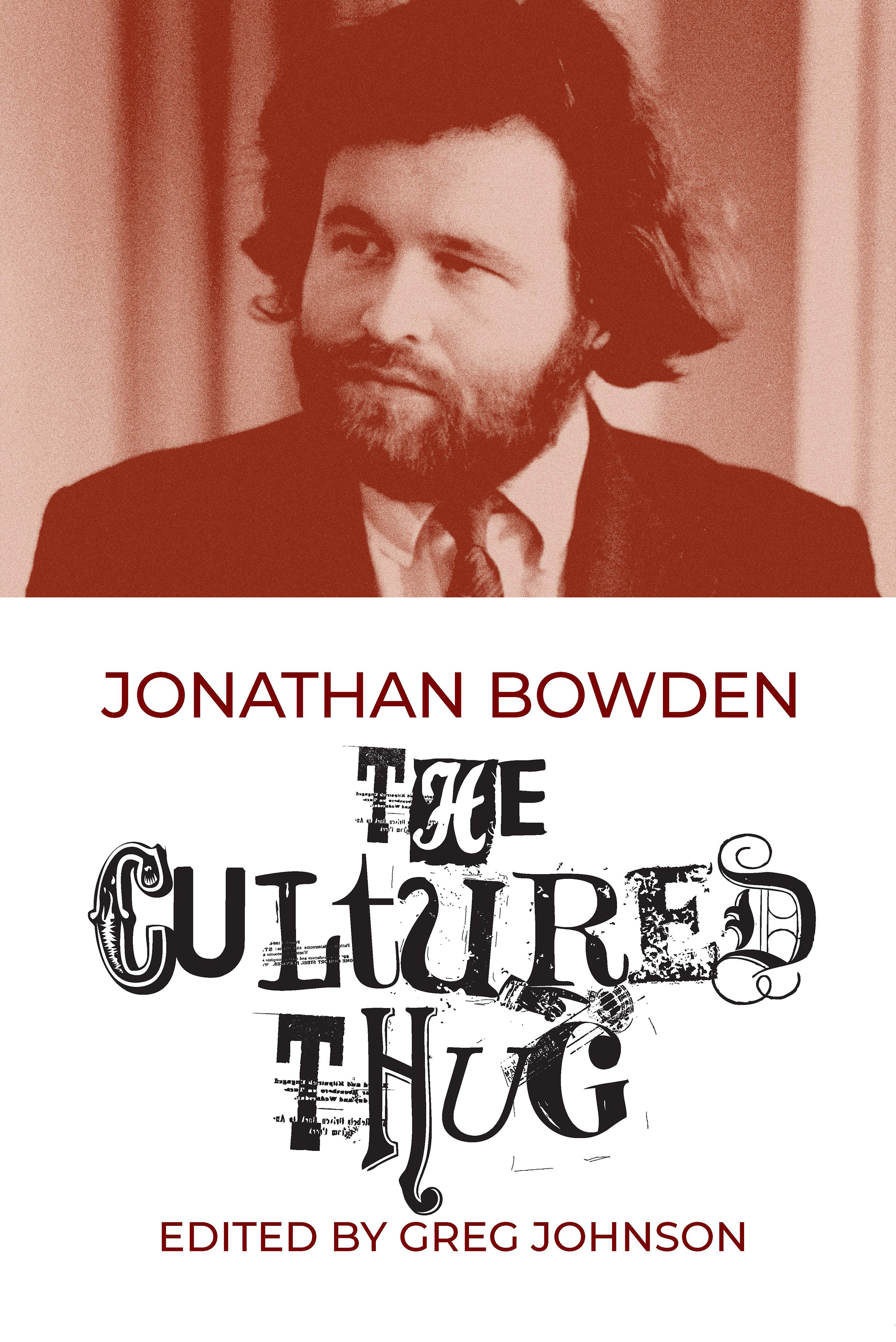
You can buy Jonathan Bowden’s collection The Cultured Thug here.
3,091 words
Part 2 of 5
Edited by Greg Johnson and Peter Jacobi
In 1995, Jonathan Bowden self-published his Collected Works in 6 volumes (London: Avant-Garde, 1995), edited by Jürgen Schwartz, one of Bowden’s pen names. The six volumes comprise 27 distinct books, 12 of which had been previously published. Altogether, the Collected Works contain more than 2,600 pages of rare early Bowden.
Craze is the fourth book in volume 2. It was first published as a distinct book under Bowden’s name (London: Avant-Garde, 1993). We will publish it online in 5 instalments.
Craze is written as an interview, but there is little overall unity to the line of questioning, but broadly there are two foci: modern art and a lesbian couple Bowden knew.It is unclear who Bowden envisioned as his interviewer and his audience. He was writing over the heads of his peers to a potential future audience who could appreciate him. Let us hope he finally found it.
As usual, real people appear under pen names. In some cases, it is easy enough to guess who Bowden is talking about. For instance, Gaudier Louter-Finiscue of the Monday Club is Gregory Lauder-Frost. Given that Bowden had a penchant for peddling fictions about his own life as fact, it is probably prudent to treat everything in this book as fictional until proven otherwise.
Eventually, a fully annotated version of Craze will appear at the Jonathan Bowden Archive. It will then be followed by similar editions of the rest of the Collected Works, plus a couple more early volumes that were not included. — Greg Johnson
Question: If you had to sum up your attitude towards “modern art” what would it be?
Answer: The question is interesting and somewhat redundant, in that to speak about modern art is to infer[1] that it exists. When modern art is dead or has died some time back, primarily in 1963, at least in between the passage of the fifties and sixties. After that you are merely kicking a corpse—lambasting that which refuses to exist, leaving lesions and marks upon a cadaver which refuses to draw breath. The basic point is that the arts are alive but modernist art has lost its raison d’être. It has become repetitive, circular, and attenuated. It merely approaches to the grandeur of an original “project” which has long been exhausted. The typical mode of present pieces is Mannerist in tone deco-mannerist, de-Mannerist, pseudo-mannerist, but Mannerist nonetheless. It is as if passim. Nietzsche in relation to his remark that “God is dead” or Foucault’s remark—in accordance with post-structuralist theory—that “the author is dead” we could say that “modern art, at least modernism, is dead.”
The whole point of the modernist avant-garde was the achievement of new forms in relation to a hidden history of the Self, a demonic premonition. Its essential purpose was to relate to a revolution in the Soul of Man—namely the First World War. After which most artists believed that there could be no turning back. This—when it was coupled with the insistence of the photographic image—led to a crisis in representation, the belief in the presentation of form, of studies in relation to form, as a form of representationalism. Ultimately, though, even the idea of representation became subject to the caprice of form—the belief which Greenberg took from Kant, the idea of artistic specialisation—of specialism, the concern with the working through the nature of the image, irrespective of what that image was to convey. This was a retreat, if you will, from communicability into the inner passions of form. Where even the representational artists—Auerbach, Freud (that’s Lucien not Sigmund), Bacon, and Balthus—have to treat the image in accordance with the absence of its loss, less they wish to be thought of as “reactionaries,” purveyors of meaning rather than form, narrative over substance and technique. The modernist aesthetic is not redundant, therefore, merely congealed. It takes a range of semi-representational codes and treats them in accordance with a formalist intrigue—whereby paint becomes the subject of its own representation. Even the post-war developments in modern art, film (insofar as the Surrealists had not exhausted this), mixed media, performance art, installations, and so forth were all attenuations of a lost essence. They were a desperate desire to find something new to say about having something new to say. All of which is not to say that striking moments of power cannot be obtained by the modernist aesthetic, merely that it is over. Indeed, the increasing attempts at humanism—“a way back to the people”—through the guerilla warfare of Pop Art, mixed media comprehensibility, the merger with fashion and Pop, et cetera . . . is merely a retreat towards the Royal Academy by way of the advertising industry. It is as if modern art will collapse either into sterility, repetition, advertising, the academic, or small modernist cliques which hold forth against the academic. When the remarkable thing is that non-academic art is highly academic, specialised, and spread amongst its admirers, sects, gurus, and potentates. For instance, late Surrealism is seen to lead to lettrisme via Romanian nihilism which then became Situationism—theory without paint or paint without theory. While Gay artists—the explorers of the chocolate freeway; the architects of their own dissolution through AIDS—explore one ghetto. While feminist artists—the matriarchal neurotics of the Bad Painterly movement or Vulvic Kitsch (Judy Chicago’s The Dinner Party)—explore another. Centre-stage in this particular state of dissolution, however, is David Hockney—whose light, ethereal, highly feminine, and insubstantial pieces are held up as some form of exemplum—when they are merely Playschool’s “Through the Windows” crossed with Gay Times. If we take Julian Schnabel’s Humanity Asleep for instance, one sees a relatively straightforward neo-expressionist image which has been built upon, Auerbach-like, as the actual paint has been covered with pieces of broken porcelain themselves painted, stuck to the image. This is an attempt—as in a Paolozzi head—to bring the image back onto the viewer more violently; to break it up and reconstitute it. Yet it does not really succeed—the strategy is too obvious, too indelicate in its approximation to its own life. It merely takes a sterile cave-painting and reflects it against itself, through the medium of broken crockery.
Whereas in Michaux’s Painting in India Ink, for example, the ink is flicked onto cartridge paper with the power of the wrist. It is a form of distended line, a space—a polka-dot space, devoid of comment. Yet it is pregnant with the possibility of absent meaning—in that rather like those images you can join up in children’s books—your eye can develop an image from the operation of the ink. Yet too many of these flics, to denote the use of a cartridge pen and a slang term for films, opens the viewer up to monotony—to the empty absence of the repeated image.
When the image is only repeated so that it will not have to be repeated!
Question: Are you siding with “the people” against “modern art”?
Answer:[2] Not at all. It is important to understand that the people know nothing about art. Art is ruthlessly elitist in any sense—it dismisses the cares of ordinary people. Nevertheless, two things need to be said; first, the men who attacked Epstein’s statues on the Chelsea Embankment up from Victoria Station before the Great War were vandals (albeit necessary ones). Second, that they represented a common attitude; a desire to go back, to renege upon the commitment to the modern—to return to tradition. When we have to remember that the desire for return has been vitiated by the Nazis, by their redundant excess. The extent to which they destroyed a large amount of degenerate art, namely modernist art they disapproved of. Yet all modern art is partly degenerate—fascinating in its degeneracy. It represents a sort of disease, an overheated inconsequentiality, which is fascinated with itself. Rather like a sculpture which is made of butterfly chrysalises before the blossoming and after the death, one can see the development, decline, and decay. It as if modern life—life lived without religious belief—will always be degenerate; fickle, lived without succour, and to a certain extent abandoned—abandoned with pain and yet beholden to a meaningless futility. As Heathcliffe declares in Wuthering Heights, it is a matter of crushing the worms underfoot, if not consuming them at the moment of their decomposition. In such a situation a bare, naked statement—a statement of nature—has a particular power, such as the sculpture in the Saatchi & Saatchi gallery in North London at the moment. Where a dead shark is to be found—its dead eye—purple and pink, if not limpid, watches you down the extent of its body—as it lies dead in a tank of formaldehyde, formaldehyde which has been dyed blue.
Question: Do you approve of the literal attempt to go back, as in the case of Arno Breker’s neo-classicism?
Answer: It depends—when one realizes that to go forwards is to go backwards in a very real sense. After all, there is a certain snobbery connected with modernism in relation to fine art. When we mean less snobbery than a form of fixated vision. This is a certain narrowness of scope—a type of militant minimalism, a desire to retreat into the inadequacy of form. This is something like Beckett’s play Footfalls, even Play itself, when the one involves the other, i.e., it is Beckett’s Play without the Footfalls, let alone any latent humour.
Nevertheless, there is a certain point to this—the desire to work over the image, to destroy the image in relation to the architecture of its composition. If you like, it is an attempt to leave the lineaments of construction bare, in relation to the inadequacy of a piece which scarcely knows itself. When you have to understand that modernism is not really opposed to representationalism—it would have to go outside art for that—merely representation, i.e., the idea that the image can be put down in such a manner as does justice to its lost echo. The real point is that narrative should be avoided—any attempt at storytelling has to be cancelled out. Moreover, the image itself is increasingly suspect—if not rendered positively harmful in its impact on the tenets of modern art. Because the whole point of modernism is to create anew, is to create the circumstances of the image again, in a way that has not been attempted before. It is not the image—the object; whatever is created—which is important—hence the absence of aesthetic judgements in relation to modern taste—merely what is created; in turn, how it has been created. So the reasons for the creation of the object—the epistemology of the artwork, as it were—(if we consider the inanimate to be sentient for a moment)—is what is important. In short, modern art says: method not realization; architecture not imprint; architectonics rather than the object itself; theory instead of art; art as a form of theory rather than theory as a rendition of art; the object as the nature of its construction rather than vice versa. In other words, modernism says: bugger the art—consider how it was made/judge in accordance with the intentions of a particular relief. Hence the fact that most ordinary people—i.e., people who are not intellectuals—consider a lot of modern work to be “ugly.” By which they mean that it does not tend towards a harmonious balance of its possibly dissentient, mobile and viscid constituents. Indeed, the idea that a classical vision of art is one which avoids dissonance is naïve—whereas, in fact, it seeks to avoid internal disagreements over form in a manner which is resolvable. Ultimately it seeks harmony and proportion, both of which are entitled to go beyond the prospect of the limitation of absence. As a result, something which is beautiful is not necessarily contrasted with ugliness—it is merely capable of contrasting the ugliness within itself. Rather like Bacon’s paintings, therefore, it indicates a form of diseased beauty, of decrepitude and calm—the loss of serenity.
Question: How do you interpret modern man at the moment of his seizure by modern art?
The important thing about the nature of the cogito—the fact that one understands that one is observed—is the recognition of pain. The degree to which suffering—in such circumstances—is mutual. As Hobbes might have inferred in a different context: the assault of each against all is only predicated on an absence within nature. For such an idea infers,[3] does it not, that the two beings, the creatures of our analysis who stare at one another—are equal, display some understanding as to the nature of their equality. When, in fact, the opposite is often the case. Nay, it is the case, in that people are not free to stare into the features of another—when one contrasts one’s own emptiness with what one sees there. This is the fact that a mutual distaste for the flesh, let alone the physical viscosity of another, is what results from such an encounter. This is in the primal state—the condition of Being and authenticity where two human beings realize one another in the presence of another’s absence. This is even the taste of another’s departed flesh. For there is a certain Sadeian wistfulness in the primary moment, the moment which arrests the prospect of passion. When one becomes apprised of the fact that one is a useless passion that seeks nothing but repose in surrender, surrender to another’s will. When the whole point of the primal encounter—the encounter which serves as the locus or crux for all future encounters—is the fact that one wishes to be still, to encounter another at the plenitude of one’s inadequacy, let alone one’s fulfilment. The fact that human beings were born to die in pain—this is what they see in another’s grasp.
Question: Why does the Radical Right hate “modern art”?
Answer: It is relatively unclear that it does—at least in a direct sense. When one understands that the more radical the right becomes the greater its desire for restoration, if not conservatism. It would be true to say, therefore, that the Right becomes less conservative and more revolutionary the more it wishes to impose a return to tradition, a desire for some sort of recapitualtion, no matter how vague, how unimportant and meaningless the fray. If you like, there will always be a salutary attempt to go forwards by virtue of moving backwards. When one understands that the far right wishes to have two things at once in relation to modern art—both of which are slightly contradictory, if not necessarily so. Since, on the one hand, the Right wishes to return to beauty and proportion—on the other, more populist elements within it genuinely seek, like the Left, an art the people can understand. When one has to realize that the people never understand art anyway! They never entirely sympathise with aesthetic matters, essentially because it is not their concern. So what is meant by this is the belief that the people respond appreciatively—if in a fragmentary and instantaneous way—to the recognition of a form of art which has lost touch with reality. When “reality” for them means something which accords with observable phenomena or an ideological rendition of reality with which they have some proximity, such as the Christian religion. An interesting point to note, however, is how modernism relates to these ideas but in a different context—a context which denies a traditionalist interpretation. For instance, in immediate post-war art a belief in the purity of abstraction was the order of the day—a type of virtual reality at the point of its own insignificance. Nevertheless, two particular schools grew up in relation to this particular form of art, the American Abstract Expressionists, such as Jackson Pollack, on the one hand, and the Paris School of abstract painters, such as de Stael and van Velde, on the other. Now the interesting thing to note is that within abstraction—within an aesthetic totally dominated by the issue of form, as and against the prospect of the absence of form—the American school was far superior. It appeared much more free, daring, and innovative—much more expressive—much less constrained or constipated than its European rivals. The reason for this was that there was a post-Europeanism to the American effort, a degree to which they were prepared to be far more modern—to throw the baby out with the bathwater and dispense with the beautiful, the proportioned, the true.
All of which is not to say that work of some grandeur could not be attempted in this field—Jackson Pollack’s Man with Knife, for instance—a sort of “pre-abstract” abstract work is a case in point.
Question: Haven’t you had some trouble with censorship recently?
Answer: Not entirely—in any event, it depends what you mean by censorship. For the word indicates repression, the actual seizing or banning of material. Yet censorship can mean many different things at once, in particular the intention to repress a particular viewpoint or statement of opinion. As happened recently at one of the printers which I use. When I suddenly discovered from a previous publication—Aryan—that a piece of paper had been included in the “job bag”—the final rendition of the off-set litho process. Apparently, the Union Chapel at the printworks, acting on behalf of the NGA (the National Graphical Association) had added a rider to the publication—a sort of withdrawal of endorsement; a shot across the bows, a statement whereby they distanced themselves from what they had to produce. While possibly informing the union or a more senior official, a regional organiser or something like that, of the fact that they had had to print up this material. Where the fact that they had distanced themselves from it was a mea culpa and a refutation; a sort of ignorant philistinism—worn with working-class pride.[4]
Notes
[1] Bowden means “imply.”
[2] The word “Answer” is omitted in the original publication.
[3] Again, Bowden means “implies.”
[4] Bowden includes the following note, written by his editorial alter ego Jürgen Schwartz: “his is completely untrue. Everything that leaves a printworks has to be stamped by the Father of the Chapel! It meant nothing. It was purely a matter of form.—J.S.”
4 comments
Thanks for keeping Bowden’s works alive. I enjoy his speeches more than his books but there are some good insights here.
An excellent project would be to reissue an fully annotated text of Bowden’s ‘Demon’. The question is, does Mr Kurtagic hold part or all of the copyright?
We are going to republish Demon and all the other early Bowden works. No, Kurtagic does not own the copyrights.
Good news. From what I’ve seen of it since, it seems like a good example of his wild prose style and a generously annotated edition will only add to the fun and games. Unfortunately I didn’t bother buying Kurtagic’s edition when it came out.
I suppose I was probably the first person to read Mad back in 1989-90, and in 1993 Bowden sent me four other self-published titles (the only other thing he included was an invoice for £30). Unfortunately they ended up being thrown in the trash by mistake ten years ago; if they had survived I would have offered them to you.
Comments are closed.
If you have a Subscriber access,
simply login first to see your comment auto-approved.
Note on comments privacy & moderation
Your email is never published nor shared.
Comments are moderated. If you don't see your comment, please be patient. If approved, it will appear here soon. Do not post your comment a second time.