 7,584 words
Michel Faure
Augusto Pinochet
Paris: Perrin, 2020
From September 11, 1973, until March 11, 1990, Chile was ruled by a pitiless military junta under President Augustus Ramón Pinochet Urgate. Michel Faure has written an extraordinarily dispassionate — I am tempted to say passionless — overview of Pinochet’s life from beginning to end. Faure has read the thousand-page biography, only available in Spanish, Yo Augusto by the Argentinian journalist Ernesto Erkeizer. This very much shorter work in French of 337 pages is unlikely to contain any material not included in Yo Augusto and it makes no attempt to analyze Chilean politics of the time in depth.
Although most of the facts and accounts given in this book, if not all, are freely available on the internet or elsewhere, this study collates them in an easy-to-read French with some colorful turns of phrase by the biographer. Although Faure’s biography is intelligent and competent, it is brief and somewhat superficial, so a reader seeking an explanation or illumination of human nature or politics either of Chile or in general is likely to come away disappointed. What Faure’s book does provide is an overview of the life of a man who Faure says in his preface has long interested him because he is an “enigmatic” figure.
Pinochet, as his name suggests, had French, (or more exactly, Breton) antecedents. His forefather, Guillaume Pinochet, was a sailor and merchant who settled in Chile between 1718 and 1720. Faure notes that ironically Guillaume’s emigration may have been part of the diaspora resulting from Louis XIV’s oppression of Brittany and the economic decline in Britanny caused by the mercantilist policies of the king’s minister, Colbert. According to Faure, the Pinochets were proud of their French ancestry and never forgot them. There were French roots on both sides of the family. Pinochet’s antecedents on his mother’s side were French Basques. Pinochet was brought up by his mother to speak French as well as Spanish (he never learned a word of English).
Pinochet’s parents were well-to-do and could afford his education at a French private Roman Catholic school in Valparaiso. There is nothing in Pinochet’s biography that can be described as remarkable, no trauma, no loss, no suffering which can be used to explain the ferocity of the dictator-to-be. He was neither a very gifted pupil nor a poor one. He excelled neither as group leader nor was he bullied. The picture painted here of Pinochet is of a stalwart and unimaginative young man with simple tastes in food and sport, although as a young boy he seems to have been somewhat turbulent and undisciplined. He was probably spoilt, a typical product of the “brat belt,” the countries where the well-heeled older sons of Roman Catholic and Muslim families grow up with little sense of personal responsibility and in full conviction of their own righteousness, superiority, and masculinity.
From an early age, Pinochet was determined to join the army. His determination and stubbornness were character streaks that stayed with him all his life. He was accepted by the Military Academy of Santiago when he 18 years old only after his third attempt. Pinochet claimed that he was too young at his first attempt and too thin (!) at his second, but Faure more credibly suggests that Pinochet was twice rejected owing to a mediocre school leaving certificate. When he was finally accepted by the military academy in 1933, at last embarking on the military career upon which he had set his heart, the reputation of the army in Chile had reached a nadir.
In 1931 the president of Chile, General Ibanez de Campo, an admirer of Mussolini, had fled the country in the wake of widespread strikes and unrest. Ibanez seems to have been something of a forerunner of Pinochet, albeit in much milder form, ruling as a dictator who protected American financial interests and with American support. Faure notes that “men about town in uniform were often attacked, and it even happened that respectable women spat in disgust if a soldier walked by” (p. 34).
Perhaps here we have an indication of a psychological influence. A young man who finally obtains the position he has sought, the career he wants, and is proud of serving his country, witnesses respectable women spitting in the streets as soldiers pass by. Soldiers were sometimes attacked in the streets too. Faure writes that we have “no witnesses” to tell us how Pinochet felt about the “prevailing ambiance,” but it more than likely that the hostility towards the military which as an officer cadet the young Pinochet witnessed and presumably experienced would have created a festering resentment in him. A striking feature of his later life was resentment towards much of civil society, especially political radicals, and love and loyalty towards his soldiers.
Once he had graduated from the Santiago military academy in 1936, Pinochet made slow but steady progress up the military hierarchy. In 1931 he became a Freemason, a decision that may not have been unconnected with the fact that the girl he was courting, Lucía Hiriart, was the daughter of Osvaldo Hiriart, himself a Freemason, and a senator for the radical party and friend of Colonel Guillermo Barrios, Pinochet’s superior officer and head of the Infantry School in San Bernando where Pinochet was stationed at the time. Barrios was a keen follower of the traditions of the Chilean general Oscar Novoa, the Chilean Commander in Chief who stressed absolute obedience in the Prussian tradition and apoliticism for the Chilean army.
Pinochet married Lucia Hiriart in 1943 with great pomp and circumstance in the Church of Los Sagrados Corazones in Santiago, with three hundred guests from the high circles of Chilean society. Pinochet, as his godparents were well aware, had married above his social station. Among the wedding guests were the wealthiest families of Chile: liberals, radicals, politicians, jurists the president of the Rotary Club and the president of the Automobile Club, fervent Catholics and free-thinkers” (p. 45). Pinochet had not married into one group in terms of politics or ideas, he had married into the club of the wealthy.
Notwithstanding the Freemasonry, Pinochet had also married into a family in which his future mother-in-law was extremely pious. Faure notes drolly that “From the moment her daughter met Augusto, Lucá’s mother watched her daughter in the way someone waits for milk to boil and she did not lower her guard before the religious consecration of their union” (p. 45). The first night of the honeymoon was spent in a hotel north of Talca where Lucá had once been taken by her parents. The honeymoon was almost stymied by another instance of strict Catholic mores: suspecting the worst, the hotel owner insisted on seeing the couple’s marriage certificate, which a “furious” Pinochet could not find. The day (or rather the night) was saved by the hotel owner’s wife, who produced a copy of the newspaper El Mercurio featuring an account of the wedding.
There is one psychological factor that Michel Faure reveals but does not perhaps accord the significance it deserves. Pinochet’s wife was, according to this account, a domineering, materialistic, very religious, and socially ambitious woman, constantly berating her husband for socially inappropriate behavior. When he became ruler of Chile, even his simple taste in food seemed to her not fittingly sophisticated for the country’s ruler, and Pinochet himself confessed that he feared her more than he would an army in battle. Here was a strong religious force behind the throne. It may well be that the man weak at home felt he needed to assert his masculinity elsewhere.
Among Pinochet’s extramarital relations Faure describes a lasting affection for an unmarried socialite, the Ecuadorian Piedad Noé, a gifted and beautiful pianist whom he met in Quito. It seems that he was not able to hide his feelings and knowledge of what Faure describes as a “passionate affair” soon reached his wife. Divorce was illegal in Chile, and Faure plausibly suggests that knowledge of the affair in a deeply Catholic country was in danger of damaging Pinochet’s career. Pinochet ended the affair, choosing career and decency before an illicit passion, but passion by all accounts it was. According to Guarderas Jijón, a surgeon and friend of Piedad Noé, Pinochet kept his lover’s letters up to her death in 1990 when he burned them. As dictator Pinochet made arrangements for visiting various mistresses, trying to make sure his wife did not find out. Faure doubts that he always succeeded. One thing seems clear, namely that Pinochet’s marriage was not a happy one.
During the 1940s Chilean politics were strongly influenced by the standoffs and conflicts of the Cold War. In 1947, Pinochet, then Captain in the Iquique regiment, was responsible for a round-up of communists, who were taken to an internment camp in Pisagua. Pinochet was in charge of running the camp. While he held this position, he ran into a confrontation with a Left-wing senator named Salvador Allende, the future president, who demanded to visit the prisoners.
Faure provides two incompatible accounts of what happened, leaving the reader to decide. One account is Pinochet’s own, according to which Allende did not have a written permit and therefore had to suffer the humiliation of being turned back by Pinochet in person; the other account is given by the Left-wing poet and journalist of Mapuche origin, Andrés Bianque. According to Bianque, Allende defied Pinochet and visited the camp with his entourage, leaving Pinochet furious but speechless. Faure recounts that among the interned Leftists was the communist mayor of Calama, Meza Jeria, whom Pinochet had met and dined with a year before. Pinochet recounts in his memoirs somewhat surprisingly that he often invited this prisoner to share a meal with him, and that it was from Jeria that Pinochet learned the essentials of Hegel and Marx and the theory of the dialectic.
In 1951 Pinochet was teaching geopolitics in the military academy and was editor of the review Cien Aguilas (A Hundred Eagles) published by an association of former military cadets. In 1968 he and his class were guests of the American government and visited Fort Leavenworth in Kansas where counter-insurgency was taught, based on the rough methods elaborated by the French army in the battle for Algeria. Assassination and torture were accepted and included as tools to combat and defeat communism and subversion.
When Eduardo Frei Motalva defeated the Marxist candidate Salvador Allende in the presidential elections in 1964, it seemed as though Chile was set on a course of reform that would take the sting out of Leftist demands, while not overly alarming the wealthy. Montalva had been an idealistic National Socialist in his young days but as president of Chile his activities were pragmatic and diplomatic, and he was ready to compromise to ensure social stability and avoid civil war. He rejected the Peronism of his predecessors, opening Chile to foreign markets, while at the same time the government acquired majority holdings in major companies. Declassified documents published in September 2004 confirm that Montalva received subventions from the CIA to the tune of 2.6 million dollars.
Frei Montalva’s gradualist approach, which seemed set on ensuring a stabilizing mixed economy, was aimed at securing peace and prosperity for Chile, a compromise politics when neither Chile’s sizeable communist element nor the radical nationalists of the anti-communist middle and upper class were sufficiently strong to achieve power by the ballot box. However, Salvador Allende had come close to winning the presidential election in 1958 when he lost against Jorge Allesandri, and the result was reversed in the 1973 elections when Allende unexpectedly won the election. Allende, a Marxist of part Jewish descent and open friend of the Soviet Union and Cuba, won by a narrow margin in a three-horse contest, and his election was ratified by a large majority in the Chilean Congress.
The Western world, especially the US government, was appalled. Was Chile about to become the new Cuba? Faure says the Nixon administration’s so-called “Track Two” strategy to stop communism in Chile was to encourage the army to intervene. The assassination in 1970 of General Schneider, who, like Novoa, was a strong advocate of the army’s political neutrality, by groups funded by the CIA, had the effect on the one hand of increasing support for Allende and on the other hand of removing the man most dedicated to the army’s political neutrality. Schneider’s doctrine of neutrality was even named after him. Neither in Faure’s account nor elsewhere is there any evidence that Pinochet knew of, still less was involved in or supported, attempts which Right-wing malcontents made at that time to stymie the election or oppose Allende, and there is no evidence that he knew anything of the plan to assassinate Schneider.
You can buy Greg Johnson’s White Identity Politics here.
Allende was elected with a wafer-thin majority. His election was confirmed in Congress with a large majority, which Faure believes was at least partly in reaction to Schneider’s assassination. Once confirmed as president, Allende set about a socialist if not communist transformation of the country. Faure does not examine the reforms in depth. Still less does he address the problem as to whether they were unconstitutional, which the opposition claimed. This is regrettable. After all, one justification (or pretext?) given for the putsch which took place three years later was that many of Allende’s measures were unconstitutional and therefore illegal.
Banks and major industries were nationalized and property confiscated. Faure quotes Pedro Vuskovic, Allende’s Minister of Economic Affairs to the effect “The purpose of state control is to destroy the economic basis of imperialism and the dominant class by ending private ownership of the means of production.” (p. 117). Allende stated in his opening speech to the Senate as President words (not quoted in Faure’s book) which must have chilled the hearts of many: “The circumstances of Russia in 1917 and of Chile at the present time are very different. Nevertheless, the historic challenge is similar.”
Allende embarked on a series of legislative measures which were widely popular to begin with. They included a massive social housing program, raising the minimum wage, and more. At the end of 1972, Allende was visited by Fidel Castro on a visit planned for an already long ten days but which was extended to twenty-four. According to Faure, Castro resented the adulation Allende was receiving and was fearful that the CIA would never tolerate a slow transformation to communism in America’s backyard without trying to prevent it (p. 118). Faure quotes the Chilean writer Noberto Fuentes that Castro was like a “Jehovah’s Witness proclaiming an approaching day of judgement” (p. 119).
Castro’s visit can have done nothing to reassure Chilean property and business owners that they were safe. Pinochet led the guard of honor when Castro unveiled a statue of Che Guevara in San Miguel. In September 1972 on a visit to Mexico with his wife and two elder children, Pinochet was interviewed on the Mexican channel Tekevisia and was questioned about the “sound of army boots in Chile” to which Pinochet replied by insisting that “the Chilean army respects the institutions of the country and the head of state, the president, with no regard to his political ideas.” (p. 122)
The rapture of the early months of Allende’s presidency “collapsed like a souffle” as Faure colorfully puts it, in the wake of the “inherent dead ends.” The Central Bank was ordered to create money by the government to finance very ambitious and costly social projects that resulted in soaring inflation (225% in 1972 and 606% in 1973). From initial growth, Chile lurched into recession. Real purchasing power of the majority of Chileans went into free fall. Following the legislative elections of 1973, which confirmed a small majority of the united forces of the right in the Chamber of Deputies, the opposition demanded a constitutional reform limiting land expropriation. The Camera de Deputados (Chamber of Deputies) also declared that Allende was acting unconstitutionally in many respects and that he was breaking his oath as president to honor the institutions of the republic. The Supreme Court upheld the complaint of the Chamber of Deputies that much of the land appropriation carried through was in fact unconstitutional. There were other actions considered unconstitutional. For those opposed to Allende, it seemed likely if not sure that the executive was arrogating power in a lead-up to a Marxist dictatorship.
Perhaps a measure that touched an especially raw nerve was the expropriation of farms. Faure does not go into the details of farm expropriations nor into how far they were legal according to the constitution. They far exceeded in scope and suddenness the expropriations which had taken place under President Montalva. Nearly two million acres of land had been expropriated in the first sixth months of the Allende presidency. Some farm owners, their land and homes taken away by force, burned down their buildings in despair. By the middle of 1973 well over fifteen million acres of land had been expropriated by the state. Something else began to take place during Allende’s rule, which no doubt brought back bitter memories for Pinochet: men in uniform were again being insulted in the streets.
Faure, like many writers, does not quite ignore, but he does play down the economic mayhem which Allende’s “socialism in one country” had caused (in fairness, not helped by US hostility and an unexpected fall in copper prices on the world market). There was hyperinflation of over 700% p.a. In 1974, came rationing, shortages, hoarding, crime, and widespread and recurring strikes.
Allende decided on forming a new government with members of the armed forces, including the Commander in Chief Carlos Prats as Minister of Defence. Faure recounts the entry of members of the army into what Allende considered “the last chance for democracy.” In retrospect, it looks like a fatal mistake to have given high-ranking officers political appointments. It broke with the Schneider doctrine that the Chilean army should always stay politically neutral, a commitment which until then had very probably been restraining discontented officers from considering military action against the president.
Allende’s decision was greeted with dismay by high-ranking military personnel, the majority of whom were not politically sympathetic to the president. The new high-ranking officer in the government, Carlos Prats, resigned (both as Commander in Chief and as Minister of Defence) soon after his appointment. In his memoirs, he gave as the reasons for his sudden resignation so soon after his appointment his lack of experience as a military man to manage political conflict professionally and his “ardent desire” that the armed forces should not “succumb to insurrection” which would be “fatal for the survival of a constitutional state” (p. 135).
The same day that Allende accepted Carlos Prat’s resignation, Augusto Pinochet was offered and accepted the post of Comandante en Jefe de las Fuerzas Armadas (Commander in Chief of the armed Forces). Allende was convinced to the end of Pinochet’s loyalty and even on the day of the coup assumed that the reason that he could not reach Pinochet by telephone was because the putshcists had already arrested him.
At the time Pinochet was appointed Commander in Chief, Faure describes the political situation in these words:
Chile had reached a dead end. . . . Society had become radicalized between right and left. The old Prussian tradition of the army which accorded the civil authority primordial rights over the military, the doctrine represented by Schneider and Prats, who were its last representatives, was in rapid decline. There were only three possible means of getting out of the dead end: a plebiscite, civil war, or a military coup. (p. 139)
Civil war an option? Surely no political element in Chile except the most radical Left elements considered civil war as an “option” to be chosen for getting out of the stalemate. It is true that Allende was under fire from his own supporters for not immediately taking the course of action which Allende’s opponents increasingly feared he would take, that is to say, declaring the dictatorship of the proletariat. On the one hand, Faure seems to accept unquestioningly the allegation later made by the junta that many people were seriously considering or even planning civil war as an “option,” and that a military coup was the only way to prevent it; on the other hand Faure does not even mention some sort of cooperation with the conservative opposition as an “option” at all. That Faure sees events only from the perspective of the government and the putschists is understandable given that they are the important players, but it is wrong to assume that what the two major players of the time considered to have been the only options to get out of a political stalemate were in fact the only options.
Be that as it may, it is a paradoxical fact that Allende proposed a plebiscite on a reform of the constitution which would give him the powers to rule without Congress, but was prevented from seeing it through by the radical members of his own politburo. It is also ironical to the point of perversity that the right claimed that Allende ignored the Constitution and they acted to save it, given the fact that the junta itself immediately abolished the very same Constitution after it had overthrown Allende!
Would the army remain politically neutral? What course would the new Commander in Chief take? Faure tells us that many discontented officers distrusted Pinochet because they considered, as Allende did himself, that he upheld the Schneider doctrine. At first, it did seem as though Pinochet might remain loyal to the president. Faure says that nobody could be sure which side Pinochet was on, that of constitutional and political neutrality or that of a deeply hostile and nationalistic officer class. A cynical interpretation is that Pinochet the tactician, survivor, and pragmatist would be loyal to Allende for just so long as Allende seemed powerful and for not a moment longer. If one thing is clear about Augusto Pinochet it is that he was adept at positioning himself in any dispute on the side which would win. In September 1973 Allende addressed a huge crowd (Faure says a staggering 800,000 people) outside the Moneda palace and later made an address on the television. Faure cites Yo Augusto: “the workers would paralyze the country to prevent a coup d’etat.” (p. 144)
Pinochet was not permitted to continue to procrastinate. Admiral Merino for the navy and General Arellan for the army had decided on a coup with or without Pinochet’s blessing. Mistrust of Pinochet ran high among the conspirators, and there was an argument as to whether Pinochet should be even included in the conspiracy. Finally, it was agreed that Arellano should tell Pinochet of their intentions and present him with a “take it or leave it” invitation which must have sounded like a hidden threat. Arellano told the journalist Monica Gonzales that Pinochet had to choose between supporting the planned coup or risking civil war. The coup would take place with or without him. Faure notes dryly and I think correctly “In committing himself to the cause of the putschists, Pinochet was not being audacious, he was being prudent” (p. 149).
Once committed, Pinochet did not look back. When his aide de camp Osvaldo Zabala voiced his opinion on the morning of the coup at 7.30 in the morning that he did not approve, Pinochet immediately had him arrested. The events of 11 September are well known. With lightning force, the armed forces struck. Santiago filled with tanks. The presidential palace was bombed, and Allende died, almost certainly taking his own life, not without leaving a message on the last loyalist radio station bidding farewell to his supporters in somewhat “Right-wing” language which stressed loyalty to Chile (Viva Chile!), to socialism, and in which denounced the putschists for treason and for acting in the interests of a foreign power.
Pinochet’s new government was marked from the very beginning as ruthless in the extreme in ensuring that no opposition of any kind dare show its head. This was achieved by imposing a regime of systematic state terror. There are disputes about the number of those who died in the years following the coup. Certainly, there were wild exaggerations in a very hostile Western press. The actual numbers of those who died in captivity are given by Faure as around three thousand. He bases his figures on the results of investigations made out by governments that followed Pinochet. I suspect there may be a bias too here, in this case playing the figures down, since governments that succeeded the dictatorship were very concerned to reduce tension so far as possible on the principle of “forgive and forget.” It is equally likely that reports of fifteen thousand dead are hugely inflated. In addition, there is a problem of definition. If someone dies earlier than they would have done, say at age forty-five instead of age seventy, because of the torture they underwent under Pinochet, are they “murder victims”?
It is the number of torture victims that astounds. Low estimates are around 30,000. The real figure may be considerably higher. Faure states in his chapter entitled The Strategy of Barbarism that there were more than 40,000 (p. 201). Of those interned for political reasons, the great majority were tortured. Particularly distressing to this reviewer are accounts of a free-for-all for soldiers so far as female prisoners were concerned, not even sparing pregnant prisoners, the breaking of limbs and the gouging out of eyes. These were (hopefully) exceptional. Electric shock treatment and various procedures intended to humiliate and degrade were standard.
What is it that causes South American regimes to be so ferocious? Barbarism, cruelty, torture occur anywhere of course. However, South American dictatorships are notable for the suddenness and ferocity of their measures, measures that seem to flare up unexpectedly. Sometimes they seem to flare up out of nowhere and out of all proportion to the strength of the foe they are seeking to crush. It is a short way from comic opera to horror. Pinochet is a case in point. There was little in his previous biography to suggest that he would sanction systematic torture, which he did, long after there appeared no practical need for such harshness at all.
Various elements came to play in Pinochet’s case, and they may be typical for many. Firstly there was the fanatical anti-communism of those who were fighting as proxies in the cold war. The United States and the Soviet Union, their hands tied to some extent by nuclear deterrent, allowed their proxies to fight one another without pity or restraint. In South America, there was the added element of a near-fanatical Roman Catholicism. Interrogation of prisoners to force confessions of guilt echo the procedures of the Inquisition. Military dictatorships are inspired to a greater or lesser extent by a hatred of civilians, contempt for their incompetence and softness, disgust at their decadence. Military dictators naturally consider themselves to be victors in a war; pillaging, murder, and rape of the defeated are soldiers’ traditional unofficial rewards.
It has never been researched (for obvious reasons) but it would be interesting to know the ethnic composition of soldiers operating under South American dictators. Who were their forefathers? The American Indian was no stranger to torture. Finally, I do not think it is fanciful to see in the Pinochet dictatorship a kind of “day of reckoning” with the hippy movement, flower power, all that the professional soldier will consider effete and decadent.
Pinochet had Allende to thank that he did not have to find a way to supreme power after the coup. He was already the Commander in Chief of the armed forces. Faure stresses, as many others have done, the fact that Pinochet’s career had been up till then unremarkable, his personality also unremarkable, and when the coup took place he was fifty-eight years old, an age when most men for better or for worse will have made their principal mark on the world and the people around them. There was some question among the plotters as to why Pinochet should be accepted as head of government, but he had the advantage of seniority and his position as head of the armed forces. Faure muses but does not elaborate that Pinochet’s position of not being a long-time plotter gained him the favor of the influential civilians who were backing the coup because they saw in him someone not so wholly committed to a purely military operation. (If that is the case, they were in for a shock.)
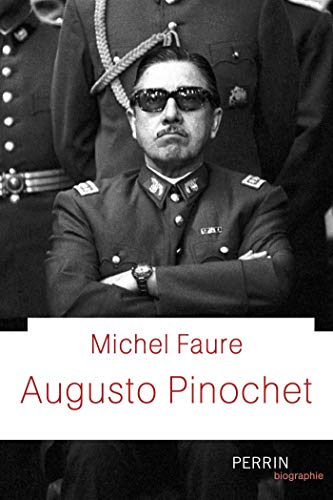
The first decree of the new government conferred the presidency on Pinochet. Following a church service a few days after the coup attended by three former presidents (seen by their attendance at the service as endorsing the coup) the former presidents, the new president, and top military brass were photographed by Chas Gerretson for Time magazine. Someone suggested to Pinochet he should remove his sunglasses for the picture. “Yo soy Pinochet” was his curt response. So was born one of the most famous pictures of all time of any dictator (it illustrates the front cover of Faure’s book). It shows Pinochet sitting with folded arms and sunglasses and a grim expression, “the face of a killer” says Faure. The photograph in the years to come was to be a symbol of a regime whose “repressive actions and odious violence are universally condemned” (p. 173).
Pinochet’s regime was characterized by pitiless discipline and terror in political life, a strict moral code in religious and social life, extreme laissez-faire economics, and no interest in ideology. He eschewed the formation of any political party, revealing his contempt for party politics but also his complete lack of any cohesive or identifiable ideology. Pinochet’s beliefs seem to have been much confined to patriotism, a devotion to the army, and an acquiescent if not especially devout adhesion to his Roman Catholic faith. The new regime would never act in the name of an ideology (unless anti-communism is an ideology) but in the name of discipline, patriotism, and defeating subversion and preventing civil war.
The regime by no means reversed all the measures of its hated predecessor, and some of the measures were only partly reversed. The nationalized copper industry remained nationalized, and only about a third of expropriated agricultural land was ever returned to its original owners. The hacienda system of vast landholdings had been abolished by Allende, and the new government made no attempt to restore it. The reason given by Allende’s government was not only because of its inherent inequality but also because it was inefficient. Pinochet’s government was not much moved by the argument of “inequality,” but they agreed that the hacienda system was inefficient. Much agricultural land was left fallow or underexploited. Chile was importing food that it could have produced itself.
You can buy Collin Cleary’s Wagner’s Ring & the Germanic Tradition here.
Expropriation of the land, accelerated for ideological reasons, in Chile as in Africa, had foundered, mainly due to the incompetence and ignorance of new landowners. They had neither the experience nor skills for managing the land. Allende and Pinochet had in common that they were both keen to reduce Chile’s dependence on food imports and were no friends of a system so lazy and inefficient, as they saw it, as the hacienda system. Anyone who places protection and care of the environment as a priority, however, has cause to regret the passing of the hacienda. Neither Allende nor Pinochet showed the least interest in stemming the urbanization of Chilean society, and it was the growth of cities that was raising the importance of agricultural efficiency. Neither ruler showed interest in environmental protection or long-term agricultural sustainability.
So what did Pinochet’s government do with the two-thirds of land not returned to its owners? Some land was auctioned. Campesinos on cooperatives were given the option to buy the land they worked on. As in everything else which he attempted economically, private ownership and pragmatism was the hallmark of Pinochet’s policy. This is in marked contrast to the more ideological and nationalistic policy of the even more ferocious Argentinian dictatorship under Jorge Videla. Since Pinochet’s government with its faith in free-market economics offered no financial help of any kind to smallholdings, and in later years when the economy faltered, small landowners sold out to ever-growing agricultural enterprises. The hacienda system gave way not to multiple smallholdings but agribusiness of the kind then seen in the United States and the European Union and which subsequently became the norm around the world.
There is little evidence for Pinochet’s claim that his putsch prevented a communist coup at the last moment, whereas the army’s allegation that Allende’s government had ruined the middle class and was leading to total economic mayhem is supported by abundant facts. Pinochet was vain, but more than vain he was pragmatic. He did not allow his vanity to go so far as to delude him that he understood economics. He appealed to those who were at once like him fanatical anti-socialists but unlike him were economically savvy. For many years post-war economic theorists had been promulgating anti-Keynesian theories. In the case of Chile, Pinochet effectively invited the Chilean economists who had studied and developed such theories to decide economic policy for him. Those economists belonged to a group of Chileans who had studied at the Catholic University of Santiago under Sergio de Castro.
Since 1955 the university was involved in exchange schemes with the University of Chicago, where the leading professors of economics were none other than the economic ultra-liberals Milton Friedman and Arnold Harberg. The “Chicago boys,” as the group became known, were able to apply their theories in practice without a pesky socialist or Peronist opposition to highlight any possible failings or misadventures. The economy certainly recovered, and Friedman himself, who visited Pinochet in person in 1975, described the economic boom under Pinochet as the “Chile miracle.” The new economic policy ushered in a radical break with desarrollismo, a term that refers to South American Keynesianism. It was capitalism with no holds barred. The state retained a hold over the crucial sections of power, notably the police and the armed forces, but in the course of time nearly every state asset was put up for sale. Three days after the coup Pinochet invited Sergio de Castro to join the government as official advisor to the Ministry of Economics.
Faure is obviously puzzled by the alliance of military dictatorship and economic liberalism, which he calls in his occasionally colorful language “a strange alliance of carp and rabbit.” But is the alliance so strange? For Pinochet, priority was to be given to a “Chile decontaminated of Marxism.” It is no exaggeration to say that Pinochet regarded Marxism as a kind of disease and good economists advising his government like surgeons and doctors combatting the effects and causes of that disease. Communism was characterized by centralism, therefore, he favored the far-reaching decentralization and freeing of the economy favored by the Chicago boys. One aspect of economics which Pinochet shared with his predecessor was indifference to environmental damage and pollution. However, in a free-market economy, the environment and health and safety at work are private, not public matters. Price controls were abandoned, property regulations lifted, and public property privatized (about 500 state enterprises were privatized). Under José Primera the Minister of Labour and Social Security (Ministro del Trabajo y Previsión Social) the pension system was completely changed from a system where workers paid into a common fund, (the system which exists in Europe today for which Primera claimed Otto von Bismark was largely responsible) and replaced the solidarity-based system with an individualized one (p. 249). A law finalizing these measures was passed in 1980. “Thirty-three years later” Primera wrote in 2013, this reform had reshaped the basis of Chilean society and the Chilean economy.” (p. 250).
Pinochet was a ruthless imposer of law and order who was happy to use torture as a weapon of terror and intimidation, but he was a pragmatist in economic matters. What of foreign affairs? In foreign policy he showed what Faure describes as a third facet of his character: Pinochet was a measured and prudent even skilled diplomat. He successfully avoided war with the more powerful and belligerent Argentina over the Beagle Straits and wisely assisted the British against his fellow South American dictator in Argentina in the Falkland Islands war. Faure acknowledges Pinochet’s skill in the face of possible Argentinian invasion and the firmness and calmness he showed in dealing with a crisis that would have pushed many other presidents, and not only dictators, into a potentially disastrous conflict. Pinochet’s diplomacy was much assisted by the foolhardy Argentinian invasion of the Falkland Islands, which led to the fall of fellow dictator, the Argentinian General Videla. Further evidence, if any is needed, of Pinochet’s pragmatism over ideology, is that he enjoyed better relations with Videla’s civilian predecessor and successor than with his fellow military dictator.
Pinochet’s aim, so far as it can be seen, was always to restore a system of elective democracy once the “communist cancer” had been extirpated. In 1978 he entrusted the hitherto toothless Consejo de Estado (Council of State) with the task, “at the point of a bayonet” according to Sergio Bitar (p. 273), of drawing up a new Constitution, one to be confirmed by plebiscite. Paragraph Four of the constitution-to-be declared that Chile was a “democratic republic.” The Council proposed a presidency of five years. Pinochet insisted on sixteen. The Constitution was approved in 1980 by 67% of the votes against 30%. “The conditions of balloting and counting were dubious” notes Faure, but it must in fairness be said they look considerably less dubious than the near 99.6% of votes obtained in the German Anschluß referendum and less risky than voting against the official candidate in a North Korean election. “Soy democrático, pero a mia maniera” (I am a democrat but in my own way) Pinochet declared to journalists.
In anticipation of his voluntary relinquishing of power, Pinochet strove to ensure the amnesty in advance of all members of the armed forces and security forces who “participated in criminal acts during the state of siege between 11th September 1973 and 10 March 1978” (p. 275). So by definition, this amnesty exempts not only actions of the regime but even actions carried out by soldiers who broke the laws of the regime itself!
Faure notes that the re-election of Ronald Reagan led to an increase of pressure on Pinochet to hasten the day when he would relinquish power. The main reason for this, according to Faure, was the relaxing of tension between East and West and the coming of glasnost. The United States simply had less need of heads of state who were “SOBs but our SOBs.”
Faure fails to explain how it came about that Pinochet was pressurized into holding a second plebiscite in 1988 which would have given him a further eight years presidency, given that under the terms of the ratified constitution this was not even necessary. The result of the second plebiscite was a rejection of the proposal. Different sources give different accounts of Pinochet’s reaction. According to the memories of the air-force general Fernando Mathei, Pinochet’s immediate reaction was to reject the result and declare that he would call out the army to “sweep out the communists” (p. 280), whereas Pinochet himself claims he accepted the result serenely. Mathei’s description sounds plausible psychologically; it paints a picture of a now old man reliving the moment of his triumph and it is made more credible by expressions of bitterness about the result uttered by Pinochet in his declining years. On the morning after the plebiscite there was rejoicing in the streets, not simply at the result which had been expected but because the army had not come out again. There was no “sweeping of the streets,” with the ominous threat that expression contained, coming from a man who a few years before had done exactly that.
While Pinochet is widely condemned in the world for the brutality of his regime, many Chileans are critical of another and less known aspect of his rule, very familiar to citizens of any government, namely cronyism and corruption. Faure quotes the Chilean writer Antonio de la Parra, that the Chileans were “poor but honest.” De la Parra says that it was a point of pride and honor for Chileans that Chile, unlike the rest of South America, was an honest country where the vices of bribery, state embezzlement, cronyism, and nepotism were marginal and in no way endemic. In the years following Pinochet’s abdication a sad tale of just those very vices began to emerge.
Civil servants appointments were based not on skill but loyalty to the regime. That was the least of it. Privatization had been carried out in many instances as a kind of pork-barrel system of rewarding regime supporters with the ownership of companies. Soldiers without the least qualification were made directors of companies overnight. Regime supports “bought” companies without the financial resources to pay for them. Arms imports from the United States were sometimes in reality imports of luxury goods, furniture, sport material, luxury wristwatches, the importers evading US tax and import duties, the taxpayer effectively paying for the luxurious life of officers and regime cronies. The regime could help itself to whatever it fancied. Faure does not describe how well or not well the newly founded companies were run. There was nothing like a consumers’ protection council under Pinochet, and unions were illegal, so we shall probably never know.
Pinochet and his family became very rich and had various bank accounts around the world. In short, the new regime had plundered the state. The Pinochet family expressed contempt towards any proceedings aimed at investigating corruption during the dictatorship. There was an implicit “so what?” in their dismissal of allegations of financial misdemeanors. This tarnished Pinochet’s image considerably among those middle-class supporters who were prepared to overlook or justify the tortures and terror.
Faure is very puzzled by what he considers to be perverted priorities, that people should be more shocked by allegations of cronyism than by allegations of torture and murder. He overlooks the fact that downplaying the heinousness of torture and murder could be conditional upon a belief in the altruistic motivation of the perpetrators. Surely it is the case that many were prepared to overlook the executions and tortures on the grounds that they were necessary and that the government was a government of the righteous, the uncorrupt, that the putsch was altruistic not self-serving.
The regime could not be free of the charge of hypocrisy and double standards. Having denounced corruption, they had instituted corruption at the highest level. To save the constitution they had destroyed the constitution. Expressing the virtues of chastity and moderation as an ideal against the free love of Bolshevism, the soldiers of the regime had committed multiple rapes and very probably even worse sexual offenses against detainees. Both ideological Marxism and its fascist antidote came out of the Chilean experience much the worse for wear.
Pinochet and those around him were largely protected by his successors and attempts to prosecute him were unsuccessful till the end. The protection which he was afforded in the years after he reluctantly but without coercion had relinquished power can be explained by the emotions which the man inspired and the fear that his public trial could trigger civil unrest, perhaps even a second putsch.
As with Rwanda after the genocide, as probably with any society after a dictatorship or genocide, the majority of Chileans after the dictatorship wanted two things above all: prosperity and the chance to forget. Pinochet’s Chicago boys had helped create a very wealthy society, at least for many if not for all. Returning exiles (los retornados) found a society completely changed. The economy was flourishing, but there was a price to pay. There were no ideals anymore. Allende was remembered by many with respect but without the enthusiasm of the crowds who cheered him when he was president. Pinochet was quietly despised by many and still honored by a prosperous middle class, but who still thinks much about him? Chile had become Americanised. “Individualism, social egoism and consumerism reigned” (p. 303). But at least fear had been removed, as well depicted by the returning Leftist Mónica Gonzalez: “Not for one day do I forget the gift of liberty. When now I hear a car at night in my quarter suddenly breaking, I can relax, I know it will just be a pair of lovers finding a quiet place to embrace” (p. 302).
Pinochet’s declining years were marked by bitterness and depression. The journalist Javier Ortega recounts Pinochet as an old man began increasingly to concern himself with another justice, not an earthly one, a justice from which he knew he himself, unlike earthly justice, could not escape. His death was approaching, and he knew it. There is no suggestion that any point in his life Pinochet abandoned or was even doubtful of his Roman Catholic faith. He firmly believed that he was soon to face a judge as severe as ever he had been, a judge who was incorruptible. The trial he believed he was soon to face preoccupied him during his last years. Faure cites Ortega,
“A friend came to see him with a present of history books and war videos, the things which he liked to read and watch. Pinochet thanked his visitor but told him that he no longer had time for that kind of thing. Pointing his finger upwards he said, “Pienso en el caballero de arriba.” (I am thinking of the gentleman upstairs). (p. 335)
* * *
Don’t forget to sign up for the weekly email Counter-Currents Newsletter for exclusive content, offers, and news.
1 comment
Great read, thanks!
Comments are closed.
If you have a Subscriber access,
simply login first to see your comment auto-approved.
Note on comments privacy & moderation
Your email is never published nor shared.
Comments are moderated. If you don't see your comment, please be patient. If approved, it will appear here soon. Do not post your comment a second time.