Counter-Currents
  • Advertise
  • Private Events
  • T&C
  • About
  • Contact
  • RSS
    • Main feed
    • Podcast feed
    • Videos feed
    • Comments feed
  • Welcome
  • Webzine
  • Books
  • Merch
  • Podcasts
  • Videos
  • Donate
  • Patrons
  • Subscribe
  • Crypto

LEVEL2

Donate Now Mailing list

Writer of June

(4 votes) David M. Zsutty

Article of June

Why White Advocates Should Avoid “Based Blacks” by Dani Vypont 4 votes
  • Welcome
  • Webzine
  • Books
  • Merch
  • Podcasts
  • Videos
  • Donate
  • Patrons
  • Subscribe
  • Crypto
    • Replacement Migration & Hypergamy

      F. Roger Devlin

      12

    • Kurds of a Feather Flock Together:
      Europe’s “Racist” Parakeet Tweet-Storm

      Steven Tucker

      1

    • Elevator Pitch to a Billionaire
      Money, Money, Money

      Ondrej Mann

      1

    • All Hail Rhodesia

      Spencer J. Quinn

      2

    • Nationalism This Week
      Disenfranchisement

      Greg Johnson

      28

    • The Murder of Ann Widdecombe

      Lipton Matthews

      9

    • Disclosure Day
      Please, Keep It Undisclosed

      Francisco Albanese

      10

    • Remembering Carl Schmitt
      July 11, 1888–April 7, 1985

      Greg Johnson

      1

    • Editor’s Update
      Fundraiser Update & New Books

      Greg Johnson

      1

    • Third Homeland Institute Poll on the Great Replacement

      David M. Zsutty

      11

    • The Bitter End of Western Metaphysics:
      Heidegger on Nietzsche, Part Five (Conclusion)

      Collin Cleary

      9

    • Fraudulent Black British History

      Mark Gullick

      7

    • A White Nationalist Response to Scott Greer

      Dave Chambers

      25

    • The Miami Mall Incident:
      Black Youths or Black Extraterrestrials?

      Dominic Fox

      6

    • The Theology of Three Populisms

      Morris van de Camp

      2

    • The Dangers of Skilled Immigration

      Lipton Matthews

      25

    • The Brotherhood of the Bell

      Beau Albrecht

      16

    • Endeavor: What Rome Means to Me

      Endeavour

    • When the Family Becomes Predation

      Jayant Bhandari

      5

    • RICU: The Gentle Art of Persuasion

      Mark Gullick

      7

    • Mind of Darkness:
      A Review of Lipton Matthews’s Busting African Delusions

      Derek Stark

      12

    • Remembering Revilo Oliver
      July 7, 1908–August 20, 1994

      Greg Johnson

      2

    • Some Advantages of Irish Nationalism

      Greg Johnson

      30

    • America at 250 from the National Cathedral

      Gabriel Anderson

      18

    • Why Not Stop All the Clocks?
      Modern Conservatism’s Flagging Commitment Towards Turning Back Time

      Steven Tucker

      3

    • Remembering Jean Raspail
      July 5, 1925–June 13, 2020

      Greg Johnson

      2

    • Editor’s Update
      Fundraiser Update & New Books

      Greg Johnson

    • The Ethnic Reality of FIFA 2026

      Samuel Valleus

      13

    • Nationalism This Week
      Tucker’s New Party

      Greg Johnson

      30

    • Ethiopia Against Italy
      How the Italo-Ethiopian Wars were part of the conflict between Eastern & Western Christiandom

      Morris van de Camp

    • Please Vote in Our Writer & Article of the Month Poll

      Greg Johnson

    • Available for Pre-Order!
      F. Roger Devlin’s Not Hooking Up

      F. Roger Devlin

    • Kolberg: The Last Nazi (or Prussian?) Film

      Steven Clark

      2

    • America 250 & The Fate of Empires

      Richard Houck

      20

    • Available for Pre-Order!
      Greg Johnson’s The Battle of the Books

      Greg Johnson

    • Why All the Silence About Blacks Being Kicked Out of South Africa?
      Because It’s Other Blacks That Are Doing It.

      Steven Tucker

      10

    • Zelensky, the Jewish Conspiracy Narrative, & the Demographic Replacement of Ukraine:
      A Critical Analysis of a Disinformation Discourse within the European Identitarian Right

      Luís Graça

      30

    • The Original Congressional Debate on Birthright Citizenship

      Alex Graham

      13

    • America at 250
      Unmanifested Destiny  

      David M. Zsutty

      32

    • The Normies are Waking Up:
      The Alliance for Responsible Citizenship Conference, London 2026

      Lipton Matthews

      2

    • Ethnic Vigilantism: The Movie

      Mark Gullick

      15

    • Lothrop Stoddard’s The Revolt against Civilization

      Kevin MacDonald

      2

    • David Zsutty on Political Organizing

      David M. Zsutty

    • PC-Incompatible Gaming:
      Plantation Simulator and the “Problem” of Racist Video Games

      Steven Tucker

      3

    • Remembering Lothrop Stoddard
      June 29, 1883–May 1, 1950

      Greg Johnson

      1

    • Editor’s Update
      Fundraiser Update & Upcoming Projects

      Greg Johnson

    • Nationalism This Week
      Metapolitics Wins:
      Scott Greer’s Whitepill

      Greg Johnson

      8

    • Remembering Colin Wilson
      June 26, 1931–December 5, 2013

      Greg Johnson

      3

    • Kevin Deanna on Political Organizing

      Kevin Deanna

      1

    • The Bitter End of Western Metaphysics:
      Heidegger on Nietzsche, Part Four

      Collin Cleary

      6

    • Dani Vypont

      Replacement Migration and Hypergamy

      I once had a Norwegian nationalist ask me to tell him the degree of mixing between White women &...

    • Dani Vypont

      Replacement Migration and Hypergamy

      Both of those sources rely on marriage data. The first one is titled "Intermarriage in America Post-...

    • James Sunderland

      Replacement Migration and Hypergamy

      Here is analysis conducted using U.S. Census Data. You can't get better than this: https://www....

    • Hairy Iranian Dude

      Replacement Migration and Hypergamy

      I love Norway. It’s a real country (used to be?). I was there for six days in 2018: Oslo and Bergen...

    • Dani Vypont

      Replacement Migration and Hypergamy

      In the U.S., white woman have the lowest rate of miscegenation across all intersections of race and...

    • Glide Ratio 0:1

      Replacement Migration and Hypergamy

      This is one hundred percent my observations moving from England to the USA. White American females...

    • Fionn McCool

      Replacement Migration and Hypergamy

      It would have been good if FRD had offered some statistics to support his claim rather than mere...

    • Greg Johnson

      Disenfranchisement

      People constantly bemoan the fact that old politicians send young men to die in wars. I guess that...

    • Peter Quint

      Replacement Migration and Hypergamy

      Sounds like Norway needs its own Casa Pound. 🦈

    • Peter Quint

      Replacement Migration and Hypergamy

      Maybe, it is because White American women have had to deal with it for a much longer time than the...

    • Glide Ratio 0:1

      Disenfranchisement

      Like Radbod said "I would rather spend eternity in hell with my ancestors than in heaven with...

    • Greg Johnson

      Disenfranchisement

      The first step is to document this in an article. Then we will get it circulating. It will bring...

    • Beau Albrecht

      Replacement Migration and Hypergamy

      I can't even begin to finish reading this.  I'll just say that the orcs need to be sent back to...

    • Beau Albrecht

      Europe’s “Racist” Parakeet Tweet-Storm

      This is for real?  It seems that leftist ideology has become a parody of itself.  The pearl-...

    • Beau Albrecht

      All Hail Rhodesia

      The author is spot-on with this.  Rhodesia did at one time have an offer to join South Africa, but...

    • James Sunderland

      Replacement Migration and Hypergamy

      “Speaking more generally, women are less loyal to the tribe into which they are born than are men...

    • Peter Quint

      All Hail Rhodesia

      Great article! Instead of writing novels about time travelers meeting Enoch Powell, and going back...

    • Gabe

      Replacement Migration and Hypergamy

      “Seeing themselves on the bottom of the local totem pole, some of these Norwegian boys have actually...

    • Mcdringle

      Some Advantages of Irish Nationalism

      'Their progenitors were born into a world that could not feed their flesh other with the almighty...

    • Will Martin

      Disenfranchisement

      Can't even pass the SAVE act, but again, declining Whites are somehow going to disenfranchise...

    • Earth Day Special

      John Morgan

      12

    • A Robertson Roundup
      Remembering Wilmot Robertson
      (April 16, 1915 – July 8, 2005)

      Margot Metroland

      13

    • The Paranoid Style in White Nationalism

      Greg Johnson

      30

    • Join the Dance!

      Andrew Hamilton

      1

    • We Can’t Save the Earth Without Reducing African Birth Rates

      James Dunphy

      36

    • “I’m Not a Conspiracy Theorist, but . . .”:
      Jeffrey Epstein’s Death Gives New Life to “Conspiracy Theories”

      Greg Johnson

      22

    • Sylvia Plath: Stasis in Darkness

      Vic Olvir

      17

    • Vanguardism, Vantardism, & Mainstreaming

      Greg Johnson

      80

    • Aviation, Geography, & Race

      Charles Lindbergh

      3

    • Some Thoughts on Yule

      Collin Cleary

      4

    • Living in Truth:
      A Yuletide Homily

      Jef Costello

      7

    • John Kennedy Toole’s A Confederacy of Dunces

      Greg Johnson

      20

    • On Aleksandr Solzhenitsyn’s Warning to the West

      Spencer J. Quinn

      7

    • Elitism, British Modernism, & Wyndham Lewis

      Jonathan Bowden

      6

    • Philip K. Dick’s Do Androids Dream of Electric Sheep? as Anti-Semitic/Christian-Gnostic Allegory

      Greg Johnson

      20

    • “Conspiracy Theory” or Conspiracy?

      Andrew Hamilton

      21

    • Remembering H. P. Lovecraft
      (August 20, 1890–March 15, 1937)

      Greg Johnson

      3

    • Who Are We?
      Nordics, Aryans, & Whites

      Greg Johnson

      71

    • Remembering William Gayley Simpson
      (July 23, 1892–December 31, 1990)
      A Pleasant Afternoon with Harriet & Bill Simpson

      Margot Metroland

      18

    • Here are the Young Men
      Remembering Ian Curtis
      (July 15, 1956–May 18, 1980)

      Mark Gullick

      18

    • Percy Grainger
      Artist of the Right

      Alex Graham

      7

    • Remembering Revilo Oliver
      (July 7, 1908–August 20, 1994)

      Greg Johnson

      18

    • The Meaning of July 4th for the White Man

      Gregory Hood

      13

    • The Front National’s Evolution

      Bruno Mégret

    • Merwin K. Hart
      Forgotten American Hero & Man of the Right

      Morris van de Camp

      10

    • George Orwell’s Nineteen Eighty-Four

      Jonathan Bowden

      8

    • Carleton S. Coon
      Scientist & Reluctant White Advocate

      Morris van de Camp

      4

    • The Kwanzaa Absurdity Will Be Dwarfed by Juneteenth

      Robert Hampton

      12

    • Stravinsky

      Alex Graham

      7

    • Like the Roman:
      Remembering Enoch Powell (1912-1998)

      Mark Gullick

      23

    • Exclusive Interview with Karel Veliky:
      The Final Chapter in the Film Series! Part II

      Ondrej Mann

      2

    • Exclusive Interview with Karel Veliky:
      The Final Chapter in the Film Series! Part I

      Ondrej Mann

      2

    • Nietzsche & Race

      Mark Gullick

    • The Crisis of Chinese Technology Thieves

      Morris van de Camp

      1

    • The Zodiac Killer

      Mark Gullick

      12

    • José Pedro Zúquete’s The Identitarians

      Greg Johnson

      3

    • Berlin: City of Stones

      Spencer J. Quinn

      6

    • Headbanging Lite

      Mark Gullick

      5

    • The Russians are Coming/The Russians are Coming

      Steven Clark

      2

    • The Cruelty of Kindness

      Morris van de Camp

      11

    • Jonathan Bowden’s Deliverance
      Part 7

      Jonathan Bowden

    • Lothrop Stoddard’s The Revolt Against Civilization

      Spencer J. Quinn

      15

    • About Film “From the Right”

      Karel Veliky

    • The 1970s: The Golden Age of Hijacking

      Morris van de Camp

      21

    • Jonathan Bowden’s Deliverance
      Part 6

      Jonathan Bowden

    • Do You Want to Play a Game?

      Mark Gullick

      1

    • Sexually Incontinent on the Indian Subcontinent:
      Who Rapes More Animals, Indians or Pakistanis? The Battle Continues!

      Steven Tucker

      3

    • Neo-Fascism in Film
      Part 5

      Karel Veliky

      15

    • The Game of Tarot

      Mark Gullick

      2

    • Institutions Cannot Be Transplanted

      Jayant Bhandari

      5

    • Jonathan Bowden’s Deliverance
      Part 5

      Jonathan Bowden

    • Crosstown Traffic:
      Jimi Hendrix & The Post-War Rock ‘N’ Roll Revolution

      Mark Gullick

      1

    • Slaves from the North:
      Finns & Karelians in the East European Slave Trade, 900–1600

      Lipton Matthews

      14

    • Neo-Fascism in Film
      Part 4

      Karel Veliky

      2

    • David Lean’s A Passage to India

      Spencer J. Quinn

      1

    • Elites are Essential to Development

      Lipton Matthews

      7

    • Jonathan Bowden’s Deliverance
      Part 4

      Jonathan Bowden

    • Neo-Fascism in Film
      Part 3

      Karel Veliky

      6

    • E. M. Forster’s A Passage to India & the Indian Mentality

      Spencer J. Quinn

      25

    • Jonathan Bowden’s Deliverance
      Part 3

      Jonathan Bowden

    • András László
    • Derek Hawthorne
    • Beau Albrecht
    • Alain de Benoist
    • Kerry Bolton
    • Jonathan Bowden
    • Collin Cleary
    • Jef Costello
    • Savitri Devi
    • Julius Evola
    • Jim Goad
    • Gregory Hood
    • Juleigh Howard-Hobson
    • Greg Johnson
    • Charles Krafft
    • Anthony M. Ludovici
    • Trevor Lynch
    • H. L. Mencken
    • J. A. Nicholl
    • James J. O’Meara
    • Christopher Pankhurst
    • Tito Perdue
    • Michael Polignano
    • Spencer J. Quinn
    • Fenek Solère
    • Irmin Vinson
    • Leo Yankevich
    • Francis Parker Yockey
    • Multiple authors
  • Editor-in-Chief

    • Greg Johnson, Ph.D.

    Featured Writers

    • Beau Albrecht
    • Gunnar Alfredsson
    • Collin Cleary, Ph.D.
    • Jef Costello
    • Morris V. de Camp
    • F. Roger Devlin, Ph.D.
    • Stephen Paul Foster, Ph.D.
    • Jim Goad
    • Alex Graham
    • Mark Gullick, Ph.D.
    • Greg Johnson, Ph.D.
    • Travis LeBlanc
    • Trevor Lynch
    • Margot Metroland
    • James J. O’Meara
    • Angelo Plume
    • Spencer J. Quinn
    • Fred Reed
    • Clarissa Schnabel
    • Michael Walker
    • David M. Zsutty

    Frequent Writers

    • Asier Abadroa
    • Aquilonius
    • Alain de Benoist
    • Kerry Bolton, Ph.D.
    • Dave Chambers
    • Steven Clark
    • James Dunphy
    • Endeavour
    • Richard Houck
    • Jason Kessler
    • Titus Livius
    • Ondrej Mann
    • Lipton Matthews
    • Mark Mazari
    • John Morgan
    • Jaroslav Ostrogniew
    • Kathryn S.
    • Christian Secor
    • Anne Wilson Smith
    • Thomas Steuben
    • William De Vere
    • Kenneth Vinther
    • Max West

    Classic Authors

    • Maurice Bardèche
    • Jonathan Bowden
    • Julius Evola
    • Guillaume Faye
    • Ernst Jünger
    • Kevin MacDonald, Ph.D.
    • D. H. Lawrence
    • Charles Lindbergh
    • Jack London
    • H. P. Lovecraft
    • Anthony M. Ludovici
    • Sir Oswald Mosley
    • National Vanguard
    • Friedrich Nietzsche
    • Revilo Oliver
    • William Pierce
    • Ezra Pound
    • Saint-Loup
    • Savitri Devi
    • Carl Schmitt
    • Miguel Serrano
    • Oswald Spengler
    • P. R. Stephensen
    • Jean Thiriart
    • John Tyndall
    • Dominique Venner
    • Leo Yankevich
    • Francis Parker Yockey

    Other Authors

    • Howe Abbott-Hiss
    • Michael Bell
    • Giles Corey
    • Jack Donovan
    • Richardo Duchesne, Ph.D.
    • Emile Durand
    • Guillaume Durocher
    • Mark Dyal
    • Tom Goodroch
    • Andrew Hamilton
    • Robert Hampton
    • Huntley Haverstock
    • Derek Hawthorne
    • Gregory Hood
    • Juleigh Howard-Hobson
    • Alexander Jacob
    • Ruuben Kaalep
    • Tobias Langdon
    • Julian Langness
    • Patrick Le Brun
    • G A Malvicini
    • John Michael McCloughlin
    • Millennial Woes
    • Michael O’Meara
    • Christopher Pankhurst
    • Michael Polignano
    • J. J. Przybylski
    • Quintilian
    • Edouard Rix
    • C. B. Robertson
    • C. F. Robinson
    • Herve Ryssen
    • Alan Smithee
    • Fenek Solere
    • Ann Sterzinger
    • Robert Steuckers
    • Tomislav Sunic
    • Donald Thoresen
    • Marian Van Court
    • Irmin Vinson
    • Book Reviews
    • Movie Reviews
    • TV Reviews
    • Music Reviews
    • Art Criticism
    • Graphic Novels & Comics
    • Video Game Reviews
    • Fiction
    • Poems
    • Interviews
    • Videos
    • English Translations
    • Other Languages
      • Arabic
      • Bulgarian
      • Croatian
      • Czech
      • Danish
      • Dutch
      • Estonian
      • Finnish
      • French
      • German
      • Greek
      • Hungarian
      • Italian
      • Lithuanian
      • Norwegian
      • Polish
      • Portuguese
      • Romanian
      • Russian
      • Slovak
      • Spanish
      • Swedish
      • Ukrainian
    • Commemorations
    • Why We Write
  • Archives
  • Top 100 Commenters
  • The Looney Bin
  • Advertise
  • Private Events
  • T&C
  • About
  • Contact
  • RSS
    • Main feed
    • Podcast feed
    • Videos feed
    • Comments feed
Sponsored Links
Europa.com Above Time Coffee Antelope Hill Publishing Paul Waggener IHR-Store Spencer J. Quinn American Renaissance Jim Goad The Occidental Observer
Print July 22, 2021 10 comments

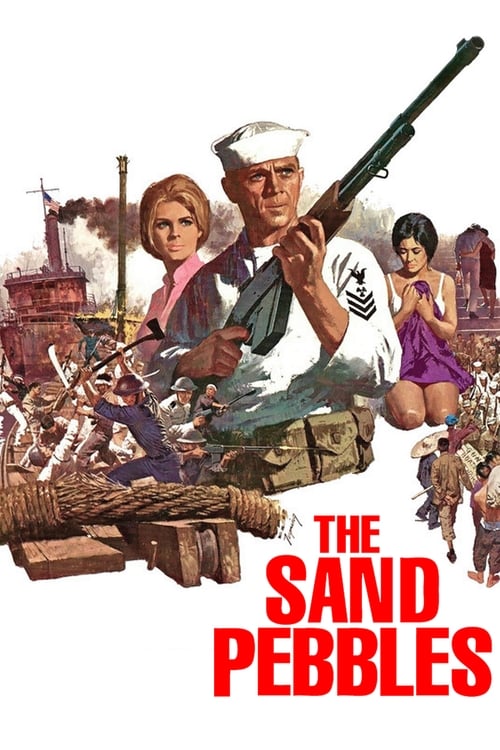
The Sand Pebbles

Steven Clark

3,612 words

Trevor Lynch can wax eloquent over Lawrence of Arabia and The Bridge Over the River Kwai, but when I choose a great movie hero from that era, forget Lawrence or Lt. Colonel Nicholson; my man is Jake Holman (Steve McQueen) in Robert Wise’s 1966 The Sand Pebbles, an epic action film examining a common man whose performance by Steve McQueen is an excellent depiction of a true, common, American.

Jake Holman is in the China of 1926, a machinist’s mate assigned to the San Pablo, a gunboat on duty in the backwaters. As Holman later tells prim, unsure novice missionary Shirley (Candace Bergen), it ain’t your brother’s navy.

Holman checks into a hotel in Shanghai on his way to his new ship, and the owner, an ex-sailor who’s retired and keeps Chinese women and children under his wing, warns Holman gunboats are nothing.

Holman cocks back. “They got engines, ain’t they? Then they ain’t nothing.”

Holman is a loner, devoted to machines and keeping them in shape.

He’s indifferent to politics. At a heated table discussion where men debate what to do with China, he’s uneasy. One Englishman urges they crack down on the simmering Chinese. A missionary, Jameson (Larry Gates), argues China must be allowed to be free, and foreign powers should leave. After some drawing room arguments, Holman is asked his two cent’s worth, and shrugs. “It’s all look-see pidgin. Just something for the officers.”

He enters the world of the San Pablo in darkness, his navy whites almost angelic as he totes his seabag and hammock with confidence. On ship, he is noticed: by the chief petty officers, the Captain, Lt. Collins (Richard Crenna), and Frenchy (Richard Attenborough). Frenchy strikes up an immediate friendship with Holman, clueing him in on how the rice bowl works. That’s the system of coolie labor on ship where Chinese do all the hard work, and the sailors . . . do what? Mostly stand around and show the flag, and practice repelling boarders, much to the delight of a Chinese crowd who watches their Kabuki war with all the glee of a stage play. The Chief Petty Officer waves a cutlass and goes “aargh!” Kids squeal with delight as American use of force becomes a use of farce.

This recalls George Orwell’s essay Shooting an Elephant, where Orwell said the white man was always onstage before a native audience, aware he could not look weak, and was forced to play a part of master. Something he thought corrupted native and white alike.

The rice bowl is a system of parasitic behavior that once may have been altruistic, but has corrupted sailor and Chinese, eventually weakening the host. Think slavery and the south. Think South Africa. Think “cheap labor.”

Holman doesn’t like the rice bowl. He refers to shave himself, carry his own gear, and maintain the aging, powerful ship’s engine without coolies all over the place, especially the chief engine coolie, a resentful man who carries a heavy wrench more as a badge of office than a tool. When Holman came on board the San Pablo, the first thing he did was inspect the engine room, in a scene showing him silently feel, stroke, tap the machinery, finally smiling and saying quietly “Hello engine. I’m Jake Holman.”

The crew call themselves the sand pebbles, and Holman is like a rock dropped among them. The crew is happy with the good life, but Holman is an engineer, and Collins can’t go on missions to show America’s strength and determination unless the engine’s shipshape. He’s determined to show the flag. As he tells the crew, “It is we who will take the first shock . . . and buy time with our lives.” A stirring call to arms while the rice bowl goes on around him. It is a prophetic line, but to Holman another example of “look-see Pidgin.”

The tension between Holman and Collins begins the moment the San Pablo sails off and Holman makes it stop because the engine is ready to break down. The San Pablo, a Spanish gunboat seized by the navy in the Spanish-American war and given a fresh coat of paint and a U.S. flag, shows its age. When someone has to go under the engine and fix it, Holman goes to the hatch, but the chief coolie insists, and Holman, aware of his unpopularity for challenging the rice bowl, lets the coolie crawl into the ship’s engine. A malfunctioning gear slips loose, and the coolie is crushed to death.

Holman gets cold stares from the other coolies, who blame him and think he’s an evil spirit. The crew isn’t that bad, but, except for Frenchy, see him as a Jonah.

When Collins tries to blame Holman for the coolie’s death, Holman shoots back that the engine was poorly maintained, and Collin’s system was to blame. Ouch. A staring Collins orders Holman to train a new coolie replacement, and that’s an order.

He chooses Po-han (Mako), a cheerful coolie who was attracted to him the first night Holman came on board. Despite Holman’s reservations training a “slopehead,” Po-han, following Holman’s training, learns the ropes. Holman is satisfied, and they drink coffee together.

This breaks the rules of the rice bowl. Stawski (Simon Oakland), slaps the cup out of Po-han’s hand. His girth and growl scare off Po-han, but when he turns on Holman, one quick gut punch sends Stawski to his knees.

Holman is a loner, but he stands by people he likes, and like a gunfighter, protects people he has an interest in.

He joins the crew at a local brothel, where Maily (Emmanuelle Arsan), a shy, strange, mysterious girl fascinates the sailors. She speaks excellent English, and when asked how she learned it, only says “my secret.”

Frenchy is drawn to Maily, but so is Stawski, who makes it clear he wants to bed her, but must pay two hundred dollars, since Maily is a virgin.

Holman says Po-han can lick Stawski, who roars back demanding a match. Holman agrees, and when the pot is at two hundred and Stawski licks his lips at buying Maily, Frenchy glares at Holman.

Holman, while just wanting to be left alone, is already a revolutionary, a true proletarian upsetting Collin’s universe where, as he told Holman, “we have to refer ourselves into the design of this ship.”

Collins is uneasy. Holman’s service record is excellent, but Collins notes Holman has no leadership abilities.

Holman coaches Po-han how to box. Po-han gets his clock cleaned by a gleeful Stawski, but Stawski’s size and cockiness work against him . . . didn’t Sun Tzu say you destroy an enemy by turning his strengths back upon him?

A bloodied Po-han goes for the gut, and Stawski falls. Victory is sweet, but at that moment sirens sound. A mob of revolutionaries surge down the street. The crew retreat to the San Pablo, just missing the mob’s thrown torches.

The revolution in China, a game of musical chairs between the communists, Chiang Kai-shek’s nationalists, and any number of warlords, now heats up.

Gunboat diplomacy is put to the test as Collins is sent to retrieve missionaries for their own safety, and sends Ensign Boudelle (Charles Knox), his second-in-command to China Light, where Jameson has refused to leave. Holman goes along and meets Shirley, now adjusting to life in China. She partly wears Chinese dress, speaks Chinese as she orders students guarding the mission to relax. She’s happy to see Holman, showing him a generator and beet machine sent to Jameson by an altruistic America, but no one knows how to operate them.

Those students are led by Cho-jen, a student who is has ostensibly arrested Jameson so he can stand trial in the regional capital.

As they proceed to the city, they stop. When they get underway, a mob charges the San Pablo chasing a terrified Po-han. The chief coolie on the ship slyly tells Collins he sent Po-han ashore on an errand. Po-han is captured, strung up, and the crew, Holman, and the missionaries look on as he is tortured to death.

To open fire might start a war the communists and nationalists are yearning for. Collins offers money for Po-han, and the mob gleefully ignores him. He raises the price, recalling the bidding for Maily in the brothel.

Holman, furious, leaves his post. He’s ordered back.

“Do something,” he orders Collins.

Collins keeps up the useless bidding as Po-han screams. Jameson, the great idealist, can only look on and lower his head. Shirley’s tearful eyes plead to Holman. Holman is ready to burst. He approaches the bridge, stopped by a staring Boudrelle. Holman won’t budge.

“Get back to your post,” Collins orders, “or I’ll have you shot for a mutineer.”

Holman sneers. “Well, shoot something!”

Po-han’s screams fill the air. The chief coolie says Po-han is begging to be shot. Holman grabs a sailor’s rifle, shoves him to one side, and coldly adjusts the sights as carefully as he works his engine. When Collins orders Holman to stand down, Holman aims, takes a moment to show his shock, then pulls the trigger and Po-han drops like a broken puppet. Music breaks out in a crescendo as Holman, looking at rifle with disgust and a quick jerk of his body, throws it overboard.

He stalks below deck to the engine room. Coldly, mechanically, he begins to shovel coal, using more and more force until he bends over and cries.

It’s a turning point for Holman.

Back in the city, Collins orders Boudrelle to escort the American missionaries to the consulate. They do this, only to find Nationalist troops under a grim Major Chin (Richard Loo), lowering the stars and stripes and commandeering the consulate as army headquarters. Unlike the neophyte revolutionary Cho-jen, Chin is a tough old boar. Boudelle orders Chin to leave American property. Chin openly refuses as he stares down the young ensign and calls his bluff. Quoting American revolutionaries, Chin says “if you mean to have a war, let it begin here.”

I was reminded of Hilary Belloc’s quip about colonialism imposed upon the natives: “Whatever happens, we have got/The Maxim gun and they have not.”

Chin shows what happens when they have the Maxim gun, and orders

Boudelle to vacate the consulate. Holman, on the detail, sees Boudelle cave. Chinese troops have the sailors outnumbered, and the Consul assures Boudelle all will be fine. Chin offers an escort back to the San Pablo, where the city turns out to heckle, jeer, and toss garbage at the sailors.

The humiliated and furious sailors tell the coolies not to wash their garbage-strewn uniforms but burn them. All except Holman, who wants his cleaned.

The sailors are now restricted only to the brothel. Frenchy has the two hundred to buy Maily, but a drunken, loutish bunch of American merchants won’t let go of her and start a bidding contest (an echo of Collin’s doomed attempt to buy Po-han’s life) Frenchy can’t win. When they raise the ante by stripping Maily, Frenchy goes wild, Holman joins him in a bar melee and gets Maily out.

Frenchy offers to marry Maily. They have no benefit of clergy, but Holman and Shirley are witnesses.

It’s a lousy time to fall in love, especially since Frenchy can’t marry a non-white woman, and the revolution is castigating foreign devils, but Frenchy hopes.

Shirley hopes as well. Holman shrugs, having his doubts. He’s not a joiner nor a believer but is starting to see something beyond the simple life he’s lived in the navy.

This develops as he gets to know Shirley. They walk together. He opens up about his past as he rows her in a lake; interesting how it’s on water that he tells her how for him it was the navy or jail. It’s a winter courtship in halcyon days, the mood soft and contemplative. Possibilities seem to appear, like the pebbles he and Shirley toss on a stone elephant. If your pebble lands on its back, you get a wish.                                Holman gets Shirley to buy a bird in a cage, the purpose being you will free it and feel good. She’s wanting to feel good, having told Holman she came to China because she wanted to be swept up by something.

But the revolution is doing the sweeping here, and everyone is about to get swamped. Shirley’s sad and poignant hope is based on pebbles tossed up to a stone elephant. Holman’s world is that of water; uncertain and impermanent.

Yet Shirley hopes for something better, and after Frenchy and Maily leave the chapel, she closes in on Holman. Like Maily, her hair is bunned. She wears western dress, as if she, too, is ready for a husband. Holman says Frenchy is fooling himself. It’s not going to last. Shirley kisses Holman. He’s stunned, returns her affection, but is open-eyed as they embrace.

“It ain’t gonna work,” he warns her, although his pained eyes say he wants it to.

She asks him to come back with her to China Light. He could make the machines function. He could teach the Chinese how to use them. Yes, he could.

But the siren from the ship sounds, breaking this peace, this hope.

Opium is discovered on the San Pablo. The Chinese mob, recalling the old curse of opium and the western intervention it brought, are seething. Collins restricts the crew to the ship. The coolies jump ship. The rice bowl is broken, and from now on, the sailors must do their own chores.

Amidst the chanting demonstrators in their sampans, another boat departs upriver carrying a smiling, waving Jameson, freed by the court. The mob cheers him. Shirley stands aft, away from her mentor, staring at Holman. He stares back.

One night Frenchy jumps ship. Later, Holman is on courier duty and on the way back to the dock, checks in on the couple. Frenchy is dead from pneumonia.

Maily had sobbed to a dying Frenchy that there was no hope for her. She wasn’t Chinese nor American. The missionaries made her into nothing.

This at the same time Jameson proudly declares himself to be stateless, and despise all nationalities, is ready to become Chinese.

Holman tells a distraught Maily she has to come with him. He’s getting out and going to China Light. She’ll be safe there.

Too late. Rioters break in, attack Holman and, as he’s being worked over (these Chinese, the new ones of revolution, know how to fight), one of them murders Maily. Holman escapes, but the next day the mob at the blockade accuse Holman of murder and demand he turn himself in.

Collins tells the mob to get lost. The crew, ready to crack, chant for Holman to surrender (recalling the American merchants chanting to strip Maily in the brothel) and are on the brink of mutiny when Collins fires a machine gun into the water, snapping the crew back to their duty.

The water in the harbor rises, and Collins orders the ship out. After a major conflict at Nanking, he has orders to rescue Jameson and Shirley at China Light, and is almost hypnotized in completing this mission. Before, he had his pistol out, staring at it. While Holman took a rifle and threw it away, Collins is ready to eat his gun.

In Collins there is a swirling sense of failure, duty, and determination. The speech he gave at the start of the film about the flag now seems to dominate his actions, as well as his cold, glazed eyes dressing down Holman. We must refit ourselves into the design of this ship. Collins will do that, and orders full speed ahead.

The river is blocked by a line of Chinese boats and cable. Collins orders battle stations. The San Pablo blasts its way close enough for a boarding party to cut the cable, and it’s a wild melee. Collins, cutlass in hand, leads the attack.

Holman joins him. The Chief Petty Officer, the man who brandished his cutlass in the semi-comic drill at the start of the film, leads the second wave and is dropped with a single shot. Holman uses his BAR to wipe out the attack, and when a sailor dies, he takes the axe and cuts the cable, killing Cho-jen when he tries to kill Holman.

The San Pablo makes it to China Light. In the dark, Collins, Holman and two sailors are there to bring Jameson and Shirley to safety, but Jameson refuses. He reminds Collins he has declared himself stateless. Romantic nonsense, Collins says: he’ll be killed, as will Shirley, after she’s been raped.

At this point Holman tells Collins he’s not going back. He’s had enough.

Before Collins can react, we hear Chinese troops in the dark. Unlike Cho-jen’s Boy Scout troop of marching students with sticks, these unseen men in the dark mean business.

When Jameson approaches the unseen soldiers waving his paper of statelessness, they gun him down. Collins now lives up to his speech early in the film and must buy time with his life. He’s almost reckless in his attack, perhaps seeking death . . . which he finds. Holman takes over. He tells the sailors to get Shirley out while he covers their retreat. He couldn’t save Po-han, he couldn’t save Maily, but he can save Shirley. She’s tearful as sailors drag her away, and Holman, in a ritual imitation of Collins, fights off the Chinese, only to be shot. He bleeds, propped against the boxed machinery he could have made run. “We were home,” he cries out, “What the hell happened?”

A final shot keels him over.

The Sand Pebbles is a movie rich in action, drama, and a theme of imperialism and rebellion, showing individuals walled in and crushed by this conflict. Running at two and half hours, it doesn’t feel slow at all, and the music is effectively used at certain points, like the punches Holman tells Po-han to make in the fight.

Richard McKenna, the author of the novel, wrote from experience. He was a machinist in a gun boat in the U.S. navy’s China fleet of the 1930s, not the 1920s. You feel the grit of authenticity of this world and how men like Holman are coaxed out of their chosen occupations only to see any alternatives dashed by the intervention of human forces beyond his control. The movie offers a tragic view of life. Not depressive, but honest and unflinching.

Released in 1966, The Sand Pebbles was immediately seen as an interpretation of Vietnam, much as The Charge of the Light Brigade was (see my review), but both films offer a timeless view of war and the conflict of peoples.

The Sand Pebbles feels just as real now as when it was first released, and the struggle of peoples and races are more than ever relevant. Maily’s impassioned outcry that the missionaries made her nobody with nowhere to go, and Jameson’s

Lofty but ultimately suicidal stance of statelessness in the midst of a civil war are always a subject for discussion, as is Collin’s almost fanatical stand for an American patriotism that is pointless in a totally foreign place like China.

The film recalls debates over China American businessmen and journalists had at that time. There was endless speculation over the China market; how hundreds of millions of Chinese would buy Model-Ts, toasters, whatever, and secure an endless American prosperity. Or the stern dictates of Henry Luce, who proclaimed it was America’s duty to Christianize China.

I remembered all the debates how America “lost” China to communism, although, as any thinking person would realize, China wasn’t ours to lose because we didn’t own it.

In the end, China became modernized, but on its own terms, not ours, because before they could become happy consumers, China had to straighten out a political mess when their empire collapsed from corruption, bureaucratic ossification, and foreign intervention. It is the personal tragedies in the film that Po-han and Maily, two people who might have become middle-class leaders, were destroyed both by foreign imperialism and a revolutionary urge to cleanse China of ‘running dogs,’ no matter who had to die.

China, as I said, will modernize on its own terms and not as an accessory to global capitalism. If anything, we could wind up as an accessory to China. If the west loses its sense of purpose, Chinese gunboats or their equivalent could patrol an America fragmented, ruptured, with perhaps some parts welcoming a China imposing stability and ending black lawlessness, ‘Woke’ madness, and a government printing warehouses full of money to spend on the next war . . . a splendid mirror image of what the 19th century did to this magnificent empire.

Regardless of geopolitics of then and possibly to come, The Sand Pebbles is a great film with spectacle, compelling scenes, and solid action. In addition to this, it is the Steve McQueen movie. His Holman propels the story and never fails to get our empathy and interest. McQueen does so much just with gestures or expressions. He was an unusual actor who always wanted his dialogue cut because he said he didn’t need most of it. The Sand Pebbles is a masterful example of this. From the first long shot of him toting his gear, he commands the movie. In the end, his Jake Holman is a wonderful everyman and, if we want to wax socialist here, a heroic laborer. Holman’s Do something! Was the true cry of the Trump supporter.

People of all persuasions should enjoy this great, epic film. It hasn’t got sand or snow like Lawrence of Arabia and Dr. Zhivago, but it has China, a long, vast river that mirrors life’s journey, and McQueen.

*  *  *

Counter-Currents has extended special privileges to those who donate $120 or more per year.

  • First, donor comments will appear immediately instead of waiting in a moderation queue. (People who abuse this privilege will lose it.)
  • Second, donors will have immediate access to all Counter-Currents posts. Non-donors will find that one post a day, five posts a week will be behind a “paywall” and will be available to the general public after 30 days.

To get full access to all content behind the paywall, sign up here:

The Sand Pebbles

The%20Sand%20Pebbles

Share

  • Gab

Enjoyed this article?

Be the first to leave a tip in the jar!

Instant Echeck GreenPay™

Related

  • Kolberg: The Last Nazi (or Prussian?) Film 

  • China’s Threat to American Security

  • The Crisis of Chinese Technology Thieves

  • The Russians are Coming/The Russians are Coming

  • China’s Quiet Hand:

  • Lewis Strauss Did Nothing Wrong:

  • The Selective Memory of Empire:

  • Le Debacle: Historical Echoes of Zola’s France

Tags

Chinacolonialismmovie reviewsSteve McQueenSteven ClarkThe Sand Pebbles

10 comments

  1. Peter Quint says:
    July 22, 2021 at 6:44 am

    Great white nationalist film, about time someone did a review of it. Jake Holman is shocked at the inroads the Chinese have made into the “Sand Pebbles” infrastructure, and does something about it. The last scene where two white men escape with the last white woman is one that all white nationalists should ponder.

    0
    0
  2. Captain John Charity Spring MA says:
    July 22, 2021 at 6:47 am

    Do, Africa Queen. Only Catharine Hepburn is a Shemima Bugum style terrorist encouraging a cynical Canuck to turn his livelihood pride n joy into a Torpedo. Bye the Bye the crew of the German boat on Lake Tanganika were almost all Askari black fellows. Rosey the Terrorist.

    0
    0
  3. Traddles says:
    July 22, 2021 at 8:46 am

    “The Sand Pebbles” is an unforgettable movie.

    I agree with you about Steve McQueen’s acting.  He really was superb in several movies, as a laconic tough guy who also showed kindness and decency.  Other McQueen roles which I especially liked were in “The Great Escape,” “Baby the Rain Must Fall,” and “Le Mans.”  In “Soldier in the Rain” he isn’t as convincing, but it’s a little-known movie with Jackie Gleason that is very worthwhile.  Jerry Mathers, of “Leave It to Beaver” fame, wrote how the real McQueen was kind to him and other child actors in Hollywood.

    I wouldn’t quite call McQueen’s character in this movie a “common American.”  Holman comes from a rough background, raised by a single mother, which was a much less common family situation at that time.  He drifts into juvenile delinquency before being strong-armed into the Navy.  Holman/McQueen does show the no-nonsense attitude that once WAS a common American trait, though.

    I found Richard Crenna’s character to be sympathetic, although a conflicted man somewhat as you described.  His mission to China Light does at least save the life of the American girl.

    The combat scene on the river is riveting and gut-wrenching.  Much more impressive to me than the special-effects dominated combat scenes of later movies.

    And in this world overrun by madness, I often find myself repeating Holman’s last words.

    0
    0
  4. James J. O'Meara says:
    July 22, 2021 at 10:04 am

    Excellent review. I only recall seeing SP on a black and white TV in the 60s, (one of those network “Night at the Movies” no doubt) and will definitely have to check it out again in a better format.

    For more on McQueen’s Stoic presentation of manhood, and Le Mans in particular, may I suggest checking out my “St. Steven of Le Mans: The Man Who Just Didn’t Care,” here on Counter-Currents (https://counter-currents.com/2016/04/st-steven-of-le-mans/); it’s so excellent it made it into my new film book, Passing the Buck (Manticore, 2021).

    0
    0
    1. Max West says:
      July 28, 2021 at 5:07 pm

      I went on a McQueen kick a few months ago, checking out many of his films.

      “Le Mans” is highly underrated. It was a Steve McQueen passion project that bombed at the box office, but improves with age. The theme of racing as a male bloodsport (riveting racing sequences), an end-in-itself, and the sparse dialogue, give the movie a 60s-Euro-cinema feel, its existentialist undertones effectively (and emotionally) conveyed through faces. This is buttressed by the emotional subplot involving a dead racer’s lonely wife.

      0
      0
  5. Lord Snooty says:
    July 22, 2021 at 4:34 pm

    Leader of the House of Commons, Jacob Rees-Mogg, has just had to apologize for using the expression “Yellow Peril”. That gave liberals an opportunity to indulge their favorite pastime: feigning outrage. The original use of the term – associated with Oswald Spengler, Sax Rohmer’s The Insidious Dr. Fu-Manchu, Lothrop Stoddard – was to warn of China’s (also Japan’s) growing ability to challenge western domination.

    Liberals, one hundred years ago, probably regarded talk of a yellow peril as they today regard talk of The Great Replacement: a paranoid right-wing conspiracy theory. They should have listened to Boris Karloff: “Men of Asia! The skies are red with the thunderbolts of Genghis Khan! They rain down on the white race… and burn them!”

    0
    0
  6. S. Clark says:
    July 22, 2021 at 4:46 pm

    James: You haven’t seen The sand Pebbles in color?? I saw it at my movie theater in 1966. You can easily check the movie on Youtube. It’s a film that made the most of  a wide screen and locations.

    If you get the DVD, there’s an enjoyable commentary with Robert Wise, Mako, and Candace Bergen. Wise’s comments on how they made the boat and engine are pretty entertaining.


    Peter Quint: I thought it good that Collins and all the sailors assume Shirley would be raped and killed, and wouldn’t let that happen. A lot of movie characters today probably wouldn’t care.

    I remember in Animal House when the frat guys take their girls to a juke joint to hear some black guy do the R&B, and some blacks come up, scare the frat boys, and they take off, leaving the girls to the blacks. I suppose this was supposed to be funny, but I found it disgusting.   But of course Jews made the film, so we see a subliminal message here.  I’m not a big fan of Animal House. I think a lot of gross movie stuff came from that film and it spawned a dozen or so imitations, so if I ever review it, it’s going to get a whipping.

    0
    0
  7. 3g4me says:
    July 23, 2021 at 11:22 am

    I remember watching The Sand Pebbles on tv as a child with my father.  And surprisingly enough, I remember most of the plot and my tears at the end.

    The rice bowl on board ship where the locals do all the work for the sailors very much reminds me of the US Embassy system of employing “Foreign Service Nationals,” i.e. local citizens of whatever country who keep any given embassy running.  They are given extraordinary access to all sorts of information and responsibility.  A movement to restrict some of their incursions was made not long before I left the government, but the American secretaries and supposed workmen brought in were nothing more than incompetent grifters who at once both aped the diplomats and were scorned by them as badWhites.  Point being, most Foreign Service Officers and American corporate executives who live overseas enjoy living like pashas and imagine themselves far above such petty concerns as nationality and loyalty.  A pox on them all.

    0
    0
  8. speedoSanta says:
    July 25, 2021 at 3:28 pm

    Yeah, it is a great movie, one of my favorites.  One of the best aspects of the movie is the moral  of the story:  how the sailors on the San Pablo are gradually seduced by the coolies (the cheap Chinese labor).  They readily turn over all the dirty work to the coolies, who probably do a better job of it than the lazy Sand Pebbles.  Underneath the gleaming facade however, the ship’s engine has a serious defect that only the dedicated and knowledgeable Jake Holman is willing and able to correct.  The crew mostly become dependent on the coolies to the point that they can no longer do the work themselves, as is apparent when the coolies jump ship in the middle of the crisis, and the ship turns from a spiffy white gunboat into a dirty, rusting hulk.

    I was impressed that the book was written decades before the United States itself became dependent on cheap Chinese labor.  Very prophetic.  Maybe it was also prophetic that the crew wound up hating Jake Holman.  Half the country wound up hating Donald Trump who was also willing to get dirty to fix the “American engine”.

    0
    0
  9. Francis XB says:
    July 28, 2021 at 1:11 am

    This is the critical scene:

    Chin shows what happens when they have the Maxim gun, and orders Boudelle to vacate the consulate. Holman, on the detail, sees Boudelle cave. Chinese troops have the sailors outnumbered, and the Consul assures Boudelle all will be fine. Chin offers an escort back to the San Pablo, where the city turns out to heckle, jeer, and toss garbage at the sailors.


    That Hegelian moment where the two warriors confront each other under arms…and one blinks.


    Up until this point in the film, the Sand Pebbles had been the Masters of the Universe. They provided protection, prestige and pay to their Chinese retainers. But with Boudelle’s capitulation, the balance of power has changed. The contempt the Chinese then shower upon the retreating shore party shows their shift of loyalty to the new big warrior on the veldt.


    This is why “stands” such as Bunker Hill, the Alamo and even Custer’s at the Little Bighorn resonate among real Americans. And Camerone and Rorke’s Drift for French and British. Soldiers stood, fought, and even if they did not win…created a legend. The 6 January 2021 patriot occupation of the US Capitol can be seen as a stand against the Regime. Same with Kyle Rittenhouse and others who made their stands against the 2020 rioters. This is why the Regime response was to go nuts. No one can challenge its status as the Big Man. So they have to rig the game. In a fair fight they wouldn’t have a chance.


    Orwell is right about when the White man chooses to be the master it does lead to a certain corruption. The dilemma is that when the White man steps down from master status someone else muscles in. What was true on the Yangtze in the 1920s has played out in South Africa, Malmo, Rotherham, the Calais jungle, and the mean streets of Kenosha.


    The movie follows fairly close to the narrative of the book, though there is a part in the middle where the San Pablo fights river pirates which did not make it to the silver screen (it would have duplicated the final battle for dramatic effect). In any event, Steve McQueen hefting a Browning Automatic Rifle is an iconic image for White Warriors.


    Time to make a stand.

    0
    0

Comments are closed.

If you have a Subscriber access,
simply login first to see your comment auto-approved.

Note on comments privacy & moderation

Your email is never published nor shared.

Comments are moderated. If you don't see your comment, please be patient. If approved, it will appear here soon. Do not post your comment a second time.

Writer of June

(4 votes) David M. Zsutty

Article of June

Why White Advocates Should Avoid “Based Blacks” by Dani Vypont 4 votes
    • Replacement Migration & Hypergamy

      F. Roger Devlin

      12

    • Kurds of a Feather Flock Together:
      Europe’s “Racist” Parakeet Tweet-Storm

      Steven Tucker

      1

    • Elevator Pitch to a Billionaire
      Money, Money, Money

      Ondrej Mann

      1

    • All Hail Rhodesia

      Spencer J. Quinn

      2

    • Nationalism This Week
      Disenfranchisement

      Greg Johnson

      28

    • The Murder of Ann Widdecombe

      Lipton Matthews

      9

    • Disclosure Day
      Please, Keep It Undisclosed

      Francisco Albanese

      10

    • Remembering Carl Schmitt
      July 11, 1888–April 7, 1985

      Greg Johnson

      1

    • Editor’s Update
      Fundraiser Update & New Books

      Greg Johnson

      1

    • Third Homeland Institute Poll on the Great Replacement

      David M. Zsutty

      11

    • The Bitter End of Western Metaphysics:
      Heidegger on Nietzsche, Part Five (Conclusion)

      Collin Cleary

      9

    • Fraudulent Black British History

      Mark Gullick

      7

    • A White Nationalist Response to Scott Greer

      Dave Chambers

      25

    • The Miami Mall Incident:
      Black Youths or Black Extraterrestrials?

      Dominic Fox

      6

    • The Theology of Three Populisms

      Morris van de Camp

      2

    • The Dangers of Skilled Immigration

      Lipton Matthews

      25

    • The Brotherhood of the Bell

      Beau Albrecht

      16

    • Endeavor: What Rome Means to Me

      Endeavour

    • When the Family Becomes Predation

      Jayant Bhandari

      5

    • RICU: The Gentle Art of Persuasion

      Mark Gullick

      7

    • Mind of Darkness:
      A Review of Lipton Matthews’s Busting African Delusions

      Derek Stark

      12

    • Remembering Revilo Oliver
      July 7, 1908–August 20, 1994

      Greg Johnson

      2

    • Some Advantages of Irish Nationalism

      Greg Johnson

      30

    • America at 250 from the National Cathedral

      Gabriel Anderson

      18

    • Why Not Stop All the Clocks?
      Modern Conservatism’s Flagging Commitment Towards Turning Back Time

      Steven Tucker

      3

    • Remembering Jean Raspail
      July 5, 1925–June 13, 2020

      Greg Johnson

      2

    • Editor’s Update
      Fundraiser Update & New Books

      Greg Johnson

    • The Ethnic Reality of FIFA 2026

      Samuel Valleus

      13

    • Nationalism This Week
      Tucker’s New Party

      Greg Johnson

      30

    • Ethiopia Against Italy
      How the Italo-Ethiopian Wars were part of the conflict between Eastern & Western Christiandom

      Morris van de Camp

    • Please Vote in Our Writer & Article of the Month Poll

      Greg Johnson

    • Available for Pre-Order!
      F. Roger Devlin’s Not Hooking Up

      F. Roger Devlin

    • Kolberg: The Last Nazi (or Prussian?) Film

      Steven Clark

      2

    • America 250 & The Fate of Empires

      Richard Houck

      20

    • Available for Pre-Order!
      Greg Johnson’s The Battle of the Books

      Greg Johnson

    • Why All the Silence About Blacks Being Kicked Out of South Africa?
      Because It’s Other Blacks That Are Doing It.

      Steven Tucker

      10

    • Zelensky, the Jewish Conspiracy Narrative, & the Demographic Replacement of Ukraine:
      A Critical Analysis of a Disinformation Discourse within the European Identitarian Right

      Luís Graça

      30

    • The Original Congressional Debate on Birthright Citizenship

      Alex Graham

      13

    • America at 250
      Unmanifested Destiny  

      David M. Zsutty

      32

    • The Normies are Waking Up:
      The Alliance for Responsible Citizenship Conference, London 2026

      Lipton Matthews

      2

    • Ethnic Vigilantism: The Movie

      Mark Gullick

      15

    • Lothrop Stoddard’s The Revolt against Civilization

      Kevin MacDonald

      2

    • David Zsutty on Political Organizing

      David M. Zsutty

    • PC-Incompatible Gaming:
      Plantation Simulator and the “Problem” of Racist Video Games

      Steven Tucker

      3

    • Remembering Lothrop Stoddard
      June 29, 1883–May 1, 1950

      Greg Johnson

      1

    • Editor’s Update
      Fundraiser Update & Upcoming Projects

      Greg Johnson

    • Nationalism This Week
      Metapolitics Wins:
      Scott Greer’s Whitepill

      Greg Johnson

      8

    • Remembering Colin Wilson
      June 26, 1931–December 5, 2013

      Greg Johnson

      3

    • Kevin Deanna on Political Organizing

      Kevin Deanna

      1

    • The Bitter End of Western Metaphysics:
      Heidegger on Nietzsche, Part Four

      Collin Cleary

      6

    • Dani Vypont

      Replacement Migration and Hypergamy

      I once had a Norwegian nationalist ask me to tell him the degree of mixing between White women &...

    • Dani Vypont

      Replacement Migration and Hypergamy

      Both of those sources rely on marriage data. The first one is titled "Intermarriage in America Post-...

    • James Sunderland

      Replacement Migration and Hypergamy

      Here is analysis conducted using U.S. Census Data. You can't get better than this: https://www....

    • Hairy Iranian Dude

      Replacement Migration and Hypergamy

      I love Norway. It’s a real country (used to be?). I was there for six days in 2018: Oslo and Bergen...

    • Dani Vypont

      Replacement Migration and Hypergamy

      In the U.S., white woman have the lowest rate of miscegenation across all intersections of race and...

    • Glide Ratio 0:1

      Replacement Migration and Hypergamy

      This is one hundred percent my observations moving from England to the USA. White American females...

    • Fionn McCool

      Replacement Migration and Hypergamy

      It would have been good if FRD had offered some statistics to support his claim rather than mere...

    • Greg Johnson

      Disenfranchisement

      People constantly bemoan the fact that old politicians send young men to die in wars. I guess that...

    • Peter Quint

      Replacement Migration and Hypergamy

      Sounds like Norway needs its own Casa Pound. 🦈

    • Peter Quint

      Replacement Migration and Hypergamy

      Maybe, it is because White American women have had to deal with it for a much longer time than the...

    • Glide Ratio 0:1

      Disenfranchisement

      Like Radbod said "I would rather spend eternity in hell with my ancestors than in heaven with...

    • Greg Johnson

      Disenfranchisement

      The first step is to document this in an article. Then we will get it circulating. It will bring...

    • Beau Albrecht

      Replacement Migration and Hypergamy

      I can't even begin to finish reading this.  I'll just say that the orcs need to be sent back to...

    • Beau Albrecht

      Europe’s “Racist” Parakeet Tweet-Storm

      This is for real?  It seems that leftist ideology has become a parody of itself.  The pearl-...

    • Beau Albrecht

      All Hail Rhodesia

      The author is spot-on with this.  Rhodesia did at one time have an offer to join South Africa, but...

    • James Sunderland

      Replacement Migration and Hypergamy

      “Speaking more generally, women are less loyal to the tribe into which they are born than are men...

    • Peter Quint

      All Hail Rhodesia

      Great article! Instead of writing novels about time travelers meeting Enoch Powell, and going back...

    • Gabe

      Replacement Migration and Hypergamy

      “Seeing themselves on the bottom of the local totem pole, some of these Norwegian boys have actually...

    • Mcdringle

      Some Advantages of Irish Nationalism

      'Their progenitors were born into a world that could not feed their flesh other with the almighty...

    • Will Martin

      Disenfranchisement

      Can't even pass the SAVE act, but again, declining Whites are somehow going to disenfranchise...

    • Earth Day Special

      John Morgan

      12

    • A Robertson Roundup
      Remembering Wilmot Robertson
      (April 16, 1915 – July 8, 2005)

      Margot Metroland

      13

    • The Paranoid Style in White Nationalism

      Greg Johnson

      30

    • Join the Dance!

      Andrew Hamilton

      1

    • We Can’t Save the Earth Without Reducing African Birth Rates

      James Dunphy

      36

    • “I’m Not a Conspiracy Theorist, but . . .”:
      Jeffrey Epstein’s Death Gives New Life to “Conspiracy Theories”

      Greg Johnson

      22

    • Sylvia Plath: Stasis in Darkness

      Vic Olvir

      17

    • Vanguardism, Vantardism, & Mainstreaming

      Greg Johnson

      80

    • Aviation, Geography, & Race

      Charles Lindbergh

      3

    • Some Thoughts on Yule

      Collin Cleary

      4

    • Living in Truth:
      A Yuletide Homily

      Jef Costello

      7

    • John Kennedy Toole’s A Confederacy of Dunces

      Greg Johnson

      20

    • On Aleksandr Solzhenitsyn’s Warning to the West

      Spencer J. Quinn

      7

    • Elitism, British Modernism, & Wyndham Lewis

      Jonathan Bowden

      6

    • Philip K. Dick’s Do Androids Dream of Electric Sheep? as Anti-Semitic/Christian-Gnostic Allegory

      Greg Johnson

      20

    • “Conspiracy Theory” or Conspiracy?

      Andrew Hamilton

      21

    • Remembering H. P. Lovecraft
      (August 20, 1890–March 15, 1937)

      Greg Johnson

      3

    • Who Are We?
      Nordics, Aryans, & Whites

      Greg Johnson

      71

    • Remembering William Gayley Simpson
      (July 23, 1892–December 31, 1990)
      A Pleasant Afternoon with Harriet & Bill Simpson

      Margot Metroland

      18

    • Here are the Young Men
      Remembering Ian Curtis
      (July 15, 1956–May 18, 1980)

      Mark Gullick

      18

    • Percy Grainger
      Artist of the Right

      Alex Graham

      7

    • Remembering Revilo Oliver
      (July 7, 1908–August 20, 1994)

      Greg Johnson

      18

    • The Meaning of July 4th for the White Man

      Gregory Hood

      13

    • The Front National’s Evolution

      Bruno Mégret

    • Merwin K. Hart
      Forgotten American Hero & Man of the Right

      Morris van de Camp

      10

    • George Orwell’s Nineteen Eighty-Four

      Jonathan Bowden

      8

    • Carleton S. Coon
      Scientist & Reluctant White Advocate

      Morris van de Camp

      4

    • The Kwanzaa Absurdity Will Be Dwarfed by Juneteenth

      Robert Hampton

      12

    • Stravinsky

      Alex Graham

      7

    • Like the Roman:
      Remembering Enoch Powell (1912-1998)

      Mark Gullick

      23

    • Exclusive Interview with Karel Veliky:
      The Final Chapter in the Film Series! Part II

      Ondrej Mann

      2

    • Exclusive Interview with Karel Veliky:
      The Final Chapter in the Film Series! Part I

      Ondrej Mann

      2

    • Nietzsche & Race

      Mark Gullick

    • The Crisis of Chinese Technology Thieves

      Morris van de Camp

      1

    • The Zodiac Killer

      Mark Gullick

      12

    • José Pedro Zúquete’s The Identitarians

      Greg Johnson

      3

    • Berlin: City of Stones

      Spencer J. Quinn

      6

    • Headbanging Lite

      Mark Gullick

      5

    • The Russians are Coming/The Russians are Coming

      Steven Clark

      2

    • The Cruelty of Kindness

      Morris van de Camp

      11

    • Jonathan Bowden’s Deliverance
      Part 7

      Jonathan Bowden

    • Lothrop Stoddard’s The Revolt Against Civilization

      Spencer J. Quinn

      15

    • About Film “From the Right”

      Karel Veliky

    • The 1970s: The Golden Age of Hijacking

      Morris van de Camp

      21

    • Jonathan Bowden’s Deliverance
      Part 6

      Jonathan Bowden

    • Do You Want to Play a Game?

      Mark Gullick

      1

    • Sexually Incontinent on the Indian Subcontinent:
      Who Rapes More Animals, Indians or Pakistanis? The Battle Continues!

      Steven Tucker

      3

    • Neo-Fascism in Film
      Part 5

      Karel Veliky

      15

    • The Game of Tarot

      Mark Gullick

      2

    • Institutions Cannot Be Transplanted

      Jayant Bhandari

      5

    • Jonathan Bowden’s Deliverance
      Part 5

      Jonathan Bowden

    • Crosstown Traffic:
      Jimi Hendrix & The Post-War Rock ‘N’ Roll Revolution

      Mark Gullick

      1

    • Slaves from the North:
      Finns & Karelians in the East European Slave Trade, 900–1600

      Lipton Matthews

      14

    • Neo-Fascism in Film
      Part 4

      Karel Veliky

      2

    • David Lean’s A Passage to India

      Spencer J. Quinn

      1

    • Elites are Essential to Development

      Lipton Matthews

      7

    • Jonathan Bowden’s Deliverance
      Part 4

      Jonathan Bowden

    • Neo-Fascism in Film
      Part 3

      Karel Veliky

      6

    • E. M. Forster’s A Passage to India & the Indian Mentality

      Spencer J. Quinn

      25

    • Jonathan Bowden’s Deliverance
      Part 3

      Jonathan Bowden

    • András László
    • Derek Hawthorne
    • Beau Albrecht
    • Alain de Benoist
    • Kerry Bolton
    • Jonathan Bowden
    • Collin Cleary
    • Jef Costello
    • Savitri Devi
    • Julius Evola
    • Jim Goad
    • Gregory Hood
    • Juleigh Howard-Hobson
    • Greg Johnson
    • Charles Krafft
    • Anthony M. Ludovici
    • Trevor Lynch
    • H. L. Mencken
    • J. A. Nicholl
    • James J. O’Meara
    • Christopher Pankhurst
    • Tito Perdue
    • Michael Polignano
    • Spencer J. Quinn
    • Fenek Solère
    • Irmin Vinson
    • Leo Yankevich
    • Francis Parker Yockey
    • Multiple authors
  • Editor-in-Chief

    • Greg Johnson, Ph.D.

    Featured Writers

    • Beau Albrecht
    • Gunnar Alfredsson
    • Collin Cleary, Ph.D.
    • Jef Costello
    • Morris V. de Camp
    • F. Roger Devlin, Ph.D.
    • Stephen Paul Foster, Ph.D.
    • Jim Goad
    • Alex Graham
    • Mark Gullick, Ph.D.
    • Greg Johnson, Ph.D.
    • Travis LeBlanc
    • Trevor Lynch
    • Margot Metroland
    • James J. O’Meara
    • Angelo Plume
    • Spencer J. Quinn
    • Fred Reed
    • Clarissa Schnabel
    • Michael Walker
    • David M. Zsutty

    Frequent Writers

    • Asier Abadroa
    • Aquilonius
    • Alain de Benoist
    • Kerry Bolton, Ph.D.
    • Dave Chambers
    • Steven Clark
    • James Dunphy
    • Endeavour
    • Richard Houck
    • Jason Kessler
    • Titus Livius
    • Ondrej Mann
    • Lipton Matthews
    • Mark Mazari
    • John Morgan
    • Jaroslav Ostrogniew
    • Kathryn S.
    • Christian Secor
    • Anne Wilson Smith
    • Thomas Steuben
    • William De Vere
    • Kenneth Vinther
    • Max West

    Classic Authors

    • Maurice Bardèche
    • Jonathan Bowden
    • Julius Evola
    • Guillaume Faye
    • Ernst Jünger
    • Kevin MacDonald, Ph.D.
    • D. H. Lawrence
    • Charles Lindbergh
    • Jack London
    • H. P. Lovecraft
    • Anthony M. Ludovici
    • Sir Oswald Mosley
    • National Vanguard
    • Friedrich Nietzsche
    • Revilo Oliver
    • William Pierce
    • Ezra Pound
    • Saint-Loup
    • Savitri Devi
    • Carl Schmitt
    • Miguel Serrano
    • Oswald Spengler
    • P. R. Stephensen
    • Jean Thiriart
    • John Tyndall
    • Dominique Venner
    • Leo Yankevich
    • Francis Parker Yockey

    Other Authors

    • Howe Abbott-Hiss
    • Michael Bell
    • Giles Corey
    • Jack Donovan
    • Richardo Duchesne, Ph.D.
    • Emile Durand
    • Guillaume Durocher
    • Mark Dyal
    • Tom Goodroch
    • Andrew Hamilton
    • Robert Hampton
    • Huntley Haverstock
    • Derek Hawthorne
    • Gregory Hood
    • Juleigh Howard-Hobson
    • Alexander Jacob
    • Ruuben Kaalep
    • Tobias Langdon
    • Julian Langness
    • Patrick Le Brun
    • G A Malvicini
    • John Michael McCloughlin
    • Millennial Woes
    • Michael O’Meara
    • Christopher Pankhurst
    • Michael Polignano
    • J. J. Przybylski
    • Quintilian
    • Edouard Rix
    • C. B. Robertson
    • C. F. Robinson
    • Herve Ryssen
    • Alan Smithee
    • Fenek Solere
    • Ann Sterzinger
    • Robert Steuckers
    • Tomislav Sunic
    • Donald Thoresen
    • Marian Van Court
    • Irmin Vinson
    • Book Reviews
    • Movie Reviews
    • TV Reviews
    • Music Reviews
    • Art Criticism
    • Graphic Novels & Comics
    • Video Game Reviews
    • Fiction
    • Poems
    • Interviews
    • Videos
    • English Translations
    • Other Languages
      • Arabic
      • Bulgarian
      • Croatian
      • Czech
      • Danish
      • Dutch
      • Estonian
      • Finnish
      • French
      • German
      • Greek
      • Hungarian
      • Italian
      • Lithuanian
      • Norwegian
      • Polish
      • Portuguese
      • Romanian
      • Russian
      • Slovak
      • Spanish
      • Swedish
      • Ukrainian
    • Commemorations
    • Why We Write
  • Archives
  • Top 100 Commenters
  • The Looney Bin
Sponsored Links
Europa.com Above Time Coffee Antelope Hill Publishing Paul Waggener IHR-Store Spencer J. Quinn American Renaissance Jim Goad The Occidental Observer
Donate Now Mailing list
Books for sale
  • Not Hooking Up
  • The Battle of the Books
  • The Philosopher Is In
  • Sexual Utopia in Power (Expanded Edition)
  • In Defense of Prejudice
  • Loving Our Own
  • Tyranny & Wisdom
  • To all books
Copyright © 2026 Counter-Currents Publishing, Ltd.

Paywall Access


Please enter your email address.

Lost your password?

Edit your comment

Writer & Article of the Month June 2026

Voting for this month has concluded. Here are the final results!

Top Writers

  • #1 David M. Zsutty 4 votes
  • #2 Mark Gullick 3 votes
  • #3 Morris van de Camp 2 votes
  • #4 Ondrej Mann 2 votes
  • #5 Dani Vypont 2 votes
  • #6 Greg Johnson 2 votes
  • #7 Collin Cleary 1 vote
  • #8 Millennial Woes 1 vote
  • #9 Beau Albrecht 1 vote
  • #10 Dave Chambers 1 vote
  • #11 Steven Tucker 1 vote
  • #12 Jayant Bhandari 1 vote

Top Articles

  • #1 Why White Advocates Should Avoid “Based Blacks” 4 votes
  • #2 Zsutty’s Maximum 3 votes
  • #3 The Murder of Henry Nowak 2 votes
  • #4 China’s Threat to American Security 1 vote
  • #5 Ethnic Vigilantism: The Movie 1 vote
  • #6 The Inferiority Behind Immigrant Superiority 1 vote
  • #7 Uncivil War 1 vote
  • #8 Liar, Liar, Pants on Fire! 1 vote
  • #9 Small Is Beautiful: The Napoleon of Notting Hill 1 vote
  • #10 Interview with Gerhard Hallstatt of Allerseelen 1 vote
  • #11 Monkeys and Typewriters 1 vote
  • #12 The Remigration Movement Solidifies  1 vote
  • #13 I’m Glad He Failed 1 vote
  • #14 The Killing of Henry Nowak 1 vote
  • #15 Alex Jones’ Endgame: Blueprint for Global Enslavement, Part 4 1 vote

Total votes cast: 21