In an era where reading is popularly promoted as a gateway to intelligence and success, it is necessary to interrogate the actual benefits of literacy beyond surface-level assumptions. While reading may improve verbal ability, it is not strongly associated with general intelligence (g), and its efficacy largely depends on how the knowledge acquired is utilized. (more…)

Tag: literacy
-
6,392 words
6,392 wordsThe idea that the norms implanted upon us by our families affect our personalities and our prospects in life is almost a truism. The idea that there is a strong relationship between the Western nuclear family and liberal modernity is no longer controversial, and so is the idea that different family types have existed across the world and that these types have played a significant role in the historical trajectories of the cultures of the world. Some are aware of the so-called “Hajnal line” proposed in 1965 by John Hajnal, (more…)
-

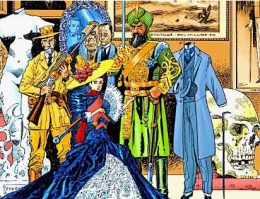
Alan Moore’s The League of Extraordinary Gentlemen: a modern take on the motifs of the weird nineteenth century.

Alan Moore’s The League of Extraordinary Gentlemen: a modern take on the motifs of the weird nineteenth century.
5,476 words
It’s ill to loose the bands that God decreed to bind;
Still we be the children of the heather and the wind.
Far away from home, O it’s still for you and me
That the broom is blowing bonnie in the north countrie. [1]Even below the Missouri-Compromise Line, the mornings now have a delicious coolness, faltering on the edge of a “chill,” and I found myself yearning for an old-fashioned, nineteenth-century ghost story. (more…)
-
8,561 words
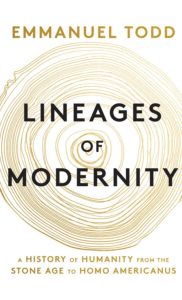
8,561 wordsEmmanuel Todd
Lineages of Modernity: A History of Humanity from the Stone Age to Homo Americanus
Cambridge, England, and Medford, MA: Polity Press, 2019Much of today’s dominant globalist ideology derives from development theory, a body of thought which shares with Marxism the view that economic relations are the basis of social life and sees the races of mankind as fundamentally equivalent beneath the superficial cultural differences which have arisen over history. (more…)
-
February 10, 2015 Greg Johnson
Critique de l’Age Axial par Jan Assmann
English original here
Dans son nouveau livre, From Akhenaten to Moses: Ancient Egypt and Religious Change [D’Akhenaton à Moïse : l’ancienne Egypte et le changement religieux] (Cairo: The American University in Cairo Press, 2014), l’égyptologue Jan Assmann dit que le concept d’Age Axial du philosophe Karl Jaspers n’est « pas une théorie mais un mythe scientifique » (p. 94). (more…)
-
January 1, 2015 Greg Johnson
Crítica a la Era Axial por Jan Assmann
English original here
En su nuevo libro, From Akhenaten to Moses: Ancient Egypt and Religious Change (Cairo: The American University in Cairo Press, 2014), el egiptólogo Jan Assmann argumenta que el concepto del filósofo Karl Jaspers de la era axial “no es una teoría sino un mito científico” (p.94).
-
In his new book, From Akhenaten to Moses: Ancient Egypt and Religious Change (Cairo: The American University in Cairo Press, 2014), Egyptologist Jan Assmann argues that philosopher Karl Jaspers’ concept of the Axial Age is “not a theory but a scientific myth” (p. 94).
According to Jaspers, the centuries between 800 and 200 BCE are a turning point in world history. During this Axial Age, Biblical monotheism and Zoroastrianism emerged in the Near East; (more…)
-
In trying to articulate the white message—I mean primarily the morality of survival, since that is presently so critical—and reach others with it, it is essential to be aware of the differences between orality, print, and electronic media. (more…)
-
Communications technologies powerfully impact how and what people think, what they view as right and wrong—even what they are capable of thinking and valuing.