2,416 words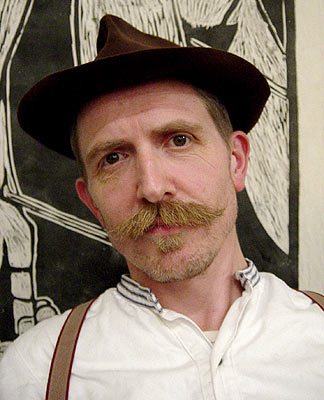
I’m a desperate man who denounces the dullness of money and status.
I’m a desperate man who will not bow down to accolade or success.
-Billy Childish, Chatham Town Welcomes Desperate Men
***
Billy Childish was born Steven John Hamper in Chatham, Kent, in 1959. His Wikipedia entry accurately describes him as an “English painter, author, poet, photographer, film-maker, singer and guitarist”. Childish says of his range of talents; “I pride myself on being an amateur in all fields. The amateur does things for love and belief, not for the mortgage”. Britain’s legendary music paper, the NME (New Musical Express, now sadly defunct) called him “the most garage and most punk rocker alive”, and The Observer (sister Sunday newspaper to The Guardian) described Childish as “a seething, dyslexic, [which he is] better-looking, British [Charles] Bukowski”.
His father left home when Billy was six years old. He is open about his past, and says that the only time his father told him he loved him was when Childish had thrown him down the stairs. But although he was missing a central role model as he grew up, he still claims his father inspired him by making the boy determined not to turn out like his dad. An uninspiring and uninspired student, Childish left school early. As he puts it in the song Archive from 1959:
I played the last of my stupid tricks.
Left school in 1976.
When punk rock arrived, Steven Hamper did what everyone did at the time and chose his punk name. He called himself Guy Claudius after the televised adaptation of Robert Graves’ novel, I Claudius. This didn’t last long, as he told a friend of his new nom de guerre and his friend replied; “You’re not Guy Claudius. You’re Billy Childish”. The name stuck.
Chatham is a dockyard town, and Childish was taken on at the local shipyard as an apprentice stonemason. He didn’t stick at the job, but it gave him a taste for creativity, and his only formal artistic training. When he became an artist, he would often paint the docks, his old workplace. He got into the famous St. Martin’s School of Art in London, left, was readmitted, and left again without graduating. As an artist, Childish never took to the company of the art world, and doesn’t much care for anything connected with fame and its pursuit. When Mick Jagger turned up at his New York art exhibition in 2022, Childish told his wife Julie (who plays bass in his band) it was time to leave, which they did. Brad Pitt collects his paintings, but Childish never mentions it.
Childish met Tracey Emin, who would later become the enfant terrible of British art by winning the prestigious Turner Prize in 1999 with her installation My Bed, which was just that, Emin’s bed in a disheveled state and surrounded by trash. Other famous and controversial works of Emin’s include Everyone I Have Ever Slept With 1963-1995. This features a tent emblazoned with the names of her various paramours, one of whom was Billy Childish. Childish claims that Emin was not an artist when he met her – his charming mother confirms this – and it is debatable, despite her being lauded by art critics, whether she ever became one.
Emin told Childish his art and music were “stuck”, and a gallery-owner friend liked the term, and decided “Stuckism” was a good name for a school of painters. Childish was in the group until the artists involved were asked to walk down the street holding their own paintings above their heads for a press shoot. He realized that a lot of the people involved were there because, “It was easy. They were just waiting for someone to sort out an exhibition”. Childish himself includes the Fauvist school as an influence on his painting. Fauvism was a brief artistic movement of the early 20th century which included Matisse. Expressionist in style and given to large canvases and an explosive use of color, the Fauvists were named for the French word fauve, which means “wild beast”. There is, appropriately, a wildness in Childish’s art which reflects both his lack of formal training and his desire to express not what he wishes to express, but somehow what art itself demands of the artist. He sometimes uses the name “Wild Billy Childish” for various projects. Childish says of his own desire to paint: “It might not be a painting I want. It might not be a painting anyone wants. But’s it’s a painting the painting wants.”
Van Gogh is a major influence, as I suspect he is for many artists, and has an odd connection with the beautiful seaside towns of the Kent coast where Childish grew up. I’ve stayed in a bed-and-breakfast hotel in the little square in Ramsgate where Van Gogh lodged during his visit to England. There was one of those National Heritage Blue Plaques on the wall opposite my room. The tortured Dutch artist walked to London from Ramsgate, “passing right above where we are now”, says Childish in a documentary. Childish is sitting in a barber chair having his hair cut in the same barber shop he has visited for over 25 years. He seems fascinated by the fact that his great hero walked above where he is sitting.
Another artist who favored the Kent coast was Turner, who was drawn by the curious quality of the light in the town of Margate. I’ve visited Margate many times and it is absolutely true. I couldn’t tell you what causes it, but the light, for a certain period of time before twilight, changes drastically, and it’s very beautiful. The same thing happens here in Costa Rica, but actually at twilight. But back to Billy Childish, working on a large painting of boats on the River Medway, and wearing working overalls with “Re-Modernist” stenciled on the back. Once a punk, always a punk.
In terms of the art world, Childish is enough of an outlier to be safe from its dark clutches, but enough of a cult name to attract an audience, whether he wants one or not. He is forthright and literate on the subject of modern art:
“The art world is the same as the rest of the world. What it requires is new, more, and now. [Much modern art] is an intellectual game that tries to lead you into an opinion or a feeling”.
Musically, Childish has had many band incarnations after his first punk band, The Pop Rivets: Thee Headcoats, The Buff Medways, The Milkshakes and, the last time I checked, The Musicians of the British Empire. He has produced over 100 albums, all on his favored vinyl. A good sampler of his brand of raw punk is the first song I heard by The Buffs (as fans called them), Troubled Mind. I have a soft spot for punk still, and I saw The Buff Medways a couple of times in Kentish Town (in London, funnily enough) getting on for 20 years ago. They made a superb racket.
Childish’s lyrics are not the shouty placardism of The Clash or the sneering anarchy of the Sex Pistols, but often charmingly English. The song Medway Wheelers is about his mother’s cycling club of the same name in the 1940s:
She joined the Medway Wheelers in June, 1944.
She grew up in Wigmore, wanted to see the big outdoors.
Cycling on a Hobb Supreme, lightweight, made to measure.
Medway Wheelers.
It’s English to a nicety, the sort of thing Ray Davies, Morrissey, or Ian Dury might have written.
Again, Childish is such an outlier in the music industry that he is protected from it, playing when he wants to play and not dancing to the tune of management, but still with a small though loyal fan base. He estimates that half of his audiences are often foreign, mostly European. These fans time their holidays to coincide with dates by Childish and his band, whatever they are called this week. Childish has a friend who is essentially a road manager – Billy drives the van – but when you see the band together there is no hierarchy, these are just mates who find each other funny and enjoy the music they create. And yet Childish has the same eclectic influence musically he has in the art world. Nirvana’s Kurt Cobain name-checked Childish as an influence on the deceased frontman’s guitar-playing, and when The White Stripes performed on the famous British show Top of the Pops, singer Jack White had “B. Childish” written on his arm in laundry-marker.
Childish was offered the chance to appear on the program Celebrity Big Brother, in which a group of famous or semi-famous people live in a house and are voted out by the viewing public one by one. He put it to the vote with the band and, as he says, “the nays got it”. Having seen how that program works, British telly-watchers (Childish does not own a TV) like nice people, they don’t like brashness or vulgar posturing. Childish would probably have won.
He comes across in various documentaries as utterly devoted to his brand of amateurism. He has a steadfast and resolute work ethic – he has produced well over 1,500 paintings – with none of the manic episodes often associated with the artist. He takes an interest in Christian and Buddhist teachings, and practices yoga. And not the type where you sit there cross-legged in a trance, but the one where you extend your leg straight out to the side like a ballerina and grab your big toe and hold that pose, the sort where you can put your foot behind your head. It doesn’t seem very punk, but look closely. Punk and its liberatory ethic run through Childish like the name of one of the charming Kent towns he lives among through a stick of rock, the candy-cane the British associate with the coast before machete fights took over as a seaside attraction. He has created an aesthetic life for himself, incredibly simple in the context of modernity, with its soma and its distractions.
It doesn’t matter if you find Childish’s paintings to be hopeless daubs, his music unlistenable, and his prose worthless. We would be better off with more like him. He embodies the dedicated English amateurism of which Orwell wrote so approvingly. He displays an infectious love of art, music, and writing, and a complete indifference to the pursuit of fame and recognition. You might say that is because he lacks talent, but the way he lives his life is his real talent. “It’s the spiritual journey that matters”, he says, “and you just have to get on with it”. Childish says he is not an artist “except on Monday morning”. This refers to the fact that he paints on a Sunday, which is when he leaves his home in Chatham and paints at his mother’s house in Whitstable. “I have to go somewhere else to paint,” he notes.
It’s also a family day out for his wife and ex-girlfriend, with whom he has a son. They all get along superbly, like an extended family should. Another talent, having a happy family. Perhaps this is an offshoot off the properly artistic life, a little reward from art.
But the reference to Monday morning suggests that Childish doesn’t feel like an artist when actually painting, but only the next day, when the work is done. Sometimes, when he arrives, he finds that his mum has cleared things away and tidied up. This doesn’t bother him because it’s her house and his studio is her front room. Childish often retouches his paintings after some time, like a sculptor going back for that one last tap at the granite.
I enjoy Childish’s art very much, but I take a strictly phenomenological approach to the visual arts. Don’t decide whether you like a painting, let the painting decide whether you like it or not. Just look at it and give your mind a couple of minutes’ coffee-break. If you over-think art, you under-see it. At least, that’s my layman’s view, aesthetics not really being my bag. But equally I enjoy the manner in which Childish conducts himself as an artist, the way he has aestheticized his life without becoming pretentious or decadent. It is inspiring to write about someone who inspires you.
Most of the documentary footage I have seen of Childish is quite old, usually at least five years ago, but I heard a recent radio interview, and he is still going strong at 66. They don’t really make documentaries for TV about white, straight, male artists anymore, so there is not much up-to-date stuff about the man. Childish is not bothered about an upcoming and unauthorized biography of him entitled Ease My Troubled Mind, after the song noted. It’s rather a silly title, because it implies that Childish is somehow a tortured soul, which he absolutely is not. Perhaps his yoga helps, but his is a rather placid nature. He put his wild days behind him, including a period of alcoholism, but kept the name “wild”. Childish says he probably won’t read the book.
The only one of his books I have read I found in a charity shop the last time I was in England and brought with me to Central America on an impulse. I’m glad I did. Notebooks of a Naked Youth reads like one of those pulp, Beat novels of the 1950s, a tale of existential and youthful angst, a punk rock Catcher in the Rye. It is the sequel to his autobiography, My Fault, published by his own small press, Hangman Books, and which he was (at least at one time) adapting as a screenplay. I would like to see a Childish movie, given that so much cinema now is just childish.
On a more trivial note, Billy Childish is also known for the hats he wears onstage: Russian bearskin, World War 2 Major’s cap, Prussian officer, a Sherlock Holmes-style deerstalker. I haven’t got enough hats to take off to Billy Childish, who has built a separate peace in the clamorous and discomforting world of modernity, a Sunday painter who has a rock band and a moustache Kitchener would have been proud of. And he is sure of who he is, which I am not sure many can seriously claim. With a tinge of Eastern wisdom blending in with English pragmatics, Billy Childish has this to say about approaching your life: “Anything you need to do will present itself to you, and then you do it.”
4 comments
I read about half of this article, it became monotonous, what is the relevance of Billy Childish to white nationalism? 🙃
Well, with respect, I’m not sure there is a statutory requirement here to stick to the relevance of white nationalism as a theme for every essay. CC has always struck me as a forum in which whites can exchange ideas, art, music, literature and so on for our general betterment. Sorry you only made it halway through. It really hots up at the end!
All this talk of his paintings with not a single one linked or embedded… I had a look via an image search, though, and they are certainly of a particular style, and very numerous. I’m not sure I like the Van Gogh look in general, but I liked some of his nonetheless.
I have to give him points for that mustache, too.
I discovered the artist Billy Childish completely by accident. I was shopping at an auction for some books by my favourite graphic artist Josef Váchal and there was a book by Billy Childish: Companions in Death Boat. The book had beautiful woodcuts of skeletons and grim reapers. These woodcuts struck my heart so much that I bought the book. Then I looked up the author and got into the art of the self-made Billy Childish. I really like outsider art, which is why I like Counter-currents.
Comments are closed.
If you have a Subscriber access,
simply login first to see your comment auto-approved.
Note on comments privacy & moderation
Your email is never published nor shared.
Comments are moderated. If you don't see your comment, please be patient. If approved, it will appear here soon. Do not post your comment a second time.