 1,070 words
Growing up in a suburban commuter colony of Canada’s federal capital in the 1980s was good, for the most part. The first house that I lived in was an attached garden home in a brand-new neighborhood. Houses were in rows of five or six units. Every unit had a modest, fenced backyard; our house featured a beautiful Russian olive tree out front as well. Everyone had surface parking spots for their family vehicles.
The first few years of life there were idyllic; the residents were predominantly white, albeit from a range of European backgrounds. There were many children our age, so my sister and I had lots of opportunity to make friends and play outside.
That was until a black family moved in next door to us. It was immediately apparent that they were very different. The family, consisting of a mother, father, and an only son, had emigrated from Jamaica. They caused problems almost immediately. The mother had a habit of lying about things and sending her volatile husband into fits of rage. They also kept their son, Tyrone, shut in the house for days at a time; when they finally let him loose, his bound-up energy made him a manic force of pent-up fury unleashed on the other children of the neighborhood.
Tyrone was difficult for teachers to deal with as well. He refused to stand up for the national anthem on multiple occasions; he constantly caused fights inside the classroom and outside in the playground at recess.
During one class, a supply teacher asked us all to describe what we had for breakfast that morning. Tyrone said he had coffee for breakfast. The teacher was a bit shocked and said that a young person in elementary school should not be having coffee, let alone coffee without any food.
There were several instances when Tyrone’s mother asked mine if she could watch him for five minutes. Oftentimes those five minutes stretched to an hour or more, with Tyrone eating lunch at our house. We quickly learned that lying was second nature to them.
It came to our attention by way of another neighbor who worked with Tyrone’s mother that she was prone to bouts of rage at work. Tyrone’s mother worked at a retirement home. She apparently had the habit of going off on irrational, expletive-laced tirades whenever she misconstrued a comment or perceived some sort of injustice.
Tyrone’s father at one point decided that it would be a good idea to have the neighborhood children race against his son — undoubtedly to prove that Tyrone was the fastest kid on the block. He produced a stopwatch and raced us in heats. My sister, who was very fleet of foot, beat him and surprised Tyrone’s father, as he thought his son would win every race handily.
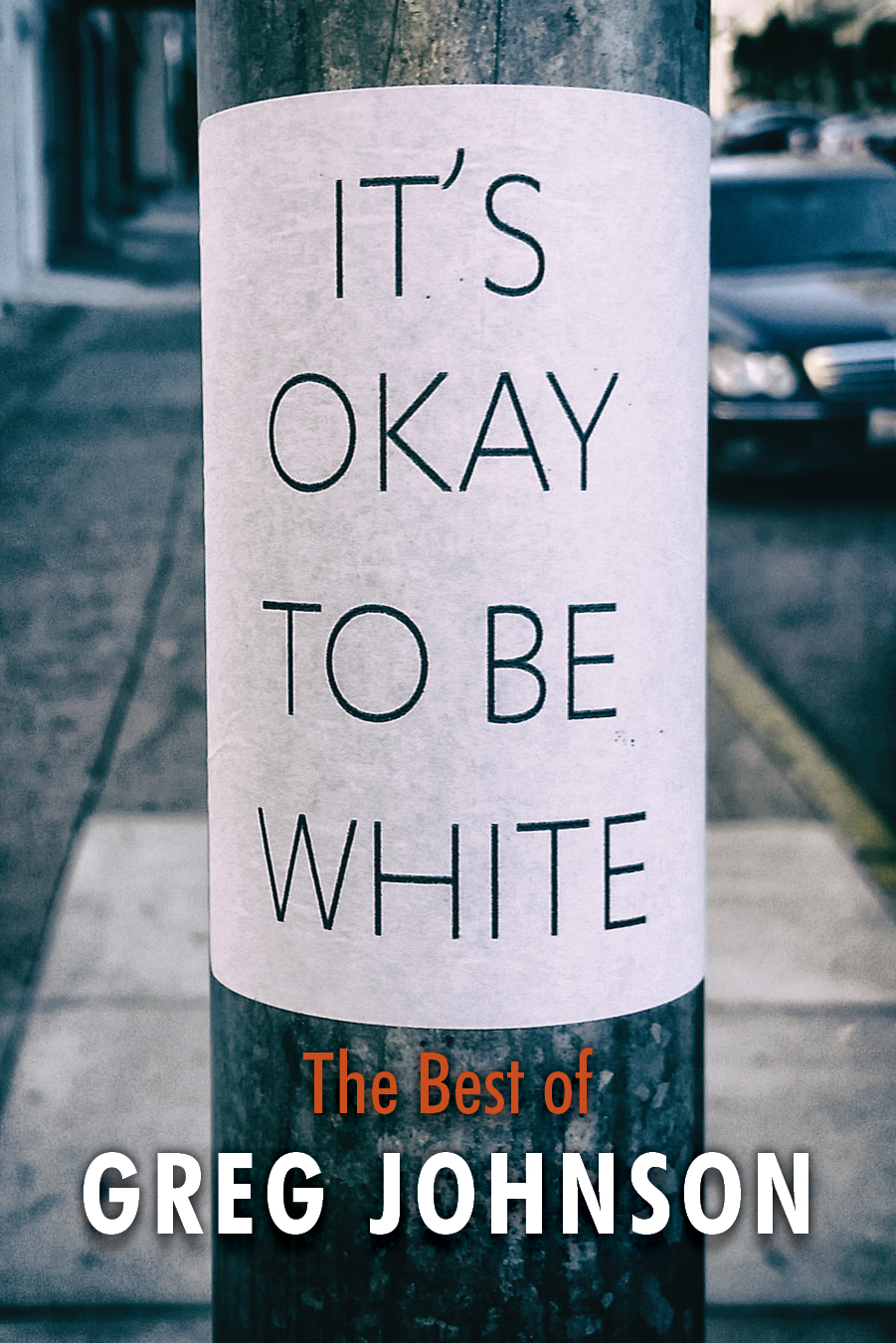
You can buy Greg Johnson’s It’s Okay to Be White here.
Another black student transferred to our elementary school from Kenya. I did not know him very well, but I do know that he didn’t hesitate to punch me in the face when we had a momentary power outage.
After the proprietors of our neighborhood decided to get lax with their vetting of potential tenants, some other unsavory characters moved in. A group of young men rented a house nearby; we could see their place from our front window. It wasn’t long before black drug dealers, sporting Rastafarian headgear, showed up. This of course made the neighborhood feel less safe, and it angered my father. One day he decided to confront them with a bat in hand. Fortunately, nothing happened except for an extended standoff and a glaring contest. In retrospect it probably wasn’t the best thing to do, but he felt compelled to do something out of a sense of honor.
Luckily, it wasn’t too long before the ne’er-do-wells moved out — but not before they had ruined the house they were renting. My family decided it was best that we move house as well. So, my parents bought a home in a new, remote suburb surrounded by farmland. It wasn’t until much later that I became aware of the term “white flight,” but this was an example of the phenomenon.
In middle school it became apparent that students of other racial, ethnic, and religious backgrounds were aware of their differences. I remember a seemingly assimilated student of Chinese extraction becoming strident about the quality of Japanese automobiles. I guess he was unaware of the mutual enmity the Japanese and Chinese had for one another.
Jewish students were there as well; they stuck together, with some of them refusing to sing Christmas carols out of fear of assimilation. Our teacher was noticeably disgusted by their behavior at the time.
When I got to high school, it had a majority white student body with a sizeable Jewish population and some blacks, east Indians, and Asians. I remember one Somalian immigrant who had enrolled in our high school and who constantly played basketball in the gym along with the rest of us. Despite fleeing his war-torn home country, he didn’t seem to be very appreciative of his adopted home. I remember him saying to me, “What have white Canadians done for me lately?” I should’ve come up with something clever, but at the time I wasn’t able to.
Another thing that comes to mind when I remember my interactions with blacks in high school was their reverence for black rappers who exulted in the nihilistic gangster lifestyle. It was a growing segment of what was being pushed by the music industry in the 1990s, just as it is now. Even though there were not many blacks at my high school, the vast majority of them identified with and sympathized with black public figures of dubious characters.
A black fellow whom everyone seemed to despise was constantly picking fights in gym class. I saw him get into a vicious, grappling-fistfight with a tough white student that had to be broken up by teachers.
It wasn’t until university that I became aware of a pervasive anti-white bias in many of my instructors and their zealous student acolytes. At the time I felt ill-equipped to counter many of their anti-white, anti-Western arguments. I just knew that what I was hearing was wrong.
When I eventually found websites such as American Renaissance, Counter-Currents, The Occidental Observer, Red Ice, and White Rabbit Radio, I finally realized that I wasn’t alone in the world — and that there was hope for the future.
8 comments
Sounds similar to my experience with Indians as our neighbors. I think they took ten years off my mother’s life. Anyone who thinks they’ll be swapping curry recipes over the fence is gravely mistaken. Their parting words to us were we rent to ni**ers. The black family that they rented to wasn’t that bad, they totally destroyed the house though. Instant karma.
Ironically the blacks in my suburban Canadian neighbourhood growing up in the 2000s were very nice (it maybe helped that they were always a small minority so always outnumbered and influenced by white culture). The one problem black was transferred in from a different school district and shortly re-transferred away after some fights.
What led to an interest into white activism was the scale of demographic change that really accelerated in the mid-2010s, when the agenda of replacement became too much to ignore.
Interesting that you should say how nice were the small number of blacks who moved into your community. Blacks frequently mind their manners when they’re outnumbered overwhelmingly. When the numbers shift so does the balance of power. I’ve known lots of white dull wits who talked about the “nice black family that moved in” and how wonderful they were. Well, there’s a reason they moved into a white neighborhood instead of a black one. Nice blacks know most blacks are trash and flee when and if the can. The whole point of slavery was to stop blacks from running away from whites and the point of “civil rights” is to stop whites from running away from blacks, at least in the long run when there are no more places to run to.
Mrs. Martin Luther King was driven out of her long time home by black crime in the black neighborhood in Atlanta, GA. Know where she moved? To a high end white condo complex in Buckhead. If she runs away from blacks , it’s civil rights. If whites run away from blacks, it’s racism.
As an American kid in Canada in the 1950’s I never saw a Negro. Now it’s all changed, so it seems.
And now they’re practically all we see!
There were always a few families of well to do blacks in the middle class white neighborhoods I grew up in. They were quite nice and fit in ok. Moreover they were treated well and never “discriminated” against in any way that I can recall. Some were lionized at times. It’s their behavior, not any negative traits of whites, in other words, that creates the divide.
In the American frame, one of the most destructive Supreme Court decisions for Whites is the little-referenced 1948 Shelley vs Kraemer. It unanimously struck down restrictive covenants in housing, which Whites used in order to keep their neighborhoods White. These covenants made it a condition of purchase that properties not be sold to non-Whites, especially “Blacks or Mongolians”, as the taxonomy then went. This has made White Flight a constant phenomenon, with no legal defense against the dusky invaders.
Thank you once again, Fourteenth Amendment.
But it would not surprise me if, given the current drift of racial orthodoxy, one day Whites will be required to sell their homes to non-Whites, in order to serve the supreme and holy cause of racial equity, which is just another name, of course, for our dispossession.
The Counter-Currents vision of a White ethnostate is the only cure for this foul sickness.
And of course, the usual tribal suspects are involved as well. Thanks for bringing this case to our attention.
Blacks get away with so much criminal and obnoxious behavior. It’s unreal.
Comments are closed.
If you have a Subscriber access,
simply login first to see your comment auto-approved.
Note on comments privacy & moderation
Your email is never published nor shared.
Comments are moderated. If you don't see your comment, please be patient. If approved, it will appear here soon. Do not post your comment a second time.