Counter-Currents
  • Advertise
  • Private Events
  • T&C
  • About
  • Contact
  • RSS
    • Main feed
    • Podcast feed
    • Videos feed
    • Comments feed
  • Welcome
  • Webzine
  • Books
  • Merch
  • Podcasts
  • Videos
  • Donate
  • Patrons
  • Subscribe
  • Crypto

LEVEL2

Donate Now Mailing list

Writer of June

(4 votes) David M. Zsutty

Article of June

Why White Advocates Should Avoid “Based Blacks” by Dani Vypont 4 votes
  • Welcome
  • Webzine
  • Books
  • Merch
  • Podcasts
  • Videos
  • Donate
  • Patrons
  • Subscribe
  • Crypto
    • Replacement Migration & Hypergamy

      F. Roger Devlin

      31

    • Kurds of a Feather Flock Together:
      Europe’s “Racist” Parakeet Tweet-Storm

      Steven Tucker

      1

    • Elevator Pitch to a Billionaire
      Money, Money, Money

      Ondrej Mann

      2

    • All Hail Rhodesia

      Spencer J. Quinn

      3

    • Nationalism This Week
      Disenfranchisement

      Greg Johnson

      31

    • The Murder of Ann Widdecombe

      Lipton Matthews

      9

    • Disclosure Day
      Please, Keep It Undisclosed

      Francisco Albanese

      12

    • Remembering Carl Schmitt
      July 11, 1888–April 7, 1985

      Greg Johnson

      1

    • Editor’s Update
      Fundraiser Update & New Books

      Greg Johnson

      1

    • Third Homeland Institute Poll on the Great Replacement

      David M. Zsutty

      12

    • The Bitter End of Western Metaphysics:
      Heidegger on Nietzsche, Part Five (Conclusion)

      Collin Cleary

      9

    • Fraudulent Black British History

      Mark Gullick

      7

    • A White Nationalist Response to Scott Greer

      Dave Chambers

      25

    • The Miami Mall Incident:
      Black Youths or Black Extraterrestrials?

      Dominic Fox

      6

    • The Theology of Three Populisms

      Morris van de Camp

      2

    • The Dangers of Skilled Immigration

      Lipton Matthews

      25

    • The Brotherhood of the Bell

      Beau Albrecht

      16

    • Endeavor: What Rome Means to Me

      Endeavour

    • When the Family Becomes Predation

      Jayant Bhandari

      5

    • RICU: The Gentle Art of Persuasion

      Mark Gullick

      7

    • Mind of Darkness:
      A Review of Lipton Matthews’s Busting African Delusions

      Derek Stark

      12

    • Remembering Revilo Oliver
      July 7, 1908–August 20, 1994

      Greg Johnson

      2

    • Some Advantages of Irish Nationalism

      Greg Johnson

      31

    • America at 250 from the National Cathedral

      Gabriel Anderson

      18

    • Why Not Stop All the Clocks?
      Modern Conservatism’s Flagging Commitment Towards Turning Back Time

      Steven Tucker

      3

    • Remembering Jean Raspail
      July 5, 1925–June 13, 2020

      Greg Johnson

      2

    • Editor’s Update
      Fundraiser Update & New Books

      Greg Johnson

    • The Ethnic Reality of FIFA 2026

      Samuel Valleus

      13

    • Nationalism This Week
      Tucker’s New Party

      Greg Johnson

      30

    • Ethiopia Against Italy
      How the Italo-Ethiopian Wars were part of the conflict between Eastern & Western Christiandom

      Morris van de Camp

    • Please Vote in Our Writer & Article of the Month Poll

      Greg Johnson

    • Available for Pre-Order!
      F. Roger Devlin’s Not Hooking Up

      F. Roger Devlin

    • Kolberg: The Last Nazi (or Prussian?) Film

      Steven Clark

      2

    • America 250 & The Fate of Empires

      Richard Houck

      20

    • Available for Pre-Order!
      Greg Johnson’s The Battle of the Books

      Greg Johnson

    • Why All the Silence About Blacks Being Kicked Out of South Africa?
      Because It’s Other Blacks That Are Doing It.

      Steven Tucker

      10

    • Zelensky, the Jewish Conspiracy Narrative, & the Demographic Replacement of Ukraine:
      A Critical Analysis of a Disinformation Discourse within the European Identitarian Right

      Luís Graça

      30

    • The Original Congressional Debate on Birthright Citizenship

      Alex Graham

      13

    • America at 250
      Unmanifested Destiny  

      David M. Zsutty

      32

    • The Normies are Waking Up:
      The Alliance for Responsible Citizenship Conference, London 2026

      Lipton Matthews

      2

    • Ethnic Vigilantism: The Movie

      Mark Gullick

      15

    • Lothrop Stoddard’s The Revolt against Civilization

      Kevin MacDonald

      2

    • David Zsutty on Political Organizing

      David M. Zsutty

    • PC-Incompatible Gaming:
      Plantation Simulator and the “Problem” of Racist Video Games

      Steven Tucker

      3

    • Remembering Lothrop Stoddard
      June 29, 1883–May 1, 1950

      Greg Johnson

      1

    • Editor’s Update
      Fundraiser Update & Upcoming Projects

      Greg Johnson

    • Nationalism This Week
      Metapolitics Wins:
      Scott Greer’s Whitepill

      Greg Johnson

      8

    • Remembering Colin Wilson
      June 26, 1931–December 5, 2013

      Greg Johnson

      3

    • Kevin Deanna on Political Organizing

      Kevin Deanna

      1

    • The Bitter End of Western Metaphysics:
      Heidegger on Nietzsche, Part Four

      Collin Cleary

      6

    • Bigfoot

      Elevator Pitch to a Billionaire
      Money, Money, Money

      From what I understand about Pantera, the latest version of it anyway, they no longer display the...

    • Greg Johnson

      Nationalism This Week
      Disenfranchisement

      The underlying assumption of this is that we have created a government with the will to separation...

    • Bigfoot

      Replacement Migration & Hypergamy

      Another factor that influences interracial couples and marriages are white females that serve in the...

    • Josephus Cato

      Nationalism This Week
      Disenfranchisement

      I thought Greg was exaggerating about the numbers of guest workers in Qatar but lo he is right.  If...

    • Peter Quint

      Replacement Migration & Hypergamy

      the proportion who mix is higher than marriage stats would lead people to believe. That’s the actual...

    • Scott

      Some Advantages of Irish Nationalism

      Well, one of caveats against Kennedy's "A Nation of Immigrants" hubris (and that is what it was) is...

    • Dani Vypont

      Replacement Migration & Hypergamy

      One case from American history has always especially impressed me. Pretty much all the sources agree...

    • Dani Vypont

      Replacement Migration & Hypergamy

      You constantly post the most controversial and self-defeating thing possible under articles. This...

    • Peter Quint

      Replacement Migration & Hypergamy

      White women are the most racially disloyal women of all races. I always assume any White female I...

    • Scott

      Disclosure Day
      Please, Keep It Undisclosed

      Dennis Weaver seemed miscast to me. I liked his shtick as McCloud, the New Mexico cowboy marshal,...

    • Ondrej Mann

      Replacement Migration & Hypergamy

      Young white men in Norway have only one option: to band together in gangs that reject...

    • Joseph C.

      Replacement Migration & Hypergamy

      I visited Oslo a year ago, for a week, and I'm going this october again (for a week as well). My...

    • Connor McDowell

      Replacement Migration & Hypergamy

      I’ve seen this OKCupid miscegenation argument before, and while much of my evidence is anecdotal, I...

    • Dominic Fox

      Nationalism This Week
      Disenfranchisement

      Even a real community will consist mostly of people who are only somewhat similar in character/...

    • Dani Vypont

      Replacement Migration & Hypergamy

      @JamesSunderland With regard to one of your earlier posts, I did some research, and it is ...

    • Dani Vypont

      Replacement Migration & Hypergamy

      What parts of the United States would you say have the most and least interracial relationships?It...

    • Dave Chambers

      All Hail Rhodesia

      Rhodesia is an inspiration to all of us whose families have had to flee the neighborhoods and...

    • Hairy Iranian Dude

      Replacement Migration & Hypergamy

      Boy, you are one Negative Nancy to interpret my post in such a cynical vein!

    • Gabe

      Replacement Migration & Hypergamy

      No doubt. And unscrupulous music (“record”) companies.

    • CC reader

      Disclosure Day
      Please, Keep It Undisclosed

      Duel was a very good movie, and it was made for tv. Good suspense, camera work, musical score, and...

    • Earth Day Special

      John Morgan

      12

    • A Robertson Roundup
      Remembering Wilmot Robertson
      (April 16, 1915 – July 8, 2005)

      Margot Metroland

      13

    • The Paranoid Style in White Nationalism

      Greg Johnson

      30

    • Join the Dance!

      Andrew Hamilton

      1

    • We Can’t Save the Earth Without Reducing African Birth Rates

      James Dunphy

      36

    • “I’m Not a Conspiracy Theorist, but . . .”:
      Jeffrey Epstein’s Death Gives New Life to “Conspiracy Theories”

      Greg Johnson

      22

    • Sylvia Plath: Stasis in Darkness

      Vic Olvir

      17

    • Vanguardism, Vantardism, & Mainstreaming

      Greg Johnson

      80

    • Aviation, Geography, & Race

      Charles Lindbergh

      3

    • Some Thoughts on Yule

      Collin Cleary

      4

    • Living in Truth:
      A Yuletide Homily

      Jef Costello

      7

    • John Kennedy Toole’s A Confederacy of Dunces

      Greg Johnson

      20

    • On Aleksandr Solzhenitsyn’s Warning to the West

      Spencer J. Quinn

      7

    • Elitism, British Modernism, & Wyndham Lewis

      Jonathan Bowden

      6

    • Philip K. Dick’s Do Androids Dream of Electric Sheep? as Anti-Semitic/Christian-Gnostic Allegory

      Greg Johnson

      20

    • “Conspiracy Theory” or Conspiracy?

      Andrew Hamilton

      21

    • Remembering H. P. Lovecraft
      (August 20, 1890–March 15, 1937)

      Greg Johnson

      3

    • Who Are We?
      Nordics, Aryans, & Whites

      Greg Johnson

      71

    • Remembering William Gayley Simpson
      (July 23, 1892–December 31, 1990)
      A Pleasant Afternoon with Harriet & Bill Simpson

      Margot Metroland

      18

    • Here are the Young Men
      Remembering Ian Curtis
      (July 15, 1956–May 18, 1980)

      Mark Gullick

      18

    • Percy Grainger
      Artist of the Right

      Alex Graham

      7

    • Remembering Revilo Oliver
      (July 7, 1908–August 20, 1994)

      Greg Johnson

      18

    • The Meaning of July 4th for the White Man

      Gregory Hood

      13

    • The Front National’s Evolution

      Bruno Mégret

    • Merwin K. Hart
      Forgotten American Hero & Man of the Right

      Morris van de Camp

      10

    • George Orwell’s Nineteen Eighty-Four

      Jonathan Bowden

      8

    • Carleton S. Coon
      Scientist & Reluctant White Advocate

      Morris van de Camp

      4

    • The Kwanzaa Absurdity Will Be Dwarfed by Juneteenth

      Robert Hampton

      12

    • Stravinsky

      Alex Graham

      7

    • Like the Roman:
      Remembering Enoch Powell (1912-1998)

      Mark Gullick

      23

    • Exclusive Interview with Karel Veliky:
      The Final Chapter in the Film Series! Part II

      Ondrej Mann

      2

    • Exclusive Interview with Karel Veliky:
      The Final Chapter in the Film Series! Part I

      Ondrej Mann

      2

    • Nietzsche & Race

      Mark Gullick

    • The Crisis of Chinese Technology Thieves

      Morris van de Camp

      1

    • The Zodiac Killer

      Mark Gullick

      12

    • José Pedro Zúquete’s The Identitarians

      Greg Johnson

      3

    • Berlin: City of Stones

      Spencer J. Quinn

      6

    • Headbanging Lite

      Mark Gullick

      5

    • The Russians are Coming/The Russians are Coming

      Steven Clark

      2

    • The Cruelty of Kindness

      Morris van de Camp

      11

    • Jonathan Bowden’s Deliverance
      Part 7

      Jonathan Bowden

    • Lothrop Stoddard’s The Revolt Against Civilization

      Spencer J. Quinn

      15

    • About Film “From the Right”

      Karel Veliky

    • The 1970s: The Golden Age of Hijacking

      Morris van de Camp

      21

    • Jonathan Bowden’s Deliverance
      Part 6

      Jonathan Bowden

    • Do You Want to Play a Game?

      Mark Gullick

      1

    • Sexually Incontinent on the Indian Subcontinent:
      Who Rapes More Animals, Indians or Pakistanis? The Battle Continues!

      Steven Tucker

      3

    • Neo-Fascism in Film
      Part 5

      Karel Veliky

      15

    • The Game of Tarot

      Mark Gullick

      2

    • Institutions Cannot Be Transplanted

      Jayant Bhandari

      5

    • Jonathan Bowden’s Deliverance
      Part 5

      Jonathan Bowden

    • Crosstown Traffic:
      Jimi Hendrix & The Post-War Rock ‘N’ Roll Revolution

      Mark Gullick

      1

    • Slaves from the North:
      Finns & Karelians in the East European Slave Trade, 900–1600

      Lipton Matthews

      14

    • Neo-Fascism in Film
      Part 4

      Karel Veliky

      2

    • David Lean’s A Passage to India

      Spencer J. Quinn

      1

    • Elites are Essential to Development

      Lipton Matthews

      7

    • Jonathan Bowden’s Deliverance
      Part 4

      Jonathan Bowden

    • Neo-Fascism in Film
      Part 3

      Karel Veliky

      6

    • E. M. Forster’s A Passage to India & the Indian Mentality

      Spencer J. Quinn

      25

    • Jonathan Bowden’s Deliverance
      Part 3

      Jonathan Bowden

    • András László
    • Derek Hawthorne
    • Beau Albrecht
    • Alain de Benoist
    • Kerry Bolton
    • Jonathan Bowden
    • Collin Cleary
    • Jef Costello
    • Savitri Devi
    • Julius Evola
    • Jim Goad
    • Gregory Hood
    • Juleigh Howard-Hobson
    • Greg Johnson
    • Charles Krafft
    • Anthony M. Ludovici
    • Trevor Lynch
    • H. L. Mencken
    • J. A. Nicholl
    • James J. O’Meara
    • Christopher Pankhurst
    • Tito Perdue
    • Michael Polignano
    • Spencer J. Quinn
    • Fenek Solère
    • Irmin Vinson
    • Leo Yankevich
    • Francis Parker Yockey
    • Multiple authors
  • Editor-in-Chief

    • Greg Johnson, Ph.D.

    Featured Writers

    • Beau Albrecht
    • Gunnar Alfredsson
    • Collin Cleary, Ph.D.
    • Jef Costello
    • Morris V. de Camp
    • F. Roger Devlin, Ph.D.
    • Stephen Paul Foster, Ph.D.
    • Jim Goad
    • Alex Graham
    • Mark Gullick, Ph.D.
    • Greg Johnson, Ph.D.
    • Travis LeBlanc
    • Trevor Lynch
    • Margot Metroland
    • James J. O’Meara
    • Angelo Plume
    • Spencer J. Quinn
    • Fred Reed
    • Clarissa Schnabel
    • Michael Walker
    • David M. Zsutty

    Frequent Writers

    • Asier Abadroa
    • Aquilonius
    • Alain de Benoist
    • Kerry Bolton, Ph.D.
    • Dave Chambers
    • Steven Clark
    • James Dunphy
    • Endeavour
    • Richard Houck
    • Jason Kessler
    • Titus Livius
    • Ondrej Mann
    • Lipton Matthews
    • Mark Mazari
    • John Morgan
    • Jaroslav Ostrogniew
    • Kathryn S.
    • Christian Secor
    • Anne Wilson Smith
    • Thomas Steuben
    • William De Vere
    • Kenneth Vinther
    • Max West

    Classic Authors

    • Maurice Bardèche
    • Jonathan Bowden
    • Julius Evola
    • Guillaume Faye
    • Ernst Jünger
    • Kevin MacDonald, Ph.D.
    • D. H. Lawrence
    • Charles Lindbergh
    • Jack London
    • H. P. Lovecraft
    • Anthony M. Ludovici
    • Sir Oswald Mosley
    • National Vanguard
    • Friedrich Nietzsche
    • Revilo Oliver
    • William Pierce
    • Ezra Pound
    • Saint-Loup
    • Savitri Devi
    • Carl Schmitt
    • Miguel Serrano
    • Oswald Spengler
    • P. R. Stephensen
    • Jean Thiriart
    • John Tyndall
    • Dominique Venner
    • Leo Yankevich
    • Francis Parker Yockey

    Other Authors

    • Howe Abbott-Hiss
    • Michael Bell
    • Giles Corey
    • Jack Donovan
    • Richardo Duchesne, Ph.D.
    • Emile Durand
    • Guillaume Durocher
    • Mark Dyal
    • Tom Goodroch
    • Andrew Hamilton
    • Robert Hampton
    • Huntley Haverstock
    • Derek Hawthorne
    • Gregory Hood
    • Juleigh Howard-Hobson
    • Alexander Jacob
    • Ruuben Kaalep
    • Tobias Langdon
    • Julian Langness
    • Patrick Le Brun
    • G A Malvicini
    • John Michael McCloughlin
    • Millennial Woes
    • Michael O’Meara
    • Christopher Pankhurst
    • Michael Polignano
    • J. J. Przybylski
    • Quintilian
    • Edouard Rix
    • C. B. Robertson
    • C. F. Robinson
    • Herve Ryssen
    • Alan Smithee
    • Fenek Solere
    • Ann Sterzinger
    • Robert Steuckers
    • Tomislav Sunic
    • Donald Thoresen
    • Marian Van Court
    • Irmin Vinson
    • Book Reviews
    • Movie Reviews
    • TV Reviews
    • Music Reviews
    • Art Criticism
    • Graphic Novels & Comics
    • Video Game Reviews
    • Fiction
    • Poems
    • Interviews
    • Videos
    • English Translations
    • Other Languages
      • Arabic
      • Bulgarian
      • Croatian
      • Czech
      • Danish
      • Dutch
      • Estonian
      • Finnish
      • French
      • German
      • Greek
      • Hungarian
      • Italian
      • Lithuanian
      • Norwegian
      • Polish
      • Portuguese
      • Romanian
      • Russian
      • Slovak
      • Spanish
      • Swedish
      • Ukrainian
    • Commemorations
    • Why We Write
  • Archives
  • Top 100 Commenters
  • The Looney Bin
  • Advertise
  • Private Events
  • T&C
  • About
  • Contact
  • RSS
    • Main feed
    • Podcast feed
    • Videos feed
    • Comments feed
Sponsored Links
Europa.com Above Time Coffee Antelope Hill Publishing Paul Waggener IHR-Store Spencer J. Quinn American Renaissance Jim Goad The Occidental Observer
Print July 3, 2019

The European Idea of Progress Supersedes the Axial Age, Part I

Ricardo Duchesne

Robert N. Bellah, theorist of the Axial Age

3,787 words

Part 1 of 4

Only European peoples have made history and discovered the idea of time, and this is why the idea of progress is uniquely European: Only European history has been characterized by progress, and there can be no conception of historical time and no history without progression or without man becoming conscious of his role in the making of history, as well as the realization that only the mind can be the adjudicator of the truth. The peoples of the Axial Age (800-200 BC – the Israelites, the Indians, the Chinese, and possibly the Persians – are the only ones who experienced some history, achieved some developments, and engendered the first inklings of historical consciousness; but only Europeans, starting with the ancient Greeks, would continue to evolve culturally beyond the Axial Age.

The Axial Age was the peak of cultural development for non-Europeans, whereas it was only the beginning of European creativity and genius in all the spheres of human life. Human creativity dried up after the Axial Age outside Europe. Subsequent changes were mere extensions of existing technologies, new territories brought under despotic rule, or mere revisions of the original cultural outlooks. Outside Europe, history became cyclical, without progression. Is it any wonder that the Chinese conception of history never developed beyond the theory of dynastic cycles, and that only Europeans learned to write historical accounts – true conceptions of history with a sense of historical time from ancient to medieval to modern times? Europeans would indeed write the history of all the other peoples of the Earth, including the history of the Earth, the evolution of animals, and the history of the universe from the Big Bang to the present.

I agree with Robert Nisbet that the idea of progress, the idea of growth, and the conception of time as linear is singularly Western. Taken in its totality, beyond Nisbet’s preoccupation with human history, and beyond the common belief that this idea is inherently Christian, this idea maintains that development is intrinsic to the very nature of things. It holds that in the course of time, from the Big Bang to the modern world, we can detect a linear sequence characterized by a movement from simplicity to complexity, from the rise of elementary particles to the formation of the atomic structures of hydrogen and helium, from the rise of heavy elements to the rise of stars and planetary organizations of matter, from the emergence of prokaryotic cells to eukaryotes with complex chromosomes, from chordates to vertebrates, from fish to amphibians, from reptiles to mammals, from primates to hominids, from Homo erectus to Homo sapiens, from the upper Paleolithic revolution to the origins of agriculture, from the Axial Age to the rise of “consciousness of consciousness.” This last stage was reached in Europe alone when men came to see themselves as the absolute ultimate for whom nothing external – not any material phenomena or religious tradition – could be deemed to be authoritative, insomuch as he had come to know that all authority can receive justification and be known through his thinking mind.

Seshat Project Workshop at Oxford (2017) held by typically PC academics inclined to view the “Axial Age” as a time when humans across ancient civilizations embraced “common values” . . . for a racially mixed future inside the West.

Rejection of the idea of progress

This idea of progress reached a high level of historical awareness in the nineteenth-century writings of Condorcet, Kant, Comte, Spencer, and – most profoundly – in the philosophy of Hegel. In the twentieth century, this idea was popularized by authors of world history texts, with their happy accounts of discoveries in science, innovations in technology, and democratic freedoms. There were always critics – Tocqueville, Burckhardt, Schopenhauer, Nietzsche – growing in numbers after the prolonged bloodbaths of the Second World War, but the incredible affluence of the post-war decades sustained this idea right into the 1970s.

Modernization theories with stages models enjoyed the greatest popularity during the 1950s and ‘60s, with their arguments that long-term trends were clearly evident in history, from traditional to modern societies, from relationships based on ascription to relationships based on personal effort and merit, from patrimonial adjudication and enforcement to universally applicable laws and rights. These theories were optimistic that Western nations could accelerate the modernization of poor societies through programs of population control, transfers of technology, investments, and diffusion of liberal attitudes and entrepreneurial skills.

But with the persistence of poverty in newly-independent countries in the Third World, the rise of dictatorial regimes rather than democracies, recurrent national and local wars, swelling populations, increasing inequalities and ethnic factionalism, modernization theories were roundly discredited. The academic world was soon taken over by a completely different outlook: Dependency Theory, or World Systems Theory. This school directly attacked notions of Western-led progression by claiming that the economic development of this civilization had been made possible through the pillage of Third World nations, the brutal enslavement of Africans, and the genocide of Amerindians. The celebrated industrial development of Europe had come along with the “underdevelopment” and destruction of Third World peoples.

1960s Leftists trying to return to a primitive lifestyle with voodoo-like feelings while living off the greatness of Western civilization.


This was only one school among numerous others. Soon the Frankfurt School swept the academic world, influencing the rise of the New Left, the environmental movement, and postmodernism. This school targeted Western science itself, claiming it was about the “instrumental domination” of the environment to serve the ends of capitalism. There was little to admire about the “progression” of the West, for it had entailed the reduction of heterogeneity to homogeneity, spontaneity to repetition, and individuality to sameness, all defined as the elimination of the Other. Combined with these schools and movements came a new anthropology, heavily influenced by the writings of Franz Boas, which rejected the earlier anthropological idea of stages of development in the name of the equal worth of primitive cultures, and against any grading of cultures in hierarchical systems that would have Western culture at the top.

The idea of progress would be turned on its head by the 1980s and ‘90s as new intellectual currents came to reinforce each other: post-colonial studies, history from below, third wave feminism, gay rights, deconstruction, and minority rights. Progress was an ethnocentric illusion of the Western mind. Throughout much of history, the standard of living, the quality of work, and the degree of equality had deteriorated for most of the peoples of the Earth. Hunting-and-gathering tribes were the “truest democracies” and the “original affluent societies,” the anthropologist Marshall Sahlins insisted, with better quality diets and shorter working days. While the standard of living in the advanced West had risen after the 1850s, the gap between the developed and less developed had steadily widened. According to this view, social evolution should be understood as a panorama of humans periodically being compelled to introduce new technologies in response to lowering living standards, resulting from demographic pressures on scarce resources. Europe’s high culture was a luxury for a parasitic elite without relevance for the vast majority. The moral and religious patterns that distinguished Europe’s elite were in truth ideologies of oppression which the rulers themselves disregarded, since their real interests were in plundering, taxing, and reaping profits unjustly. The real agents of history were not elites, but anonymous masses, peasants and workers, geographical factors, climatic change, infectious diseases, and ordinary humans seeking to satisfy their everyday needs.

Even those who continued to endorse the idea of scientific progress were adamant in their rejection of the idea that evolution could be equated with progress. Herbert Spencer’s observation that one could detect a progressive movement in evolution from simplicity to complexity, from the homogeneous to the heterogeneous, was dismissed. There was no pre-determined goal in evolution, no meaningful pattern or trend that could be interpreted as a movement from worse to better. The trend was toward increasing diversity of life-forms. Each life-form, announced Stephen J. Gould to millions of impressionable readers, was equally “successful.” If anything, the first organisms – bacteria – were the most successful in their adaptive capacities, “the organisms that were in the beginning, are now, and probably ever shall be . . . the dominant creatures on earth by any . . . evolutionary criterion . . . range of habitats, resistance to extinction.”

If there was to be improvement in the conditions of life, the idea of progress had to go, along with the ethnocentric notion that Western civilization was the culmination of progress. Indigenous peoples, it would be claimed, were more advanced in their ecological knowledge of nature, their egalitarian ethics, and their simplicity of life. The idea of progress was racist, propounded by the likes of Joseph Arthur de Gobineau and Madison Grant, with their claim that the Aryan race was the parent stock of the ethnic groups responsible for the progression of civilization: the Greeks, Romans, Germans, and Anglos. This idea was outrageous, responsible for the worst crimes in history.

Indeed, the conclusion would soon be reached that whites as such, on their own, with their own nations, are inherently inclined to think that their societies are better than African and Muslim societies, and thus to be racist. The only way to bring about true improvements and overcome this nasty, white arrogance would be to diversify all white nations through the integration of immigrants from diverse races, coupled with the implementation of multicultural programs celebrating the achievements of all peoples regardless of their level of cognition. Whites, with their “instrumental” mind set, would benefit from the “enrichment” of Third World cultures, with their authentic values, humbleness, and lack of racist attitudes.

“Progress” for a diverse & global humanity

The idea of progress did not disappear, however, but what remained of it was clearly demarcated from any identification with Western history. Conservatives retained a truncated version, arguing that “the West” should stand as a name for a civilization that was unique precisely in being a “universal civilization” without any ethnic identity, a civilization with values expressing the “natural” wishes of “man as man” for equal rights, the rule of law, freedom of expression, and private property. From this truncated version, it was but a small step for conservatives-turned-globalists to equate progress with a Western world open to the assimilation of immigrants to “universal” values.

But the globalist Left has been the one in charge of a totally revised idea of progress. Once they drove Eurocentrics out of academia, eliminated the teaching of Western civilization, and criminalized whites who affirmed their heritage, the globalist Left set up its own progressive shop. Leftists, after all, were supposed to be the real “improvers of humankind” since the radical Enlightenment. Some admitted there had been technological and scientific “development,” while emphasizing above all else the need for further progress in women and minority rights.

A number of discursive strategies were developed in this endeavor. From about the 1990s, world historians began promulgating a “historyforusall” – a “world history connected” – which now rules across all schools and universities in the United States aimed at viewing all developments, including the rise of modern science, the mapping of the world, the Industrial Revolution, and the Enlightenment as global affairs. Another interconnected discourse was the promotion of the idea of an “Axial Age” between 800 and 200 BC in which the major civilizations of the Old World were said to have experienced a “spiritual process” characterized by a common set of religious, psychological, and philosophical inquiries about what it means to be “specifically human.” The founding text of this idea, as I explained in “Discovering the European Mind,” was Karl Jaspers’ 1948 book, The Origin and Goal of History.
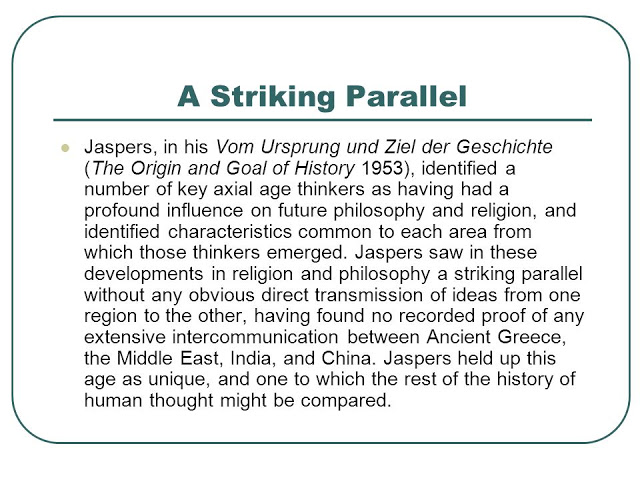
Feeling guilty about what the Germans had done in the Second World War, Jaspers, whose wife was Jewish, reached the view that any notion of European exceptionalism was tainted with supremacist impulses. The only way to overcome German supremacism was to promote the idea that European culture was rooted in a common source: the Axial Age. Europeans should see themselves as beings with a profound spiritual unity with humans across the world, and use the Axial concept to nurture a sense of “human solidarity.” Humanity, long before the Enlightenment, had posed universal questions about the meaning of life together, coming up with similar answers about the need to create polities based on the humane treatment of the population. Europeans did not carve out a unique historical path beginning with the achievements of the Greeks. Axial Age humans had developed a common cultural outlook at more or less the same time that would shape their histories along similar ethical trajectories, with the West only “rising” in recent times due to a combination of “unusual circumstances.”

The “Axial Age” is now a staple of world history texts taught in Western campuses. The beatific images of a common humanity marching together towards a racially-mixed future has proven too irresistible to credulous academics trained to believe uncritically that “diversity is our greatest strength.” Take a look at a recent workshop on “Testing the Axial Age” held at Oxford in 2017 by the Seshat Project, which claims to handle the “most current and comprehensive body of knowledge about human history in one place.”

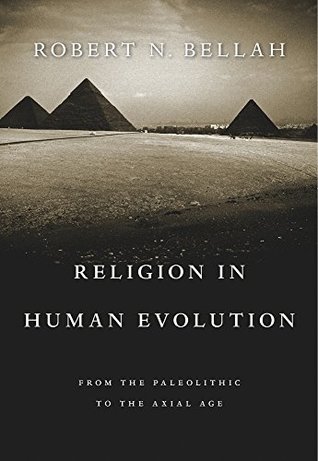
Having examined some key texts about the Axial Age, in what follows I have decided to concentrate on the best, most researched effort defending the universal validity of this age: Robert N. Bellah’s Religion in Human Evolution: From the Paleolithic to the Axial Age (2011). The concept of an Axial Age has substantial merits, or so I will argue, so long as it is delimited to the non-European world. This concept is inherently incapable of grasping the superior intellectual breakthrough of ancient Greece and the fact that non-Western Axial civilizations did not manage to produce any major novelties after this age, whereas this age was just the beginnings of an exponential outpouring of Western creativity and greatness.

The basic argument of Religion in Human Evolution

Religion in Human Evolution: From the Paleolithic to the Axial Age is a highly referenced book of 608 small-print pages, with over a hundred pages of notes, which took Bellah twelve years to write. This sweeping book frames the Axial Age within the evolutionary history of living beings and the cultural history of primitive humans. It effectively shows that human cultural development was made possible only with the emergence of “relaxed fields” in which natural selection and the struggle for existence did not “have full sway,” and in which humans became free to develop cultural conditions for their own evolution. While there is no purpose in the blind selective processes of nature, and while natural selection remains the primary mechanism of evolution, Bellah argues that the emergence of parental care among mammals created a sheltered environment once their needs for nutrition were met, in which newborns were free to play. Human play, beginning with the play of children under parental care, would move to the level of “serious” cultural play among adults in their rituals, mythical stories, and their philosophies, wherein the “full spiritual and cultural capacities” of humans would be “given free reign.” The emergence of cultural capacities cannot be explained in evolutionary terms alone.

Using the work of Merlin Donald, Bellah identifies three stages of human culture: mimetic, mythic, and theoretic. Mimetic culture, which likely began with Homo erectus some 1-2 million years ago, consists in the ability to “use our bodies to enact past and future events as well as gesture for communication” (p. xviii), including perhaps the use of dance, music, and the beginnings of some linguistic capacities. Mythic culture, which began between 250,000 and 100,000 years ago with Homo sapiens, involves a new capacity for narrative and storytelling, combined with the use of “full grammatical language.” With mythic culture, humans raised themselves above “episodic consciousness,” with a new capacity to think beyond the present and tell stories with past, present, and future tenses, rather than being locked within the consciousness of the moment. Donald emphasizes the ability to use metaphorical language as a new cognitive capacity, and defines mythical thought as “a unified, collectively held system of explanatory and regulatory metaphors.” With this new cognitive capacity, “the mind has expanded its reach beyond the episodic perception of events, beyond the mimetic reconstruction of episodes, to a comprehensive modeling of the entire human universe” (p. 134).

The emergence of theoretic culture is what the Axial Age is about. For Donald, theoretic culture really emerged in ancient Greece, and it required a “fully alphabetic writing system” – more than the mathematics and calendrical astronomy witnessed, for example, in Babylonia. It involved a capacity for “second-order thinking”; that is, “thinking about thinking,” as is evident in the geometrical proofs the Greeks offered. Second-order thinking also involves a capacity to stand back and look beyond the conventions of the time and the accepted worldviews in the name of ideas based on argumentation. While Bellah quietly acknowledges a few times that “strict” second order thinking may have been lacking in some Axial civilizations, his overall argument is that all axial civilizations developed theoretic thinking: “The beginnings of science, of a critical view of the world, of knowledge for its own sake, can be found in all the axial civilizations” (p. 595). At the same time, he broadens the definition of a theoretic culture to include the rejection of old kinship hierarchies as well “in the name of ethical and spiritual universalism” (p. xix). Axial thinkers outside Greece also took a “critical, reflective questioning” of the old mythical stories and advocated new visions for humanity in general: transcendental morals for a better future. The call for new morals beyond kinship ties, beyond the present, and beyond the pragmatics of power entailed “a standing back and looking beyond” (p. 474), which, for him, equals “thinking about thinking.”

One-third of Religion in Human Evolution covers the pre-Axial Age, starting with the origins of the universe. Bellah’s implicit endorsement of the idea of progress, coupled with his argument that cultural developments can’t be explained solely in Darwinian terms, is most commendable. Humans developed new cultural capacities over and above their evolutionary needs. The chapters on ancient Israel, Greece, China, and India are possibly the most thorough attempts to defend the idea of an Axial Age. Each of these chapters, he says, took him a year to write, and the chapter on India two years. Since I believe that the peak of cultural development outside the West was reached in the Axial Age, these chapters may suffice to grasp (if you tend to agree with me) the highest intellectual achievement of non-Europeans.

Bellah, however, backs off from an explicit endorsement of the idea of progress. He accepts the Leftist argument that history cannot be seen as a progression “from worse to better” (p. xxii); and yet he clearly wants to argue that the Axial Age was the most important turning point in human history, the time when the highest values and ideas were expressed. The view coming from his book is that progress after the Axial Age can only be measured in terms of the degree to which people have lived up to Axial ideals. There were no major cultural developments in Europe after this age, other than efforts to actualize Axial ideals.

I believe that the Europeans who invented the idea of progress continued to develop new capacities after this age, whereas the rest of humanity stagnated. The Greeks were already far ahead in their cognitive capacities, and were the only ones who became conscious of consciousness (which I take to mean more than what Merlin Donald means). The aim of Bellah, which reflects the aim of an Axial Age, is to bring Europeans down to the Axial level of non-Europeans, and thus promote the idea that Europeans are not unique, but generic members of a common humanity without any kin identity.

Who is Robert N. Bellah?
He died two years after the publication of Religion in Human Evolution at the age of 86. He was an American sociologist and the Elliott Professor of Sociology at the University of California, Berkeley. A white man, he converted to Episcopalianism and was married to a Jewish woman. He was a serious scholar, the “most widely read sociologist of religion,” best known for his now classic essay, “Civil Religion in America,” published in 1967, and the book Habits of the Heart, written with four additional authors.

But we will see in this essay that Bellah is a prototypical white academic male without cultural backbone, always looking over his shoulder for fear that he may have been insensitive to non-whites, afraid to question the Cultural Marxist establishment, and sheepishly welcoming the day the United States becomes majority non-white. Listen to the interview he gave in Germany in 2012, right after Obama’s reelection. He joyfully says that the Republicans are a party of “old white males” who will likely never win an election because immigrants are replacing whites.

I am often accused of bringing politics into topics that should be judged strictly according to scholarly criteria. The reality, however, is that academic research for the last few decades has been driven by the unchallenged or inexplicit supposition that racial diversity inside the West is inherently good and superior to “white hegemony.” Ignorance of this unchallenged presupposition, of the fact that all academics today work within universities “committed” to racial equality and diversification, violates the principle of being conscious of one’s consciousness. We can’t understand the ideas of our major academics, including the ones who are not overtly political, without bringing up this supreme political presupposition permeating academic research. In the next parts, as we acknowledge Bellah’s significant contributions to the concept of an Axial Age, we will see that he can’t restrain himself from taking regular shots against “Eurocentrism” and paying homage to cultural diversity, even as he tries to defend the notion of progressive developments in history.

The fundamental flaws in Religion in Human Evolution are a result of his inability to acknowledge Western superiority due to his ingrained blindness to the very possibility that Western culture achieved far more “new developments,” because such a possibility would violate the sacrosanct, non-scholarly, purely political mandate of multiculturalism. Bellah is merely a peon in an academic world enslaved to diversity. You can be sure that the seemingly “scientific” and innocent-looking “scholarly” individuals photographed in the image above at the workshop on “Testing the Axial Age” are firm supporters of the racial diversification of England and the ethnocide of the British people. Some may have discomforting thoughts about this sinister plan, but most likely they are too afraid to question the mandates of diversification, too devoid of a critical capacity to understand it, or too opportunistically aware where the academic gravy train is moving.

This article was reproduced from the Council of European Canadians Website.

The European Idea of Progress Supersedes the Axial Age, Part I

The%20European%20Idea%20of%20Progress%20Supersedes%20the%20Axial%20Age%2C%20Part%20I

Share

  • Gab

Enjoyed this article?

Be the first to leave a tip in the jar!

Instant Echeck GreenPay™

Related

  • China’s Threat to American Security

  • Politics Without God

  • Curtis Dozier’s The White Pedestal

  • 500 Years of British Art (Part 1 of 2)

  • Keep Laughing at the Black Man

  • An Obsessive Mind: Ronald Beiner’s Radical Right Ideologues in the Age of Trump

  • Why the West Misreads the Third World

  • Civility and its Discontents

Tags

academiaanti-white rhetoricAxial AgeCouncil of European Canadianscultural MarxismevolutionKarl Jasperspolitical correctnessRicardo DuchesneRobert N. BellahWestern uniqueness

Writer of June

(4 votes) David M. Zsutty

Article of June

Why White Advocates Should Avoid “Based Blacks” by Dani Vypont 4 votes
    • Replacement Migration & Hypergamy

      F. Roger Devlin

      31

    • Kurds of a Feather Flock Together:
      Europe’s “Racist” Parakeet Tweet-Storm

      Steven Tucker

      1

    • Elevator Pitch to a Billionaire
      Money, Money, Money

      Ondrej Mann

      2

    • All Hail Rhodesia

      Spencer J. Quinn

      3

    • Nationalism This Week
      Disenfranchisement

      Greg Johnson

      31

    • The Murder of Ann Widdecombe

      Lipton Matthews

      9

    • Disclosure Day
      Please, Keep It Undisclosed

      Francisco Albanese

      12

    • Remembering Carl Schmitt
      July 11, 1888–April 7, 1985

      Greg Johnson

      1

    • Editor’s Update
      Fundraiser Update & New Books

      Greg Johnson

      1

    • Third Homeland Institute Poll on the Great Replacement

      David M. Zsutty

      12

    • The Bitter End of Western Metaphysics:
      Heidegger on Nietzsche, Part Five (Conclusion)

      Collin Cleary

      9

    • Fraudulent Black British History

      Mark Gullick

      7

    • A White Nationalist Response to Scott Greer

      Dave Chambers

      25

    • The Miami Mall Incident:
      Black Youths or Black Extraterrestrials?

      Dominic Fox

      6

    • The Theology of Three Populisms

      Morris van de Camp

      2

    • The Dangers of Skilled Immigration

      Lipton Matthews

      25

    • The Brotherhood of the Bell

      Beau Albrecht

      16

    • Endeavor: What Rome Means to Me

      Endeavour

    • When the Family Becomes Predation

      Jayant Bhandari

      5

    • RICU: The Gentle Art of Persuasion

      Mark Gullick

      7

    • Mind of Darkness:
      A Review of Lipton Matthews’s Busting African Delusions

      Derek Stark

      12

    • Remembering Revilo Oliver
      July 7, 1908–August 20, 1994

      Greg Johnson

      2

    • Some Advantages of Irish Nationalism

      Greg Johnson

      31

    • America at 250 from the National Cathedral

      Gabriel Anderson

      18

    • Why Not Stop All the Clocks?
      Modern Conservatism’s Flagging Commitment Towards Turning Back Time

      Steven Tucker

      3

    • Remembering Jean Raspail
      July 5, 1925–June 13, 2020

      Greg Johnson

      2

    • Editor’s Update
      Fundraiser Update & New Books

      Greg Johnson

    • The Ethnic Reality of FIFA 2026

      Samuel Valleus

      13

    • Nationalism This Week
      Tucker’s New Party

      Greg Johnson

      30

    • Ethiopia Against Italy
      How the Italo-Ethiopian Wars were part of the conflict between Eastern & Western Christiandom

      Morris van de Camp

    • Please Vote in Our Writer & Article of the Month Poll

      Greg Johnson

    • Available for Pre-Order!
      F. Roger Devlin’s Not Hooking Up

      F. Roger Devlin

    • Kolberg: The Last Nazi (or Prussian?) Film

      Steven Clark

      2

    • America 250 & The Fate of Empires

      Richard Houck

      20

    • Available for Pre-Order!
      Greg Johnson’s The Battle of the Books

      Greg Johnson

    • Why All the Silence About Blacks Being Kicked Out of South Africa?
      Because It’s Other Blacks That Are Doing It.

      Steven Tucker

      10

    • Zelensky, the Jewish Conspiracy Narrative, & the Demographic Replacement of Ukraine:
      A Critical Analysis of a Disinformation Discourse within the European Identitarian Right

      Luís Graça

      30

    • The Original Congressional Debate on Birthright Citizenship

      Alex Graham

      13

    • America at 250
      Unmanifested Destiny  

      David M. Zsutty

      32

    • The Normies are Waking Up:
      The Alliance for Responsible Citizenship Conference, London 2026

      Lipton Matthews

      2

    • Ethnic Vigilantism: The Movie

      Mark Gullick

      15

    • Lothrop Stoddard’s The Revolt against Civilization

      Kevin MacDonald

      2

    • David Zsutty on Political Organizing

      David M. Zsutty

    • PC-Incompatible Gaming:
      Plantation Simulator and the “Problem” of Racist Video Games

      Steven Tucker

      3

    • Remembering Lothrop Stoddard
      June 29, 1883–May 1, 1950

      Greg Johnson

      1

    • Editor’s Update
      Fundraiser Update & Upcoming Projects

      Greg Johnson

    • Nationalism This Week
      Metapolitics Wins:
      Scott Greer’s Whitepill

      Greg Johnson

      8

    • Remembering Colin Wilson
      June 26, 1931–December 5, 2013

      Greg Johnson

      3

    • Kevin Deanna on Political Organizing

      Kevin Deanna

      1

    • The Bitter End of Western Metaphysics:
      Heidegger on Nietzsche, Part Four

      Collin Cleary

      6

    • Bigfoot

      Elevator Pitch to a Billionaire
      Money, Money, Money

      From what I understand about Pantera, the latest version of it anyway, they no longer display the...

    • Greg Johnson

      Nationalism This Week
      Disenfranchisement

      The underlying assumption of this is that we have created a government with the will to separation...

    • Bigfoot

      Replacement Migration & Hypergamy

      Another factor that influences interracial couples and marriages are white females that serve in the...

    • Josephus Cato

      Nationalism This Week
      Disenfranchisement

      I thought Greg was exaggerating about the numbers of guest workers in Qatar but lo he is right.  If...

    • Peter Quint

      Replacement Migration & Hypergamy

      the proportion who mix is higher than marriage stats would lead people to believe. That’s the actual...

    • Scott

      Some Advantages of Irish Nationalism

      Well, one of caveats against Kennedy's "A Nation of Immigrants" hubris (and that is what it was) is...

    • Dani Vypont

      Replacement Migration & Hypergamy

      One case from American history has always especially impressed me. Pretty much all the sources agree...

    • Dani Vypont

      Replacement Migration & Hypergamy

      You constantly post the most controversial and self-defeating thing possible under articles. This...

    • Peter Quint

      Replacement Migration & Hypergamy

      White women are the most racially disloyal women of all races. I always assume any White female I...

    • Scott

      Disclosure Day
      Please, Keep It Undisclosed

      Dennis Weaver seemed miscast to me. I liked his shtick as McCloud, the New Mexico cowboy marshal,...

    • Ondrej Mann

      Replacement Migration & Hypergamy

      Young white men in Norway have only one option: to band together in gangs that reject...

    • Joseph C.

      Replacement Migration & Hypergamy

      I visited Oslo a year ago, for a week, and I'm going this october again (for a week as well). My...

    • Connor McDowell

      Replacement Migration & Hypergamy

      I’ve seen this OKCupid miscegenation argument before, and while much of my evidence is anecdotal, I...

    • Dominic Fox

      Nationalism This Week
      Disenfranchisement

      Even a real community will consist mostly of people who are only somewhat similar in character/...

    • Dani Vypont

      Replacement Migration & Hypergamy

      @JamesSunderland With regard to one of your earlier posts, I did some research, and it is ...

    • Dani Vypont

      Replacement Migration & Hypergamy

      What parts of the United States would you say have the most and least interracial relationships?It...

    • Dave Chambers

      All Hail Rhodesia

      Rhodesia is an inspiration to all of us whose families have had to flee the neighborhoods and...

    • Hairy Iranian Dude

      Replacement Migration & Hypergamy

      Boy, you are one Negative Nancy to interpret my post in such a cynical vein!

    • Gabe

      Replacement Migration & Hypergamy

      No doubt. And unscrupulous music (“record”) companies.

    • CC reader

      Disclosure Day
      Please, Keep It Undisclosed

      Duel was a very good movie, and it was made for tv. Good suspense, camera work, musical score, and...

    • Earth Day Special

      John Morgan

      12

    • A Robertson Roundup
      Remembering Wilmot Robertson
      (April 16, 1915 – July 8, 2005)

      Margot Metroland

      13

    • The Paranoid Style in White Nationalism

      Greg Johnson

      30

    • Join the Dance!

      Andrew Hamilton

      1

    • We Can’t Save the Earth Without Reducing African Birth Rates

      James Dunphy

      36

    • “I’m Not a Conspiracy Theorist, but . . .”:
      Jeffrey Epstein’s Death Gives New Life to “Conspiracy Theories”

      Greg Johnson

      22

    • Sylvia Plath: Stasis in Darkness

      Vic Olvir

      17

    • Vanguardism, Vantardism, & Mainstreaming

      Greg Johnson

      80

    • Aviation, Geography, & Race

      Charles Lindbergh

      3

    • Some Thoughts on Yule

      Collin Cleary

      4

    • Living in Truth:
      A Yuletide Homily

      Jef Costello

      7

    • John Kennedy Toole’s A Confederacy of Dunces

      Greg Johnson

      20

    • On Aleksandr Solzhenitsyn’s Warning to the West

      Spencer J. Quinn

      7

    • Elitism, British Modernism, & Wyndham Lewis

      Jonathan Bowden

      6

    • Philip K. Dick’s Do Androids Dream of Electric Sheep? as Anti-Semitic/Christian-Gnostic Allegory

      Greg Johnson

      20

    • “Conspiracy Theory” or Conspiracy?

      Andrew Hamilton

      21

    • Remembering H. P. Lovecraft
      (August 20, 1890–March 15, 1937)

      Greg Johnson

      3

    • Who Are We?
      Nordics, Aryans, & Whites

      Greg Johnson

      71

    • Remembering William Gayley Simpson
      (July 23, 1892–December 31, 1990)
      A Pleasant Afternoon with Harriet & Bill Simpson

      Margot Metroland

      18

    • Here are the Young Men
      Remembering Ian Curtis
      (July 15, 1956–May 18, 1980)

      Mark Gullick

      18

    • Percy Grainger
      Artist of the Right

      Alex Graham

      7

    • Remembering Revilo Oliver
      (July 7, 1908–August 20, 1994)

      Greg Johnson

      18

    • The Meaning of July 4th for the White Man

      Gregory Hood

      13

    • The Front National’s Evolution

      Bruno Mégret

    • Merwin K. Hart
      Forgotten American Hero & Man of the Right

      Morris van de Camp

      10

    • George Orwell’s Nineteen Eighty-Four

      Jonathan Bowden

      8

    • Carleton S. Coon
      Scientist & Reluctant White Advocate

      Morris van de Camp

      4

    • The Kwanzaa Absurdity Will Be Dwarfed by Juneteenth

      Robert Hampton

      12

    • Stravinsky

      Alex Graham

      7

    • Like the Roman:
      Remembering Enoch Powell (1912-1998)

      Mark Gullick

      23

    • Exclusive Interview with Karel Veliky:
      The Final Chapter in the Film Series! Part II

      Ondrej Mann

      2

    • Exclusive Interview with Karel Veliky:
      The Final Chapter in the Film Series! Part I

      Ondrej Mann

      2

    • Nietzsche & Race

      Mark Gullick

    • The Crisis of Chinese Technology Thieves

      Morris van de Camp

      1

    • The Zodiac Killer

      Mark Gullick

      12

    • José Pedro Zúquete’s The Identitarians

      Greg Johnson

      3

    • Berlin: City of Stones

      Spencer J. Quinn

      6

    • Headbanging Lite

      Mark Gullick

      5

    • The Russians are Coming/The Russians are Coming

      Steven Clark

      2

    • The Cruelty of Kindness

      Morris van de Camp

      11

    • Jonathan Bowden’s Deliverance
      Part 7

      Jonathan Bowden

    • Lothrop Stoddard’s The Revolt Against Civilization

      Spencer J. Quinn

      15

    • About Film “From the Right”

      Karel Veliky

    • The 1970s: The Golden Age of Hijacking

      Morris van de Camp

      21

    • Jonathan Bowden’s Deliverance
      Part 6

      Jonathan Bowden

    • Do You Want to Play a Game?

      Mark Gullick

      1

    • Sexually Incontinent on the Indian Subcontinent:
      Who Rapes More Animals, Indians or Pakistanis? The Battle Continues!

      Steven Tucker

      3

    • Neo-Fascism in Film
      Part 5

      Karel Veliky

      15

    • The Game of Tarot

      Mark Gullick

      2

    • Institutions Cannot Be Transplanted

      Jayant Bhandari

      5

    • Jonathan Bowden’s Deliverance
      Part 5

      Jonathan Bowden

    • Crosstown Traffic:
      Jimi Hendrix & The Post-War Rock ‘N’ Roll Revolution

      Mark Gullick

      1

    • Slaves from the North:
      Finns & Karelians in the East European Slave Trade, 900–1600

      Lipton Matthews

      14

    • Neo-Fascism in Film
      Part 4

      Karel Veliky

      2

    • David Lean’s A Passage to India

      Spencer J. Quinn

      1

    • Elites are Essential to Development

      Lipton Matthews

      7

    • Jonathan Bowden’s Deliverance
      Part 4

      Jonathan Bowden

    • Neo-Fascism in Film
      Part 3

      Karel Veliky

      6

    • E. M. Forster’s A Passage to India & the Indian Mentality

      Spencer J. Quinn

      25

    • Jonathan Bowden’s Deliverance
      Part 3

      Jonathan Bowden

    • András László
    • Derek Hawthorne
    • Beau Albrecht
    • Alain de Benoist
    • Kerry Bolton
    • Jonathan Bowden
    • Collin Cleary
    • Jef Costello
    • Savitri Devi
    • Julius Evola
    • Jim Goad
    • Gregory Hood
    • Juleigh Howard-Hobson
    • Greg Johnson
    • Charles Krafft
    • Anthony M. Ludovici
    • Trevor Lynch
    • H. L. Mencken
    • J. A. Nicholl
    • James J. O’Meara
    • Christopher Pankhurst
    • Tito Perdue
    • Michael Polignano
    • Spencer J. Quinn
    • Fenek Solère
    • Irmin Vinson
    • Leo Yankevich
    • Francis Parker Yockey
    • Multiple authors
  • Editor-in-Chief

    • Greg Johnson, Ph.D.

    Featured Writers

    • Beau Albrecht
    • Gunnar Alfredsson
    • Collin Cleary, Ph.D.
    • Jef Costello
    • Morris V. de Camp
    • F. Roger Devlin, Ph.D.
    • Stephen Paul Foster, Ph.D.
    • Jim Goad
    • Alex Graham
    • Mark Gullick, Ph.D.
    • Greg Johnson, Ph.D.
    • Travis LeBlanc
    • Trevor Lynch
    • Margot Metroland
    • James J. O’Meara
    • Angelo Plume
    • Spencer J. Quinn
    • Fred Reed
    • Clarissa Schnabel
    • Michael Walker
    • David M. Zsutty

    Frequent Writers

    • Asier Abadroa
    • Aquilonius
    • Alain de Benoist
    • Kerry Bolton, Ph.D.
    • Dave Chambers
    • Steven Clark
    • James Dunphy
    • Endeavour
    • Richard Houck
    • Jason Kessler
    • Titus Livius
    • Ondrej Mann
    • Lipton Matthews
    • Mark Mazari
    • John Morgan
    • Jaroslav Ostrogniew
    • Kathryn S.
    • Christian Secor
    • Anne Wilson Smith
    • Thomas Steuben
    • William De Vere
    • Kenneth Vinther
    • Max West

    Classic Authors

    • Maurice Bardèche
    • Jonathan Bowden
    • Julius Evola
    • Guillaume Faye
    • Ernst Jünger
    • Kevin MacDonald, Ph.D.
    • D. H. Lawrence
    • Charles Lindbergh
    • Jack London
    • H. P. Lovecraft
    • Anthony M. Ludovici
    • Sir Oswald Mosley
    • National Vanguard
    • Friedrich Nietzsche
    • Revilo Oliver
    • William Pierce
    • Ezra Pound
    • Saint-Loup
    • Savitri Devi
    • Carl Schmitt
    • Miguel Serrano
    • Oswald Spengler
    • P. R. Stephensen
    • Jean Thiriart
    • John Tyndall
    • Dominique Venner
    • Leo Yankevich
    • Francis Parker Yockey

    Other Authors

    • Howe Abbott-Hiss
    • Michael Bell
    • Giles Corey
    • Jack Donovan
    • Richardo Duchesne, Ph.D.
    • Emile Durand
    • Guillaume Durocher
    • Mark Dyal
    • Tom Goodroch
    • Andrew Hamilton
    • Robert Hampton
    • Huntley Haverstock
    • Derek Hawthorne
    • Gregory Hood
    • Juleigh Howard-Hobson
    • Alexander Jacob
    • Ruuben Kaalep
    • Tobias Langdon
    • Julian Langness
    • Patrick Le Brun
    • G A Malvicini
    • John Michael McCloughlin
    • Millennial Woes
    • Michael O’Meara
    • Christopher Pankhurst
    • Michael Polignano
    • J. J. Przybylski
    • Quintilian
    • Edouard Rix
    • C. B. Robertson
    • C. F. Robinson
    • Herve Ryssen
    • Alan Smithee
    • Fenek Solere
    • Ann Sterzinger
    • Robert Steuckers
    • Tomislav Sunic
    • Donald Thoresen
    • Marian Van Court
    • Irmin Vinson
    • Book Reviews
    • Movie Reviews
    • TV Reviews
    • Music Reviews
    • Art Criticism
    • Graphic Novels & Comics
    • Video Game Reviews
    • Fiction
    • Poems
    • Interviews
    • Videos
    • English Translations
    • Other Languages
      • Arabic
      • Bulgarian
      • Croatian
      • Czech
      • Danish
      • Dutch
      • Estonian
      • Finnish
      • French
      • German
      • Greek
      • Hungarian
      • Italian
      • Lithuanian
      • Norwegian
      • Polish
      • Portuguese
      • Romanian
      • Russian
      • Slovak
      • Spanish
      • Swedish
      • Ukrainian
    • Commemorations
    • Why We Write
  • Archives
  • Top 100 Commenters
  • The Looney Bin
Sponsored Links
Europa.com Above Time Coffee Antelope Hill Publishing Paul Waggener IHR-Store Spencer J. Quinn American Renaissance Jim Goad The Occidental Observer
Donate Now Mailing list
Books for sale
  • Not Hooking Up
  • The Battle of the Books
  • The Philosopher Is In
  • Sexual Utopia in Power (Expanded Edition)
  • In Defense of Prejudice
  • Loving Our Own
  • Tyranny & Wisdom
  • To all books
Copyright © 2026 Counter-Currents Publishing, Ltd.

Paywall Access


Please enter your email address.

Lost your password?

Edit your comment

Writer & Article of the Month June 2026

Voting for this month has concluded. Here are the final results!

Top Writers

  • #1 David M. Zsutty 4 votes
  • #2 Mark Gullick 3 votes
  • #3 Morris van de Camp 2 votes
  • #4 Ondrej Mann 2 votes
  • #5 Dani Vypont 2 votes
  • #6 Greg Johnson 2 votes
  • #7 Collin Cleary 1 vote
  • #8 Millennial Woes 1 vote
  • #9 Beau Albrecht 1 vote
  • #10 Dave Chambers 1 vote
  • #11 Steven Tucker 1 vote
  • #12 Jayant Bhandari 1 vote

Top Articles

  • #1 Why White Advocates Should Avoid “Based Blacks” 4 votes
  • #2 Zsutty’s Maximum 3 votes
  • #3 The Murder of Henry Nowak 2 votes
  • #4 Uncivil War 1 vote
  • #5 Liar, Liar, Pants on Fire! 1 vote
  • #6 Small Is Beautiful: The Napoleon of Notting Hill 1 vote
  • #7 Interview with Gerhard Hallstatt of Allerseelen 1 vote
  • #8 Monkeys and Typewriters 1 vote
  • #9 The Remigration Movement Solidifies  1 vote
  • #10 I’m Glad He Failed 1 vote
  • #11 The Killing of Henry Nowak 1 vote
  • #12 Alex Jones’ Endgame: Blueprint for Global Enslavement, Part 4 1 vote
  • #13 China’s Threat to American Security 1 vote
  • #14 Ethnic Vigilantism: The Movie 1 vote
  • #15 The Inferiority Behind Immigrant Superiority 1 vote

Total votes cast: 21