This year marks the 80th anniversary of the end of the Second World War. One might assume that, especially for those of us who hail from the United States, this would be an occasion for celebration and pride. The Second World War was the largest military conflagration in the history of mankind (It isn’t called a “world war” for no reason) and our soldiers came out on top. (more…)
Tag: post-war America
-
Lawrence Dennis & Maximilian St. George
A Trial on Trial: The Great Sedition Trial of 1944
First published in 1945 by the National Civil Rights Committee
Torrence California: Institute for Historical Review, 1984In 1944, when the Allies were on the cusp of winning the Second World War, the Roosevelt administration’s Justice Department put thirty people on trial for “sedition.” The trial was not justice. It was lawfare meant to suppress wise ideas masquerading as a public relations stunt. The story of this lawfare, and the people involved, still resonates eighty years after the trial’s conclusion. (more…)
-
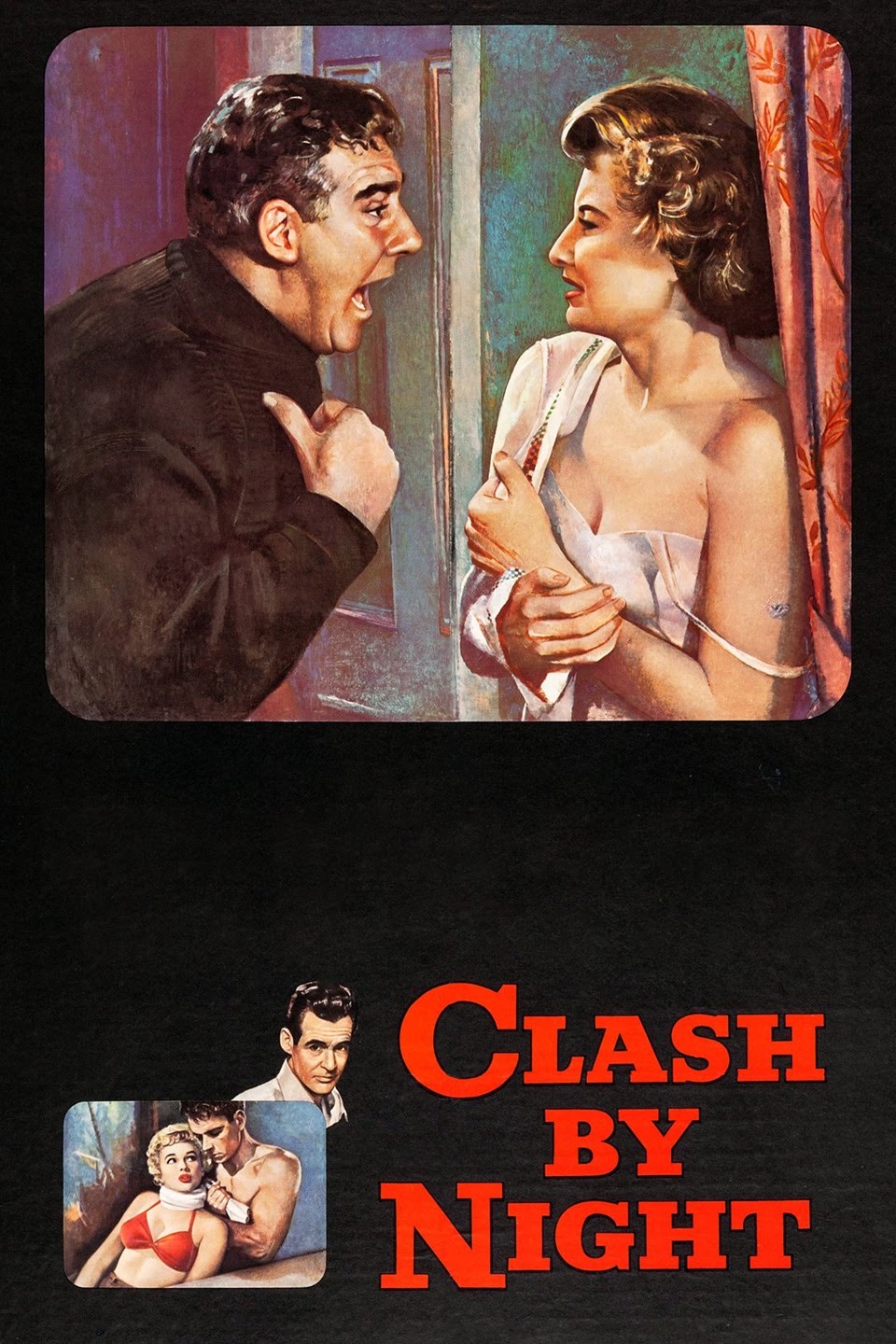
Since I am avoiding Oppenheimer and Barbie, I went back into the archives. While reading Arthur Miller’s The Price, I conjured YouTube and watched 1948’s All My Sons, where Edward G. Robinson and Burt Lancaster brought a tragedy by Henrik Ibsen to Middle America. I continued my sortie into post-war American cinema with Clash by Night, a 1952 Fritz Lang film based on a 1941 play by Clifford Odets. Considered a strong melodrama, it is a very watchable film dealing with emotions and relationships in post-war America in a semi-noir setting. (more…)
-

Karl Popper, one of the intellectuals who gave rise to the anti-populist conception of democracy that has prevailed in the West since the Second World War.
3,535 words
Part 5 of 9 (Chapter 1 here, Chapter 4 Part 1 here, Chapter 5 Part 1 here)
Whereas liberal elites had always harbored a cynical and technocratic rejection of the fundamental premises of popular government, after the Second World War “the highly educated [also began] to deplore working-class movements for their bigotry, their refusal of modernity,” and their apparent instinctual tendency towards nationalism and authoritarian leaders. They became openly and dogmatically hostile towards all forms of “collectivism” and solidaristic political movements because they identified popular social organization as fundamentally incompatible with liberalism’s hallowed individual rights and liberties. Post-war elites embraced anti-fascism and anti-populism as two necessary tenets of contemporary liberalism. (more…)
-
1,704 words
Countless multitudes recently undertook an annual ritual: making New Year’s resolutions. Surely one of the most popular is to begin an exercise program. For regular gym rats, we observe that the January crowding starts to taper off by February. Perennially, it’s clear evidence that there’s a problem in following through. However, you can take extra assurance by a recent Time article, which tells us that getting fit isn’t just the right thing to do, it’s the white thing to do. Thanks, mainstream media! (more…)
-
2,804 words
2,804 wordsThere is no city quite like Detroit, Michigan that exemplifies American deindustrialization. If one flies into the city’s airport at night, one looks down on a dark void, occasionally lit by streetlamps shining their light upon a ruin. By day, things look no better. Vast stretches of the city have become urban prairie. The story of Detroit (more…)
-
4,912 words
4,912 wordsSenator Bilbo excerpts from a compilation of fourteen essays by black notables in one of the recent egalitarian books, What the Negro Wants, edited by Rayford W. Logan (Chapel Hill: University of North Carolina Press, 1944). He identifies one of the authors, W. E. B. DuBois, (more…)
-
4,280 words
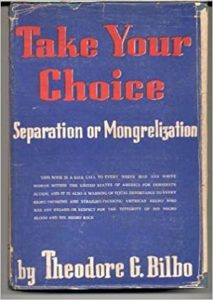
4,280 wordsTheodore G. Bilbo
Take Your Choice: Separation or Mongrelization
Poplarville, Mississippi: Dream House (1947)The final political testament by Senator Bilbo of Mississippi, Take Your Choice, is a useful opportunity to see how well old documents stand in the light of the present day. (more…)