Liberals reliably fall for what I call the “just like me” fallacy—that is, they assume that all humans are inherently like them in terms of motivations, intelligence, and outlook. Any perceivable differences in behavior—whether interpersonal, intercultural, or interracial—must result from environmental causes, not from anything innate. (more…)

Tag: English
-
Ian Dury was an English singer who was the first to admit that he couldn’t sing. He could battle adversity, however, having been crippled by polio at the age of nine from infected water at a swimming-pool. Polio was a terrible and often fatal disease which had several outbreaks in Britain, and Dury contracted it in 1951. (more…)
-
August 3, 2022 Counter-Currents Radio
Counter-Currents Radio Podcast No. 472 Hwitgeard on The Writers’ Bloc
The Writers’ Bloc had their good friend Hwitegeard over for a friendly, low-intensity chinwag with host Nick Jeelvy, where they also answered listener questions, and it is now available for download and online listening.
Topics discussed include:
00:07:00 How does one speak Anglo-Saxon and what does it sound like? (more…)
-
Earlier this week, Greg Johnson and Millennial Woes did a surprise livestream about some common mistakes in English, and it is now available for download and online listening.
Topics discussed include:
00:03:23 “Cliché”
00:04:50 “There is” vs. “There are” (more…) -
The second half of last weekend’s broadcast of Counter-Currents Radio was a solo Ask Me Anything with Greg Johnson, and it is now available for download and online listening.
Topics discussed include: (more…)
-

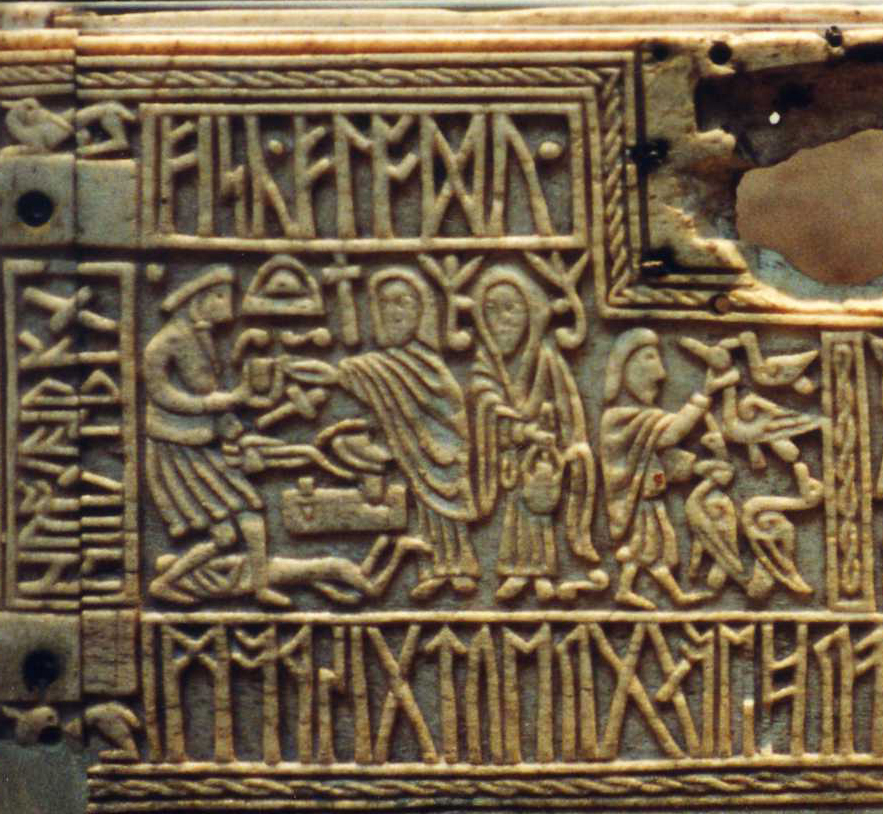
Front left detail of the Franks Casket, featuring Weyland the Smith and Anglo-Saxon futhorc runic writing
2,197 words
If you want a mouthful of history, just say “mouthful of history.” It’s a hybrid phrase, Germanic and Greek, combining two great European traditions that met and mingled on the island of Britain. But there’s a local flavor to it too: the second consonant of “mouthful” is distinctively English. That’s why we once had a good way to write that second consonant: in Old English, “mouth” was muð, pronounced “mooth.” (more…)
-
Editor’s Note:
The following is a selection from chapter 3, “Prussians and Englishmen,” of Oswald Spengler’s Prussianism and Socialism, (more…)