So far in this short series, we have been examining the widespread mass hysteria-like phenomenon of demon-attack panics in contemporary African schools, but gullible children are not only limited to the Third World. Consider events in Houston, Texas, in 1983, when hundreds of schoolchildren (presumably of all races) became convinced they were going to be murdered by the Smurfs. (more…)
Tag: Africans
-
David Lammy is a very large man. The left-wing black Labour Party MP and Deputy Prime Minister of the United Kingdom is a political giant in only one sense of the term: the width of his trousers. You could use his belt as a noose to hang a hippo with. He does, in all sincerity, increasingly come to resemble Idi Amin, a fact I am not the only one to have noticed lately. (more…)
-
Being a former high school English teacher, every autumn the beginning of the new academic year brings back memories of my former life in the classroom, and some of its odder incidents – none odder than the time I was accused of possessing magical powers.
Teaching a play in which one character is highly superstitious, I asked students to list as many superstitions as they could. (more…)
-
1,936 words
Asked to review a book about cannibalism for another outlet recently, [1] I was pleased to be reminded of a 1970 Monty Python sketch in which a group of sailors stranded in a lifeboat eagerly compete to see who should be served for dinner to the rest of the crew first. (more…)
-
Did you know there was once a black African monarch of Scotland called King Ken the Nigger? No? That’s because there wasn’t. King Kenneth II (r.962-967), or “King Kenneth Niger”, or “King Kenneth Dubh”, as he was sometimes known, probably just had black hair rather than black skin, dubh meaning “black” in Gaelic, with niger meaning the same in Latin. (more…)
-
Since Paul Theroux never stayed for long in one place while writing his African travelogues, the act of traveling itself takes up much ink in Dark Star Safari (2002) and The Last Train to Zona Verde (2013). Thus, the train becomes the leitmotif which connects both works. Theroux treats it as a symbol of the swollen, arthritic nexus between the West and modern Africa—magnificent in design, ambitious in scope, and but now timeworn, barely relevant, and poorly maintained by the indigenous population. In Dark Star, Theroux visits the grand and still-functioning railway station in Maputo, Mozambique, which was designed by the Portuguese in 1910. (more…)
-
In 2023, blacks murdered 602 whites in America according to a site called National Conservative. In return, whites murdered one-sixth of that number, despite outnumbering blacks around five-to-one. The link between black populations and high rates of violent crime is well established, with American whites being far and away the most frequent victims of interracial crimes. The links between blacks and poverty, blacks and corruption, and blacks and low academic achievement are also well established. (more…)
-
3,828 words
John Alan Coey
A Martyr Speaks
CPA Book Publishers, 1994White racialism is demonized in Western countries today, but this was not always so, and will not always be so. Our race consists not only of the millions of white people alive today, but also includes our ancestors and descendants, who live today in us, for their blood flows through our veins. They are relying on us to do the hard work of building a better future for our people. (more…)
-
2,808 words
White people commonly respond to demands for reparations for slavery and slave trading by pointing out that it was whites who abolished these things.[1] I don’t know whether they notice that this doesn’t get them the credit from their antagonists that they seem to expect; they certainly don’t appear to see why this is. (more…)
-
3,244 words
The uniqueness of whites can be partly explained by the their homelands’ climate. Europe is the second-cloudiest continent after Antarctica. Western hunter-gatherers colonized Europe as the ice sheets retreated. They evolved blue eyes, which are useful in cloudy weather because they are more sensitive to light and protect people from developing seasonal affective disorder. (more…)
-
3,618 words
If it is yet not universally known, it is certainly increasingly understood by a large segment of society that academia peddles simplistic ideologies, luxury beliefs, and outright falsehoods. Gender ideology is an obvious house built upon sand, yet no administrator has the courage to wash this harmful ideology away.
The root of the problem is Black Studies departments in universities, alongside Negro Worship. In the 1960s, universities across the United States organized Black Studies departments. These departments then hired ethnonationalist sub-Saharan professors and allowed them to recruit a core of sub-Saharan “students” as muscle for violent and intimidating actions against white university administrators, creating a culture of fear. (more…)
-
Sabrina Strings
Fearing the Black Body: The Racial Origins of Fat Phobia
New York: New York University Press, 2019This was a yummy, provocative idea for a book that didn’t quite work out. Its proposition is that fat-shaming and racism and white supreemism are all part of the same deal. Their history is intertwined. Hundreds of years ago, Europeans looked at the strange, repellent physiognomies and fleshy bodies of the African Negro, the Bushman, and the Hottentot, and were both fascinated and repelled. (more…)
-
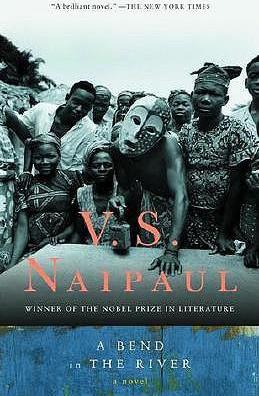
V. S. Naipaul was a prolific Indian writer from the West Indies who remains of interest to dissidents today largely due to the respect he afforded Western Civilization, as well as his often insightful race realism. Both qualities appear starkly in his 1979 novel, A Bend in the River.
The story takes place in an unnamed town in an unnamed country in post-colonial sub-Saharan Africa, and focuses on the thoughtful yet unambitious Salim, an ethnically Indian Muslim shopkeeper. The town is located at a bend in the river (also unnamed), which makes it an ideal place for trading. (more…)