Remembering D. H. Lawrence: September 11, 1885–March 2, 1930
Posted By Greg Johnson On In North American New Right | Comments Disabled [1]414 words
David Herbert Lawrence was born on September 11, 1885 in Eastwood, Nottinghamshire, England and died from tuberculosis on March 2, 1930 in Vence, France, at the age of 44.
The fourth son of a nearly-illiterate coal miner, Lawrence rose by dint of genius and hard work to become an internationally famous, often censored, and sometimes persecuted novelist, poet, essayist, and painter.
Underlying Lawrence’s writings was a visionary “vitalist” philosophy which affirmed the primary reality of life and criticized Christianity, science, technology, democracy, and feminism for suppressing, deforming, and profaning the life force.
Lawrence was also a man of the Right. A frank elitist, he rejected egalitarianism, liberalism, and democracy in favor of a hierarchical, organic society ruled by a dictator — a society that gave priority to aesthetic, cultural, and eugenic values. Lawrence also had strongly ecological and neopagan sensibilities.
Lawrence was astonishingly productive in his 44 years. His best-known novels are , Sons and Lovers, Lady Chatterley’s Lover, and The Rainbow. He also wrote numerous poems, short stories, essays, criticism, travelogues about Italy and Mexico, and many letters which were posthumously published.
To learn more about Lawrence, consult the following writings on Counter-Currents:
By Lawrence:
- “Benjamin Franklin [2].”
- “D. H. Lawrence on Fenimore Cooper’s Leatherstocking Novels [3].”
- “D. H. Lawrence on Fenimore Cooper’s White Novels [4].”
- “D. H. Lawrence on Herman Melville’s Typee and Omoo [5].”
- “D. H. Lawrence on Moby Dick [6].”
- “‘The Great Death Continent’: D. H. Lawrence on America [7].”
- “The Spirit of Place [8].”
- “Things [9]” (short story)
- “Whitman [10].”
 [11]
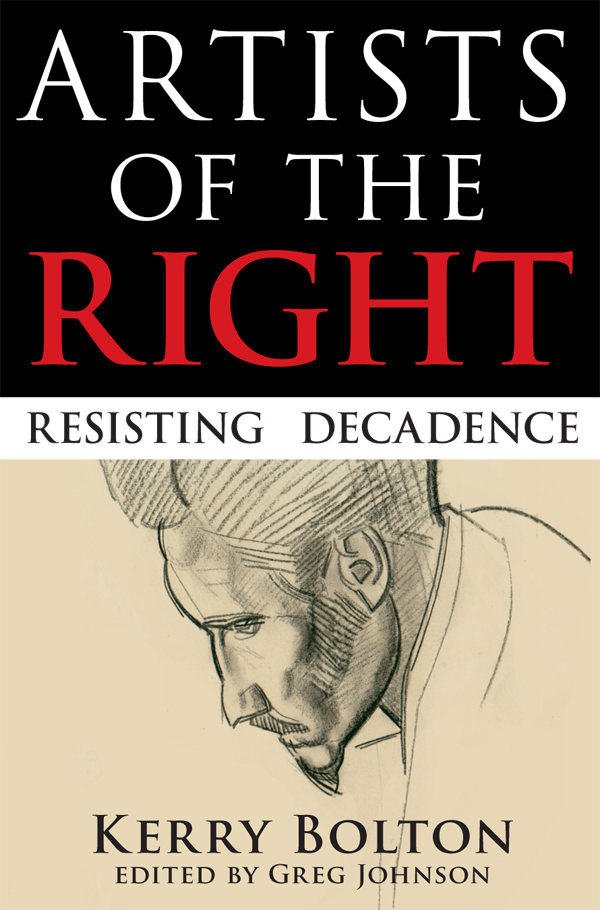
[11]You can buy Kerry Bolton’s Artists of the Right here [12].
About Lawrence:
- Kerry Bolton, “D. H. Lawrence [13]” (from Artists of the Right [14]) (Czech translation here [15], French translation here [16])
- Kerry Bolton, “Rex Fairburn [17].”
- Kerry Bolton, “Wyndham Lewis [18]” (from Artists of the Right [14])
- Jonathan Bowden, “Elitism, British Modernism & Wyndham Lewis [19].”
- Collin Cleary, “F. W. J. Schelling & Indo-European Triparition [20].”
- Julius Evola, “The Enjoyment of Vulgarity [21].”
- Derek Hawthorne, “D. H. Lawrence on America,” Part 1 [22], Part 2 [23]
- Derek Hawthorne, “D. H. Lawrence on Idealism and Evil [24].”
- Derek Hawthorne, “D. H. Lawrence on Men and Woman,” Part 1 [25], Part 2 [26], Part 3 [27], Part 4 [28], Part 5 [29], Part 6 [30]
- Derek Hawthorne, “D. H. Lawrence on the Metaphysics of Life [31].”
- Derek Hawthorne, “D. H. Lawrence on the Unconscious [32].”
- Derek Hawthorne, “D. H. Lawrence’s Critique of Idealism [33].”
- Derek Hawthorne, “D. H. Lawrence’s Critique of Modernity,” Part 1 [34], Part 2 [35]
- Derek Hawthorne, “D. H. Lawrence’s Critique of Reductionism [36].”
- Derek Hawthorne, “D. H. Lawrence’s Phallic Traditionalism [37].”
- Derek Hawthorne, “D. H. Lawrence’s Women in Love: Anti-Modernism in Literature,” Part 1 [38], Part 2, [39] Part 3 [40], Part 4 [41]
- Robert Steuckers, “Paganism and Vitalism in Knut Hamsun and D. H. Lawrence,” Part 1 [42], Part 2 [43]
- Offa Whitesun, “Untainted Love [44].”
Also see essays tagged [45] D. H. Lawrence.
* * *
Counter-Currents has extended special privileges to those who donate at least $10/month or $120/year.
- Donors will have immediate access to all Counter-Currents posts. Everyone else will find that one post a day, five posts a week will be behind a “paywall” and will be available to the general public after 30 days. Naturally, we do not grant permission to other websites to repost paywall content before 30 days have passed.
- Paywall member comments will appear immediately instead of waiting in a moderation queue. (People who abuse this privilege will lose it.)
- Paywall members have the option of editing their comments.
- Paywall members get an Badge badge on their comments.
- Paywall members can “like” comments.
- Paywall members can “commission” a yearly article from Counter-Currents. Just send a question that you’d like to have discussed to [email protected] [46]. (Obviously, the topics must be suitable to Counter-Currents and its broader project, as well as the interests and expertise of our writers.)
To get full access to all content behind the paywall, please visit our redesigned Paywall [47] page.