Frantz Fanon’s Black Skin, White Masks: A Primary Text of Post-Colonial Jive Part 4
Posted By Beau Albrecht On In North American New Right | Comments Disabled [1]1,968 words
Part 4 of 4 (Part 1 here [2], Part 3 here [3])
By Way of Conclusion
The conclusion is pretty mopey, as usual. For example:
The situation that I have examined, it is clear by now, is not a classic one. Scientific objectivity was barred to me, for the alienated, the neurotic, was my brother, my sister, my father. I have ceaselessly striven to show the Negro that in a sense he makes himself abnormal; to show the white man that he is at once the perpetrator and the victim of a delusion.
Yeah, it’s all our fault, always. (Of course, right?) There’s much about disavowing connection to the past, and instead living for the present; this seems a curious attitude for a racial nationalist. Throughout, he resumes the sort of detached and above-it-all style of the opening preface, sounding again like a guy chatting casually at a train station while playing with the switch to his suicide vest. Much pouting follows, including these items:
I as a man of color do not have the right to hope that in the white man there will be a crystallization of guilt toward the past of my race.
I as a man of color do not have the right to seek ways of stamping down the pride of my former master.
I have neither the right nor the duty to claim reparation for the domestication of my ancestors.
Finally, we’re starting to agree about something.
Frantz versus France
 [4]
[4]
In summary, Black Skin, White Masks is a collection of essays, introduced with overly lengthy prefaces, and jazzed up in places with postmodern mumbo-jumbo, all to the effect that whites are responsible for black people’s problems. (Of course, right?) Since the author was a psychiatrist, this stuff can be passed off as “science,” no matter how much of a stretch some of the politicized codswallop was. Moreover, not only does the book have a scholarly imprimatur, but it’s one of the primary texts of post-colonial studies — one of the Ivory Tower “disciplines” to appear after cultural Marxism made its first move to colonize academia.
 [5]
[5]You can buy Beau Albrecht’s Space Vixen Trek here [6].
In a number of places Fanon shows immoderate resentment of stereotypes portraying blacks as provincial, quaint, rustic, primitive spear-chuckers, headhunters, or happy-go-lucky darkies fum de eeylunds, mon. This prickliness is not unfamiliar to us lately. For example, imagine a black sitting on a tree stump while eating a slice of watermelon while wearing a porkpie hat, tattered overalls, and sporting bare feet. If this scene were featured in a movie, it would lead to a mushroom cloud over Hollywood.
Granted, one could say that this sort of thing is disrespectful, conjures up outdated images, and all the rest of it. The problem is that Fanon was really overdoing it. If that seems too deplorable of a conclusion, consider the vast difference between blacks and whites in this regard. None of us hit the ceiling about the silly hicks in the Dukes of Hazzard or the Beverley Hillbillies, for instance. Even B movies such as Deliverance or Pumpkinhead seldom raised an eyebrow, although if applied to blacks good liberal opinion would call the portrayals damaging and highly pernicious. Sure, there’s a big dose of condescension in this stuff by Hollywood types who mock the people who grow their food. Sometimes it’s even a deliberate insult by those of (((our betters))) who comprise much of the film industry. Still, there are worse things in the world, and we generally shrug it off even though we could legitimately raise moderate objections. Everyone gets stereotyped; what of it?
But there’s an interesting side note: Blacks seem ashamed of their ancient forebears [7].[1] [8] As a psychological defense mechanism, some go the Afrocentric route and creatively try to reimagine a past of powerful, advanced societies. Everything was going great until of course wypipo stole their inventions, magically causing the blacks to forget their own technology. This sort of thing, of course, is the source of the “we wuz kangz ‘n sheeit [9]” meme.
Meanwhile, whites are proud of our ancient past: the Greco-Roman civilization, the Iron Age, the barbarian days, and the legends of prehistoric antiquity shrouded in the mists of time. I can’t speak for the bugmen out there who are addicted to their cell phones, of course, but there’s even a certain sparkle to the Dark Ages compared to Clown World.[2] [10] We’d laugh it off if someone told us, “Go wear a toga, honky!” Likewise, certain ancient near-white societies such as Egypt and Mesopotamia remain iconic thousands of years after the fact. The Chinese likewise have much to remember fondly about their very long history. American Indians are proud of their forebears, though I don’t know any who’d really enjoy revisiting the good old days for too long; the Stone Age was no picnic.
I understand that Fanon didn’t appreciate stereotypes, assumptions that he was an ignorant jungle bunny, and all that. (I’ll add that American travelers abroad get a pretty bad rap too sometimes, although we’re only half as bad as we seem. I don’t lose too much sleep over it, though.) Still, the Afro-dyspepsia was hyperbolic in the extreme. I can’t imagine Rightist radicals caterwauling like this! William Pierce’s acid pen never produced lugubrious moaning. Perhaps Fanon knew he was jazzing it up for propaganda purposes, correctly assuming that his obscure manuscript would one day become wildly popular among Leftist gluttons for punishment who eat up all the guilt-inducing wangst like candy. More likely he was playing it straight, suffering from hypersensitivity and a massive chip on his shoulder.
Other themes
 [11]
[11]Il Duce ha sempre raggione!
The opening topic of linguistic prestige and its relation to social class was hardly anything new by Fanon’s time. I actually got dunked headfirst into all that jive in college. (The short version is that I took a grammar class, only to be taught that proper English is a means of systemic oppression. If any grammar Nazis out there want to find fault with my syntax, go blame my professor who failed to instruct me in the subject I paid to study.) I’ll further add that this sort of thing is not always racially charged. Most debates are about the status of regional dialects and languages within a nation. Examples include the place of Welsh, Catalan, Occitan, and so forth. Fanon’s contribution to the subject here is mainly a lot of melodrama.
Another theme is an “us versus them” mentality that seems to feed into a certain style of reductive thinking. It’s not one more fault ascribed to evil white people, but instead by the author. The major topic is the supposed evils of colonialism, and obviously there were colonies in areas other than Africa and the Caribbean. But aside from a brief mention of Vietnam at the end, the book has a curious absence of people other than pure blacks, mulattos of various hues, and whites. (Fanon occasionally brings up Jews, though he classifies them as whites, and for no discernable reason he holds them in higher esteem than blacks. Other than that, whites are generally considered as a monolithic category.) It’s almost as if no other races exist.
This reductive tendency is named, mostly in the prefaces, as “Manicheanism” — a highfalutin and inaccurate[3] [12] way of saying bifurcation between black and white. This seems to be an operating principle, almost as if Fanon regarded all other non-whites as honorary blacks. If so, that would be a bit solipsistic. It’s telling that he soon would side with the Algerians against the French, although the near-white Arabized Berbers aren’t black, and he didn’t share their religion.
Other than that, a major theme in the book is equating cultural assimilation — even learning a normative Western language — with “becoming white.” That’s rather silly, in essence an error similar to civic nationalist reasoning and “magic dirt” arguments. I think it’s impossible to change one’s race [13] by taking on another people’s customs, but what the hell do I know? Frantz Fanon was a bomb-chucking psychiatrist still doted on by Leftist academia, and I’m just a dumb blond from Flyover Country.
You mad, bro?
 [14]
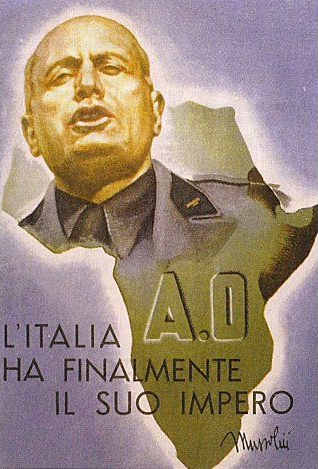
[14]Mussolini freed the slaves in Ethiopia. Maybe colonialism wasn’t such a bust!
What are we to make of this strange cri-du-cœur which bitterly and extravagantly denounces white society, yet shows profound envy of it? Given this intemperate book-length screed smearing the white race, psychoanalyzing the psychiatrist is on the table. A passage discussing moral insanity from Max Nordau’s study on degeneration [15] is quite telling:
In view of [Cesare] Lombroso’s researches, it can scarcely be doubted that the writings and acts of revolutionists and anarchists are also attributable to degeneracy. The degenerate is incapable of adapting himself to existing circumstances. This incapacity, indeed, is an indication of morbid variation in every species, and probably a primary cause of their sudden extinction. He therefore rebels against conditions and views of things which he necessarily feels to be painful, chiefly because they impose upon him the duty of self-control, of which he is incapable on account of his organic weakness of will. Thus he becomes an improver of the world, and devises plans for making mankind happy, which, without exception, are conspicuous quite as much by their fervent philanthropy, and often pathetic sincerity, as by their absurdity and monstrous ignorance of all real relations.
If one wanted to describe Fanon in a nutshell, that would come close. He didn’t like it in Martinique, where with some luck he eventually might’ve become a big fish in a little pond, just as Aimé Césaire did. He didn’t like it in France, and was indignant that he was considered a stranger — despite receiving a university education. He wasn’t about to shrug it off as the sort of minor aggravations that all outsiders inevitably experience navigating another society. He could’ve advocated for peaceful change, but instead he joined up with terrorist whack-jobs. Their Leftist ideologies preached freedom and equality, but their badly-flawed premises [16] made them inherently unworkable. Unable to make the real world conform to their theories, these “liberation movements” left a trail of misrule, death, and destruction. Of course, this was hardly the only time that radical movements espousing freedom, universal brotherhood, equality, and all the rest of it ended in chaos and disaster.
Finally, Black Skin, White Masks is memorable for its decades-long use as agitprop by Leftist professors, giving white students a guilt trip and making them feel like the wretched of the Earth. Other than that, this much-ballyhooed skintellectual’s text is a notable example of Olympic-level bellyaching. Early on I became thoroughly tired of all the interminable kvetching by this overrated horse’s ass. Wading through this thing was like a labor of Hercules. Surely then it was a greater deed to write it. If it was a mighty feat to clean the Augean Stables, then surely it was also an accomplishment in the first place to pile up so much horse shit.
* * *
Like all journals of dissident ideas, Counter-Currents depends on the support of readers like you. Help us compete with the censors of the Left and the violent accelerationists of the Right with a donation today. (The easiest way to help is with an e-check donation. All you need is your checkbook.)
For other ways to donate, click here [17].
Notes
[1] [18] They could hand-wave it by saying that their ancestors were in simple societies, relying on the land’s tropical abundance to sustain them all year, and had no pressing need to develop things such as multi-story architecture, writing, or navigation. But I’ve never heard of them advancing such an argument.
[2] [19] Consider, for example, Burgundy during the interesting times when the events inspiring the Nibelungenlied were unfolding and wild nature was never too far away. That sounds like more of an adventure than editing spreadsheets all day for some soulless corporation, doesn’t it? Granted, lords were lords and peasants were peasants, but nobody was a damn Soviet security number.
[3] [20] Manicheanism is a religion which, similar to its Zoroastrian precursor, sharply distinguishes between good and evil. For the inside skinny, see St. Augustine’s Confessions. This never had anything to do with blacks and whites; those who use the term in a racial context are overstretching an analogy.