Typee
Posted By Spencer J. Quinn On In North American New Right | Comments Disabled2,144 words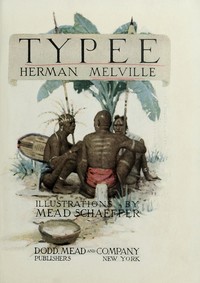 [1]
[1]
In July of 1842, a young American sailor named Herman Melville deserted a whaling vessel anchored off the island of Nukuheva in the Marquesas Archipelago in the South Pacific. He may not have known it then, but the several weeks he would spend among the Typee, the primitive Polynesian inhabitants of the island, would launch one of the most famous American literary careers of the nineteenth century. Four years later, his account of his time on the island was published as Typee: A Peep at Polynesian Life During a Four Months’ Residence in a Valley of the Marquesas. We today think of Melville as a novelist and the author of the great whaling epic Moby-Dick, but at the time Typee was marketed as a kind of amateur ethnology and travelogue. Non-fiction, in other words. A glimpse at the Edenic lives of innocent savages in the state of nature, uncorrupted by Western decadence and dogmatic missionaries. In his preface Melville states that he hopes his “anxious desire to speak the unvarnished truth will gain for him the confidence of his readers.” He must have felt the need to add such a caveat because what he offers in Typee is not the truth, varnished or otherwise.
Vivid in imagery and written by an author easily and often transfixed by the beauty of nature, Typee filters the base and brutish world of the Polynesian—as well as the Polynesian himself—through a lens sparkling with Enlightenment ideas and Romantic notions. This of course flies in the face of the imperialistic and race conscious mindset which was perhaps even more common at the time, especially among seafaring men. So Melville starts out as something of a rebel. From the coastal islanders who often traded with whites, Melville learns of the fierce and pitiless reputation of the secluded Typee. He is led to believe they are “inveterate gormandizers of human flesh,” and recalls an episode from years past in which hundreds of Typee swarmed an anchored British vessel and murdered every soul onboard. Naturally, after he and his companion Toby jump ship and disappear into the island’s interior, they hope to encounter any tribe not called Typee. They don’t get their wish and soon are surrounded by people who are not nearly as hostile or violent as they are reputed to be. Instead, they prove to be warm and generous and happily take the two haggard white men in.
As he lives among them and learns of their strange ways, Melville makes comparisons with civilized life—as would be expected—but goes out of his way to make civilization come out the poorer. He doesn’t need to do this to propel his narrative or portray the lives, culture, and environs of his exotic subjects, but does so anyway—and often:
In a primitive state of society, the enjoyments of life, though few and simple, are spread over a great extent, and are unalloyed; but Civilization, for every advantage she imparts, holds a hundred evils in reserve—the heart burnings, the jealousies, the social rivalries, the family dissensions, and the thousand self-inflicted discomforts of refined life, which make up in units the swelling aggregate of human misery, are unknown among these unsophisticated people.
We’ve heard this kind of moralizing before, perhaps most stridently from Jean-Jacques Rousseau [2], whom Melville names in his narrative and whose most famous idea—the noble savage—he explicitly appropriates. He also wishes for us to dwell upon the physical beauty of the Typee. Well, actually, Melville is the one doing all the dwelling—on both sexes and in lurid detail:
The stranger could not have been more than twenty-five years of age, and was a little above the ordinary height; had he been a single hairsbreadth taller, the matchless symmetry of his form would have been destroyed. His unclad limbs were beautifully formed; whilst the elegant outline of his figure, together with his beardless cheeks, might have entitled him to the distinction of standing for the stature of the Polynesian Apollo.
Famously in Typee, Melville carries on an extended flirtation—or coded love affair—with an adolescent girl named Fayaway. There is no superlative strong enough to capture the man’s captivation at her unparalleled beauty.
Her free pliant figure was the very perfection of female grace and beauty. Her complexion was a rich and mantling olive, and when watching the glow upon her cheeks I could almost swear that beneath the transparent medium there lurked the blushes of a faint vermillion. The face of this girl was a rounded oval, and each feature as perfectly formed as the heart or imagination of man could desire. Her full lips, when parted with a smile, disclosed teeth of a dazzling whiteness; and when her rosy mouth opened[…]
Well, you get the point. Herman Melville found this 14-year old damsel to be the epitome of feminine beauty and made sure the entire world knew about it. Indeed, Melville often emphasizes the erotic nature of the Typee, with their uninhibited ways, but does so artfully enough not to scandalize his Victorian readers (or titillate his modern ones). One example occurs when he is boating with Fayaway. The young nymph stands in the canoe, and with “a wild exclamation of delight” completely disrobes in order to use her tapa robe as a sail. Melville declares that “a prettier little mast than Fayaway made was never shipped aboard of any craft.”
Not only are the Typee better looking than whites and have better sex, they are also morally superior. They don’t steal from one another. Property rights are both communal and sacrosanct. They are also inherently honest, and so require little by way of government. Melville claims he could plainly trace in their naïve gestures and expressions “all those passions which had been thus unexpectedly roused in their bosoms.” They are religiously tolerant—as opposed to Christian missionaries, many of whom Melville decries as suffering from “a want of vital piety.” They enjoy lax marital relations, with multiple so-called husbands per woman, so jealousy and crimes of passion are unheard of. Melville swears he never witnessed even a quarrel among the Typee. There is also no money, a fact he celebrates with a long list of civilized ills which the Typee blissfully do without. These include mortgage foreclosures, bills payable, “unreasonable tailors and shoemakers,” and the dreaded “assault-and-battery attorneys.” With such odd specificity, one would suspect that Herman Melville had lost his home to an irate cobbler who punched him in the nose while trying to collect on an unpaid bill.
Despite their fearsome reputation, the Typee are also more peaceful than whites. Melville attests that the Typee language is “almost destitute of terms to express the delightful ideas conveyed by our endless catalog of civilized crimes.” He goes on to write—infamously, in my opinion—about civilized man’s “fiendlike skill” in constructing “death-dealing engines” that makes him “the most ferocious animal on the face of the earth.” In the book’s one scene of intertribal war, Melville portrays the skirmish as decidedly less than lethal, perhaps as dangerous as a particularly violent rugby match. The Typee losses include a forefinger, a thumbnail, a bruised arm, and a bloody gash resulting from the thrust of a spear.
For many decades Typee was considered more or less accurate by the English-speaking public. This changed in 1939 when Charles Roberts Anderson published Melville in the South Seas [3], which revealed how Melville had lied about his chronology and had passed off previously published accounts [4] of the Marquesas as his own. The latter action occurred when his publisher had insisted he include chapters conveying the every day lives of the Typee. This becomes noticeable in the narrative when Melville transposes what began as a south-sea adventure into a work of proto-anthropology. And he gives us good stuff. In lively prose, he describes not only the habits and traditions of the Typee, but their food, their clothing, their rituals, and their intricate art of tattooing, which both fascinates and repels him. In one amazing passage, he seems to channel Graham Hancock when encountering ancient structures on the island which are inexplicably huge, sturdy, and complex. In pondering their origin, he asks, “how could [the Typee] with their rude implements have chiseled and hammered them into shape?”
None of this exonerates lying, however. With the veil obscuring Melville’s source-stealing lifted, one must ask what else was he lying about. According to official records he spent three to four weeks among the Typee—not the four months claimed in the book’s title. How much could he have witnessed in such a brief time? Also, with so many angry, unmotivated broadsides leveled against civilized people—some of which descend into unseemly insults—it’s clear that Melville had an axe to grind. For example, he dismisses white men as “a sorry set of round-shouldered, spindle-shanked, crane-necked, varlets” when compared to the statuesque demigods stomping around Nukuheva. At one point he even seriously suggests that sending Marquesan islanders to the United States as missionaries would be as useful as the other way around.
So did Herman Melville exaggerate or fabricate the tranquil lives and pacific nature of the Typee? Most likely, yes. Margaret Mead [5], under the aegis of Franz Boas [6], did something similar nearly a century later. Decades after that was the Gentle Tasaday [7] hoax of the 1970s in which Pilipino President Ferdinand Marcos hired island primitives to pretend they belonged to a peaceful, secluded tribe which had no word for war. Anthropologist Lawrence Keeley thoroughly undresses the noble savage trope in his 1996 volume War Before Civilization [8]. In it he shows how primitive peoples waged war and continue to wage war more often than civilized people, and are in all respects more violent and lethal. Thomas Hobbes was indeed much closer to the truth than the egalitarian Rousseau [2]. Two other edifying works which dispel the noble savage myth are CR Hallpike’s 2018 Ship of Fools [9] and Geoffrey Blainey’s 1976 study of the Australian Aborigines Triumph of the Nomads [10].
Melville’s equivocating never gets more obvious than when he is forced to address cannibalism among the Typee. Apparently for him, resorting to this ghastly practice is acceptable only when involving the bodies of slain adversaries. His rationalizations are unintentionally funny. When his companion Toby complains that the Typee eat human flesh, Melville ridiculously responds, “Granted. But a more human, gentlemanly, and amiable set of epicures do not probably exist in the Pacific.”
What?
Typee does diverge at times from its humanistic relativism; it seems there is only so much truth that Melville can obscure. For example, while describing the Typee as atavistic innocents, he also implies they are simple-minded, such as when he constructs toy pistols from bamboo shoots only to witness Typee adults playing with them for hours like children. He also states that the Typee “were somewhat inclined to be lazy.” Due to the “luxurious provisions of nature” the Typee do not need to farm or hunt—subsequently disproven by Anderson—and never seem to appreciate the value of hard work. Melville describes a hundred or so islanders cooperating, each a tiny bit, to build a crude hut and taking all day to complete such a trivial task. Only one person on the island, an old woman, Melville describes as industrious.
Melville deserves credit for spotting the correct things about civilization against which to rail. Yes, our propensity for war and cruelty could and should be curtailed—both then and now. Yes, even the best intentioned missionaries often did more harm than good by introducing foreign modes of thought to primitive peoples. And yes, something is seriously wrong with modern civilization when people starve by the thousands in cities across Europe, while Pacific Islanders who cannot count to four enjoy fruit falling out of trees all around them. Then, of course, there was how some people back then misused race realism and capitalism to justify slavery. So Herman Melville’s repugnance towards the excesses of his own civilization is not unjustified. It’s just that propagating lies about stone-age peoples is hardly a just way to express it. Yes, familiarity breeds contempt, but placing twenty-five hundred Typee on a higher moral plain than 250 million whites is simply ridiculous.
Regardless, Herman Melville remains a writer of genius. Typee is an engaging and thought-provoking read which has earned a permanent spot in the history of cultural anthropology as well as South Sea literature. Also, I have not given away the best part of the book, the ending, in which Melville plots and then manages his escape in breathtaking fashion. He finally discerns something unspeakably sinister about the Typee, and cannot separate himself from them quickly enough. It’s as if he’s perfectly willing to disregard his Enlightenment ideals and Romantic notions about human nature as long as he can live to tell the tale.
Which he did, dishonestly, as it turned out.