1,842 words
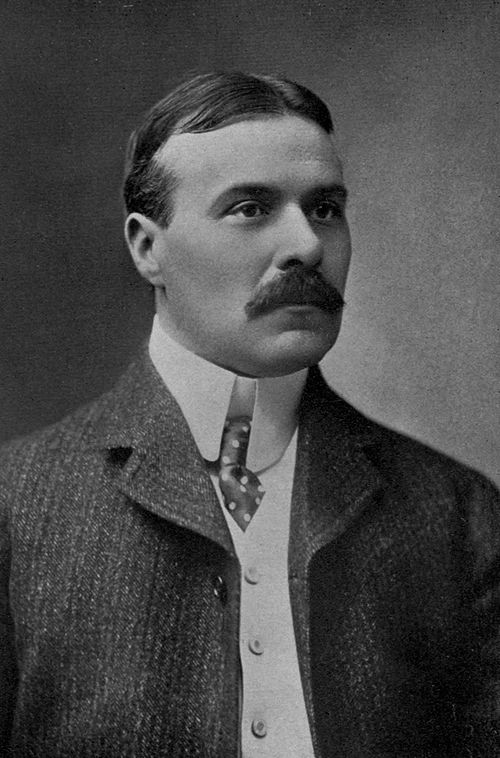
Robert Chambers
In 1974, popular fantasy author Marion Zimmer Bradley (1930-1999) penned an essay on fellow author Robert W. Chambers titled, after a quote by Chambers,The Necessity for Beauty: Robert W. Chambers and the Romantic Tradition.
Now, Zimmer Bradley is an acquired taste, and I’m not even talking about her questionable personal life (she was a lesbian or bisexual married to the convicted child rapist Walter Breen, and was herself posthumously accused of abuse by the couple’s daughter Moira Greyland in 2014)[1]. As a writer, Zimmer Bradley churned out some very trite and even downright bad fiction, but she certainly had her moments. The Necessity for Beauty was one of them, and it is still worth looking into – for the sake of Chambers, if not Zimmer Bradley.
Robert Chambers was obviously near and dear to Zimmer Bradley’s heart, as evidenced by the fact that she adopted some of the characters of his collection of loosely connected short stories, The King in Yellow (1895), for her Darkover mythology. In that, I argue, she did better than the followers of H. P. Lovecraft who equally claimed Chambers’ creation for the Cthulhu mythos where it doesn’t belong. Lovecraft himself appreciated The King in Yellow (or at least some of the stories therein) and mentioned the names Hastur and Carcosa in one of his stories as a homage. It was only later authors who tried to shoehorn the vague references Chambers made to the plot of his fictional book of doom into Lovecraft’s universe.
Yes, the case could be made for similarities between Chambers and Lovecraft. There is a book that drives people who read it insane or brings doom upon them, there are bizarre and otherworldly characters, there is the ominous Yellow Sign, there are strange happenstances, and there is a murderous cat, which probably made Lovecraft very happy. But looking closer, The King in Yellow owns much more to the Parisian artistic milieu that Chambers as a former art student was familiar with than to any cosmic horror à la Lovecraft. Chambers at his core was a romantic writer, something that shines through even in most of the fantastic stories in The King in Yellow that are really veiled love stories, tragic or otherwise. So however vague the plot of his fictional book remains to the reader, to imagine its characters of Hastur, Cassilda, and Camilla as anything but a love triangle is naïve. In fact, we find early ideas for The King in Yellow in Chambers’ first novel, In the Quarter (1894), a story about a young American artist in Paris (just as Chambers had been) torn between two women. (Hint: it ends tragically.)
Marion Zimmer Bradley was wise to this, and she clearly had done a lot of research into Chambers and his works, which is why it is a great shame that she limited herself to a 45-page booklet instead of going for a full monograph. Zimmer Bradley proved herself an excellent literary critic, something that gets overlooked very easily in the considerable body of her often trivial fiction writings.
She recalls,
The present writer, in her teens, was addicted to haunting antiquarian bookshops in and out of Albany, New York. The proprietor of one such bookshop, which had become something of a central hangout for Chambers fans, had known Chambers fairly well before his death; and any undocumented information in this paper can be attributed to conversations with this man […]According to him, Chambers treated his “modern novels” with a shrug of contempt, turning them out carelessly and quickly for the money in it, and (in his later years) occasionally farming them out to be ghost-written, although under his close supervision, by other impecunious writers. His loving care was reserved for the fantasies and the historical novels, particularly the Cardigan novels.
This is itself a statement of historical value by now. Elsewhere, we get a glimpse of price inflation when Zimmer Bradley mentions that most of Chambers’ novels “can be found now in second-hand bookstores in the chuck-out bins for fifteen and twenty cents … Yet any of the thirteen editions of The King in Yellow will bring enormous prices from a collector of fantasy; The Mystery of Choice, scarcer still, has been offered for as much as $25”. Try that today, says somebody who once owned a first edition of The King in Yellow.
It is the so-called Cardigan novels (Cardigan, The Maid-at-Arms, The Reckoning, The Hidden Children, and The Little Red Foot) that Marion Zimmer Bradley focuses on in her essay, as well as the romantic tradition she places Chambers in. As she explains,
Chambers has today dropped into obscurity. My contention in this paper will be that this is not due to any lack of merit in his work, but a revolution in taste: that Chambers was a writer misplaced in time, a last offshoot of the late revival of romanticism, doomed to defeat by the surging forces of realism and naturalism.
[…] The novels of Chambers (and a majority of them deal with New York society just before, during and after the Great War) just happened to be written at a time when realism and the Lost Generation were kicking over the traces. Compared with the sexual revolt of the Twenties and the grim naturalism of the Depression years, the novels of Chambers appear to belong to another age of the world. Romances, per se, had gone out of fashion, to be replaced by social problem novels. Chambers, who spoke of a writer’s task as that of satisfying “the necessity for beauty”, must have seemed frothy, escapist, and even (horror of horrors to the Stark School) sentimental.
Zimmer Bradley herself gets quite romantic and even sentimental – in a good way – when she discusses the influence of countryside, environment, and history on Chambers’ writings:
A major characteristic of romantic fiction is that it deals with the far away and the long ago; with the glories of the past[…] The Cardigan novels might be called, then, “regional romantic” fiction[…]
Chambers was well fitted to deal with his subject. His home was at Broadalbin, near Fort Johnson in the Mohawk Valley. This area of New York state is particularly rich in history. It is near the old Dutch city of Albany, where Fort Crailo and the Schuyler Mansion call to mind the history of the Revolution (the mark of an Indian tomahawk may still be seen on the staircase of the Schuyler Mansion), and the natives of the region can trace every step of the old campaigns and battles, walk down the cobblestone streets, see the blue hills and haze of the Helderbergs, and the Adirondacks, the Catskills. In the somber beauty of Cherry Alley, an old stone ruin stands, still blackened with the ancient smoke of the massacre. The reader of the Cardigan novels will trace that verisimilitude, that fidelity to detail, which cannot be pretended or faked, and is true local color at its best.
One primary feature of the Cardigan novels is the lovely, intense, lyrical description of the geography, the scents and trees and flowers and hills and birds of New York and the Mohawk Valley. “Description” is out of fashion in the modern novel, to the extent that some modern novels could equally have taken place in Philadelphia, Buenos Aires or on the Moon; but Chambers was so saturated in the region that on almost every page some color or bird will peep through, and his passionate love for the countryside, filtered through the mask of the character speaking, not infrequently bursts through the “action” and “adventure”.
While I have yet to read the Cardigan novels (or visit New York and the Mohawk Valley), I can testify to Robert Chambers’ talent in painting a landscape and its people with words from In the Quarter, which features a holiday in the Bavarian Alps and vividly describes the locals and localities. I was very much reminded of Anna Mary Howitt’s wonderful 1853 travelogue An Art-Student in Munich.
Marion Zimmer Bradley, in yet pre-political correctness and DEI days, continues,
Indians have usually been treated badly in fiction. This is natural enough. In this country, the Indians were the adversary, the nemesii, the major antagonistic force to settlement, expansion and growth. There were plenty of settlers who maintained firmly, well into the Nineteenth Century, that the only good Indian was a dead Indian. Where the frontiers ran red with the blood of the scalped, this was perhaps natural enough.
On the other hand we have the recent glorification of the Indians; the tendency in fiction to treat them as permanent underdogs, mercilessly exploited by the white men, desperately defending their homeland… the Noble Savage tradition, brought up to date and treated with grim realism which makes the white men into the “bloody fiends” which the Indians themselves were accused of being.
Sound familiar?
A curious paradox of the romantic tradition is the way in which these two variant views are balanced. James Fenimore Cooper, in his Leatherstocking Tales, shows all the killing and scalping, and yet occasionally presents a “good” Indian character. The Cardigan novels fall even more clearly into this pattern. A major distinctive feature of these novels is the loving care and fidelity, the balance and plausibility, of Chambers’ portrait of the Iroquois Confederacy. The massacres are presented in their horror – and Chambers, whose horror stories have been compared with those of Poe, can be very horrible when he wishes. The account of the torture of Lieutenant Boyd, in The Hidden Children, is almost unreadable by the squeamish, as are the graphically depicted hand-to-hand battles and scalpings of The Little Red Foot.
Things certainly have changed since 1974, to the point that even Marion Zimmer Bradley’s praise of Chambers’ “romantic realism”, so to speak, seems dated. Yet, I consider Chambers’ “necessity for beauty” more current and more important than ever. Beauty is an actual force. It is closely related to idealism, which is also in short supply these days. Beauty and idealism are forces for good. They lift us up, which is of course why they are so despised and ridiculed in this dark age we live in.
Marion Zimmer Bradley concludes,
If a day should come when a public sated with naturalism should begin to yawn at the candid camera portraits of life, Chambers may be discovered again for the very traits which sent him into eclipse; his effusive style, his poetic fidelity to the loveliest of worlds, his sense of fantasy in the commonplace things … And the view of beauty, the vision that lies at the core of the best work of Robert W. Chambers, is that changeless and imperishable stuff which outlasts the gilt and glitter of a dozen fid in the art or the artist. For at its best, the romantic tradition struck deep into the human heart with its passionate emotions, its idealism, and its eternal optimism, hope, and unending faith in the human good and justice.
Notes
[1] Greyland had some interesting things to say about the connection between homosexuality and the liberal dream of utopia we’re so familiar with by now.
4 comments
There is a book that drives people who read it insane or brings doom upon them…
Great article! That book sounds like the Bible. 🙃
Very nice article. I haven’t read MZB, partly due to the pedophilia allegations, but I’ve read most of the big SFF works 1990 – 2010 (my username comes from Malazan, maybe the most reactionary modern fantasy epic) I hadn’t heard of Chambers until now.
If C-C writes more on SFF, you’ll have at least one happy reader. I also enjoy Greg on Lovecraft and Morgoth on Dune.
Someone of here years back recommended Thomas Covenant but I just couldn’t get into it even though I was a big fantasy fan as a teen. I briefly started on Gardens of the Moon long ago but’ve considered going back to the genre again. Not GRRM but is Malazan, Tad Williams, Rothfuss, or anyone else I’m missing worth exploring, preferably not the typical mediocre same old derivative storyline with middle school-level grasps of English.
Mostly the answer is no, modern Fantasy is not worth reading unless you really like the genre. Just what you describes
Malazan is very autistic, I would recommend it if you like military history, classical civilizations, trains, etc. It focuses on the civilizational scale, leaving individual characters underdeveloped.
I like Rothfuss, but he’s for teenagers. Martin is talented but deeply nihilistic – I dislike ASOIAF more and more as time goes on. Williams’ Otherland is good SF about VR if you like Star Trek Holodock episodes.
Joe Abercrombie is an interesting one. Not really reactionary, but the villians of his series are pastiches of the Prophet Muhammed and of the Rothschildes.
The first 2 Stormlight books are amazing, but 3-5 are woke garbage.
Comments are closed.
If you have a Subscriber access,
simply login first to see your comment auto-approved.
Note on comments privacy & moderation
Your email is never published nor shared.
Comments are moderated. If you don't see your comment, please be patient. If approved, it will appear here soon. Do not post your comment a second time.