American Renaissance 2024: Joy in the Morning (and All Day Long)
Posted By Jef Costello On In North American New Right | Comments Disabled5,082 words [1]
[1]
One of the most bizarre moments of Kamala Harris’s shockingly inept campaign was when, speaking at a church in Philadelphia, she began screaming in the voice of a black preacher, “Joy cometh in the morning [2]!! The path may seem hard, the work may seem heavy, but joy cometh in the morning!!” Then, inexplicably, she cried “Church morning is coming!!” This was one of several moments late in the campaign where it seemed that the pressure was really getting to Kamala, and that she was about to crack.
I couldn’t relate to Kamala’s joy-centered campaign – and neither, it turned out, could a majority of voters. On election night, I finally got the message: I finally started feeling the joy that Kamala was talking about, though obviously she didn’t intend it to happen this way. I have been experiencing an emotional high ever since then. Joy mixed, I will admit, with a certain amount of disbelief. I didn’t expect Trump to win as big as he did, and I didn’t expect a victor to be declared that very night.
It was with a certain amount of apprehension that I set off for the 21st American Renaissance conference at beautiful Montgomery Bell State Park in Tennessee. I was concerned that I might be surrounded by buzzkills. I halfway expected to emerge from the conference blackpilled by sore winners convinced that Trump’s victory was meaningless. I expected to encounter a parade of accelerationists convinced that the white race would be better off if Kamala had won.
I was pleasantly surprised to find that my fears were baseless. The mood was the most positive I have ever encountered at an American Renaissance conference. There was joy to spare: not just in the morning, but all day long, throughout the entire event. But AR attendees are smart people. They were delighted by Trump’s victory and hopeful that he might truly benefit the country, and benefit white people (top of the list of “hopes” would be his promise of mass deportations). But this hopefulness was tempered by realism. Even if Trump deported all the illegal aliens, given current demographic trends white people are still slated to be a minority in the US by 2045.
A perfect example of hopefulness tempered by realism was provided by Jared Taylor, in the opening address of the conference. Taylor began by paying tribute to fallen comrades (Sam Francis, Lawrence Auster, and Joseph Sobran) as well as those with whom he has lost touch over the years (Michael Levin and Eugene Valberg). I suppose everyone in the room was as curious as I was about Taylor’s views on the election. He began his discussion by focusing things in a very useful manner. He asked us what it is that we really want. Answer: a nation that protects our interests as white people.
This is a point about which everyone at the conference could agree – with the insignificant exception of the tiny band of left-wing protestors screaming at us impotently from a safe distance. (This year they actually brought an Antifa flag.) But Taylor insisted that this country, as it is presently constituted, will not protect the interests of white people. He made it very clear that he is delighted that Trump won. “America blew a resounding raspberry to every institution in the country. It was a joyful sound,” Taylor said – a line which drew thunderous applause from the audience.
However, Taylor insisted that even with Trump in power, demographic decline will not be reversed. In addition, he predicted that the facts about IQ differences will not become widely known and accepted. Nor will the Civil Rights Act of 1964 be repealed. Nor will the right of whites to go their own way be affirmed. Taylor said that he believes that Trump’s administration can end anti-white indoctrination, and racial preferences. But this is not enough.
The old America is not coming back. What must we do, then? “We must give up on America,” Taylor said. But this is obviously a very bitter pill for white Americans to swallow. Most whites do not want to believe that their leaders have made so many mistakes that the US has been ruined and is no longer salvageable. “To really make America great again, Trump would have to make America white again,” Taylor said (another line that drew applause).
Taylor asked us to consider whether whites will begin to think in terms of race again when Donald Trump inevitably fails to reverse our present decline. Taylor seemed optimistic about this. He pointed out that if a majority of voters defied elite opinion on Donald Trump, they can defy elite opinion on race. Taylor insisted that he does not number himself among the accelerationists. As he correctly observed, there is a difference between giving up on the US and wanting it to die. A Harris victory, Taylor said, would have been catastrophic for our people, as it would have brought even more immigration, as well as censorship and persecution of dissident voices.
For what then, should we work? What exactly constitutes giving up on America? For Taylor, it consists in racial separation. And this is no pipe dream. As Taylor pointed out, separation is a solution older than the US itself. In a recent poll, 23% of Americans favored secession for their own state. A further 27% “weren’t sure,” which means that 50% of those polled are either for secession or could be persuaded to support it. Of registered Republicans, only 46% opposed secession. Alaska had the largest percentage of voters calling for secession.
What will secession look like? It could be a formal, de jure secession arrived at by democratic vote. But it could also be a de facto secession, in which states simply began to ignore the federal government. Taylor stated that there can be degrees of secession. He also insisted, as he has many times before, on the necessity of building white communities. He cited the Orania community in South Africa as an example.
Taylor’s talk had a very upbeat ending. “I am more optimistic than ever,” he said. Once more, he is not optimistic that Trump is suddenly going to become a white advocate and reverse demographic decline in the US. But Taylor is optimistic that Trump’s victory could break “the intellectual logjam that has kept our ideas out.”
I found myself agreeing with most of Taylor’s talk, including his realistic assessment of what to expect, and not to expect, from a second Trump term. However, I think Taylor ought to be a wee bit more optimistic – not about Trump, but about the prospects of a shift in white opinion about race and other matters. I noted above that Taylor said that we should not expect, under Trump, that the facts about race and IQ will become widely known and accepted. The truth of the matter, however, is that that is already happening.
To see this, one has to pay careful attention to social media, especially X, as well as the comments sections of sites like YouTube. The facts about race and IQ are widely known and widely discussed – and a great deal of this has to do with the efforts of Jared Taylor and men like him. Almost everyone knows the truth at this point – even liberals, which is why they deny the truth so hysterically and are bent on destroying anyone who speaks it. The only problem is that the truth about racial differences is not yet being spoken in the halls of power. No politician will do this. But the voters are way ahead of their politicians.
One also has to pay attention to alternative media, where some amazing shifts and transformations have been taking place. In just the last year, a new frankness about the Jewish problem has blossomed. Influencers like Mark Dice, Candace Owns, and Dan Bilzerian have made some extraordinarily honest statements about God’s Chosen People – and they are still around and still influencing. Just twelve months ago, I would have considered this impossible. It’s a Black Swan Event [3]. My point is that the Overton Window [4] is shifting – and it is happening fast, and in unpredictable ways. Who knows what people may be speaking about openly a year from now?
But to have a sense of all this, one has to be “plugged in” to social media and alternative media. I have no idea what sources of information Jared Taylor looks at. I suspect he is already quite plugged in, so the following comment is not meant to apply to him. A pattern I noticed at the conference is that some of the older attendees are not looking at much social media or alternative media. They are quite aware that it exists, and will sing the praises of the internet for busting the establishment monopoly on the flow of information.
But they’re not looking at much of it. Many are not on X. Many do not listen to podcasts. I know one prominent older right winger who still listens to NPR as a way to “take the pulse” of the nation. This might be a good way to gather intelligence on how the enemy is spinning the latest news, but it affords absolutely no insight into what real people are thinking. I think some of our comrades have not yet realized that mainstream media is now largely irrelevant – something that this election has surely proved (hence the panic among the chattering classes).
When I was teaching, I happened to gather around me, quite without setting out to do so, a coterie of about a dozen conservative students who came to my office once a week to eat lunch and converse about recent events. I was astonished at how redpilled these students were. I needed to do absolutely nothing. Only one did not know the name “Jared Taylor,” but even he had seen at least one of Jared’s videos (“Is that the guy that sits behind the big desk?” he asked).
COVID-19 destroyed those weekly meetings, and I have seen only one of those students since my retirement. But if I could assemble them all again and have them listen to Jared Taylor’s speech at this conference, I think they would encourage his optimism. We are already breaking the intellectual logjam. Take heart, Comrade Taylor, you really are changing the world.
Next up was Professor Amy Wax of the University of Pennsylvania Law School. Wax got into hot water with her university when she invited Jared Taylor to address one of her classes. They can’t fire her, so they have settled on visiting upon her various petty indignities, such as stripping Wax of her endowed chair and not paying her over the summer. Wax has wisely responded to this by doubling down. Not only has she invited Taylor back, she has now come to him and spoken at American Renaissance. Taylor introduced her as “the most fearless academic in the US.” Indeed.
Wax began her talk (entitled “Can America Handle ‘Race Realism’? Can It Survive Without it?”) by saying that she once rejected the designation “race realist” but has come to embrace it. But selling others on race realism is, of course, a difficult task, which she characterized as a “multi-stage process.” She likened it to climbing a tall mountain. The first obstacle is the dogma that race is not even real, but merely a “social construct.” Countering this theory, Wax stated, is not easy.
Wax spoke also of a strong reluctance to acknowledge basic facts about group differences – especially IQ. She attributed this reluctance to an “equalitarian imperative.” An imperative, in other words, to see all people as equal – and thus to see manifestations of inequality as explicable only as a result of “injustice.” What drives the equalitarian imperative is the widespread delusion that all groups have the same potential. As one of her students put it, “Anyone is capable of anything.” Yes, even capable of believing in pure, unadulterated nonsense. Equalitarians dismiss the evidence of IQ testing by claiming (without evidence) that tests must be “biased.”
Wax dealt with some equalitarian arguments that, while ultimately unconvincing, are still worth a serious response. For example, some say that openly acknowledging racial differences will have a demoralizing effect on blacks, who may not strive to realize what potential they have. In response to this, Wax said that she accepts evolved sex differences and does not feel burdened by them. For example, she accepts the fact that the Harvard Physics Department is going to remain mostly male. “I don’t lose sleep over this,” she said. “My endowment is my endowment and I have to work within those limits.” Besides, it must always be borne in mind that statements about racial differences represent averages. Most blacks are singularly unimpressive so far as smarts are concerned. But then again, there’s Thomas Sowell [5].
Wax also argued that delusions about race don’t end up promoting social peace. They unreasonably raise expectations, and when those expectations continually fail to be realized, they foster more resentment and more guilt. Blaming black shortcomings on white people is resulting in the destruction of precious aspects of our own culture. This includes the lowering of standards in law schools and even in medical schools, which has the potential to harm many people, especially the very people that such misguided efforts are intended to help. We can respond to racial differences, Wax said, by a return to bourgeois values such as hard work, marital fidelity, parental responsibility, and self-reliance. These values can help the less intelligent to lead decent, productive lives.
In response to Amy Wax, I might add that her views on the difficulties of persuading people of race realism seem to have been largely shaped by her experiences with other academics. I believe that Wax would acknowledge this. For example, the theory that race is “not real” is a kind of derangement that one finds only in academia and among affluent, college educated liberals. Large numbers of people, and even a large portion of Democratic voters (most of whom are not doctrinaire progressive leftists) have never even heard of the theory, and when it is explained to them they respond with derision. When I laid it all out for my late father, who was a Democrat, he was incredulous and accused me of making things up. “How could anyone think that?” he asked. I believe that the vast majority of regular people already are race realists. The problem is that, under present conditions, they can’t openly admit to it.
 [6]
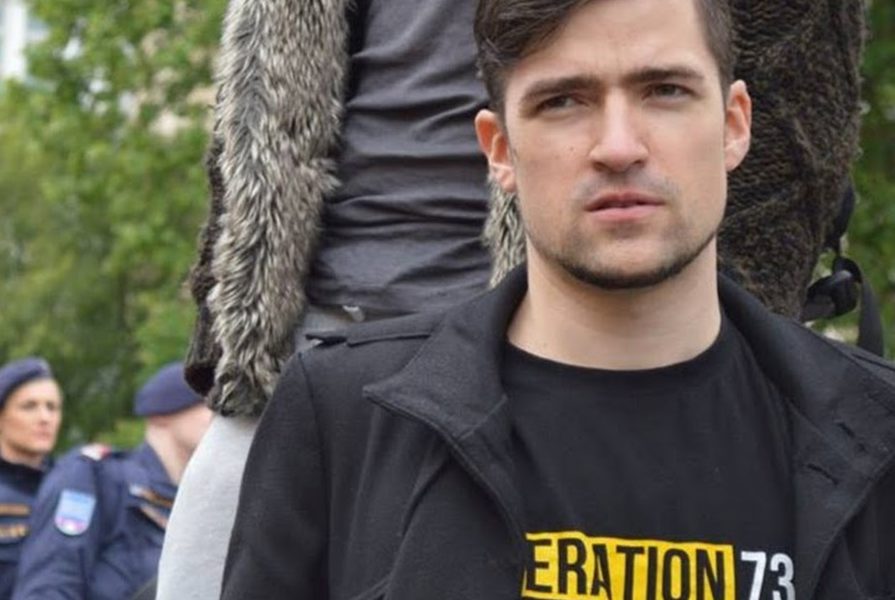
[6]Martin Sellner
After a coffee break, Martin Sellner joined us by video link, as he is not permitted to enter the US (despite being married to an American). In case you do not know, Sellner is an Austrian activist affiliated with the group Generation Identity. He has paid a hefty price for his views. In addition to being banned from many countries, he has been debanked multiple times. “I have a dream,” Sellner said, “involving planes, ships, and buses.” (For some reason, he didn’t mention trains.) Sellner is referring, of course, to the repatriation of migrants.
Rather less optimistic than his American counterparts, Sellner stated that politicians are followers, not leaders, and that Donald Trump is no exception. It is true that demography is everything, but Sellner insisted that demography is not destiny. This is what the political establishment in Europe and America would have us believe. They want us to believe that migration cannot be reversed. But if it was possible to get them in, then it is possible to get them out. The trouble is that we lack the political will.
The good news, however, is that the left is losing the battle of ideas – which is why they are now resorting to outright repression. The task that we face is metapolitical. We must overcome the idea that migration is irreversible. In order to change people’s minds, we must be radical enough, but still popular. As one of his comrades put it, we must not be the sort of people who would frighten our grandparents. We must be reasonable. The enemy fears Generation Identity precisely because it is not scary. Its members are quite reasonable and stay strictly nonviolent. If we adhere to this approach, repression actually works in our favor. Ordinary people see that those being repressed are not frightening monsters, but people making reasonable arguments. And this reveals the establishment for what it is – an unreasonable and oppressive Leviathan.
After lunch with friends at a local Japanese grill, we returned to hear Richard Marksbury, who taught anthropology for many years at Tulane University. Marksbury presented a very simple and cogent argument which I can present quite briefly. Our enemies believe that nurture (aka “culture”) is everything, not nature. Accordingly, they believe that all they must do is promote egalitarian ideas, and human relationships will then magically change. The problem with this is that for 99.9% of our history we have lived in small, ethnically homogeneous tribal bands. We are genetically no different from our primitive hunter-gatherer ancestors.
Human beings are therefore hardwired for ethnocentrism. As a result, any political structure that artificially binds together people of different ethnicities will be inherently unstable. As one piece of evidence for this, Marksbury presented the results of a striking survey [7] that asked people in various parts of the world whether they would fight for their country. Unsurprisingly, it was in the most ethnically homogenous countries that a majority of people said that they would: 73% in the Middle East, 76% in India, 58% in Latin America. In the Western EU, the figure was only 29%! In the more homogenous Eastern EU it was 39%. In non-EU Europe it was a whopping 61%. (For the record, in the US it was 41%.) No one wants to fight for “diversity,” or for an artificial political construct that binds them to people with whom they have nothing in common. Not even the people who think they’re in favor of such an arrangement!
Possibly the most eagerly anticipated speaker of the day, next to Jared Taylor, was Gregory Hood, American Renaissance’s most popular author. Mr. Hood is an excellent speaker, and never disappoints. His talk was entitled “The Last Election and the Last American.” Like Taylor, Hood began by reminding us of our goal, which has not changed: a white homeland. However, the recent election complicates things. Hood praised Donald Trump as a “man of destiny,” and said that his political comeback was the greatest in American history. This is certainly true: it has now eclipsed Nixon’s comeback in ’68, which itself was quite remarkable.
The election presented us with some surprises. For example, Trump won more Hispanic men than white women. Indeed, he expanded his share of the non-white vote generally. However, Trump did not expand his share of the white vote. There was considerably more enthusiasm for Trump this time around, more than in 2020 or even in 2016. The Democrats are now in shock. Thanks to Elon Musk, they can no longer control social media, which destabilizes the entire political situation. This breakdown in media control coincides, needless to say, with the rise in populism. As a result, the establishment is now trying to clamp down.
This itself is a sign of the progress we have made (after all, they wouldn’t be trying to clamp down if they didn’t view us as a threat). But there is a temptation on the part of many people on the right to fall into “doomerism,” and Hood cautioned us against this. “I do have hope,” he said. 2024 is vastly different from 2020, and there are more reasons for hope now than there were in 2016. For one thing, this time Trump has a very good team backing him up. Even if Trump disappoints us (again) a revolution betrayed may inspire more people to fight.
Hood outlined three paths available to white nationalists. The first is the path that American Renaissance has followed: pursuing what Martin Sellner referred to as the metapolitical task. This means presenting arguments to people in power that they can then use, even if they never credit us. This is a strategy that is working: I know of many examples of high profile, highly influential people who I know to be readers of American Renaissance, Counter-Currents, VDARE, and other sites (I just can’t mention any of their names).
The second path is that of seeking power. This essentially means trying to infiltrate the established power structures. This is possible, but one has to keep one’s nose very, very clean. (Among other things, you can never go to AR conferences.) The third path consists in building “parallel networks of power.” It is not realistic, Hood argued, to think that a revolution consists in people who have absolutely no power suddenly finding themselves in positions of power. No, the revolutionaries are always individuals who have gained some form of power and influence on a local level. We need, in other words, people “on the ground” who have built some kind of network and who can, if necessary, assume positions of political power when the time comes. In any case, as Hood put it, “There is no solution apart from power.” It was a passionate, well-argued talk and was very well received.
Then came the banquet. I had been very much looking forward to hearing our speaker, Anthony Cumia – who is, I believe, the most popular radio personality in the country after the odious Howard Stern. Mr. Cumia had been co-host in New York of the extraordinarily popular “Opie and Anthony Show.” I never listened to the show myself during my New York years, but I had a friend who listened religiously and was constantly reporting to me what Opie and Anthony had been talking about.
I expected Cumia to be very funny, and he did not disappoint. He began by doing the best Jared Taylor impression I have yet heard (far better than my own). The audience, including Mr. Taylor, roared with laughter at this affectionate parody. Cumia lost his gig with Opie after a “racist” tweet concerning an incident in which a black woman assaulted him in Times Square. Like many who have been cancelled, however, this turned out to be one of the best things that ever happened to him. After becoming an independent broadcaster, he got beyond the whole “shock jock” thing and began talking about issues that matter to him.
 [8]
[8]Anthony Cumia and Jared Taylor
It is impossible for me to do justice to Cumia’s talk, which was hilariously funny and very well received (I believe I enjoyed it more than any other AR banquet speech). His talk ranged over his whole career, and gave the audience very valuable insights into the corporatization of radio (which was its ruination) as well as the rise of wokeness. I hope that Cumia’s talk was recorded and that Jared Taylor will make it available to all.
After the banquet, we had our usual “after party” at one of the villas in the park. Just as I do every year, I showed up for five minutes and then left. As an introvert, I find parties overwhelming. At AR conferences, I do a good impression of an extrovert and wind up talking to many people. I pack into one weekend more socializing than I do the entire rest of the year. It warms my heart to be around so many likeminded people, but it is also exhausting. I ended the evening drifting off to sleep to back-to-back reruns of Hogan’s Heroes on MeTV.
On Sunday, our final day, we were joined by Italian activist Guido Taietti. Like Martin Sellner, Taietti joined us by video link. Whereas Sellner was denied entry into the US, Taietti was not permitted to leave the EU. We need our own O. Henry to make a story out of this. Taietti is affiliated with the nationalist CasaPound organization, and his talk was mainly about activism and organizing. His remarks nicely complemented those of Sellner and Hood.
Taietti emphasized the importance of establishing an organizational presence in all cities (which, granted, may be easier to do in a smaller country like Italy than in the US). These local “satrapies,” if you will, would be networked together. The purpose of this approach, which is almost unknown in the US, is to thwart deplatforming and online censorship. Even if we are prevented from posting or communicating online, local groups could still keep in touch by other means, hold conferences, and engage in other forms of activism. It is a promising idea, and not quite as difficult to implement as one might think. We are, after all, everywhere, in all cities, in all localities. The only issue is getting people to step out from behind online anonymity and meet up. Okay, on second thought maybe it won’t be that easy. But neither is it impossible.
Our final speaker of the conference, my good friend Sam Dickson, has addressed all 21 AR meetings (and by the way, that’s 21 conferences over the course of 30 years: the first was in 1994). Traditionally, Dickson is the final speaker of the conference, and his remarks are always a special treat. His talk this year was titled “Whitey on the Psychiatrist’s Couch” and dealt, as its title implies, with the psychological peculiarities of white people. Dickson believes, wisely, that different peoples have different psychologies.
The psychology of the Ango-Saxons is, he argued, rather unique. In their entire history, the Anglo-Saxons were only invaded once (the English Channel posing a great obstacle to hostile foreigners). The Anglo-Saxon life was thus a good deal more comfortable than that of other peoples, including continental Europeans, who were subjected to invasion after invasion. This made them, Dickson argued, overly individualistic and obsessed with freedom. You don’t find this so much with, for example, the Germans or Italians, because in those countries individual freedom had to be subordinated to survival.
Indeed, in both the US and the UK there is a veritable obsession with freedom, and with abstract ideals. We are, Dickson said, “the people that cannot speak our name.” Monuments always say for example, “they died for freedom,” never “they died for the US” or “they died for England.” It is always an ideology that they supposedly died for. Even in Dixie the monuments say that the Confederates “died for the constitution as originally intended” or “they died for states’ rights.” Never “they died for Dixie.” But in France we do indeed find “they died for France,” or in Italy “they died for Italy.”
Dickson brought down the house when he declared that “Americans are Britons on meth.” They have the Channel we have the Atlantic Ocean. We’ve never been invaded, only the American South has been. But our more recent Southern apologists will say it was all about states’ rights and that race had nothing to do with it. We always have a “moral purpose.” For example, “making the world safe for democracy.” As a Southerner I must point out that it is the North, and more specifically New England, that is the epicenter of this sort of nonsense. Dickson quoted Emerson saying of the civil war that it was “a war to make the entire world New England.”
Dickson noted that our country’s first fatal error occurred in Jamestown. We allowed people to come to these shores voluntarily. As a result, what we got were people who were highly individualistic and willing to turn their backs on their country for their own advancement or to follow their own notions. The story we tell of the American Revolution was that we rose up against “British tyranny.” But Britain is the mother of all of these freedom ideas.
We Americans have, in one way or another, set ourselves in opposition to Britain and to Europe. But Dickson noted that it is the Jews who provide us with the right response to this, and with the correct attitude. He quoted one prominent Jew who said “we have been Americans for only 250 years, but we have been Jews for 2,500 years.” Echoing these sentiments, Dickson noted that we have been Americans for only about 420 years, but we have been Europeans for thousands of years. Dickson’s audience vigorously applauded this.
Whites seem also to have a marked tendency to live in a world of imagination and fantasy. Abstract reasoning makes us quite vulnerable to nonsense. Studies have shown that it is highly intelligent people who are the most easily victimized by confidence tricksters. You also have to have high intelligence to follow all the fallacious logic that underlies liberal ideas. And whites love illusions that make them feel good about themselves. Dickson noted that anybody who believes “all men are created equal” ought to be considered certifiably insane. Whites seem able to completely ignore reality in fealty to whatever notions they feel compelled to affirm. Perhaps the transgender ideology is the starkest and most extreme example of this.
Dickson argued that we have to overcome this tendency to deceive ourselves and to deny reality; this tendency to engage in what he called “fact-free thinking.” And we have to overcome our respect for traditional authorities. We must be aware of the dangerous tendency to individualism in our makeup and we need to curb our obsession with freedom. It is only by becoming more collectivistic that we can survive.
I found myself agreeing with most of what Sam Dickson had to say. But I wonder, and I have long wondered this, whether what he proposes is even possible. For what he describes as our individualism and our obsession with freedom, as well as our high intelligence and gift for abstract thought, seem to me to be both the sources of our present predicament, but also the sources of our greatness. And, like most of the conference attendees, Dickson believes our white psychology is a set of evolved traits, rather than a set of beliefs that we could simply abandon at will. Perhaps Dickson is right that we must change these aspects of ourselves in order to survive. But can we do it? I look forward to arguing with Sam about this.
And I look forward to the next American Renaissance conference, which will take place November 14-16, 2025. This year’s conference had 240 attendees, which is up from last year. God only knows what will happen between now and the 2025 conference. I arrived at this conference feeling, like Kamala, unburdened by what has been [9]. Now let’s see what can be. All I know is that I will be discussing it at AR next year.