 2,916 words
Where would cinema be without its paid assassins, hired guns, and hitmen? The profession of hitman seems a fairly straightforward job description, but the great hitman movies both differ enormously and are far from straightforward. The target, the contract, the money, the hit, right? Wrong. These various tales of men hired to kill other men forms a genre which comes at you from different perspectives and in varied cinematic styles.
There had to be omissions for a Top 10, and Pulp Fiction couldn’t really be left out, so fans of Leon (directed by Luc Besson and released in 1994) may be enraged to know it had to make way for Tarantino’s modern classic. This may be taken as a punishment for Gary Oldman’s unforgiveable overacting in the film. Obviously, this is my Top 10 of dedicated, hardworking bad guys, so any contenders gratefully received. Meet me by the old docks at midnight, and bring the list.
So, the bullet is in the chamber and the crosshairs have found their man. Let’s, as they say, do it.
1. Pulp Fiction (Quentin Tarantino, 1994).
This blew the critics away, so to speak, at the Cannes Film Festival and never looked back. A couple of weeks after this came out in Britain, pubs across the country were full of young men who knew all the dialogue. Pulp Fiction excited the movie-going public, who had already gone big on Tarantino’s Reservoir Dogs and clearly wanted more. The dialogue, the narrative time shifts, the bad-guy/bad-guy pairing of John Travolta and Samuel L. Jackson as hitmen Vincent and Jules, the gimp — Pulp Fiction had it all. It also features a mysterious case whose glowing contents we never see (although Vincent does), and I do wonder if Tarantino filched this idea from 1984’s Repo Man, Alex Cox’s underrated movie starring Harry Dean Stanton and Emilio Estevez, which has a similar case.
The film boffins got excited about Pulp Fiction, too, what with all that talk of “let’s get into character” and other alienation techniques bringing out a tedious breed: the film intellectual. But the sheer gall of the film, the maverick bravado with which Tarantino cuts up a story and patches it back together again, makes it special. Superb performances help matters, including one from the ever-reliable Harvey Keitel, and this is the Bruce Willis film it’s okay to like. I award him the top line (even better than Jules’ description of his wallet) for the scene in which a pretty Latina in a taxi is explaining what her name means in her native country. When Willis tells her his name is Butch, she asks him what that means. “I’m an American, honey,” Willis responds. “Our names don’t mean shit.”
2.The Hit (Stephen Frears, 1984).
Small-time British film with a superb English cast featuring Terence Stamp, John Hurt, and Tim Roth, his second entry and we are only on number nine. Braddock (Hurt) and Myron (Roth) are dispatched to Spain to whack a gangster, Parker, played by Stamp. He has unforgivably grassed up (to use the approved London criminal vernacular) his former partners in crime and sent them off to jail for a long stretch of bird (same vernacular). Terence Stamp, incidentally, was once Michael Caine’s flatmate, and not a lot of people know that. Let me know in the comments if anyone got that.
Roth is a tearaway in it for the kicks, while Hurt is playing rather an odd role for him, but one to which he lends a philosophical depth as he and Stamp, who they have captured, get into a mind game over Stamp’s apparent lack of concern at his imminent death. What is death? asks Parker. “It’s just a moment. You’re here, and then you’re not here. You’re somewhere else.”
The Hit is equal parts hitman flick, road movie, and psychological cat-and-mouse game. Even the ice-cold Hurt is appalled at hostage Laura del Sol when she alerts a gas-station attendant to the fact that she has been kidnapped, then smiles broadly at Hurt as he realizes that she knows she has doomed the boy. Hurt follows the attendant, now calling the police, back into the gas station and blows his brains out in company-approved mafia fashion.
Watch it if you can find it, a quality British crime movie set in the sultry wastes of Spain.
3. Day of the Jackal (Fred Zimmerman, 1973).
Edward Fox as Carlos the Jackal raised eyebrows not just because, if you’ve seen pictures of Carlos the actual Jackal, aka the Venezuelan Ilich Ramirez Sanchez, a suave English actor in the mold of David Niven or James Mason seemed an obvious miscast. When Fox tests his custom-made rifle, he’s wearing a white shirt and an Oxford cravat. He looks like he’s on his way to a boating party at the Henley Regatta. But curious casting or no, this was in with a bullet at number 74 in the top 100 British movies of the twentieth century, and Fox’s performance is a big part of that. Referred to only as “The Jackal” throughout, the man with no name is hired to off French President Charles de Gaulle (aim for the nose!). Fox is the suavest hitman on the list, and the long build-up to the hit is worth the wait.
4. The Killing of a Chinese Bookie (John Cassavetes, 1976).

You can buy Trevor Lynch’s Classics of Right-Wing Cinema here.
My introduction to Cassavetes, I loved it, and this was the film of his the critics panned. There is a twist to the hitman genre here in that Ben Gazarra’s Sinatra-like character Cosmo — who owns what is surely cinema’s seediest nightclub — is a reluctant killer. After a card game leaves him out $23,000 to some unamused bad guys, they offer him the slip to tear up if he guns down the Chinese bookie of the title. The assignment turns into a slaughter and is followed by the obligatory double cross by Cosmo’s gangster creditors.
The film keeps building to scenes which are inevitable and then turning its attention elsewhere, and Cassavetes is adept in the art of the cinematic non-sequitur, some of which are very funny. After the hit, Cosmo calls the club he micromanages, asking the dolt on the other end who is onstage and what song he is singing. When the guy doesn’t know the song I Can’t Give You Anything but Love, Cosmo starts singing it down the phone, despite the fact he has just butchered several strangers.
Cassavetes’ films have been called “agitating,” and the movie’s stubborn refusal to settle into normal cinematic rhythm and structure became his signature. As noted, the critics put the boot into Cassavetes for this, but they want to be looking over their shoulders.
5. Grosse Point Blank (George Armitage, 1997).
The first of two black comedy entries, John Cusack is a hired gun who ditched his prom date, Minnie Driver, ten years before and returns to Grosse Point to win her back, provided she can live with his choice of careers. In the spirit of the free market, Cusack, playing Martin Blank, has competition in the form of Dan Aykroyd, who wants a merger as a kind of Hitman Inc.
The bit parts are hilarious vignettes, including a literalist schoolteacher and a psychiatrist so terrified of Martin he can’t end the gunman’s therapy. The final gunfight between Cusack and Aykroyd in a kitchen is ballistic slapstick. The dialogue is so sharp you could do yourself a mischief with it, and great lines hold a steady beat throughout. Considering going to his high school’s ten-year reunion, Martin says that all his ex-classmates will have houses, dogs, wives, lives. “What do I tell them I do?” he asks. “Do I tell them that last week I killed the President of Paraguay with a spoon?”
The love angle with Minnie Driver is bona fide feelgood, and this would be a rom-com if it weren’t for all the killing. Both Cusack and Driver underact, which I love to see in the cinema, and the romance keeps rekindling at the reunion as the bullets keep flying. The soundtrack is studiedly cool, and there is original incidental music by Joe Strummer. A movie featuring a string of assassinations will not usually leave a smile on your face (if it does, it may say something about you), but Grosse Point Blank does just that.
6. No Country for Old Men (Ethan and Joel Coen, 2007).
Armed with an absurdly powerful rifle, a gas cylinder, and one of modern cinema’s most outrageous hairstyles, Xavier Bardem’s character, Anton Chigurh, is on the trail of a case of money that has gone missing after a murderous drug deal near the United States/Mexican border. We never meet his handlers, but his brief is clearly to terminate anyone who stands in his way with top-of-the-range prejudice. But the true dynamic of both book and film is that Chigurh is armed with more than just weaponry, cunning, and bad hair, having brought along his own warped ethical code. He has a moral compass, but it is stuck pointing in just one direction, and it is not a good one for anyone he meets.
Socrates famously informs us that no one does wrong willingly, but he hadn’t reckoned on Chigurh, who believes that a rigid moral code must be followed simply because it is rigid. So what if it is also psychopathic? For him, life is a very serious game with very definite rules. Indeed, when he has another bounty hunter (Woody Harrelson) cornered and is about to shoot him, he asks the man a simple question to ponder in death. “If the rule you followed led you to this, of what use was the rule?”
In both Cormac McCarthy’s excellent novel on which it is based and the film itself, the focal character is not Chigurh, but Ed Tom Bell, a town sheriff who is on Chigurh’s trail but does not know what he is. Tommy Lee Jones is outstanding in the role, as the sheriff’s monologues are the highlight of the novel.
If you only see this for the unbearably tense coin toss scene at a gas station, watch it, but maybe read the book first.
7. Le Samouraï (Jean-Pierre Melville, 1967).
There are cool movies and cool actors, then there are Le Samouraï and Alain Delon. From the opening scene, in which Delon dons an impeccable trench coat before ensuring his fedora is just so, this is an homage to American film noir, with which director Melville was obsessed. You get that impression just by the fact that his Parisian gunman is not called Jean-Michel Dupont, but Jef Costello. How American is that? We learn that Costello is on the shady side of la rue when he gets into a car — an immaculate, silver-grey Citroen DS, naturally — with a chain of alternative starter keys.
One small quibble about the script. After Delon has taken infinite care on the sartorial side of things, he botches his first hit by attracting a small crowd of witnesses. I would have thought that in that trade, perfectionism extended beyond your perfect hat and coat, but this is France.
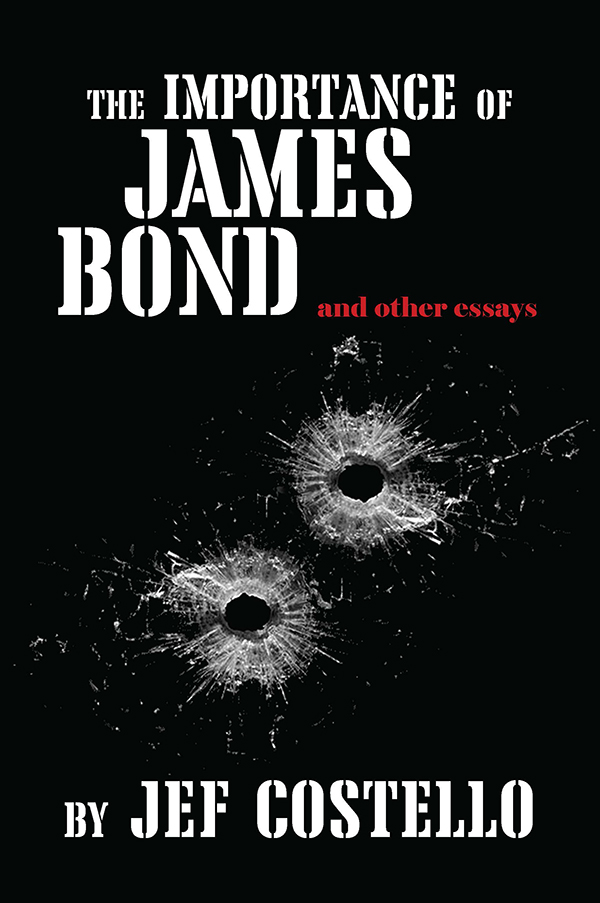
You can buy Jef Costello’s The Importance of James Bond here
Melville knows his symbolism from his plot points, and the caged bird seen at the start in Costello’s apartment looks like an obvious symbol of captivity. But when the hitman is out, and someone breaks into his room and agitates the bird, Costello knows on returning that an intruder has visited by the fallen feathers in the bird’s cage.
Film endings can rest on tiny editorial decisions — see Casablanca — and an alternative version of the finale was shot but never used. It features Costello with a broad smile on his face, something that has not happened in the rest of the movie. But Melville discovered a similar ending to one of Delon’s other movies, and canned it. The shot was deemed unnecessary, which you can’t really say in general about hitmen.
If you like cinema as visual art form, this is a film you will either have seen or must do so. Each shot is painterly in its composition but restrained in its use of color, which is so drained that some scenes are on the cusp of monochrome. An exercise in cool, and exercise is good for you.
8. Il Conformista (Bernardo Bertolucci, 1970).
Bertolucci’s adaptation of Alberto Moravia’s novel, this is another beautiful film to look at. Set in 1930s Italy, our Italian hitman Marcello Clerici is not a mafia wiseguy but a Fascist, although not a very committed one. When he is given a contract to snuff his former professor, things look molto bene until he complicates things by starting an affair with the prof’s wife. Well, this is Italy. Clerici didn’t have the greatest start in life, what with mamma being a morphine addict and papa in an insane asylum, so he can be forgiven for going ever so slightly nuts as the time for the hit approaches. That, and a series of flashbacks involving gay sex he has tried to forget and a murder he may have committed are enough to spook the horses in Marcello’s top paddock, but his Hamlet-like prevarication can’t stop a bloody denouement brilliantly shot in a snowy forest.
The cinematographer deserves a special mention for this visual banquet. It launched Vittorio Storaro’s cinematic career, which went on to include Last Tango in Paris, The Last Emperor, and Coppola’s Apocalypse Now. The whole film is sumptuous, the mises-en-scènes near-perfect, and the story so gripping it made me want to read the book, if it wasn’t so outrageously expensive. Well, now, since we are in Europe, let’s head north to the low countries and Belgium.
9. In Bruges (Martin McDonagh, 2008).
Colin Farrell and Brendan Gleeson are an unlikely comedy duo stranded in a medieval Belgian city so beautiful I visited it on the strength of this movie alone. Two Irish hitmen have been told to lie low in Bruges after Ray (Farrell) botches a hit back home and accidentally kills a small boy. Ken (Gleason) wants to take the opportunity to sightsee, but Ray is more interested in a girl he meets working on the set of a movie featuring a dwarf actor. “Midgets!” cries Ray with glee. “They’re filming midgets!” Lying low doesn’t last long, and trouble follows Ray around. He knocks a man out in a restaurant after an argument. Taking the man to be American (he turns out to be Canadian), Ray leans over his prostrate form and shouts, “That’s for John Lennon, you Yankee cunt.” Then it’s off to the girl’s flat, where her boyfriend walks in on them and threatens Ray with the type of knife more commonly seen on the streets of London. Ray blinds the man in one eye with a blank-firing pistol, and it is clear that Ray is not lying low.
Then comes the twist every crime movie must have as the pair’s boss, Harry (Ralph Fiennes), calls to give Ken the name of his next hit. It’s Ray. He’s become a liability, and now Ken has to off his friend. Fiennes is a tour de force of mannered violence. Visiting the mysterious Yuri, his supplier of guns in Bruges, the Belgian offers him an Uzi. “An Uzi?” says an incredulous Harry. “I’m not doing a fucking drive-by on some ten-year-old kids. I want a normal gun for a normal person.” Well, quite.
The walled Medieval city of Bruges is a co-star in the movie, and its placid beauty is an incongruous context for the psychological turmoil that drives the action. But this is a gem if you don’t know it, a morality tale wrapped up in a gangster movie wrapped up in a comedy.
10. Kill List (Ben Wheatley, 2011).
Hitman/horror crossovers are, I would imagine, as rare as hen’s teeth, but that best describes Kill List. A pair of hitmen, Jay and Gal, are once again lying low — it seems to go with the job — after an unspecified and botched assignment in Kiev, but they are drawn back into professional assassination by a tempting cash offer. As they tick off their victims, they discover they are hunting down a pedophile ring, causing Jay to act erratically and employ even more violence than usual on his victims, such is his disgust with and hatred of the men on the kill list. As a concerned Gal asks him, “Are you going to go about this like a Hackney crackhead?”
But there is something else going on. The victims say strange things before their deaths, Jay is forced to sign a contract in his own blood, a visit to the doctor becomes a wandering existential conversation about nothing and everything, a dinner-party guest scratches a curious runic design on the back of her host’s bathroom mirror. This is a film you have to see twice to make sense of its jarring incongruities first time around.
It takes a long time coming, but the payoff has seen Kill List shelved alongside The Wicker Man in what must be the pretty slim genre of English folk horror, and the film is psychologically nerve-jangling in a way that connects with the pagan. Even mundane scenes become charged with meaning and mystery. Every scene is disturbing, and you can’t always say why. The movie has no musical soundtrack as such, just a backdrop of ominous grinding noise. If the end doesn’t make your jaw drop, it’s wired up, and Kill List takes my top spot.
So, that is my Top 10 hitman movies and, if you will excuse me, the special phone is ringing, which may mean I have to go to work.
34 comments
Collateral, with Tom Cruise and Jamie Foxx.
Terrific movie.
Cruise is a chilling, focused, and virtually unstoppable assassin methodically terminating witnesses slated to testify against a cartel kingpin.
Foxx, the cab driver everyman, inadvertently thrust into the center of this maelstrom, unsure of what to do but eventually forced to do….something. But what? He makes it up as he goes along, a scared but determined hero.
Fantastic movie. Unreservedly recommended.
Agree, that’s a great one. It foils existentialism versus nihilism. Highly philosophic. Mark should appreciate!
There’s also this weird theme of inversion in it. I can’t figure out precisely what it’s trying to say. It casts Tom Cruise against type as an evil hitman(this was copied with Kevin Costner in the less good Mr Brooks). Then all the good guys and professionals are black, all the criminals and degenerates are white. You might think on a superficial level that it’s just the usual Hollywood BS, but I think there’s something deeper going on I think it’s driving at something about inversion.
Well, that’s not true and maybe you saw a different movie. Not sure what this “inversion” nonsense is about.
But Collateral is a tightly paced thriller and not a single scene rings false.
When you hear, “Yo homie, that my briefcase?” get ready.
Thank you, I’ll put a contract out.
I like pulp fiction a lot. I’m not into hit person(I prefer to be pc)movies per se, but if you liked le samurai, I bet you would also like Ghost Dog, way of the samurai by Jarmusch, which contains allusions to le samurai and an earlier Japanese movie called Branded To Kill, which was pretty good.
B to K is transparently about the IT. Number One gradually psychologically degraded the target until the final kill..”this is how number one works..”
Hit Man by Richard Linklater just came out, and even though it’s less bloody than most on your list it was a good one to watch with the wife.
Also a rare movie in its accurate depiction of New Orleans, without focusing on the city itself
I first thought of *Ghost Dog* which includes one of the most funny scene I’ve seen about man/woman “equality” (won’t spoil it, just see the movie), but Mr Dark Plato already mentionned it. Hence, I’ll give these more or less underrated movies :
— *The Hard Way*, with Patrick “The Prisoner” McGoohan and Lee Van Cleef ;
— *This Gun for Hire* with Alan Ladd (it’s often quoted as *Le Samouraï*’s inspiration) ;
— *Collateral* with Tom Cruise (the conversation with the cab driver about victims is excellent) ;
— *The Assassination Bureau* with Diana Rigg and Oliver Reed (funny adaptation of London’s unfinished novel — too bad F&L wrote an end for Dickens’ *The Mystery of Edwin Drood* and not for London’s book) ;
— *Crying Freeman* with Mark Dacascos ;
— *The Mechanic* with Charles Bronson.
I’d add *John Wick*, which was a pleasant surprise indeed.
That’s my viewing sorted for about a mont. I thank you.
@Mark Gullick, PhD : You’re welcome. Should you have time to waste — which I doubt –, there are two interesting “cleaners” making problems go away in a 22 episodes tv series by John Woo, *Once a Thief*. Recurring roles Mr Murphy (Greg Kramer) and Mr Camier (Julian Richings), often contracted by The Director (Jennifer Dale), have several funny dialogues about their particular line of work and even their philosophy. I mention them for the sake of completeness, for the series itself is globally bland (bad casting) though there are a few entertaining episodes. There are also hitmen and reformatters in *Nikita* series (the second one, with Maggie Q.) but this is far from the scope you defined.
https://en.wikipedia.org/wiki/Once_a_Thief_(TV_series)
Great idea for a post – but shouldn’t it have been in reverse numeric order (#10, #9, etc)?
I’ve seen a lot of movies in my life, and yet only half on this list (and while I remember seeing Grosse Point Blank in theater, I recall nothing about it). In Bruges was hilarious. No Country for Old Men was excellent, of course (I was therefore surprised it actually won the Best Picture Oscar). So was the book (which I’d read when it was published). A very rightwing book, I’d thought then and still do. One can do a lot of ‘existentializing’ about Chigurh, but for me, this strange evil from outside the normal parameters of both Christian morality and American life represented the perils of globalization and having an overly ‘open society’.
(I’d had the same thought about The Shire when rereading The Lord of the Rings in 2001 right before seeing the first of the Peter Jackson films: it was a cozy, decent place needing protection from horrific evils beyond its boundaries and imagining.
We in the West, too, wish to protect our special civilization, and preserve it for future generations, against the forces of Chaos and Old Night – embodied in Chigurh – trying to penetrate and pollute it from without.)
Tarantino is a master of cinematic grunge dialogue, and that for me was what was best about Pulp Fiction, an unserious but fun flick (which describes all of his films).
Day of the Jackal was fantastic, even now I would imagine (I haven’t seen the film for at least 20 years, maybe much longer). So was the thriller it was adapted from, which I remember reading one summer during college in a one volume Frederick Forsyth trilogy (the others being The Odessa File and The Dogs of War) my dad had bought for me. I was delighted to discover decades later that Forsyth is a conservative, which did not at all surprise me when I learned of it (though he may not be a racial nationalist). I still recall that scene of Fox methodically sighting his rifle using watermelon targets.
Prizzi’s Honor?? Anyone?
Nicholson and K Turner as a couple of killers ( for the fun ) ,I adore this movie.
I will [ahem] very gently and respectfully disagree about Pulp Fiction.
You’re not judging Pulp Fiction on its own merits. It is, as you admit in your article, a movie about gangster movies, not a movie about gangsters. The title lays as much bare.
Tarantino doesn’t want to document violence, he wants to entertain using violence, and he’s being blatantly ostentatious about it. There’s nothing in his entire film career that would hint at a pretense of real-world familiarity with any of the subjects he approaches. He is open and vocal about it both in interviews and in scenes where characters explode from gunshots or get their skulls neatly sliced in half with swords.
What do you find so wrong with entertainment for its own sake? Spaghetti Westerns and Hong Kong karate films were just that; without Tarantino’s constant references and his latter attempts at meta-commentary about cinema (which I personally find to be pathetic and failed grasps at some profundity from a now old director)
From what I’ve been able to endure of his movies, my judgment is: His films have no merits and aren’t entertaining. But there are no right and wrong answers when it comes to subjective matters, which seems to be a point I increasingly have to make.
Amazing that people get so defensive about such a blatantly anti-white nerd.
But I think his movies suck regardless of the messaging.
I love his movies through Jackie brown, among the best in cinema. To be honest, I didn’t like the aesthetic of kill bill, too self indulgent, but some okay stuff. His later movies degenerate into the most incoherent anti white junk. I wish he had just stuck to what he did well. Also, the sound tracks are independent works of art.
TLC: “ don’t go chasing waterfalls, please stick to the rivers in the lakes that you’re used to.”
Do you have a favorite hitman film, Jim?
Probably The Killers (1964).
I’ll have to check it out.
You rarely go wrong with Lee Marvin.
If you haven’t already, you should check out Death Hunt, this Charles Bronson number from the early 80s. Marvin plays a tracker or something like that hunting down the Bronson character after he kills a bunch of dog fighters. It’s set in the great white north somewhere and features Bronson doing impossible, Rambo-like things (before Rambo was an actual thing) like jumping off of snow-capped cliffs and surviving.
“When you watch a Martin Scorsese movie, you can tell he grew up in Little Italy around mobsters. When you watch a Quentin Tarantino movie, you can tell he grew up watching Martin Scorsese movies.”
Bull’s eye!
Jim Goad is the king of opening sentences.
Jules & Vincent were incompetent hitmen who survived (temporarily in the latter’s case) only through dumb luck / script contrivance.
I glad you did not include The Missouri Breaks but wanted to make sure everyone knew that there was a movie by that name in which Marlon Brando played a crossdressing assassin named Robert E Lee Clayton. Such was the state of our culture in the year of the bicentennial.
I would put Unforgiven and Taxi Driver (more Spirit of 76) on that list, up there with Pulp Fiction. Maybe above it.
My view: Repo Man (and its soundtrack) had more lasting cultural impact than any of these, but at a remove and as an influence, if that makes sense.
Pulp Fiction, The Day of the Jackal, and The Conformist. I guess the others need a look-see!
My favorite is The Hit.
And John Hurt was so well casted
Real hitmen are usually very average looking, mister nobody types. That’s why they are terrifying.
Don’t understand this ” cult ” with pulp fiction and this ugly disgusting Tarentino, even among ” right wingers ” ,..
I never tried The conformist, blablabla, we italians trying so hard to beg pardon for a few years of Mussolini, but I should give it one day a try.
OK list but like all such lists it has limitations which is inherent in the nature of compiling lists.
The mysterious case in Pulp Fiction is indeed a theme from Repo Man but Repo reused it from Kiss Me Deadly 1955. Interestingly the use of the case was not present in the actual Mickey Spillane novel but written specifically for the film which helped the KMD movie to far surpass the novel. Also interesting is that in the original, we kind of know what is inside the case and if we don’t know the inside is revealed at the end-and yes indeed it is a deadly kiss. Later homages left the contents open-ended; it could be an Alien device, Pandora’s Box, revelation of Satan etc..
The Day of the Jackal had a sauve assassin (but the assassin’s point of origin is not clear, he could have only be pretending to be sophisticated English gentleman. For all we know he was a native from New Jersey who naturally talked in a thick NJ accent).
Carlos the Jackal was a fat, unathletic Hispanic but his association with the Jackal of the novel/movie was largely a UK media creation; UK journalists read the novel and seen the movie so when a real-life international assassin for hire came about they gave him lazily the Jackal monicker which he never really used, he used Carlos as his codename.
Ramirez-Sanchez (Carlos) also was not really for hire, he was an active leftist backing left-wing causes as his rich father raised him to do (he named his three sons after V I Lenin-Vladimir, Ilych, Lenin-being the second son his first name was Ilych hence Ilych Ramirez-Sanchez.
Finally one of the best and realistic hit man movies is Ashes and Diamonds from Poland 1958. Interestingly coming so soon after the death of Stalin and with quite omni-present communist censorship, the hero is an anti-communist assassin and is quite sympathetic (and extremely handsome). The sympathy also extends to his target and the assassins direct superior. The main unsympathetic character is a minor communist official. All-in-all a major highlight of Polish cinema looking at the post-war Polish situation with an air of tragedy. All the more remarkable in that Poland was officially a communist country with, as said, major censorship of anti-communist POVs.
It was a special moment in the history of the communist occupation of Poland. It was a temporary reprieve after the death of Stalin and the defeat of the Jewish faction in the party. That’s why such a film (based on real events) could be created
The fictitious Forsythe’s Jackal has nothing in common with real Carlos The Jackal.
Let’s not forget Murder by Contract (1958) and Blast of Silence (1961), two “existentialist hitman” noirs, that preceded Le Samourai.
I think the case in Pulp Fiction came from Kiss Me Deadly (1955).
And just FYI, I actually lived in the neighborhoods where it was filmed, and was a regular diner at the “PleaseU” – yes, it’s a real place, with great fried chicken and,of course, pie
I would like to add “Violet & Daisy”.
A very strange movie – to say the least.
And one of the assassins has a secret.
Fun discussion and a lot of great suggestions from the article and comments, though Grosse Point didn’t do much for me.
I’d add The Parallax View (1974) & Manchurian Candidate (1962), both about training political assassins. Carlos (Assayas, 2010) is a film biography of Carlos the Jackal, technically a political terrorist, but a potent reminder that the Left has plenty of the worst of the worst among their ranks.
From Asia, the Seijun Suzuki movies and Fallen Angels (Wong Kar Wai, 1995).
In modern times Sicario (Villeneuve, 2015), The Killer (Fincher, 2023) and Hit Man (Linklater, 2024) are worth a view.
Pulp Fiction, No Country, The Conformist, and Apocalypse Now have so much going I’m not comfortable calling them hit men movies.
Possibly dumbest of all time: The Accountant (2016) – Ben Affleck as an autistic hitman/accountant
Kill List belongs in the #1 spot on that list–easily the most creative and unpredictable hit man movie I’ve ever seen. I’ve watched it a couple more times since then and it holds up. I’d put No Country at #2.
While I loved Pulp Fiction (I actually enjoyed the first three Tarantino films, but have hated most of his output since then) when I first saw it a million years ago, I find that it has aged poorly for me over time, and I’ve now concluded that it’s just an above-average and highly overrated film. As such, Mark Gullick is now my eternal mortal enemy or something. Plus all those lines that seemed so funny and new at the time seem so trite and overdone now (American names have all kinds of meanings–Butch is just an idiot). Worst of all, it spawned a litany of horrible Pulp Fiction ripoffs that I can never forgive Tarantino for.
I loved Grosse Point Blank, and have seen it multiple times. And I guess In Bruges was okay, but I wouldn’t put it in the top 10.
I absolutely hated the new Linklater movie Hit Man—starts off promising and funny, but degenerates into a boring and derivative love story that goes on WAY too long. Plus the supporting cast were all annoying and talentless.
I was happy to see someone mention Ghost Dog with Forrest Whittaker–it’s definitely an underrated gem and should be on any top 10 hit man movie list. I would also add Unforgiven and the original Manchurian Candidate (1962). I saw someone mention Taxi Driver, and while that’s a fantastic movie, I don’t really see how it’s a hit man movie.
Comments are closed.
If you have a Subscriber access,
simply login first to see your comment auto-approved.
Note on comments privacy & moderation
Your email is never published nor shared.
Comments are moderated. If you don't see your comment, please be patient. If approved, it will appear here soon. Do not post your comment a second time.