Counter-Currents
  • Advertise
  • Private Events
  • T&C
  • About
  • Contact
  • RSS
    • Main feed
    • Podcast feed
    • Videos feed
    • Comments feed
  • Welcome
  • Webzine
  • Books
  • Merch
  • Podcasts
  • Videos
  • Donate
  • Patrons
  • Subscribe
  • Crypto

LEVEL2

Donate Now Mailing list
Upcoming podcasts
  • Rob Rundo on Counter-Currents Radio

    Rob Rundo on Counter-Currents Radio

    Counter-Currents Radio

    06/13/2026 — 3 pm EST / 9 pm CET
  • Daniel Tyrie on Counter-Currents Radio

    Daniel Tyrie on Counter-Currents Radio

    Counter-Currents Radio

    06/20/2026 — 3 pm EST / 9 pm CET

Writers of May

(2 votes) Morris van de Camp David M. Zsutty Derek Stark Jayant Bhandari Greg Johnson

Articles of May

The Lunch Wars by David M. Zsutty Heidegger on Nietzsche, Part One by Collin Cleary 2 votes
  • Welcome
  • Webzine
  • Books
  • Merch
  • Podcasts
  • Videos
  • Donate
  • Patrons
  • Subscribe
  • Crypto
    • Black Intellectual Fatigue

      Derek Stark

      12

    • Why White Advocates Should Avoid “Based Blacks”

      Dani Vypont

      10

    • Nietzsche & Race

      Mark Gullick

    • Editor’s Update
      Rob Rundo Rescheduled to Next Week on Counter-Currents Radio;
      Tonight Greg Johnson & David Zsutty Answer Your Questions;
      Fundraiser Update & a New $20,000 Matching Grant

      Greg Johnson

    • The Counter-Currents 2026 Fundraiser
      Lifetime Subscriber Welcome Packages Extended

      Greg Johnson

    • Nationalism This Week
      Who’s Looking Back?

      Greg Johnson

      25

    • China’s Threat to American Security:
      Food, Farmland, Foreign Control, & Energy Policy

      Lipton Matthews

      5

    • The Bitter End of Western Metaphysics:
      Heidegger on Nietzsche, Part Two

      Collin Cleary

      13

    • The Killing of Henry Nowak

      Mark Gullick

      31

    • The Crisis of Chinese Technology Thieves

      Morris van de Camp

      1

    • The Strange World of Gender Bender Fiction:
      & What This Genre Tells Us About Autosexuality

      Dani Vypont

      3

    • Watching the Watchers:
      The Dark Triad Question

      David M. Zsutty

      14

    • The Remigration Movement Solidifies

      F. Roger Devlin

      1

    • Casting Aspersions:
      The Fatal Consequences of Race-Swapped Casting, From Helen of Troy to Henry of Southampton

      Steven Tucker

      20

    • The Murder of Henry Nowak

      Millennial Woes

      23

    • Don’t Forget to Vote in Our Writer & Article of the Month Poll

      Greg Johnson

    • The Robot Hotdog Stand

      Greg Johnson

      35

    • Laughing Our Way to Victory

      Dave Chambers

      7

    • The Zodiac Killer

      Mark Gullick

      11

    • Jared Taylor: What Rome Means to Me

      Jared Taylor

      1

    • An Interview with Endeavour:
      My Way of Life Is an Adventure!

      Ondrej Mann

      6

    • José Pedro Zúquete’s The Identitarians

      Greg Johnson

      3

    • Editor’s Update
      Fundraiser Update & How to Watch the Remigration Summit

      Greg Johnson

      5

    • The Bitter End of Western Metaphysics:
      Heidegger on Nietzsche, Part One

      Collin Cleary

      11

    • Berlin: City of Stones

      Spencer J. Quinn

      6

    • True Folk-Horror Is Horror of Your Own Folk:
      Mark Gatiss vs the Brexit Blind Dead  

      Steven Tucker

      4

    • Counter-Currents Radio Podcast No. 689
      Thomas Massie, the America 2050 Bust, the Need for Whites to Divest from America, the AI Economic Apocalypse, & Pro-White Project Pitches to Billionaires

      Counter-Currents Radio

      7

    • Nationalism This Week
      Remigration is Inevitable, Part 3

      Greg Johnson

      27

    • Why Billionaires Should Fund White Identity Politics

      Lipton Matthews

      8

    • How Cold War Two Came About

      Morris van de Camp

      5

    • Now Available for Pre-Order at a Special Price!
      Greg Johnson’s The Philosopher Is In

      Greg Johnson

    • David Zsutty’s Elevator Pitch to a Billionaire

      David M. Zsutty

      1

    • Headbanging Lite

      Mark Gullick

      5

    • White Advocacy Past and Present

      Peter Bradley

      13

    • The Lunch Wars

      David M. Zsutty

      47

    • The Russians are Coming/The Russians are Coming

      Steven Clark

      1

    • Peak Fatigue in Fort Wayne

      Gabriel Anderson

      24

    • Keith Woods’ Elevator Pitch to a Billionaire

      Keith Woods

    • The Cruelty of Kindness

      Morris van de Camp

      9

    • Predation Wearing the Mask of Civilization

      Jayant Bhandari

      13

    • The Mandalorian & Grogu

      Trevor Lynch

      24

    • Editor’s Update
      Fundraiser Update & a New $20,000 Matching Grant
      Greg Johnson & David Zsutty Discuss Thomas Massie on Counter-Currents Radio

      Greg Johnson

      2

    • How the Jews Defeated Thomas Massie—& Themselves

      David M. Zsutty

      25

    • Jared Taylor’s Elevator Pitch to a Billionaire

      Jared Taylor

      15

    • Nationalism This Week
      Remigration Is Inevitable, Part 2

      Greg Johnson

      8

    • Could Fascism Work?

      Mark Gullick

      40

    • Jonathan Bowden’s Deliverance
      Part 7

      Jonathan Bowden

    • China’s Quiet Hand:
      Influence, Infiltration, & the Western Blind Spot

      Lipton Matthews

      9

    • Counter-Currents Radio Podcast No. 688
      Tyler Dykes on Running for US Congress in South Carolina

      Counter-Currents Radio

      4

    • Lothrop Stoddard’s The Revolt Against Civilization

      Spencer J. Quinn

      14

    • DarkPlato

      Black Intellectual Fatigue

      I think it’s cruel to put blacks in prison.  They can’t understand cause and consequence and are not...

    • Connor McDowell

      Black Intellectual Fatigue

      Yeah that’s why I said “that’s where we already are in many respects” as far as the lowering of...

    • Derek Stark

      Black Intellectual Fatigue

      You’re not totally wrong; our rules and institutions were created from a white perspective. But even...

    • Connor McDowell

      Black Intellectual Fatigue

      So I’m going to offer a comment that might ruffle some feathers, but I think it is true and needs to...

    • Joe Gould

      Black Intellectual Fatigue

      Anyway, Derek Stark is right. Even a a sign of increased Black fatigue of a purely academic and...

    • Joe Gould

      Black Intellectual Fatigue

      Cohabitation with other races is harm to Whites. Cohabitation with Blacks is harm to Whites....

    • Glide Ratio 0:1

      Why White Advocates Should Avoid “Based Blacks”

      I don't know anyone who considers Candice Owens "based". She's seen as a schizo who talks about...

    • Glide Ratio 0:1

      Why White Advocates Should Avoid “Based Blacks”

      We have a regular based black writer here on CC. Is it a good thing when nons know what is actually...

    • Lord Snooty

      The Game of Tarot

      "It had previously been simply the Rider-Waite deck, after its non-artistic creator, Arthur Rider-...

    • ArminiusMaximus

      Black Intellectual Fatigue

      We will know the tide has turned when scholars like Staddon begin writing papers and cultural ing...

    • Eric

      Black Intellectual Fatigue

      Greetings.  "Black intellectuals" are also known as, "professional negroes."

    • Collin Cleary

      The Bitter End of Western Metaphysics:
      Heidegger on Nietzsche, Part Two

      Perhaps the irony here is that he was mistaking appearance (what appears to a human subject) as...

    • Sam JP

      Why White Advocates Should Avoid “Based Blacks”

      There's nothing special about being based, it's just the baseline common sense and self-respecting...

    • Collin Cleary

      The Bitter End of Western Metaphysics:
      Heidegger on Nietzsche, Part Two

      No, Heidegger wasn't an influence on either.

    • Scott

      China’s Threat to American Security:
      Food, Farmland, Foreign Control, & Energy Policy

      I don’t fear or hate the Chinese. But China is still a Communist nation and they will never be our...

    • Eric

      Black Intellectual Fatigue

      Thank you very much for this fine article.  One book opens another.  Mr. Stark has...

    • Scott

      Why White Advocates Should Avoid “Based Blacks”

      Agree with most of the article. Spot on about Negroes and the dusky grifter, Candace Owens.However,...

    • Hugo Raven

      China’s Threat to American Security:
      Food, Farmland, Foreign Control, & Energy Policy

      Much ado about nothing. So China has acquired a strong position in some minor industry or in a...

    • White Lives Matter!

      The Killing of Henry Nowak

      Great coment. This pray, pray, pray nonsense makes me sick too. No, I won't pray for Nowak's...

    • Will Williams

      Black Intellectual Fatigue

      Am I the only White racial nationalist who is fatigued from Black “intellectual” Lip Man Matthews...

    • Earth Day Special

      John Morgan

      12

    • A Robertson Roundup
      Remembering Wilmot Robertson
      (April 16, 1915 – July 8, 2005)

      Margot Metroland

      13

    • The Paranoid Style in White Nationalism

      Greg Johnson

      30

    • Join the Dance!

      Andrew Hamilton

      1

    • We Can’t Save the Earth Without Reducing African Birth Rates

      James Dunphy

      36

    • “I’m Not a Conspiracy Theorist, but . . .”:
      Jeffrey Epstein’s Death Gives New Life to “Conspiracy Theories”

      Greg Johnson

      22

    • Sylvia Plath: Stasis in Darkness

      Vic Olvir

      17

    • Vanguardism, Vantardism, & Mainstreaming

      Greg Johnson

      80

    • Aviation, Geography, & Race

      Charles Lindbergh

      3

    • Some Thoughts on Yule

      Collin Cleary

      4

    • Living in Truth:
      A Yuletide Homily

      Jef Costello

      7

    • John Kennedy Toole’s A Confederacy of Dunces

      Greg Johnson

      20

    • On Aleksandr Solzhenitsyn’s Warning to the West

      Spencer J. Quinn

      7

    • Elitism, British Modernism, & Wyndham Lewis

      Jonathan Bowden

      6

    • Philip K. Dick’s Do Androids Dream of Electric Sheep? as Anti-Semitic/Christian-Gnostic Allegory

      Greg Johnson

      20

    • “Conspiracy Theory” or Conspiracy?

      Andrew Hamilton

      21

    • Remembering H. P. Lovecraft
      (August 20, 1890–March 15, 1937)

      Greg Johnson

      3

    • Who Are We?
      Nordics, Aryans, & Whites

      Greg Johnson

      71

    • Remembering William Gayley Simpson
      (July 23, 1892–December 31, 1990)
      A Pleasant Afternoon with Harriet & Bill Simpson

      Margot Metroland

      18

    • Here are the Young Men
      Remembering Ian Curtis
      (July 15, 1956–May 18, 1980)

      Mark Gullick

      18

    • Percy Grainger
      Artist of the Right

      Alex Graham

      7

    • Remembering Revilo Oliver
      (July 7, 1908–August 20, 1994)

      Greg Johnson

      18

    • The Meaning of July 4th for the White Man

      Gregory Hood

      13

    • The Front National’s Evolution

      Bruno Mégret

    • Merwin K. Hart
      Forgotten American Hero & Man of the Right

      Morris van de Camp

      10

    • George Orwell’s Nineteen Eighty-Four

      Jonathan Bowden

      8

    • Carleton S. Coon
      Scientist & Reluctant White Advocate

      Morris van de Camp

      3

    • The Kwanzaa Absurdity Will Be Dwarfed by Juneteenth

      Robert Hampton

      10

    • Stravinsky

      Alex Graham

      7

    • Like the Roman:
      Remembering Enoch Powell (1912-1998)

      Mark Gullick

      23

    • Neo-Fascism in Film
      Part 5

      Karel Veliky

      15

    • The Game of Tarot

      Mark Gullick

      2

    • Institutions Cannot Be Transplanted

      Jayant Bhandari

      5

    • Jonathan Bowden’s Deliverance
      Part 5

      Jonathan Bowden

    • Crosstown Traffic:
      Jimi Hendrix & The Post-War Rock ‘N’ Roll Revolution

      Mark Gullick

      1

    • Slaves from the North:
      Finns & Karelians in the East European Slave Trade, 900–1600

      Lipton Matthews

      14

    • Neo-Fascism in Film
      Part 4

      Karel Veliky

      2

    • David Lean’s A Passage to India

      Spencer J. Quinn

      1

    • Elites are Essential to Development

      Lipton Matthews

      7

    • Jonathan Bowden’s Deliverance
      Part 4

      Jonathan Bowden

    • Neo-Fascism in Film
      Part 3

      Karel Veliky

      6

    • E. M. Forster’s A Passage to India & the Indian Mentality

      Spencer J. Quinn

      25

    • Jonathan Bowden’s Deliverance
      Part 3

      Jonathan Bowden

    • The Rest Is Silence
      Heidegger’s Quietism

      Mark Gullick

      2

    • Dispelling the Historical Fallacy of Indian Nationalism

      Lipton Matthews

      8

    • Neo-Fascism in Film
      Part 2

      Karel Veliky

      8

    • Jonathan Bowden’s Deliverance
      Part 2

      Jonathan Bowden

    • Life of a Klansman

      Mark Gullick

      8

    • Jonathan Bowden’s Deliverance, Part 1

      Jonathan Bowden

    • Decolonial Ideas are Holding Back Developing Countries

      Lipton Matthews

      8

    • Neo-fascism in Film, Part 1

      Karel Veliky

      21

    • Jonathan Bowden’s Onslaught, Part 8
      Divigations on Decadence

      Jonathan Bowden

    • Jonathan Bowden’s Onslaught, Part 7
      Intrigues in the National Front

      Jonathan Bowden

      1

    • Rotten to the Core

      Mark Gullick

      8

    • Strauss on Husserl’s “Philosophy as Rigorous Science”

      Greg Johnson

    • Jonathan Bowden’s Onslaught, Part 6
      Francis Bacon & Right-Wing Nihilism

      Jonathan Bowden

    • London After (& Before) Midnight:
      Aleister Crowley, The Landlord’s Worst Nightmare

      James J. O'Meara

      2

    • Jonathan Bowden’s Onslaught, Part 5
      The Post-War British Far Right

      Jonathan Bowden

    • No Rules: Rollerball

      Mark Gullick

      4

    • Jonathan Bowden’s Onslaught, Part 3
      Brett Easton Ellis’ American Psycho

      Jonathan Bowden

    • András László
    • Derek Hawthorne
    • Beau Albrecht
    • Alain de Benoist
    • Kerry Bolton
    • Jonathan Bowden
    • Collin Cleary
    • Jef Costello
    • Savitri Devi
    • Julius Evola
    • Jim Goad
    • Gregory Hood
    • Juleigh Howard-Hobson
    • Greg Johnson
    • Charles Krafft
    • Anthony M. Ludovici
    • Trevor Lynch
    • H. L. Mencken
    • J. A. Nicholl
    • James J. O’Meara
    • Christopher Pankhurst
    • Tito Perdue
    • Michael Polignano
    • Spencer J. Quinn
    • Fenek Solère
    • Irmin Vinson
    • Leo Yankevich
    • Francis Parker Yockey
    • Multiple authors
  • Editor-in-Chief

    • Greg Johnson, Ph.D.

    Featured Writers

    • Beau Albrecht
    • Gunnar Alfredsson
    • Collin Cleary, Ph.D.
    • Jef Costello
    • Morris V. de Camp
    • F. Roger Devlin, Ph.D.
    • Stephen Paul Foster, Ph.D.
    • Jim Goad
    • Alex Graham
    • Mark Gullick, Ph.D.
    • Greg Johnson, Ph.D.
    • Travis LeBlanc
    • Trevor Lynch
    • Margot Metroland
    • James J. O’Meara
    • Angelo Plume
    • Spencer J. Quinn
    • Fred Reed
    • Clarissa Schnabel
    • Michael Walker
    • David M. Zsutty

    Frequent Writers

    • Asier Abadroa
    • Aquilonius
    • Alain de Benoist
    • Kerry Bolton, Ph.D.
    • Dave Chambers
    • Steven Clark
    • James Dunphy
    • Endeavour
    • Richard Houck
    • Jason Kessler
    • Titus Livius
    • Ondrej Mann
    • Lipton Matthews
    • Mark Mazari
    • John Morgan
    • Jaroslav Ostrogniew
    • Kathryn S.
    • Christian Secor
    • Anne Wilson Smith
    • Thomas Steuben
    • William De Vere
    • Kenneth Vinther
    • Max West

    Classic Authors

    • Maurice Bardèche
    • Jonathan Bowden
    • Julius Evola
    • Guillaume Faye
    • Ernst Jünger
    • Kevin MacDonald, Ph.D.
    • D. H. Lawrence
    • Charles Lindbergh
    • Jack London
    • H. P. Lovecraft
    • Anthony M. Ludovici
    • Sir Oswald Mosley
    • National Vanguard
    • Friedrich Nietzsche
    • Revilo Oliver
    • William Pierce
    • Ezra Pound
    • Saint-Loup
    • Savitri Devi
    • Carl Schmitt
    • Miguel Serrano
    • Oswald Spengler
    • P. R. Stephensen
    • Jean Thiriart
    • John Tyndall
    • Dominique Venner
    • Leo Yankevich
    • Francis Parker Yockey

    Other Authors

    • Howe Abbott-Hiss
    • Michael Bell
    • Giles Corey
    • Jack Donovan
    • Richardo Duchesne, Ph.D.
    • Emile Durand
    • Guillaume Durocher
    • Mark Dyal
    • Tom Goodroch
    • Andrew Hamilton
    • Robert Hampton
    • Huntley Haverstock
    • Derek Hawthorne
    • Gregory Hood
    • Juleigh Howard-Hobson
    • Alexander Jacob
    • Ruuben Kaalep
    • Tobias Langdon
    • Julian Langness
    • Patrick Le Brun
    • G A Malvicini
    • John Michael McCloughlin
    • Millennial Woes
    • Michael O’Meara
    • Christopher Pankhurst
    • Michael Polignano
    • J. J. Przybylski
    • Quintilian
    • Edouard Rix
    • C. B. Robertson
    • C. F. Robinson
    • Herve Ryssen
    • Alan Smithee
    • Fenek Solere
    • Ann Sterzinger
    • Robert Steuckers
    • Tomislav Sunic
    • Donald Thoresen
    • Marian Van Court
    • Irmin Vinson
    • Book Reviews
    • Movie Reviews
    • TV Reviews
    • Music Reviews
    • Art Criticism
    • Graphic Novels & Comics
    • Video Game Reviews
    • Fiction
    • Poems
    • Interviews
    • Videos
    • English Translations
    • Other Languages
      • Arabic
      • Bulgarian
      • Croatian
      • Czech
      • Danish
      • Dutch
      • Estonian
      • Finnish
      • French
      • German
      • Greek
      • Hungarian
      • Italian
      • Lithuanian
      • Norwegian
      • Polish
      • Portuguese
      • Romanian
      • Russian
      • Slovak
      • Spanish
      • Swedish
      • Ukrainian
    • Commemorations
    • Why We Write
  • Archives
  • Top 100 Commenters
  • The Looney Bin
  • Advertise
  • Private Events
  • T&C
  • About
  • Contact
  • RSS
    • Main feed
    • Podcast feed
    • Videos feed
    • Comments feed
Sponsored Links
Europa.com Above Time Coffee Antelope Hill Publishing Paul Waggener IHR-Store Spencer J. Quinn American Renaissance Jim Goad The Occidental Observer
Print April 21, 2020 9 comments

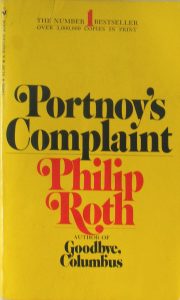
Philip Roth’s Portnoy’s Complaint

Beau Albrecht

4,552 words

Philip Roth
Portnoy’s Complaint
New York: Random House, 1969

Six years ago, I decided that I should finally get around to reading a classic great American novel, Portnoy’s Complaint, by Philip Roth. So I delved into the book without knowing anything about it. I had no preconceptions other than that it was rated an excellent literary work. Was I ever in for a surprise!

Preliminary observations

Like Philip Roth’s other books, this contains many semi-autobiographical elements. It’s a matter of debate as to just how “semi” the autobiography is. It’s true that the author and his protagonist have several things in common. This is rather like how Mark Twain put much of his boyhood personality into Tom Sawyer.

The book is a long narrative from a neurotic patient to his therapist as the framing story. Indeed, it was written at a time when psychoanalysis was almost a religion, and Sigmund Freud was the seal of the prophets. Psychiatrists had a priestly confessor role, and sometimes were regarded more cynically as witch doctors of the mind, thus the term “headshrinkers.” The basic methodology is that the shrinks mainly take notes and occasionally ask nonjudgmental questions, while the patients ramble on about their problems. Somewhere along the way — as the theory goes — the patients will realize the error of their ways, call themselves out on their own bullshit, and screw their heads back on straight. It’s a slow and very costly process, and whether this type of psychoanalysis really accomplishes much remains a matter of debate. The proletarian equivalent — talking the bartender’s ear off — might be just as effective, and certainly is cheaper even with exorbitantly marked-up booze prices.

What troubles the narrator’s soul? The book’s brief preface begins defining “Portnoy’s Complaint” as if it’s a psychological condition. This manifests in terms of cognitive dissonance:

A disorder in which strongly-felt ethical and altruistic impulses are perpetually warring with extreme sexual longings, often of a perverse nature. Spielvogel says: ‘Acts of exhibitionism, voyeurism, fetishism, auto-eroticism and oral coitus are plentiful; as a consequence of the patient’s “morality,” however, neither fantasy nor act issues in genuine sexual gratification, but rather in overriding feelings of shame and the dread of retribution, particularly in the form of castration.’

The preface implies a few things. First of all, Dr. Spielvogel (“play bird”) wrote him up as a case study for a new syndrome. It’s rather like how Freud used Oedipus Rex of ancient Greek lore as the index case for Oedipus Complex. To do so, Portnoy himself would have to give approval for lending his name to the condition and discussing the particulars of his case, so apparently, he didn’t mind airing out his own dirty laundry to the world. That might imply an instance of this exhibitionism writ large, but it’s possible I’m reading too much into it. Either way, his case is remarkable enough to name after him as a prime example, yet common enough to designate as a syndrome.

More importantly, the preface informs us right out of the starting gate that the narrator throughout this ordeal of a novel is certainly an upstanding human being. It says that he possesses these “strongly-felt ethical and altruistic impulses.” For him, these characteristics amount to the phony righteousness that today is called being “woke.” The problem for this wonderful man is that his lust keeps getting in the way. It’s a common affliction of male feminists too, like Harvey Weinstein.

What the above definition implies is that the id and superego are at odds. Essentially, it’s that old mind-body dichotomy thing. Nietzsche had a few words to say on that subject:

To the despisers of the body I speak my word. I wish them neither to learn afresh, nor teach anew, but only to bid farewell to their own bodies — and thus become silent.

Many have pondered that one, but didn’t get the full impact. To rephrase this witty barb colloquially, “If the struggle between spirit and flesh troubles you so much, then solve your problem by taking a long walk off of a short pier, so you’ll shut up forever.” However, silence certainly isn’t in the cards with this book.

It’s a very long kvetch-fest, as the title implies, and it’s remarkably wordy. This isn’t like Victorian verbosity, such as George Eliot or Edward Bulwer-Lytton, in which the heavily ornamented language was for stylistic effect. Portnoy’s Complaint is something else entirely. It’s as if the wangst had been packed in with a pile driver. Philip Roth’s verbal barrage is a little much even for a story about a neurotic complaining nonstop from a psychiatrist’s couch.

Childhood

The book opens with Alexander Portnoy as a young and promising kindergartener. We’re soon introduced to the rest of his family. Hannah is his older sister, a fairly minor character. His mother is the overbearing type, who at first seems omnipresent to him. He grows up with a mother complex that he never is able to shake. (Needless to say, there’s a lot of Freud in the story.) Still, despite the narrator’s very strange attitudes about her, there’s nothing in the book indicating that she’s abusive. Reading between the lines, she’s simply a nice lady — whatever her quirks might be — who wants the best for her kids.

Alexander’s father is the book’s most sympathetic and relatable major character, probably unintentionally. He’s actually a pretty decent fellow, but gets little appreciation. Working for a WASP company, he sells life insurance to low-income customers, particularly blacks. It’s a difficult racket, and the sense of humiliation is palpable. It’s obvious that he played by the rules, did everything society told him to do, and life gave him no glory in return and barely a crumb of recognition. His family certainly should appreciate him, but apparently showing respect to the man who puts food on the table and keeps a roof over their heads is too much to ask.

The father suffers from constipation, a topic first covered early on in a long and grotesque paragraph covering laxatives and suppositories. It concludes:

I remember that when they announced over the radio the explosion of the first atom bomb, he said aloud, “Maybe that would do the job.” But all catharses were in vain for that man: his kishkas [intestines] were gripped by the iron hand of outrage and frustration.

The counterpart to this is when Alex becomes an adolescent and his mother takes a keen interest in his loose stools, attributing his condition to hamburgers and French fries. So the father’s constipation and the son’s diarrhea make for a physical manifestation of the anal-retentive and anal-expulsive complexes. Did I mention that there’s quite a bit of Freud in this book?

Adolescence

The chapter covering Portnoy at thirteen is called “Whacking Off,” which proves to be quite apt. The masturbation plot was central to the story, since it was the oldest part Roth had written, and the rest of the book grew around it. Also, it tends to be the most memorable. It must be seen to believed, and the opening is a fairly representative sample:

Then came adolescence-half my waking life spent locked behind the bathroom door, firing my wad down the toilet bowl, or into the soiled clothes in the laundry hamper, or splat, up against the medicine-chest mirror, before which I stood in my dropped drawers so I could see how it looked coming out. Or else I was doubled over my flying fist, eyes pressed closed but mouth wide open, to take that sticky sauce of buttermilk and Clorox on my own tongue and teeth-though not infrequently, in my blindness and ecstasy, I got it all in the pompadour, like a blast of Wildroot Cream Oil.

Indeed, to call Portnoy a wanker would be like calling Pablo Escobar a pharmacist. The rest of the chapter’s momentous first paragraph describes his performances with a candy wrapper, a cored apple, a milk bottle, and a piece of liver. (Much later in the book, we find out that after his second encounter with a piece of liver, it ends up as supper a couple of hours later.) Still, that isn’t yet the full extent of his onanistic creativity. There’s much more to come, if you’ll pardon the expression.

Then there’s an extended sequence in which he leaves the supper table for a trip to the bathroom. As he strokes himself, with his other hand, he rubs his sister’s panties on his face. He’s excited enough to shoot DNA evidence onto a light bulb over the sink. (Is that about coming to enlightenment, or is that reading the symbolism too far?) After supper, he goes back to produce an encore into his sister’s bra. When questioned about the return trip to the bathroom, he pretends he’s having diarrhea. That causes a family uproar; the scene drags on ad nauseam.

The chapter ends with a rant about being expected to stay in touch with his parents, then about conforming to his cultural rules. The chapter concludes:

. . . Is this what has come down to me from the pogroms and the persecution? From the mockery and abuse bestowed by the goyim over these two thousand lovely years? Oh, my secrets, my shame, my palpitations, my flushes, my sweats! The way I respond to the simple vicissitudes of human life! Doctor, I can’t stand any more being frightened like this over nothing! Bless me with manhood! Make me brave! Make me strong! Make me whole! Enough being a nice Jewish boy, publicly pleasing my parents while privately pulling my putz! Enough!

Pity poor Portnoy! What a tortured soul! Anyway, it’s a good lead-in to the next chapter, “The Jewish Blues.” It begins with a flashback about a medical condition concerning his testicles, of no great importance to the rest of the story. After that, it describes a father-son chat about ecumenicalism:

They worship a Jew, do you know that, Alex? Their whole big-deal religion is based on worshiping someone who was an established Jew at that time. Now how do you like that for stupidity? How do you like that for pulling the wool over the eyes of the public?

That’s always seemed rather like saying that Martin Luther was a good Catholic for all his life. However, the subject matters little to me. After more of the same, it finishes:

I assure you, Alex, you are never going to hear such a mishegoss [craziness] of mixed-up crap and disgusting nonsense as the Christian religion in your entire life. And that’s what these big shots, so-called, believe!

Suddenly the subject changes from religion and cuts away to a discussion of his father’s private parts. (He seems rather awed.) Then there’s a much longer section about his mother’s menstrual periods and other TMI matters. Later, it discusses a trip to the sauna, another opportunity to talk about his father’s anatomy. Actually, it’s quite understandable why he ends up consulting the services of an old-school Freudian shrink.

You can buy Greg Johnson’s The White Nationalist Manifesto here

Then it’s back to religion. Despite instruction in his youth, he professes atheism, causing a major quarrel at home. Then he professes egalitarianism. It’s not too hard to see how it becomes a substitute religion for him. Indeed, this sort of thing was — and still is — a major problem in the real world. Now that we’re getting all Freudian, his progressive ideology increasingly becomes a defense mechanism to prop up his ego, whereby he can reassure himself that he’s a wonderful person despite his reptilian personality.

“Quondam Crazy”

The next chapter, with an unprintably dirty title — “quondam” is the closest I’m going to that — returns to the condition of Portnoy’s teenage libido. Apparently, he’s one of the guys who gave New York public transit a bad name. While on a bus trip heading back to New Jersey, he masturbates next to a sleeping girl. (Remember to be awed when reading that; this is Serious Literature!) She’s a gentile, which gives him an extra thrill.

Also on the subject of forbidden meat, shortly before, he had his first lobster. That leads to a long digression on kosher rules. A brief excerpt:

Let the goyim sink their teeth into whatever lowly creature crawls and grunts across the face of the dirty earth, we will not contaminate our humanity thus. Let them (if you know who I mean) gorge themselves upon anything and everything that moves, no matter how odious and abject the animal, no matter how grotesque or shmutzig [dirty] or dumb the creature in question happens to be. Let them eat eels and frogs and pigs and crabs and lobsters; let them eat vulture, let them eat ape-meat and skunk if they like — a diet of abominable creatures well befits a breed of mankind so hopelessly shallow and empty-headed as to drink, to divorce, and to fight with their fists.

Eventually, that rolls into an even more cringe-worthy rant about hunting. The tone is similar to that of non-vegetarian liberals who seem to assume their meat sort of materializes on the supermarket shelf.

He digresses further, with very flimsy evidence, into wondering if his father cheated on his mother with a gentile. Somehow this is wrapped together with his memory of an uproar caused by stealing his sister’s chocolate pudding. (There’s a Freudian connection between these things, but I’m at a loss to describe it coherently.) Then the subject returns to lobster. Needless to say, this chapter makes for tiresome reading, and there’s much more to follow.

Then it digresses at length about an older boy in the building who committed suicide. Then, flashing forward to the present, he discusses the expectations of his parents that he’ll find a nice Jewish lady and start a family. (Objectively, that’s hardly unreasonable.) He’s just not interested; he wants to chase gentiles instead. The chapter’s chiasmus starts wrapping back, and so there’s more about the suicide, tying up the threads of this tedious digression. The point is that Portnoy, despite all his rebelliousness and other flaws, didn’t turn out that way:

For had I kept it all inside me, believe me, you too might have arrived home to find a pimply adolescent corpse swinging over the bathtub by his father’s belt.

Then he digresses back to when he masturbated on the bus. He reminisces also about getting hot and heavy with his baseball mitt while attending a burlesque show. All of that stretches on for several long paragraphs. The next digression is about his toilet training. Then he jumps far forward into a vacation with his girlfriend, who he calls “The Monkey.” In Italy, he rents a hooker for a threesome, which turns out to be a disaster. Before going further into that relationship, for several pages, he reminisces back to his adolescence and waxes eloquently about shikses [female gentiles]. He laments that he can’t pretend to be Anglo-Saxon because his nose is too big.

The narration has become quite non-linear, so I’ll proceed thematically until the end. Portnoy suffers from a troubled relationship with his culture of origin. It’s not that he’s experienced any persecution; he grows up in a Jewish neighborhood, and only 5% of his high school’s students are gentiles. He develops a love/hate relationship with his Jewish background, and an envy/hate relationship with gentile society. He could be happy that he’s part of a very ancient tradition, but it doesn’t work out that way.

He disposes of one girlfriend after another, moving onto the next quickly. One needn’t be Sigmund Freud to see that his pursuit of shikses is a desire to become an Anglo-Saxon. Needless to say, Portnoy is the poster boy for maladaptive assimilation, though the book doesn’t explain it that way. (The Italians of Jersey Shore are a breath of fresh air compared to this guy. They’re Ellis Island Americans too, but don’t have a constellation of weird complexes.) Other than that, the more that Portnoy reveals about his love life — if one can call it that — the clearer it becomes that he’s hardly changed since he was a thirteen-year-old wanker.

Chronological adulthood

Young Portnoy, not too long out of college, makes a name for himself during the 1950s quiz show scandals.

I was on the staff of the House subcommittee investigating the television quiz scandals. Perfect for a closet socialist like myself: commercial deceit on a national scale, exploitation of the innocent public, elaborate corporate chicanery — in short, good old capitalist greed. And then of course that extra bonus. Charlatan Van Doren. Such character, such brains and breeding, that candor and schoolboyish charm — the ur-WASP, wouldn’t you say? And turns out he’s a fake. Well, what do you know about that. Gentile America? Supergoy, a gonif! [thief] Steals money. Covets money. Wants money, will do anything for it. Goodness gracious me, almost as bad as Jews — you sanctimonious WASPs!

Apparently, he held profound righteous indignation on the hunt for the Lying Dutchman. Game shows were phony! Imagine that; what a blow to the MSM’s sterling credibility. Still, would he have been as enthusiastic about helping Congress bust Wall Street crooks? (Every era has its Milkens, Boeskys, and Madoffs; compared to vulture capitalists, Charles Van Doren was small fry.) Moreover, how would the young closet socialist have felt about going after pro-Soviet collaborators and spies? That certainly was a hot topic for Congress during the early 1950s, before they eschewed “McCarthyism” and aimed their investigatory firepower at the menace of rigged quiz shows.

This is around the same time he starts getting successful with the shikses. He explains his motives:

What I’m saying, Doctor, is that I don’t seem to stick my dick up these girls, as much as I stick it up their backgrounds — as though through fucking I will discover America. Conquer America — maybe that’s more like it. Columbus, Captain Smith, Governor Winthrop, General Washington — now Portnoy.

Well, how romantic! Shortly after this:
You can buy Greg Hood’s Waking Up From the American Dream here.

I know all the words to “The Marine Hymn,” and to “The Caissons Go Rolling Along” — and to “The Song of the Army Air Corps.” I know the song of the Navy Air Corps: “Sky anchors aweigh / We’re sailors of the air / We’re sailing everywhere–” I can even sing you the song of the Seabees. Go ahead, name your branch of service, Spielvogel, I’ll sing you your song!

Now he’s trying too hard.

Following the quiz show adventure, for five years Portnoy worked for his fellow closet socialists at the ACLU. Eventually, he cashed in on the street cred when New York’s mayor appointed him the Assistant Commissioner at the Commission on Human Opportunity. Surely being a high-ranking “civil rights” pencil pusher is a lucrative racket that had a veneer of respectability in some circles.

Still, he has an IQ of 158 and serves the interests of people with barely half that score. He doesn’t realize that it’s a waste of his natural talents that would be better put to doing something constructive, like being a doctor or an engineer. He believes that becoming a bureaucrat with the right political opinions was a noble calling, but the truth is that he’s a drain on society whose job involves enabling hordes of moochers. The book doesn’t have a trace of irony about that, so it’s fair to say that the irony escaped the author too.

The conclusion

After his girlfriend has a suicide crisis, he ditches The Monkey in Greece. Way to go, Champ! His next stop is in Israel. He’s as happy as a clam. Better yet, he meets someone his parents would approve of:

In the afternoon I befriend a young woman with green eyes and tawny skin who is a lieutenant in the Jewish Army. The Lieutenant takes me at night to a bar in the harbor area. The customers, she says, are mostly longshoremen. Jewish longshoremen? Yes. I laugh, and she asks me what’s so funny.

Things seem quite promising, until he blows it by declaring that he might’ve caught a venereal disease. Then he meets another Israeli lady. She’s warm, attractive, sincere, and overall very nice. He considers her like a younger and perfected version of his mother — needless to say, before she became a scolding matron. (It’s Freud until the bitter end here.) After they’ve gotten acquainted a bit, she drops a political argument on him. This part especially rings true, and I could hardly say it better:

You are not the enemy of the system. You are not even a challenge to the system, as you seem to think. You are only one of its policemen, a paid employee, an accomplice. Pardon me, but I must speak the truth: you think you serve justice, but you are only a lackey of the bourgeoisie.

Then she launches into a brief riff on socialism, and he declares his love. She does not take it well. His terrible game had worked suitably up to this point — after all, this was the 1960s — but now it was failing badly. He tries to get grabby, and she pops him in the jaw. I’d been waiting for this book to get good for a long time, and finally, the payoff arrives at the end. It’s about time he got a beating.

“Do you know,” she said, and without a trace of charity, “there is something very wrong with you.”

Given how this book has been going, it’s almost an understatement. If you might’ve suspected that Portnoy has a deep instinct to defile, the following begins a rather long and increasingly surreal passage:

With a flying tackle [I] brought this big red-headed didactic dish down with me onto the floor. I’ll show her who’s a shlemiel! [fool] And baby! And if I have VD? Fine! Terrific! All the better! Let her carry it secretly back in her bloodstream to the mountains! Let it spread forth from her unto all those brave and virtuous Jewish boys and girls! A dose of clap will do them all good! This is what it’s like in the Diaspora, you saintly kiddies, this is what it’s like in the exile! Temptation and disgrace! Corruption and self-mockery! Self-deprecation — and self-defecation too! Whining, hysteria, compromise, confusion, disease! Yes, Naomi, I am soiled, oh, I am impure — and also pretty fucking tired, my dear, of never being quite good enough for The Chosen People!

She fights him off, he only manages to land a couple of sloppy kisses, and he’s discouraged when he can’t get an erection. He still tries to ingratiate himself, but gets kicked for his efforts.

After the holy “civil rights” bureaucrat deservedly gets beaten up by a girl, his monologue concludes with declarations of self-pity and self-righteousness (a common theme in the book) and finally a long scream. At last, the psychiatrist gets in a word edgewise:

So [said the doctor]. Now vee may perhaps to begin, yes?

Actually, that one-liner is a great finish!

Who promoted this crap?

How did the book get to be so popular with such an unlikable protagonist, among other artistic defects? In its time, it had mixed reviews. A few thought Roth spoke too candidly about tribal matters. To that, I’ll say that discussing bad behavior isn’t the problem, and it doesn’t matter who is doing the discussing; the bad behavior itself is the problem. Bad behavior causes bad relations. It’s a simple matter of cause and effect. Stop doing that.

You can buy Greg Johnson’s The White Nationalist Manifesto here

Some reviews stated that the book was irredeemably filthy. Imagine that — as late as 1969, there still were some professional literary reviewers willing to tell it like it is, and their opinions actually got past the editorial desk! Apparently these holdouts are long gone, since the controversy has died down by now.

On the other hand, many reviews have been paeans to Roth’s brilliance. This is the consensus opinion of the literary establishment, and the fact that others disagreed is increasingly fading from memory. Here is a selection of the many who sang his praise:

Roth is the bravest writer in the United States. He’s morally brave, he’s politically brave. And Portnoy is part of that bravery.
— Cynthia Ozick, Newsday

Touching as well as hilariously lewd. . . Roth is vibrantly talented…as marvelous a mimic and fantasist as has been produced by the most verbal group in human history.
— Alfred Kazin, New York Review of Books

It’s a marvelously entertaining book, and one that mines a narrow but central vein more deeply than it has ever been done before.
— Theodore Solotaroff

Deliciously funny. . . absurd and exuberant, wild and uproarious. . . a brilliantly vivid reading experience.
— New York Times Book Review

Simply one of the two or three funniest works in American fiction.
— Chicago Sun-Times

The hype is how I got suckered into reading it. (Perhaps my review can spare someone the agony.) The book has quite an enduring legacy, ranking in Time Magazine’s All-Time 100 Novels as well as Modern Library’s 100 Best Novels list. Sweet!

What’s the matter with the talking heads who praised this detritus to the skies? Is it just because people took a lot of drugs in the 1960s? The Adventures of Tom Sawyer became popular because the titular character was relatable. He still remains the archetypal all-American kid, even over a century after publication. On the other hand, what kind of reviewers were identifying so viscerally with the highly neurotic Portnoy and his dysfunctional life? More to the point, why are they in the racket of telling us what books to read? Res ipse loquitur.

In any event, they proclaimed Philip Roth’s semi-autobiographical character kvetching lengthily from the psychiatrist’s couch to be a great American novel. This promotional boost, along with the publisher that decided to print this turkey in the first place, helped make the author rich. Still, how many other aspiring writers were overlooked? They could’ve made a positive contribution to literature, but apparently, they didn’t have the right connections.

Moreover, trash like Portnoy’s Complaint was in fashion. The degeneracy was hardly unprecedented. Jerry Rubin and Allen Ginsberg already had been famous for that during those times. Long before, the Weimar Republic was the dress rehearsal for the 1960s. Contributing to the zeitgeist was Willi Münzenberg’s edict in 1922 from the Marx-Engels Institute in Moscow:

We must organize the intellectuals and use them to make Western civilization stink. Only then, after they have corrupted all its values and made life impossible, can we impose the Dictatorship of the Proletariat.

Long after degeneracy came into vogue, with relatively few aware of what purpose it was to serve, Portnoy’s Complaint was merely one small contribution toward the wrecking job being carried out in our cultural landscape. With the residual hype inflating its importance, it remains something like a bird dropping — one among countless others — befouling a magnificent basilica. To further the analogy, this will continue until the majestic and almost forgotten beauty of the carved marble is restored, when the crap is washed away by a long-awaited cleansing storm.

Please support our work by sending us a credit card donation through Entropy — just click “send paid chat.” Entropy allows you to donate any amount from $3 and up. All paid chats will be read and commented upon in the next episode of Counter-Currents Radio, which airs every Friday.


Philip Roth’s Portnoy’s Complaint

Philip%20Rothand%238217%3Bs%20Portnoyand%238217%3Bs%20Complaint

Share

  • Gab

Enjoyed this article?

Be the first to leave a tip in the jar!

Instant Echeck GreenPay™

Related

  • The Strange World of Gender Bender Fiction

  • The Russians are Coming/The Russians are Coming

  • The Game of Tarot

  • Counter-Currents Radio Podcast No. 686

  • Crosstown Traffic

  • A Novel Approach: Roberto Bolaño’s 2666

  • Restoring American Deterrence through Innovation and Industry

  • E. M. Forster’s A Passage to India & the Indian Mentality

Tags

America in the 1960sBeau Albrechtbook reviewsPhilip Rothpsychoanalysispsychologythe Jewish question

9 comments

  1. Jud Jackson says:
    April 21, 2020 at 8:50 am

    I read it when I was about 16 and I remember laughing a lot. Of course, I would never consider re-reading it now.

    Along with Jerry Rubin and Allen Ginsberg you might also mention Lenny Bruce.

    0
    0
  2. margot metroland says:
    April 21, 2020 at 9:10 am

    A lot of words for a book that most people will find intrinsically repellent. Very enjoyable, though. The review, I mean. The book is fascinating for its sociological context.

    Some random observations:

    • The quasi-autobiographical family details and geography are similar to what Roth put into The Plot Against America. If I recall correctly, Alex Portnoy has an older male cousin who is a high school and college track star; in the later book, this figure is repurposed as the cousin who runs off to Canada and comes back with a wooden leg.

    • The running subtext of the book is ridicule of Freudian psychoanalysis, which was still very big in the 1950s and 60s. This background is not so clear 50 years later. All the scatological and pornographic episodes—emphasis on masturbation, anal-retentiveness—follow from that.

    • You can read an early draft of the book’s opening chapters in the April 1967 issue of Esquire, available in the magazine’s online archive. Here it’s clear that Roth’s target is psychoanalysis and Freudian theory, with particular attention to mother-fixation.

    • When Roth makes Alex Portnoy a lawyer in the “Twenty-One” game-show investigations (the Charles Van Doren reference), he’s appropriating the career of Dick Goodwin, later Presidential speechwriter and still later husband of Doris Kearns Goodwin. Goodwin was one of two House subcommittee attorneys investigating the case, the other being Chip Howze, whose later career was rather more obscure. When Roth was writing this in the late 60s, game-show scandals were much in public memory, although Charlie Van Doren had been an unperson for ten years. Roth was not a lawyer, so when he borrowed Dick Goodwin’s identity for his Portnoy character he was just grabbing “low-hanging fruit.”

    0
    0
  3. Bernie says:
    April 21, 2020 at 9:39 am

    I’ve heard of the book but never read it. I was a fan of Howard Stern in my younger days. It seems as if Stern stole a lot from Roth.

    0
    0
  4. 12AX7 says:
    April 21, 2020 at 3:41 pm

    I admit I haven’t read the book although I’ve known about it and heard what it’s like many years ago. The review was excellent, another piece of trash promoted as great literature: ” . . . a tale told by an idiot, full of sound and fury, signifying nothing”.

    0
    0
  5. Martin Venator says:
    April 21, 2020 at 11:04 pm

    Thanks for reading Jewish filth like this so we don’t have to.

    0
    0
  6. Kerry Bolton says:
    April 22, 2020 at 12:52 am

    Contributing to the zeitgeist was Willi Münzenberg’s edict in 1922 from the Marx-Engels Institute in Moscow:

    We must organize the intellectuals and use them to make Western civilization stink. Only then, after they have corrupted all its values and made life impossible, can we impose the Dictatorship of the Proletariat.

    This premise was taken over by the USA, and the USSR later countered with its campaign against ‘rootless cosmopolitanism’. Munzenberg was purged by Stalin. At an early stage he had held Comintern meetings at the Institute of Sexual Science founded by Magnus Hirschfeld, where he also lived with his wife, along with a bunch of blokes in dresses.

    0
    0
    1. Beau Albrecht says:
      April 22, 2020 at 1:03 pm

      Münzenberg was quite an interesting character, much like Otto Katz (who also got whacked) and Alexander Gumberg. I’m familiar with your work, so I’m sure you’ve heard of those other fine gentlemen! Likewise, Hirschfeld and his circle of degenerates set lots of things in motion.

      In some ways, these tricky behind-the-scenes types have been more influential in history than garden-variety politicians, but it takes much deep digging to find out who they were and what they did to change the world. It’s something I call cultural forensics, a concept I developed in Deplorable Diatribes.

      0
      0
  7. Happy Larry says:
    April 22, 2020 at 6:49 am

    The book did what it needed for Roth to get his name out there. His work prior was good but was relegating him to a small market. Portnoy is shocking enough to get people talking and still sell. A lot like the worst of Houellebecq, a writer similar in both projection and honesty which at times is embarrassing to look over.

    I like the novel but it’s not the one I’d recommend to someone interested in reading him. Goodbye Columbus or say My Life as A Man would be the one to start with. I’m with Steve Sailer and Harold Bloom that his later period of Sabbath’s Theatre, American Pastoral, and The Human Stain is his strongest work and the ones people will still read in years to come. Not a fan of Plot Against America with its obvious historical mistakes and retreading of certain family tropes he’d already explored in better novels. He’d past his peak by then, he was never going to top what had already been written.

    Interesting essay. It’s been just over a year since I last read it so a lot came back to me quite refreshingly.

    0
    0
    1. Sickelbabbing says:
      April 22, 2020 at 6:59 pm

      Nobody will read Phillip Roth in the future. Now that he is dead his ethnic boosterism will eventually tail off and he will be forgotten.

      The most parochial of writers he produced utter trash.

      0
      0

Comments are closed.

If you have a Subscriber access,
simply login first to see your comment auto-approved.

Note on comments privacy & moderation

Your email is never published nor shared.

Comments are moderated. If you don't see your comment, please be patient. If approved, it will appear here soon. Do not post your comment a second time.

Upcoming podcasts
  • Rob Rundo on Counter-Currents Radio

    Rob Rundo on Counter-Currents Radio

    Counter-Currents Radio

    Sat, Jun 13th — 3 pm EST / 9 pm CET
  • Daniel Tyrie on Counter-Currents Radio

    Daniel Tyrie on Counter-Currents Radio

    Counter-Currents Radio

    Sat, Jun 20th — 3 pm EST / 9 pm CET

Writers of May

(2 votes) Morris van de Camp David M. Zsutty Derek Stark Jayant Bhandari Greg Johnson

Articles of May

The Lunch Wars by David M. Zsutty Heidegger on Nietzsche, Part One by Collin Cleary 2 votes
    • Black Intellectual Fatigue

      Derek Stark

      12

    • Why White Advocates Should Avoid “Based Blacks”

      Dani Vypont

      10

    • Nietzsche & Race

      Mark Gullick

    • Editor’s Update
      Rob Rundo Rescheduled to Next Week on Counter-Currents Radio;
      Tonight Greg Johnson & David Zsutty Answer Your Questions;
      Fundraiser Update & a New $20,000 Matching Grant

      Greg Johnson

    • The Counter-Currents 2026 Fundraiser
      Lifetime Subscriber Welcome Packages Extended

      Greg Johnson

    • Nationalism This Week
      Who’s Looking Back?

      Greg Johnson

      25

    • China’s Threat to American Security:
      Food, Farmland, Foreign Control, & Energy Policy

      Lipton Matthews

      5

    • The Bitter End of Western Metaphysics:
      Heidegger on Nietzsche, Part Two

      Collin Cleary

      13

    • The Killing of Henry Nowak

      Mark Gullick

      31

    • The Crisis of Chinese Technology Thieves

      Morris van de Camp

      1

    • The Strange World of Gender Bender Fiction:
      & What This Genre Tells Us About Autosexuality

      Dani Vypont

      3

    • Watching the Watchers:
      The Dark Triad Question

      David M. Zsutty

      14

    • The Remigration Movement Solidifies

      F. Roger Devlin

      1

    • Casting Aspersions:
      The Fatal Consequences of Race-Swapped Casting, From Helen of Troy to Henry of Southampton

      Steven Tucker

      20

    • The Murder of Henry Nowak

      Millennial Woes

      23

    • Don’t Forget to Vote in Our Writer & Article of the Month Poll

      Greg Johnson

    • The Robot Hotdog Stand

      Greg Johnson

      35

    • Laughing Our Way to Victory

      Dave Chambers

      7

    • The Zodiac Killer

      Mark Gullick

      11

    • Jared Taylor: What Rome Means to Me

      Jared Taylor

      1

    • An Interview with Endeavour:
      My Way of Life Is an Adventure!

      Ondrej Mann

      6

    • José Pedro Zúquete’s The Identitarians

      Greg Johnson

      3

    • Editor’s Update
      Fundraiser Update & How to Watch the Remigration Summit

      Greg Johnson

      5

    • The Bitter End of Western Metaphysics:
      Heidegger on Nietzsche, Part One

      Collin Cleary

      11

    • Berlin: City of Stones

      Spencer J. Quinn

      6

    • True Folk-Horror Is Horror of Your Own Folk:
      Mark Gatiss vs the Brexit Blind Dead  

      Steven Tucker

      4

    • Counter-Currents Radio Podcast No. 689
      Thomas Massie, the America 2050 Bust, the Need for Whites to Divest from America, the AI Economic Apocalypse, & Pro-White Project Pitches to Billionaires

      Counter-Currents Radio

      7

    • Nationalism This Week
      Remigration is Inevitable, Part 3

      Greg Johnson

      27

    • Why Billionaires Should Fund White Identity Politics

      Lipton Matthews

      8

    • How Cold War Two Came About

      Morris van de Camp

      5

    • Now Available for Pre-Order at a Special Price!
      Greg Johnson’s The Philosopher Is In

      Greg Johnson

    • David Zsutty’s Elevator Pitch to a Billionaire

      David M. Zsutty

      1

    • Headbanging Lite

      Mark Gullick

      5

    • White Advocacy Past and Present

      Peter Bradley

      13

    • The Lunch Wars

      David M. Zsutty

      47

    • The Russians are Coming/The Russians are Coming

      Steven Clark

      1

    • Peak Fatigue in Fort Wayne

      Gabriel Anderson

      24

    • Keith Woods’ Elevator Pitch to a Billionaire

      Keith Woods

    • The Cruelty of Kindness

      Morris van de Camp

      9

    • Predation Wearing the Mask of Civilization

      Jayant Bhandari

      13

    • The Mandalorian & Grogu

      Trevor Lynch

      24

    • Editor’s Update
      Fundraiser Update & a New $20,000 Matching Grant
      Greg Johnson & David Zsutty Discuss Thomas Massie on Counter-Currents Radio

      Greg Johnson

      2

    • How the Jews Defeated Thomas Massie—& Themselves

      David M. Zsutty

      25

    • Jared Taylor’s Elevator Pitch to a Billionaire

      Jared Taylor

      15

    • Nationalism This Week
      Remigration Is Inevitable, Part 2

      Greg Johnson

      8

    • Could Fascism Work?

      Mark Gullick

      40

    • Jonathan Bowden’s Deliverance
      Part 7

      Jonathan Bowden

    • China’s Quiet Hand:
      Influence, Infiltration, & the Western Blind Spot

      Lipton Matthews

      9

    • Counter-Currents Radio Podcast No. 688
      Tyler Dykes on Running for US Congress in South Carolina

      Counter-Currents Radio

      4

    • Lothrop Stoddard’s The Revolt Against Civilization

      Spencer J. Quinn

      14

    • DarkPlato

      Black Intellectual Fatigue

      I think it’s cruel to put blacks in prison.  They can’t understand cause and consequence and are not...

    • Connor McDowell

      Black Intellectual Fatigue

      Yeah that’s why I said “that’s where we already are in many respects” as far as the lowering of...

    • Derek Stark

      Black Intellectual Fatigue

      You’re not totally wrong; our rules and institutions were created from a white perspective. But even...

    • Connor McDowell

      Black Intellectual Fatigue

      So I’m going to offer a comment that might ruffle some feathers, but I think it is true and needs to...

    • Joe Gould

      Black Intellectual Fatigue

      Anyway, Derek Stark is right. Even a a sign of increased Black fatigue of a purely academic and...

    • Joe Gould

      Black Intellectual Fatigue

      Cohabitation with other races is harm to Whites. Cohabitation with Blacks is harm to Whites....

    • Glide Ratio 0:1

      Why White Advocates Should Avoid “Based Blacks”

      I don't know anyone who considers Candice Owens "based". She's seen as a schizo who talks about...

    • Glide Ratio 0:1

      Why White Advocates Should Avoid “Based Blacks”

      We have a regular based black writer here on CC. Is it a good thing when nons know what is actually...

    • Lord Snooty

      The Game of Tarot

      "It had previously been simply the Rider-Waite deck, after its non-artistic creator, Arthur Rider-...

    • ArminiusMaximus

      Black Intellectual Fatigue

      We will know the tide has turned when scholars like Staddon begin writing papers and cultural ing...

    • Eric

      Black Intellectual Fatigue

      Greetings.  "Black intellectuals" are also known as, "professional negroes."

    • Collin Cleary

      The Bitter End of Western Metaphysics:
      Heidegger on Nietzsche, Part Two

      Perhaps the irony here is that he was mistaking appearance (what appears to a human subject) as...

    • Sam JP

      Why White Advocates Should Avoid “Based Blacks”

      There's nothing special about being based, it's just the baseline common sense and self-respecting...

    • Collin Cleary

      The Bitter End of Western Metaphysics:
      Heidegger on Nietzsche, Part Two

      No, Heidegger wasn't an influence on either.

    • Scott

      China’s Threat to American Security:
      Food, Farmland, Foreign Control, & Energy Policy

      I don’t fear or hate the Chinese. But China is still a Communist nation and they will never be our...

    • Eric

      Black Intellectual Fatigue

      Thank you very much for this fine article.  One book opens another.  Mr. Stark has...

    • Scott

      Why White Advocates Should Avoid “Based Blacks”

      Agree with most of the article. Spot on about Negroes and the dusky grifter, Candace Owens.However,...

    • Hugo Raven

      China’s Threat to American Security:
      Food, Farmland, Foreign Control, & Energy Policy

      Much ado about nothing. So China has acquired a strong position in some minor industry or in a...

    • White Lives Matter!

      The Killing of Henry Nowak

      Great coment. This pray, pray, pray nonsense makes me sick too. No, I won't pray for Nowak's...

    • Will Williams

      Black Intellectual Fatigue

      Am I the only White racial nationalist who is fatigued from Black “intellectual” Lip Man Matthews...

    • Earth Day Special

      John Morgan

      12

    • A Robertson Roundup
      Remembering Wilmot Robertson
      (April 16, 1915 – July 8, 2005)

      Margot Metroland

      13

    • The Paranoid Style in White Nationalism

      Greg Johnson

      30

    • Join the Dance!

      Andrew Hamilton

      1

    • We Can’t Save the Earth Without Reducing African Birth Rates

      James Dunphy

      36

    • “I’m Not a Conspiracy Theorist, but . . .”:
      Jeffrey Epstein’s Death Gives New Life to “Conspiracy Theories”

      Greg Johnson

      22

    • Sylvia Plath: Stasis in Darkness

      Vic Olvir

      17

    • Vanguardism, Vantardism, & Mainstreaming

      Greg Johnson

      80

    • Aviation, Geography, & Race

      Charles Lindbergh

      3

    • Some Thoughts on Yule

      Collin Cleary

      4

    • Living in Truth:
      A Yuletide Homily

      Jef Costello

      7

    • John Kennedy Toole’s A Confederacy of Dunces

      Greg Johnson

      20

    • On Aleksandr Solzhenitsyn’s Warning to the West

      Spencer J. Quinn

      7

    • Elitism, British Modernism, & Wyndham Lewis

      Jonathan Bowden

      6

    • Philip K. Dick’s Do Androids Dream of Electric Sheep? as Anti-Semitic/Christian-Gnostic Allegory

      Greg Johnson

      20

    • “Conspiracy Theory” or Conspiracy?

      Andrew Hamilton

      21

    • Remembering H. P. Lovecraft
      (August 20, 1890–March 15, 1937)

      Greg Johnson

      3

    • Who Are We?
      Nordics, Aryans, & Whites

      Greg Johnson

      71

    • Remembering William Gayley Simpson
      (July 23, 1892–December 31, 1990)
      A Pleasant Afternoon with Harriet & Bill Simpson

      Margot Metroland

      18

    • Here are the Young Men
      Remembering Ian Curtis
      (July 15, 1956–May 18, 1980)

      Mark Gullick

      18

    • Percy Grainger
      Artist of the Right

      Alex Graham

      7

    • Remembering Revilo Oliver
      (July 7, 1908–August 20, 1994)

      Greg Johnson

      18

    • The Meaning of July 4th for the White Man

      Gregory Hood

      13

    • The Front National’s Evolution

      Bruno Mégret

    • Merwin K. Hart
      Forgotten American Hero & Man of the Right

      Morris van de Camp

      10

    • George Orwell’s Nineteen Eighty-Four

      Jonathan Bowden

      8

    • Carleton S. Coon
      Scientist & Reluctant White Advocate

      Morris van de Camp

      3

    • The Kwanzaa Absurdity Will Be Dwarfed by Juneteenth

      Robert Hampton

      10

    • Stravinsky

      Alex Graham

      7

    • Like the Roman:
      Remembering Enoch Powell (1912-1998)

      Mark Gullick

      23

    • Neo-Fascism in Film
      Part 5

      Karel Veliky

      15

    • The Game of Tarot

      Mark Gullick

      2

    • Institutions Cannot Be Transplanted

      Jayant Bhandari

      5

    • Jonathan Bowden’s Deliverance
      Part 5

      Jonathan Bowden

    • Crosstown Traffic:
      Jimi Hendrix & The Post-War Rock ‘N’ Roll Revolution

      Mark Gullick

      1

    • Slaves from the North:
      Finns & Karelians in the East European Slave Trade, 900–1600

      Lipton Matthews

      14

    • Neo-Fascism in Film
      Part 4

      Karel Veliky

      2

    • David Lean’s A Passage to India

      Spencer J. Quinn

      1

    • Elites are Essential to Development

      Lipton Matthews

      7

    • Jonathan Bowden’s Deliverance
      Part 4

      Jonathan Bowden

    • Neo-Fascism in Film
      Part 3

      Karel Veliky

      6

    • E. M. Forster’s A Passage to India & the Indian Mentality

      Spencer J. Quinn

      25

    • Jonathan Bowden’s Deliverance
      Part 3

      Jonathan Bowden

    • The Rest Is Silence
      Heidegger’s Quietism

      Mark Gullick

      2

    • Dispelling the Historical Fallacy of Indian Nationalism

      Lipton Matthews

      8

    • Neo-Fascism in Film
      Part 2

      Karel Veliky

      8

    • Jonathan Bowden’s Deliverance
      Part 2

      Jonathan Bowden

    • Life of a Klansman

      Mark Gullick

      8

    • Jonathan Bowden’s Deliverance, Part 1

      Jonathan Bowden

    • Decolonial Ideas are Holding Back Developing Countries

      Lipton Matthews

      8

    • Neo-fascism in Film, Part 1

      Karel Veliky

      21

    • Jonathan Bowden’s Onslaught, Part 8
      Divigations on Decadence

      Jonathan Bowden

    • Jonathan Bowden’s Onslaught, Part 7
      Intrigues in the National Front

      Jonathan Bowden

      1

    • Rotten to the Core

      Mark Gullick

      8

    • Strauss on Husserl’s “Philosophy as Rigorous Science”

      Greg Johnson

    • Jonathan Bowden’s Onslaught, Part 6
      Francis Bacon & Right-Wing Nihilism

      Jonathan Bowden

    • London After (& Before) Midnight:
      Aleister Crowley, The Landlord’s Worst Nightmare

      James J. O'Meara

      2

    • Jonathan Bowden’s Onslaught, Part 5
      The Post-War British Far Right

      Jonathan Bowden

    • No Rules: Rollerball

      Mark Gullick

      4

    • Jonathan Bowden’s Onslaught, Part 3
      Brett Easton Ellis’ American Psycho

      Jonathan Bowden

    • András László
    • Derek Hawthorne
    • Beau Albrecht
    • Alain de Benoist
    • Kerry Bolton
    • Jonathan Bowden
    • Collin Cleary
    • Jef Costello
    • Savitri Devi
    • Julius Evola
    • Jim Goad
    • Gregory Hood
    • Juleigh Howard-Hobson
    • Greg Johnson
    • Charles Krafft
    • Anthony M. Ludovici
    • Trevor Lynch
    • H. L. Mencken
    • J. A. Nicholl
    • James J. O’Meara
    • Christopher Pankhurst
    • Tito Perdue
    • Michael Polignano
    • Spencer J. Quinn
    • Fenek Solère
    • Irmin Vinson
    • Leo Yankevich
    • Francis Parker Yockey
    • Multiple authors
  • Editor-in-Chief

    • Greg Johnson, Ph.D.

    Featured Writers

    • Beau Albrecht
    • Gunnar Alfredsson
    • Collin Cleary, Ph.D.
    • Jef Costello
    • Morris V. de Camp
    • F. Roger Devlin, Ph.D.
    • Stephen Paul Foster, Ph.D.
    • Jim Goad
    • Alex Graham
    • Mark Gullick, Ph.D.
    • Greg Johnson, Ph.D.
    • Travis LeBlanc
    • Trevor Lynch
    • Margot Metroland
    • James J. O’Meara
    • Angelo Plume
    • Spencer J. Quinn
    • Fred Reed
    • Clarissa Schnabel
    • Michael Walker
    • David M. Zsutty

    Frequent Writers

    • Asier Abadroa
    • Aquilonius
    • Alain de Benoist
    • Kerry Bolton, Ph.D.
    • Dave Chambers
    • Steven Clark
    • James Dunphy
    • Endeavour
    • Richard Houck
    • Jason Kessler
    • Titus Livius
    • Ondrej Mann
    • Lipton Matthews
    • Mark Mazari
    • John Morgan
    • Jaroslav Ostrogniew
    • Kathryn S.
    • Christian Secor
    • Anne Wilson Smith
    • Thomas Steuben
    • William De Vere
    • Kenneth Vinther
    • Max West

    Classic Authors

    • Maurice Bardèche
    • Jonathan Bowden
    • Julius Evola
    • Guillaume Faye
    • Ernst Jünger
    • Kevin MacDonald, Ph.D.
    • D. H. Lawrence
    • Charles Lindbergh
    • Jack London
    • H. P. Lovecraft
    • Anthony M. Ludovici
    • Sir Oswald Mosley
    • National Vanguard
    • Friedrich Nietzsche
    • Revilo Oliver
    • William Pierce
    • Ezra Pound
    • Saint-Loup
    • Savitri Devi
    • Carl Schmitt
    • Miguel Serrano
    • Oswald Spengler
    • P. R. Stephensen
    • Jean Thiriart
    • John Tyndall
    • Dominique Venner
    • Leo Yankevich
    • Francis Parker Yockey

    Other Authors

    • Howe Abbott-Hiss
    • Michael Bell
    • Giles Corey
    • Jack Donovan
    • Richardo Duchesne, Ph.D.
    • Emile Durand
    • Guillaume Durocher
    • Mark Dyal
    • Tom Goodroch
    • Andrew Hamilton
    • Robert Hampton
    • Huntley Haverstock
    • Derek Hawthorne
    • Gregory Hood
    • Juleigh Howard-Hobson
    • Alexander Jacob
    • Ruuben Kaalep
    • Tobias Langdon
    • Julian Langness
    • Patrick Le Brun
    • G A Malvicini
    • John Michael McCloughlin
    • Millennial Woes
    • Michael O’Meara
    • Christopher Pankhurst
    • Michael Polignano
    • J. J. Przybylski
    • Quintilian
    • Edouard Rix
    • C. B. Robertson
    • C. F. Robinson
    • Herve Ryssen
    • Alan Smithee
    • Fenek Solere
    • Ann Sterzinger
    • Robert Steuckers
    • Tomislav Sunic
    • Donald Thoresen
    • Marian Van Court
    • Irmin Vinson
    • Book Reviews
    • Movie Reviews
    • TV Reviews
    • Music Reviews
    • Art Criticism
    • Graphic Novels & Comics
    • Video Game Reviews
    • Fiction
    • Poems
    • Interviews
    • Videos
    • English Translations
    • Other Languages
      • Arabic
      • Bulgarian
      • Croatian
      • Czech
      • Danish
      • Dutch
      • Estonian
      • Finnish
      • French
      • German
      • Greek
      • Hungarian
      • Italian
      • Lithuanian
      • Norwegian
      • Polish
      • Portuguese
      • Romanian
      • Russian
      • Slovak
      • Spanish
      • Swedish
      • Ukrainian
    • Commemorations
    • Why We Write
  • Archives
  • Top 100 Commenters
  • The Looney Bin
Sponsored Links
Europa.com Above Time Coffee Antelope Hill Publishing Paul Waggener IHR-Store Spencer J. Quinn American Renaissance Jim Goad The Occidental Observer
Donate Now Mailing list
Books for sale
  • The Philosopher Is In
  • Sexual Utopia in Power (Expanded Edition)
  • In Defense of Prejudice
  • Loving Our Own
  • Tyranny & Wisdom
  • The Populist Moment
  • Is America Doomed?
  • To all books
Copyright © 2026 Counter-Currents Publishing, Ltd.

Paywall Access


Please enter your email address.

Lost your password?

Edit your comment

Writer & Article of the Month May 2026

Voting for this month has concluded. Here are the final results!

Top Writers

  • #1 Morris van de Camp 2 votes
  • #2 David M. Zsutty 2 votes
  • #3 Derek Stark 2 votes
  • #4 Jayant Bhandari 2 votes
  • #5 Greg Johnson 2 votes
  • #6 Jared Taylor 1 vote
  • #7 Collin Cleary 1 vote
  • #8 Spencer J. Quinn 1 vote
  • #9 Mark Gullick 1 vote
  • #10 Lipton Matthews 1 vote
  • #11 Keith Woods 1 vote
  • #12 Steven Tucker 1 vote

Top Articles

  • #1 The Lunch Wars 2 votes
  • #2 Heidegger on Nietzsche, Part One 2 votes
  • #3 Could Fascism Work? 1 vote
  • #4 Jared Taylor's Elevator Pitch to a Billionaire 1 vote
  • #5 Predation Wearing the Mask of Civilization 1 vote
  • #6 Peak Fatigue in Fort Wayne 1 vote
  • #7 Keith Wood's Elevator Pitch to a Billionaire 1 vote
  • #8 Do You Want to Play a Game? 1 vote
  • #9 Why Billionaires Should Fund White Identity Politics 1 vote
  • #10 The 1970s: The Golden Age of Hijacking 1 vote
  • #11 True Folk-Horror Is Horror of Your Own Folk 1 vote
  • #12 Finding Atlantis Part 4 1 vote
  • #13 Berlin: City of Stones 1 vote
  • #14 The Ghost of the Confederacy 1 vote
  • #15 Lothrop Stoddard’s The Revolt Against Civilization 1 vote

Total votes cast: 17